

Tesla Battery Upgrade Guide for PA Homes
You're at home in Southeastern Pennsylvania when the lights flicker, the internet drops, and the refrigerator starts its familiar restart cycle. Your existing solar array may be producing nothing because the grid is down, and the portable generator you considered would need fuel, supervision, and a safe connection. That's often the moment a homeowner starts searching for a Tesla battery upgrade, only to discover that the battery itself is just one part of a much larger electrical project.
For a Pennsylvania home, backup storage has to work with the service panel, transfer equipment, protected circuits, utility requirements, local inspections, and the loads you expect to run. A well-designed Powerwall installation can provide quiet, automatic outage protection, but a poorly scoped project can leave you with inadequate backup, unexpected panel work, or a system that can't support your heating, cooling, or vehicle-charging plans.
Table of Contents
Why Southeastern PA Homeowners Are Upgrading to Battery Backup
Defining a Home Battery Upgrade and System Sizing - Capacity isn't the same as runtime
Electrical Panel Readiness and Service Upgrades - Why panel age matters - The service upgrade can be the hidden project
Integrating Battery Storage with EV Charging Infrastructure - Coordinate both projects
Navigating Local Permitting and Utility Interconnection - Local details affect the schedule
Evaluating Your Readiness for a Powerwall Installation - Choose workmanship before capacity
Why Southeastern PA Homeowners Are Upgrading to Battery Backup
A short outage can become a serious household problem when it interrupts refrigeration, internet equipment, sump pumps, well pumps, medical devices, or heating controls. Southeastern Pennsylvania weather can bring thunderstorms, heavy rain, winter ice, and wind events that challenge distribution equipment. Even when an outage lasts only part of a day, the disruption is immediate for anyone working from home, caring for family members, or relying on electrically controlled equipment.
Many homeowners first consider a battery after an inconvenient outage, not because they want a complicated energy project. A gas generator can provide substantial output, but it also requires fuel storage, outdoor placement, exhaust clearances, maintenance, and manual planning unless it has automatic transfer equipment. A Powerwall-based system takes a different approach. It can monitor the grid, disconnect the home when utility power fails, and supply selected circuits without engine noise or combustion.
Practical rule: Backup power should be designed around the loads you can't afford to lose, not the appliance list you hope to run during a rare outage.
The value isn't limited to emergency use. A battery can store solar energy for later consumption, help a homeowner use more self-generated electricity, and reduce reliance on the grid during selected periods. Those benefits depend on the system's controls, tariff structure, solar production, and household consumption, so the installation should begin with an energy review rather than a product choice.
The same principle applies to a vehicle owner. A Tesla may increase the home's electrical demand through regular charging, while the battery system needs to preserve energy for essential circuits. That connection makes the project an infrastructure decision. The question isn't only whether a Powerwall fits on the wall. It's whether the property can safely support storage, charging, and the homeowner's resilience goals together.
Defining a Home Battery Upgrade and System Sizing
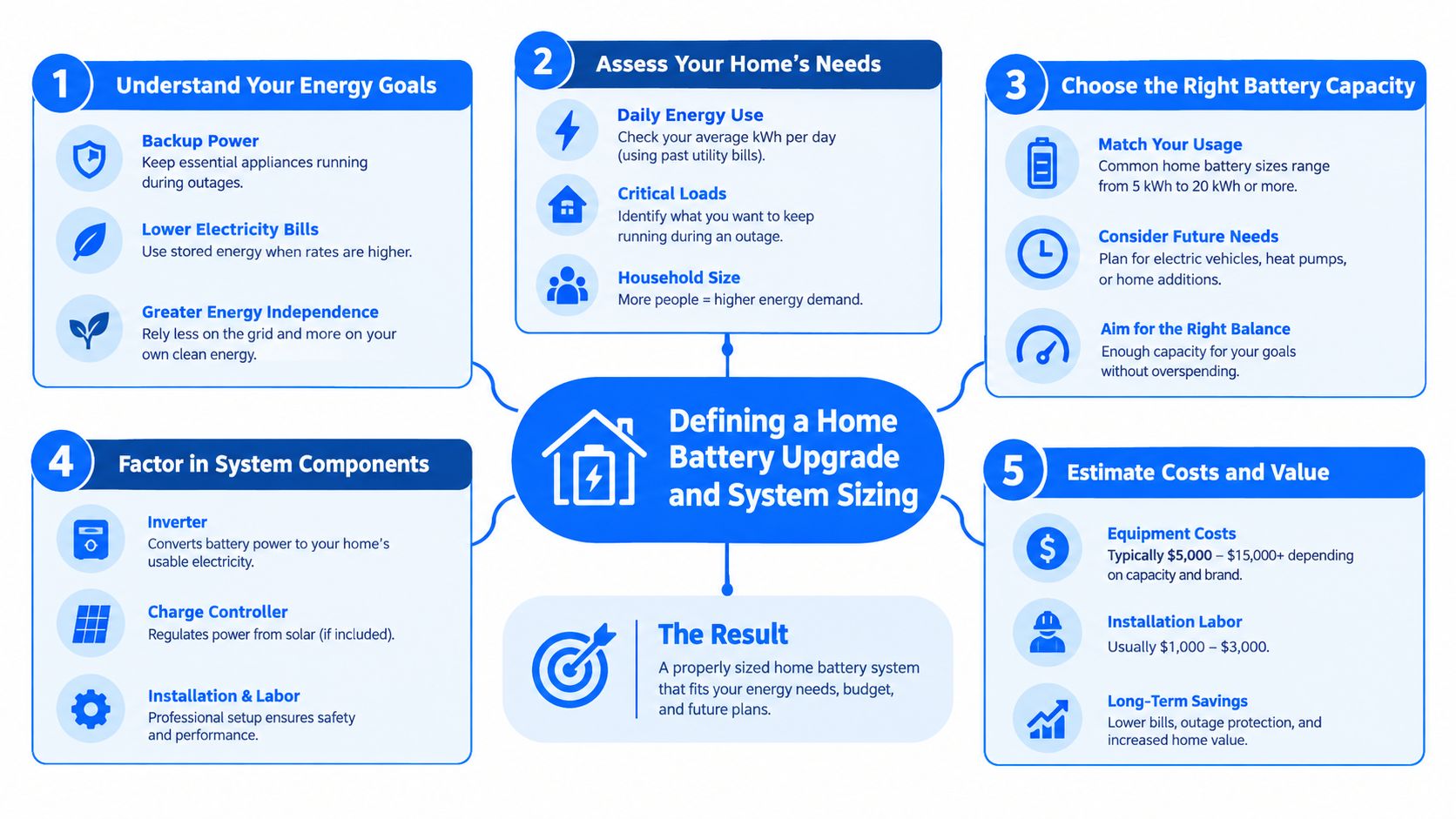
A home battery upgrade can mean several different things. It may be the first installation of a Powerwall at a property that has solar but no storage. It may mean adding another battery to an existing system, replacing aging equipment, or changing the backed-up load plan. Those are different electrical designs, even when the homeowner uses the same phrase.
Start with four questions:
What must remain powered? Refrigeration, lighting, internet equipment, a sump pump, a well pump, security systems, and medical equipment usually rank ahead of electric cooking or vehicle charging.
How much energy does the home use? Review utility bills and interval data if available. Daily consumption matters more than the home's square footage alone.
How much power must operate at the same time? A battery may have enough stored energy but still struggle with the starting or running demand of large motors, pumps, compressors, or electric heat.
What recharges the system? Solar can replenish storage during an extended outage, but the array, inverter controls, weather, and protected loads determine how quickly that happens.
Capacity isn't the same as runtime
Manufacturers describe battery systems using capacity and power ratings, but homeowners experience runtime. A system can support a refrigerator and internet equipment for a useful period while draining quickly under electric resistance heat, central air conditioning, an oven, or a Level 2 charger. Runtime changes with weather, thermostat settings, appliance cycling, and whether solar is available to recharge the battery.
Sizing also requires separating whole-home backup from critical-load backup. One Powerwall may be appropriate for a carefully selected group of circuits, while a larger installation may be needed for broader coverage. The right answer comes from a load calculation and a circuit-by-circuit review, not from assuming that a larger advertised capacity automatically solves every outage concern.
For an existing system, an expansion may require additional space, communications wiring, protection equipment, and changes to the backup load center. The installer should verify the existing battery model, inverter arrangement, firmware compatibility, clearances, and service history before promising that another unit can easily be added.
Electrical Panel Readiness and Service Upgrades
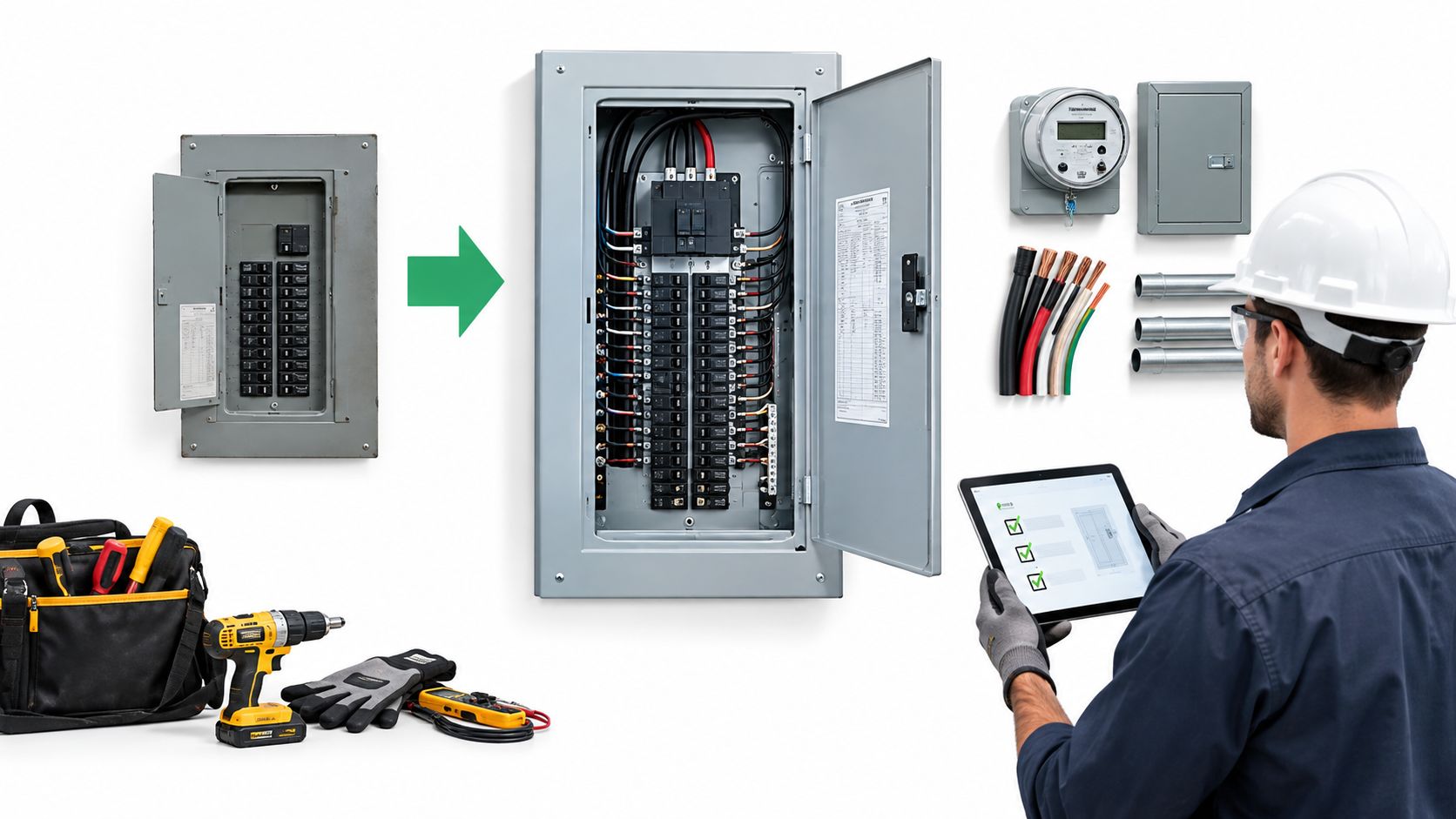
The panel is where most battery projects become real. A Powerwall, solar inverter, electric water heater, heat pump, electric range, and Level 2 EV charger can all compete for limited capacity. An older service may be functional for the home's original loads but unsuitable for the combination a homeowner wants to add.
A panel assessment should examine the service rating, feeder conductors, busbar capacity, breaker spaces, grounding and bonding, meter equipment, and the condition of the service entrance. The electrician also needs to identify whether the proposed battery will connect at the main panel, a backup load center, a distribution panel, or a dedicated energy-management system.
Why panel age matters
A 100-amp or 150-amp service isn't automatically disqualified, and a 200-amp service isn't automatically ready. The load calculation determines whether the service can support the planned equipment. In some homes, load management can coordinate high-demand devices. In others, the practical answer is a service upgrade, panel replacement, new meter equipment, or revised distribution layout.
Physical space matters as much as calculated capacity. Battery systems and transfer equipment need accessible working clearance. New circuits need properly sized breakers, and the panel may need enough spaces for solar, storage, EV charging, and future loads. Tandem-breaker shortcuts or crowded wiring aren't substitutes for a sound design.
The service upgrade can be the hidden project
A service upgrade may involve the utility, the meter socket, the weatherhead, the service conductors, grounding electrodes, and inspection scheduling. That work can affect the exterior of the house, not just the indoor panel. If the service drop or lateral can't support the new arrangement, the electrician must coordinate the change before the battery equipment is commissioned.
Homeowners should request a written scope that separates battery equipment, installation labor, panel work, service work, permitting, inspections, and utility coordination. A useful overview of the planning issues appears in this guide to home electrical panel upgrades.
Panel reality: A battery installation isn't complete when the equipment is mounted. It's complete when the service, protection, disconnects, conductors, controls, and inspections all support the operating plan.
Whole-Home Backup Versus Critical Loads Protection
Whole-home backup sounds straightforward, but it can require more equipment and a more demanding design. The system must account for the home's largest loads, motor-starting behavior, service configuration, and the battery's ability to supply power without nuisance trips. Critical-load backup narrows the responsibility to circuits that matter most.
A critical-load design commonly moves selected circuits into a backed-up subpanel or protected load center. Refrigeration, lighting, communications, sump equipment, a well pump, and medical devices may be included. Central air conditioning, electric dryers, resistance heat, hot tubs, and vehicle charging may be excluded unless the system has been specifically sized and configured for them.
Feature | Whole-Home Backup | Critical Loads Backup |
|---|---|---|
Coverage | Most or all household circuits | Selected essential circuits |
Design demand | Higher, because large loads remain connected | Lower, because nonessential loads are isolated |
Equipment layout | May require broader transfer and distribution changes | Usually requires a dedicated backup panel or protected load center |
Battery use | Can drain faster when large appliances operate | Easier to preserve energy for essential services |
Installation complexity | Greater coordination with service equipment and load controls | More circuit identification and relocation work |
Best fit | Homeowners prioritizing broad comfort and automatic continuity | Homeowners prioritizing essentials, runtime, and controlled cost |
The choice should reflect how the home operates during an outage. A homeowner with gas heat and modest electrical loads may protect most of the house without excessive battery demand. A home with electric heat, a large heat pump, or several high-draw appliances may need selective circuits even when the owner wants whole-home convenience.
Space and access also influence the decision. A new backup panel needs room for circuits and safe working clearance. Whole-home arrangements may require additional transfer or energy-management equipment near the service equipment. The installer should label every protected and nonprotected circuit so the homeowner understands what will happen when utility power fails.
Integrating Battery Storage with EV Charging Infrastructure
A Powerwall and an EV charger serve different purposes, but they share the home's electrical capacity. Vehicle charging can become one of the largest routine loads on the property, while the battery needs to retain energy for outage protection. Treating the charger as an afterthought can force a redesign after the battery installation is already complete.
The design should answer three operating questions:
Can the service support charging and storage together? The answer depends on the calculated load, charger settings, existing equipment, and any approved load-management strategy.
What happens during an outage? Many systems pause vehicle charging when the grid fails so stored energy remains available for household circuits.
When should the car charge? Scheduling charging for solar production or lower-demand periods can reduce competition with household loads.
A charger installation also needs the correct circuit, overcurrent protection, conductor sizing, conduit route, disconnect requirements, and mounting location. The shortest cable path isn't always the best path if it creates difficult access, poor weather protection, or conflicts with battery clearances.
Coordinate both projects
Installing storage and charging infrastructure under one electrical plan can reduce duplicated site work. The contractor can evaluate the service once, coordinate conduit routes, reserve panel space, and submit a consistent permit package. That approach also makes future troubleshooting easier because the battery, charger, and service equipment were designed as parts of one system.
A dedicated guide to Level 2 EV charger installation can help homeowners prepare the questions that matter before the site visit. Ask whether the proposed charger will remain available during an outage, whether it will be placed on a backed-up circuit, and how the system prevents vehicle charging from consuming the reserve intended for refrigeration or heating controls.
The practical answer for many homes is to make the charger a normal-grid load and preserve battery backup for essential circuits. That isn't a limitation to hide. It's often the most sensible way to protect the household while still getting dependable overnight charging when utility power is available.
Navigating Local Permitting and Utility Interconnection
Southeastern Pennsylvania isn't governed by one universal local process. Requirements can vary by municipality, building department, utility territory, property layout, and whether the project includes solar, a service change, exterior equipment, or structural work. The contractor should identify the authority having jurisdiction before finalizing the equipment layout.
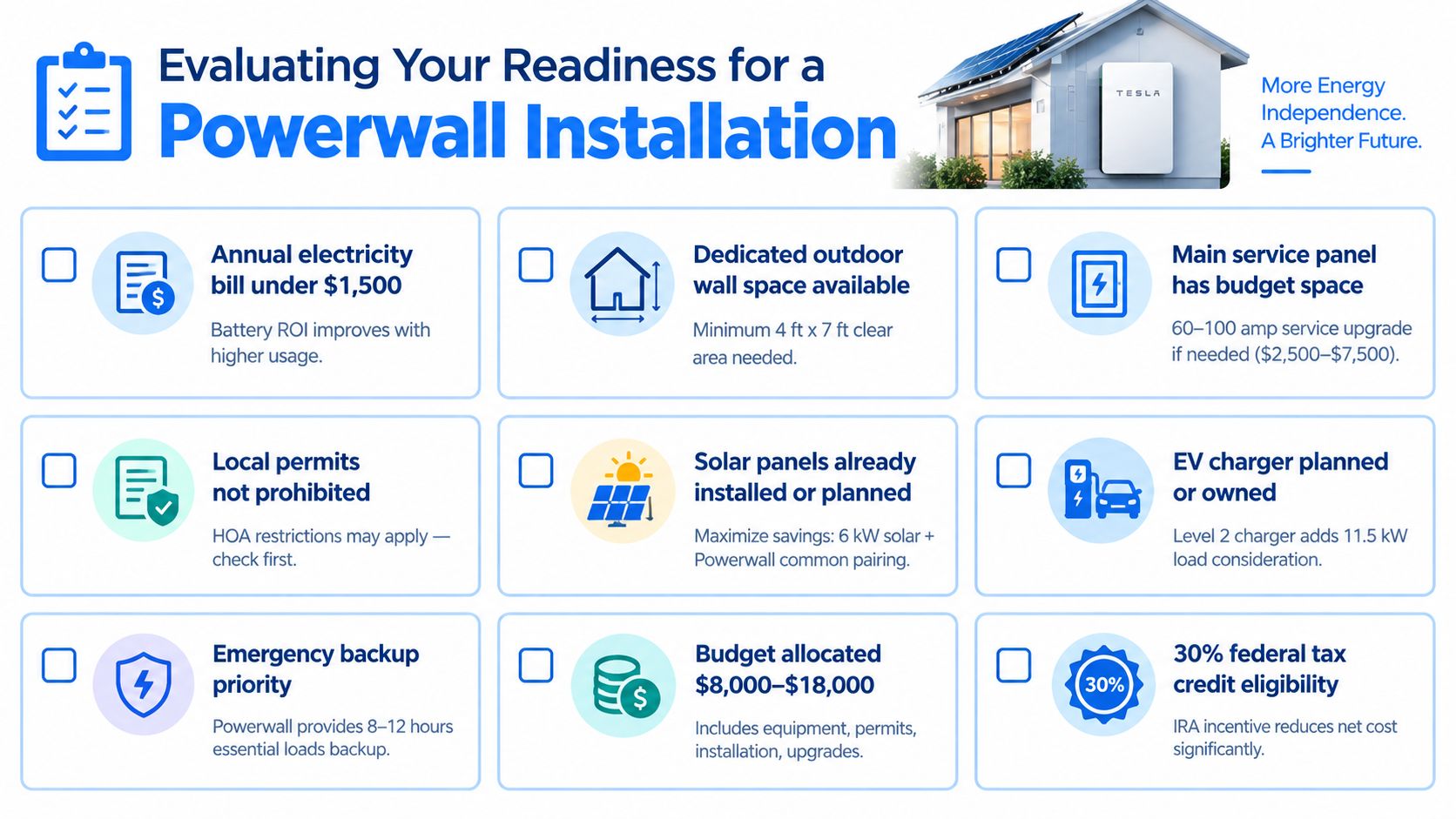
A typical project sequence looks like this:
Site assessment: The electrician documents the service, panel, proposed battery location, solar equipment, grounding, clearances, and protected loads.
Electrical design: The plan identifies equipment ratings, disconnects, conductors, overcurrent protection, transfer functions, and any load-management controls.
Permit submission: The contractor submits the electrical drawings and any related building or zoning materials required by the municipality.
Utility coordination: Interconnection paperwork may be required for systems that can operate in parallel with the grid, even when the homeowner doesn't intend to export energy.
Installation: The crew completes the approved work and follows manufacturer clearances, labeling, and safety requirements.
Inspection and approval: The local inspector reviews the work. Utility approval or meter-related coordination may follow before final operation.
Local details affect the schedule
Exterior battery placement may raise questions about wall construction, equipment clearances, flood exposure, access, and fire-safety requirements. A garage installation may involve vehicle-impact protection and working-clearance concerns. Historic districts, planned communities, and homeowner associations can add review requirements that aren't part of the electrical permit itself.
Don't assume a permit is unnecessary because the battery doesn't generate electricity on its own. The installation changes the home's electrical system and may interact with solar generation and utility service. A local electrical panel replacement permit guide provides useful context for the administrative side of related electrical work.
The cleanest proposal identifies who handles each submission, what the homeowner must provide, and when commissioning can occur. Ask whether the price includes permit fees, utility paperwork, inspection corrections, and a return visit if the authority requests a change. Those details protect the schedule and prevent an attractive equipment quote from becoming an incomplete project scope.
Evaluating Your Readiness for a Powerwall Installation
A battery project makes sense when the homeowner has a defined resilience problem and a property that can support the equipment safely. The first question isn't whether a Powerwall is desirable. It's whether the system will protect the circuits that matter, fit the home's electrical infrastructure, and operate within the property's physical and regulatory limits.
Use this decision screen before requesting final proposals:
Backup objective: Identify the appliances and systems that must operate during an outage.
Load profile: Review actual electricity use and list high-demand equipment, including heating, cooling, cooking, water heating, pumps, and EV charging.
Service condition: Have a qualified electrician inspect the panel, service rating, grounding, breaker spaces, and available connection points.
Installation location: Confirm clearances, weather exposure, access, wall construction, and protection from accidental impact.
Solar relationship: Determine whether existing or planned solar can recharge the battery during an extended outage.
Operating expectations: Decide whether the vehicle charger, central air conditioning, electric heat, or other large loads belong in the backup plan.
Documentation: Require a written design, equipment list, permit scope, utility responsibilities, warranty information, and commissioning procedure.
Choose workmanship before capacity
A larger battery can't correct an undersized service, a poor transfer design, or an unrealistic load plan. The installer should be able to explain what happens at the instant of an outage, which circuits disconnect, how the battery recharges, and what happens when the reserve reaches its operating limit.
Tesla-certified installation experience matters because the work combines high-voltage equipment, residential wiring, communications, commissioning, and local code compliance. Traditional electrical skills matter just as much. The contractor must understand service equipment and local inspection expectations, not just mount energy hardware.
A responsible site assessment may conclude that a battery upgrade should wait. You may need a panel replacement first, a revised backup plan, or a repair diagnosis rather than additional capacity. That kind of answer protects the homeowner from paying for equipment that doesn't solve the underlying problem.
For Southeastern Pennsylvania homeowners, the next step is a documented assessment of the service, loads, battery location, charging plans, and permitting path. Amp'd Energy Solutions provides Tesla Powerwall, EV charging, service upgrades, and backup power installations for homes and businesses in the region. Contact the team to schedule a site evaluation and receive a practical plan for safe, code-compliant battery and electrical infrastructure.