

Electrical Panel Replacement Permit Guide for PA
You've scheduled an EV charger or battery backup installation, the equipment is ready, and then the electrician tells you the job can't move forward because the panel work needs a permit. In Southeastern Pennsylvania, that delay usually means the project was scoped as a simple panel swap when it impacts service capacity, grounding, conductors, or new connected loads.
An electrical panel replacement permit isn't just municipal paperwork. It creates the review and inspection record that confirms the new equipment fits the building's electrical demand and current code requirements. The most important decision happens before the old panel comes out: determine whether the job is a like-for-like replacement, a panel change with new circuits, or a broader service upgrade.
Table of Contents
Understanding the Electrical Panel Replacement Permit Process
Gathering Required Documentation and Load Calculations - Why the circuit map matters
Navigating Utility Coordination and Service Upgrades - Use a decision tree before setting the installation date
Preparing for the Electrical Inspection and Final Approval - Run the audit before the inspector arrives - Treat closeout as a project deliverable
Understanding the Electrical Panel Replacement Permit Process
Pennsylvania's Uniform Construction Code requires an owner or authorized agent to obtain the applicable permit before regulated electrical work begins, including installing, enlarging, altering, repairing, removing, converting, or replacing a regulated electrical system. Upper Darby's electrical permit guidance specifically identifies electrical-panel replacement and service-equipment upgrades as work that triggers permitting.
That means the permit must be approved before installation, not after the panel has been energized. A replacement can look like a cabinet-for-cabinet change, but the work still involves circuit terminations, breaker compatibility, conductor sizing, grounding, bonding, and service connections. If an EV charger, battery system, generator, or other high-demand equipment is part of the project, the electrical load may change as well.
Practical rule: Don't let anyone remove the existing panel until the permit path, utility requirements, and inspection sequence are clear.
The application may ask for a project description, equipment specifications, service details, panel schedules, load calculations when applicable, and supporting documents. A straightforward replacement at the same location and ampacity may require less technical documentation than a service upgrade, but the local authority having jurisdiction decides what must be submitted.
A sound process follows this order:
Define the scope. Record the existing service size, panel location, meter arrangement, connected equipment, and planned additions.
Confirm the AHJ. The municipality or its designated enforcement agency controls the application and inspection process.
Prepare the permit package. Include accurate panel information and proposed loads rather than describing the job vaguely.
Obtain approval before work. Keep the permit record available at the property.
Schedule the inspection and closeout. The project isn't complete until the required inspection is passed and the record is closed.
For homeowners planning a charger, backup system, or panel replacement, a contractor that handles electrical installation and upgrade services should be able to explain which part of the work requires the permit and whether utility coordination is also involved.
Gathering Required Documentation and Load Calculations
The paperwork should reflect the actual electrical work, not just the equipment being installed. A permit application that says “replace panel” may be inadequate if the project also adds a dedicated EV circuit, changes the service rating, relocates the disconnect, or modifies service-side equipment.
For a basic replacement, the AHJ may request the project description, panel and breaker specifications, service information, and a proposed circuit directory. For a more involved project, expect the documentation to expand:
Project scope: Describe whether the work is a same-ampacity replacement, a new circuit installation, a panel relocation, or a service upgrade.
Panel schedule: Identify each circuit, breaker rating, conductor type when relevant, and the equipment served.
Load calculation: Account for existing demand and proposed equipment, including charging equipment, battery storage, generators, electric heating, and other substantial loads.
Service details: Show the service conductors, disconnect arrangement, meter equipment, grounding and bonding path, and proposed changes.
Equipment specifications: Provide the relevant model and rating information for the panel, breakers, charger, storage equipment, transfer equipment, or other connected devices.
Why the circuit map matters
Before circuits are transferred, map the existing installation. Turn circuits off one at a time, verify what they serve, and document the result. An experienced electrician can find shared neutrals, multiwire branch circuits, obsolete breakers, aluminum conductors, double-lugged terminals, missing equipment grounds, or circuits that need updated AFCI or GFCI protection.
A load calculation isn't a box-checking exercise. It answers a practical question: Can the existing service support the proposed demand under the applicable rules? If the answer is unclear, the project may require a larger service, new service conductors, utility coordination, or a change in how the added equipment operates.
For a homeowner installing a backup battery, the design also needs to identify which loads the system will support and how the equipment connects to the service. The Tesla Powerwall installation process should therefore be coordinated with the panel scope from the beginning, rather than added after the permit application has already been submitted.
Submit one consistent story. The equipment schedule, load calculation, panel schedule, and contractor's scope should describe the same project. Mismatched documents create correction notices and can force a redesign after the work has already been priced.
Navigating Utility Coordination and Service Upgrades
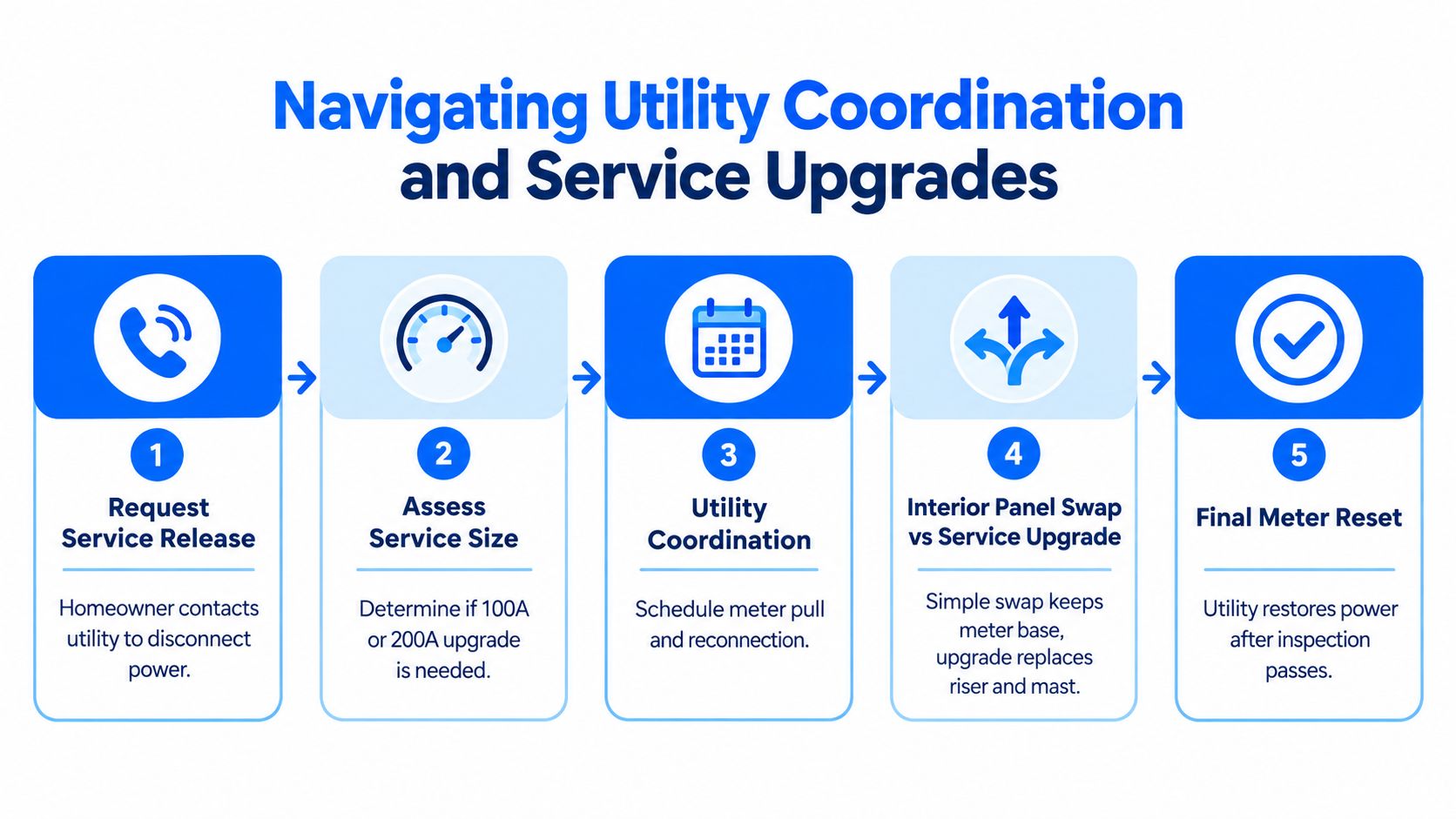
The phrase “replace the panel” hides two very different jobs. An interior panel replacement may leave the meter base, service mast, service conductors, and utility connection unchanged. A service upgrade can involve those exterior components, the service rating, the disconnect, and the utility's reconnection process.
Project type | Typical scope question | Main planning concern |
|---|---|---|
Like-for-like replacement | Is the panel staying in the same location and serving the same service arrangement? | Confirm permit, listed equipment, circuit compatibility, grounding, bonding, and inspection requirements. |
Panel replacement with new circuits | Are additional circuits being added for charging, storage, or other equipment? | Update the panel schedule and load information before filing. |
Service upgrade | Will the amperage, meter base, service conductors, disconnect, or panel location change? | Coordinate the AHJ, utility, equipment, and inspection sequence before scheduling the work. |
Harrisburg's electrical permit instructions state that when any part of the service changes, including the service cable, meter base, or panel, the property must meet applicable minimum city-code requirements. The same guidance identifies broader service changes as a compliance issue, not merely a replacement of one piece of equipment. Review the Harrisburg permit instructions before assuming the existing service arrangement can remain untouched.
Manheim Township separately identifies service replacements involving meter bases, disconnects, panels, or subpanels as permit-triggering work and requires a PPL work-order number for electrical service replacements. That requirement illustrates why the utility boundary must be identified during estimating, not after the electrician discovers an outdated meter base.
Use a decision tree before setting the installation date
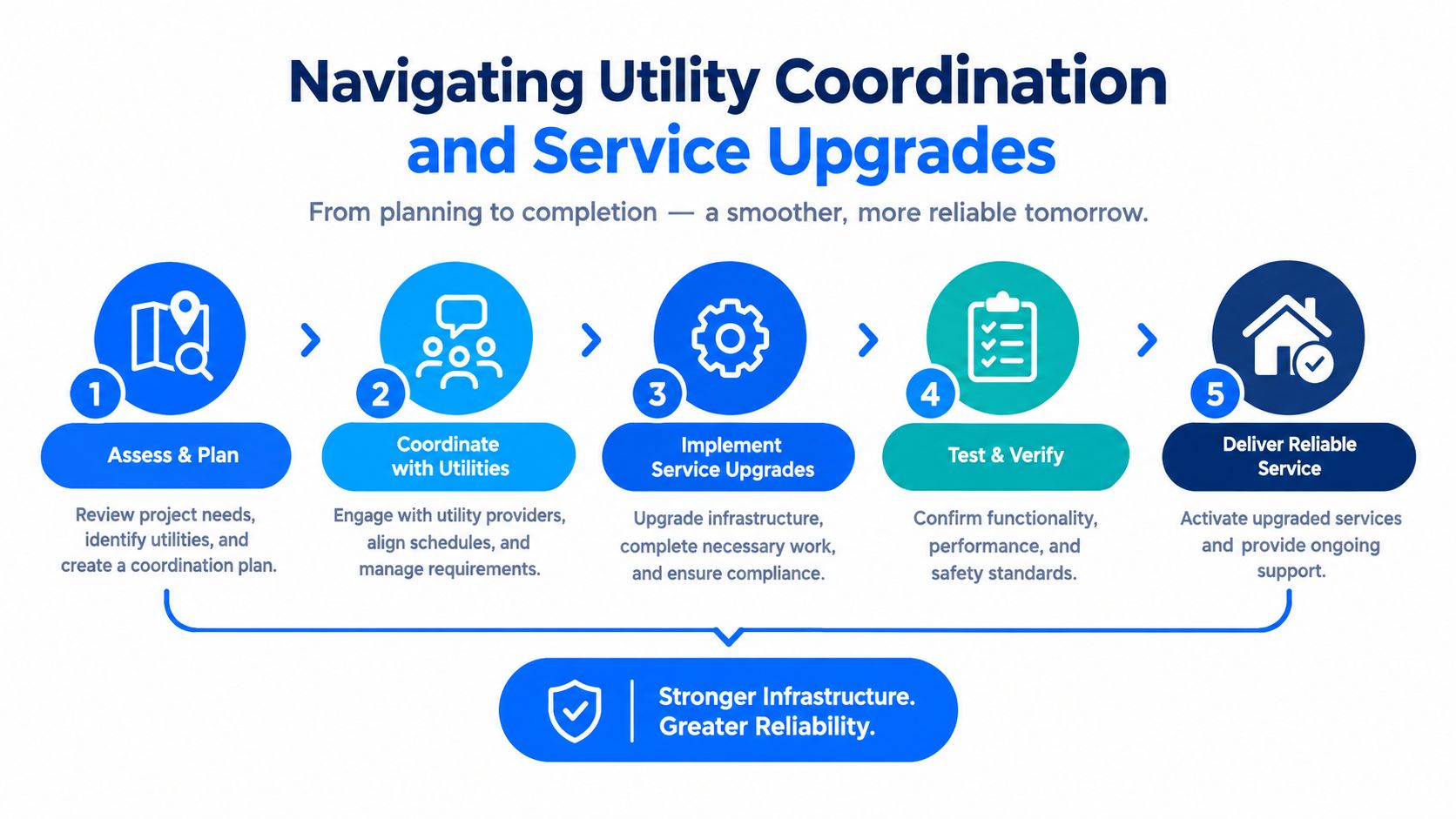
Ask these questions in order:
Same service rating? If yes, determine whether the meter base, service conductors, disconnect, and panel location remain unchanged.
New high-demand equipment? If yes, include it in the load review before selecting the replacement panel.
Changed service-side equipment? If yes, ask who obtains the utility work order and who schedules the disconnect and reconnection.
Inspection before re-energization? Confirm whether the utility requires municipal approval before restoring power.
A panel may pass an interior inspection and still leave the project waiting on utility work. A contractor handling electrical service upgrades should identify that risk in the proposal, state which party contacts the utility, and document what must happen before reconnection.
Filing the Application in Southeastern Pennsylvania
Southeastern Pennsylvania doesn't use one universal filing routine. The responsible AHJ may be a municipality, a county-related office, or a third-party UCC enforcement agency. One township may accept an online application, while another may require a different form, supporting documents, or direct coordination with its inspection agency.
Start with the property address, not the contractor's preferred process. Ask the municipality:
Who is the AHJ? Get the name and contact details of the office or enforcement agency that reviews electrical work.
What application is required? Confirm whether the panel replacement and any service work belong on one permit or separate filings.
What documents are expected? Ask specifically about load calculations, panel schedules, service diagrams, equipment specifications, and utility work-order information.
Who may apply? Requirements for owners, authorized agents, and contractors can vary by jurisdiction.
What inspections are required? Confirm whether the AHJ uses rough, service, final, or another sequence.
What closes the permit? Find out how the final approval is recorded and whether the contractor must provide additional documentation.
Municipal differences are not a minor administrative inconvenience. A national historical survey identified 3,938 jurisdictions and 8,401 in-house electrical authorities having jurisdiction. It also found that 32% of inspectors were single-hat electrical inspectors, while 68% were multi-hat inspectors handling electrical inspections alongside other code responsibilities. The electrical authority survey is summarized in Chicago's permit guidance.
Those figures help explain why a contractor's experience in one municipality doesn't automatically transfer to the next. New York City, for example, requires electrical work to be performed by a Licensed Master Electrician under an electrical permit, while its building department treats certain panel-part replacements differently from other electrical work. Chicago's process can require electrical drawings, including a single-line diagram and load calculations, for specified work. Local rules control your project.
Save the submitted application, payment confirmation, approved permit, inspection notices, correction responses, and final approval. That file gives the homeowner a clear record and helps the next electrician understand what was installed.
Preparing for the Electrical Inspection and Final Approval
A permit doesn't make an installation compliant. The inspector evaluates the physical work, and small details often determine whether the project closes cleanly.
Begin with the panel's working area. Pennsylvania permit guidance commonly interprets NEC 110.26 as requiring 30 inches of width, 36 inches of depth, and 6.5 feet of height around the panel. The service disconnect should remain readily accessible near the point where the conductors enter. See the Pennsylvania electrical permit inspection guidance for the cited working-space requirements.

Run the audit before the inspector arrives
A useful pre-inspection check follows the same order an inspector is likely to use:
Panel and enclosure: Verify the panel is listed for the application, mounted securely, and installed with all unused openings closed.
Conductors and breakers: Confirm conductor ampacity, breaker sizing, terminal compatibility, and secure terminations.
Grounding and bonding: Trace the grounding-electrode conductor, equipment grounding conductors, and neutral-to-ground bonding location.
Circuit directory: Label every circuit clearly and specifically. “Lights” or “outlets” doesn't identify the affected rooms or equipment well enough for reliable fault isolation.
Protection devices: Test required AFCI and GFCI protection and verify that the devices are compatible with the circuits they protect.
Physical protection: Check that conductors are protected from damage and that conduit, fittings, and cable entries are secure.
Existing branch circuits deserve deliberate testing rather than blind transfer. Identify shared neutrals, multiwire branch circuits, obsolete breakers, aluminum conductors, double-lugged terminals, missing equipment grounds, and any circuit whose labeling doesn't match what it serves.
Treat closeout as a project deliverable
The inspection sequence varies locally. Philadelphia-area practice may separate rough, service, and final stages, while other Pennsylvania jurisdictions describe approximately three inspections. Confirm the exact sequence with the AHJ before the panel is installed, then make sure the contractor schedules each required visit.
Photograph the finished labels and grounding connections, record terminal torque according to manufacturer specifications, verify breaker listing compatibility, and confirm utility coordination. If the inspection fails, correct the specific issue, document the repair, and reschedule promptly. The permit isn't finished when the panel door closes. It's finished when the required approval is recorded.
Avoiding Common Permit Denials and Contractor Mistakes
A licensed electrician can still mishandle local permitting. Licensing speaks to qualification, but it doesn't guarantee that the contractor understands every AHJ's forms, utility procedures, inspection stages, or documentation preferences.
The most common avoidable problems are predictable:
Vague scope: “Panel replacement” doesn't disclose a new charger, battery, generator, relocation, or service change.
Missing proposed loads: Leaving high-demand equipment out of the initial load review can force corrections later.
Unclear directory: Labels such as “lights” and “outlets” make circuit isolation difficult and invite inspection comments.
Unresolved existing defects: Double-lugging, missing grounds, incompatible breakers, and damaged conductors are discovered only after the old panel is opened.
No utility plan: A contractor schedules the installation without confirming whether the meter base, service conductors, or disconnect require utility involvement.
Unscheduled closeout: The work is complete, but nobody has taken responsibility for the final inspection or reconnection.
Before signing: Ask for the permit scope, the proposed panel schedule, the load-calculation responsibility, the utility-contact responsibility, and the inspection-closeout plan in writing.
Don't accept a low quote that excludes the decisions most likely to create delays. Ask for the permit number once issued, a copy of the approved scope, and confirmation that the contractor will correct any inspection comments tied to the contracted work. A careful pre-inspection audit usually costs less than opening a finished installation to fix preventable problems.
Amp'd Energy Solutions evaluates panel capacity, EV charging, battery backup, generators, and service upgrades as connected parts of one electrical project. Visit Amp'd Energy Solutions to discuss the permit scope, utility coordination, and inspection plan before your panel replacement begins.
Comments