

100 Amp vs 200 Amp Panel: Which One Your Home Needs
A panel's amp rating sets its service ceiling, but the number alone does not show how much capacity remains for new equipment. Modeling by the American Council for an Energy-Efficient Economy found that when homes add full-home heat pumps, heat-pump water heaters, electric cooking and two 60-amp EV chargers, about 40% become overcapacity by up to 20%, while another 10% approach capacity.
The modeled services were rated at 200 amps. The same analysis found that every modeled 200-amp home could add a heat pump, cooking and water heating, but only 85% could also add an EV charger, according to the American Council for an Energy-Efficient Economy.
The useful question is how much of your service is already committed, what you plan to add, and whether the load calculation supports a larger service or better management of the existing one. A 200-amp upgrade is one option; managed or smaller EV charging may also address capacity limits. In Southeastern Pennsylvania, where many homes use gas heat and some add EV charging, the right choice depends on the household's planned loads.
Table of Contents
Side-by-Side Capacity of 100 and 200 Amp Panels - What the Numbers Do and Don't Promise
EV Chargers and Whether 100 Amps Can Handle Them - When a Smaller Charger or Managed Charging Wins - What the Calculation Should Include
Why 200 Amps Can Still Fall Short - What Changed Since the Panel Was Installed - What a Bigger Service Doesn't Fix
Side-by-Side Capacity of 100 and 200 Amp Panels
At the nominal 120/240-volt split-phase service used in North American homes, a 100-amp panel represents roughly 24,000 volt-amperes (VA) of service capacity, while a 200-amp panel represents roughly 48,000 VA. That's amps multiplied by volts, and the NEC standard electrical load calculation guide frames the difference correctly: twice the theoretical capacity, not a modest step up.
Panel rating | Nominal capacity at 240 V | Share used by one 40 A EV charger | Typical fit |
|---|---|---|---|
100 amp | 24,000 VA | 40% | Smaller homes with gas heat and modest electric loads |
200 amp | 48,000 VA | 20% | Electrified homes with an EV, heat pump or battery plans |
Reading it column by column. The first two columns are arithmetic. The third column shows how much of each rating a single 40-amp Level 2 charger claims, and it explains why so many 100-amp homes end up in a conversation about upgrades. The fourth column describes the household each rating usually fits, which is a description, not a rule.
What the Numbers Do and Don't Promise
A 48,000 VA panel doesn't hand you 48,000 VA of appliance load you can run simultaneously. Permitted loading depends on the calculated demand, the conductor ratings, the breakers, the metering equipment and the utility's own requirements. The rating sets the ceiling; the calculation shows how much of that ceiling the house already uses, and no label substitutes for it.
Breaker spaces are a separate question. A 200-amp panel usually offers more circuit positions than a 100-amp panel, but position count and service capacity get confused constantly. You can own a healthy 200-amp service with no room for another two-pole breaker, and you can own a 100-amp panel with several spaces free. Count them separately when you plan a charger, a heat pump or a subpanel.
The upgrade itself adds 100 amps to the main breaker, which is a real doubling of the ceiling. Whether that headroom gets used depends entirely on what the house draws and what you intend to add.
How to Find Your Current Service Size
Two numbers drive this decision, and only one of them is printed on the equipment. The other is the demand your house draws on its busiest evening.
Read the main breaker first. The rating stamped on the main breaker or service disconnect is the service rating. A main marked 100 means a 100-amp service, whatever the panel door or an old inspection report says.
Then read the panel label, and don't trust it alone. A panel's bus rating can be higher than the breaker feeding it. A 200-amp rated enclosure with a 100-amp main is a 100-amp service, and this anatomy of a load center explains why the bus and the main are two different numbers.
Confirm the rating at the meter or service entrance. Utilities keep the service rating on record and will confirm it on request, which helps when the main breaker label is faded or the equipment has been replaced.
Count the open spaces, then count the two-pole ones. An EV charger, heat pump or generator transfer switch needs a double-pole breaker. A panel stuffed with tandem breakers can look full and still lack the one space that matters.
Find your measured peak. Pull interval data from the smart meter for a hot afternoon and a cold morning, or have an electrician clamp the service while the big loads run. The highest 15-minute interval is the number worth writing down.
What to bring to the conversation: the main breaker rating, the count of open two-pole spaces, and the highest demand interval you can find. Those three inputs decide more than the panel's age does.
Panel age and total breaker count don't set service size. The rating and the peak do.
How a Load Calculation Sets the Service Size
A 100-amp service may suit a smaller home with gas appliances, while a home adding electric vehicle charging, heat pumps, electric water heating, induction cooking, batteries, or whole-house backup may need more capacity. The NFPA service-calculation material for the NEC outlines the method for assessing those loads.
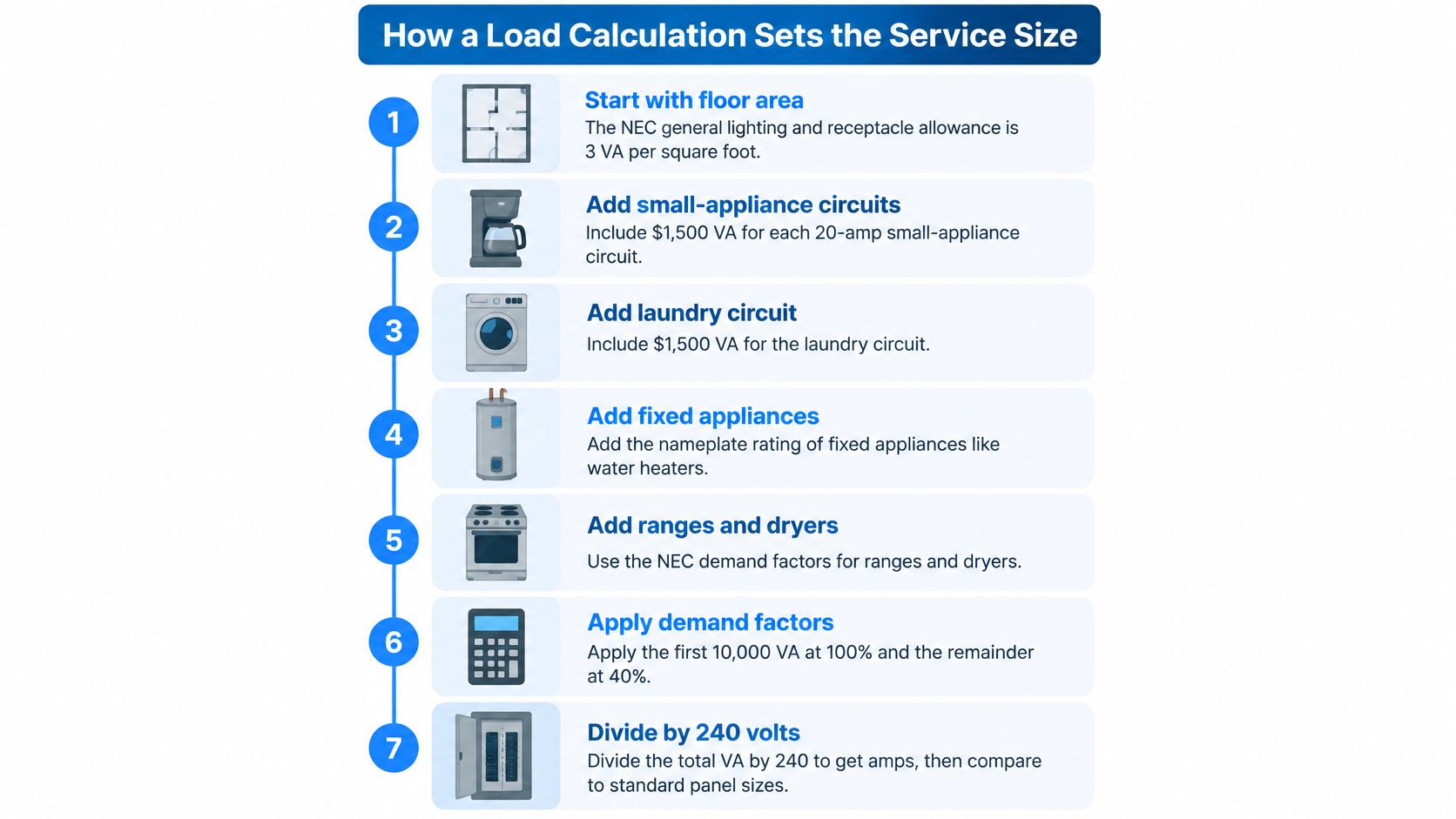
A load calculation turns planned equipment and household demands into a service-size decision:
Start with floor area. General lighting and receptacles are calculated at 3 VA per square foot, or about 32.3 VA per square meter. A 2,000-square-foot home begins with 6,000 VA for this allowance, rather than counting every outlet and light individually.
Add small-appliance and laundry circuit allowances. These code-required allowances are included even if kitchen and laundry loads rarely operate at the same time.
Add fixed appliances and apply permitted demand factors. Include the nameplate ratings for the range, dryer, water heater, and cooling equipment. Applicable demand factors account for the fact that household appliances do not all draw their full rated load simultaneously.
Include planned equipment. Add EV supply equipment, a heat pump, battery system, or generator transfer switch. Leaving planned loads out can make a service appear adequate when it will not support the intended setup.
Divide the calculated total by 240 volts. A hypothetical load-calculation illustration totals 47,520 VA. Dividing by 240 volts gives 198 amps.
Choose the next standard service size. A calculated demand of 198 amps points to a 200-amp service, rather than rounding down and selecting a size below the result.
The calculation depends on the loads being counted and the applicable demand factors. Panel age, breaker count, and floor area alone do not establish the required service size. Before choosing equipment, request an electrical load assessment and ask for the arithmetic behind the recommendation. A documented calculation can also show whether a full 200-amp upgrade is warranted or whether a smaller or managed addition, such as EV charging, fits the available capacity.
EV Chargers and Whether 100 Amps Can Handle Them
A Level 2 charger can take a substantial share of a 100-amp service, but charger size is only one part of the capacity decision.
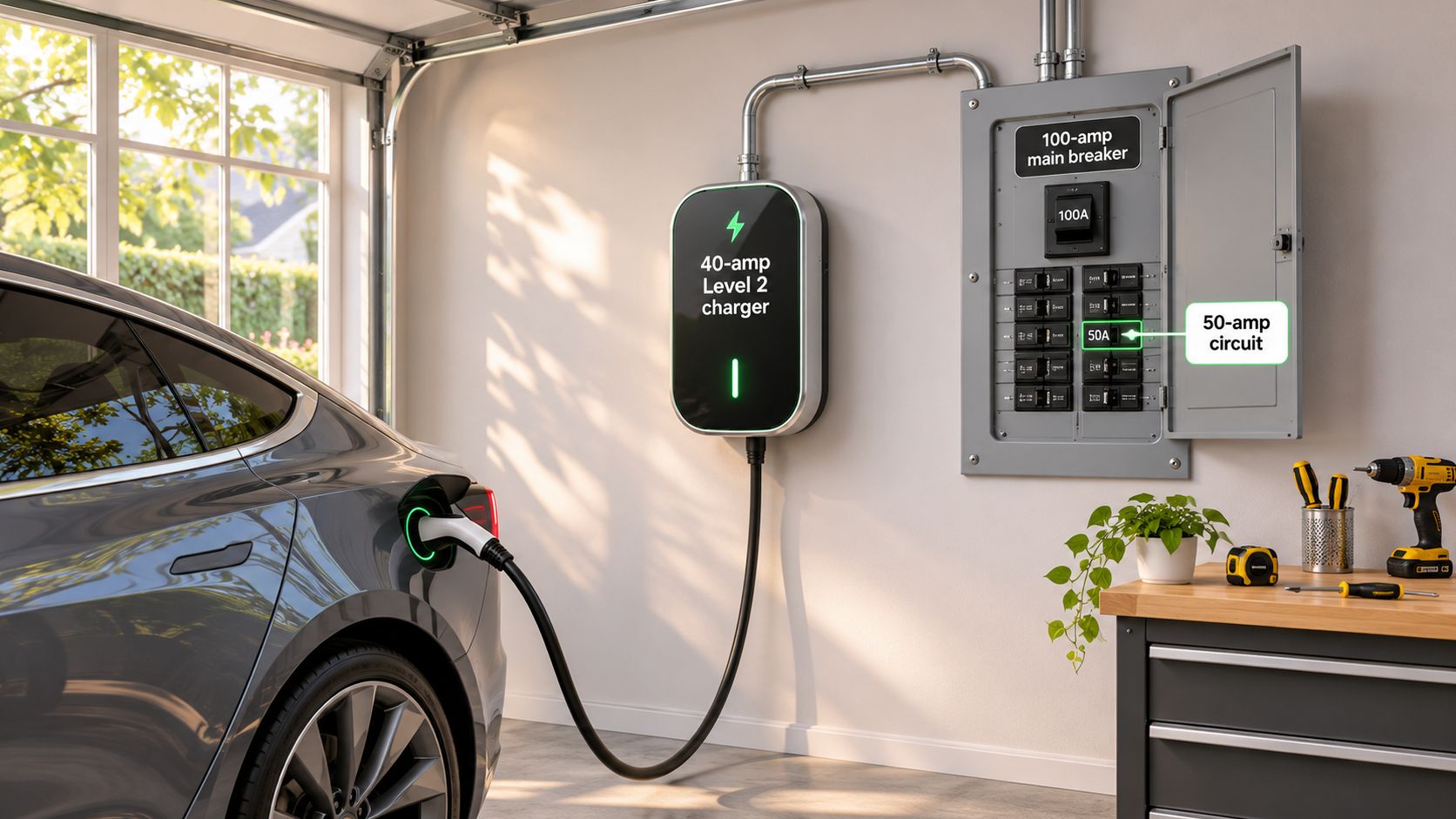
A 40-amp Level 2 charger requires a circuit of at least 50 amps because EV charging is a continuous load, and the overcurrent device is sized at 125%. At 240 volts, its nameplate demand is 9,600 VA. That equals 40% of a 100-amp service's 24,000 VA or 20% of a 200-amp service's 48,000 VA, using the charging details in the EPA's plug-in vehicle guidance. The remaining capacity must also serve loads such as the range, dryer, water heater, and air conditioner.
A 48-amp charger is counted as a 60-amp continuous load. That can leave little room on a 100-amp service, depending on the rest of the home's demand. Check the circuit requirements for a 48-amp wall connector when comparing charger output with available service capacity.
Charger option | How the load is counted | Likely service fit |
|---|---|---|
40 A Level 2 charger | 50 A circuit, 9,600 VA nameplate | Uses 40% of a 100-amp rating; leaves more capacity on a 200-amp service |
48 A Level 2 charger | Counted as 60 A continuous | May exceed the available margin on a 100-amp service; consider an upgrade or managed charging |
16 A charger | Lower draw against the measured peak | May fit a 100-amp service if the calculation allows |
Managed charging | Throttled during high household demand | May avoid a full upgrade if the calculation supports it |
When a Smaller Charger or Managed Charging Wins
A published EV charger load calculation walkthrough shows the middle ground: a 100-amp service with a measured peak of 60 amps may not support a full-output charger, but could allow roughly a 16-amp charger or managed charging. An energy-management device can reduce charging when the home is drawing heavily, such as during cooking or a heat-pump cycle, then allow faster charging when household demand falls overnight.
Most quotes compare two panel sizes; the more useful comparison is a full upgrade against managed charging. If another EV, a heat-pump conversion, or a battery installation is planned, added service capacity may be justified. In a gas-heated home with a short daily commute, a smaller charger or managed charging may meet the need without upgrading. The load calculation, not the panel label alone, determines which option fits.
What the Calculation Should Include
Compare the household's measured peak demand plus 125% of the EV load with the service capacity. If that total exceeds the available capacity, load management can be a valid design option, provided the system is configured to control demand appropriately.
Amp'd installs EV chargers for all EV makes and models in residential and commercial settings and is a Tesla Certified Wall Connector contractor. Its electricians can assess charger circuit sizing and service capacity as part of the project.
Why 200 Amps Can Still Fall Short
A 200-amp service adds 100 amps of nameplate capacity over a 100-amp service, a 100% increase before demand factors or continuous-load rules are considered. That larger rating creates more room, but it does not guarantee that every combination of new equipment will fit. For a 120/240-volt, single-phase dwelling with copper conductors, the service entrance conductors may be 2/0 AWG copper under the cited provisions in NFPA's residential service-sizing guidance.
What Changed Since the Panel Was Installed
A service that once supplied lighting, receptacles and conventional appliances may now need to support EV charging, electric space heating, battery storage or a generator. Several of these loads can operate at the same time. A home's calculated demand can rise as equipment is added, even if the original appliances remain unchanged.
The key planning question: does the service fit the equipment in the home now, or the additional equipment planned for later?
Two EV chargers, a heat pump, a heat-pump water heater and induction cooking can combine into a demand that a 200-amp nameplate alone does not resolve. The service rating is a capacity limit, not a promise that every future load can run at full output simultaneously. For a home moving toward full electrification, the load calculation must account for how the equipment will be used together.
What a Bigger Service Doesn't Fix
A service upgrade does not automatically provide enough breaker spaces, nor does it ensure that the utility-side supply can support the added demand without changes. Battery backup and generator transfer equipment also need to be included in the system's load review. Load management or demand controls may allow some new equipment to work with a 100-amp service; a 200-amp upgrade generally provides more electrical headroom.
Amp'd Energy Solutions assesses the existing setup and explains the options for a panel upgrade or a full service replacement. It also future-proofs electrical systems for added solar, battery backup, new equipment or additions. The choice between 100 and 200 amps depends on calculated demand and the equipment the property needs to support, not the panel label alone.
Which Panel Fits Your Household Situation
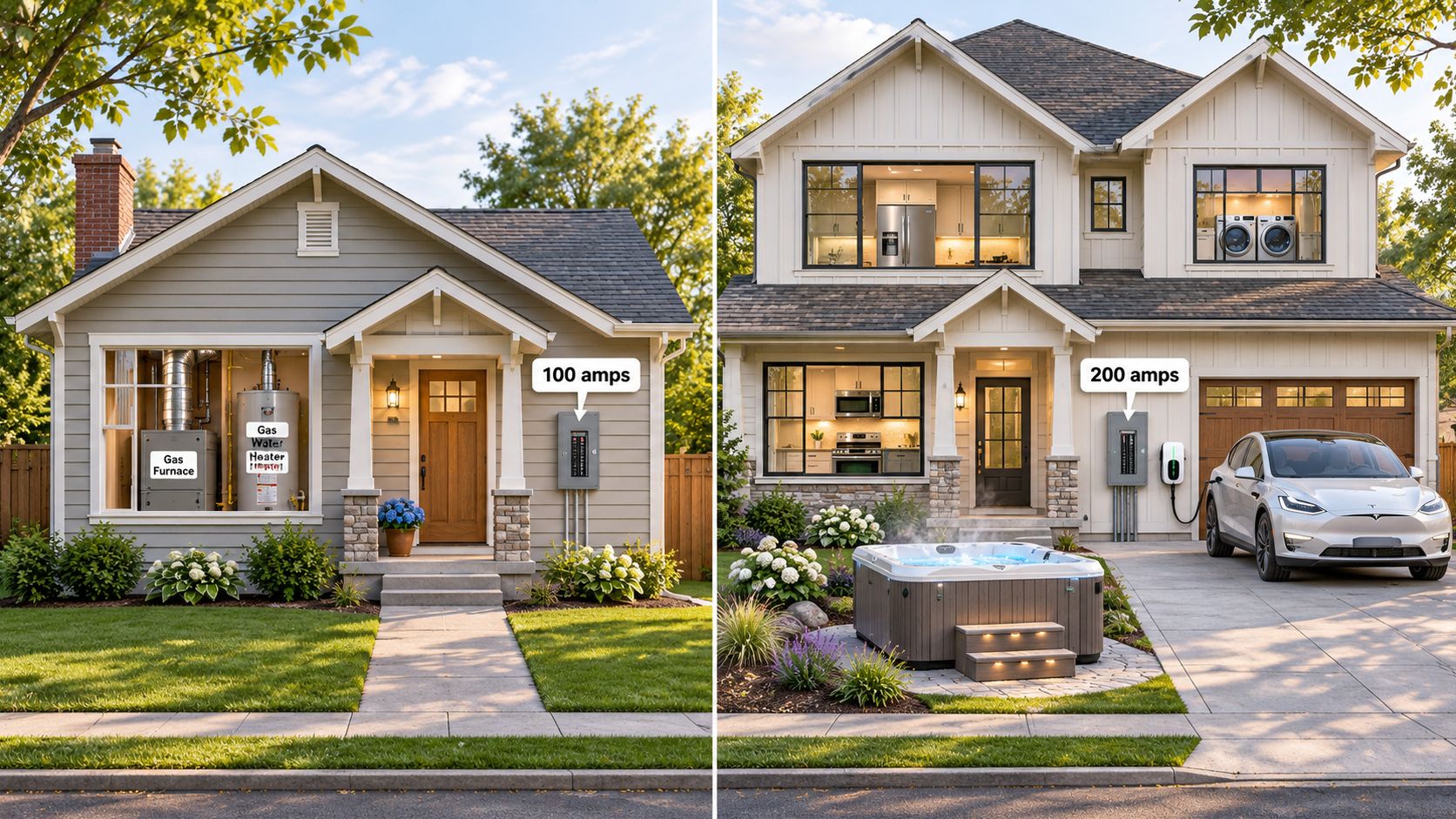
A panel rating is a starting point for planning, not a verdict on a household. The likely fit depends on the equipment already in place and what the load calculation supports.
Household situation | Likely panel | Why |
|---|---|---|
Gas heat and water heating, no EV | 100 amp | The calculation may show enough capacity for current demand |
One EV with a Level 2 charger, gas appliances | 100 amp with managed charging, or 200 amp | The result depends on the calculated load and charger rating |
Heat pump, electric water heater and EV | 200 amp | Combined demand may exceed 100-amp capacity |
Battery backup added to existing solar | 200 amp, to be confirmed | Storage and transfer equipment must be included in the design |
Planned all-electric conversion or home addition | 200 amp | Added equipment can increase future demand |
For a home with gas heat and water heating and no EV, retaining 100 amps may make sense if the calculation shows sufficient capacity. A service upgrade adds value when it addresses a real capacity need, not because a larger rating is available.
An EV does not automatically require a 200-amp service. With gas appliances and one vehicle, managed charging or a lower-output charger may fit within a 100-amp service, depending on the calculated load. Adding another major electric load, such as a heat pump, can change that result.
Homes combining a heat pump, electric water heating and EV charging have a stronger case for testing a 200-amp upgrade. The combined demand can exceed what a 100-amp service supports, but the recommendation should still follow the calculation rather than the equipment list alone.
Battery backup paired with existing solar also needs to be considered alongside the home's other electrical loads. Planned conversions and additions can shift the decision in the same way: each adds equipment that must be accounted for, so a service that fits today may not fit the intended setup.
For these profiles, use the earlier service-size checks and load calculation to compare present demand with planned equipment. In particular, an EV owner can compare the cost and capacity implications of managed or smaller charging against a service upgrade. The choice is not 100 amps or 200 amps; charging controls may keep the smaller service viable when the calculated load allows it.
When several of the 200-amp profiles apply, treat a 200-amp service as an option to evaluate, not an automatic answer. The deciding factor is whether the calculated demand and planned additions support that upgrade.
Get a Load Calculation Before You Upgrade
The decision rule is short. Choose 200 amps when the calculated load plus the loads you plan to add exceeds what 100 amps can carry safely, and choose managed charging or a smaller charger when the calculation shows headroom only for controlled charging.
The cost of guessing is not small. CostCandor's analysis of permit filings reported that the median cost of a 200-amp panel upgrade rose from $4,000 in 2018 to $8,000 in 2025. Prices vary by city, service mast, meter equipment and utility coordination, so use that as a benchmark and insist on a written quote.
Write down what you own. Current appliances, heating and cooling equipment, plus every charger, battery or generator you plan to add.
Ask for a load calculation based on measured demand. Panel age is not an input. The interval data and the appliance list are.
Get a second quote for the alternative. Price managed charging or a lower-output charger against the full upgrade and compare the two side by side.
Confirm licensing and permitting. The electrician should be licensed, and the work should be permitted and inspected rather than handled as a weekend swap.
Book the assessment. Do this before you buy the charger, the heat pump or the battery, not after.
Amp'd Energy Solutions offers a free consultation, and our electricians are licensed. Call 267-450-6992 or email sales@ampd.life to schedule one or request a quote.
Amp'd Energy Solutions sizes service upgrades around a load calculation instead of a panel label, so you find out what your house draws before anyone quotes a 200-amp replacement. We install the EV chargers, Tesla Powerwall systems and whole-house generators that create those loads in the first place, which means the panel, the circuits and the equipment get planned together across Southeastern Pennsylvania. Visit Amp'd Energy Solutions to book a free consultation and see where your headroom really stands.
Comments