

What Size Breaker for EV Charger? Use This Chart
A 32 amp EV charger needs a 40 amp breaker, a 40 amp charger needs a 50 amp breaker, and a 48 amp charger needs a 60 amp breaker. The arithmetic behind all three is identical: multiply the charger's maximum continuous current by 1.25, then round up to the next standard breaker size.
That multiplication is the easy half of what size breaker for EV charger projects turn on, and it's the half most online advice gets right. The popular version of the answer stops there and implies two things that aren't true. The first is that the breaker describes the charger. It doesn't. It describes the circuit, and the circuit is only correct when the charger itself is configured to match it. The second is that a large main breaker means room for a large branch circuit. It doesn't. A 200 amp panel can be completely spoken for by electric heat, a water heater, and a range, while a 100 amp service with gas appliances can often carry a charger without breaking a sweat.
So the useful order of operations runs like a careful electrician at the panel. Find the current the charger is permitted to draw, size the breaker from that, size the wire to the breaker, then prove the service can carry the result. Skip the last step and the first three don't matter.
Table of Contents
Breaker Sizes and the Continuous Load Rule - Read Every Row Through the 125 Percent Rule - Why the Breaker Is Larger Than the Charging Current - What Level 2 Charging Looks Like in Real Homes - Configure the Charger to the Circuit
Wire Gauge and a Dedicated Circuit - What the Permit Packet Needs
Why Panel Capacity Can Block That Breaker - The Loads That Eat the Margin - Checks the Load Calculation Does Not Cover
Choosing 24 32 40 or 48 Amps for Real Driving - Match the Setting to the Week, Not the Catalog - The Limit on Turning It Down
Smaller Settings Versus a Service Upgrade - Reserve the Upgrade for Stacked Loads
Breaker Sizes and the Continuous Load Rule
Start with the number, then the reason. The table below gives the minimum breaker for a charger's maximum continuous current, and every row comes out of one multiplication.
Charger current | Minimum breaker | Typical setting | Approx. power |
|---|---|---|---|
16 amps | 20 amps | Small or plug-in unit | about 3.8 kW at 240 V |
24 amps | 30 amps | Reduced Level 2 | about 5.8 kW at 240 V |
30 amps | 40 amps | Common home Level 2 | about 7.2 kW at 240 V |
32 amps | 40 amps | Common hardwired Level 2 | about 7.7 kW at 240 V |
40 amps | 50 amps | Higher home Level 2 | about 9.6 kW at 240 V |
48 amps | 60 amps | Maximum typical home Level 2 | about 11.5 kW at 240 V |
64 amps | 80 amps | Workplace or public | about 15.4 kW at 240 V |
80 amps | 100 amps | High workplace Level 2 | about 19.2 kW at 240 V |
The right-hand column never decides anything. It tells you how much power reaches the car once the circuit is built, which is useful for comparing settings and useless for choosing a breaker. The two columns on the left are the ones that end up on the permit.
Read Every Row Through the 125 Percent Rule
In the United States, the breaker is determined by the charger's maximum continuous current, not by the vehicle's brand or battery size. Schneider Electric's EV charging distribution guide sets out the requirement and the arithmetic that follows from it: EV charging is treated as a continuous load, and the branch-circuit overcurrent protection must be rated at least 125 percent of the equipment's maximum load.
The practical calculation is charger amperage × 1.25 = minimum circuit rating, and the common settings fall straight out of it. 16 amps needs 20. 24 needs 30. 32 needs 40. 40 needs 50. 48 needs 60. Each one lands on a standard breaker size, so there's no judgment call at those steps.
Two habits keep the arithmetic honest. Standard two-pole breakers follow a fixed ladder of 20, 30, 40, 50, 60, 80 and 100 amps, so when the multiplication lands between sizes you go up, never down. And the number you multiply is the current the charger will be permitted to draw after it's commissioned, which isn't always the largest figure printed on the carton.
Why the Breaker Is Larger Than the Charging Current
Most household loads cycle. A dryer tumbles for forty minutes, a range element clicks off, a compressor rests between runs. An EV doesn't. A car plugged in at 11 p.m. is still pulling its full set current at 5 a.m., and that sustained draw is what the code is written around.
The rule in one line: charger amps × 1.25 = minimum breaker, because an EV can hold its set current for hours rather than minutes.
The guide states the consequence plainly. A 50 amp breaker should not be used to support a charger configured to draw 50 amps continuously, and under the rule a 50 amp circuit supports a maximum continuous charging load of 40 amps. The 25 percent margin buys thermal headroom in the breaker internals and the conductors, because charging runs for hours, unlike the short-duration loads most household circuits were built for.
That mismatch is where a lot of home plans fall apart. Someone reads "48 amp charger" and buys a 50 amp breaker, which is precisely the pairing the code doesn't allow. The breaker isn't oversized for the charger. It's sized so the charger can run flat out all night without consuming the margin.
What Level 2 Charging Looks Like in Real Homes
Level 2 equipment is why residential installs cluster around 40, 50 and 60 amp two-pole breakers. The Department of Energy's Alternative Fuels Data Center describes Level 2 charging as typically operating at 240 volts in a residence and 208 volts in a commercial building. It reports that most residential Level 2 chargers operate at up to 30 amps and deliver about 7.2 kilowatts, and that those units generally require a dedicated 40 amp circuit under NEC Article 625.
The same source notes that Level 2 equipment in public and workplace settings can operate from 40 to 80 amps. That's why a commercial install and a garage install look so different at the panel, even though both obey the same multiplication. Commercial work starts from a bigger first number, and 208 volts changes the power delivered for the same current.
The top two rows belong to workplace and public equipment. 64 amps of charging sits on an 80 amp breaker, and 80 amps sits on a 100 amp circuit, which is why fleet and multifamily projects begin with a service study before anyone orders hardware. Those rows describe an electrical relationship, not a target for a single-family garage.
Set the four home settings side by side and the pattern holds: 16 times 1.25 is 20, 24 times 1.25 is 30, 32 times 1.25 is 40, and 48 times 1.25 is 60. Every one is a two-pole breaker feeding a single piece of equipment.
Configure the Charger to the Circuit
The rule sizes the circuit. It doesn't configure the equipment, and the two have to agree before the cover goes back on. A wall unit capable of 48 amps bolted to a 40 amp circuit must be commissioned at 32 amps, and that setting is what an inspector checks. Leave it permitted to draw 48 and the breaker is undersized no matter how neatly the panel label was typed.
From there the design widens. The circuit is normally dedicated to the EV supply equipment, and the breaker and conductors get chosen as one assembly rather than by breaker size alone. Terminal ratings, wire type and gauge, conduit conditions, panel capacity, the service load calculation, the manufacturer's instructions and the locally adopted code edition all move the final number.
In Southeastern Pennsylvania, that last item decides what gets submitted. A design that passes in one municipality can need a different conductor or an extra line on the load calculation in the next, so the final rating gets verified against the adopted electrical code and the permit requirements for the address where the work happens.
Wire Gauge and a Dedicated Circuit
Picking the breaker is step one of four. The rest is the conductor that carries the load, the dedicated route it takes, and the paperwork that shows all three agree with each other.
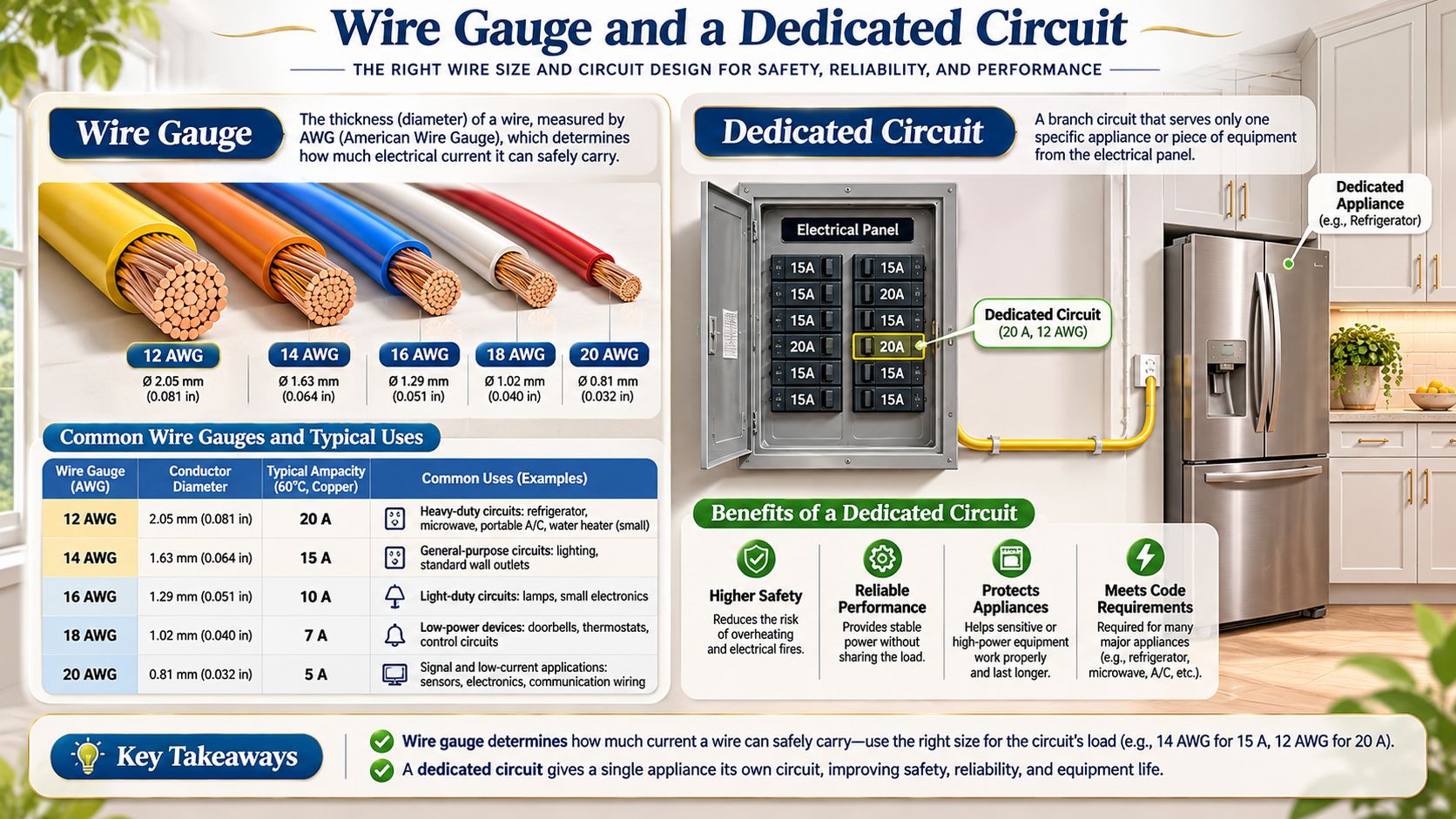
A breaker protects the wire behind it. That's the whole reason the pair is chosen together: a 60 amp breaker on conductors that can only carry 50 amps has removed the protection the last breaker was providing, and the wire becomes the weak link in a circuit that runs for hours. Conductor size comes from the ampacity tables, adjusted for the temperature rating of the terminals it lands on, the insulation type, and the conditions along the route.
In a normal garage install with 75°C copper terminations, 8 AWG copper covers a 40 amp circuit and 6 AWG copper covers 50 and 60 amp circuits. Those are starting points, not guarantees. A run to a detached garage, an attic crossing that bakes in July, or a conduit already crowded with other circuits can force a size up even when the breaker doesn't change, because voltage drop and derating bite harder on a load that never rests.
The dedicated circuit requirement is the other half of the design. An EV charger shouldn't share a breaker with a dryer, a welder, or a string of garage receptacles, even when the panel math looks like it might fit. Sharing means somebody eventually runs both at once, and the breaker does what breakers do.
Then there's the equipment itself. A plug-in charger needs the correct receptacle and a breaker matched to that assembly, and the common 50 amp receptacle route caps continuous draw at 40 amps. A hardwired unit takes its maximum from the nameplate and the instructions instead. Outdoor and garage locations add wet-location fittings, proper cable support, and working clearance in front of the panel.
What the Permit Packet Needs
A reviewer wants five things, and they should all tell the same story:
The charger model and maximum current, read from the nameplate or installation manual rather than the retail listing.
The breaker size that the multiplication produces for that current.
Conductor type and gauge, including any upsizing for the length of the run.
A panel schedule showing the new two-pole breaker and its position.
The load calculation that proves the service can carry it.
If any two of those disagree, stop. A neatly labeled 60 amp breaker on wire sized for 50 is still a hazard, and an inspector will find it before the meter turns.
Why Panel Capacity Can Block That Breaker
A 200 amp main breaker is a rating, not a budget. It tells you the ceiling the service was built to carry and nothing about how much of that ceiling is already spoken for. Spare capacity is whatever remains after the load calculation subtracts existing demand, which is why two houses with identical panels land on opposite answers. One has a heat pump, electric cooking and a hot tub. The other has gas heat and a gas range.
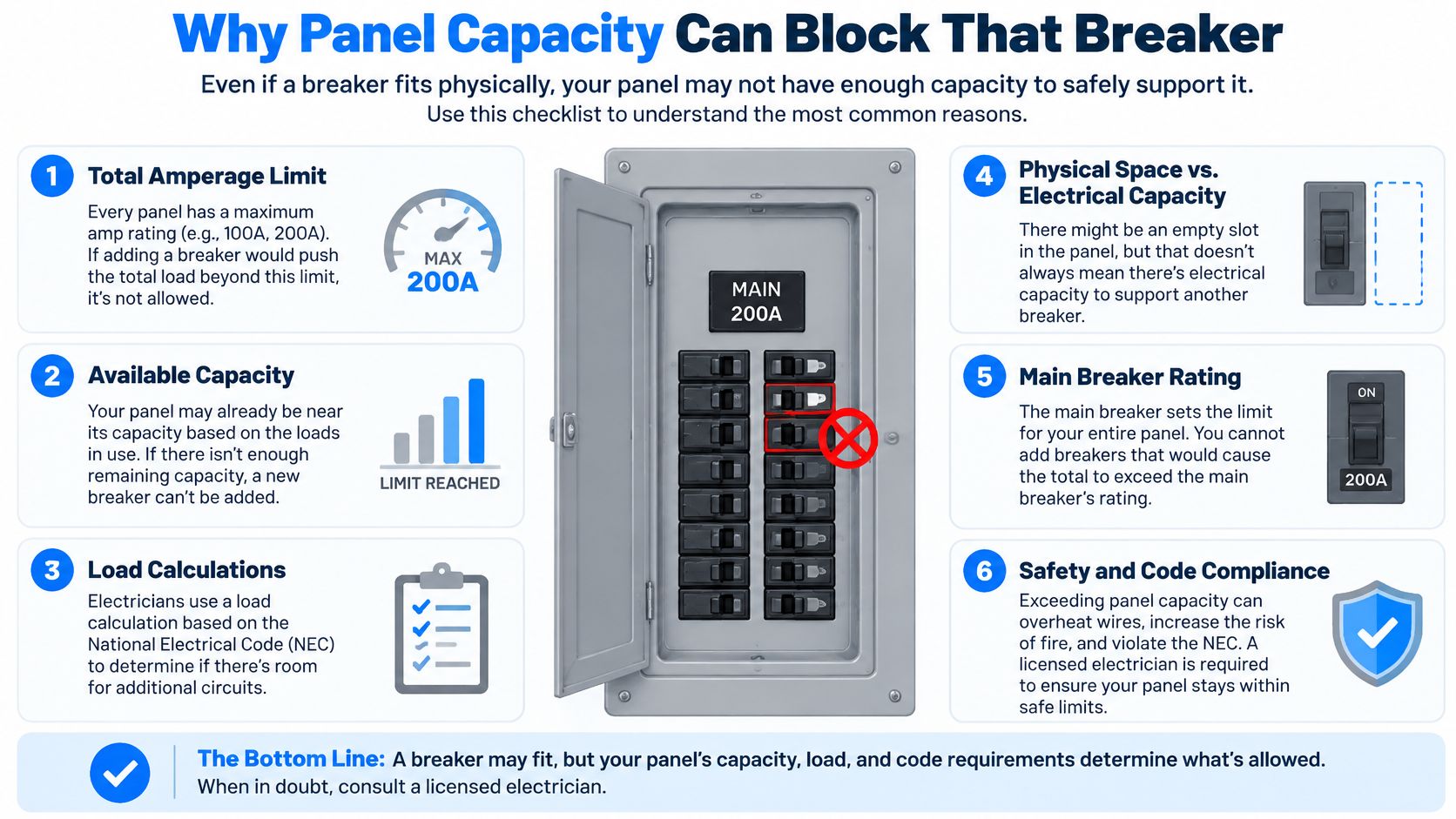
Home Depot's outdoor EV charger guide puts the step where it belongs, advising that an electrician perform a load calculation to determine whether the existing panel can support the charger. Municipal load-calculation forms run the same arithmetic on paper: the proposed charger is added to the home's existing loads, and the resulting demand is compared with the service rating before anyone decides an upgrade is necessary.
The Loads That Eat the Margin
Walk a panel and the big consumers announce themselves:
Electric resistance heat or a heat pump with backup strips, the single largest seasonal load in most all-electric homes.
An electric water heater, which reheats on its own schedule regardless of what else is running.
Range and dryer, both high draw and both used at the same hour of the evening.
A pool, spa, or hot tub, often on its own schedule and often forgotten in the tally.
A well pump or workshop tools, intermittent but heavy when they kick in.
A second EV, a home battery, or a generator, any of which changes the picture for years.
Add 40 or 48 amps of continuous charging to that list and the total can cross the service rating even when the panel has two empty slots staring at you.
Which is why the two common assumptions both fail. A 200 amp main does not automatically mean a 60 amp EV circuit is acceptable, and a 100 amp service does not automatically rule out charging. The first assumption produces installations that fail the calculation. The second produces upgrades homeowners didn't need.
Checks the Load Calculation Does Not Cover
Physical inspection runs alongside the math. A two-pole breaker needs two adjacent spaces, and a panel that's full needs a different answer than one with room to spare. Age matters too, since obsolete panels with damaged bus bars or no breakers of the right type turn a simple circuit into a replacement project. The route matters as well, because a long garage run can need heavier conductors even when ampacity is fine, and the panel upgrade decision usually turns on how those physical findings stack against the service calculation.
Approved energy management or load-sharing equipment can change how the maximum EV load is counted when the adopted code and the utility allow the method. That's a design decision for the electrician doing the calculation, never something to assume on a hunch.
The calculation produces one of three answers: install as planned, set the charger lower and size the circuit to that, or upgrade the panel or service. Nothing else.
Choosing 24 32 40 or 48 Amps for Real Driving
The top row of the chart is a ceiling, not a target. A bigger breaker and a faster charger cost more, and past a certain point they force a panel or service upgrade for capacity the household will never touch. The EPA's guide to home charging frames the decision as site-specific and recommends confirming both panel capacity and safe installation rather than treating one breaker size as universal.
So put the driving first and the hardware second. Four settings cover almost every home, and each answers a different situation.
24 amps on a 30 amp breaker. The smallest Level 2 setting most drivers should consider. It suits a short commute, a one-car household, or a home with a crowded 100 amp service where the calculation has little room to give.
32 amps on a 40 amp breaker. The middle of the road, and the setting most hardwired installs land on because it covers typical daily driving with hours of parking left over.
40 amps on a 50 amp breaker. A sensible pick for a long commute, a cold-climate household that preconditions the cabin, or two drivers sharing one car.
48 amps on a 60 amp breaker. For a household that needs the fastest home Level 2 and has a load calculation showing room for it. Everything else is paying for speed that sits unused overnight.
Match the Setting to the Week, Not the Catalog
The number that matters isn't the fastest charge the car can accept. It's how many hours the car sits in the driveway and how many miles the household covers between those hours.
Say a household parks from 7 p.m. to 7 a.m. and covers a modest daily distance. Twelve hours of parking is generous by any standard, and a moderate setting that finishes the refill before morning costs less to install than the setting that fills the battery in half the time.
Off-peak utility windows shift that math. When the cheap hours are a narrow band, a faster setting earns its keep because it can squeeze the whole refill into the discount period. Solar or a home battery on the same service changes it again, since charging from production or during a managed window is a different question than raw speed.
The Limit on Turning It Down
Here's the part the "just turn it down" advice skips. Reducing the charger's configured current can avoid an upgrade only when the equipment, the breaker, the conductors, and the local approval all support that configuration. Most wall units have a restricted-access ampere setting, and the code treats that commissioned setting as the equipment rating.
Installing a smaller breaker without changing the charger's permitted maximum isn't a fix. It removes protection, leaves the load exactly where it was, and creates the failure the breaker existed to prevent.
Smaller Settings Versus a Service Upgrade
When the load calculation says no to the circuit you wanted, three paths open, and only one of them carries the cost of a service change. Choosing between them is a question of what the household will look like in five years, not what the charger can do on paper.
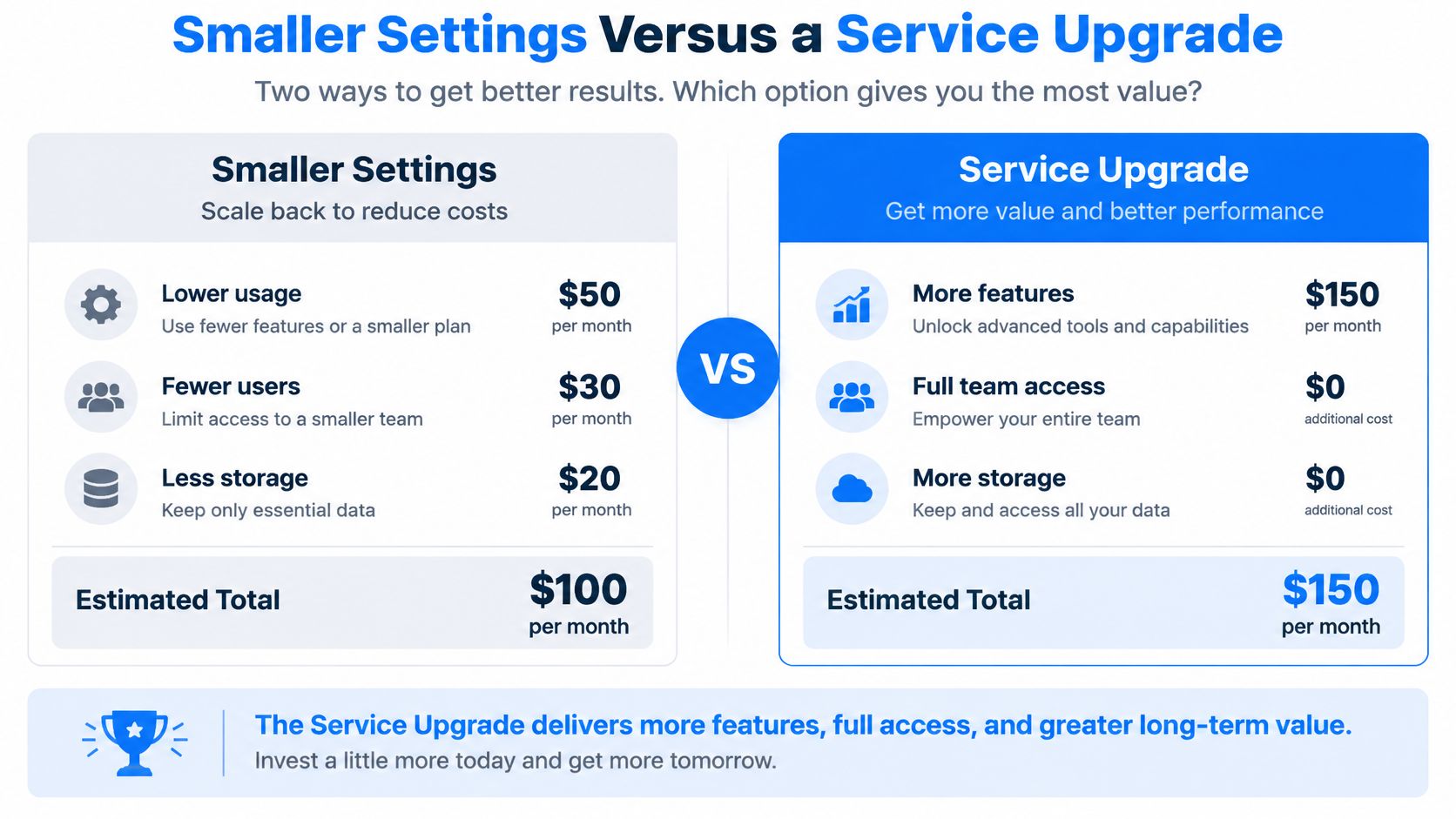
Path one turns the charger down. It fits when daily miles still recover overnight, and it requires the breaker, the wire and the charger's permitted setting to all match the new, lower maximum. Nothing else about the install changes.
Path two manages the load. A load-sharing or energy-management device watches the service and pauses or trims charging while the range, heat pump, or water heater runs. It fits homes where peaks overlap, and it needs the adopted code to accept the method plus equipment listed for the job. That route keeps the full charging rate available at 2 a.m. when the house is quiet.
Path three changes the panel or the service. It fits when several future loads will share the same service: a second EV, a heat pump, an induction range, solar, or a battery. The larger service sized by a load calculation carries all of them at once instead of rationing.
Path | When it fits | What it requires |
|---|---|---|
Lower permitted current | Daily miles still recover overnight | Breaker, wire, and charger setting all match the new maximum |
Energy management or load sharing | Peaks overlap with range, heat pump, or water heater | Adopted code and equipment approval allow the method |
Panel or service upgrade | Several future loads share the same service | Panel or larger service sized by a load calculation |
One piece of arithmetic gets confused here often. A battery backup or a standby generator does not create spare utility capacity during normal grid operation. It carries the house through an outage, not through a Tuesday evening peak, so sizing a charger on the assumption that storage adds headroom on the service gets the calculation wrong.
Reserve the Upgrade for Stacked Loads
The upgrade is worth doing when it carries several loads at once. A panel change for a single charger that would have been fine at 32 amps is money spent on speed nobody uses. The reverse is just as expensive: a household stacking electric heat, a second EV and a heat pump will be back at the panel within a couple of years if it caps charging at the minimum today.
Right-size the charger when miles allow, manage the peaks when loads overlap, and upgrade when the service is already at its limit.
Confirm the Breaker With a Load Calculation
Before anything gets ordered, put four items on one page:
Charger make and model, with the maximum current taken from the nameplate.
The current you'll permit it to draw, which may be lower than that maximum.
The breaker that multiplication produces for the permitted current.
The big existing loads, listed alongside photos of the panel label and the main breaker.
A licensed electrician takes that page, runs the service calculation, checks panel space and the wire route, and returns one of three answers: the breaker is acceptable, the charger should be set lower, or the panel or service should be replaced. The load assessment calculations behind that verdict are the same ones that decide any service change.
In Southeastern Pennsylvania, Amp'd Energy Solutions handles that assessment directly. Our licensed electricians review the current setup and explain a panel upgrade versus a full service replacement, with the reasoning behind each option. A free consultation is available by calling 267-450-6992 or emailing sales@ampd.life.
Don't buy a 60 amp breaker because a listing said 48 amp chargers use one. Buy it when the nameplate, the conductors and the load calculation all land on that same number.
Amp'd Energy Solutions installs Level 2 chargers for every EV make, in homes and workplaces across Southeastern Pennsylvania, and every job starts with the load calculation that decides whether your panel can carry the circuit. If the answer is a panel or service upgrade, you'll hear why and what the alternatives are before anything gets scheduled. Visit Amp'd Energy Solutions to book a free consultation and get your breaker sized against your actual service.
Comments