

Level 2 EV Charger Installation Guide
You're standing beside a new EV, looking at the garage wall, and wondering whether installing a faster charger means replacing the electrical panel. Sometimes it does. Often, the answer depends on a calculation that many rushed quotes skip.
A Level 2 EV charger installation is an electrical design project, not just a matter of mounting a box and pulling cable. The charger becomes a sustained load on your home's service, so the panel's existing demand, the wire route, the local permit process, and the charging equipment all have to work together. A proper assessment can reveal that your home is ready for a standard circuit, or that load management can avoid a major upgrade.
Table of Contents
Understanding Level 2 Charging Performance and Costs - Charging time depends on the vehicle - Budget for the complete electrical project
Calculating Electrical Capacity and Circuit Requirements - Start with the service, not the equipment - Why the breaker size matters - Don't rely on panel size alone
Navigating Panel Upgrades Versus Smart Load Management - Compare the two paths - Load sharing works only when engineered - Ask for two written designs
Securing Permits and Coordinating with Local Utilities - Follow the local sequence - Paperwork protects more than compliance - Expect redesign risk
Executing the Physical Installation and Final Commissioning - Routing determines much of the workmanship - Commissioning catches problems before handover
Verifying Contractor Qualifications and Project Readiness - Use the consultation to test readiness
Understanding Level 2 Charging Performance and Costs
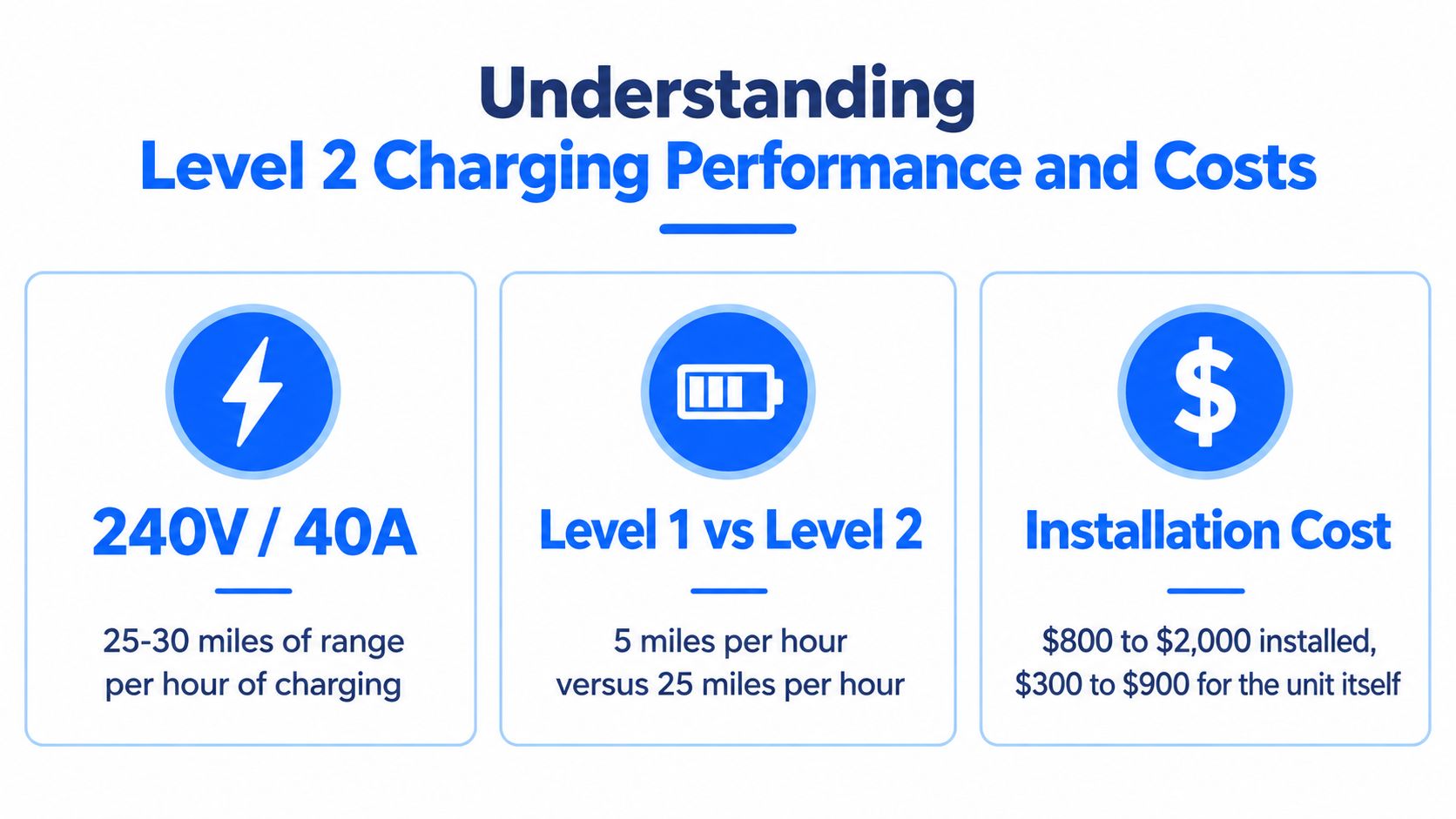
A homeowner may choose a Level 2 charger expecting the fastest possible refill, then discover that the vehicle, circuit, or service cannot deliver the nameplate output. Charging performance starts with 208 to 240 volts of alternating current, but the useful result depends on the vehicle's onboard charger, battery condition, temperature, and available electrical capacity. The U.S. Department of Energy describes Level 2 as a practical option for drivers with longer commutes or vehicles with larger batteries.
A typical unit can add roughly 10 to 20 miles of range per hour of charging, although the vehicle determines how much energy becomes usable range. An efficient drivetrain may travel farther on the same input, while a larger battery can require more time to reach a high state of charge. The charger's rating alone does not predict the daily result.
Charging time depends on the vehicle
A battery-electric vehicle generally needs several hours for a substantial recharge. A plug-in hybrid often needs less time because its battery is smaller. In practice, a battery-electric vehicle typically needs 4 to 10 hours on a Level 2 circuit, while a plug-in hybrid may need 1 to 2 hours, depending on battery size and charger output. Treat those ranges as planning guidance rather than a guarantee for every model.
Daily driving patterns matter more than the maximum advertised output. Connecting the vehicle after returning home can cover ordinary commuting without a public fast-charging stop. A lower-output circuit may meet that schedule, while a higher-output charger could require larger conductors, a larger breaker, or changes to the service.
Budget for the complete electrical project
Federal transportation data estimated the average cost to install Level 2 chargers and outlets in a single-family house at $1,400, with estimates ranging from $680 for a detached-house outlet upgrade to $4,100 for an apartment charger upgrade. These figures appear in the Department of Energy Alternative Fuels Data Center's residential charging information.
Argonne National Laboratory reports an average U.S. cost of about $1,800, including equipment and installation, for a faster Level 2 home charger. Eligible consumers may qualify for a federal credit covering 30% of the charger's cost, up to $1,000, as described in Argonne's EV charging infrastructure overview. Eligibility depends on current rules and project documentation, so verify requirements before including an incentive in the budget.
A useful quote separates the charger, breaker, conductors, conduit, mounting, permit work, inspection coordination, and any panel or service changes. Homeowners can review this guide to how much it costs to install an EV charger at home, then compare the scope against the proposed installation. Route length, wall access, equipment location, and available service capacity can change the final price substantially.
Practical rule: Select the charger only after an electrician confirms its expected charging performance, circuit requirements, service capacity, and installation route.
Calculating Electrical Capacity and Circuit Requirements
A homeowner can have an empty breaker position and still lack the capacity for Level 2 charging. The deciding factor is the service's calculated demand, including existing household loads and the EV charger's continuous load.
A Level 2 EV charger operates as a continuous load. Branch-circuit conductors and overcurrent protection must therefore be sized at 125% of the charger's maximum continuous current, as outlined in municipal EV charger installation guidelines. A 32-amp charger is treated as a 40-amp load for circuit sizing, while a 48-amp charger typically requires a 60-amp breaker with conductors sized for the installation.
Start with the service, not the equipment
A licensed electrician should verify the service rating, inspect the panel, and review the main disconnect and service conductors. The rating shows the dwelling's total available capacity, not the amount left after heating, cooling, cooking, water heating, pumps, workshop equipment, and other operating loads.
A sound assessment includes:
Service verification, including the main disconnect rating and panel condition.
Existing-load inventory, covering fixed appliances and significant branch circuits.
EVSE demand, calculated at 125% of the charger's maximum continuous current.
Capacity comparison, using the applicable electrical code method and local authority requirements.
Design decision, whether to install a dedicated circuit, reduce charger output, add load management, or upgrade the service.
For background on the process, review this electrical load assessment guidance for EV charging. It does not replace a calculation based on the property's actual equipment and usage.
Why the breaker size matters
Suppose the selected EVSE draws 48 amps continuously. The circuit must account for the continuous-load requirement, which commonly leads to a 60-amp breaker and conductors selected for the site conditions. Conductor length, ambient temperature, conduit fill, termination ratings, equipment grounding, and the manufacturer's instructions can all affect the final installation.
A breaker does not make undersized wire safe. It protects conductors from overcurrent, while the charger's controls and installation requirements address operating and safety conditions. A circuit that passes a brief test may still be unsuitable for repeated overnight charging.
Don't rely on panel size alone
A 100-amp or 200-amp service does not automatically have spare capacity. The same municipal guidance recommends an individualized peak-load calculation before adding the EV load.
As a screening rule of thumb, a 200-amp service with two open slots for a double-pole breaker may have room for one Level 2 charger. That screening clue is not approval to proceed. Panel age and condition, existing demand, service conductors, charger output, and local rules determine whether a standard installation is appropriate or whether load management or additional electrical work is required.
Navigating Panel Upgrades Versus Smart Load Management
Your load calculation shows the proposed charger exceeds the home's available capacity. That result does not automatically require a new service entrance. The practical choice is between increasing the electrical capacity available to the house and controlling EV charging so the existing service limit is not exceeded.
A traditional upgrade may include a panel replacement, larger service equipment, new service conductors, utility coordination, and additional inspection work. It creates more room for future electrification, but the project can become much larger than the charger installation. The calculated shortfall, the home's planned loads, physical access, panel condition, and utility requirements should guide the decision.
Smart load management addresses the same bottleneck through control rather than added capacity. A properly designed system monitors household demand and temporarily reduces or pauses EV charging when an oven, heat pump, water heater, or other substantial load operates. Charging resumes as demand falls. The vehicle still receives energy, while the charger avoids drawing its full permitted output during the home's highest-demand periods.
Compare the two paths
Feature | Traditional Panel Upgrade | Smart Load Management |
|---|---|---|
Primary purpose | Increases service or panel capacity | Controls charger demand within existing capacity |
Charging behavior | Allows the charger to operate at its designed output when available | May reduce or pause charging during simultaneous high demand |
Construction scope | Can require panel, service, conductor, and utility work | Usually adds approved control equipment and commissioning |
Future expansion | Creates more electrical headroom | Preserves the existing service limit |
Best fit | Homes planning several large electrical loads | Homes with limited capacity but flexible charging schedules |
Main trade-off | More work, cost, and coordination | More controls and possible charging interruptions |
Load sharing works only when engineered
Load management is not permission to bypass electrical code. The electrician still must calculate the dwelling load, verify the service equipment, select compatible hardware, and install the system according to its listing and manufacturer instructions. The control scheme must respond predictably when major household loads start, and its operation must be acceptable to the authority having jurisdiction.
The main benefit is schedule flexibility. A vehicle that charges overnight may tolerate a temporary reduction in output without affecting the driver's routine. Someone who needs rapid replenishment after every trip may be better served by a service upgrade. The lower-cost option is not automatically the better fit if charging interruptions create a daily problem.
The right comparison is the capacity the home needs versus the charging behavior the owner will accept.
Ask for two written designs
When capacity is tight, request both a minimum compliant design and a future-ready design. The first could use a lower charging setting with load management. The second could include service work sized for planned electric heating, storage, another EV, or other substantial loads.
Do not accept a generic claim that a panel upgrade is mandatory without seeing the load calculation. Do not accept a promise that smart load sharing solves every capacity problem without a clear explanation of which loads it monitors, how the controls respond, what happens during a fault, and how the authority having jurisdiction will approve the installation.
Securing Permits and Coordinating with Local Utilities
The administrative work should begin before the electrician orders equipment. A Level 2 project may involve a utility review, a municipal electrical permit, inspection scheduling, and documentation for incentives or program approval. Utility guidance for charger installation from LADWP illustrates why the project can require more than a wiring appointment.
Follow the local sequence
The exact process varies, but a disciplined workflow usually looks like this:
Confirm the utility context. Ask whether the service, meter, rate plan, or interconnection arrangement needs review.
Complete the electrical design. Document the charger rating, circuit size, routing, disconnect requirements, and any load-management equipment.
Submit the permit application. Include the required load information, equipment details, and site documentation.
Schedule the installation. Avoid closing walls or burying conduit until the approved design is clear.
Arrange inspection. The authority may need to verify the wiring, protection, grounding, equipment placement, and labeling.
Retain the closeout records. Keep the permit, inspection result, invoice, equipment information, and any utility correspondence.
The electrician should tell you who handles each item. “Permits included” is too vague unless the proposal identifies application, fees, inspection coordination, and correction work.
Paperwork protects more than compliance
Permits create a record that the work was reviewed and inspected. That record can matter during a property sale, an insurance question, a warranty issue, or a future electrical project. An unpermitted installation may also need to be opened, corrected, or documented later, which can erase any short-term saving.
Funding programs often require proof that the installation was completed legally and that the equipment matches program rules. Keep itemized invoices and final inspection documentation instead of assuming the contractor's invoice alone will satisfy every requirement.
Expect redesign risk
A permit reviewer may request a different disconnect location, conductor method, equipment specification, or load-management detail. Utility staff may also require information before approving service-related work. Build time for those decisions into the schedule, especially if the project includes a panel change or unusual route.
A charger should not be purchased first and engineered afterward. Approval requirements can affect the equipment, circuit, and installation method.
Executing the Physical Installation and Final Commissioning
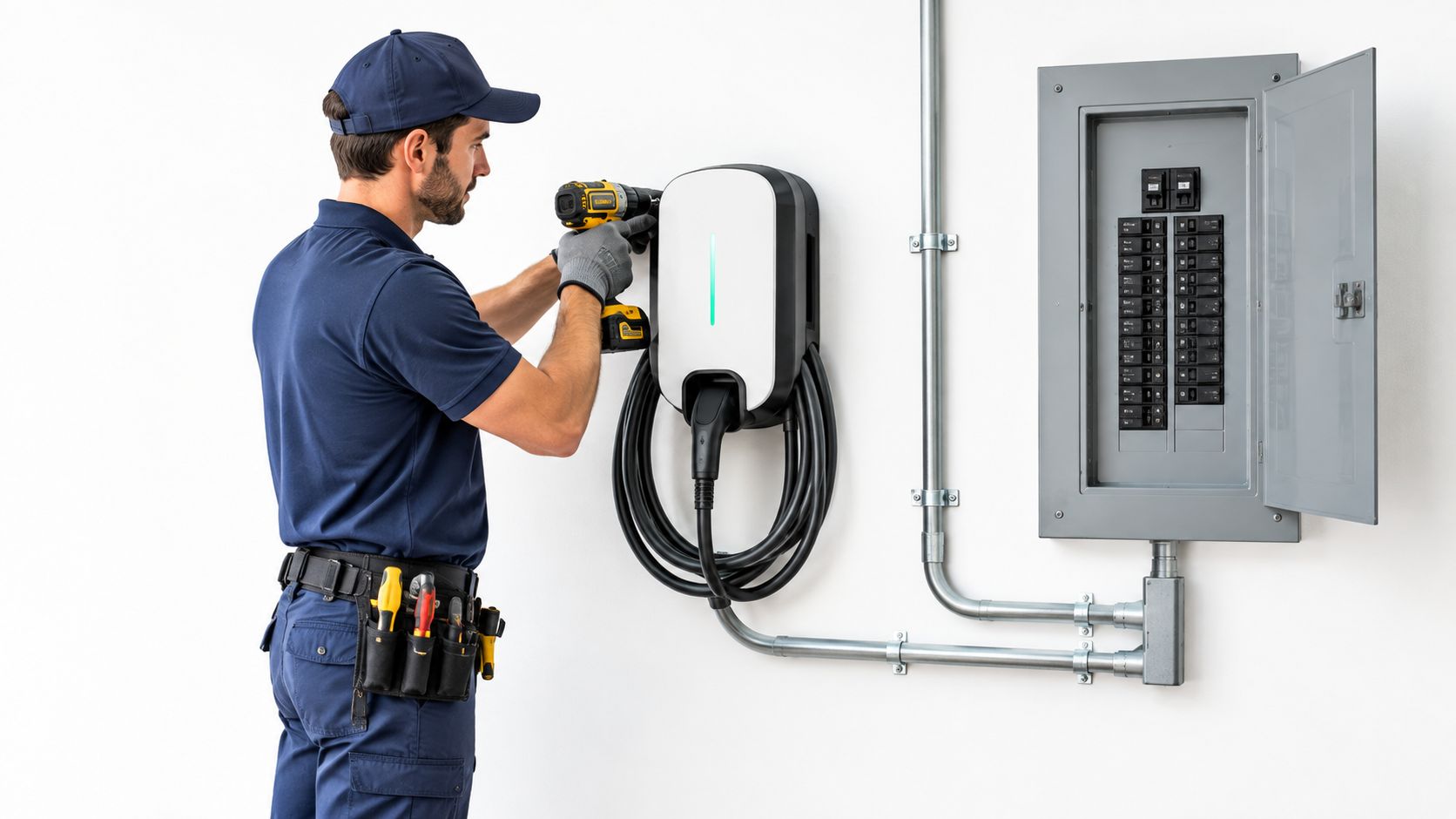
A charger can fit on the wall and still expose weaknesses in the electrical installation. On installation day, the electrician should confirm the approved plan, panel and charger locations, cable route, and any load-sharing equipment before cutting into finished surfaces. A last-minute route change can affect conductor sizing, conduit, weatherproofing, and labor.
The mounting point should let the vehicle reach the connector without pulling on the cable. Keep the equipment clear of likely vehicle impact, standing water, excessive heat, and unnecessary exposure. Outdoor installations require an enclosure and wiring method suited to the environment.
Routing determines much of the workmanship
A short, accessible route may pass through open framing or a garage ceiling. A longer or more difficult route may cross finished walls, masonry, exterior surfaces, or a detached structure. The electrician should select conductors, conduit, fittings, supports, penetrations, and weatherproofing for the actual path, rather than relying on a rough distance estimate.
The circuit also needs the required overcurrent protection, grounding, and bonding. Terminations should be tightened to the manufacturer's specified torque with the proper method and documentation. A loose connection can heat during sustained charging. Unsupported conduit, poor strain relief, or an unsealed penetration can create failures later.
Commissioning catches problems before handover
The electrician should test the circuit and EVSE as one system. The closeout should include:
Visual inspection, confirming enclosure security, conductor protection, labels, clearances, supports, and weather sealing.
Electrical verification, checking voltage, polarity where applicable, grounding, breaker operation, and protective functions.
Load testing, running the charger long enough to identify abnormal heating, unstable operation, or nuisance tripping.
Control setup, configuring current limits, schedules, network settings, and load-management behavior when included in the design.
Owner handover, explaining the disconnect, reset process, charging controls, maintenance expectations, and warranty records.
A networked charger should be tested at its installed location, not merely powered on. If smart load sharing is part of the design, the electrician should demonstrate how charging responds when monitored household loads rise, how the charger is limited, and how charging resumes afterward.
The final test is part of the installation, not a courtesy after it. A charger that powers on has not necessarily passed a proper commissioning check.
Verifying Contractor Qualifications and Project Readiness
A qualified contractor should be able to show why your home needs a panel upgrade, a standard dedicated circuit, or smart load management. Ask for the dwelling-load calculation, not a recommendation based only on the main breaker rating. If load sharing is proposed, confirm which household circuits are monitored, how charging current is limited, and how the inspector will approve the arrangement.
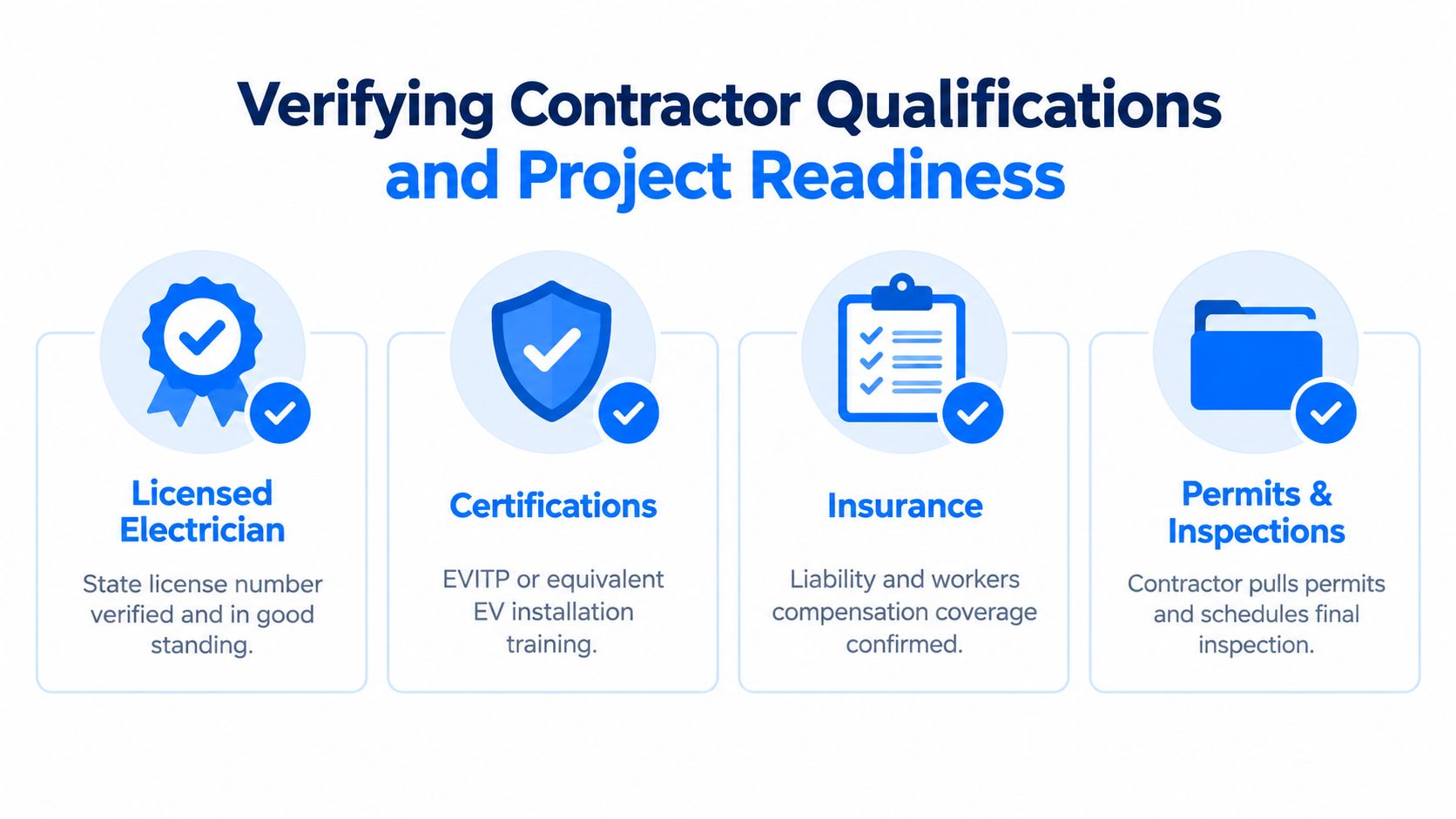
Choose a licensed electrician familiar with local permits and utility requirements, especially for service work, outdoor conduit, battery storage, or several major electrical loads. Manufacturer training also matters when the charger uses proprietary controls or connects to a home battery system. Review the contractor's EV charger installation certification before comparing proposals.
Use the consultation to test readiness
Provide panel photos, the charger's installation manual, the parking location, and a list of existing or planned large loads. Ask these questions:
License and insurance: Can the contractor provide current licensing and confirm liability and workers compensation coverage?
Load calculation: Will the proposal include a dwelling-load assessment that accounts for the charger and future demand?
Circuit design: What charging current, breaker, conductor, grounding, and disconnect arrangement will be used?
Capacity options: If service capacity is limited, will the quote compare smart load management with a panel or service upgrade?
Permits: Who submits the application, pays fees, schedules inspection, and handles corrections?
Commissioning: What tests will be performed, and which records will the homeowner receive?
Future planning: Can the design account for another EV, battery storage, electric heating, or other planned loads?
A clear proposal should identify assumptions, exclusions, equipment, permit responsibilities, and the conditions that could change the price. Amp'd Energy Solutions is one option for homeowners seeking a site assessment, dedicated Level 2 circuit, permitting support, load-management evaluation, or service upgrade. Its family-operated team serves Southeastern Pennsylvania and works on EV charging, battery backup, generators, and related electrical infrastructure.
For a safe installation, visit Amp'd Energy Solutions to request a project consultation.
Comments