

Home Electrical Panel Upgrade: What You Need to Know
A home electrical panel upgrade is typically required when an EV charger, heat pump, or battery backup pushes the calculated ampacity above the existing main breaker rating. Over 20% of single-family homes have service rated at 100 A or less, and a major electrification analysis estimated that 21.1% of all homes, about 16.2 million single-family homes, could trigger service upgrades under full electrification. Read the residential panel barrier analysis.
The question isn't whether the breaker box has empty spaces. An electrician has to calculate the home's demand, compare it with the service rating, and determine whether the project needs a new panel at the same capacity or a true service upgrade that changes equipment between the utility connection and the panel.
Table of Contents
When a Home Electrical Panel Upgrade Becomes Necessary - Conditions that change the recommendation
How Load Calculations Decide Panel Size - What the calculation actually includes
Panel Replacement vs Full Service Upgrade - Why the quote wording matters
Sizing for EV Chargers Generators and Battery Backup - How the equipment changes the calculation
When Load Management Avoids a Panel Upgrade - Capacity is replaced by operating rules
Key Decisions Before You Sign the Quote - Define the physical scope - Verify the paperwork and equipment
When a Home Electrical Panel Upgrade Becomes Necessary
The question often surfaces during an EV charger installation. The electrician walks through the basement or garage, opens the panel, counts the breakers, and then asks a more important question: What size is the main breaker? That rating, along with the home's calculated demand, tells the electrician whether the existing service can safely support the new equipment.
A home electrical panel upgrade may become necessary when a planned load pushes the calculated service demand above the existing main breaker rating. Common additions include EV chargers, heat pumps, induction ranges, hot tubs, electric water heaters, workshops, generators, and battery storage. Empty breaker spaces only tell you that a circuit might physically fit. They don't prove that the service can supply it.
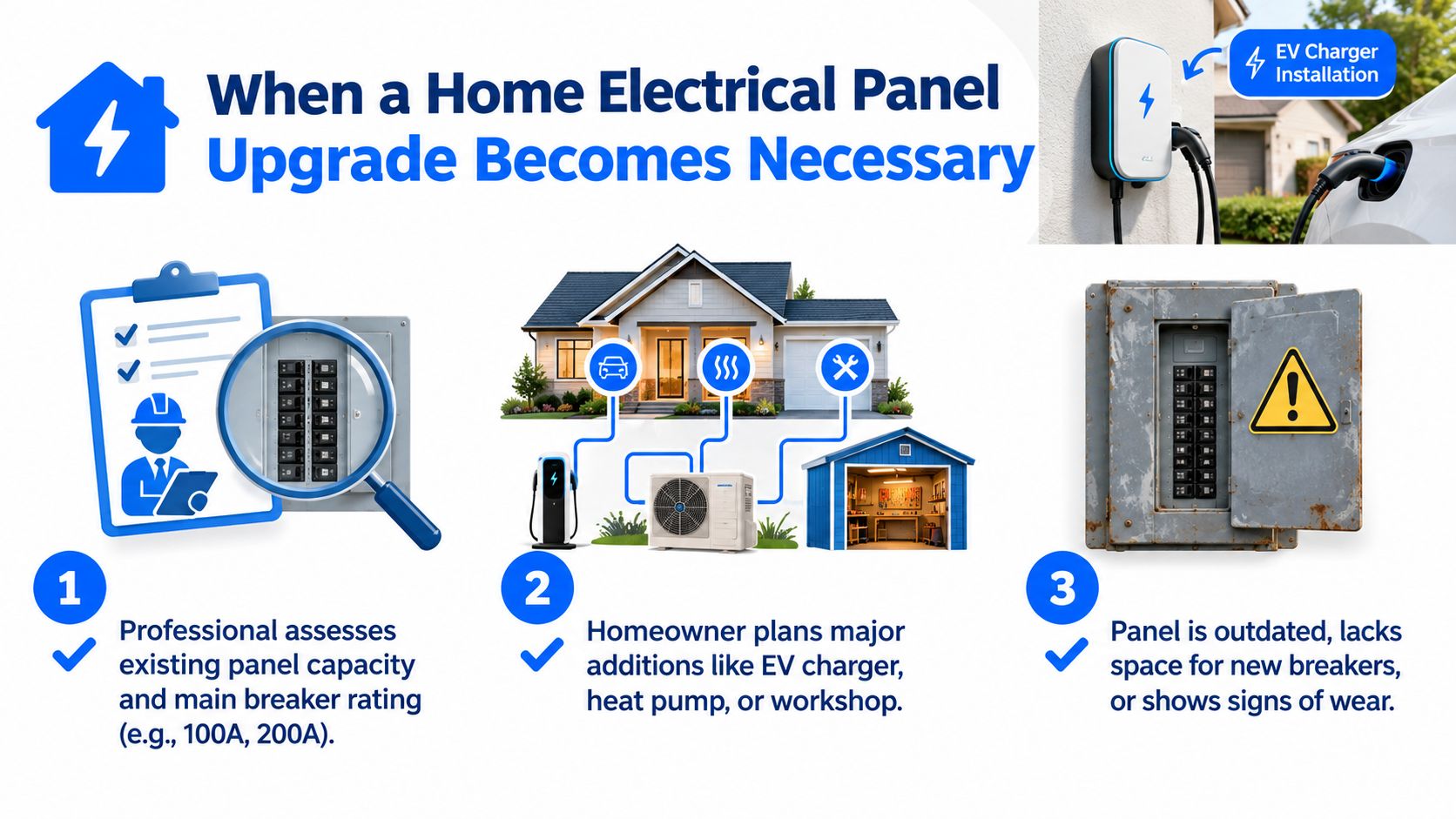
Conditions that change the recommendation
An older home with a 60 A or 100 A fuse box deserves closer evaluation before adding modern high-demand equipment. A panel associated with known safety concerns, such as Federal Pacific or Zinsco equipment, may need replacement even if the calculated load appears manageable. A crowded panel with tandem breakers, signs of overheating, or poor circuit organization also changes the risk assessment.
During an inspection, the electrician may look for:
Aluminum branch wiring: The terminations and compatibility need careful evaluation.
A warm bus bar or enclosure: Heat can indicate a loose connection, excessive loading, or damaged equipment.
Missing knockouts and open spaces: These can expose energized components or compromise the enclosure.
No readily accessible main disconnect: The service arrangement may require correction during the work.
Storm or water damage: Insurance or an inspector may require replacement before reconnection.
Practical rule: A panel assessment should begin with the main breaker and service conductors, not with a count of unused breaker slots.
The final decision comes from a numerical load calculation. Visual condition determines safety concerns and equipment suitability, while the calculated load determines whether the service rating is large enough.
How Load Calculations Decide Panel Size
NEC Article 220 treats the home as a complete electrical system. The electrician totals general lighting, required small-appliance circuits, laundry, fixed appliances, heating and cooling equipment, motors, and special loads. The result is expressed in volt-amperes, then divided by the service voltage to determine the required ampacity.
A residential calculation commonly starts with 3 VA per square foot of living area, 1,500 VA for each required small-appliance circuit, and 1,500 VA for laundry. Demand factors then reduce portions of the general load. The verified planning method provided for this project applies 100% of the first 3,000 VA and 35% of the next 117,000 VA for general lighting, while fixed equipment and special loads receive their applicable treatment. Review this explanation of residential load calculations.
What the calculation actually includes
The electrician then adds nameplate information for equipment such as an electric range, dryer, water heater, HVAC system, and EV charger. Motors and continuous loads may require additional treatment, and the calculation must account for how equipment operates rather than just adding every breaker handle together.
The following sample uses the stated methodology. It illustrates the process, not a universal result for every home.
Load Category | Calculation Method | VA Result |
|---|---|---|
General lighting | 3 VA per square foot, with applicable demand factors | Based on floor area |
Small-appliance circuits | 1,500 VA for each required circuit | Based on circuit count |
Laundry circuit | 1,500 VA | 1,500 VA |
Fixed appliances | Nameplate ratings with applicable demand treatment | Based on equipment |
HVAC and motors | Equipment rating with required demand adjustment | Based on equipment |
EV charger | Dedicated special load with continuous-load treatment | Based on charger rating |
Service sizing | Total calculated VA divided by 240 V | Required service ampacity |
A home can have several empty spaces and still fail the capacity test. Conversely, an electrician may be able to reorganize circuits, install a different listed panel, or use load management without increasing the service rating. The electrical load assessment calculation guide can help homeowners understand the information they should expect to see before approving the work.
The load calculation belongs with the permit submission where required. The authority having jurisdiction reviews the calculated demand and proposed service size, not the visual appearance of the panel.
Panel Replacement vs Full Service Upgrade
Homeowners and contractors often use panel upgrade as a catch-all phrase. That causes confusion because a like-for-like panel replacement and a service upgrade are different jobs, with different upstream equipment, scheduling requirements, and risks of change orders.
A panel swap replaces the distribution equipment while keeping the service rating the same. The meter base, service conductors, and utility connection may remain in place if they are suitable and compliant. The electrician obtains the permit, de-energizes the equipment, replaces the enclosure and interior, reconnects the existing circuits, labels the panel, and prepares it for inspection.
A full service upgrade increases the available capacity. That can require a new meter base, larger service-entrance conductors, a different main disconnect, grounding work, changes to the service mast or lateral, and coordination with the utility. The panel is only one part of the project.
Factor | Panel Swap (Same Ampacity) | Service Upgrade (100A to 200A or Higher) |
|---|---|---|
Main objective | Replace aging or damaged distribution equipment | Increase service capacity |
Upstream conductors | Usually remain if suitable | Often replaced or upsized |
Meter equipment | Usually remains | May require replacement |
Utility involvement | May be limited | Commonly required for disconnect and reconnect |
Permit scope | Panel replacement and circuit reconnection | Service equipment, conductors, grounding, and panel |
Main risk | Hidden condition inside existing equipment | Unforeseen work between utility and panel |
Cost driver | Labor, enclosure, breakers, and corrections | Conductors, meter equipment, utility work, and building repairs |
Why the quote wording matters
Independent guidance places a like-for-like replacement around $1,500 to $4,000, while a full 100 A to 200 A service upgrade can run around $3,000 to $6,500 or more when relocation or utility work is involved. See the distinction between panel replacement and service upgrade costs.
Those figures are planning ranges, not promises. A quote that calls a service upgrade a “panel replacement” can look inexpensive until the contractor discovers that the meter base or service conductors can't support the proposed rating. Ask the contractor to identify every component being replaced and state clearly whether the service rating changes.
Sizing for EV Chargers Generators and Battery Backup
Each major addition affects the Article 220 calculation differently. The service decision depends on the equipment's electrical characteristics, how continuously it operates, and what other loads can run at the same time.
EV charging deserves special attention because charging commonly continues for several hours. A 40 A EV charging load is generally treated at 125%, so the circuit and overcurrent protection must be sized above the charger's expected continuous current. Review the EV capacity planning guidance.
How the equipment changes the calculation
A heat pump adds heating or cooling demand, but the applicable calculation depends on the equipment ratings and operating assumptions. An electric range and water heater add fixed loads. A standby generator uses a transfer switch to select the source, but the electrician still has to identify which backed-up loads the system can carry.
Battery backup systems introduce their own design questions. The installation may need an inverter connection, a properly located breaker, equipment grounding, disconnecting means, and a control strategy for backed-up circuits. The panel doesn't automatically gain capacity because a battery is present.
Load | Typical Amps | NEC Treatment |
|---|---|---|
EV charger | Based on charger setting and equipment rating | Dedicated load, with continuous-load treatment |
Heat pump | Based on nameplate and installation data | Apply equipment and demand requirements |
Electric range | Based on nameplate rating | Apply residential cooking demand treatment where permitted |
Standby generator | Based on generator and backed-up load design | Transfer equipment and selected-load coordination |
Battery backup | Based on inverter and system design | Backfeed, disconnect, grounding, and operating controls |
For EV projects, the EV charger installation requirements guide is useful preparation, but the installed design still needs to match the equipment listing, local requirements, and the home's completed load calculation.
A charger, generator, or battery doesn't make the service decision by itself. The combined demand is what matters.
The best design may be a larger service, a lower charging setting, managed loads, or a dedicated backed-up-load panel. The electrician should show the options rather than assume that every project requires the same service rating.
Code Permits and Inspection Requirements
A panel upgrade must satisfy three separate requirements: electrical code, the local permitting process, and utility procedures. Article 230 covers service equipment and conductors. Article 220 supplies the load calculation supporting the proposed service size. EV charging equipment falls under Article 625, including dedicated-circuit and continuous-load rules.
The permit package should reflect the actual scope, not just the panel label. It commonly includes the documented load calculation, panel and service information, grounding details, and any associated EV, generator, or battery equipment. The authority having jurisdiction, or AHJ, reviews that proposal under its adopted process before installation or at a specified stage.
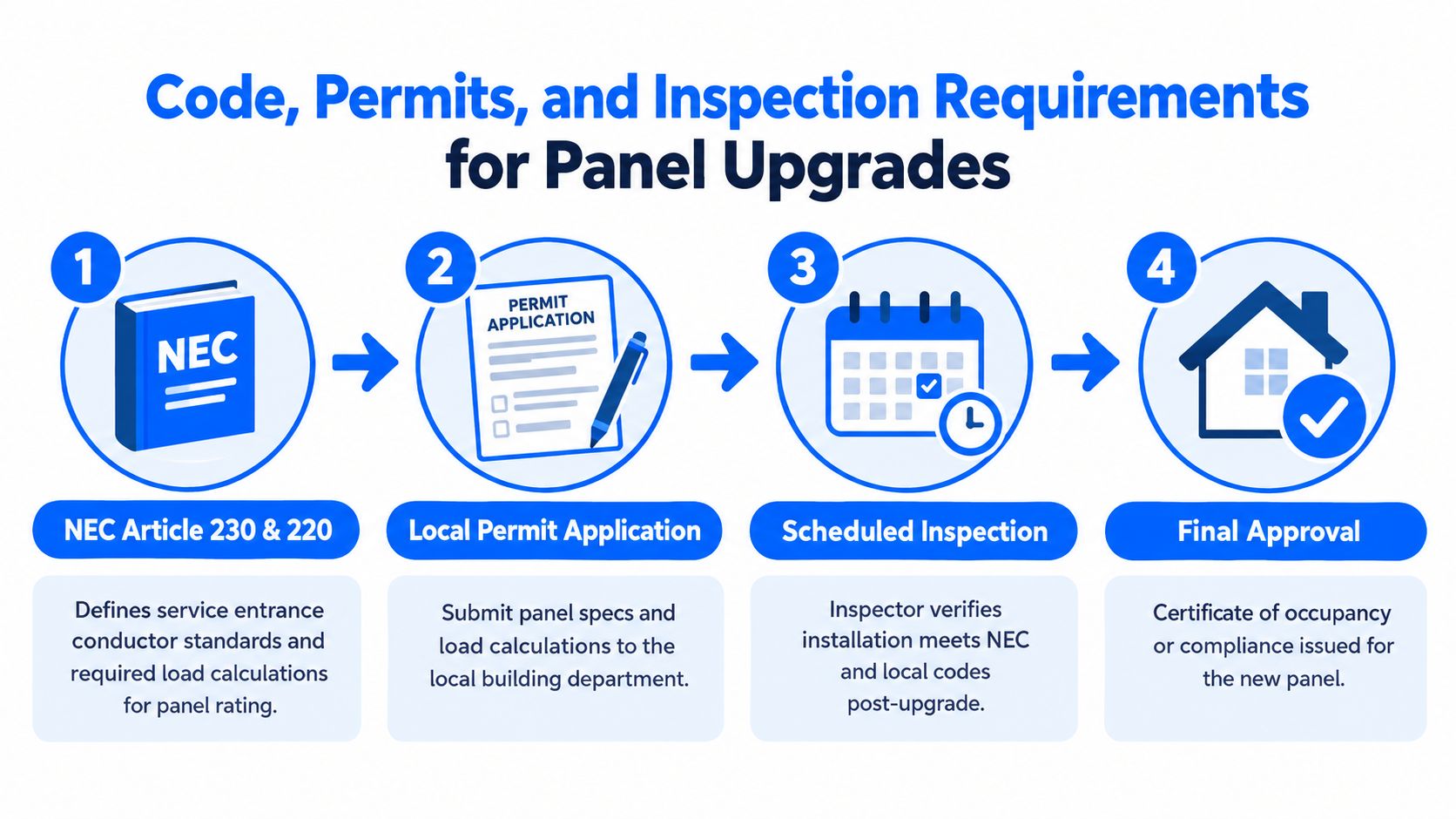
Responsibility is divided. The electrician performs the work and supplies the technical documentation. The AHJ evaluates compliance and conducts inspections. The utility handles its portion of the service, which may include disconnecting and reconnecting power, utility-controlled conductors, and meter-related changes.
Before scheduling the outage, get clear answers to these points:
Permit approval: Confirm the permit number, jurisdiction, and approved equipment information.
Utility work order: Ask whether the utility must disconnect and reconnect the service.
Rough or concealed inspection: Determine whether grounding, conductors, or equipment must be inspected before they are covered.
Final inspection: Confirm that labeling, clearances, grounding, and installed equipment will be reviewed.
Utility release: Check whether inspection approval is required before permanent service is restored.
In our Southeastern Pennsylvania projects, a separate utility work order has typically added one to three weeks after contractor permit approval. Local procedures vary, so confirm that timing with both the electrician and utility before choosing an installation date.
A Level 2 EV charger normally uses a dedicated branch circuit because it is a special load that may operate continuously. The permit documents should identify the circuit, overcurrent protection, disconnecting method, and effect on the Article 220 service calculation. A like-for-like panel swap may follow a simpler path, while a service upgrade usually adds utility coordination and additional inspection requirements.
When Load Management Avoids a Panel Upgrade
A home with an existing service may handle an EV charger without a larger panel, but only if the Article 220 load calculation supports that conclusion. Empty breaker spaces do not establish capacity. The decision depends on calculated demand, service rating, conductor limits, and how other major loads operate.
Load management can keep simultaneous demand within those limits. The system monitors competing loads and temporarily pauses selected equipment. An EV charger might reduce or stop charging while an electric range, dryer, or water heater runs, then resume automatically. A managed distribution system can coordinate several noncritical circuits without changing the service rating.
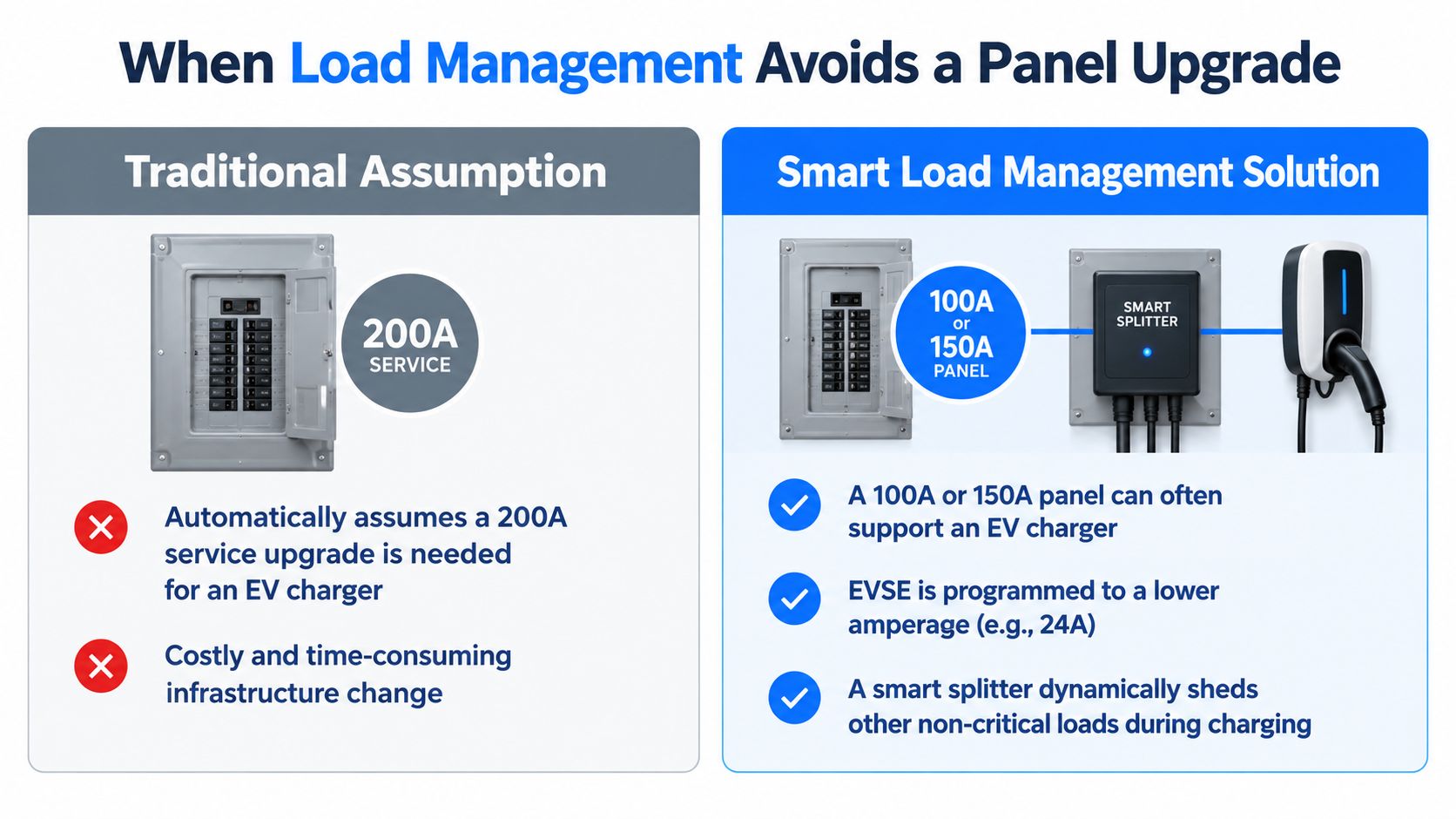
Capacity is replaced by operating rules
This approach works only when the household accepts those rules. Decide whether vehicle charging can pause, whether cooking must continue, and whether a water heater can be shed during periods of high demand. The equipment must be listed for its application and installed according to the manufacturer's instructions and local requirements.
Before approving the design, establish:
Loads that can pause: Identify equipment that may turn off temporarily without disrupting the household.
Loads that stay powered: Keep medical equipment, refrigeration, security, and other designated circuits protected.
Charging performance: A lower charging setting or interrupted cycle can extend charging time.
Calculated capacity: The managed arrangement still must satisfy applicable service and branch-circuit requirements.
Failure response: The system should fail safely instead of allowing an uncontrolled overload.
The same decision applies to backup power. A generator or battery system can serve selected circuits instead of the whole house, reducing equipment size and simplifying distribution. That can be a practical alternative when whole-home backup would require a larger service, but it also means accepting a defined list of circuits during an outage.
Load management does not excuse an undersized service. It is a controlled design that limits simultaneous demand after the calculation confirms the arrangement is permitted. If the existing service cannot support the calculated loads, a service upgrade remains necessary.
Realistic Timeline and 2026 Cost Considerations
A like-for-like panel swap can fit within one planned outage. The project calendar may still stretch because permits, inspection availability, utility coordination, material approvals, and site conditions control when work can begin. A full service upgrade usually takes longer because larger conductors, meter equipment, and utility scheduling are involved.
For budgeting, compare the scope described in the proposal rather than relying on the panel label alone. This panel box replacement cost guide provides additional context. The quote should state whether the existing service rating remains unchanged or whether the service equipment will be modified.
Scope of work | On-site work | Total calendar time | Budget reference |
|---|---|---|---|
Same-rating panel replacement | One planned outage and circuit reconnection | Depends on permit and inspection availability | Same range as above. See the cost breakdown in the panel swap versus service upgrade discussion. |
Service upgrade with larger conductors and meter work | Extended electrical installation plus utility coordination | Longer because utility scheduling is involved | Same range as above. Confirm the service-upgrade scope before comparing bids. |
Complex service or equipment changes | May include relocation, grounding, mast, lateral, or site repairs | Depends on AHJ and utility requirements | Quote required after the site assessment. |
The panel and breakers may represent only part of the invoice. Review these items before accepting a price:
Utility coordination: Confirm whether disconnect, reconnect, meter, or service requirements are included.
Service lateral work: Underground excavation or repair may be required if the connection cannot support the new service.
Meter-base repairs: Damaged equipment or unsuitable mounting can expand the work.
Grounding corrections: The grounding electrode system may need modification.
Building repairs: Siding, masonry, drywall, and weatherproofing can be affected.
Hazardous materials: Older siding or nearby materials may require special handling.
The federal tax-credit treatment also requires verification. The supplied 2026 guidance states that the panel tax credit ended for property placed in service after December 31, 2025. Older articles may therefore give homeowners an inaccurate basis for a current budget. Review the current panel-upgrade and EV guidance.
Before comparing bids, obtain the Article 220 load calculation and the utility requirements. Those documents reveal whether the quote covers a panel replacement or a true service upgrade.
Key Decisions Before You Sign the Quote
A sound proposal answers three questions before any deposit changes hands. What does the load calculation show? What equipment is included? Is this a panel swap or a service upgrade?
Require the contractor to attach the Article 220 calculation, or at least provide it before final approval. It should identify the existing calculated load and the projected load after the EV charger, heat pump, range, generator, battery, or other new equipment is added. If the proposal recommends a higher service rating without showing the calculation, ask why.
Define the physical scope
The words on the quote should match the work at the property. Confirm whether the contractor will:
Replace only the panel interior and enclosure at the existing ampacity.
Replace the meter base and service-entrance conductors.
Modify the service mast, lateral, grounding electrode system, or main disconnect.
Coordinate the utility disconnect and reconnect.
Install new breakers, surge protection, transfer equipment, or load-management hardware.
Repair siding, drywall, masonry, or weatherproofing.
A contractor who handles EV charging, battery backup, generators, and service work can evaluate those systems together. Amp'd Energy Solutions offers site assessments, EV charger installations, battery backup and Powerwall systems, whole-house generator integration, and electrical service upgrades for homes in Southeastern Pennsylvania.
Verify the paperwork and equipment
The contractor should pull the permit in the correct jurisdiction and clarify who schedules each inspection. Homeowner-pulled permits can create warranty and insurance complications, so confirm the permit arrangement in writing.
Also verify that the panel is listed for its intended use and that the breakers are compatible with that panel's listing. Mixing brands or using unapproved breakers can create inspection problems and may invalidate the equipment listing. Request the inspection schedule and utility coordination plan before installation day, especially if the service must be disconnected.
The lowest quote isn't necessarily the lowest-cost project. A cheaper bid that omits the meter base, conductors, grounding, utility work, or load calculation can become expensive once the upstream limitations appear.
If you're planning an EV charger, heat pump, generator, or battery backup, Amp'd Energy Solutions can assess the existing service, prepare the capacity plan, and explain whether you need a panel swap, a full service upgrade, or load management. Contact the team before signing a quote so the scope, permits, utility coordination, and future electrical needs are addressed together.
Comments