

Electric Generator Transfer Switch: Types and Safe Setup
The wind took the neighborhood out at 9:40 on a Tuesday night. By Wednesday morning the freezer has softened, the sump pit is filling, and there's a portable generator in the garage with a cord that very nearly reaches the dryer outlet. That last idea, feeding a generator into a receptacle that normally sends power out, is the one that gets people hurt.
A transfer switch exists so nobody has to make that choice. It isn't a heavy-duty breaker or a convenience accessory. It's the device that decides which source feeds your wiring and guarantees the other source stays disconnected while it does.
Getting it right comes down to a few decisions that have nothing to do with the number printed on the box.
Table of Contents
How a Transfer Switch Keeps Power Sources Apart
The generator is in the driveway, the panel is ten feet away, and a cord with the right plug would bridge them. What the cord can't do is stop the generator from pushing current backward through the main breaker onto the utility lines while a crew works a few blocks away. Current flowing the wrong way up the service drop is called backfeed, and it's the reason an electric generator transfer switch is classified as a safety device before it's anything else.
Think of a railway switch. One set of tracks splits two ways, and the switch sends the train down one branch or the other. It can't send it down both, and there's no lever position where two trains arrive in the same block head-on. A transfer switch is that switch, with the utility on one branch and the generator on the other.
The hardware looks like this when it's done properly, with the inlet outside and the switch doing the deciding.
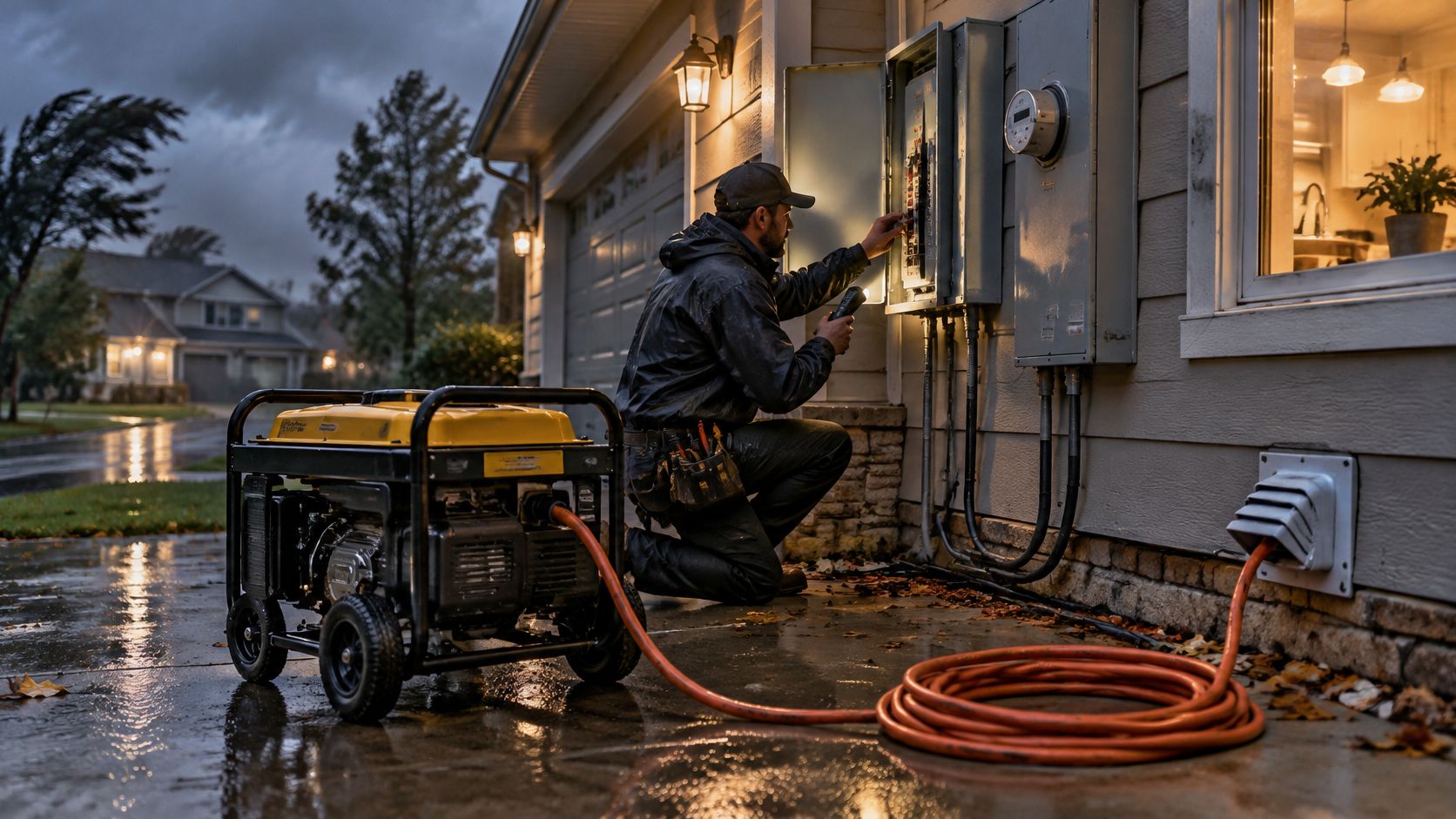
The rule that governs everything else: the utility and the generator must never be able to touch the same circuit at the same time.
What the code actually requires
Physically, the switch sits between the main panel and the generator inlet on the outside wall. A manual unit has a handle. An automatic unit has a controller and a motor operator. In both, a mechanical or electrical interlock blocks the second source from closing while the first one is closed, and that interlock is the whole point of the product.
The National Electrical Code treats this as a design requirement rather than an operating instruction. Transfer equipment has to be listed, suitable for the intended use, and built so the sources cannot be inadvertently interconnected during operation. The effect is that nobody has to remember a sequence under stress, because the equipment makes the wrong sequence impossible.
A generator inlet wired to a breaker with no interlock doesn't meet that bar. It looks like a transfer switch and it costs less, but with both breakers closed the two sources energize the same bus and nothing in the hardware prevents it.
Three decisions shape everything downstream: which circuits transfer, whether the switch operates by hand or on its own, and how it handles the instant of transfer. Each one changes the equipment, the labor and the price.
Automatic Versus Manual Transfer Switches Compared
A power failure at 2 a.m. sorts the two designs quickly. One waits for someone to get up, find a flashlight and move a handle. The other has already sensed the voltage drop, started the generator and transferred the load before anyone wakes. Everything else about the choice follows from who operates the switch.
A manual unit is the simpler machine. With the utility dead, a person walks to the switch, moves the handle from utility to generator, and the selected circuits come back on. Fewer parts means a lower price: listed residential manual models typically run a few hundred dollars, and the simpler mechanism also means less to maintain. The trade for that price is a human step in a sequence that always happens in the dark, usually in bad weather, sometimes when nobody is home at all.
An automatic unit runs the same operation without a person. A controller watches the incoming utility voltage, starts the generator when that voltage collapses, waits for the engine to reach speed and the output to stabilize, then closes the transfer contacts. That waiting period matters. Closing onto a generator that is still ramping up feeds the house unstable power, so the controller holds off until the output is clean. The generator and the switch also have to be wired to communicate, which is why the two are usually specified together; a standby generator installed without that control wiring is only half a system.
Feature | Manual transfer switch | Automatic transfer switch |
|---|---|---|
Operation | Person moves the switch after the power fails | Senses the outage, starts the generator and transfers on its own |
Typical equipment price | Lower; listed residential models run a few hundred dollars | Higher, and usually quoted together with the standby generator |
Response during outage | Waits until someone is present to act | Transfers on its own within seconds once the generator stabilizes |
Best fit | Occasional outages, someone usually home, tighter budget | Frequent outages, unattended property, refrigeration or medical needs |
Interlock | Required to block the second source | Built in to prevent both sources connecting |
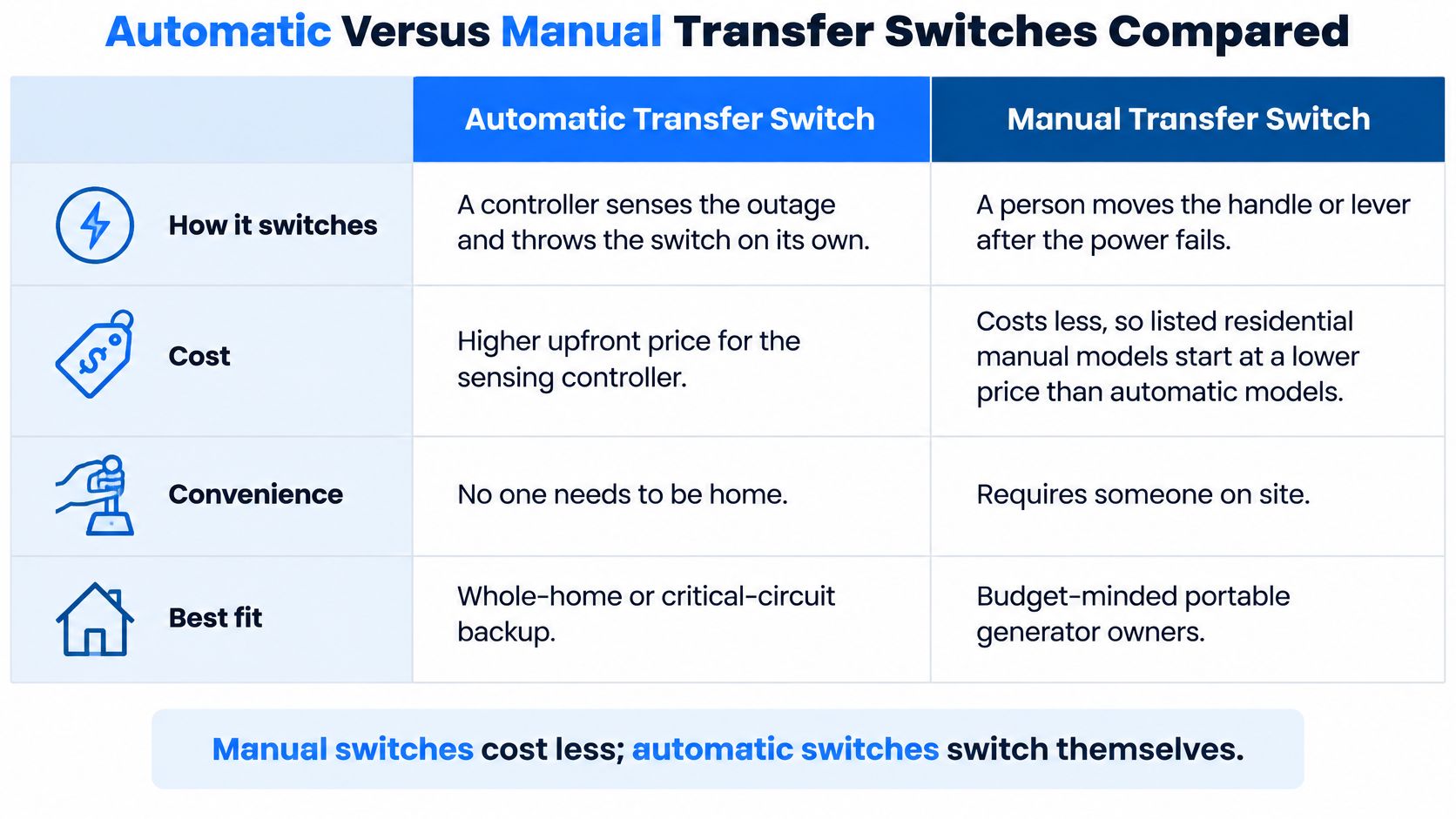
Choosing an automatic switch does not commit the house to full coverage. Both types can serve a selected set of circuits, and pairing automatic operation with a partial-home setup often avoids the service upgrade a larger switch would demand. Automation buys unattended response; circuit coverage is a separate decision.
The safety question lands the same way in both columns. A manual switch blocks the second source as firmly as an automatic one. What the extra money buys is the sequence happening without a person standing at the panel.
Four questions settle the choice faster than a spec sheet:
How often does the power fail? Two short outages a year points at manual. A week of storm interruptions every winter argues for automatic.
Is anyone home at night? An unattended house, a rental property or a business closed on weekends stays dark until someone drives over.
Which loads cannot stop? A sump pump, medical equipment or a full refrigerator raises the stakes in a way lighting and outlets don't.
Does the budget cover labor as well as the box? The switch is one line on the invoice; wiring, permit and inspection are others.
Open and Closed Transition Explained
Transition is the moment the switch moves, and it is where the two designs part company.
Transition type | Switching sequence | Power interruption | Best for |
|---|---|---|---|
Open transition | Break before make: utility disconnects first | Brief interruption, typically under 100 milliseconds | Motors, lighting, ordinary residential loads |
Closed transition | Make before break: generator connects before utility opens | Near-continuous power with a momentary parallel | Sensitive controls, communications, medical or process loads |
Open transition is break before make. The utility connection opens, the load goes dark for an instant, and the generator connection closes. The move works like an ordinary light switch: off comes before on. A white paper on transfer switch transition and load coordination puts that gap typically under 100 milliseconds, and the same paper sets the required supply windows at 10 seconds for emergency loads and 60 seconds for legally required loads.
Motors coast through a gap that short. Lights flicker. A computer on a UPS never notices. A modem, a programmable thermostat or a variable-speed furnace control may reboot, and a contactor holding a motor starter in can drop out and have to be pulled back in.
Closed transition runs the other way: make before break. The generator connects while the utility is still connected, so the load sees almost no gap, and for a moment the two sources run in parallel. A relay-race handoff is the right picture, with the receiver already moving before the passer lets go. That momentary parallel is exactly what an open-transition switch exists to prevent, so closed-transition gear needs monitored source parameters, synchronization and utility interconnection approval. Closed transition trades a near-zero gap for a brief parallel with the utility, and the approval requirement follows from that.
Switch speed alone doesn't decide whether a backup system meets those supply windows. Hitting either one depends on the whole chain cooperating: voltage and frequency sensing, engine start and warm-up, contact transfer, then delayed loads returning in stages. A fast switch bolted to a slow start sequence still misses.
Default recommendation: specify open transition for a house or a small shop. Reach for closed transition only when an interruption measured in milliseconds breaks something.
For communications gear, medical devices or process controls where a reboot costs real money, the practical choice is usually a closed-transition switch, a small UPS on the sensitive loads, or both. The backup-source comparison later in this guide weighs where a UPS earns its place.
Matching the Switch to Your Service and Loads
Amperage is the first number everyone compares and the least informative one on its own. A transfer switch works like a traffic cop for electricity: it decides which loads get served and keeps the utility and the generator from ever meeting. What it has to match is the scope of what you are backing up.
Scope | What transfers | Service requirement | Typical use |
|---|---|---|---|
Whole-house switch | Entire service | Matched to utility service rating | Full backup of large loads including HVAC and EV charging |
Backed-up-loads panel | Selected circuits chosen in advance | Lower-rated, with connected loads limited by design | Refrigerator, lights, outlets, furnace controls |
Load-management system | Selected loads shed or cycled during outage | No service upgrade needed when the design sheds the high-demand loads | Avoiding a service upgrade when heat or EV charging is high |
A whole-house switch carries the entire service, so it must be rated for service-equipment duty and matched to the utility service it sits ahead of. A backed-up-loads panel carries a list of circuits you picked in advance, and it can be a lower-rated unit because the design limits what is connected to it. A load-management system takes that idea further: it sheds the heavy loads automatically during an outage, so the generator and the switch stay modest even in a large house.
The questions that set the size
Which loads transfer? Write the list by room before you shop. A panel schedule beats a guess.
Does the generator start large motors? A compressor or a well pump can pull several times its running current for a second or two, and that starting surge sizes the generator.
Is the neutral switched or solid? A switched-neutral switch and a solid-neutral switch aren't interchangeable, and the choice has to match the generator and the grounding scheme.
Can EV charging or electric resistance heat stay on? If a heat pump, baseboard heat and a Level 2 charger all stay enabled during an outage, the generator has to carry all of it.
Sizing mistakes usually begin with compatibility, not capacity. A whole-home system generally needs transfer equipment matched to the utility service rating, while a lower-rated switch suits selected circuits only when the design limits connected loads and protects the equipment. Anything installed on the service side has to be rated for that duty and built so the two sources cannot be connected at once.
Safety regulators approach the same point from the user side. OSHA requires an approved transfer switch, installed per the manufacturer's instructions by a qualified person, whenever a portable generator supplies a building. That is the floor, not the ceiling.
Start by counting the load, because a room-by-room electrical load assessment calculation decides everything that follows.
Here is the part that surprises homeowners: the largest switch is rarely the best value. A carefully managed partial-home backup can keep refrigeration, heating controls and medical equipment running without a service upgrade, and a load-management system can shed the heat pump or the EV charger for the duration of an outage so the generator never has to carry them. Matching the switch to the loads you need costs less than matching it to the number stamped on the meter base.
Installing and Verifying a Transfer Switch Safely
A transfer switch can be sized perfectly and still be installed wrong. The order below keeps the paperwork and the hardware in agreement.
Record five numbers before buying anything. Generator output, service rating, available fault current, neutral requirement, and the exact circuits to be transferred. Those five set the equipment, and skipping them is how a switch gets bought twice.
Match the short-circuit current rating, not just the amps. Transfer equipment has to withstand the maximum available fault current at its terminals, so the switch's rating is checked against the service fault-current calculation rather than selected by continuous ampere rating alone, as Hamden, Connecticut's generator requirements for standby and manual systems explains.
Confirm the interlock, then confirm it again. NEC 702.5 requires transfer equipment to be listed, suitable for the intended use, and installed so all sources cannot be inadvertently interconnected during operation. A mechanically or electrically interlocked mechanism works like a doorway only one source can pass through at a time. An inlet plus a breaker does not satisfy that rule.
Pull the permit. Local rules and the utility's interconnection requirements apply to anything that touches the service, and an inspection record is worth having years later when the house sells.
Have a licensed electrician do the wiring. Equipment on the supply side of the service disconnect must be listed for service use, and that listing drives the enclosure, bonding and overcurrent protection. Our electricians are licensed.
Keep the documents with the panel. The equipment listing, the fault-current calculation and the permit belong in an envelope inside the panel cover, not in a truck.
Test it under a simulated outage. Time how long each load takes to return and confirm the reconnect order matches the design, rather than assuming it does.
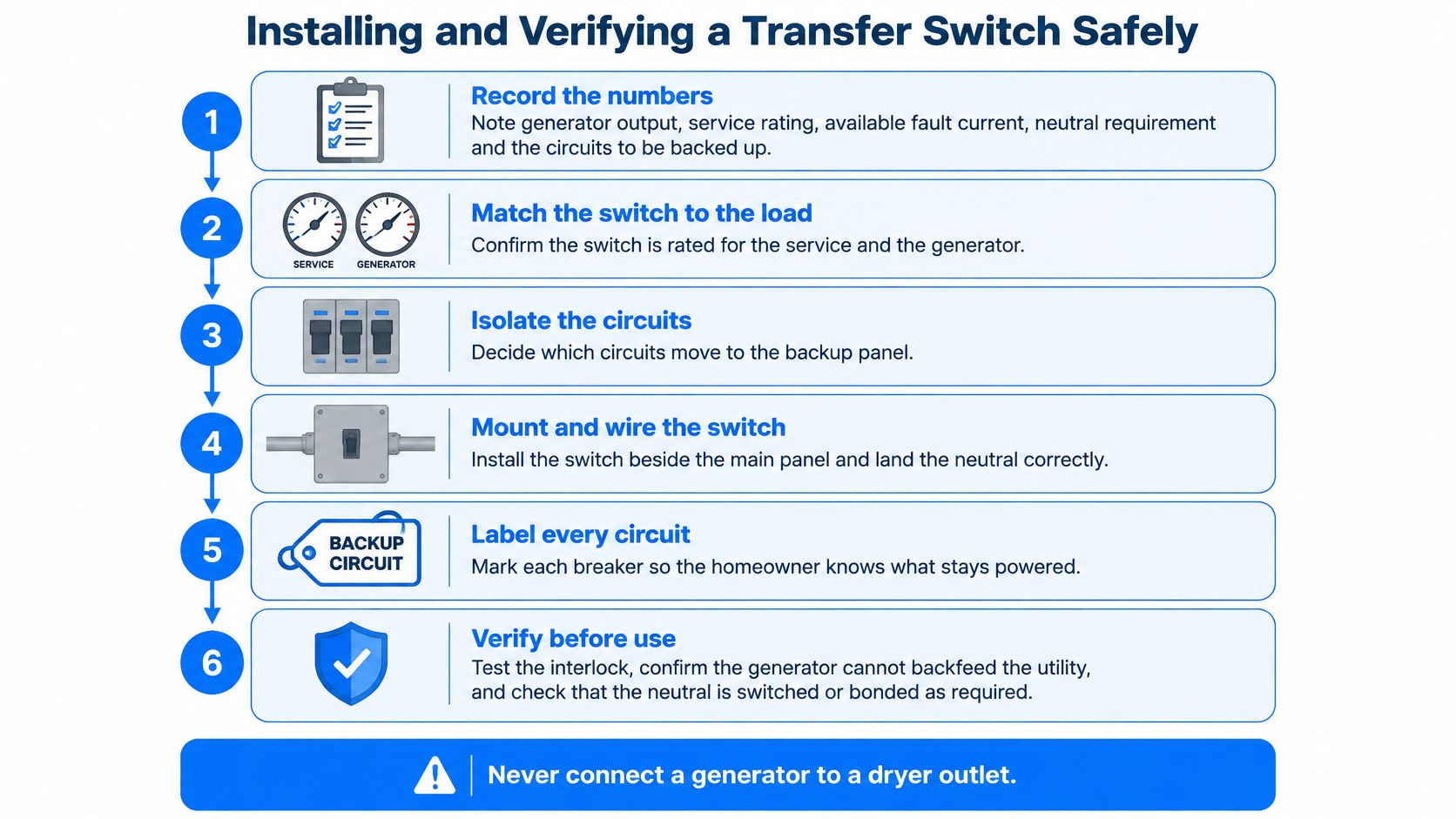
Verification earns its keep after the last screw is tightened. Delayed-load settings should stagger air conditioner and heat pump starts so they don't all hit the generator at once. In a hybrid system, confirm which source takes priority and that the controller honors it. Note what happens when utility power returns, since retransfer is its own timed sequence and a load that struggles on the way out will struggle again on the way back. Keep the generator fuelled and serviced, because a transfer switch attached to a dead generator is a well-wired disappointment.
Ask in writing: the fault-current calculation, the listing that applies to the switch, and the interlock detail. An installer who can produce all three has done the job properly.
The inlet belongs to the same chain. A generator inlet box installation done to the same standard keeps the outside half of the system as sound as the inside half. We size and install whole-house generator systems, and when a service upgrade enters the conversation we assess the existing setup and lay out panel upgrade versus full service replacement rather than assuming the bigger service is the right answer. Get those pieces right and the switch spends its whole service life doing one quiet job: keeping two sources apart while it feeds the loads it was given.
Generator, Battery and Hybrid Backup Compared
A refrigerator, a sump pump, a cold-climate heat pump and a home office where two people work: that is the load list on a typical Southeastern Pennsylvania panel schedule. When the grid drops, the question isn't whether the house has backup. It's which architecture is doing the backing up.
A generator transfer switch is one answer among several, and it gets installed by default because it is familiar. That default deserves a second look, because stored energy now covers essential loads in many homes and a generator and a battery answer different questions. The right choice depends on outage length and load, not on which technology arrived first.
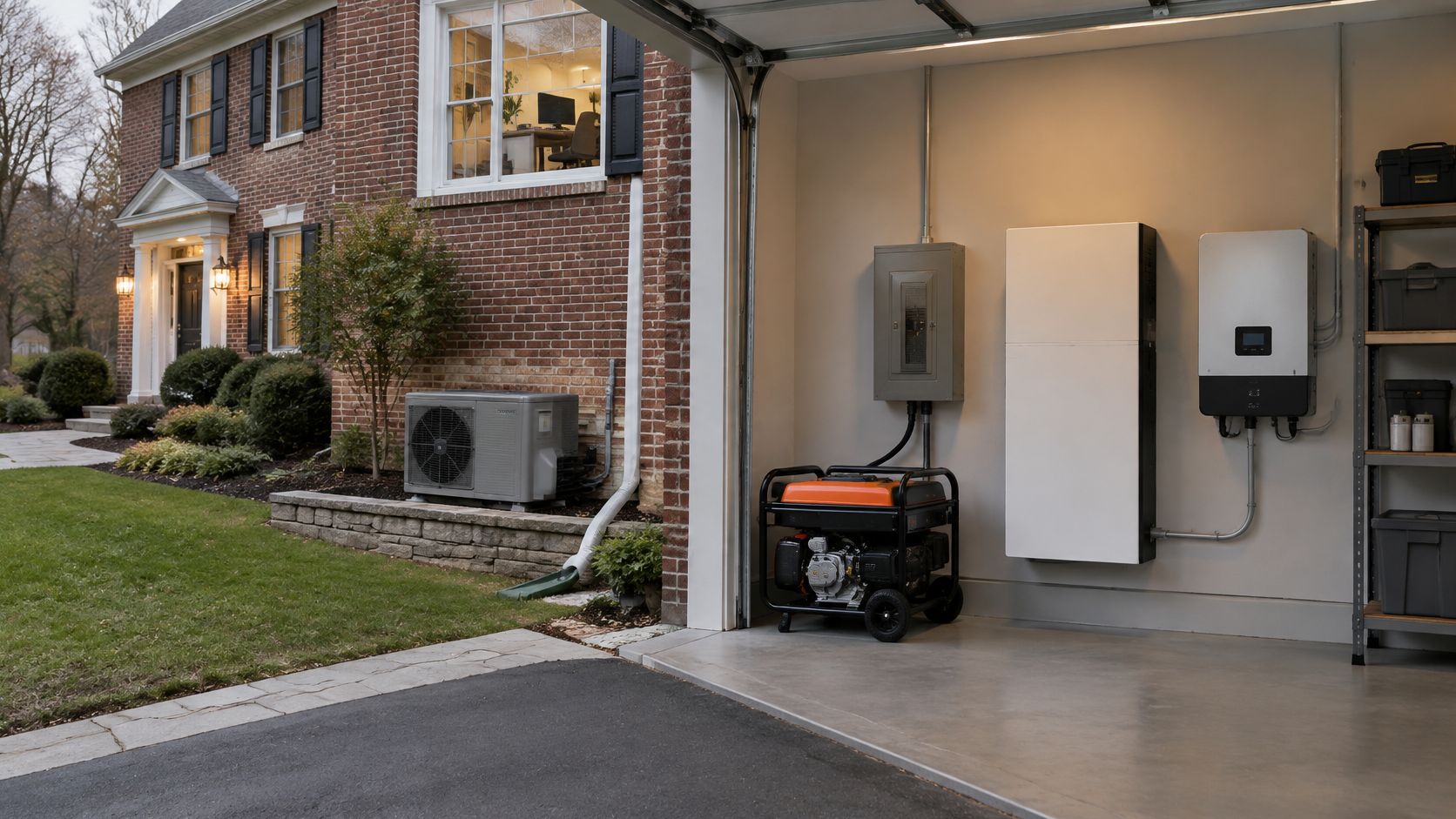
Where each design earns its place
Generator only handles long outages and heavy loads, and it keeps going as long as fuel arrives. The trade is fuel storage, oil changes, exercise runs and an interlocked switch that has to be right.
Battery only is quiet, fume-free and has no startup delay. It pairs naturally with existing solar, and it also works with ordinary utility service for homes without panels, charging from the grid so it is ready when the grid fails. Most systems offer app monitoring of stored energy and load. What a battery can't do is outlast its stored energy, so a multi-day outage with a heat pump running is a different conversation than an eight-hour one.
Hybrid uses both and forces a decision the other two avoid: which source takes priority when the battery is low and the generator is running. Get that priority wrong and the battery recharges off the generator all night while the house runs on the engine.
The edge cases are where these systems surprise people. Transfer equipment has to be compatible with inverter output, not just with a rotating generator, and the inverter's behavior during a transfer matters. Solar often has to be curtailed while a generator runs, so the panels sit idle during exactly the outage when their output feels most valuable. And as the transition section covered, electronics that reboot across a millisecond transfer gap still need an uninterruptible power supply downstream, whichever architecture feeds the house. If you're weighing the two paths directly, this comparison of battery backup versus generator walks through the trade-offs load by load.
The priority question cuts through all of it: which loads must stay on, for how long, and from which source? Answer that in writing and the equipment choice stops being a preference.
Amp'd Energy Solutions is a family-owned electrical contractor serving homes and businesses across Southeastern Pennsylvania, and we handle the whole chain: generator sizing, transfer equipment matched to your service and fault current, panel and service upgrades when the numbers call for one, and Tesla Powerwall installation when stored energy suits a house better than fuel. We'll walk your panel schedule and your outage history with you and say plainly which loads you can back up and which ones aren't worth carrying. Visit Amp'd Energy Solutions to book an assessment before the next storm rather than during it.
Comments