

Most Quiet Whole House Generator: Top Picks for 2026
A whole-house unit rated at or below 65 dBA at 23 feet under normal load, with exercise mode near 55 dBA, is generally quieter than many conventional residential standby generators. That specification is a practical starting point, not proof that the generator will satisfy the noise rules on your property.
The popular advice is to find the lowest number in a product comparison and buy that model. For homeowners in Southeastern Pennsylvania, that approach skips the measurement that may matter most: the sound level at the property line, under the operating conditions your neighbors will experience.
A generator can carry an attractive catalog rating yet sound louder beside a masonry wall, in a narrow side yard, or near a bedroom window. The right question isn't which system is marketed as the most quiet whole house generator. It's which backup system can deliver the required electrical capacity while remaining acceptable at your lot lines, during normal operation and overnight exercise.
Table of Contents
Why the Lowest Decibel Rating May Not Make It the Quietest Choice - The property line is the practical test - Why the usual rankings fall short
How Generator Noise Is Measured and Why Results Vary - A more useful comparison table - Ask for the conditions behind the number
The Hidden Factors That Change Real-World Generator Noise - Placement can defeat a good specification - Nighttime operation deserves separate attention
How to Verify Generator Compliance With Your Local Noise Ordinance - Use a property-line verification sequence - Separate measurement from perception
What Quiet Means When Whole-Home Capacity Matters - Design around real outage loads - Whole-home coverage isn't one fixed design
Battery Integration and Load Management as Noise Reduction Solutions - Shift peaks instead of chasing a marginal rating - Compare complete systems
Why the Lowest Decibel Rating May Not Make It the Quietest Choice
The lowest advertised dBA figure doesn't automatically identify the quietest compliant installation. Manufacturers may publish sound pressure at a particular distance, under a particular load, or during a reduced-speed exercise cycle. Those conditions can produce a number that doesn't describe the sound heard during a prolonged outage with heating, cooling, pumps, and household circuits operating.
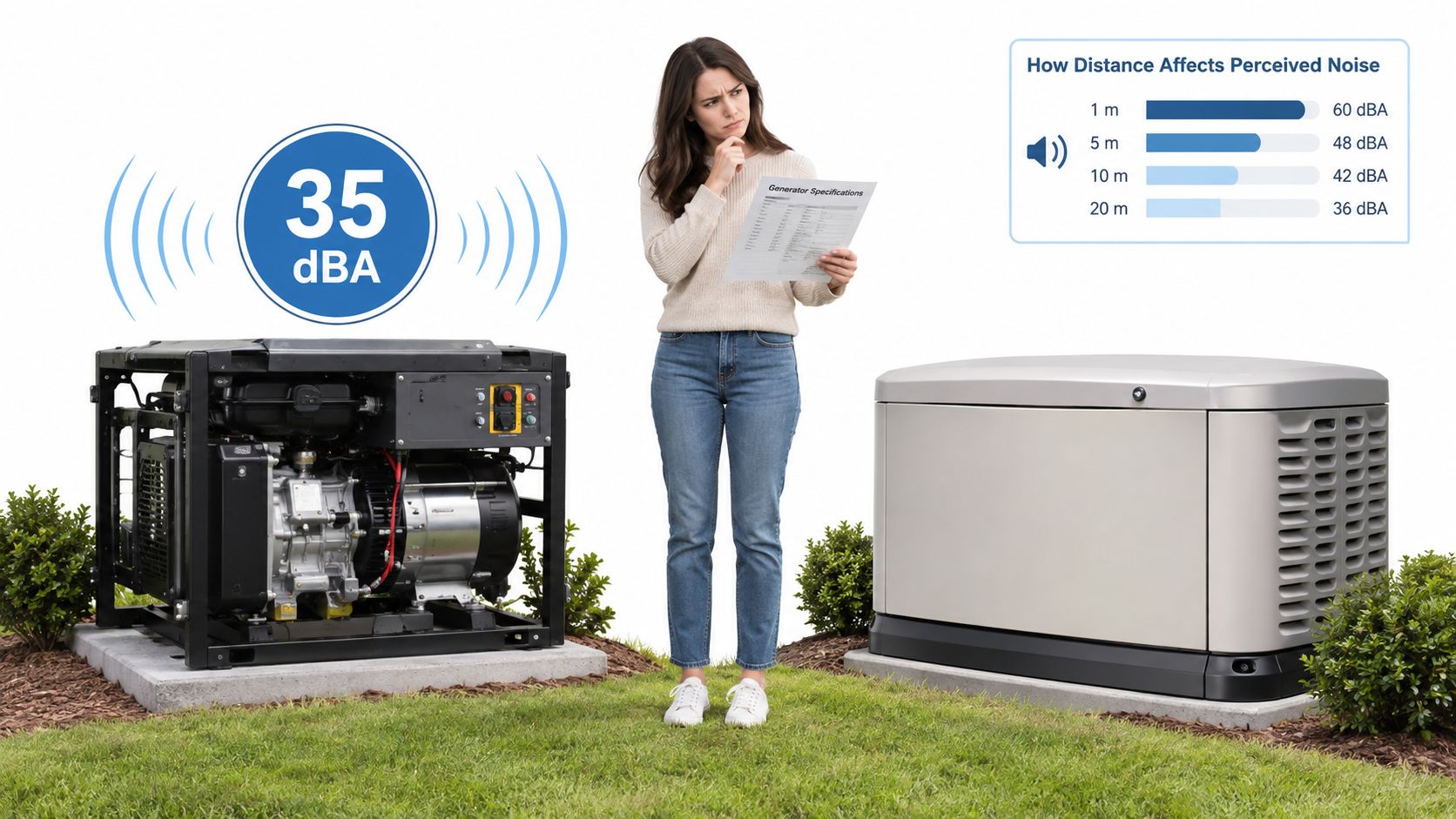
Published coverage indicates that enclosed residential standby generators commonly produce approximately 62 to 70 dBA at 23 feet, while municipal residential limits may range from roughly 50 to 65 dBA during the day and 45 to 55 dBA at night. Those ranges come from available guidance on quiet whole-house generators and local noise limits. A unit that appears acceptable at the test distance may still create a problem at a nearby property line.
The property line is the practical test
Many homeowners compare sound beside the generator. Municipal rules may instead evaluate sound where one parcel meets another, sometimes with different limits for daytime and nighttime. Distance, walls, fences, corners, elevation, and the existing ambient sound environment can all change the reading without changing the generator's published rating.
That makes compliance a site question. A unit rated at 65 dBA at 23 feet isn't automatically 65 dBA at your neighbor's bedroom-facing property line, and a rating measured during exercise mode doesn't establish performance while the engine is carrying a substantial load.
Practical rule: Treat every catalog dBA number as incomplete until you know the distance, load, operating mode, and measurement location.
Why the usual rankings fall short
Product rankings are useful for identifying candidates, but they rarely answer whether a specific township or borough will accept the proposed installation. They also tend to place normal operation and exercise mode beside each other as though both represent the same homeowner experience. They don't.
Normal operation determines what neighbors may hear during an outage. Exercise mode matters because scheduled testing can occur when the surrounding environment is quiet. Before choosing a model, review the local ordinance, ask for the manufacturer's operating-condition data, and assess whether the proposed location gives sound enough room to dissipate.
Noise is also one reason installation quality matters after the purchase. A maintenance plan can help prevent loose panels, deteriorated mounts, or other conditions that make an otherwise acceptable generator sound harsher over time. Homeowners should review whole-house generator maintenance requirements as part of the selection process, not after the first complaint.
How Generator Noise Is Measured and Why Results Vary
A decibel figure has meaning only when its measurement conditions are clear. Sound pressure level describes what a microphone receives at a particular location. Sound power level describes the acoustic energy emitted by the equipment under a defined method. These are related, but they aren't interchangeable specifications.
ISO 8528-10 provides a more rigorous framework for measuring airborne noise from engine-driven generating sets, including sound-power level and emission sound-pressure level. Residential generator manufacturers don't always present their figures with identical test conditions, so two numbers that look directly comparable may not describe equivalent tests.
A more useful comparison table
The following published comparison illustrates why operating mode must appear beside the rating. The figures are approximate, and the measurement distance shown is the same where stated.
Generator Size | Normal Operation | 50% Load | Exercise Mode | Measurement Distance |
|---|---|---|---|---|
26 to 28 kW unit | Approximately 67 dBA | Not published in the comparison | Approximately 55 dBA | 23 feet |
20 kW model | Approximately 66 dBA | Not published in the comparison | Not published in the comparison | 23 feet |
Air-cooled residential units | Approximately 65 dBA | Not published in the comparison | Not published in the comparison | 23 feet |
These figures come from the published residential standby-generator comparison. The missing 50%-load values are important. A manufacturer that publishes only a quiet exercise figure gives the homeowner no reliable way to judge sustained outage operation at a moderate electrical demand.
Ask for the conditions behind the number
Request three values before comparing models:
Normal-load sound pressure: This is the most relevant figure for a generator carrying the home's active outage demand.
50%-load sound pressure: This helps reveal how the engine behaves during a more typical partial-load period.
Exercise-mode sound pressure: This matters for scheduled testing, especially in quiet evening or early-morning conditions.
Also confirm whether the figure is measured at 23 feet, 7 meters, or another distance. A rating at 23 feet cannot be treated as equivalent to the same number recorded much closer to the enclosure.
Load changes engine speed, cooling demand, and fuel consumption. Enclosure design changes how mechanical noise and airflow escape. The test method changes how the result is recorded. A careful buyer therefore compares a complete operating profile, not one isolated dBA value.
The Hidden Factors That Change Real-World Generator Noise
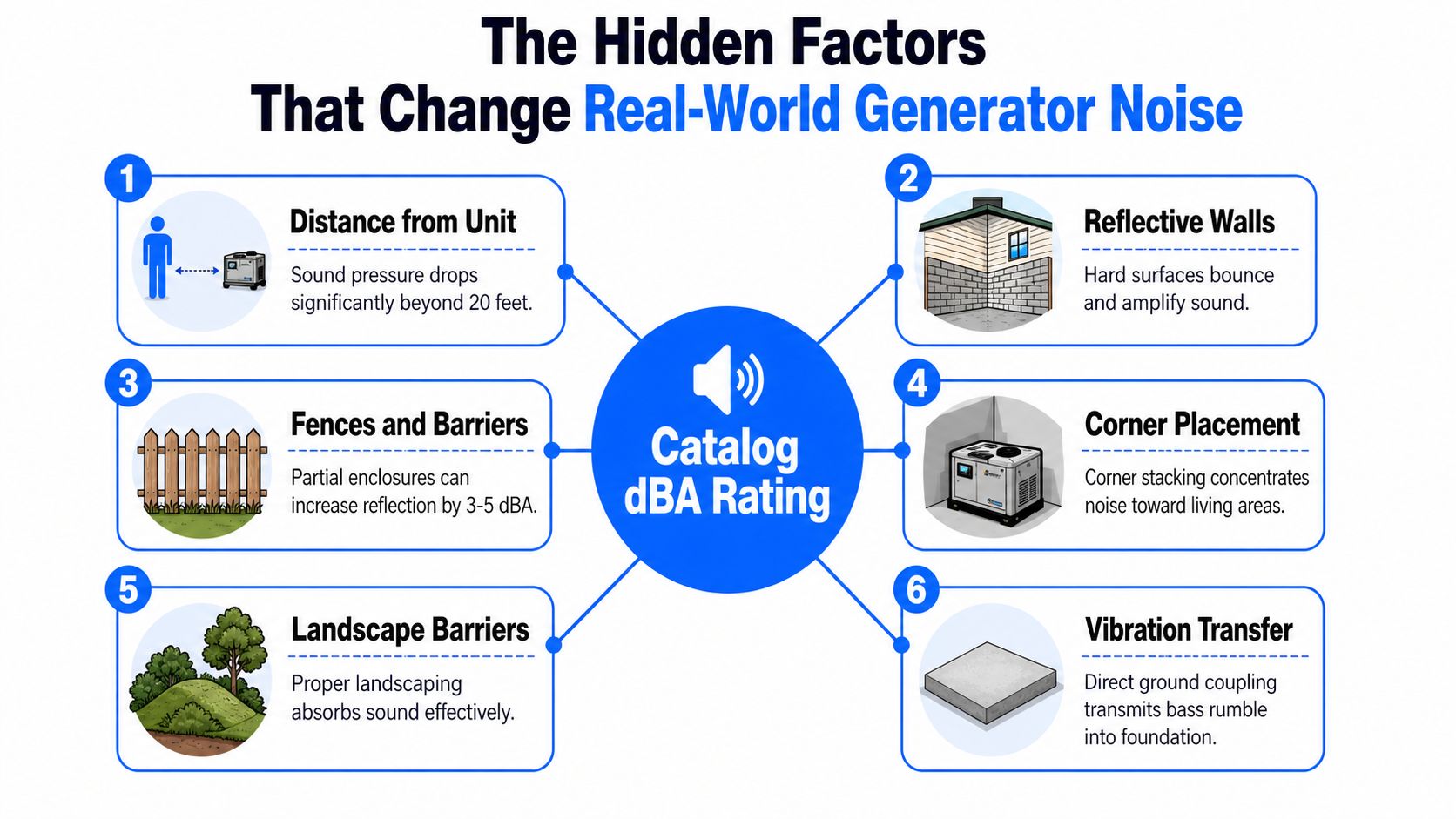
A catalog rating describes a controlled test. Your property contains walls, fences, windows, pavement, landscaping, and neighboring buildings that can redirect sound toward people. The generator's rating may remain unchanged while the perceived noise at a bedroom or property line changes substantially.
Distance is one variable, but it isn't the only one. Sound pressure generally decreases as the listener moves farther away, while reflective surfaces can redirect energy into areas that weren't part of the manufacturer's test setup.
Placement can defeat a good specification
A generator installed in an open location may be less disruptive than a quieter-rated unit placed in a narrow corridor between hard surfaces. Walls and fences can reflect sound. Corners can concentrate it toward the home. Elevation differences can change the line of sight between the enclosure and a neighboring property.
Vibration creates a different problem. The engine can transmit low-frequency rumble through the mounting pad and surrounding ground. That sound may be more noticeable indoors than the published airborne rating suggests, particularly when the unit shares a foundation wall or sits close to a living space.
Installation decisions should therefore address:
Orientation: Direct the engine and exhaust side away from bedrooms, patios, windows, and adjacent property lines while preserving required safety clearances.
Clearance: Use the manufacturer's required spacing. A barrier that blocks airflow or traps heat isn't a safe acoustic solution.
Mounting: Use an appropriate pad and vibration-isolation approach rather than allowing the unit to couple unnecessarily with the structure.
Surface conditions: Account for masonry, siding, retaining walls, fences, and other hard surfaces that can reflect sound.
Nighttime operation deserves separate attention
Residential backup-generator guidance uses approximately 55 dBA during the day and 45 dBA at night, as described in the noise pre-consultation guidance. The nighttime figure may matter more than homeowners expect because a long outage can require continuous operation overnight, when ambient sound is lower and neighbors are more sensitive to mechanical noise.
For a Southeastern Pennsylvania installation, a sensible screening target is a documented normal-operation rating below roughly 65 dBA at 23 feet, paired with an exercise-mode value near or below the mid-50-dBA range. That target doesn't replace the local ordinance. It helps remove candidates that are unlikely to perform well before you spend time on a site review.
How to Verify Generator Compliance With Your Local Noise Ordinance
A quiet generator passes local review only when the proposed installation satisfies the rules that apply to the property. Municipal limits can depend on the municipality, zoning district, time of day, and measurement method. An HOA may add its own approval process, but it can't be treated as a substitute for municipal requirements.
The most reliable approach is to treat the installation like an engineering check. Gather the equipment data, map the site, and compare equivalent measurements.
Use a property-line verification sequence
Identify the controlling authority. Find the noise, zoning, building, and generator provisions for the applicable township or borough. Confirm whether the ordinance uses a property-line measurement and whether daytime and nighttime limits differ.
Measure the proposed location. Determine the distance from the generator enclosure to the nearest property line, then note windows, walls, fences, corners, raised grades, and outdoor living areas between the unit and the neighboring parcel.
Match the manufacturer's test condition. Record the published distance, load, operating mode, and whether the figure describes sound pressure or sound power. Don't compare a 23-foot normal-load result with a close-range exercise result.
Evaluate the worst credible operating condition. Consider the loads that may run during an outage, such as heating or cooling equipment, pumps, refrigeration, and charging equipment. A reduced-speed exercise number can't establish normal outage compliance.
Ask how the authority measures sound. The ordinance may specify a location, time, meter setting, or method. If the language is unclear, ask the municipality or have the installer coordinate the review before ordering equipment.
Document the proposed layout. Keep the site plan, manufacturer's data sheet, clearance drawings, and any HOA submission together. This gives the reviewer a traceable explanation rather than a marketing claim.
Separate measurement from perception
A 3-dB reduction is measurable, but it doesn't mean people will experience the generator as “twice as quiet.” Decibels use a logarithmic scale, while human response also depends on frequency, duration, background sound, and the character of the noise.
A steady low hum may be less objectionable than intermittent rattling, even when a meter doesn't capture the difference in the way a neighbor experiences it. Conversely, a modestly lower reading won't solve a placement problem if reflected sound points directly at a bedroom.
The right compliance question is not “What is the lowest published dBA?” It is “What level is likely to reach the nearest property line under the operating condition that matters?”
If the model's documentation omits normal-load or property-relevant information, treat that omission as a selection risk. Ask the installer to obtain the missing data or choose a system whose operating profile can be evaluated before permitting.
What Quiet Means When Whole-Home Capacity Matters
Quiet operation has no value if the generator can't start the loads your home depends on. A system that handles only refrigerators, lighting, internet equipment, and selected outlets faces a different design problem from one expected to start a heat pump, well pump, sump pump, electric water heater, or EV charger.
The most quiet whole house generator is therefore not necessarily the unit with the lowest isolated rating. It may be the system that supplies adequate surge capacity, avoids nuisance shutdowns, and operates without being pushed continuously toward its limits.
Design around real outage loads
Start with the equipment that creates the hardest electrical demand, not just the appliances that consume energy continuously. Motor-driven equipment can impose a starting surge. HVAC systems may dominate the calculation. EV charging can add a large sustained load, while a sump pump may need to start precisely when other equipment is operating.
A qualified load calculation should distinguish:
Continuous demand, such as refrigeration, lighting, networking, and control systems.
Starting demand, especially from pumps, compressors, and HVAC equipment.
Selectable demand, including EV charging, electric resistance heat, and discretionary appliances.
Priority demand, which must remain available during an outage.
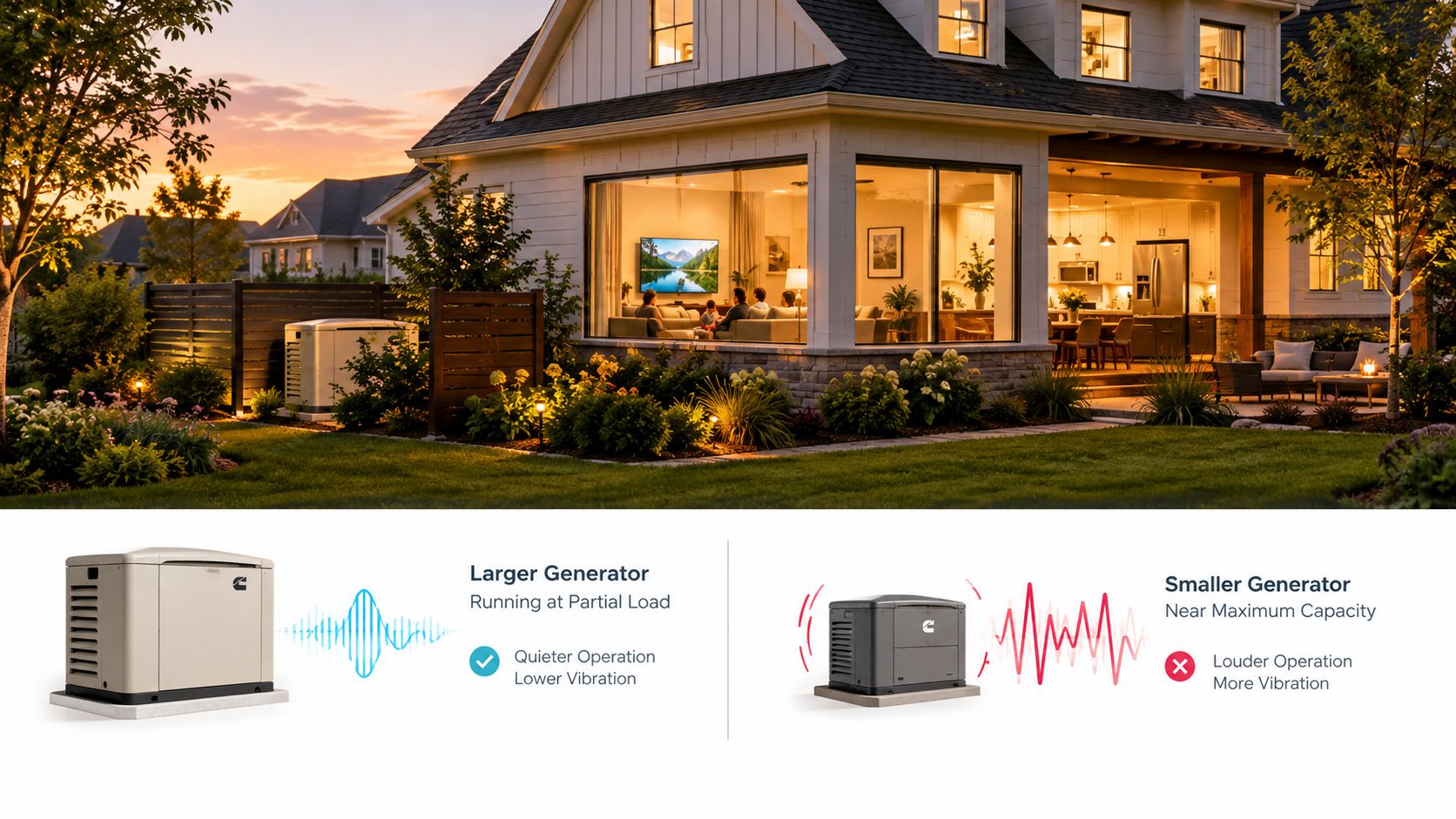
A smaller generator operating near its limit may produce more disruptive sound than a larger system operating with managed headroom. It may also have less flexibility when several loads start together. The useful comparison isn't generator size alone. It's the relationship between required output, available surge capacity, load controls, and the engine's noise at that condition.
Whole-home coverage isn't one fixed design
Homeowners often use “whole home” to mean either every circuit remains energized or the automatic system selects all practical loads while managing conflicts. Those are different electrical architectures. A managed installation may preserve comfort and safety without allowing every high-demand device to operate simultaneously.
Before selecting equipment, create an outage priority list. Put heating, cooling, medical equipment, water systems, refrigeration, and communications ahead of discretionary charging or high-demand appliances. Then use a whole-house generator sizing calculator as a planning aid, followed by a site-specific professional calculation.
Engineering judgment: A modestly quieter engine isn't a quiet system if it repeatedly reaches overload, starts and stops under stress, or forces the household to switch major loads manually.
That is why capacity and acoustic performance should be evaluated together. A generator that has sufficient headroom can support load management more gracefully, reducing the chance that the engine spends the outage at its most demanding operating point.
Battery Integration and Load Management as Noise Reduction Solutions
The most effective noise reduction may happen before the generator runs. A battery can absorb short-duration peaks, while load controls can delay or disconnect discretionary equipment. This changes the generator's operating pattern rather than relying only on a quieter enclosure or a lower headline dBA number.
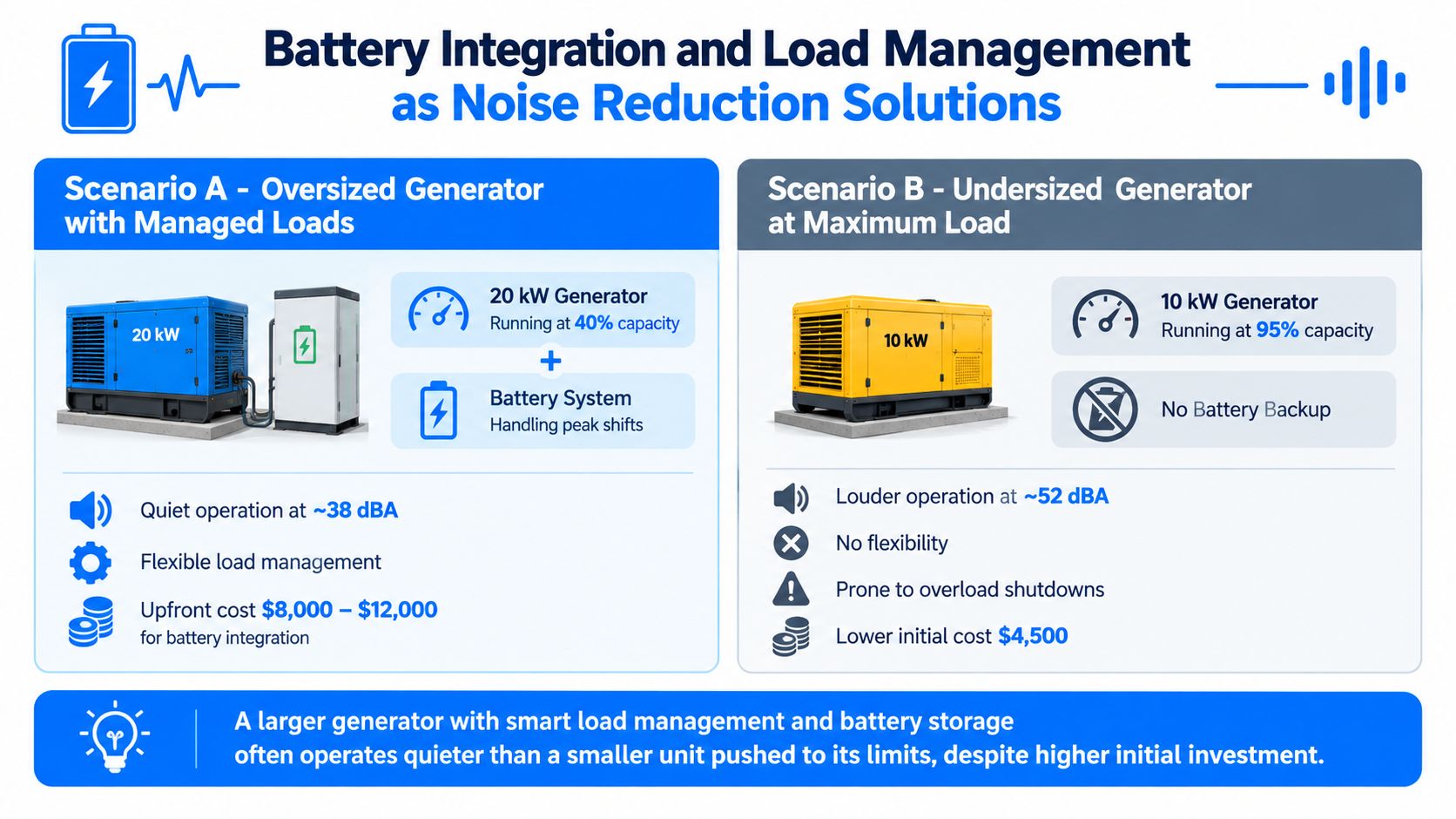
A larger generator with managed loads may operate more comfortably than a smaller unit running close to maximum capacity. The larger system costs more and requires careful design, but the acoustic decision should include runtime, peak demand, and how often the engine must operate at high output.
Shift peaks instead of chasing a marginal rating
Consider a home with an EV charger, heat pump, and sump pump. A small generator may run near its limit when several demands overlap. A managed system can pause charging, prioritize the pump, and let the battery cover a short peak. The engine then avoids some of the abrupt load changes that make a conventional comparison misleading.
Battery storage can also reduce generator runtime. The available guidance states that a properly configured system with battery support can reduce generator runtime by 60 to 80%, depending on the design and operating conditions, as described in guidance on generator noise and load management. Less runtime means fewer hours of airborne engine noise, vibration, and exercise-related disturbance.
That doesn't mean every battery system replaces a fuel-powered standby unit. Storage capacity, recharge strategy, essential-load priorities, and outage duration all affect the design. A battery may provide silent operation during discharge, while the generator starts later to recharge it or support sustained demand.
Compare complete systems
Evaluate these architectures on the same basis:
Generator-only backup: Simple and familiar, but the engine carries the outage load whenever utility power is unavailable.
Generator with load management: Uses controls to delay or shed selected loads, reducing simultaneous demand.
Generator with battery support: Adds stored energy for peak shifting and quiet periods, while the generator handles longer-duration demand or recharging.
Battery-centered backup: Can operate in silence during discharge, but requires a careful assessment of stored energy, solar or utility recharge, and the home's priority circuits.
The comparison should include normal-load noise, exercise noise, property-line exposure, surge handling, and expected runtime. Amp'd Energy Solutions offers battery backup and outage power services alongside whole-home generator and electrical integration work, which can help homeowners assess these elements as one system rather than separate purchases.
The quietest practical design may therefore combine adequate generator capacity, automatic load controls, and battery storage. That approach addresses the sound that neighbors hear, the electrical conditions that create it, and the operating hours that determine whether the installation remains acceptable through a long outage.
Amp'd Energy Solutions helps Southeastern Pennsylvania homeowners evaluate whole-house generators, battery backup, EV charging loads, and electrical service capacity as one coordinated design. Visit Amp'd Energy Solutions to request a site assessment focused on property-line noise, outage priorities, and code-compliant installation planning.
Comments