

Whole House Generator Sizing Calculator Guide
Buying the largest standby generator you can afford sounds safe, but it's often the wrong starting point. A generator that's too small can trip during motor startup, while one that's too large may operate inefficiently because the home rarely uses enough power to load it properly. A reliable whole house generator sizing calculator should reflect how your home uses electricity, not just the rating on your service panel.
The practical calculation has three parts: add the running watts of the loads you want online, identify the largest single starting surge, then apply headroom for continuous operation and real site conditions. That method accounts for load diversity, motor inrush, altitude, temperature, fuel type, and the difference between powering selected circuits and carrying everything at once.
Table of Contents
Why Bigger Is Not Always Better for Generator Sizing - The three numbers that matter
Understanding the NEC Dwelling Load Optional Method - Build the dwelling baseline
Motor Starting Surge and Why It Dominates Your Calculation - Read the nameplate before using a table
Applying Safety Margins and Environmental Derating - Apply reserve before you choose the unit
Managed Whole House Coverage vs Priority Circuit Backup - Choose based on outage behavior
Load Diversity and Sequential Startup in Modern Calculators - What a better calculator asks
Step by Step Process for Using a Sizing Calculator - Build the input list
Consequences of Oversizing and Undersizing Your Generator - What failure looks like
Complete Sizing Example for a Southeastern Pennsylvania Home - Establish the calculation
Quick Reference Checklist and Decision Matrix - Decision matrix
Why Bigger Is Not Always Better for Generator Sizing
A larger generator doesn't automatically provide better backup. If the generator is much larger than the loads it serves, you've paid for capacity your home may rarely use. Light loading can also create operating and maintenance concerns, particularly with diesel equipment, where prolonged low-load operation can contribute to wet stacking.
The opposite mistake is more common. Homeowners add refrigerator watts, lighting watts, pump watts, and appliance watts, then choose a generator based on that total without accounting for the moment a compressor or pump starts. That calculation can look reasonable on paper while producing voltage sag, nuisance trips, or failed starts in the home.
The three numbers that matter
A sound sizing process asks three questions:
What must run continuously? Add the running watts for the loads you expect to operate during an outage.
What has the largest startup demand? Find the single largest motor or compressor surge, rather than automatically adding every startup surge together.
How much headroom is appropriate? Add a reserve so the machine isn't forced to operate at its nameplate limit.
This running-load-plus-largest-surge method is described in the whole-house generator sizing calculator workflow, which also calls for reviewing steady load, starting need, recommended generator size, and estimated amperage.
Practical rule: Size for the loads that can realistically overlap, then verify the result against the equipment nameplates and the transfer equipment.
A whole-house generator doesn't necessarily need to energize every circuit simultaneously. If an electric range, dryer, water heater, heat pump, and vehicle charger won't operate together during an outage, treating them as a guaranteed simultaneous load can lead to unnecessary oversizing. Correct sizing is a design decision based on priorities and operating behavior, not a contest to cover every breaker.
Understanding the NEC Dwelling Load Optional Method
A generator calculation should begin with a defensible estimate of the dwelling's connected load. For residential work, the NEC dwelling-load optional method provides a recognized framework for estimating general lighting, required small-appliance circuits, laundry demand, and service amperage. The calculation is useful for establishing a baseline before you account for generator-specific motor surges and backup priorities.
Build the dwelling baseline
The method starts with general lighting at 3 VA per square foot, then adds 1,500 VA for each required small-appliance circuit, with a minimum of two, and 1,500 VA for the laundry circuit. The residential electrical load calculation guidance describes applying 100% of the first 10 kVA and 40% of the remainder, then converting the result to amperage at 240 V.
For a 2,000 square foot dwelling, the lighting allowance is:
General lighting: 2,000 square feet × 3 VA per square foot = 6,000 VA
Small-appliance circuits: 1,500 VA for each of the required two circuits = 3,000 VA
Laundry circuit: 1,500 VA
Subtotal: 10,500 VA
The optional-method demand calculation applies the full first 10,000 VA, then applies the reduced demand factor to the remaining 500 VA. That produces a calculated dwelling demand of 10,200 VA. At 240 V, the corresponding service-current estimate is 42.5 A.
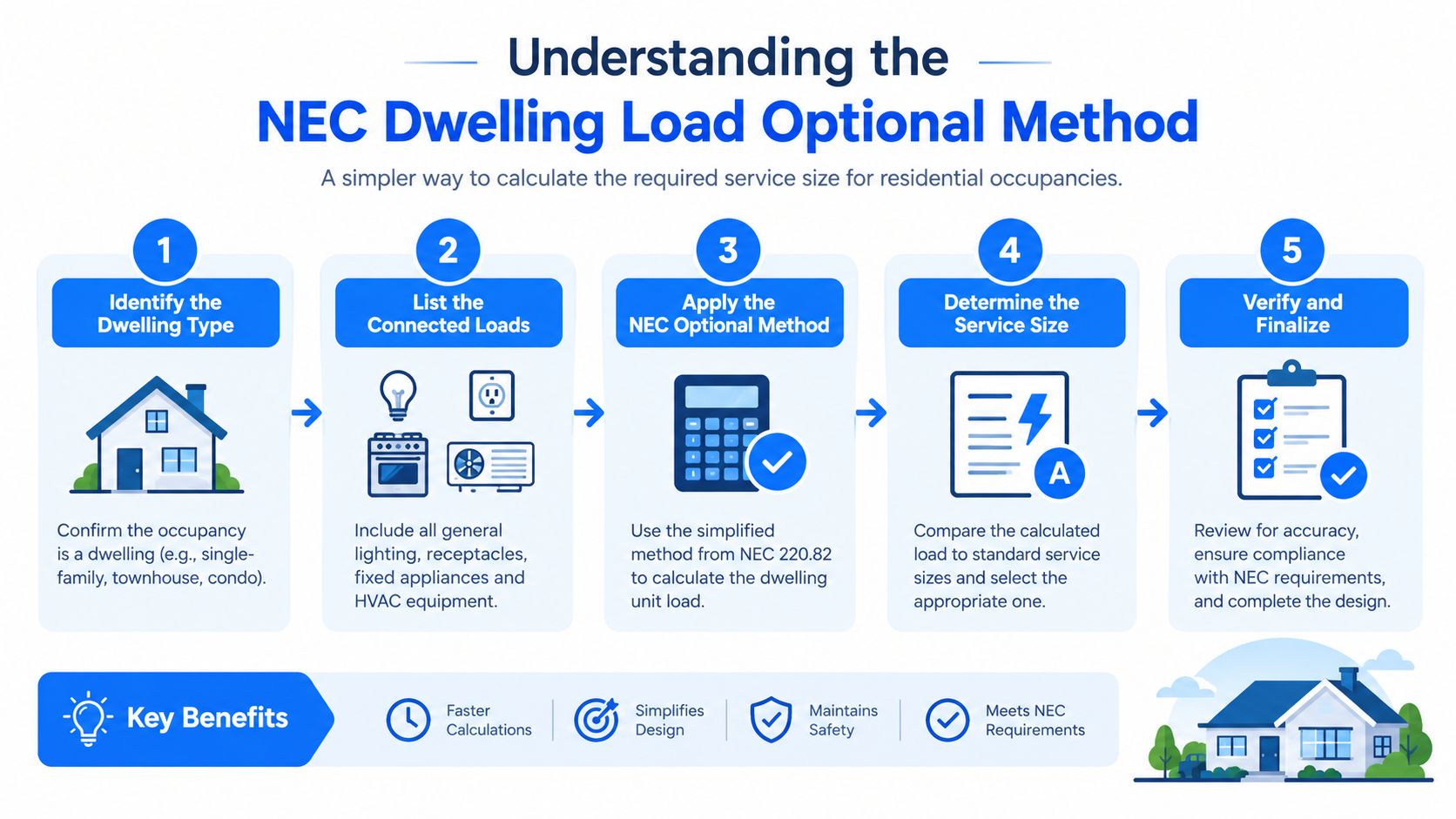
This is a baseline, not the final generator selection. Heating equipment, air conditioning, cooking equipment, pumps, water heating, electric vehicle charging, and other fixed loads still need review. The optional method also estimates dwelling demand differently from a generator's ability to start motors, so an electrician should reconcile both calculations before submitting permit documents or selecting a transfer switch.
For additional background on the electrical reasoning behind this process, review this electrical load assessment resource.
Motor Starting Surge and Why It Dominates Your Calculation
Running watts tell you what a load consumes after it's operating. Starting watts tell you what the generator must deliver when a motor or compressor first engages. That brief event often determines the generator size.
Central air conditioners, well pumps, sump pumps, furnace blowers, and refrigerators all use motors. Their locked-rotor or starting current can be several times their normal running demand, as explained in this motor-starting sizing guidance. A generator that handles the steady load may still stall or drop voltage when the largest motor starts.
Read the nameplate before using a table
A generic appliance table is only a planning aid. Motor size, efficiency, age, compressor design, wiring distance, and temperature all affect starting performance. Use the equipment nameplate, installation manual, or measured data whenever it's available.
Appliance | Running Watts | Starting Surge Watts |
|---|---|---|
Central air conditioner | Use nameplate data | Use locked-rotor or manufacturer data |
Well pump | Use nameplate data | Use motor-starting data |
Sump pump | Use nameplate data | Use motor-starting data |
Furnace blower | Use nameplate data | Use motor-starting data |
Refrigerator | Use nameplate data | Use compressor-starting data |
The table intentionally avoids invented appliance values. A claimed wattage for a particular motor without its nameplate can be misleading, especially for central air conditioning and well pumps.
The calculation normally adds the largest single starting surge to the combined running load. It doesn't automatically add the startup demand of every motor because appliances rarely start at precisely the same instant. However, a home with multiple large motors that can start together deserves closer review, particularly when an automatic thermostat, pump control, or other equipment could create overlap.
A soft-start device, staged controls, or load management may reduce the generator's starting burden, but those are design choices that must be verified for the specific equipment. Don't assume a control accessory fixes an undersized generator without confirming the resulting current and voltage behavior.
Applying Safety Margins and Environmental Derating
A generator's nameplate rating describes its rated capability under stated conditions. Your installation may not operate under those conditions. Altitude, ambient temperature, fuel type, and the generator's continuous operating limit can reduce the usable capacity available when the outage arrives.
Industry guidance commonly keeps continuous operation to about 80% of rated output, leaving roughly 20% headroom, while other sizing guidance recommends adding at least a 25% margin after accounting for the running load and largest starting surge. These practices are discussed in the generator load calculation basics guide.
Apply reserve before you choose the unit
Start with the calculated simultaneous running load plus the largest startup surge. Then add an appropriate reserve rather than selecting a unit that matches the result exactly. The reserve helps the generator tolerate changing demand, cold starts, aging motors, and short overlaps that weren't present during the initial inventory.
Derating deserves separate attention:
Altitude: Thin air reduces engine performance and can reduce available generator output.
Temperature: Hot ambient conditions can lower engine and alternator capacity.
Fuel type: The same nominal generator may have different output ratings depending on the fuel configuration.
Installation conditions: Ventilation, enclosure placement, and service conditions can affect how the equipment performs.
Don't invent a derating factor from a generic chart. Use the manufacturer's installation data for the exact model, fuel, elevation, and expected temperature range. A generator selected at the edge of the calculation may no longer have enough usable capacity after those adjustments.
The nameplate is a starting point, not permission to run continuously at the limit.
Managed Whole House Coverage vs Priority Circuit Backup
Two homes with the same service size can need very different generators. One homeowner may want every major system available, while another may only need refrigeration, lighting, communications, heating controls, and a pump. The right choice depends on which loads can operate together and which loads can wait.
Managed whole-house coverage uses a transfer switch with load management. The panel can remain broadly connected, but controls prevent selected high-demand loads from operating together when the generator lacks capacity for all of them at once. This approach can preserve comfort while avoiding the cost and operating burden of a generator sized for every possible simultaneous load.
Priority circuit backup takes a narrower approach. The electrician transfers only the circuits that matter most, leaving large discretionary loads disconnected during an outage. That may include refrigeration, lighting, a furnace blower, a sump pump, a well pump, or communications equipment, while an electric range, dryer, water heater, or vehicle charger remains offline.
Choose based on outage behavior
Managed coverage suits households that want automatic operation and can accept load cycling. It requires careful coordination between generator capacity, transfer equipment, and the loads being controlled. Priority backup suits homeowners who can make clear choices and want a simpler load profile.
Before requesting an installation quote, decide:
Comfort expectation: Must central heating or cooling operate automatically?
Water dependence: Does the home rely on a well pump or sump pump?
Electrical heating: Are heat strips or electric water heating essential?
Vehicle charging: Can charging wait until utility power returns?
Outage duration: Would manual conservation become difficult during a long outage?
The transfer switch must match the generator output and service arrangement. Review the wiring and switching implications in this guide to whole-house generators with transfer switches before treating “whole house” as a guarantee that every appliance can run together.
Load Diversity and Sequential Startup in Modern Calculators
Simple wattage charts assume the worst in a way that often doesn't reflect household operation. A refrigerator cycles. A thermostat starts equipment when the indoor temperature changes. A water heater, oven, dryer, and vehicle charger may be controlled by people or timers. Those loads are connected to the home, but they aren't necessarily active at the same moment.
Load diversity means selecting the loads that overlap rather than treating every connected appliance as a continuous demand. Sequential startup means allowing major motors or compressors to start in an intentional order, so the generator doesn't face multiple large inrush events at once.
What a better calculator asks
A more useful calculator should ask which loads you want powered, which ones are likely to operate together, and which equipment has a motor or compressor. It should also allow context such as:
Square footage, as a baseline for dwelling load
Altitude and temperature, for environmental adjustment
ZIP code, when local conditions or installation requirements affect planning
Fuel type, because output can vary by configuration
Startup information, including the largest motor surge
Independent calculator guidance recommends selecting only loads that run simultaneously, adding the largest single motor surge, and then applying a safety margin because every appliance rarely starts together. See the load-diversity calculator approach for that broader workflow.
This doesn't mean you should ignore a worst-case operating condition. It means you should define that condition. A household that insists on central cooling, electric cooking, electric water heating, and vehicle charging at the same time needs a different design from a household that sheds those loads during an outage.
Step by Step Process for Using a Sizing Calculator
A calculator is only as reliable as the information entered into it. Start with a load inventory, not a generator model.
Build the input list
Walk through the panel schedule and identify the circuits that need backup. Separate essential, comfort, and discretionary loads. Then gather the running and starting information from equipment labels or manufacturer documentation.
Use this order:
List the loads: Include refrigeration, lighting, heating or cooling, pumps, cooking, water heating, communications, medical equipment, and charging equipment that may need backup.
Record running watts: Enter the normal operating demand for each load you want online.
Record starting watts: Identify motor and compressor inrush, especially for air conditioning, pumps, blowers, and refrigeration.
Select simultaneous loads: Remove equipment that won't realistically operate during the same period.
Identify the largest surge: Add the largest single starting demand to the applicable running load.
Apply headroom: Account for reserve capacity and manufacturer derating.
Review the output: Check the recommended generator size, steady running load, starting need, and estimated amperage.
This three-part workflow, running watts, largest motor surge, and safety margin, is described in the whole-house generator calculator method.
The output shouldn't be accepted without a wiring review. Confirm that the transfer-switch ampacity matches the generator output and service rating, then compare the result with the NEC dwelling-load baseline. For installation and connection considerations, review this guide to wiring a whole-house generator.
Consequences of Oversizing and Undersizing Your Generator
Sizing errors show up during the outage, not during the sales conversation. An undersized unit may start lights and electronics normally, then struggle when a compressor or pump engages. An oversized unit may run comfortably but spend much of its life lightly loaded, while you carry unnecessary equipment and installation capacity.
A typical 2,000 square foot single-family home with central HVAC, a well pump, refrigeration, lighting, and standard outlets commonly needs 15–20 kW to carry all those loads simultaneously, according to this whole-home generator load benchmark. That figure is a benchmark, not a substitute for a site calculation.
Issue | Undersizing Symptoms | Oversizing Symptoms |
|---|---|---|
Startup performance | Voltage sag, failed motor starts, nuisance trips | Startup feels easy, but capacity remains unused |
Daily operation | Generator runs near its limit | Generator operates with light loading |
Equipment planning | Loads must be manually avoided | Purchase and installation may exceed actual needs |
Corrective action | Reduce simultaneous loads, add controls, or select more capacity | Recalculate priorities and consider managed load control |
What failure looks like
Voltage sag can affect sensitive electronics and motor performance. Repeated breaker trips can leave a sump pump, furnace blower, or refrigeration circuit without power when it matters most. If the calculator ignored starting surge, the problem may appear only after installation.
Oversizing can conceal weak load planning. Instead of deciding which equipment must operate together, the homeowner pays for capacity to cover every theoretical combination. For diesel units, chronic light loading can contribute to wet stacking, while any fuel-powered generator can consume resources without delivering a proportional benefit.
The fix isn't automatically “buy bigger.” Recheck the nameplates, the simultaneous-load assumptions, the largest surge, the transfer arrangement, and the environmental conditions.
Complete Sizing Example for a Southeastern Pennsylvania Home
Consider a 2,200 square foot Southeastern Pennsylvania home with central air conditioning, a well pump, an electric water heater, a refrigerator, a sump pump, and a Level 2 EV charger. The property needs reliable refrigeration, water, drainage protection, and temperature control, but that doesn't mean every large load should operate together during an outage.
Start by separating the loads. The refrigerator, sump pump, well pump, lighting, communications, and heating or cooling controls may belong on the priority list. The electric water heater and EV charger are candidates for scheduled operation or automatic shedding. Central air conditioning requires nameplate data and compressor-starting information because its surge may dominate the design.
Establish the calculation
Use the dwelling method as a baseline. For 2,200 square feet, general lighting is calculated at 3 VA per square foot. Add the required small-appliance and laundry allowances, apply the optional-method demand treatment, and convert the result to amperage at 240 V.
Then create the generator load scenario:
Continuous scenario: Include the loads expected to operate together.
Motor event: Add the largest single starting surge, likely from the air-conditioning compressor, well pump, or sump pump, depending on the equipment data.
Managed loads: Place the water heater and EV charger under load control unless the homeowner specifically requires them during outages.
Site adjustment: Apply the manufacturer's derating information for the property's conditions and fuel configuration.
A professional wouldn't select a final generator from square footage alone. The decision would depend on measured or documented equipment demand, startup characteristics, the desired level of load management, and the transfer-switch configuration. The EV charger deserves special attention because it can become a substantial discretionary load and may need to remain off while the generator serves motors and essential circuits.
The final proposal should show the assumptions, the loads transferred, the loads shed, the calculated surge, the reserve, and the generator's usable output after derating. If those details aren't visible, ask for them before approving the installation.
Quick Reference Checklist and Decision Matrix
Use this checklist before buying equipment or requesting an installation proposal:
Inventory loads: List every circuit you want backed up.
Separate priorities: Mark essential, comfort, and discretionary equipment.
Check nameplates: Record running and starting information for motors and compressors.
Model overlap: Identify which loads can operate at the same time.
Find the largest surge: Use the single largest starting event in the calculation.
Add headroom: Apply reserve capacity and manufacturer derating.
Verify switching: Confirm transfer-switch ampacity and service compatibility.
Review the dwelling baseline: Compare the result with the NEC optional-method calculation.
Document exclusions: Write down which loads will be shed or left offline.
Plan maintenance: Confirm how the generator will be exercised, serviced, and inspected.
Decision matrix
Your situation | More suitable direction |
|---|---|
You need only refrigeration, lighting, communications, and selected pumps | Priority circuit backup |
You want heating or cooling with automatic load control | Managed whole-house coverage |
You have large electric heating, water heating, or charging loads | Detailed load management and site calculation |
You expect to run every major appliance together | Full simultaneous-load design |
You can change appliance use during outages | Smaller, prioritized system may work |
Ask the electrician to show the running-load total, largest starting surge, reserve calculation, derating assumptions, generator output, and transfer-switch rating. A proposal that offers only a generator size without those inputs deserves closer scrutiny.
Amp'd Energy Solutions helps Southeastern Pennsylvania homeowners assess electrical loads, select and size whole-house generator systems, and coordinate installation with automatic transfer equipment. Visit Amp'd Energy Solutions to request a site consultation and build a backup plan around your actual loads, motor surges, EV charging needs, and outage priorities.
Comments