

Whole House Generator Maintenance That Actually Works
An annual oil change is not a reliability program. It's one task in a system that may still fail because the battery can't crank the engine, fuel can't reach the cylinders, the transfer switch can't connect the load, or the generator has never been proven under realistic demand.
That's the mistake behind many standby failures. The unit looks clean, the controller runs its exercise cycle, and the owner assumes the house is protected. In practice, whole house generator maintenance works best when it targets failure modes first and calendar dates second. The schedule matters, but only when each visit answers a practical question: can the generator start, transfer, run, and keep carrying the home?
Table of Contents
Why Most Generators Fail When You Need Them Most - A running engine isn't the same as backup power
Weekly and Monthly Tasks You Can Do Yourself - Start with a short visual walk-around
What a Professional Annual Service Should Include - Engine and fuel system checks - Electrical and transfer verification - What the paperwork should show
Seasonal Maintenance for Cold Winters and Storm Seasons - Before cold weather - Before storm season - After severe weather
Knowing When to DIY and When to Call a Pro - Tasks that usually stay in owner territory - Tasks that require professional service
Real Costs and Time Expectations for Ongoing Care - What changes the annual budget
Putting It All into a Simple Maintenance Rhythm - Separate exercising from load verification - A rhythm card for the enclosure
Why Most Generators Fail When You Need Them Most
A yearly tune-up does not guarantee backup power. It can replace oil and filters, apply a service sticker, and still leave a standby unit unable to start after months of inactivity. Reliability depends on preventing the failures that stop the system from starting, transferring, or carrying the home's load.
The weak points are predictable:
Battery decay: A battery may show acceptable voltage yet lack the cranking capacity for a cold start. Sulfation, loose terminals, poor charging, and age can remain hidden between service visits.
Fuel delivery: Stale fuel, restricted lines, closed valves, contamination, or degraded fuel quality can keep the engine from receiving what it needs.
Transfer equipment: Corroded or pitted contacts can prevent the generator from carrying household circuits even when the engine starts normally.
Unverified capacity: A no-load exercise confirms that the engine runs. It does not confirm that the alternator, voltage regulation, transfer switch, and connected circuits will work together under demand.
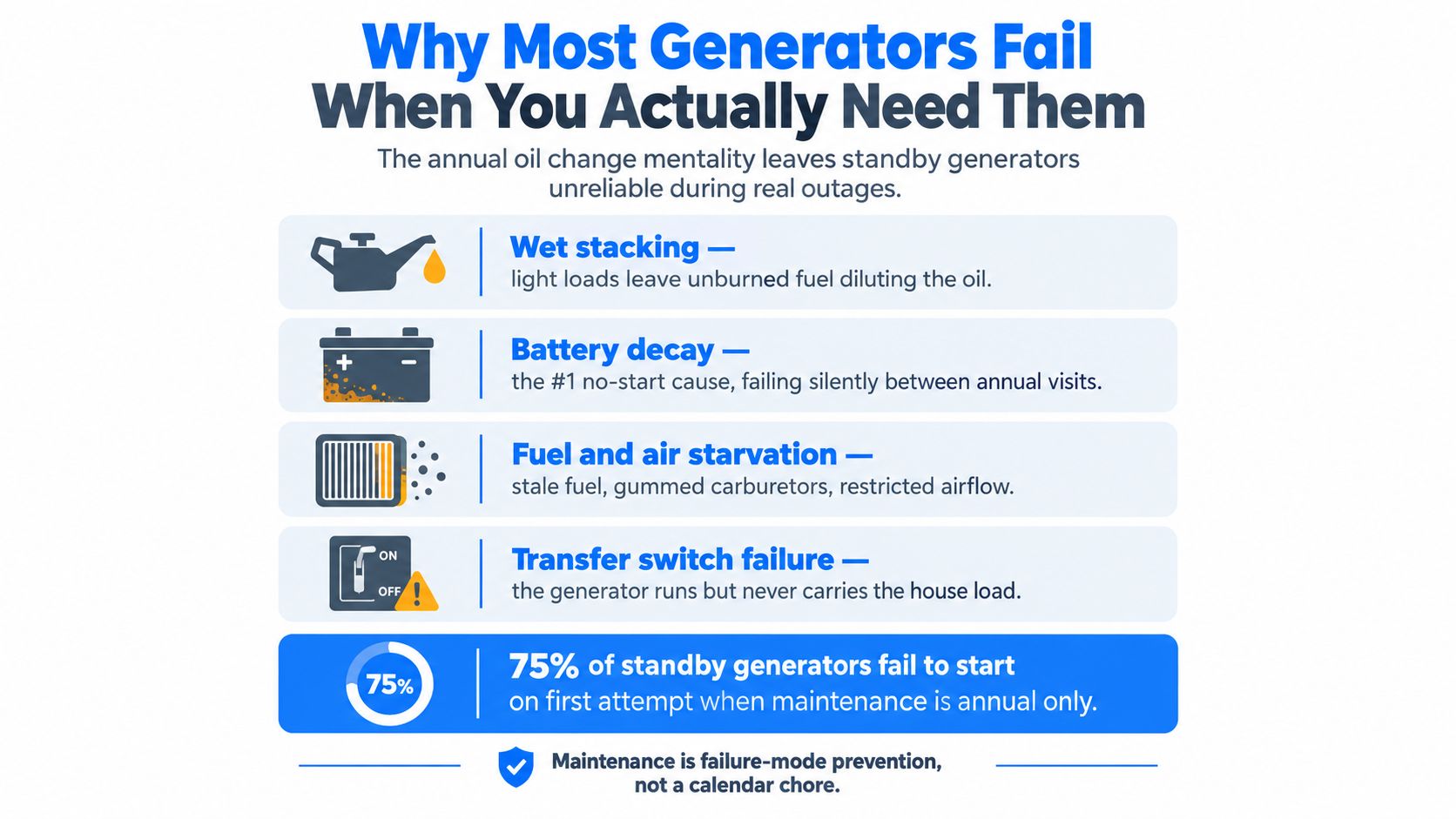
A running engine isn't the same as backup power
A useful verification test makes the complete system perform. The generator must start, stabilize, transfer safely, accept the household load, and keep running without fault codes, overheating, fuel starvation, or unstable voltage.
NFPA 110 provides a maintenance framework for emergency power systems. It calls for monthly exercising under load for at least 30 minutes at no less than 30% of the nameplate kW rating, annual functional testing of automatic transfer switches, and full-duration load-bank testing every 36 months for Level 1 systems. The PNNL standby generator maintenance guidance explains this approach and the role of regular exercising.
A cold start after weeks of inactivity can expose several weaknesses together. Pre-season verification therefore provides more useful evidence than a cosmetic inspection halfway through the season. Treat whole house generator maintenance as failure-mode prevention, measured by time, runtime, and load, rather than as an oil-change appointment with a receipt.
Weekly and Monthly Tasks You Can Do Yourself
Owners can catch many developing problems without opening energized electrical equipment. A flashlight, a suitable multimeter, and a simple log sheet are enough for routine observation. The purpose isn't to imitate a technician. It's to notice changes before a small problem becomes a no-start condition.
Start with a short visual walk-around
Once a week, inspect the enclosure and the space around it. Keep exhaust outlets, intake openings, and service access clear. Look for oil or coolant beneath the unit, chewed wiring, nesting material, damaged insulation, and standing water around the pad.
Read the controller display and record any warning or fault. Confirm that the scheduled exercise cycle ran and note the date, duration, hour-meter reading, and anything unusual about sound, exhaust, or vibration. A trend in the log often tells you more than one isolated observation.
A monthly check should include the basics that owners can perform safely:
Check oil and coolant levels. Use the dipstick and sight glass according to the manufacturer's instructions. A falling level needs an explanation, not just a top-up.
Inspect battery terminals. Look for white or green corrosion, loose connections, swollen cases, and damaged cables. Don't disconnect a battery unless the equipment instructions clearly permit it.
Check battery voltage at rest. A healthy resting 12-volt battery is commonly expected to read 12.6 volts or higher, while a 24-volt bank should be evaluated according to its configuration and manufacturer specification. A low reading after proper charging can indicate deterioration.
Run a controlled exercise or transfer test. Follow the equipment instructions and local safety requirements. Confirm that the generator starts cleanly, the transfer sequence occurs, voltage remains stable, and the unit returns to utility power without alarms.
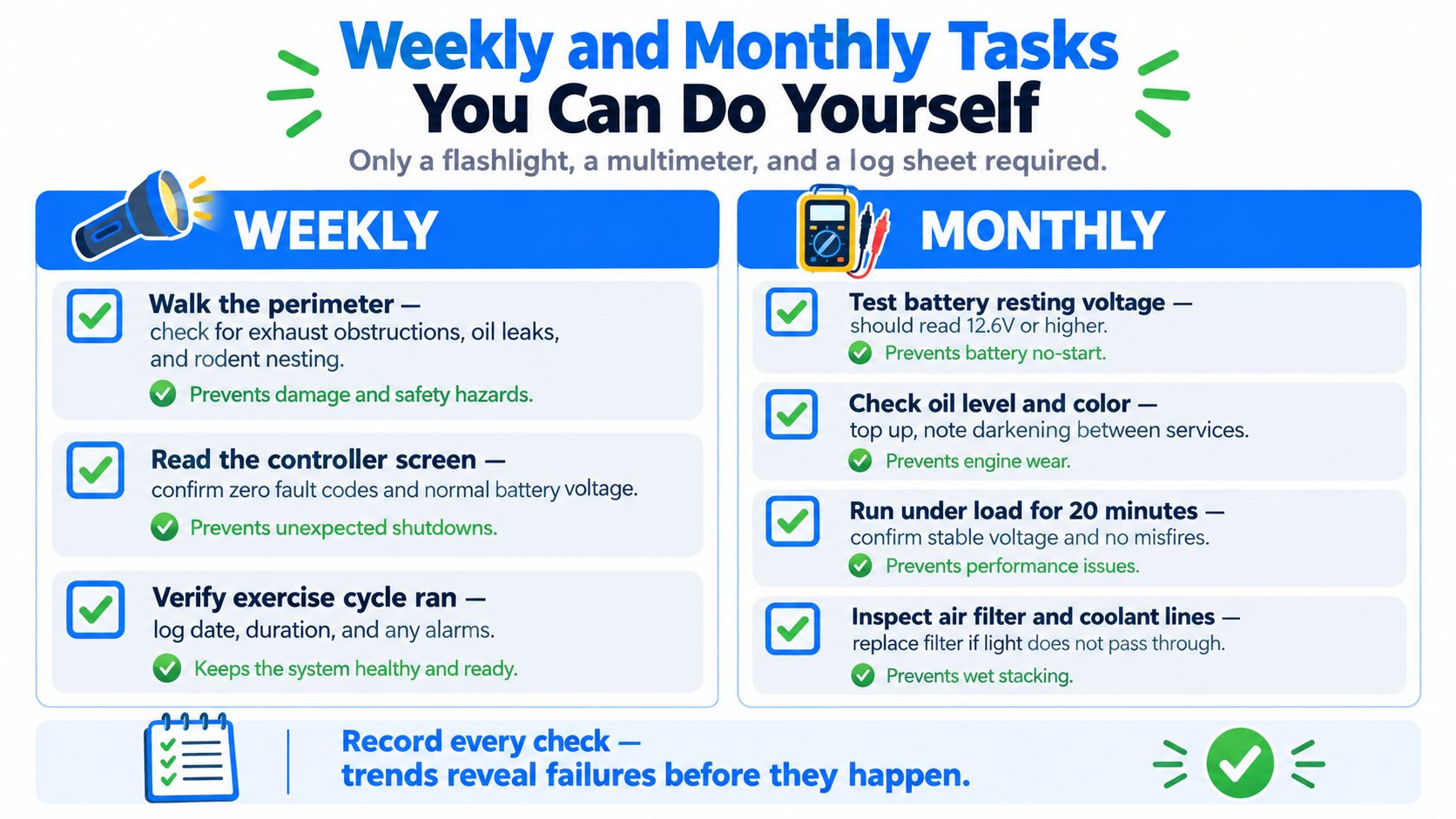
Record the result, not just the date. “Ran normally” is useful. “Started after two attempts, battery read low, transfer delayed” is actionable.
A self-test still has limits. It may not apply enough load to expose weak transfer contacts, voltage-regulator problems, restricted fuel delivery, or overheating. Treat owner checks as early warning, not a substitute for professional verification.
What a Professional Annual Service Should Include
A professional visit should test failure points, not just reset the service calendar. The report should give you measured results, observed defects, and a prioritized repair list. An oil change and service sticker cannot show whether the generator will start, transfer the house, and carry its required load during an outage.
Engine and fuel system checks
The technician should replace the oil and filter with the lubricant specified for the installed engine and its operating conditions. The inspection should also cover spark-plug condition and gap on applicable gas or propane engines, valve clearance where required by the engine design, air filtration, belts, hoses, coolant condition, and visible fuel-system defects.
Diesel equipment requires additional checks for fuel pressure, injector performance, and contamination control. Gas and propane units still need inspection of valves, regulators, lines, and connections. Fuel-system work should reflect the generator type and its operating history, not a generic checklist. A unit that has run rarely can have a different risk profile from one that carried repeated outage loads.
Electrical and transfer verification
A resting battery-voltage reading gives limited information. The service report should identify battery condition through conductance or load testing, confirm charger operation, record terminal integrity, and note starting performance or voltage drop during cranking.
The technician should separate a no-load exercise from a controlled load test. A load-bank test shows whether the generator can produce and sustain output under demand, while a functional transfer test checks whether the house changes power sources and returns to utility power correctly. The automatic transfer switch should be inspected for heat damage, corrosion, pitting, and abnormal temperature under load. Review this guide to automatic transfer switch maintenance for related inspection detail.
What the paperwork should show
Request a written report that supports comparison at the next service. It should include:
Component | Task Performed | What to Verify in the Report |
|---|---|---|
Engine | Oil, filter, plugs, belts, hoses, and valve inspection | Correct service, wear observed, fluid condition |
Battery | Voltage, conductance or load assessment, charger check | Test result, terminal condition, replacement recommendation |
Fuel system | Pressure, valve, line, and fuel-quality inspection | Stable delivery, leaks, restrictions, contamination concerns |
Alternator | Output and insulation checks where applicable | Voltage stability and recorded readings |
Transfer switch | Functional transfer and contact inspection | Transfer performance, contact condition, abnormal heat |
Controller | Fault history, settings, and firmware review | Active or stored faults, exercise schedule, updates |
Load system | Controlled load-bank or simulated-load test | Accepted load, frequency, voltage, alarms, shutdown behavior |
Good paperwork turns maintenance into a trend rather than a yearly checkbox. Worsening battery performance, unstable voltage, slower transfer, or repeated controller faults gives you time to repair the cause before an outage exposes it.
Seasonal Maintenance for Cold Winters and Storm Seasons
Southeastern Pennsylvania gives standby equipment several different problems to handle. Cold starts stress batteries and engine fluids. Storms bring debris, water, rodents, and extended runtime. Seasonal maintenance should happen before those conditions arrive, not while the neighborhood is already without utility power.
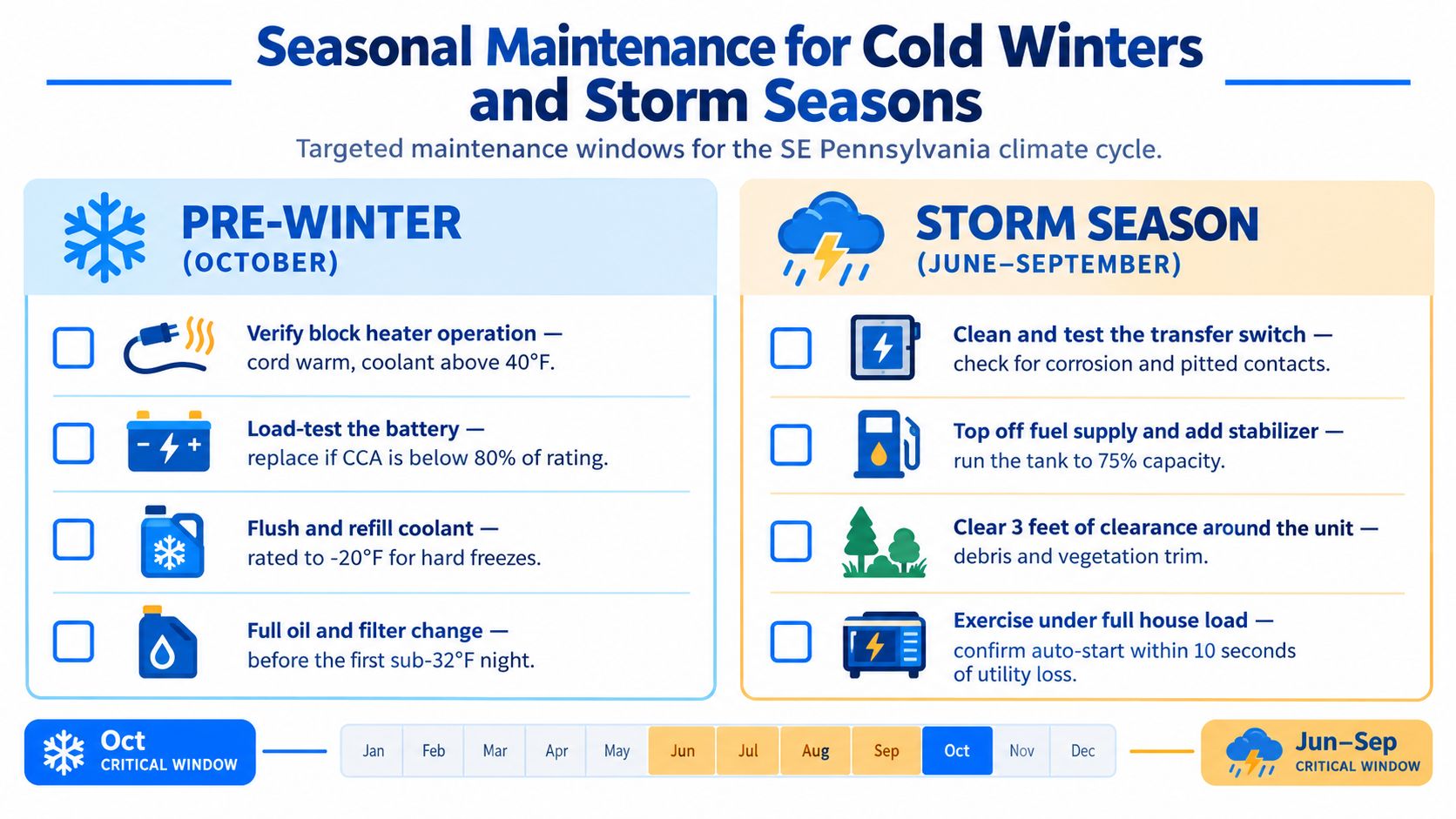
Before cold weather
Verify that the block heater operates and that the coolant system has the protection specified by the manufacturer. Inspect battery condition under the temperatures the unit is likely to encounter, because a marginal battery becomes less dependable as starting conditions worsen.
Diesel systems need protection against cold-weather fuel problems. Gas and propane systems still need sound valves, regulators, lines, and connections. Inspect enclosure seals and ventilation openings so wind-driven snow can't block intake or exhaust paths.
Change oil and filters before the coldest period if the service interval calls for it. Use the manufacturer-specified seasonal grade rather than assuming one lubricant suits every condition.
Before storm season
Inspect the transfer switch for corrosion and signs of heat. Clear vegetation and debris from around the enclosure, check the pad for erosion or shifting, and look underneath for rodent nesting. A storm-preparation visit should also confirm fuel availability and the condition of fuel lines.
A load test before the region's most demanding storm period is more useful than another unloaded run. It confirms that the system can carry the intended household demand rather than merely start and idle. Fuel type and installation considerations are also covered in this overview of whole-house generator gas systems.
After severe weather
After a storm, check for branches, leaves, water intrusion, damaged covers, and disturbed soil. Don't reset a recurring fault without finding its cause. If the generator ran for an extended period, record the additional runtime and arrange service based on both the elapsed calendar interval and the hour meter.
Knowing When to DIY and When to Call a Pro
The safe boundary is narrower than many homeowners expect. You can observe, record, clean accessible surfaces, and follow clearly documented owner procedures. You shouldn't work inside energized transfer equipment or improvise around fuel and control circuits.
Tasks that usually stay in owner territory
Visual inspections, accessible oil checks, air-filter replacement, battery-terminal cleaning with the equipment isolated as directed, and controller-based exercise functions are reasonable owner tasks when the manual permits them. The owner should stop if the enclosure, panel, or procedure presents uncertainty.
The same applies to spark plugs. Inspection may be straightforward, but removal, gap adjustment, torque, and reinstallation can affect engine operation. If the instructions aren't clear, leave the work to a qualified technician.
Tasks that require professional service
Any work involving live voltage, transfer-switch internals, fuel-line disconnection, control-board firmware, alternator testing, or warranty-covered components belongs with a licensed professional. A panel cover can expose lethal energy even when the generator isn't running. Competence with household wiring doesn't remove that hazard.
Manufacturers and service providers may also require documented maintenance for warranty support. Keep invoices and reports, especially when a repair depends on proving that scheduled care was completed.
Task | DIY Safe? | Professional Required | Decision Trigger |
|---|---|---|---|
Exterior inspection | Usually | No | Stop if you find fuel, electrical, or structural damage |
Oil-level check | Usually | No | Escalate if the level keeps falling |
Air-filter replacement | Often | Sometimes | Use professional help if access or reset procedures are unclear |
Battery-terminal cleaning | Conditional | Sometimes | Follow isolation instructions and stop with swollen or leaking batteries |
Exercise-cycle review | Usually | No | Call if faults, misfires, or repeated starts occur |
Transfer-switch test | Limited | Yes for internal work | Escalate for corrosion, heat, pitting, or wiring concerns |
Fuel-line service | No | Yes | Any leak, odor, valve, regulator, or line issue |
Live-voltage testing | No | Yes | Licensed technician and proper test equipment required |
Controller firmware or diagnostics | Limited | Usually | Use a professional when updates or intermittent faults are involved |
DIY should feel routine, never heroic. If the task requires defeating a safety interlock, opening energized equipment, or guessing at a fault, stop.
Real Costs and Time Expectations for Ongoing Care
Maintenance costs are easier to control when the budget follows failure modes, not just oil-change dates. U.S. consumer-service estimates put average generator maintenance at about $274 per service, with a typical range of $171 to $395 per visit. Annual upkeep is commonly estimated at $200 to $600. These figures come from consumer generator repair cost estimates, while the actual invoice depends on equipment type, runtime, access, parts, and local labor.
Routine service is usually predictable. Emergency troubleshooting is not. A failed battery, contaminated fuel, damaged transfer equipment, or an overdue load test can turn a planned service call into a repair, particularly after an outage exposes a problem that monthly exercising never checked.
What changes the annual budget
Most major generator manufacturers use a combined runtime-and-calendar schedule. Primary service is due at 100 hours or one year, whichever comes first, followed by intervals at 200 hours or two years and 400 hours or four years, depending on the service level. That schedule is only a baseline. Standby systems also need exercising, transfer verification, battery checks, and load confirmation. Changing oil on time does not prove the generator will start or carry the house.
A lightly used residential unit may need less hands-on work than one operating through repeated outages. More runtime increases oil consumption, filter loading, thermal stress, and the need to inspect fuel and cooling systems. Battery age and starting performance can matter more than the hour meter.
Service Task | Typical Cost | Frequency | Owner vs Pro |
|---|---|---|---|
Routine maintenance visit | About $274 average, with $171 to $395 typical service estimates | As scheduled by time and runtime | Pro |
Annual upkeep budget | Commonly $200 to $600 | Yearly planning range | Owner budget, often pro work |
Oil and filter service | Varies by engine, oil, and parts | By manufacturer interval and runtime | Owner if permitted, otherwise pro |
Battery evaluation or replacement | Varies by battery and equipment | Based on test results and lifecycle | Test by pro, replacement may be owner or pro |
Load-bank testing | Varies by equipment and test scope | Periodic, according to system requirements | Pro |
Diagnostic repair | Varies by fault and parts | Only when symptoms appear | Pro |
Larger liquid-cooled systems, emergency callouts, and major hour-based services require a written local estimate. Ask whether the quoted work includes transfer verification, battery testing, fault-history review, and a service report. For planning questions about upkeep, review this guide to whole-house generator maintenance cost.
Putting It All into a Simple Maintenance Rhythm
A useful rhythm assigns every task to a failure mode. The calendar is only the reminder. The result you record is what tells you whether the system remains ready.
Use the first week of each month for a visual walk-around, controller review, battery observation, and exercise-history check. At the six-month point, inspect oil and coolant more deliberately and review the log for changes. Schedule professional service at the manufacturer's time or runtime interval, whichever arrives first.
Separate exercising from load verification
The automatic exercise cycle is valuable because it keeps the engine, charger, controls, and starting system active. It doesn't automatically prove that the transfer switch will connect the home or that the alternator will sustain the expected demand.
Plan a controlled simulated-load or load-bank test according to the applicable maintenance standard and equipment requirements. NFPA 110's framework calls for monthly loaded exercising, annual automatic transfer switch functional testing, and full-duration load-bank testing every 36 months for Level 1 systems, as documented in the PNNL emergency power maintenance guidance. Follow the installed system's classification and the service provider's documented procedure.
A rhythm card for the enclosure
Task | Frequency | Performed By | What to Check | Log |
|---|---|---|---|---|
Walk around enclosure | Weekly or monthly | Owner | Obstructions, leaks, nesting, damage | Date and observations |
Review controller | Weekly or monthly | Owner | Faults, exercise status, battery indication | Fault code and hour meter |
Inspect fluids | Monthly and before seasonal extremes | Owner or pro | Oil level, coolant level, visible leaks | Levels and changes |
Review battery condition | Monthly observation, professional testing as needed | Owner and pro | Corrosion, case damage, charging, cranking | Reading and test result |
Exercise generator | Per manufacturer schedule | Owner through controller | Start, sound, alarms, stable operation | Start result and duration |
Verify transfer and load | Periodically, with annual ATS testing | Pro | Transfer, voltage, frequency, sustained load | Test readings and defects |
Service engine and fuel system | By time and runtime | Pro or qualified owner | Oil, filters, plugs, fuel delivery, cooling | Parts and hour meter |
Three signals should end DIY troubleshooting immediately:
Persistent fault codes after a proper reset and basic inspection.
A battery that won't hold above 12.4 volts after charging.
Any fuel leak, even a small one.
Maintenance that prevents those conditions is worth more than a service sticker. Keep the log, test the transfer path, verify the load, and repair weak starting or fuel components before the next outage makes the decision for you.
Amp'd Energy Solutions provides whole-house generator installation, annual maintenance, troubleshooting, and repair services for homes and businesses in Southeastern Pennsylvania. Visit Amp'd Energy Solutions to schedule a system assessment and turn your generator maintenance plan into documented outage protection.
Comments