

Battery Backup Power Outage: How Home Systems Really Work
The power goes out just as the weather turns ugly. Your refrigerator stops humming, the furnace blower goes quiet, and the microwave clock flashes 12:00. In a Southeastern Pennsylvania home, that silence can mean a minor inconvenience, a flooded basement, frozen pipes, spoiled food, or a much more serious problem for anyone who depends on medical equipment.
A battery backup power outage system changes the experience from scrambling to planning. Instead of trying to power every appliance, the system keeps selected circuits operating automatically, then gives you a clear limit to manage. The important question isn't how long the battery lasts. It's which circuits stay on, how much power they draw, and what happens when the outage lasts longer than the stored energy.
Table of Contents
What Happens When the Grid Goes Dark - The house doesn't stay fully powered by default - A controlled transition replaces guesswork
How a Home Battery Backup System Actually Works - Four actions happen during a grid failure - Panel design determines what stays alive
Identifying the Critical Loads That Matter Most - Three useful priority tiers
Sizing Your System for Real-World Runtime - A Southeastern Pennsylvania example
Battery Backup Versus Generator Backup - Where batteries fit - Where generators fit
Outage Scenarios and How Systems Behave - Scenario one, a two-hour summer thunderstorm - Scenario two, a twenty-four-hour ice event - Scenario three, a three-day windstorm
Common Misconceptions That Lead to Undersized Systems - Myth one, the battery powers the whole house - Myth two, more capacity fixes every runtime problem - Myth three, modern electronics don't matter - Myth four, a heat pump is automatically efficient backup heating - Myth five, a portable power station is a whole-home system
Planning Your Own Battery Backup Installation - Put the priorities on paper - Confirm local requirements - Compare proposals by promised performance
What Happens When the Grid Goes Dark
A winter storm has coated the trees behind a Pennsylvania split-level home. The lights blink once, twice, then disappear. The furnace shuts down before the house has had time to lose much heat. The refrigerator falls silent between cycles, the internet router goes dark, and the microwave clock resets to 12:00.
For a few seconds, everyone waits. Someone checks the breaker panel. Someone else looks outside for a neighbor's porch light. The house feels different because the systems that normally run in the background have stopped announcing that they're working.
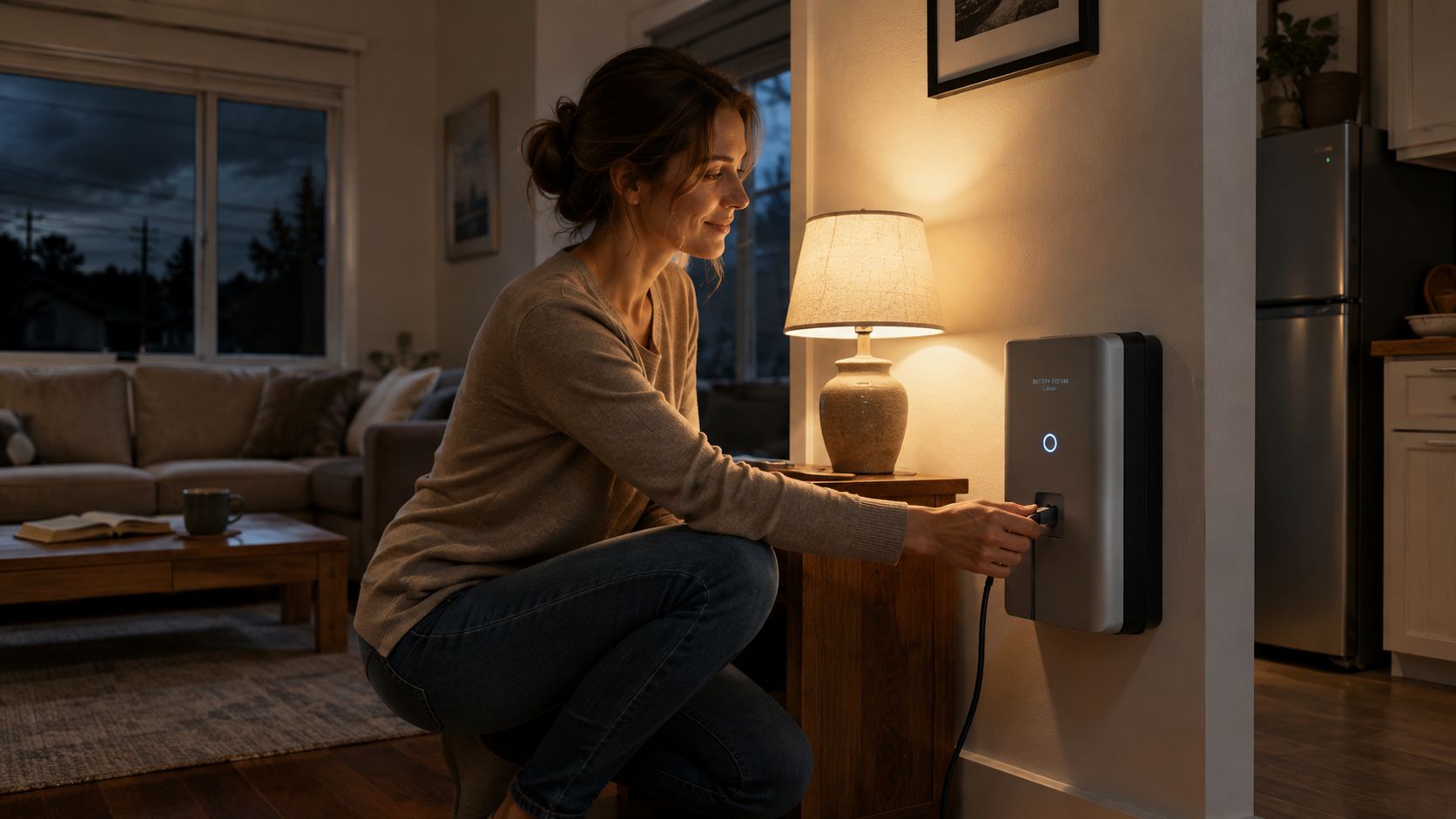
A properly installed battery backup interrupts that helpless pause. It detects that utility power has failed, separates the home's backed-up circuits from the grid, and supplies those circuits from stored energy. The transition happens automatically, so a few lights may flicker or may not visibly change at all.
The house doesn't stay fully powered by default
That distinction matters. A battery system doesn't magically make the utility grid unnecessary, and a mid-sized installation usually isn't intended to run every circuit at once. The refrigerator, a few lights, internet equipment, selected outlets, a sump pump, or medical equipment may remain active while an electric range, dryer, water heater, air conditioner, or vehicle charger stays disconnected.
The homeowner may notice that the refrigerator resumes its cycle and the router comes back online. The furnace might restart if its circuit was included. The electric oven won't necessarily work, and that isn't a failure. It means the system is protecting stored energy for the loads that matter most.
A controlled transition replaces guesswork
This is the practical value of battery backup during an outage. You don't need to carry a fuel can through the storm, run extension cords across a hallway, or decide which appliance to unplug while the house is dark. The system follows the circuit plan created during installation.
U.S. reliability data help explain why that planning matters. In 2016, customers experienced an average of 1.3 interruptions and about 4 hours without power during the year. When major events were excluded, the average customer still lost power for 112 minutes and experienced one outage. Including major events raised the total to 250 minutes and 1.3 outages. The U.S. Energy Information Administration's reliability overview also shows how utility type and severe weather can change the experience from one community to another.
The scene in the dark is familiar. The technology's job is to make the next few minutes predictable. To understand why the lights can come back so quickly, we need to look at what the system is doing behind the panel.
How a Home Battery Backup System Actually Works
Think of a battery backup system as a reserve water tank connected to a house. Under normal conditions, the utility supplies the pressure and the tank stays ready. When the incoming pressure drops, a check valve closes the connection to the main line, and the reserve tank supplies only the fixtures assigned to it.
Electricity follows a similar sequence.
Four actions happen during a grid failure
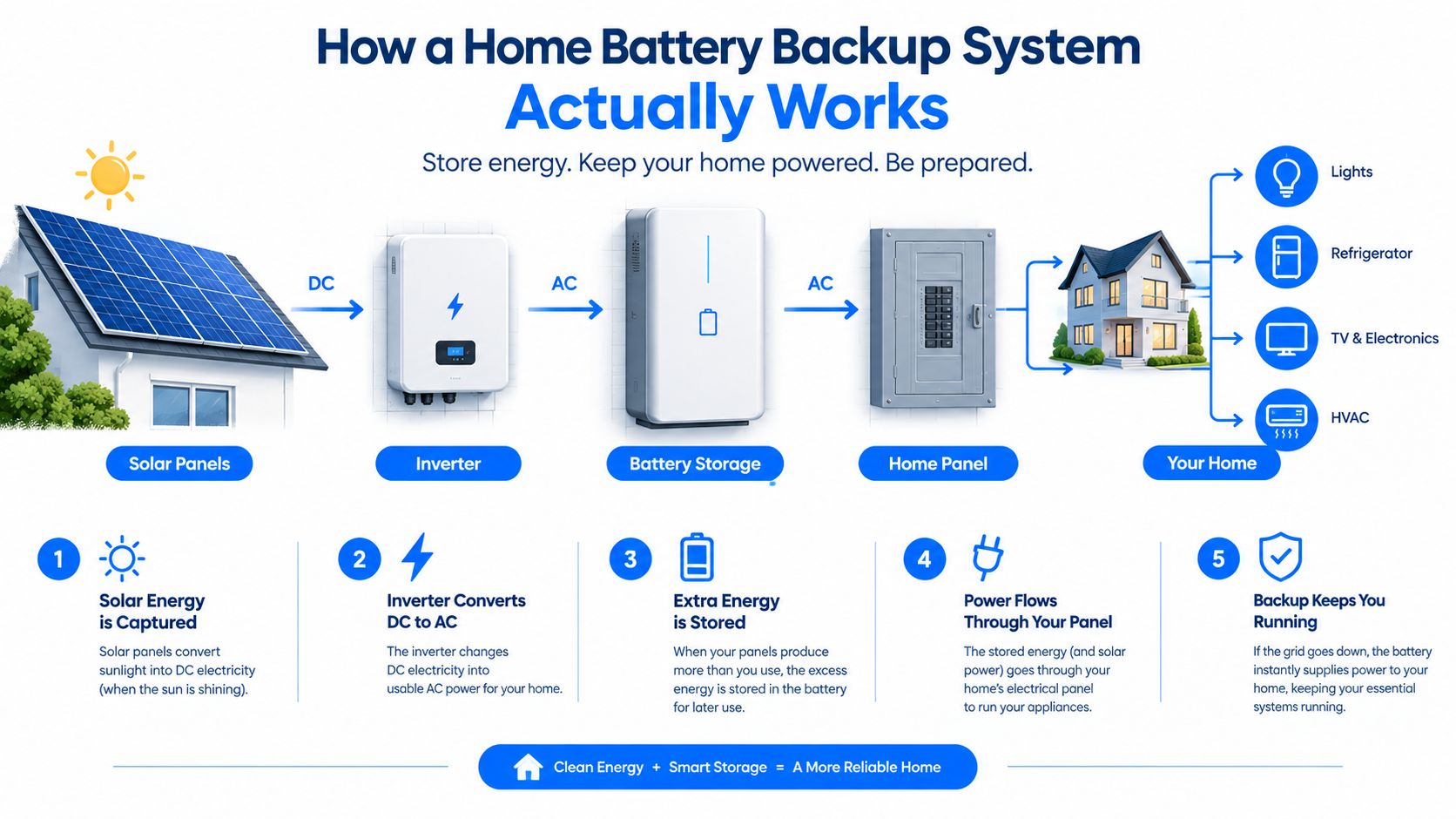
The inverter watches the grid. It continuously checks the incoming voltage and frequency. When those conditions move outside the acceptable range, the inverter recognizes a utility failure instead of treating it as an ordinary fluctuation.
The transfer equipment isolates the home. A transfer switch disconnects the backed-up circuits from the utility conductors. This prevents the battery from sending power onto damaged lines, which could endanger utility workers. The isolation step is a safety requirement, not an optional convenience.
The battery releases stored energy. Internal controls regulate the flow from the battery so the system can deliver power without exceeding its operating limits. The usable energy depends on the battery's configuration and the loads connected to it.
The inverter creates household AC power. Batteries store direct-current energy, while ordinary household circuits use alternating current. The inverter converts the stored energy into the AC power required by the selected circuits, including the home's 120-volt and 240-volt loads where the system is designed to support them.
Panel design determines what stays alive
A partial-home system normally routes chosen circuits through backup equipment or a critical-loads panel. A whole-home design uses equipment and service planning capable of supporting a much broader group of circuits. The difference isn't just the number of batteries. It also involves transfer equipment, panel capacity, circuit arrangement, conductor sizing, and the starting demands of large motors.
Lithium-based systems, including Tesla Powerwall and similar residential products, commonly combine battery storage and inverter functions in a compact installation. The product name matters less than the design around it. An installer still has to determine what the panel can support and which loads can start together.
For a homeowner, the process feels simple because the system handles the electrical sequence quickly. The grid fails, the connection opens, stored power flows to the assigned circuits, and the house continues operating in a limited mode. A useful overview of home energy storage system design can help you understand how storage fits into the larger electrical installation.
Identifying the Critical Loads That Matter Most
The best backup plan starts with circuits, not battery brands. Walk through the home and ask what protects food, health, communication, water management, and basic safety. Then separate those loads from appliances that are comfortable to have but expensive to keep running.
A refrigerator may draw roughly 100 to 400 watts while operating intermittently, while a modem may use only about 10 to 20 watts. A sump pump can draw roughly 800 to 1,500 watts while running. The appliance that sounds less important may be harmless to the battery, while a device tied to a vital household function may create a sharp demand.
Three useful priority tiers
Tier 1 protects essentials. This usually includes refrigeration, internet equipment, phone charging, a few efficient lights, medical equipment, and a sump pump where basement drainage is a concern. These circuits form the backbone of a practical outage plan.
Tier 2 preserves normal function. A gas furnace blower, well pump, garage door opener, selected receptacles, and a small home office may fit here. These loads can be valuable, but their motor-starting demands and operating schedules deserve careful review.
Tier 3 consumes stored energy quickly. Electric ranges, central air conditioning, electric dryers, hot tubs, vehicle chargers, and resistance space heaters can dominate the load list. Including them may require more inverter output, more battery capacity, load controls, or a generator-supported design.
Appliance | Tier | Running Watts | Notes |
|---|---|---|---|
Refrigerator | 1 | 100 to 400 intermittently | Starting demand can exceed running demand |
Internet modem or router | 1 | 10 to 20 | Low draw, useful for communication |
LED lighting | 1 | Varies by fixtures | Back up only the rooms you use |
Medical equipment | 1 | Verify nameplate and measured draw | Treat health-related loads as first priority |
Sump pump | 1 or 2 | 800 to 1,500 while running | Motor cycling can create substantial demand |
Gas furnace blower | 2 | Varies by motor | Heat source may be gas, but the blower still needs electricity |
Well pump | 2 | Varies by motor | Starting surge requires specific inverter review |
Garage door opener | 2 | Varies by motor | Useful during an outage, but not usually continuous |
Electric range | 3 | High draw | Avoid unless the system is designed for it |
Electric dryer | 3 | High draw | A poor match for limited stored energy |
Space heater | 3 | High draw | Can overwhelm a small backup system quickly |
EV charger | 3 | High draw | Usually disabled during backup operation |
Practical rule: If a load produces heat, moves air, pumps water, or charges a vehicle, assume it deserves extra scrutiny before it earns a place on the backed-up panel.
Circuit priority turns a vague runtime promise into a manageable operating plan. Once you know which loads are staying on, the next step is converting their power use into stored energy.
Sizing Your System for Real-World Runtime
Battery sizing uses two related measurements. Power, measured in watts or kilowatts, tells you whether the inverter can run a load at a given moment. Energy, measured in kilowatt-hours, tells you how long the battery can support that load. A system can have enough stored energy for an appliance but still fail if the inverter can't handle that appliance's starting or continuous demand.
The basic estimate is straightforward:
Runtime in hours = usable battery energy in kWh ÷ active load in kW
A battery rated at 13.5 kWh, supplying a sustained 500-watt load, provides a simple theoretical estimate of about 27 hours before losses and reserve settings. A more conservative everyday estimate is roughly 24 hours, depending on usable capacity and system conditions. Add a 1,500-watt space heater, and the total active load becomes about 2,000 watts. That same battery then falls to roughly 6 to 7 hours, not a full day.
Those are planning examples, not guarantees. Refrigerators cycle, pumps start and stop, furnaces run more during cold weather, and inverter losses reduce the energy that reaches the circuits. A load assessment should use actual equipment information and, where possible, measured operation. Electrical load assessment calculations provide a useful framework for organizing that work.
A Southeastern Pennsylvania example
Suppose a homeowner wants to support a refrigerator, freezer, sump pump, furnace blower, modem, and a few LED lamps. If those selected loads average 460 watts continuously, daily energy use is:
0.46 kW × 24 hours = 11.04 kWh per day
A 13.5 kWh battery could cover one overnight cycle with some margin, assuming the estimate reflects actual operation and the battery's usable energy supports the plan. It shouldn't be expected to carry the same load through two full days without recharge or stricter load management.
A practical design also leaves room for uncertainty. One planning approach is to multiply the expected load by 1.2 to account for inverter losses and unexpected draws. For the example above, that produces a planning figure of about 552 watts, or approximately 13.25 kWh across a full day.
Appliance | Running Watts | Daily kWh Estimate |
|---|---|---|
Refrigerator | 100 to 400 intermittently | Measure actual daily use |
Freezer | Varies by model and cycle | Measure actual daily use |
Sump pump | 800 to 1,500 while running | Depends on cycling time |
Furnace blower | Varies by motor | Depends on heating demand |
Modem or router | 10 to 20 | Low continuous consumption |
LED lamps | Varies by number and use | Limit to occupied rooms |
The calculation is useful because it reveals the trade-off immediately. Reducing active load can extend runtime without adding another battery, while adding a high-draw appliance can make a seemingly large system feel small.
Battery Backup Versus Generator Backup
Batteries and generators solve different outage problems. Treating them as competing versions of the same product leads homeowners toward the wrong equipment.
A battery is like a reserve water tank. It holds a finite supply, delivers it, and begins working almost immediately when the utility fails. A generator is closer to a fire hydrant connected to a fuel source. It creates a continuing flow, but it needs fuel, combustion, maintenance, ventilation, and a safe transfer arrangement.
Where batteries fit
Batteries work well for short outages, repeated brief interruptions, planned utility shutoffs, and households that value silent automatic operation. They don't produce exhaust and don't require a fuel delivery during the event. When the battery runs low, however, the system can't keep supplying loads unless solar production, grid power, or another source recharges it.
A more recent U.S. trend shows why outage duration deserves attention. In 2018, customers experienced an average of 5.8 hours of outage time per customer, while interruption time excluding major events stayed around 2 hours. State averages ranged from 1.5 hours in South Dakota to nearly 30 hours in North Carolina. EIA's 2018 reliability data show how major weather events can dominate the total, especially in vulnerable regions.
Where generators fit
Generators make more sense when the outage may stretch beyond the battery's practical reserve or when the home has heavy continuous loads. They can keep producing power as long as fuel is available, but homeowners accept noise, exhaust, servicing, fuel storage, and outdoor placement requirements.
A hybrid system can combine the two. The battery handles the first transition and carries priority circuits, while a generator supplies extended energy or recharges the battery during a prolonged event. That arrangement lets the battery handle the first difficult minutes without forcing the generator to start for every brief interruption.
The right question isn't “battery or generator?” It's what is the likely outage profile, which loads must remain active, and what level of manual involvement is acceptable?
Outage Scenarios and How Systems Behave
A battery system behaves differently in every outage because the weather, household loads, battery state of charge, and solar availability change together. The same installation can feel oversized during a short thunderstorm and inadequate during a cold, extended storm.
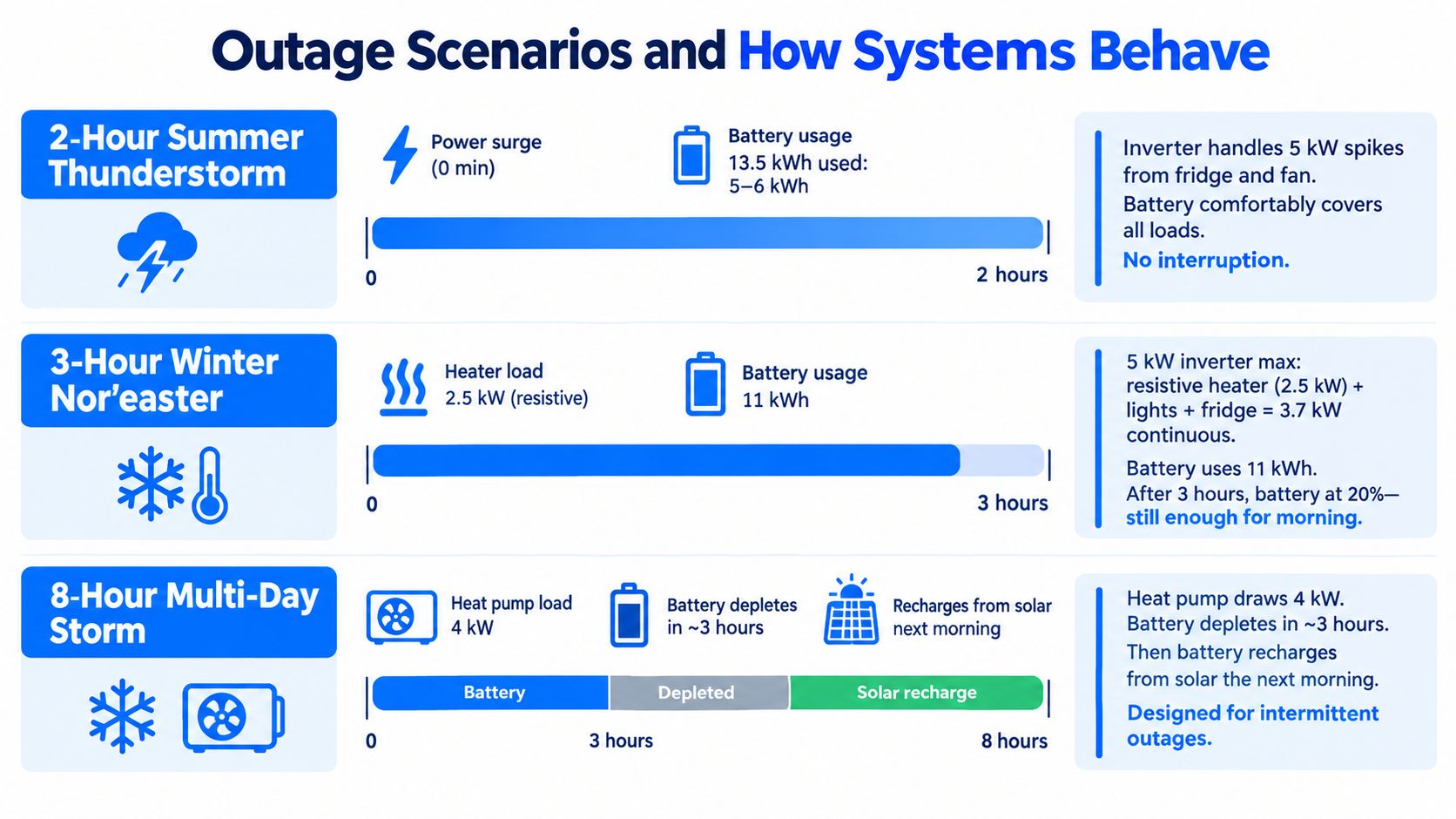
Consider a Southeastern Pennsylvania home with a 13.5 kWh battery and a 5 kW inverter. Those figures describe stored energy and instantaneous output, but they don't tell you the outcome until you add the actual circuits.
Scenario one, a two-hour summer thunderstorm
The lights flicker before the utility finally drops. The battery system detects the failure, isolates the backed-up circuits, and keeps the refrigerator, internet equipment, selected lighting, and other priority loads operating. The inverter can manage ordinary motor starts within its design limits, and the homeowner doesn't need to pull out extension cords.
With modest loads, a two-hour event uses only part of the stored energy. When the grid returns, the system reconnects according to its controls and begins restoring its reserve.
Scenario two, a twenty-four-hour ice event
Cold weather changes the calculation. The furnace blower cycles more often, the refrigerator and freezer continue operating, and the well pump may start repeatedly. If those loads consume roughly 14 kWh over the event, a single 13.5 kWh battery reaches its reserve before the outage ends.
The homeowner then has to shed loads. Turning off the well pump may preserve heat and refrigeration, but that choice only works if the household understands the plumbing, heating, and medical priorities before the storm. A battery plan should include those decisions in advance, not leave them to a dark basement at dawn.
Scenario three, a three-day windstorm
A larger, stacked system with 27 kWh can provide substantially more stored energy, but it still isn't an unlimited supply. Without solar recharge or generator support, heavy cycling can deplete the system by roughly the second day, forcing strict rationing of medical equipment, refrigeration, communication, and lighting.
Daylight solar production can change the result by serving active loads and replenishing the battery. Utility rules and interconnection requirements also affect how a solar-plus-storage system operates during an outage. Homeowners should confirm those details with their installer and utility rather than assuming that rooftop panels will operate automatically when the grid is down.
The transfer equipment controls the safe transition between utility and backup supply. A plain-language explanation of automatic transfer switch operation can help homeowners understand why a proper installation matters.
Common Misconceptions That Lead to Undersized Systems
Most disappointing battery installations don't fail because batteries are useless. They fail because the homeowner and installer never agreed on what “backup” meant.
Myth one, the battery powers the whole house
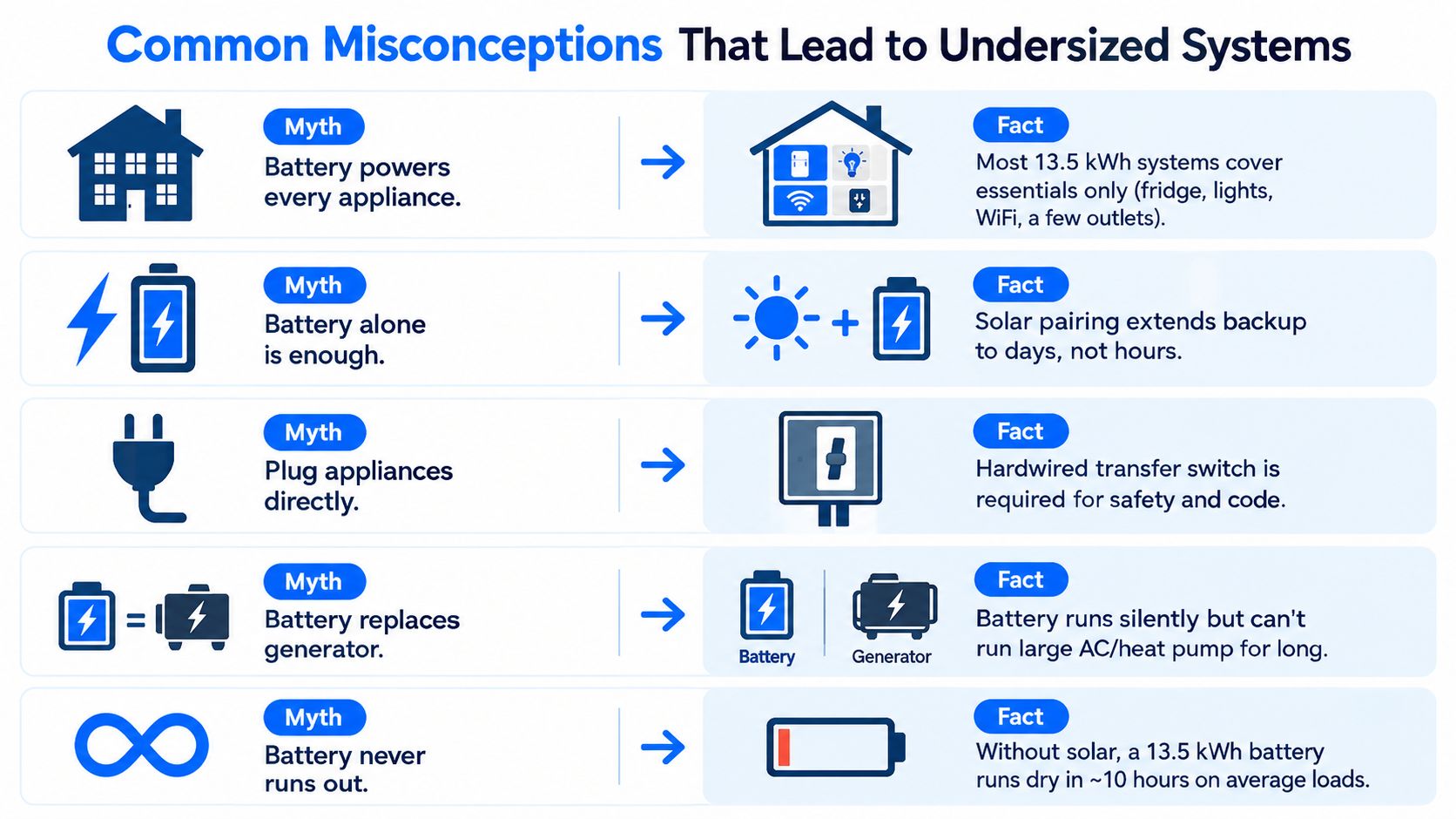
A battery connected to a panel doesn't automatically support every appliance. Most mid-sized systems work through a selected critical-loads arrangement. Whole-home backup requires a separate design that accounts for service capacity, inverter output, large motor starts, and simultaneous demand.
Planning correction: Ask for a circuit-by-circuit list of what remains energized, not a general promise that the house is backed up.
Myth two, more capacity fixes every runtime problem
Adding battery capacity extends the same load pattern, but it doesn't make an inefficient load pattern sensible. If a space heater, electric dryer, or large heat pump consumes most of the available power, doubling storage may only postpone the same problem.
Planning correction: Reduce or control heavy loads before adding storage.
Myth three, modern electronics don't matter
LED lights and small electronics generally use little power individually. Always-on networking equipment, chargers, smart-home hubs, and similar devices still operate around the clock, so their combined consumption deserves a place in the load audit.
Planning correction: Count every continuous device, then remove the ones that aren't needed during an outage.
Myth four, a heat pump is automatically efficient backup heating
A heat pump's electrical demand can rise sharply in cold weather when supplemental resistance heat operates. That strip heat can exceed 10 kW, which can overwhelm a battery system in a short period.
Planning correction: Have the installer identify the emergency heat stages and decide whether they should be locked out, controlled, or supported by another source.
Myth five, a portable power station is a whole-home system
A portable unit may run selected devices through cords or a properly designed connection, but it isn't the same as a code-compliant, permanently integrated backup system. It may lack the output, transfer equipment, circuit control, or safety features required for household service.
Planning correction: Treat portable equipment as a limited device-level option unless a qualified electrician designs the connection.
Planning Your Own Battery Backup Installation
Start with the electrical panel, not the battery catalog. An electrician should review the panel's age, service rating, breaker spaces, wiring condition, and available capacity. A straightforward critical-loads panel may be possible in one home, while another may require a service or panel upgrade before it can safely add storage, an EV charger, or other high-demand equipment.
Put the priorities on paper
Write down the circuits that protect health, food, communication, water control, and heat. Include refrigeration, internet equipment, medical devices, selected lighting, a sump pump, a well pump, and the furnace blower where appropriate. Mark optional loads separately so the installer can model what happens when they start together.
A site visit is more useful than relying on nameplate ratings alone. A clamp meter can show the current a circuit draws during real operation, including cycling behavior that a label may not reveal. Ask the installer to document both continuous load and starting demand.
Confirm local requirements
Pennsylvania jurisdictions may apply electrical-code requirements differently, including requirements related to transfer equipment, service changes, inspections, and solar installations. Your installer should identify the applicable permit sequence, coordinate inspections, and explain what must happen before the system is energized.
If the system connects with a utility such as PECO or PPL, the interconnection process may involve utility review and metering changes. A bidirectional meter may be required for systems that import and export energy. Don't assume a signed installation contract means the system can be commissioned immediately.
Compare proposals by promised performance
A useful proposal should identify:
Backed-up circuits: The proposal should name the actual panel or circuits included.
Usable energy: Ask how much stored energy the household can access during backup operation.
Continuous and surge output: Confirm whether the inverter can start pumps, blowers, and other motors.
Recharge plan: Determine whether recharge comes from the grid, solar, a generator, or a combination.
Permit responsibility: Verify who submits permits and schedules inspections.
Runtime guarantee: Ask what runtime is guaranteed for your specific critical loads under stated conditions.
Costs vary with service work, equipment, site conditions, panel changes, and the amount of backup coverage. Financing may be available, and homeowners should ask a qualified tax professional whether a federal clean-energy credit applies to their specific project. Don't accept a generic runtime estimate. The meaningful promise is tied to your circuits, your load measurements, and the weather conditions the installer used for planning.
For Southeastern Pennsylvania homeowners, Amp'd Energy Solutions designs and installs battery backup systems, Tesla Powerwall systems, whole-house generators, and electrical service upgrades. Visit Amp'd Energy Solutions to request a site assessment focused on your critical loads, panel readiness, and the right battery-only or battery-plus-generator strategy.
Comments