

EV Charger Installation Permit in Southeastern PA: A Guide
A Level 2 charger is still in its box in the garage. The electrician who's going to hang it has a Tuesday open in three weeks, and the only thing between you and 240-volt charging is a municipal website that says "apply for an electrical permit" and then stops talking.
That page doesn't tell you this. The EV charger installation permit isn't one thing. A charger plugged into an existing outlet in a two-car garage, a pedestal unit at the curb, and a four-port setup in a workplace lot go through three different reviews, in three different offices, with three different drawing sets.
Southeastern Pennsylvania makes this harder because there's no county-wide electrical authority. Philadelphia runs its own standard. Chester County alone contains dozens of townships and boroughs, each with its own application form, fee schedule, and review calendar. The question worth answering first isn't "what does an EV charger permit require." It's "which approval applies to this address."
Table of Contents
Which Permit Path Your Charger Project Needs - Where Philadelphia draws the line - What pushes a project off the simple row
Sizing the Circuit So Plan Review Passes - What the calculation has to prove beyond the breaker
Build the Packet and File in Order - The filing sequence that keeps the clock moving - What runs in parallel
Which Permit Path Your Charger Project Needs
The approval path is set by where the charger sits and whether the work adds a circuit, a panel, or equipment in a public space. Match the project to one row before you assemble drawings or book an inspection slot.
Project type | Likely approvals | What changes the path |
|---|---|---|
Level 2 charger on an existing outlet at a one- or two-family home | Electrical permit, often no separate building permit in Philadelphia | Accessory use at a one- or two-family dwelling, pedestal mount no more than 60 inches above grade |
New 240-volt circuit from the main panel at a home | Electrical plans and electrical permit | Load calculation and conductor sizing fall outside the simplified-path conditions in the row above |
Charger requiring a panel or service upgrade | Electrical permit plus utility coordination | Added capacity expands the scope beyond the charger |
Curbside or public right-of-way charger | Municipal right-of-way or streets approval plus electrical permit | Equipment placed in public space, with clearance rules |
Commercial or multifamily property | Electrical plans, building permit, possible zoning and accessibility review | Parking rights, accessible spaces and multiple tenants |
Level 1 charger on an existing outlet | Often no permit, but confirm locally | Installing a new outlet usually triggers a permit |
A charger plugged into a working 240-volt outlet is usually an electrical permit and nothing more. Pull a new circuit from the main panel across a finished basement and the same house becomes a plan review, because someone has to confirm the panel can carry the added load.
Where Philadelphia draws the line
Philadelphia shows how narrow a simple residential path really is. Philadelphia's standard for EV charger permits lets a qualifying project proceed without submitted electrical plans or a separate building permit only when the installation is accessory use at a one- or two-family dwelling, the pedestal sits no more than 60 inches above grade, the work complies with the 2020 National Electrical Code and the manufacturer's instructions, equipment is set back 18 inches from the curb line, overhead wiring is not used, and nothing is placed within 10 feet of a transit stop, fire hydrant, manhole, or other utility access point. Outside those conditions, electrical plans and a separate building permit are required.
Location stacks more approvals on the electrical review. Private-property work can need zoning approval for off-street parking. Equipment in the public right-of-way can need Department of Streets and Art Commission approval.
Elsewhere in the Commonwealth, municipal rules commonly require compliance with the currently enforced NEC, including Article 625, and work performed by qualified electrical personnel. The authority having jurisdiction decides whether the filing is electrical only, or electrical plus zoning, building, or right-of-way review. Amp'd Energy Solutions serves Chester County, where that office is often a township rather than a city department, and the local amendments come from that office's own form.
Practical rule: The property determines the permit, and the product rarely does. Two neighbors with identical chargers can need different approvals.
What pushes a project off the simple row
A panel or service upgrade. When the existing service cannot carry the charger, the job stops being a charger job. The utility enters the sequence, and review covers the service, the meter, and the panel.
A detached garage, trenching, or a long run. Buried conduit needs inspection before backfill. A run under a driveway adds a site drawing showing depth, route, and restoration.
Weight and mounting height. Oakland's guidance treats equipment above 400 pounds with its center of mass more than four feet above the floor as something that can require a building permit and engineered anchoring, per Third Way's analysis of charging infrastructure barriers. Wherever a pedestal or canopy holds the unit, expect the reviewer to ask how it is anchored.
Multifamily and commercial sites. Parking rights come from the owner or the association, not the tenant who ordered the charger. Accessible spaces, striping, and shared panel capacity pull in a second reviewer.
Public right-of-way placement. Clearance rules and streets approval apply. An electrical permit alone will not cover where the equipment sits.
Two questions settle the path in about five minutes. Where will the charger physically sit, and does it need a new circuit or any panel work? If the answers are "in my garage" and "no," the simplest row is the likely one. If either answer points anywhere else, I would call the authority with the address and the charger's nameplate current before filing anything.
Sizing the Circuit So Plan Review Passes
A 48-amp wall connector on a 50-amp breaker fails plan review before anyone opens the site plan. The first number a reviewer checks is the breaker rating against the charger's output.
Charger output (amps) | Minimum breaker (amps) |
|---|---|
32 | 40 |
40 | 50 |
48 | 60 |
80 | 100 |
The rule behind the table is the continuous-load requirement. Overcurrent protection for an EVSE branch circuit or feeder must be rated at least 125 percent of the equipment's maximum load. A 40-amp Level 2 charger therefore lands on a 50-amp circuit, and a 48-amp unit generally needs 60 amps.
Run the arithmetic once and it sticks. A charger with a 40-amp maximum output multiplied by 1.25 gives 50 amps, so 50 is the floor. Conductors then come from the ampacity table at the temperature rating the terminations allow, derated for ambient temperature and conduit fill. Where the wiring method is NM cable, ampacity is capped at the 60°C column, which pushes a 48-amp charger to larger conductors or a raceway. Final sizing still depends on the equipment listing, conductor ampacity, installation method, temperature limitations, and the NEC edition your jurisdiction has adopted.
What the calculation has to prove beyond the breaker
Service capacity. Existing service load, panel rating, and feeder capacity, with the charger added as continuous load. This number decides whether the project stays a new circuit or becomes a service upgrade.
Fault current. Available fault current where the interrupting rating of the equipment matters, typically on commercial services.
Voltage drop. Long runs from a detached panel lose voltage. A charger that drops to 208 volts charges slower and may trip its own low-voltage protection.
Grounding and disconnecting means. Size the equipment grounding conductor to the overcurrent device, and show any disconnect the adopted edition requires.
GFCI protection. Receptacles installed for EV charging need it, which usually means a GFCI breaker behind a NEMA 14-50 or 6-50 outlet. Hardwired units typically carry listed personnel protection in the equipment.
Manufacturer instructions. The install manual is part of the listing. Reviewers read it against the one-line.
One local limit catches people who size the circuit correctly and then place the unit wrong. Philadelphia caps usable output-cable length at 25 feet unless the unit has an integral listed cable-management system, as the Philadelphia EV charger permit standard for plan review sets out. Check that length before you mount the charger at the far end of a two-car garage.
The markups I see on otherwise complete calculations are an undersized panel, no 125 percent figure written on the sheet, a receptacle or cord the charger is not listed for, equipment set in the right-of-way with no permission, and wiring closed up before inspection.
If the project is a single new circuit and nothing else, the scope is a dedicated circuit installation and the drawing set stays close to one page.
Build the Packet and File in Order
Packages come back for one reason far more often than bad math: the drawings describe a different project than the application. A generic residential diagram resubmitted for a commercial lot tells the reviewer you didn't read their requirement, and the clock restarts.
This is the shape of a submittal that clears first review.
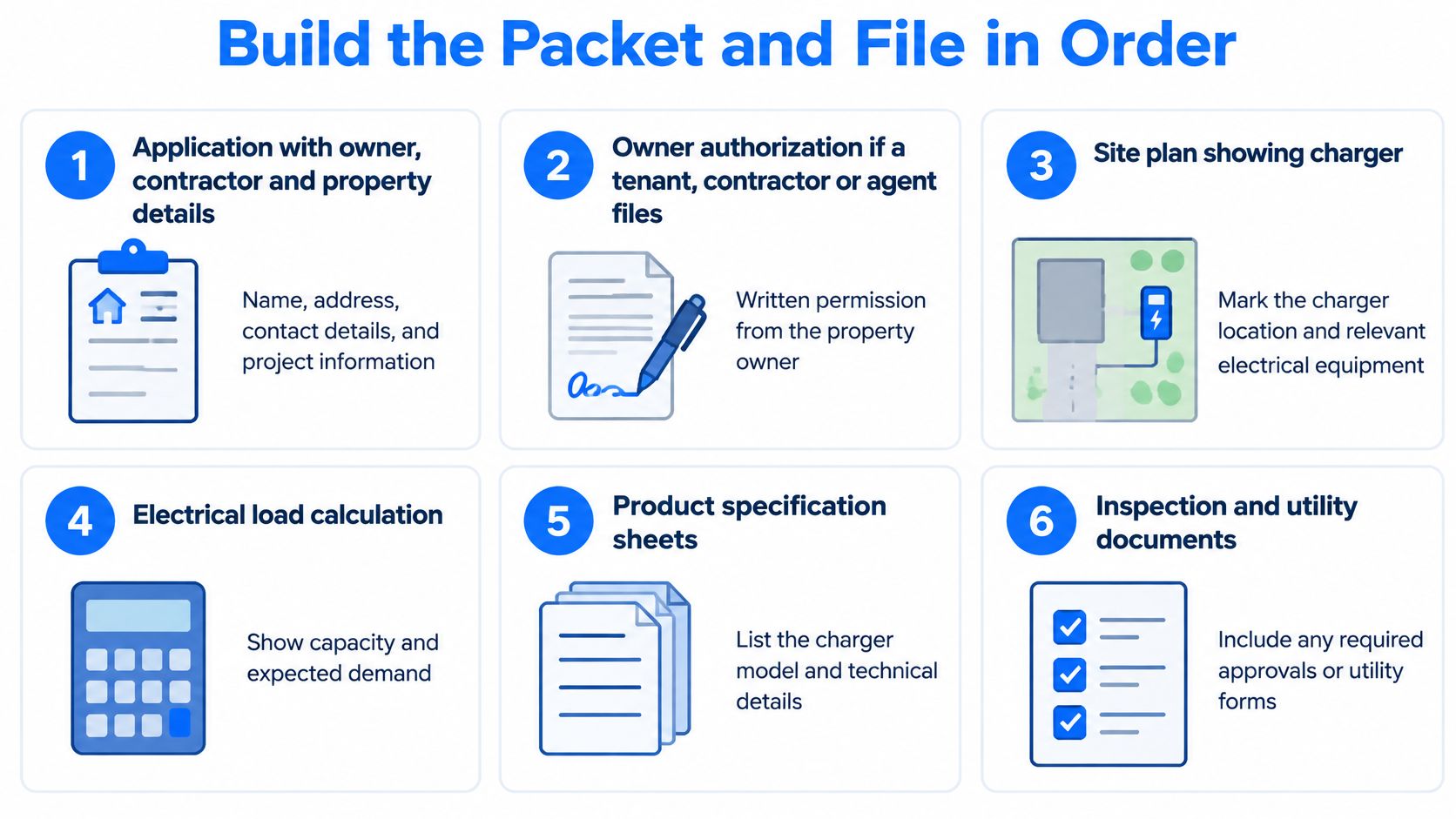
The application. Owner name, contractor name and license number, property address, scope of work, and the charger make and model. Fill in every field rather than writing "see attached."
Owner authorization. If a tenant, an electrician, or a property manager files, include written permission from the owner. A signed letter on letterhead naming the address is enough.
A site plan for this property. Charger location, distance to the property line or curb, mounting height, and where the panel and meter sit. Mark any trench route and what gets restored.
A one-line or wiring diagram. Conductor sizes, overcurrent protection, disconnecting means, grounding, and the mounting detail. The numbers here must match the load calculation exactly.
The load calculation. Existing service, panel rating, feeder capacity, and the charger's continuous load added in. Show your work; a reviewer who can't follow the math sends it back.
Equipment listing and manufacturer instructions. The cut sheet proving the unit is listed for the location, plus the pages of the install manual that set clearances and cable management.
Proof of qualified personnel. The licensed electrician's name and license number. Pennsylvania municipal guidance expects qualified electrical personnel on the work, and our electricians are licensed.
Fees. Whatever the local schedule requires, paid at filing. A missing payment stalls review as effectively as a missing drawing.
A partial package doesn't get reviewed faster. It gets a comment letter, and you go to the back of the queue.
The filing sequence that keeps the clock moving
Identify the authority and every approval. The recurring slip is assuming the electrical permit is the only one. Zoning, streets, and utility requests sit outside it.
Finish the load calculation first. Every later document depends on it, including the utility request.
Draw the site plan for this address. Not the last property, not a stock layout.
Submit everything together. Application, plans, load calculation, equipment data, authorization, fees.
Install only after the permit issues. Work done before issuance is work an inspector can require you to expose or remove.
Book the inspection before wiring is concealed. The classic mistake is backfilling the trench the day before the inspection request goes in.
Pennsylvania municipal guidance describes the same order: identify the authority having jurisdiction, run the load calculation, prepare a site plan and one-line diagram, submit the application with plans, fees and owner authorization, install only after issuance, and schedule inspection before energization or concealment, per the Electric Vehicle Guidebook for PA Municipalities.
What runs in parallel
Three things don't have to wait for plan review. The utility request can go in as soon as the load calculation is done, and on any project that touches service capacity it should. The equipment order can be placed, since a Wall Connector hardwired on a 60-amp circuit doesn't change because a reviewer asked for a revised site plan. And the inspection booking can be penciled in once the permit number exists.
A service upgrade belongs on its own track with its own electrical panel replacement permit filing and its own review time. Sequencing it behind the charger permit is how projects lose a month.
The finish line isn't the approval email. It's the signed inspection record that lets you energize the charger.
Fees, Costs and Who Sets Them
A wall-mounted charger on a private garage and a curbside pedestal do not land on the same fee lines. Every fee is set by that municipality's own schedule. There is no statewide number and no reliable regional average, so the lines below stay types, not dollars. A fee that is correct in one township is wrong two miles down the road. An underpaid application stops at the counter before anyone reads the drawings.
Take a curbside pedestal in a township. That project usually carries an electrical permit, because the work pulls a circuit or hardwires the unit, and a zoning or streets application fee, because placement touches off-street parking or the public right-of-way. A plan review fee appears when drawings are required, which usually tracks complexity rather than charger count. A building permit fee appears when a pedestal, canopy, or raised equipment triggers structural review. Inspection is the line that splits offices: some fold it into the permit, and others charge per visit.
Philadelphia is the one place the approval path itself changes a fee. The simplified residential route, mapped in the path section, can remove the separate building permit fee when the project qualifies.
Fees must accompany the package, so pull the current schedule before you file. I would ask two things the printed schedule rarely settles: whether inspection is billed per visit, and how payment is handled if the project is withdrawn. Permit lines are only the paperwork. For what the work itself runs, see what a home charger installation costs.
Plan Your Timeline and Confirm the Permit Path
A homeowner in a township above 30,000 people files a Level 2 charger the same week a borough of 6,000 reviews a similar garage install. Those two addresses do not share a clock. Match the project to its approval path first, then run the stages in an order that keeps the long wait from starting late.
Stage | What shortens it |
|---|---|
Pre-application site and load review | Gather the service panel details before the call |
Plan review in a covered municipality (population above 30,000, curbside residential) | File a complete package the first time |
Plan review in other municipalities | Ask the authority for its published review time |
Utility service upgrade or energization | Start the utility request while plan review runs |
Electrical inspection after installation | Book inspection before wiring is concealed |
One federal benchmark is written down. The U.S. Department of Energy's Alternative Fuels Data Center states that municipalities with populations above 30,000 must establish a permitting procedure for curbside residential EV-charging stations and must approve or deny an application within 90 days of receiving it, per the DOE Alternative Fuels Data Center policy summary. The 90-day benchmark applies to curbside residential charging in larger municipalities. A private driveway, a garage, or a workplace Level 2 install follows the review time that office publishes, and so does a small borough under that population line. Ask for the published time for this project type, and take the answer from the office that will stamp the plan.
The utility usually sets the date, not the plan reviewer. Electrify America's 2025 national report averaged 104 business days for DC-fast-charging permits and 65 weeks for new-service utility interconnection, with utility construction, inspection, and energization landing an average of 19 weeks after site construction finished, according to Electrify America's 2025 national annual report. Those figures describe large public DC sites. On a home or workplace Level 2 job, read them as proportion only: the permit is the short leg and the service is the long one.
A permit approval is a decision. Energization is a sequence the utility controls.
Place the utility request while plan review is still open, especially if the panel cannot carry the new circuit. Waiting for the stamp, then starting the service application, stacks the long leg on top of the short one. Book the electrical inspection before the wiring is concealed so a failed rough-in does not force a second visit after drywall or pavement is closed.
Call the local authority with the property address before you buy the charger. Fee lines for this address are already covered in the fee schedule, so use the call for the two items that set the calendar: the published review time for this project type, and how inspection is booked, whether by phone, portal, or online scheduling, plus how much notice they need. If the answers point to a service upgrade or a commercial row, bring the panel details and the load calculation. That turns a vague conversation into a fifteen-minute review.
AMP'D Energy Solutions, LLC is a family-owned, father-and-son electrical contractor serving Chester County and the rest of Southeastern Pennsylvania. Licensed electricians, and a Tesla Certified Wall Connector contractor, scope the panel, the circuit, the permit path, and the inspection as one project. Call 267-450-6992 or email sales@ampd.life for a free consultation, or visit Amp'd Energy Solutions.
Comments