

How Much to Install EV Charger at Home Costs Explained
Most U.S. homeowners pay roughly $800 to $3,000 to install a home EV charger before incentives. A simple install near the panel can land around $900 to $1,300, while a more complex project with a panel upgrade and longer wiring can reach $4,000 or more. A useful baseline for a single-family home with adequate electrical capacity is about $1,400.
That's the number many homeowners want first, because the quotes they get can feel all over the map. One homeowner sees a modest price for a garage charger, another gets a much higher estimate for the exact same wall unit, and both quotes can be right.
The difference usually isn't the charger itself. It's what's hiding behind the wall, how far the wiring has to run, and whether the home's electrical panel can handle the load. A home charging project is often affordable, but it's really a small electrical project, not just a product purchase.
Table of Contents
Breaking Down the Four Parts of Your Installation Cost - 1. Charger hardware - 2. Electrical labor and wiring - 3. Permit and inspection fees - 4. Panel or service upgrades
Do You Really Need a Panel Upgrade to Charge at Home - The right question is not just whether the panel has space - The wrong upgrade can cost more than it helps
How to Budget and Plan Your Home Charger Project - What to gather before calling for a quote
Introduction What Home EV Charging Really Costs
A first-time EV owner usually starts the same way, with a charger in mind and a budget in hand. Then the quotes arrive, and the numbers don't match, because one electrician is pricing a simple wall mount near the panel while another is pricing a longer run, permit work, and possible service upgrades.
That's why the how much to install EV charger at home question is so confusing. The charger hardware is only one part of the job, and sometimes it isn't even the biggest part. The cost sits in the home's electrical setup, especially panel capacity, wiring distance, and local permit and inspection requirements.
For a lot of homes, the project stays in a manageable range. A straightforward install near the electrical panel may land around $900 to $1,300, while a more complex job can rise to $4,000 or more if panel work and longer wiring are needed. A federal transportation estimate put the average cost for Level 2 charging in a single-family house at about $1,400, which works well as a baseline when the home already has enough capacity and a short wiring path. See the federal transportation estimate for the single-family baseline of about $1,400 in the ITS estimate for residential charging installation.
Practical rule: If the charger is close to the panel and the panel has room, the quote usually stays much closer to the lower end. If the electrician has to open up the electrical system, the price moves fast.
The rest of this guide separates the sticker price from the true project cost, so you can read quotes like an electrician would. That makes it easier to budget before a site visit and easier to tell whether a higher estimate reflects real work or just a vague allowance.
Understanding Level 2 Charging at Home
Level 1 and Level 2 charging feel similar on the surface. Both charge your car at home, both use electricity from the house, and both let you wake up with more range than you had the night before. The difference is speed and the kind of electrical setup required.
Level 1 uses a standard 120V outlet. It's the slow, low-effort option, like filling a bucket with a garden hose. Level 2 uses a 240V circuit, which moves power faster, more like a wider hose with stronger pressure. That extra speed is why most daily drivers prefer it.
A Level 2 charger isn't just a fancier plug. It needs a dedicated circuit, a proper breaker, and enough panel capacity to support continuous charging safely. If the home already has a practical electrical path to the parking spot, the installation is much simpler. If the charger has to cross a garage, run through walls, or reach a detached structure, the job becomes more involved.
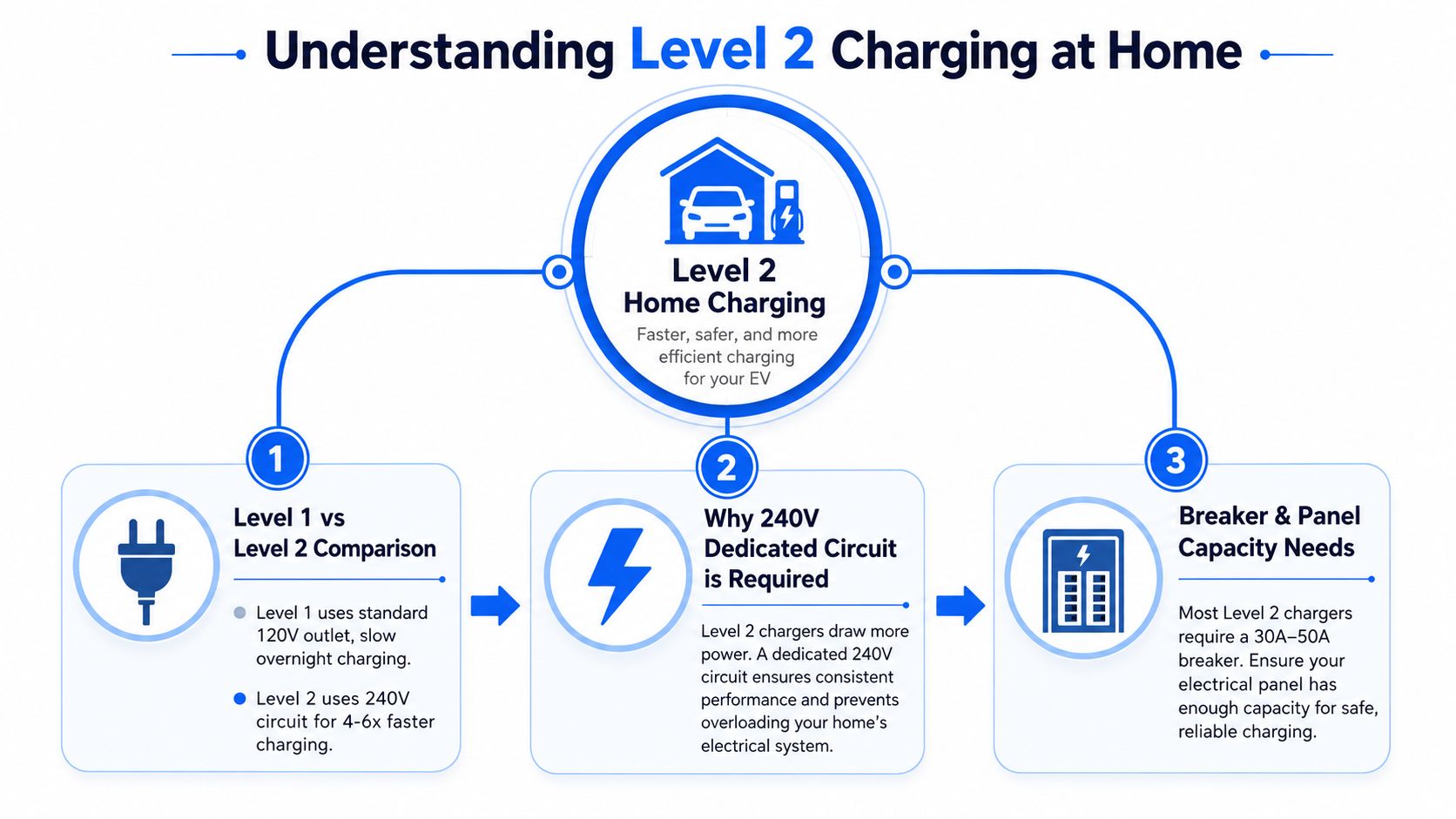
If you want a plain-language walkthrough of the wiring side, the overview of a 240 volt charging station helps connect the idea of faster home charging to the electrical circuit behind it.
A charger can sit on the wall for years, but the circuit feeding it has to be sized correctly from day one.
The key thing to remember is that Level 2 isn't difficult because the charger is complicated. It's difficult when the home's electrical system wasn't built with that load in mind. That's the point where a home charging project stops being a simple appliance install and becomes an electrical planning decision.
Breaking Down the Four Parts of Your Installation Cost
The biggest mistake homeowners make is treating the quote as one single number. In practice, the price usually breaks into four buckets, and each bucket can move independently depending on the home.
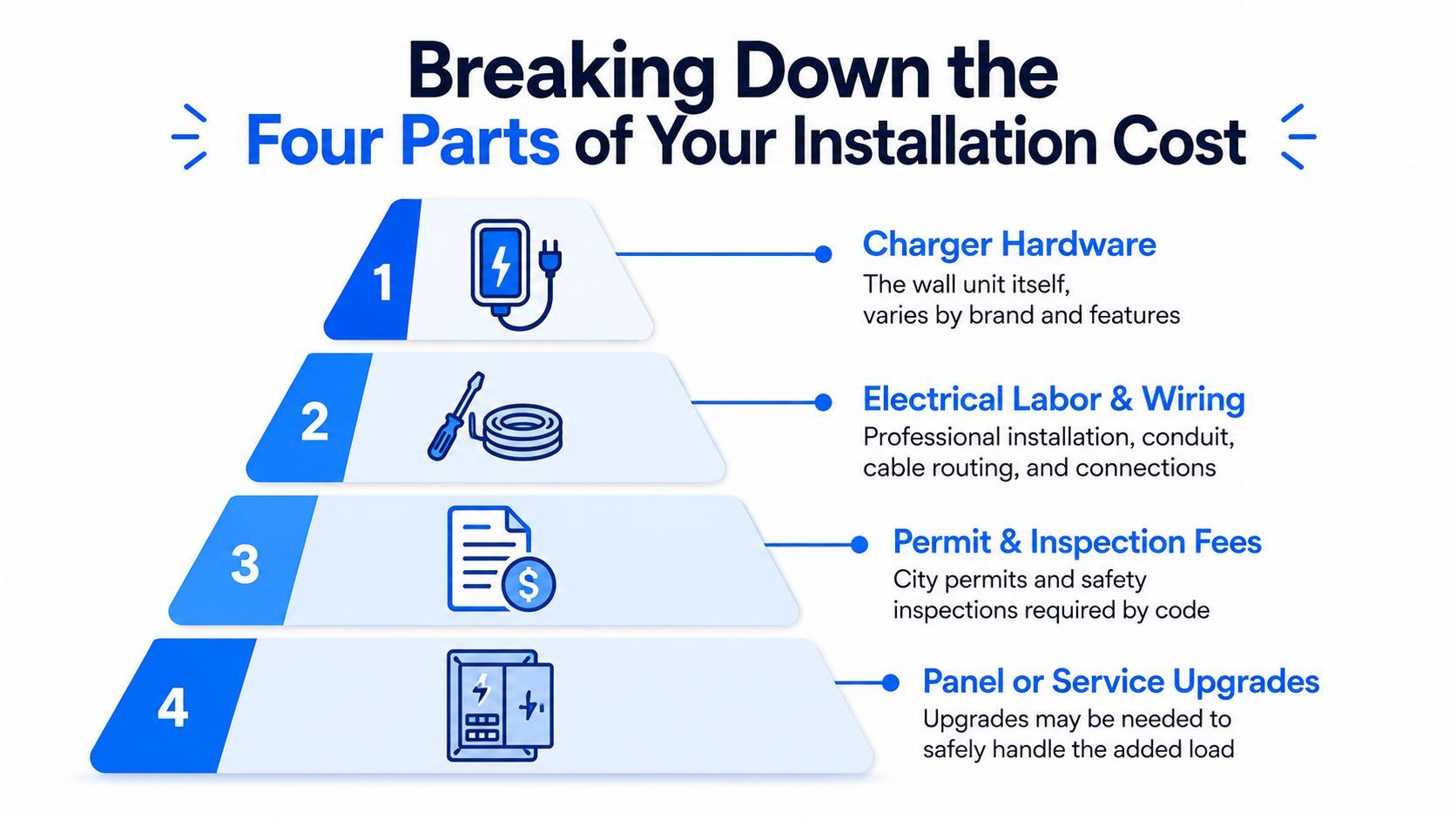
1. Charger hardware
The wall unit itself is often the smallest slice of the bill. Industry breakdowns place the charger unit around $300 to $800. That range depends on features, weather protection, and whether the unit is basic or more advanced. The point is simple, the box on the wall rarely explains why one quote is so much higher than another.
2. Electrical labor and wiring
Many projects start to stretch here. Typical electrical work can add about $400 to $1,500 or more, because the electrician may need to run a new circuit, pull wire, install conduit, and tie everything into the existing system. If the wiring path is short and clean, the job stays straightforward. If it crosses a finished space or a longer route, the labor changes fast.
3. Permit and inspection fees
Permits and inspections are smaller than the wiring bill, but they still matter. A typical residential EV circuit permit often falls around $50 to $300, and inspection fees can add $50 to $200 more. A national all-in permitting average near $297 shows that compliance isn't the headline cost, but it's still part of the total.
4. Panel or service upgrades
This is the part that changes everything. When the home's electrical service is undersized, a panel upgrade can add $1,000 to $4,000+. In some homes, that's the difference between a modest project and a major one. A home with spare capacity and a close panel can stay in the lower range, while a home that needs infrastructure work moves into a very different budget category.
For a deeper look at how service changes affect pricing, the discussion of electrical panel box replacement cost gives useful context on why panel work can dominate the budget.
Why the Same Charger Costs So Much More in Some Homes
Two homes can install the same Level 2 charger and get wildly different numbers. One garage sits a few feet from the panel, has spare capacity, and needs little more than a dedicated circuit. Another has a detached garage, a long wiring path, and an older service that needs upgrades before the charger can even be added.
Here's the practical comparison.
Cost Factor | Simple Install Near Panel | Complex Install With Upgrades |
|---|---|---|
Distance to charger | Short run, near the panel | Long run to garage or parking area |
Electrical capacity | Spare capacity available | Panel is near full or undersized |
Wiring and conduit | Minimal material and labor | More conduit, longer wire, more labor |
Permits and inspection | Standard compliance steps | More coordination and code work |
Overall project type | Straightforward add-on | Larger electrical project |
A short wiring run matters because electricians price time and materials together. Every extra foot of conduit, every wall opening, and every additional step in the route adds labor. A home that needs trenching or work to reach a detached structure can jump far beyond the baseline install.
Panel condition matters just as much. If the service is old, crowded, or already close to its limit, the electrician may need to rework the system before the charger can be added safely. That's why neighbors can own nearly identical EVs and still see very different quotes.
If the quote sounds high, ask what part of the electrical system is driving it. Most of the answer is usually in the panel, the wire path, or both.
The cleanest way to think about it is this, the charger is the easy part, the home is the variable. That's why one home gets a manageable quote and another gets a quote that looks more like a small renovation.
Do You Really Need a Panel Upgrade to Charge at Home
A lot of homeowners assume a panel upgrade is automatic, especially if the house is older. That isn't always true. Some homes can support Level 2 charging with a dedicated circuit, a subpanel, or a load-management device instead of a full service replacement.
The reason this matters is simple, you don't want to overbuild the electrical system if a smarter option already fits the house. Recent pricing guidance shows panel upgrades often add about $1,500 to $4,000+, but that doesn't mean every home needs one. In some cases, an electrician can design the charging setup around the home's actual load rather than defaulting to a bigger service upgrade.
The right question is not just whether the panel has space
Breaker space alone doesn't tell the whole story. A panel might have an open slot and still not have enough available capacity for a Level 2 charger running at the rate you want. The electrician looks at the whole home load, not just the empty spaces.
That's where alternatives can help. A load-management device can balance charging against other home usage. A subpanel can organize the new circuit more cleanly. A right-sized charging rate can keep the setup reliable without forcing a full rebuild of the service.
The wrong upgrade can cost more than it helps
A full upgrade can make sense when the home needs it, especially if the service is already maxed out or future loads are coming soon. But if the home has enough flexibility to support charging safely another way, a full replacement may be more expensive than necessary.
The most useful reference point here is the electrical panel upgrade for EV charging discussion, which highlights how newer approaches can avoid a full service change in some homes. That's the kind of nuance many homeowners need before they approve work.
The cheapest path isn't always the best value, but the most expensive path isn't always required either.
A good electrician should explain the tradeoff in plain language. If the answer is “yes, you need the upgrade,” you'll know why. If the answer is “not yet,” you'll know what alternative protects the home and still supports daily charging.
How to Budget and Plan Your Home Charger Project
A solid budget starts before the quote. If you can describe the home's electrical setup clearly, the electrician can give you a much tighter estimate and avoid padding the job for unknowns.
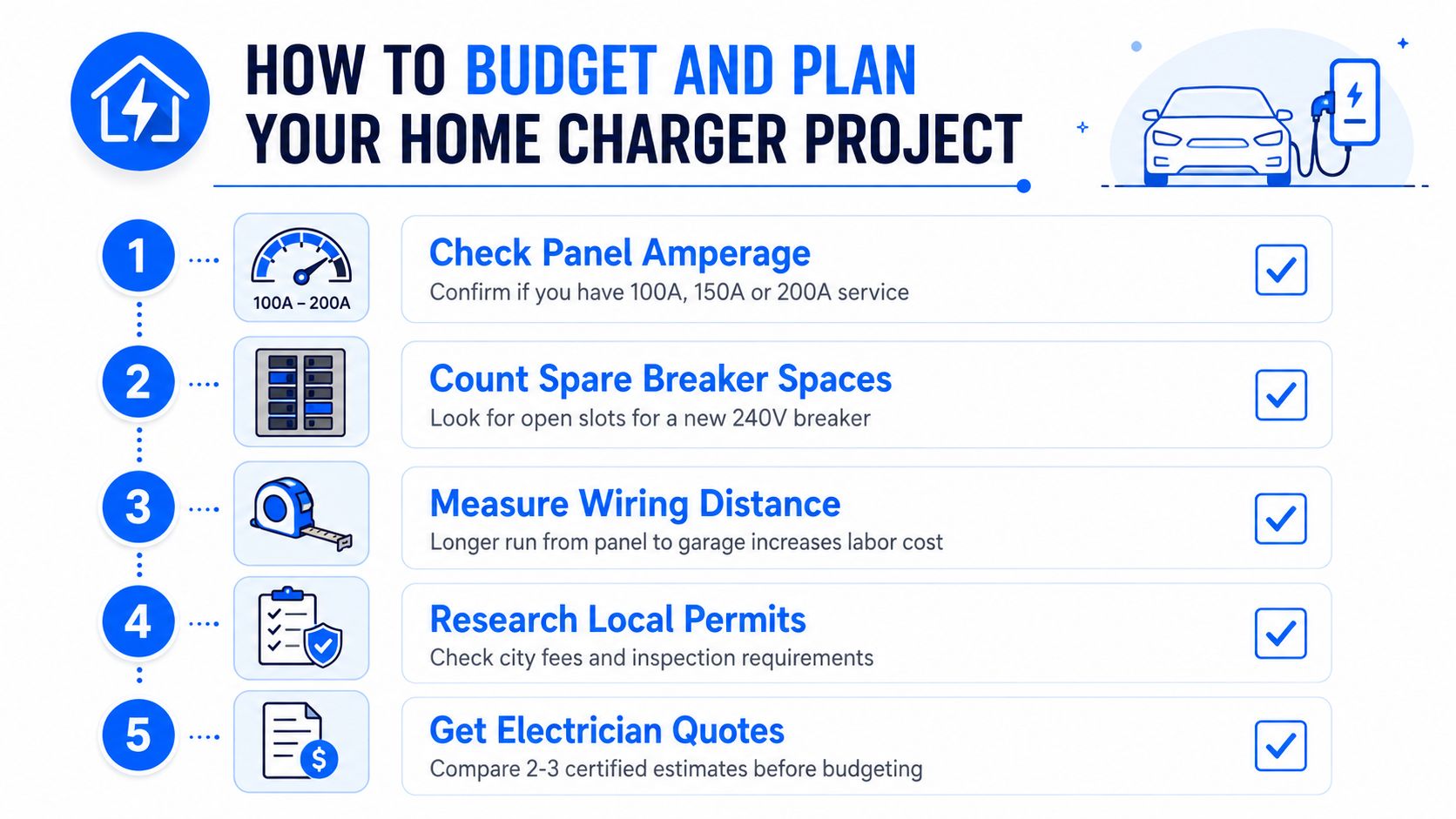
What to gather before calling for a quote
Check the panel rating: Open the panel door and note the service size if it's labeled. If you're unsure, ask the electrician to confirm whether the home has adequate capacity.
Look at breaker space: A new charger needs room for a dedicated breaker, and the available space can change how the work gets designed.
Measure the distance: Estimate the path from the panel to the parking spot. A short route usually means less labor, while a longer route means more wire and conduit.
Notice the route obstacles: Finished walls, tight crawl spaces, detached garages, and outdoor runs all change the project scope.
Ask about permits early: Local permit and inspection requirements can affect timing and cost, especially when the project needs coordination with the authority having jurisdiction.
For homeowners comparing options, the guide on EV charger installation certification is useful because it reinforces why licensed, code-aware work matters before any wiring starts.
A few photos help a lot. A clear shot of the panel, the garage or parking area, and the route between them gives an electrician a better first impression than a vague description ever will. If you're planning for a second EV, battery backup, or other heavy electrical loads later, say that up front so the system can be sized with the future in mind.
Budget for the home you have now, but ask questions that protect the home you'll need later.
That mindset keeps the project practical. It also prevents the common mistake of choosing a low quote that solves today's charging problem but creates a bigger one later.
Planning Your Next Step Toward Faster Home Charging
The answer to how much to install EV charger at home is not one price, it's a range shaped by your panel, your wiring distance, and your local permit process. A charger near the panel with spare capacity can stay in the low end, while a home that needs service work can move into a much larger budget.
The smartest quote is the one that separates hardware, labor, permits, and infrastructure clearly. That makes it easier to compare estimates and easier to see whether a panel upgrade is needed or whether a dedicated circuit, subpanel, or load-management approach will do the job.
If you're in Southeastern Pennsylvania and want a code-compliant plan before you commit to the work, Amp'd Energy Solutions handles EV charger installations, electrical service upgrades, and site assessments for future-ready home charging. A careful walkthrough now can save you from surprises later and help you size the project for the way you drive.
If you're ready to stop guessing at your installation cost, Amp'd Energy Solutions can help you review your panel, measure the wiring path, and plan a charger setup that fits your home. Reach out for a site assessment, and get a clear plan before you buy the hardware or schedule the install.
Comments