

How Many Batteries to Power a House: A Sizing Guide
Most homes need one 10 kWh battery to hold the essentials for about 10 hours, three to carry a full average day of consumption, and four or more once electric heat, EV charging or whole-home backup joins the load list. The count isn't a property of the house. It's a property of the outage you're planning for, which is why two neighbors on the same street with near-identical floor plans can land on very different numbers.
So here's the question that exposes the gap in most sizing advice: how many batteries to power a house, when the only inputs anyone asks for are square footage and a monthly bill? Neither tells you which circuits stay live at 2 a.m. in February. That answer sets the count, and it comes from your load list, your outage target and the surge your motors demand. What follows walks the same path an electrical planner does, from annual energy use down to a single number of batteries, explaining each term the first time it appears.
Table of Contents
Battery Count for Each Backup Scenario - What the table counts and what it leaves out
Energy Capacity, Power Output and Surge Limits - Why a surge can outweigh a full battery - The three checks every design has to survive
How to Calculate Your Critical Load - Reference values for common loads
Worked Example for a Pennsylvania Home - What the national modeling shows
Battery Count for Each Backup Scenario
Start with the scenario that matches your outage goal, not with the size of your house. Every row below uses a 10 kWh battery as the unit so the arithmetic stays visible.
Backup scenario | Battery count (10 kWh units) | Expected runtime |
|---|---|---|
Essentials only, about 1 kW average | 1 battery (10 kWh) | About 10 hours |
Essentials plus well pump and refrigeration, about 2 kW average | 2 batteries (20 kWh) | About 10 hours |
Half of an average day, about 15 kWh | 2 batteries (20 kWh) | About half a typical day, with spare capacity |
Full average day, about 29 kWh | 3 batteries (30 kWh) | About one typical day |
Electric heat, EV charging or whole-home backup | 4 or more batteries | Set by the load calculation and inverter capacity |
Read the first row as the simplest case. Essentials such as lights, a refrigerator and internet average around 1 kW, and 10 kWh of stored energy carries that load for roughly 10 hours. Add a well pump and a second refrigeration cycle and the average doubles to about 2 kW, so the same 10 hours now costs two batteries. Nothing about the house changed. The load list did.
The national numbers explain the shape of the table. A typical U.S. home uses approximately 10,500 kWh of electricity per year, which works out to about 875 kWh a month or roughly 29 kWh a day (U.S. Energy Information Administration). Against that baseline, one 10 kWh battery covers about one-third of an average day and two cover about two-thirds.
What the table counts and what it leaves out
That one-third and two-thirds arithmetic is a sanity check, not a design. Real runtime shifts with heating and cooling, electric water heating, cooking, refrigeration, well pumps, medical equipment and EV charging, and those loads don't spread evenly across a day.
The 10 kWh figure is a comparison unit, not a product rating you'll find on every box. Batteries come in different sizes, and the usable number quoted after reserve and conversion losses is smaller than the nameplate. Plan with the usable figure and each row's runtime gets shorter, not longer.
Practical rule: find the row that matches your outage goal, treat its count as your opening bid, then check it against surge and panel limits before anyone quotes equipment.
Peak power is a separate question from stored energy, and it's the one that catches people out, so it gets its own treatment next. If you're weighing storage against a fuel-burning unit, this comparison of battery backup versus a generator covers the trade-offs.
Energy Capacity, Power Output and Surge Limits
A battery's energy rating and power rating answer different questions. Kilowatt-hours (kWh) measure how much energy it stores, like water in a tank. Kilowatts (kW) measure how quickly it can deliver that energy, like the width of the pipe. A wide pipe cannot make a small tank last longer, and a large tank cannot run appliances that demand more power than the pipe can carry.
For example, a 10 kWh battery serving a 1 kW load lasts about 10 hours. The same battery serving a 5 kW load lasts about 2 hours. These are simple estimates: actual runtime depends on usable capacity and losses.
A 2024 peer-reviewed study of U.S. residential solar-plus-storage systems used a default battery rated at 10 kilowatt-hours of energy and 5 kilowatts of power, for a 2-hour duration (IOP Science). The duration follows from dividing stored energy by output: at full rated power, 10 kWh supplies 5 kW for two hours.
Why a surge can outweigh a full battery
A battery system must meet both the total energy demand, measured in kWh, and the instantaneous power demand, measured in kW. Starting a sump pump, well pump, refrigerator compressor, air-source heat pump or air-conditioning compressor can briefly require much more power than the appliance uses while running (U.S. Energy Information Administration).
A system may have enough stored energy for the night and still trip when a well pump starts. The inverter, which converts battery power for household use, must be able to supply that short surge as well as the other loads running at the same time.
A battery can hold enough energy for the whole night and still stall on a well pump. Energy and power are separate tests, and a design has to pass both.
The three checks every design has to survive
Continuous output and surge against calculated peak. The inverter's steady rating must cover the running load, while its surge rating must cover a motor starting alongside other active appliances.
Service-panel limits. Backup circuits must fit the existing panel and transfer equipment. If they do not, a panel upgrade may add cost.
Winter and summer cases. Heating and cooling are the largest residential electricity uses, according to EIA data on household electricity use. Model both seasons because each can put different demands on the system.
An installer who measures or estimates 15-minute demand can get a better picture of peak use than a monthly bill provides. That shorter interval can reveal appliances cycling together, which an annual total does not show.
Compare both ratings for each battery under consideration: its stored energy in kWh and its power output in kW. Then check the inverter's surge rating against the largest starting load. Confirm the inverter's surge rating before you commit to a battery count, and see how a home battery inverter sets the power ceiling to understand how that rating works.
How to Calculate Your Critical Load
Everything so far has been preparation. The actual method fits on an index card, and doing it once gives you two numbers, a peak in kW and an energy total in kWh, that together fix the battery count.
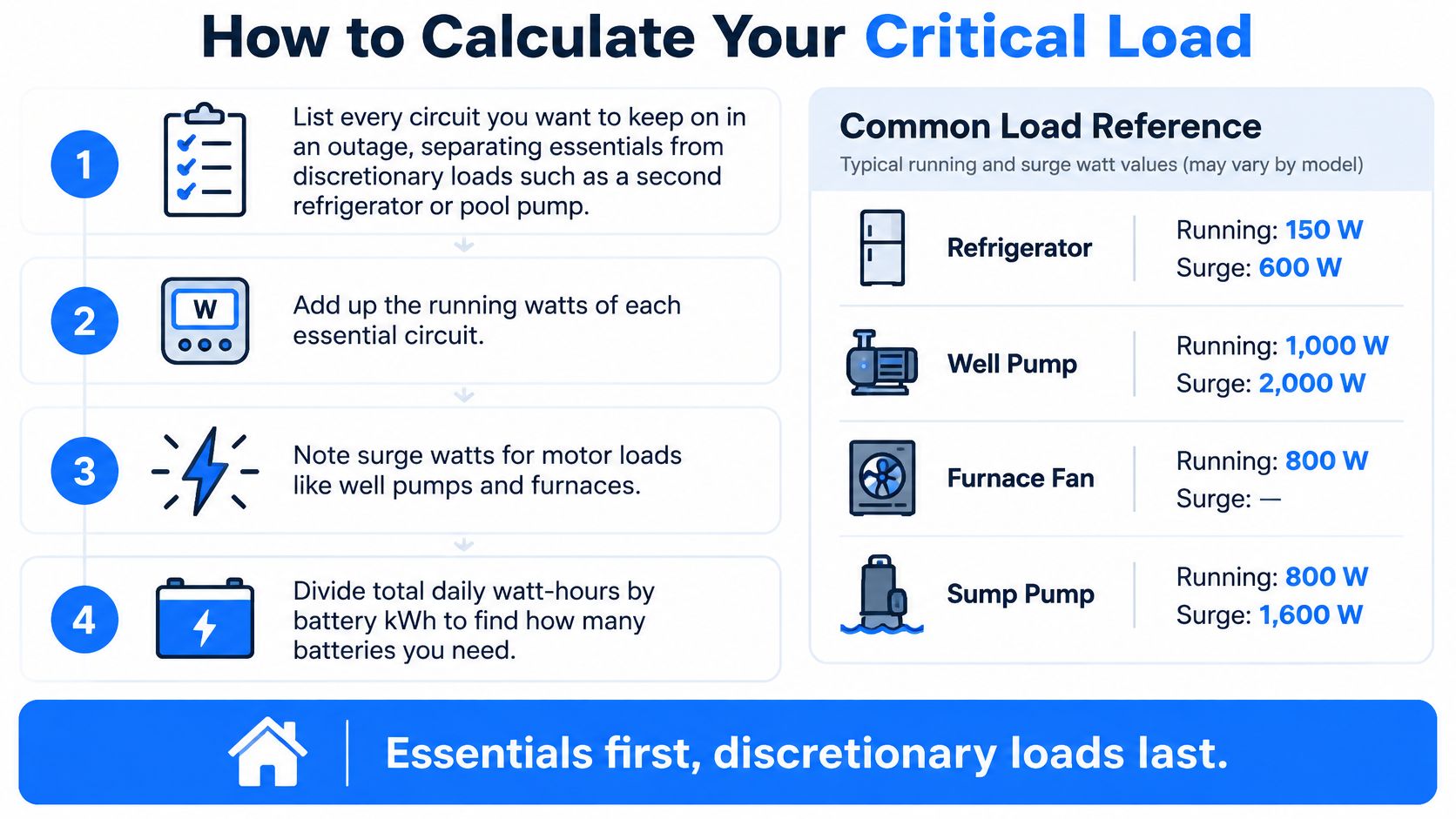
List every circuit you want live during an outage. Walk the panel with a notebook and split the list into essentials and discretionary loads such as a second refrigerator or pool equipment. Circuits you skip get forgotten, and forgotten circuits are how systems end up undersized.
Read the nameplate or manual for each appliance. Record running watts and, for anything with a motor, the starting amps. Nameplate watts usually sit above real running draw, so treat the label as a ceiling rather than a forecast.
Add the running watts into one average kW figure. Divide the total by 1,000. This is your power number, and it decides the inverter, not the battery count.
Convert each circuit into daily energy in kWh. Multiply its kW by the hours it runs during an outage, then add the circuits. A refrigerator cycles rather than running flat out for 24 hours, which is why it draws far less energy than its nameplate suggests.
Add a surge allowance for the biggest motor start. Take the largest single startup and stack it on top of the running total. Motors pull several times their running current for a second or two, and that instant is what the inverter has to survive.
Multiply by your outage target and divide by usable kWh per battery. A 1.5 kW critical load across a 12-hour outage is 18 kWh. Assume roughly 9 kWh usable per 10 kWh unit once reserve is held back, and you need two batteries. Always round up.
Reference values for common loads
Use these as starting estimates and replace them with real readings where you can.
Load | Startup surge | Planning note |
|---|---|---|
LED lighting and internet | None | Low draw, easy to keep on |
Refrigerator | About 600 W | Runs near 150 W and cycles, roughly 1 to 2 kWh per day |
Well pump (1 HP) | About 2 kW | Runs near 1 kW, so check the pump nameplate |
Sump pump (1/3 HP) | 1 to 2 kW | Cycles on and off in short bursts, often during the storm that caused the outage |
Central air conditioning (3 ton) | About 4 to 5 kW | Largest surge in summer, and a soft-start kit reduces it |
Electric resistance heat | No surge, steady high draw | Often the largest winter load because it runs for hours |
Electric water heater | None | Heats in bursts and can be scheduled off during an outage |
An installer with a demand logger can measure actual 15-minute demand instead of estimating, which matters most in homes with heat pumps, well pumps or electric heat.
When you're done, you should be holding two numbers: the average kW your backup circuits draw and the kWh they'll consume over your chosen outage length. Divide the second by usable battery capacity and you have your count. If you'd rather see the panel-side arithmetic in more detail, electrical load assessment calculations shows how the service numbers come together.
Worked Example for a Pennsylvania Home
How many batteries does one Pennsylvania home need for a 12-hour outage? The answer depends on which appliances the household wants to run, not the home's square footage. Consider a 2,000-square-foot colonial with a gas furnace, a well pump and no EV.
Case A: basic backup. The homeowner wants the furnace blower, refrigerator, lights, internet and well pump. Together, these loads average about 1.5 kW because the blower and pump cycle on and off. Over 12 hours, that adds up to 18 kWh. If each 10 kWh battery provides about 9 kWh of usable energy, two units supply 18 kWh, with no margin for extra use or longer outages. Three units would provide more breathing room. The well pump's startup surge also needs to fit within the inverter's power rating.
Case B: backup that includes electric heat. The same household also wants electric resistance heat during a winter outage. Its average load rises to about 3.5 kW, or 42 kWh over 12 hours. Four batteries provide about 36 kWh usable, which falls short. Five provide about 45 kWh usable, so this scenario calls for five units and an inverter sized for the higher power demand.
Case | Average critical load | Energy over 12 hours | Battery count |
|---|---|---|---|
Case A, gas furnace blower, refrigerator, lighting, internet and well pump | 1.5 kW | 18 kWh | 2 batteries (18 kWh usable), with no margin |
Case B, Case A plus electric resistance heat in winter | 3.5 kW | 42 kWh | 5 batteries (45 kWh usable) |
Same house, same outage length, different backup plan. The gap is one comfort decision, and the worksheet makes that decision visible.
What the national modeling shows
Lawrence Berkeley National Laboratory found that a 10 kWh solar-plus-storage system could meet basic backup needs during a three-day outage in virtually all U.S. counties when heating and cooling were excluded. When those loads were included, a 10 kWh system served about 86% of modeled critical load on average, while 30 kWh served about 96%, according to Berkeley Lab's study of backup power needs.
The difference between those results is a trade-off between battery capacity and the amount of heating or cooling available during an outage. Whether that added comfort is worth the extra capacity depends on the household's priorities.
The same analysis found required capacities ranging from roughly 10 kWh in Los Angeles to 90 kWh in Dallas–Fort Worth and Phoenix, as reported in Berkeley Lab's study of backup power needs. Results depend on the home, climate, outage timing and equipment selected for backup. Identical outage goals can therefore lead to very different battery counts.
Pick the outage target before the equipment. A 12-hour plan, a 24-hour plan and a three-day plan produce different counts. The count only makes sense once the outage duration is set.
Sizing Mistakes That Lead to Too Few Batteries
The mistake that causes more undersizing than any other is sizing by square footage. Square footage tells you nothing about whether the house heats with gas or resistance coils, and that single fact can double or triple the count.
The rest cluster around the same habit, which is measuring the wrong thing.
Planning from a monthly kWh average. A battery system isn't normally sized to reproduce an entire month of grid consumption. The average U.S. residential customer used 10,791 kWh in 2022, or roughly 899 kWh per month and about 30 kWh per day, and EIA projections for June through August 2023 put typical residential use near 1,100 kWh per month, with some hot regions reaching about 1,490 kWh (U.S. Energy Information Administration). The fix is to convert to your outage target and critical load instead of chasing a monthly total.
Ignoring surge. A design that covers running watts but not the largest motor start will trip on the first well pump cycle. Compare the biggest startup against inverter output before you buy.
Forgetting the EV charger. Decide whether the car charges during an outage. Say a Level 2 charger pulls 7 kW; that alone empties a 10 kWh battery in about an hour and a half, so it usually belongs on the discretionary list.
Treating nameplate kWh as usable. Subtract reserve and conversion losses. A 10 kWh unit delivering 9 kWh changes your count at the margin.
Planning only for summer. Air conditioning gets all the attention, but winter heating can dominate, and the ice storm that takes the grid down is the same storm that pushes the furnace to run for days.
Assuming the battery stays at rated capacity. Every unit loses capacity with age, so a count that just barely works on day one won't work in year ten.
Assuming solar will refill it. Several consecutive cloudy days can leave a battery flat when the next outage arrives, and no amount of panel wattage fixes a week without sun.
A battery that dies at hour eight of a twelve-hour outage is worse than no battery at all, because you built the whole plan around it.
Rounding up costs money once. Undersizing costs you every outage for the next fifteen years.
Confirm Your Battery Count Before You Buy
Bring five things to the site visit and the conversation stays short. Your circuit list from the critical-load steps. The nameplate data for your largest motors. Your outage target in hours. The service panel size. And whether the house heats with gas or electricity, since that single answer moves the count more than any other.
Then put four questions to whoever quotes the job, and write the answers down.
Does the design check surge and inverter capacity against my largest motor start? A count without a power check is half a design.
How are permitting, testing and commissioning handled? A battery that's installed but never tested under load is an unknown quantity on the day you need it. Amp'd Energy Solutions handles system design, permitting, installation and testing for battery backup projects, and our electricians are licensed.
Does the count cover my winter case as well as my summer case? Ask for both, and ask which loads were assumed for each.
What usable kWh is quoted after reserve and conversion losses? Compare that figure against your own worksheet numbers rather than the nameplate on the spec sheet.
Line every answer up against the two numbers you calculated: average kW and total kWh. If a quote's battery count implies a lower load than your worksheet shows, find out which circuits were dropped before you accept it.
Get it in writing. The outage target, the backed-up loads and the battery count should all appear on the proposal, not just in the conversation.
A count you can defend beats a count you were handed.
Amp'd Energy Solutions designs and installs battery backup systems for homes across Southeastern Pennsylvania, sizing the system to your circuits and your outage target rather than a rule of thumb. In a free consultation, our team walks you through your options and helps you choose a backup system that fits your property, budget and peace of mind, then handles permitting, installation and testing. Visit Amp'd Energy Solutions to book a site assessment and get your battery count confirmed in writing.
Comments