

Automatic Transfer Switch Residential: How It Works
You just sat through another evening watching the porch lights flicker while wind rattled the utility lines down the street. Maybe you're already shopping for a standby generator or home battery, and every quote includes a separate metal cabinet called an automatic transfer switch. It looks like an extra box bolted next to your breaker panel, so it's easy to wonder whether it's just a pricey convenience option.
It isn't. Choosing an automatic transfer switch residential electrical systems can safely rely on is a core safety and system-architecture decision, not an outage-time accessory. The switch decides when your house disconnects from the electric utility, how your backup source starts and takes over, and whether your wiring stays safe for both your family and the utility workers restoring power down the block.
Extended blackouts are common enough that backup planning has become routine for many homeowners. According to the 2023 American Housing Survey by the U.S. Census Bureau, roughly 33.9 million households, or about 1 in 4 nationwide, experienced a complete power outage during the 12 months before being surveyed. Among those affected households, roughly 70%, or 23.6 million homes, reported at least one interruption lasting six hours or longer. Getting the transfer switch right is what turns a generator or battery sitting outside into dependable power inside your walls.
Table of Contents
What an Automatic Transfer Switch Does in a Home - Three Connections Inside the Cabinet
How the Switch Hands Power to a Generator and Handles Brownouts - Transfer Timing and Sensitive Electronics - Why Brownouts Challenge Transfer Switches
Transfer Types and Which One Fits a Home - Matching the Switch Category to Your Loads - System Architecture Decides the Switch Type
Ratings to Check Before You Buy - Specification Checklist for Residential Service - Sizing Beyond the Generator Nameplate
Installation, Neutral Wiring and Safety Checks - Placement and Neutral Bonding in Mixed Backup Systems - Interlocks, Load Management and Code Compliance
Confirm Your Transfer Setup Before the Next Outage - When to Schedule a Professional Assessment
What an Automatic Transfer Switch Does in a Home
A residential automatic transfer switch (ATS) is the electrical control point that moves your home's load from utility power to a standby generator when normal service fails, while making it physically impossible for generator electricity to flow back onto utility lines.
Think about a freezing January night when heavy ice snaps a distribution line two streets over. The living room goes dark, the furnace blower winds down, and the house starts losing heat within the hour. Even if you have a standby generator parked outside with a full fuel line, that machine can't safely power a single light or circuit on its own. Without a transfer switch sitting between the utility feed and your home's electrical panel, there is no controlled bridge to carry backup electricity inside.
The cleanest way to picture an ATS is as a railway switch on a train track. A railway switch directs a train onto one set of rails at a time so two trains can never share the same stretch of track. Your transfer switch performs that exact job with electricity, keeping utility power and generator power strictly separated while routing one safe source to your household circuits.
A typical residential installation places the switch cabinet directly beside the main service panel, creating a clean layout for inspection and service.
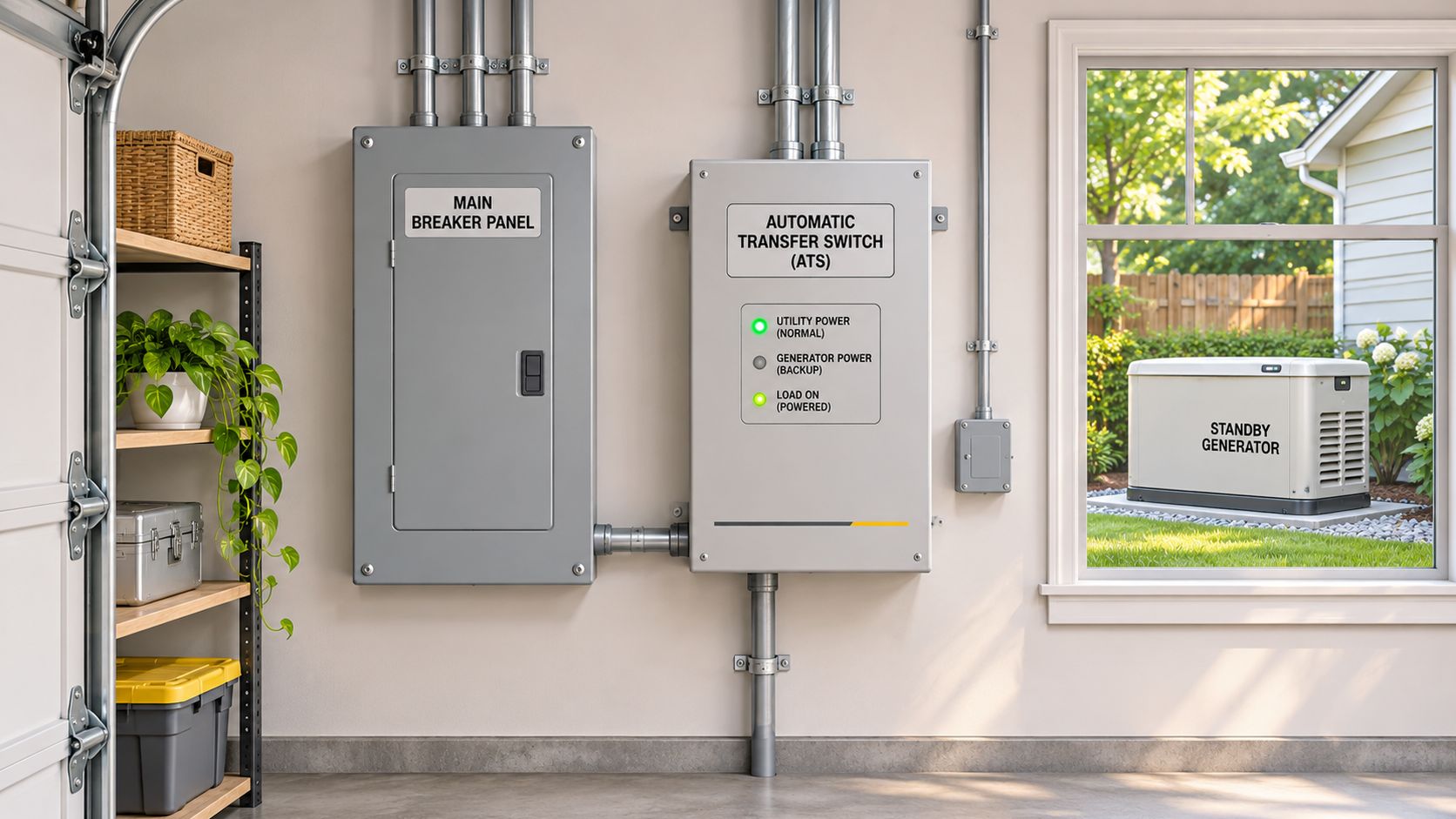
Three Connections Inside the Cabinet
Open a wiring diagram for a residential ATS and you'll see three main power paths meeting inside one enclosure:
Utility Input: The normal power feed coming from your electric meter and the utility grid.
Emergency Input: The backup power feed arriving from your standby generator.
Load Output: The conductors leaving the switch to energize either your entire main breaker panel or a dedicated critical-load subpanel.
Under the National Fire Protection Association's NFPA 110 standard, which covers complete emergency and standby power systems including transfer equipment and controls, an automatic transfer switch "continuously monitors normal power and transfers the load to the emergency supply during an outage." First issued in 1985 with its current 2025 edition issued on April 22, 2024, NFPA 110 also distinguishes automatic, delayed-automatic, and manual transfer switches to account for different load characteristics and response needs.
A transfer switch exists first to protect human life, and second to keep the lights on.
That distinction matters whenever homeowners confuse backup components. An ATS prevents backfeeding, a hazardous condition where generator power travels backward through your meter and energizes dead utility lines where line crews are working to repair storm damage. Just as important, understand what the switch is not: it's not a generator, it doesn't store energy like a battery, and it isn't a surge protector. NFPA 110 guidance also specifies that automatic transfer switches include a testing method capable of simulating failure of the normal source, allowing you or your installer to verify automatic switching before a real blackout arrives.
Before going further with equipment quotes, answer two practical questions about your home. First, do you already have a standby generator installed, or are you planning one? Second, do you have open, accessible wall space right next to your existing service panel where a transfer switch cabinet can safely mount?
How the Switch Hands Power to a Generator and Handles Brownouts
Homeowners often expect an automatic switch to make utility outages invisible. The equipment works more like a careful doorman than a light switch: before it lets a single watt of generator power into your home, it verifies the outage, wakes the engine, and waits for voltage it can trust.
Before any mechanical contacts move inside the cabinet, the controller handles two continuous sensing tasks that separate real outages from harmless grid flickers.
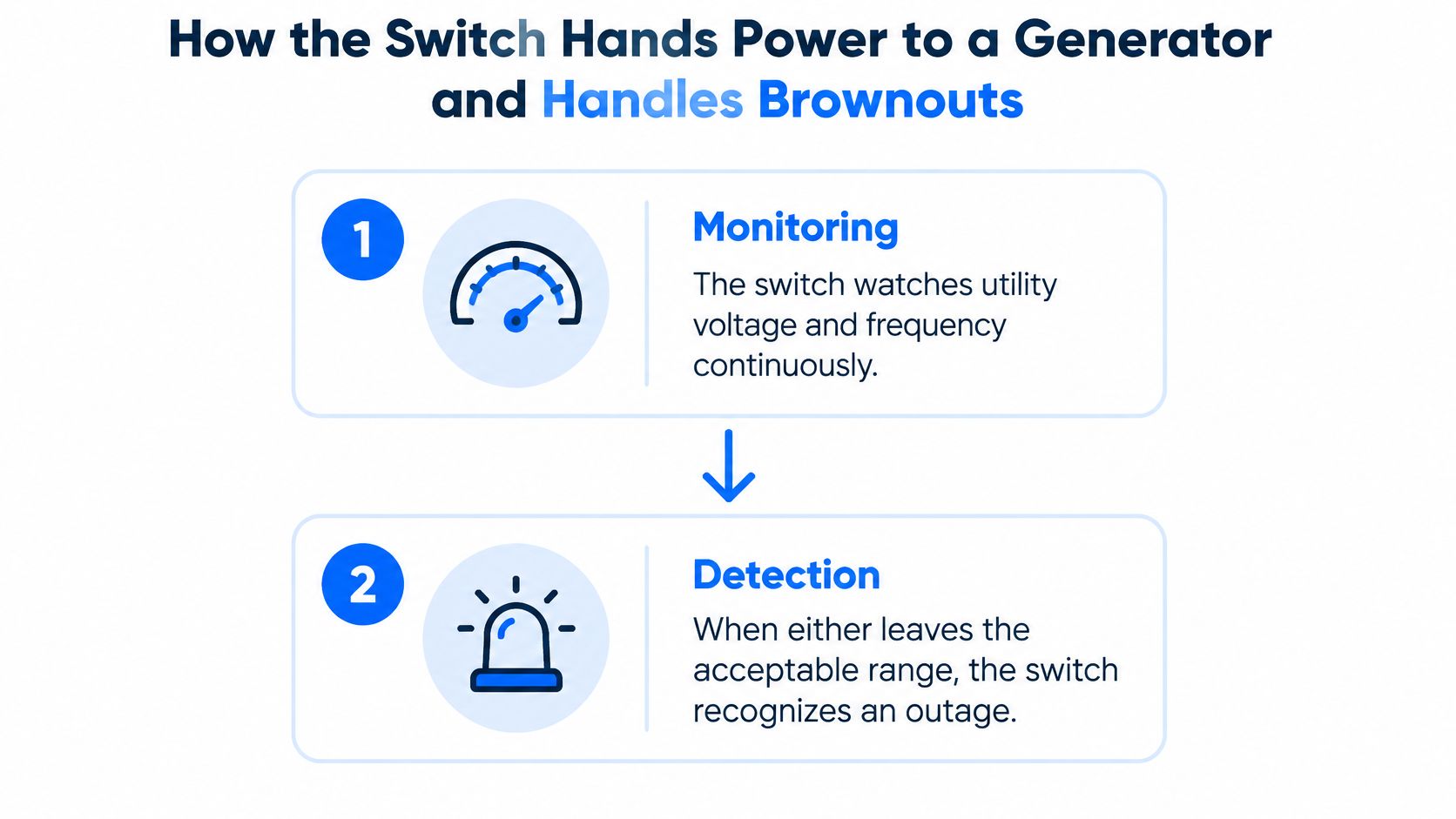
Once normal utility power drops out, a generator-backed residential ATS walks through seven steps in order:
Monitoring: The internal controller watches incoming utility voltage and frequency continuously so it catches a problem the moment it starts.
Detection: When voltage or frequency falls outside the acceptable range, the switch waits briefly to confirm a genuine outage rather than reacting to a split-second grid blip.
Disconnect: The switch separates your home's circuits from the utility supply before connecting backup power so the two sources never meet.
Start Signal: The controller sends a low-voltage start command to the standby generator so the engine cranks automatically without anyone walking outside.
Warm-Up: The switch holds off while the engine climbs to steady speed, voltage, and frequency, which takes the longest share of the outage window. Our guide to how a standby generator works explains what the engine is doing during that span.
Transfer: Once backup electricity stabilizes, the switching mechanism closes onto the generator feed and restores power to your connected circuits.
Retransfer and Cool-Down: After utility power returns and holds steady through a programmed confirmation timer, the switch moves your home back to the grid and lets the generator run unloaded for a cool-down cycle before shutting off.
That order never changes. The switch will not skip warm-up to save time, because feeding unstable generator voltage into your home would trade one problem for another.
Transfer Timing and Sensitive Electronics
Understanding where the time goes during that sequence clears up a major source of confusion between generators and home batteries. According to the Minnesota Department of Health's NFPA 110 generator guide, emergency power systems are classified by maximum restoration time: a Type 10 system must restore power within 10 seconds, and once the alternate source is up to speed, common residential and light-commercial ATS units can move between sources in about 100 milliseconds, while motor-operated switching mechanisms can take up to one-quarter second for the mechanical cycle itself.
Stage or Standard | Typical Timing Value | What Happens in Your Home |
|---|---|---|
NFPA 110 Type 10 restoration class | Within 10 seconds | Maximum window to detect failure, start the engine, and restore emergency power |
Source-to-source transfer (alternate source ready) | About 100 milliseconds | Rapid electrical contact movement once generator output stabilizes |
Motor-operated switching cycle | Up to one-quarter second | Mechanical travel time for motor-driven switch contacts to change position |
Generator warm-up and stabilization | Several seconds | Engine cranks, builds speed, and stabilizes voltage before taking household load |
The math can be surprising. The actual contact movement is nearly instant; the engine start is what eats the clock. Even with a fast transfer mechanism, a generator-backed home still experiences a dark period lasting several seconds while the engine cranks and stabilizes. During that brief gap, desktop computers, Wi-Fi routers, home medical devices, and certain digital HVAC thermostats will lose power and reboot. If those devices need uninterrupted electricity, pair them with a small plug-in uninterruptible power supply (UPS) or consider a battery backup system designed to provide no-break backup rather than expecting a generator ATS to eliminate every blink.
Why Brownouts Challenge Transfer Switches
A total blackout is easy for a switch to read. Voltage drops to zero, the controller acts, and power transfers cleanly. A brownout, where utility voltage sags below normal without shutting off completely, is much trickier for residential equipment.
As a guide to residential transfer switches explains, many household ATS units may initiate a transfer during a brownout or a repeated momentary disturbance. When voltage dips and recovers erratically, motor-driven appliances like heat pumps, air-conditioning compressors, well pumps, battery chargers, and networking gear can face rapid cycling or under-voltage stress that shortens equipment life. Careful system setup addresses this through voltage-sensing thresholds, compressor restart intervals, and load shedding that delays or disables heavy draws like EV chargers during backup operation.
Practical rule: Source isolation and automatic transfer are not power conditioning. An ATS keeps utility and generator power safely apart, but it will not regulate sagging utility voltage or shield delicate electronics from brownouts on its own.
The right switch is not automatically the one bundled in a generator kit, so plan around your actual household loads before finalizing equipment. Take a quick inventory of your home today: which specific devices or medical loads cannot wait roughly 10 seconds for backup power to arrive?
Transfer Types and Which One Fits a Home
Transfer switches fall into three distinct operating categories. Putting them side by side makes it clear that the right model depends on your daily schedule, your appliances, and the backup equipment you plan to run.
Type | How it transfers | Best fit | Trade-off |
|---|---|---|---|
Automatic | Senses outage, starts generator, transfers after warm-up | Away-from-home owners, overnight outages, refrigeration or medical needs | Needs a tested automatic generator and a working start signal |
Delayed-automatic | Adds a timed pause before transfer so motors and compressors settle | Homes with heat pumps, well pumps or sump pumps | Longer dark period before transfer; the delay setting must be verified |
Manual | Homeowner moves a lever or breaker to connect the generator | Budget installs, short outages, occupants who are home | Needs someone present who can start the generator by hand |
Matching the Switch Category to Your Loads
Each option solves a different household problem, and picking the wrong category creates frustration when bad weather hits.
An automatic switch fits homeowners who travel, sleep through overnight storms, or rely on continuous refrigeration, sump pumps, or home medical gear. Because the unit senses the outage and handles startup on its own, your basement stays dry and your freezer stays cold even when nobody is in the driveway.
A delayed-automatic switch uses the same hands-free logic, except it inserts a brief, deliberate pause in the neutral-off position between disconnecting one source and closing onto the next. Spinning electric motors generate residual voltage for a split second as they coast down. Giving heat pumps, well pumps, and sump pumps that extra moment to settle prevents harsh electrical and mechanical jolts when the alternate source connects.
A manual transfer switch keeps equipment costs lower and works reliably with portable generators when someone is physically present to roll the unit outside, plug in the heavy cord, start the engine, and flip the switch handles. That simplicity comes with an obvious limitation: if the power dies while you're at work, out of town, or unable to step out into freezing rain, the house stays dark.
System Architecture Decides the Switch Type
Homeowners sometimes treat manual versus automatic switching like choosing cabinet hardware, assuming any switch pairs with any generator. In practice, your generator's control system dictates what the switch can do. A portable pull-start generator lacks the integrated start logic and control wiring an automatic switch expects, so bolting an ATS onto the wall won't make a portable unit self-starting. Conversely, pairing a permanently piped standby generator with a manual switch strips away the core reason you bought a standby machine in the first place.
Use these plain decision rules when weighing your options:
Occupied Home with Short Outages: A manual transfer switch paired with a portable generator handles occasional daytime outages when an able adult is always nearby to operate it.
Overnight Storms or Frequent Travel: A standard automatic switch keeps essential systems running without requiring anyone to brave bad weather or wake up at 2 a.m.
Motor-Heavy Mechanical Systems: A delayed-automatic configuration gives high-inrush motors like heat pumps, air compressors, and deep well pumps a safer transition between sources.
One mistake shows up constantly in residential backup projects: buyers choose the least expensive manual switch to trim upfront cost, then leave their generator untouched in the garage during an overnight storm because nobody wants to haul cords through sleet in the dark. Match the switch to how you live, not to the best-case sunny afternoon scenario.
Ratings to Check Before You Buy
If you check only one number on a transfer switch specification sheet, make sure it isn't just the amperage. Selecting a switch solely because its amp rating matches your main breaker panel is the most common specification oversight in residential backup installations.
According to an automatic transfer switch selection white paper, a residential ATS must carry a UL 1008 withstand-and-close-on rating (WCR) at least equal to the available fault current at the exact point where the switch is installed. WCR measures the massive short-circuit current the switch contacts can safely close onto and endure without welding shut or failing violently before the upstream breaker or fuse trips clear. A 200 A transfer switch can easily handle your home's everyday continuous load and still be unsafe if your electric utility can deliver a higher short-circuit fault current than the switch is rated to withstand.
Before approving equipment, a qualified installer obtains the available fault-current value from the local electric utility or an engineer. From there, the electrician verifies voltage, pole configuration, and coordination with your existing main service disconnect and the generator's output breaker.
Specification Checklist for Residential Service
Review these seven specifications with your electrician before ordering transfer equipment.
Specification | What it controls | What to verify |
|---|---|---|
Ampere rating | Continuous current the switch carries | Matches the service size (100 A, 200 A or 400 A) or the selected critical-load panel |
WCR (UL 1008) | Fault current the switch can withstand and close onto | At least the available fault current at the installation point, from the utility or engineer |
Voltage | Supply configuration of the home | 120/240 V split-phase in most homes; confirm against the service |
Poles | Number of conductors the switch transfers | Two-pole for 120/240 V residential service; confirm in the design |
Transfer type | Automatic, delayed-automatic or manual | Matches the generator controls and household motor loads |
Enclosure rating | Protection from weather and location | Indoor listing for utility rooms; NEMA-rated outdoor housing for garages or exterior walls |
Generator breaker and disconnect | Compatibility with the switch and service | Confirmed in the one-line diagram before installation |
Sizing Beyond the Generator Nameplate
Two practical sizing details often trip up homeowners reviewing electrical proposals. First, most U.S. homes operate on 120/240 V split-phase service, which calls for a two-pole switch (or a three-pole configuration only when the neutral must be switched, depending on grounding design). Second, location dictates the cabinet itself: a dry basement utility room allows an indoor enclosure, whereas a damp garage or exterior siding wall requires a properly rated outdoor NEMA housing that seals out rain and dust.
Always follow this core sizing rule: size the transfer switch to match either your home's full electrical service rating or the dedicated critical-load subpanel it feeds, never to the generator's kilowatt nameplate alone. Even a modest standby generator backing up selected circuits can sit downstream of a larger service panel, and the switch must safely carry the continuous current of the circuits passing through it. Running your household appliances through a whole-house generator sizing calculator helps clarify whether a whole-service switch with load management or a targeted critical-load panel fits your electrical demand best.
Keep your panel documentation up to date as your home evolves. Adding solar panels, a home battery system, an EV charger, or a service upgrade changes the electrical paths and protective arrangement, so your electrician should verify the protection settings and update equipment labels whenever new major gear joins the service.
Installation, Neutral Wiring and Safety Checks
Installing a transfer switch puts a second live power source at the nerve center of your house. Treat it as a safety exercise first and a wiring job second, and the work falls into a clear sequence: physical layout, grounding design, mechanical protection, and code compliance.
Placement and Neutral Bonding in Mixed Backup Systems
Every clean installation starts with site selection. Your electrician looks for a dry, reachable spot beside the main service panel with a clear conduit path to the outdoor generator pad, leaving the required working clearance in front of the enclosure so anyone inspecting or servicing the switch can stand safely without reaching over appliances or storage shelves.
Next comes the technical point that homeowner guides often skip: how the switch handles the neutral conductor. According to a technical FAQ on neutral switching for transfer equipment, an ATS can be built with a solid neutral, a switched neutral, or an overlapping-neutral design. The right choice depends on whether your generator or battery inverter operates as a separately derived system and on exactly where the neutral-to-ground bond lives.
The stakes are return current. Electricity always seeks a path back to its source, and if an installer ties neutrals together across two power sources that keep separate ground references, that current can travel over equipment grounding conductors, metal conduit, and appliance frames. The result is a code violation and a real shock hazard for anyone touching the equipment.
This architecture question gets sharp when a battery storage system shares the service with a standby generator, an EV charger, or a panel upgrade. The 100 A or 200 A rating on your service sets the switch's ampacity, and your installer then maps inverter topology, bonding location, existing service equipment, generator compatibility, and local inspection rules before choosing a configuration.
A smaller, properly engineered critical-load panel often matches a battery inverter's output limits better than a whole-home switch. Battery backup systems also work with ordinary utility service on homes without solar panels, so a house can carry both a battery and a generator on the same service, and the neutral plan has to account for each source. That answers a common question: if your battery already isolates the house from the grid during an outage, do you still need a generator-style ATS? The answer depends on the battery equipment's listed operating mode and on whether a generator is also wired into the system.
Interlocks, Load Management and Code Compliance
With the neutral and grounding architecture settled, the plan addresses four operational safeguards:
Mechanical and Electrical Interlocks: The transfer mechanism and generator breaker arrangement must make it physically impossible for utility power and generator power to close onto your home circuits at the same time.
Load Management Strategy: Decide up front which circuits stay energized during backup and whether heavy loads such as Level 2 EV chargers should automatically shed or stay disabled while the system runs on stored or generated power.
Permits and Code Compliance: Residential electrical upgrades are completed to ensure full compliance with local electrical codes, and a licensed electrician coordinates the permit application, the municipal inspection, and any utility notifications the job requires.
Live Transfer Testing: Before the job closes, watch a simulated utility failure run from start to finish so you can observe the disconnect, engine startup, load transfer, and the return to normal utility power.
Never plug a generator into a dryer outlet, range receptacle, or wall plug using a homemade cord. Backfeeding through a household outlet bypasses safety interlocks, threatens utility line workers, and risks fire inside your walls.
Build three habits once the equipment is live. Keep the working clearance in front of the enclosure free of shelving and storage so a technician can reach it fast. Keep the printed manual operating instructions beside the switch so any adult in the household can find them with a flashlight. After any future electrical work on the panel, verify that updated circuit directories and disconnect warning labels are still intact.
Confirm Your Transfer Setup Before the Next Outage
A garage-wall transfer switch is easy to forget until the lights go out. Before storm season, five concrete checks show whether the setup is ready. Open the outer door, but never remove dead-front safety covers. Confirm that the ampere rating, UL 1008 WCR, and voltage match your electrical service and utility fault-current documentation. Treat the nameplate like the rating plate on a breaker panel. It tells you what the equipment is built to handle, not just where wires land.
Next, write down the programmed behavior. Ask the installer for the exact transfer category, generator warm-up setting, and retransfer delay. Keep those numbers on a card beside the panel so normal operation is easy to recognize. Then run a supervised test cycle, follow a consistent automatic transfer switch maintenance schedule, and note which circuits keep running smoothly versus which electronics reboot and need a small battery UPS.
Check the labels before you need them in the dark. The generator breaker, main service disconnect, and backup source warning plaques should be present, accurate, and readable with a flashlight. Store the electrical permit, one-line diagram, and final municipal inspection sign-off with your permanent home records for future service or resale.
When to Schedule a Professional Assessment
If a cabinet rating is unclear, a test transfer hesitates or trips a breaker, or an older panel may receive a generator, battery system, or EV charger, resolve those gaps before severe weather arrives. Waiting until an outage leaves no time for load calculations, utility coordination, or permit approvals. A transfer switch is a safety device that controls which source feeds the home. It should be selected and installed with the panel, neutral setup, and backup equipment in mind.
For homeowners in Southeastern Pennsylvania, Amp'd Energy Solutions assesses the current setup and explains panel upgrade or full service replacement options. In a free consultation, the team walks through backup options and helps you choose a system that fits your property, budget, and peace of mind. Call 267-450-6992 or email sales@ampd.life to schedule a consultation or request a quote.
Comments