

Automatic Transfer Switch Maintenance: A Practical Guide
The usual call comes after the outage, not before it. The generator started, or maybe it didn't. The battery system looked fine on the app, but half the house stayed dark. The business owner swears the backup equipment was “just installed a few years ago,” which usually means the automatic transfer switch has been sitting on the wall with no real attention.
That's the problem with ATS equipment. When it's working, nobody thinks about it. But the transfer switch is the traffic cop between utility power, backup power, and the loads you care about. If it sticks, misreads source voltage, or fails to complete a transfer, the generator or battery backup behind it can't save the day.
Residential systems and light-commercial systems aren't hospitals, but the maintenance logic is the same. The larger facilities already follow a schedule because they know backup gear fails in silence first. Homeowners and small-business owners should borrow that habit and scale it to their equipment.
Table of Contents
Why Automatic Transfer Switch Maintenance Matters Year-Round - What a year-round rhythm catches - Safety comes first - Residential scale still carries real consequences
Monthly Inspection and Transfer Test Routine - What to check before the test - Run the transfer and log what happened
Semi-Annual and Annual Service Tasks - Semi-annual work inside the enclosure - Annual tasks that prove readiness
Quantitative Measurements That Catch Hidden Wear - Four readings worth keeping
Common Maintenance Mistakes to Avoid - Three shortcuts that cause real trouble - Better habits that actually extend service life
Troubleshooting an ATS That Will Not Transfer - Isolate the problem in the right order - What to document during the call
Your Ongoing ATS Maintenance Checklist - A practical cadence you can live with - The part most owners skip
Why Automatic Transfer Switch Maintenance Matters Year-Round
A lot of ATS failures show up on the first ugly weather day of the year. The outage hits, the generator starts or the battery system wakes up, and the switch either hesitates, sticks, or never completes the transfer. By then, the useful maintenance window is gone.
I see the same pattern in homes with standby generators, battery-backed homes with backup load panels, and small commercial buildings with life-safety or business-critical circuits. The scale changes. The maintenance logic does not. Larger facilities put transfer equipment on a schedule because idle gear drifts out of readiness. Homeowners and small-business owners should do the same, with a simpler calendar that fits residential and light-commercial equipment.
Transfer switches spend a lot of their life waiting. That waiting period is hard on equipment in quieter ways than people expect. Dust builds on mechanisms and boards. Humidity leaves corrosion on low-voltage terminations. Insects get into warm enclosures. Contacts can wear or pit from prior transfers and sit unnoticed until the next outage asks them to carry load again.
The U.S. Department of Energy and Pacific Northwest National Laboratory ATS maintenance guidance treats the ATS as recurring service equipment, with monthly, semi-annual, and annual checks. That lines up with what works in the field. Small systems do not need a hospital-grade maintenance program, but they do need a repeatable routine that proves the switch will recognize source loss, transfer cleanly, and return to normal without hanging up.
For a house with a generator, the ATS belongs on the same service calendar as the engine and starting system. For battery backup, including storage systems that feed selected loads, the transfer controls still need periodic verification even though the power source has fewer moving parts. If you are planning backup power for a residence, it helps to understand how whole-home generator systems connect to transfer equipment.
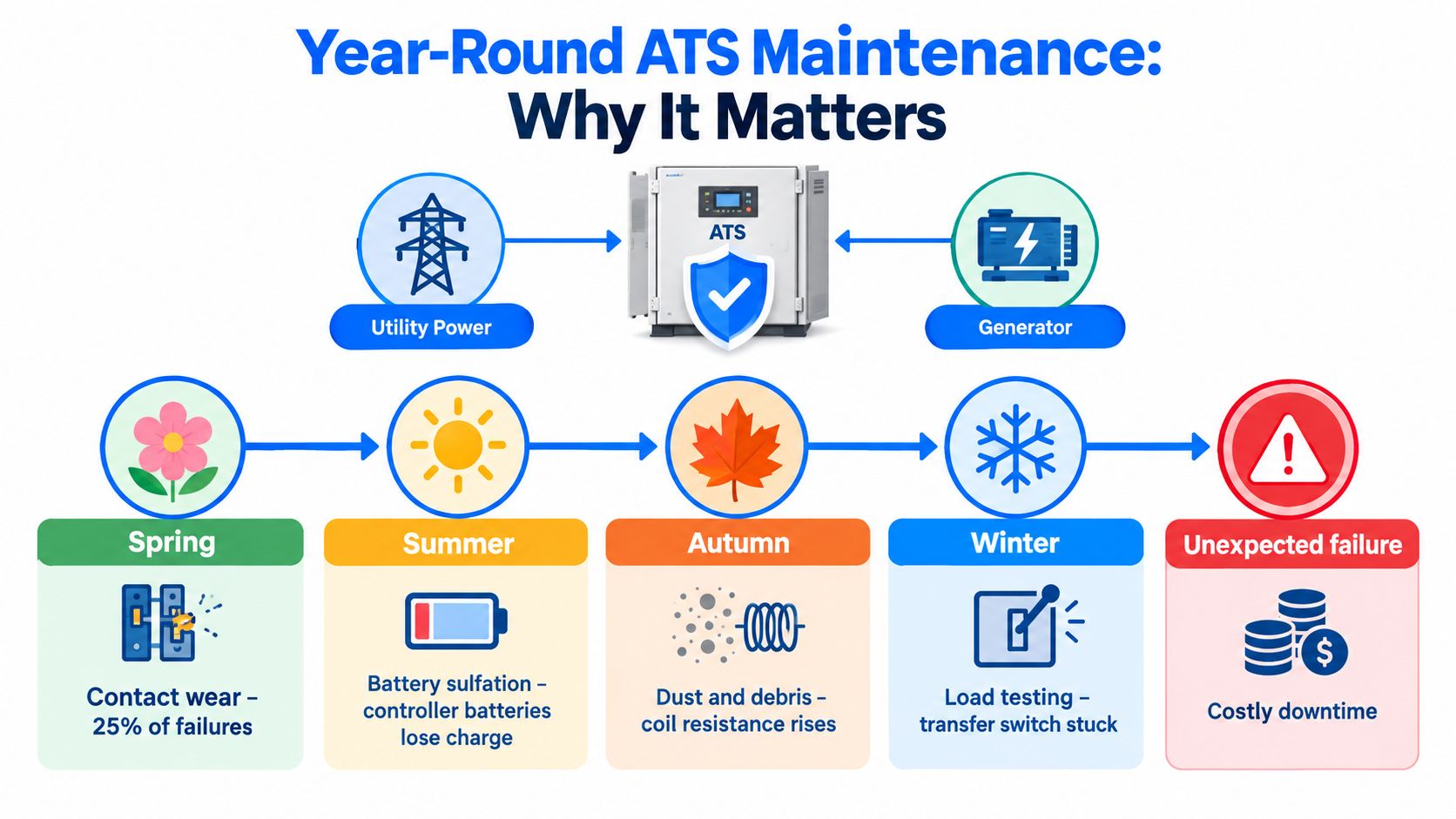
What a year-round rhythm catches
Each interval catches a different class of problem, which is why skipping straight to an occasional annual visit leaves gaps.
Monthly checks catch visible issues and operating changes early. That includes active alarms, moisture marks, insect activity, unusual controller messages, and slow or noisy transfers.
Semi-annual service is where cabinet conditions start to matter. Dirt on components, loose control conductors, weak terminations, and linkage wear usually show up here.
Annual service confirms performance under test and gives you hard condition data. That is the point where torque checks, electrical readings, contact condition, and return-to-normal behavior should be documented.
If the ATS only gets attention after an outage complaint, the maintenance plan has already failed.
Facility managers understand this because code-driven programs force a cadence. Residential owners and small-business owners can borrow that mindset without importing industrial paperwork or oversized procedures. Put the switch on the calendar, keep notes, and correct small findings while they are still cheap.
Safety comes first
An ATS can have utility power on one side and generator or inverter power on the other. I have opened plenty of enclosures where one source was dead and the other was still fully available. That is how people get hurt.
Use lockout procedures at the upstream disconnecting means for every source feeding the switch. Verify absence of voltage with a properly rated meter at the correct terminals. A controller screen is not proof, and a non-contact tester is not enough for this job.
A safe setup usually includes:
Voltage-rated gloves and leather protectors when there is any chance of exposure.
Arc-rated clothing matched to the hazard.
A properly rated meter with fused leads for live verification.
A documented lockout step before anyone reaches into the enclosure.
If the generator has been running, let it cool down before battery or control work. If there are signs of water entry, stop there and inspect the extent of contamination before re-energizing the equipment.
Residential scale still carries real consequences
At a house, a missed transfer can leave the sump pump off, the refrigerator warming, medical equipment without backup, or a work-from-home setup dead in the middle of an outage. In a small commercial space, the same failure can shut down refrigeration, internet, point-of-sale equipment, access control, or tenant circuits that were supposed to stay up.
That is why ATS maintenance needs a year-round schedule instead of a storm-season scramble. The work is straightforward. Inspect it, test it, clean it, log it, and fix what the checks uncover. Small warnings show up first. Scheduled maintenance is what catches them.
Monthly Inspection and Transfer Test Routine
The monthly routine is the most useful maintenance habit because it's simple enough to keep doing. You're not rebuilding anything. You're confirming that the switch looks normal, reports normal, and moves when commanded.
Start outside the enclosure before you touch any controls. Look at the cabinet, conduit entries, fasteners, and surrounding area. Dust buildup, insect activity, corrosion at fittings, and discoloration around the door or louvers all tell you something.
What to check before the test
A good monthly walk-through includes these points:
Enclosure condition. Look for rust, water staining, dented covers, or signs that the cabinet has been left open or loosely latched.
Controller status. Confirm the display shows normal source available, alternate source available if applicable, and no active alarms or fault messages.
Area condition. Check for storage piled against the cabinet, blocked working clearance, or evidence of rodents.
The monthly transfer itself should be a real operational check. According to Minnesota emergency generator inspection materials citing NFPA 110 guidance, transfer switches must be operated monthly, and the test should consist of a full electrically operated transfer from the normal position to the alternate position and back again.
Run the transfer and log what happened
For a typical residential or light-commercial setup, simulate loss of normal power through the proper upstream means for the system design. Don't improvise. Don't pull a meter. Don't create a problem bigger than the test.
Watch and listen during the sequence:
Did the backup source start as expected?
Did the switch transfer cleanly?
Did the mechanism sound smooth, or did it chatter or hesitate?
Did it retransfer properly once normal power returned?
Log what you see in a maintenance record that the next technician can read without guessing.
Field | What to Record |
|---|---|
Date | The day the inspection and test were completed |
Equipment ID | ATS location or panel designation |
Normal source status | Whether normal source appeared available before testing |
Alternate source status | Whether backup source was available before testing |
Alarm status | Any active or stored alarm shown on the controller |
Visual findings | Dust, corrosion, moisture, pests, discoloration, or damage |
Transfer result | Successful transfer to alternate and return to normal, or failure details |
Audible observations | Smooth operation, chatter, delay, or unusual noise |
Technician notes | Anything to watch before the next service |
A short, readable log beats a vague memory every time.
Semi-Annual and Annual Service Tasks
A switch can pass a monthly transfer test and still be overdue for service. I see that a lot on residential battery systems and small standby-generator setups. The owner knows it transferred last storm, so they assume the ATS is fine. Then we open the enclosure and find dust packed into the mechanism, loose control wiring, or heat discoloration starting at a lug.
Semi-annual and annual work is where condition gets checked, not just function. That is the same logic larger facilities use on a stricter schedule. Homeowners and small-business owners do not need an institutional maintenance program, but they do need a calendar they can keep.
Semi-annual work inside the enclosure
After proper isolation and verification, open the enclosure and inspect the interior with good light. Garages, exterior-rated cabinets, utility closets, and back-room electrical spaces collect more contamination than the outside of the cabinet suggests. Fine dust, insect debris, and moisture residue all matter because they affect moving parts, control components, and terminations.
Clean with a vacuum and a soft brush.
Do not use compressed air to scatter debris deeper into relays, linkages, or the controller section. On smaller ATS units, especially ones tied to a Powerwall or residential generator, there is not much extra space inside. Dirt that gets pushed around tends to stay inside the equipment.
During that semi-annual visit, check:
Power and control terminations against the manufacturer's torque values
Mechanical linkage and travel for full movement, proper return, and no binding
Contacts and insulated parts for overheating, pitting, erosion, tracking, or cracked material
Door latches, deadfronts, and barriers so the enclosure closes correctly and remains safe to service
Signs of moisture or pests such as corrosion, staining, nests, or insect accumulation around warm components
Any ATS with bypass features, isolation functions, or service modes needs to be handled exactly as the manufacturer directs. If the switch does not provide those features, internal service is licensed electrical work. It is not a homeowner clean-out job with a shop vacuum and a screwdriver.
Annual tasks that prove readiness
Annual service should verify the full control chain and wear points. That applies whether the backup source is a whole-house generator, a battery system, or a small commercial generator feeding a retail panel.
Controller batteries deserve attention here. NFPA 110 requires storage batteries, including engine starting, control, alarm, and other responsibilities for emergency power supply systems, to be maintained in accordance with the manufacturer's instructions. For the kinds of ATS units small properties use, that means checking the controller battery during annual service and replacing it on the equipment's stated interval instead of waiting for a low-battery alarm or a no-transfer call. See NFPA 110, Standard for Emergency and Standby Power Systems.
If the ATS is paired with a generator, annual service should confirm operation through ATS command. Starting the generator locally proves the engine can run. It does not prove the switch, start contacts, timing logic, and retransfer sequence all work together under the same conditions the building will see during an outage.
For battery-backed systems, the annual visit should confirm the ATS or gateway equipment still follows the current operating mode, utility settings, and backup configuration. I have seen perfectly good hardware fail to perform the way the owner expected because settings changed after other electrical work or a software update.
A qualified contractor is often the right call at this interval. Amp'd Energy Solutions handles backup-power work that includes transfer switch integration, generator support, and electrical upgrades when existing service equipment needs attention before reliable ATS operation.
Quantitative Measurements That Catch Hidden Wear
A transfer switch can look clean, exercise on command, and still be wearing out at the contact level. The problems usually show up first in measured values, not in a quick visual check. That is how larger facilities catch trouble before a no-transfer event, and the same approach scales down well for a home standby generator, a small commercial ATS, or a battery-backed setup.
Manufacturers and inspection standards both rely on recorded electrical readings, not just a pass-fail test. NFPA 70B guidance on electrical equipment maintenance supports a condition-based approach built around inspection, testing, and trending. In the field, that means keeping the same few readings every service visit so you can compare this year's numbers to the last set instead of guessing.
Four readings worth keeping
For a homeowner, two of these checks are usually enough to request and review during service. For a small business with an ATS on revenue-producing loads, all four are worth logging.
Measurement | What to look for | Tool Required |
|---|---|---|
Source voltage at ATS terminals | Match expected system voltage and compare with what the controller is displaying | Properly rated multimeter |
Load current by phase | Look for persistent imbalance, unexpected loading changes, or one leg running hotter than the rest | True-RMS clamp meter |
Millivolt drop across closed contacts | Compare pole to pole and trend over time. Rising difference on one pole deserves follow-up | Millivolt-capable meter |
Contact resistance after de-energizing | Compare against prior service readings. A rising value points to contact wear or connection issues | Micro-ohmmeter |
Those last two measurements are where hidden wear usually shows up first.
Voltage checks verify source sensing. If the utility side and emergency side both meter correctly at the lugs, but the controller is reading something different, the switch may have a sensing, fuse, or control-board problem rather than a source problem.
Current checks tell you how hard the switch is living. I have opened residential ATS enclosures serving additions, EV chargers, or reworked panel circuits and found one phase carrying much more than it did a year earlier. The switch did not create that imbalance, but the extra heat still affects contacts, insulation, and terminations.
Millivolt drop across closed contacts is one of the most useful trend readings on a working ATS. You are not chasing a magic number. You are looking for change. If one pole starts reading noticeably higher than the others on the same source, or higher than it did on the last service record, that is a reason to inspect contact condition and connection tightness more closely.
Contact resistance gives you the same kind of warning with the equipment safely de-energized. On smaller residential units, this test is often skipped because it takes more setup and the owner does not want the outage window. On light-commercial equipment, I recommend it during planned annual shutdowns because it catches aging contacts before they start causing nuisance heating or unreliable transfer.
Battery-backed systems need the same discipline. A setup tied to battery backup solutions for critical home or business circuits still depends on accurate voltage sensing, stable control logic, and transfer hardware that closes cleanly every time. The hardware may be smaller than what you see in a hospital or data room, but the maintenance logic is the same. Record the readings, compare them at the next visit, and act on drift before the owner finds it during an outage.
Common Maintenance Mistakes to Avoid
A common service call goes like this. The homeowner says the generator starts every month, the battery backup app shows no alerts, and the switch looked clean the last time anyone opened it. Then the first real outage hits, the ATS hangs up, and the root cause turns out to be basic maintenance work that was skipped or done the wrong way.
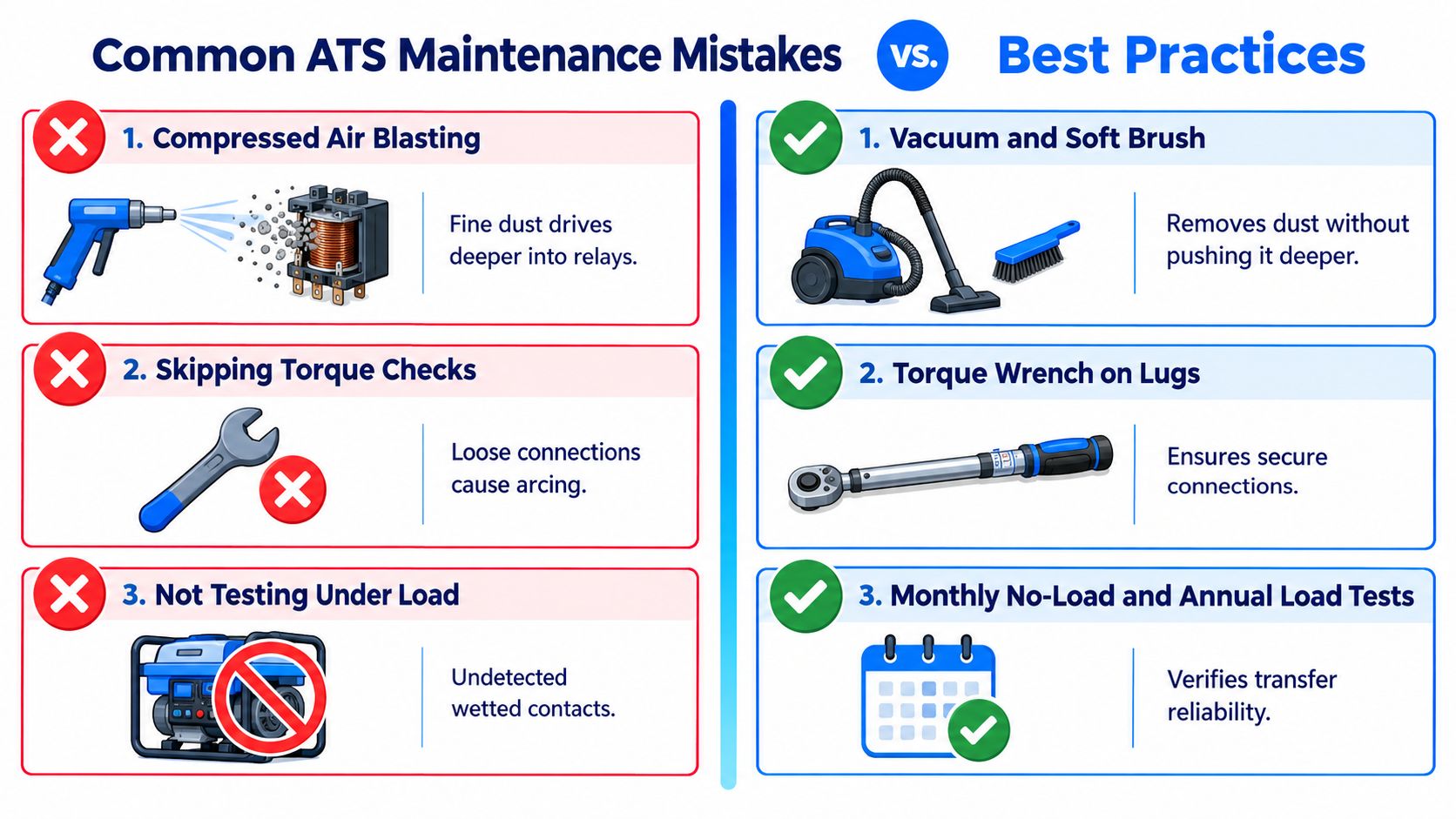
Three shortcuts that cause real trouble
Blowing out the enclosure with compressed air is high on the list. It looks fast, but it often drives dust into the mechanism, control boards, and contact surfaces instead of removing it. On small residential ATS units tied to a standby generator or battery system, that dirt can be enough to interfere with sensing or mechanical travel. In larger facilities, technicians usually treat dry cleaning more carefully because a missed transfer has bigger consequences. The same discipline belongs in a house or small shop.
Moisture gets dismissed too often because the switch still works today. Condensation on the door window, rust marks near the bottom of the can, white residue on lugs, or green corrosion on copper all point to water getting where it should not. I have seen exterior residential units mounted under roof drip lines and indoor commercial switches installed in damp electrical rooms. Both fail for the same reason. Corrosion raises resistance, weakens terminations, and causes controls to behave unpredictably.
Poor recordkeeping causes the longest delays. If the last entry says only "tested OK," the next technician has no baseline for transfer time, alarm history, battery condition, torque checks, or signs of heat and moisture. A hospital or plant would never accept that level of documentation. Homeowners and small-business owners do not need industrial paperwork, but they do need a simple dated log that shows what was checked and what changed.
A quick look is not maintenance. If the switch was not inspected closely, operated under test, and written up, the visit did not buy much reliability.
Better habits that actually extend service life
Use a vacuum and a soft brush. Check for water entry before re-energizing. Verify terminations to the manufacturer's torque values when the service procedure calls for it. Test the ATS with the source equipment and load path it serves, not just the generator running by itself.
Keep the routine scaled to the installation. A home ATS paired with a Powerwall or standby generator may only need a short monthly exercise review and a scheduled annual service visit. A light-commercial switch usually needs tighter documentation and a firmer test cadence because more people and more revenue depend on it.
Simple habits prevent expensive failures. Consistency matters more than complexity.
Troubleshooting an ATS That Will Not Transfer
A realistic failure call usually starts with confusion. The owner knows the normal power dropped. The generator may have started, or maybe it stayed idle. The building didn't transfer, and now everyone is staring at the switch.
Take a small medical clinic with a 400-amp ATS as an example, because that's a size where guesswork gets expensive quickly. The clinic simulates a utility outage during a scheduled test. Normal source is removed, but the load stays on dead utility instead of moving to the alternate source.
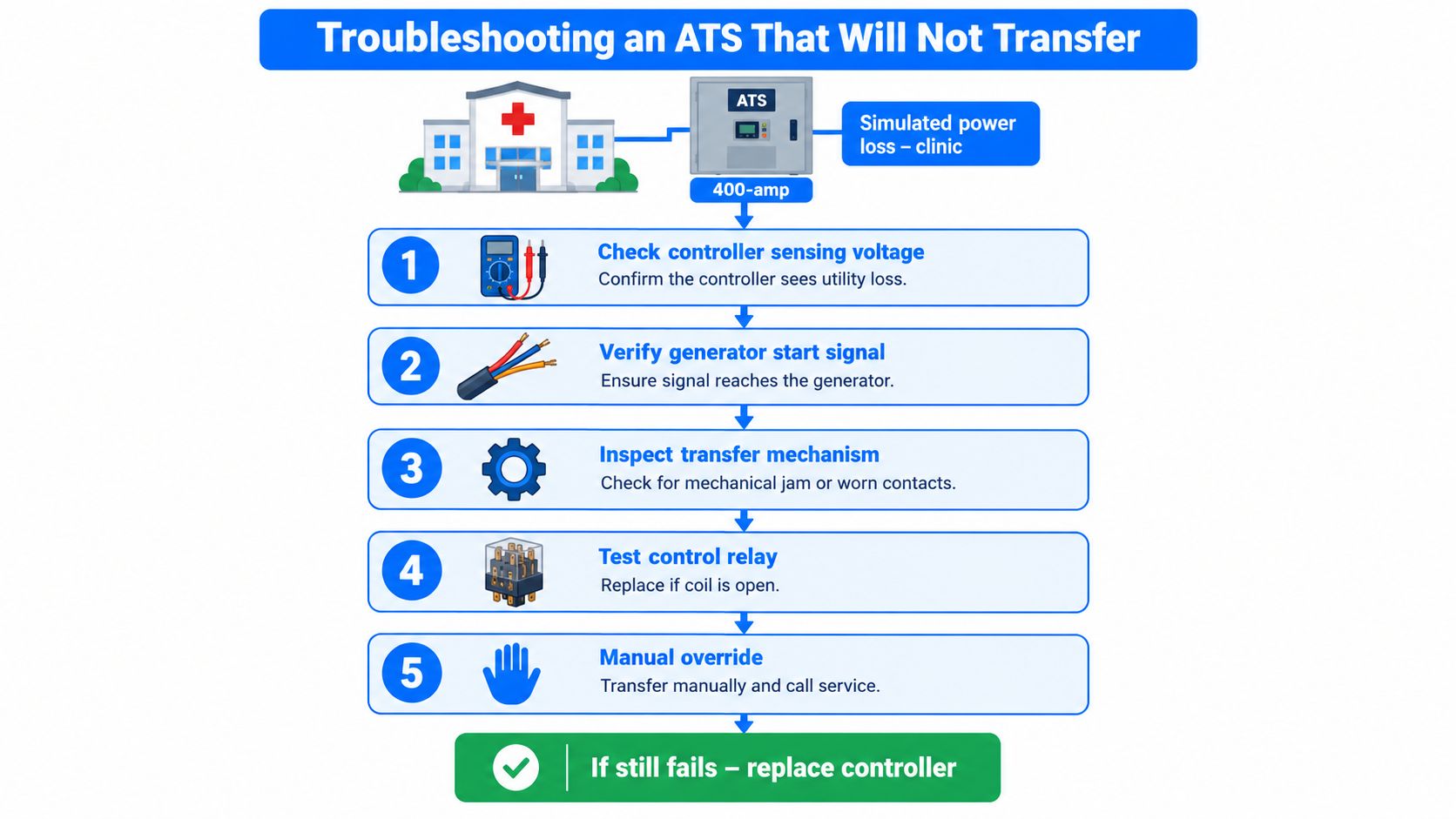
Isolate the problem in the right order
Start at the controller. Does it see the loss of normal source? If the sensing circuit still thinks utility is present, the switch may never issue a start command or transfer command. Capture the display status, alarm lights, and meter readings at the ATS terminals.
Then check whether the ATS is sending the engine-start signal to the generator. If the generator doesn't receive that command, the problem may be in the control wiring, the controller output, or an interposing relay.
If the generator starts and builds output, move to the mechanism side. Confirm the alternate source is available at the ATS, then inspect whether the transfer mechanism is being blocked by a faulted auxiliary contact, a mechanical bind, or a tripped control component.
What to document during the call
Write down what happened in sequence:
Source condition at the ATS line terminals
Controller indication before and during the failed transfer
Generator response after the start signal should have been sent
Mechanism status including any fault lights or abnormal position indication
Manual operation result if the design allows safe manual transfer under proper procedure
A problem can also sit upstream. I've seen owners blame the switch when the normal-source breaker was already open, or when the generator breaker never closed after maintenance. Troubleshooting has to separate utility supply, generator output, control logic, and the actual transfer mechanism.
If the issue points to service capacity, breaker condition, or outdated gear upstream of the ATS, that's when broader electrical work enters the picture, including electrical service upgrades that support reliable backup-power integration.
If you can't confidently verify both sources, the control path, and the mechanism condition, stop there. An ATS fault under live conditions is not a good place to experiment.
For homeowners, basic observation and log keeping are reasonable. Opening energized equipment, defeating interlocks, or forcing transfers without procedure is not.
Your Ongoing ATS Maintenance Checklist
The cleanest way to manage automatic transfer switch maintenance is to stop thinking of it as one job. It's a cadence. Some tasks are simple owner checks. Others belong to a licensed electrician or generator technician. What matters is that each one lands on the calendar and gets recorded.
A practical cadence you can live with
For a house, put the monthly test on the same reminder cycle as other backup-power checks. For a small business, make it part of the facility routine and keep the log where the next person can find it without digging through emails.
Here's a working checklist you can print and use:
Task | Frequency | Performed By | Log Entry |
|---|---|---|---|
Visual exterior inspection | Monthly | Owner or facility staff | Date, cabinet condition, area condition, alarms |
Controller status check | Monthly | Owner or facility staff | Source status, alarm status, notes |
Electrical transfer test | Monthly | Qualified operator or technician, depending on system | Successful transfer and retransfer, anomalies observed |
Interior cleaning with vacuum and brush | Semi-annual | Licensed technician | Condition inside cabinet, contamination found, cleaning completed |
Termination and mechanical inspection | Semi-annual | Licensed technician | Lug check, mechanism condition, corrective work needed |
Voltage and current measurements | Annual or as part of scheduled service | Licensed technician | Recorded readings by source and phase |
Millivolt drop and contact resistance checks | Annual | Licensed technician | Measured values and trend notes |
Control battery review or replacement per equipment requirement | Annual review | Licensed technician | Battery condition, replacement date if changed |
Generator exercise under ATS command where applicable | Annual | Licensed technician | Start, transfer, run, retransfer result |
Maintenance record review | Annual | Owner and service provider | Open issues, repaired items, next due date |
The part most owners skip
Documentation keeps this work useful. Without records, every service visit starts from zero. With records, a technician can see drift, repeat faults, skipped tests, and components that are aging before they strand the building.
If you've missed the last few inspections, don't wait for the next storm or utility event to find out what still works. Put the next monthly test on the calendar now. If the switch hasn't been opened, cleaned, or measured in years, schedule qualified service and get the baseline back.
Amp'd Energy Solutions helps homeowners and businesses in Southeastern Pennsylvania with backup-power projects that include generator integration, battery backup systems, transfer equipment, and the electrical upgrades that support them. If your transfer switch hasn't been tested on schedule or your backup setup needs a professional review, visit Amp'd Energy Solutions and line up the next step before the next outage does it for you.
Comments