

How Does a Standby Generator Work? a Step-by-Step Guide
When the transfer switch detects a utility outage, it starts the engine, the alternator produces electricity, and the switch moves the home's loads onto the generator. That handoff is automatic, so you are not in the garage pulling a cord while the house goes cold.
Say the lights drop during dinner. The fridge compressor stops, the furnace blower goes quiet, and a phone flashlight becomes the only light in the kitchen. A standby generator is the equipment outside that is supposed to take over without you doing anything. It stays idle while utility power is healthy, then starts itself and feeds the circuits an installer chose. A portable unit is a different tool. You start it by hand, handle fuel, and run cords to a few appliances. The standby system has to notice the outage, make power, and move the house onto that power without sending electricity back onto the utility lines.
Table of Contents
Core Components and What Each One Does - What each part needs
The Outage Sequence From Power Loss to Restored Power - How the switch changes sources
Fuel Sources and How Each Affects Runtime - How the choice plays out at a house
Maintenance, Safety and Code Requirements - A routine you can actually keep
How a Standby Generator Works in Plain Terms
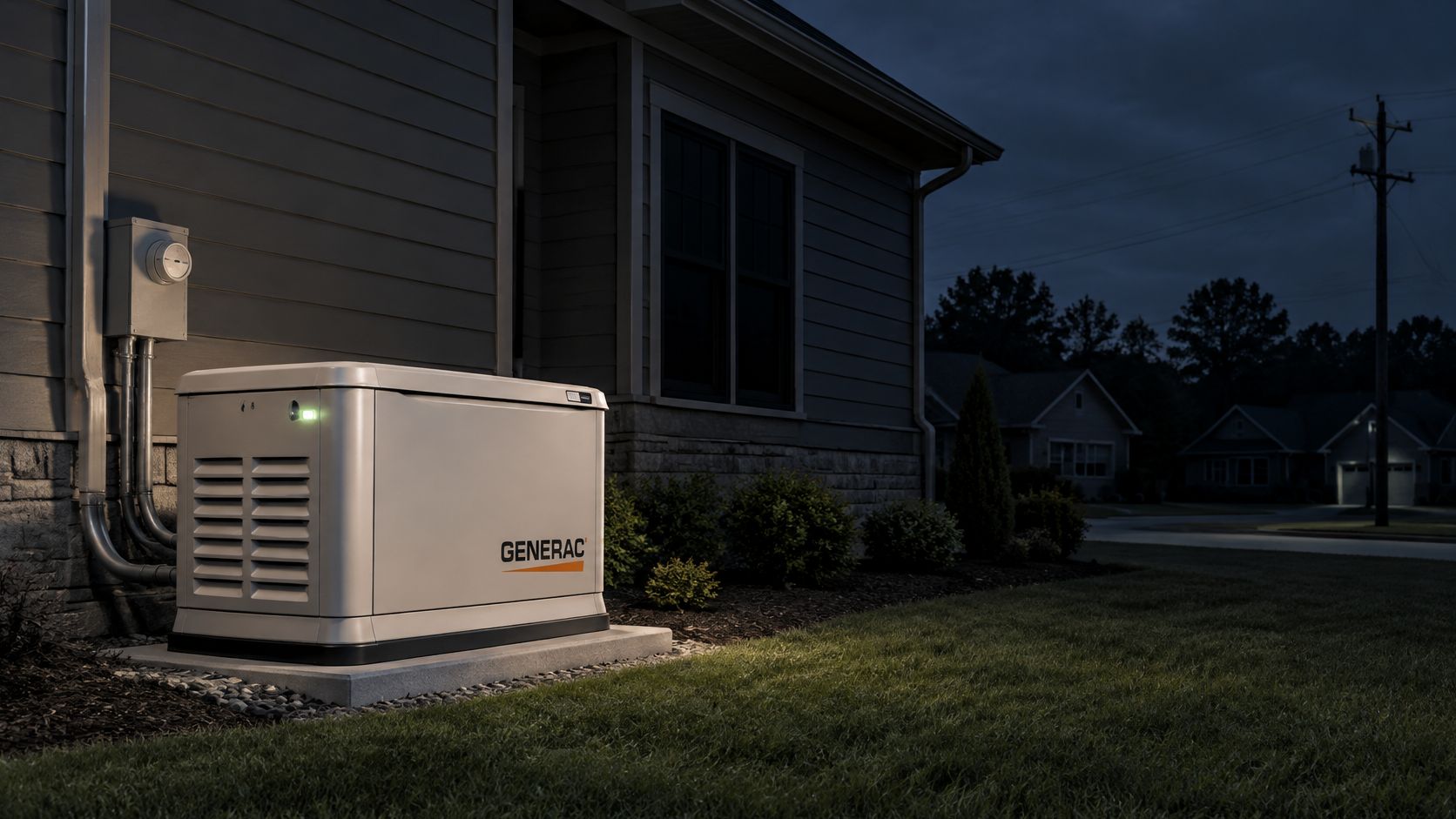
A standby generator is a permanently installed, engine-driven power plant that sits outside the home. It waits while the grid is healthy and starts itself when power fails, typically restoring the chosen circuits within seconds.
Think of a smoke alarm. It watches one condition all the time and acts without anyone touching a switch. The generator's controls do the same with utility voltage. Nobody has to walk outside, flip a breaker, or remember where the extension cords are.
Notice, make, and move are the three jobs. Sensing catches the failure. The engine and alternator make electricity. Switching puts the house on that electricity and later puts it back on the utility. If a quote only talks about kilowatts and skips the switch, the sensing, or where the exhaust goes, the quote is incomplete.
In 2024, approximately 6.61 million U.S. homes, about 5.0% of occupied primary residences, had a whole-home or standby generator, according to Solar Waypoint's analysis of U.S. Energy Information Administration data. Most homes still rely on the grid alone, which is why the first outage feels chaotic if nobody has walked through the sequence.
Once you can name those three jobs, spec sheets and installer quotes get easier to read. You look for sensing, generation, and a safe transfer, not a single horsepower figure on a brochure.
Core Components and What Each One Does
Fuel does not turn into wall power by magic. An internal-combustion engine converts chemical fuel energy into shaft torque, and an alternator converts that torque into electrical power through electromagnetic induction, as the NFPA overview of NFPA 110 describes a standby generator.
During normal operation, an automatic transfer switch (ATS) continuously monitors utility voltage. When utility power falls outside its acceptable range, the ATS sends a start command to the engine. Once the generator reaches acceptable voltage and frequency, the switch disconnects the utility and connects the building load to the generator. That interlock matters because the generator and the utility must not be electrically connected at the same time. A simultaneous connection is a dangerous backfeed condition.
When utility voltage returns and remains stable, the ATS retransfers the load, typically lets the engine cool while unloaded, and then stops it. For critical systems, NFPA 110 load sequencing gives priority to emergency loads before legally required and optional standby loads. Emergency loads are expected to be connected within 10 seconds when the system is configured for that performance level.
What each part needs
Component | Job in the system | What it depends on |
|---|---|---|
Engine | Burns natural gas, propane, or diesel to create shaft rotation | Fuel supply, cooling air, lubricating oil, and a healthy starting system |
Alternator | Turns rotation into electricity through electromagnetic induction | Rating matched to the load, plus correct voltage and frequency output |
Automatic transfer switch (ATS) | Senses utility loss, signals the engine, and moves loads between sources | Correct sizing for the loads, and an interlock that prevents simultaneous connection |
Controller | Verifies generator voltage and frequency before transfer and runs exercise cycles | Sensing wires, settings, and the transfer logic chosen for the building |
Starting battery and charger | Supplies cranking current and keeps the battery ready | Battery age, charger condition, and periodic testing |
Enclosure and exhaust | Protects the engine and directs exhaust away from openings | Clearance from windows, doors, soffits, and air intakes |
Practical rule: When a quote lists parts, check that the transfer switch, controller, and exhaust clearance are included, not only the engine and alternator.
The engine still needs fuel, oil, and cooling air even if the alternator is correctly rated. A dead starting battery leaves a perfectly good engine silent. The enclosure can look tidy on a pad and still be too close to a soffit or a fresh-air intake.
The Outage Sequence From Power Loss to Restored Power
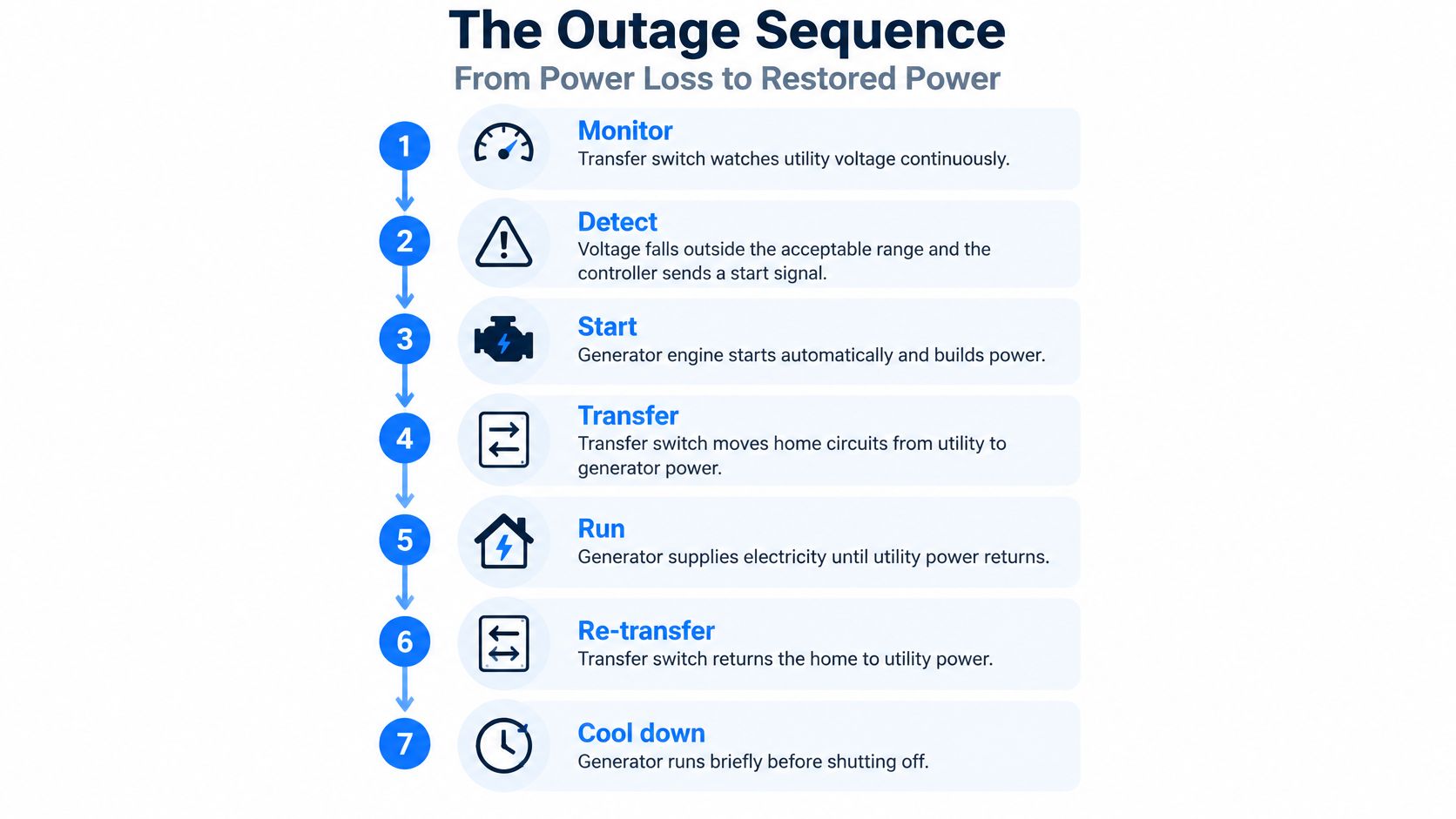
A standby generator is an automated backup-power system built around three functions: sensing, starting, and switching. The Pacific Northwest National Laboratory guidance on automatic transfer switches lays out what that equipment does from the first sag to the cooldown. How an automatic transfer switch is chosen and wired decides whether those steps stay coordinated.
Monitor. The ATS continuously watches the utility supply for unacceptable voltage or a full power failure. It does this while you are asleep, at work, or standing in that dark kitchen.
Detect. When voltage falls outside the acceptable range, the ATS controller signals the generator engine to start. A brief flicker is not always enough. The settings decide what counts as a real failure.
Start. The engine cranks, reaches running speed, and drives the alternator. A rotating magnetic field induces an electrical current in stationary windings. Combustion made the rotation. Induction made the electricity.
Verify. Before energizing the building, the controller checks that the generator has reached suitable voltage and frequency. Loads should not land on weak, unstable power.
Transfer. The ATS disconnects the property from utility power and connects the designated loads to the generator. That break stops generator power from backfeeding onto utility lines.
Run. The generator carries those loads until the outage ends. Lights, the fridge, and the furnace blower come back only if they are on the backed-up circuits and the set can hold them.
Retransfer. When utility power returns and remains stable, the ATS reverses the process and reconnects the building to the grid.
Cool and stop. The controller commands the generator to cool down and shut off. An immediate stop under load is harder on the engine than a short unloaded run.
How the switch changes sources
The most common transfer method is "open transition," or "break-before-make," which creates a brief interruption while the load changes sources. You may see lights dip for a moment even though the generator is already running. "Closed transition" equipment can transfer between two live sources with little or no interruption. Delayed transition adds time for inductive-load voltages to dissipate, which matters with motors that keep a magnetic field after power is removed.
Whole-house installations need correctly sized transfer equipment and coordinated electrical controls, not merely an engine and an alternator. On a status panel, look for utility loss, engine run, generator available, and load on generator. Commissioning notes should show the same stages in the order the switch performed them.
Fuel Sources and How Each Affects Runtime
The fuel never becomes electricity directly. Combustion produces mechanical energy, and electromagnetic induction turns that motion into current. Michael Faraday showed in 1831 that changing magnetic fields can induce current in a nearby conductor, and the Britannica account of Faraday's discovery notes that this is still the principle behind generators. A standby set is a small, automatic power plant using that same idea. Natural gas, propane, or diesel only decides how long the shaft keeps turning.
Fuel | Where it comes from | Runtime depends on | Main trade-off |
|---|---|---|---|
Natural gas | Utility gas line | Continuous supply while the line delivers gas | The gas service has to survive the same event that killed the power |
Propane | On-site tank | Tank size and fill level | The tank must be sized, filled, and kept accessible |
Diesel | On-site storage tank | Tank size, and the fuel ages so it needs rotation | More maintenance, and some installations need permits |
How the choice plays out at a house
Natural gas is convenient when a line already serves the house, because you are not watching a gauge during a three-day outage. A storm or a dig-in can still take the gas with the electricity. Propane keeps fuel on the property, so runtime is a tank question. A half-full tank in January is not the same plan as a full tank sized for the load. Diesel also lives in a tank, but stored fuel breaks down, so it has to be rotated, and the installation can bring extra maintenance and permit steps.
Review your outage history before you pick. Ask whether gas service is already at the meter, where a tank would sit, and what the township requires. A deeper look at whole-house generator gas connections helps when the choice is between a utility line and a tank. Runtime is a fuel-supply question, not just an engine question.
Sizing for Loads and Starting Surges
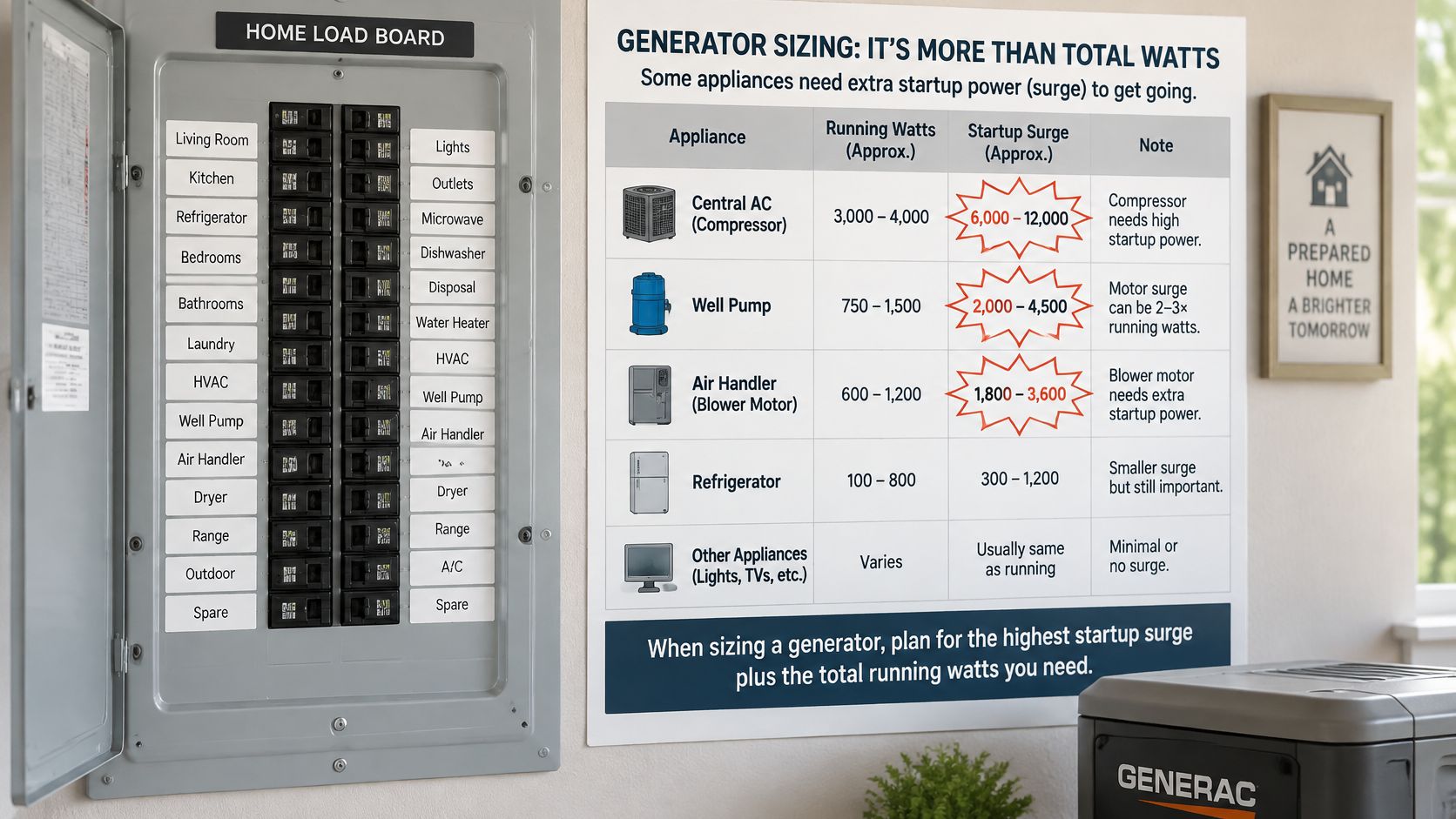
Adding the wattage printed on appliances is not enough. Generator performance depends on matching engine capacity, alternator rating, starting-current capability, and transfer controls to the actual load, which a City of Lakeland public lift-station generator specification states directly.
Large motor loads such as HVAC compressors, well pumps, and air handlers can draw several times their running current during startup. That surge can produce a temporary voltage and frequency dip even when steady-state watts look fine. A fridge, a well pump, a furnace blower, lights, and a few outlets can be a modest running load and still stumble if the pump and the blower start together.
The ATS verifies both generator voltage and frequency before transferring load. In that public specification, emergency-source sensing is at approximately 90% of rated voltage and frequency. Transfer starts when normal voltage declines to about 70%. Retransfer waits until utility voltage recovers to about 90%.
Setting | Value | Why it matters |
|---|---|---|
Emergency source sensing | About 90% of rated voltage and frequency | Generator must be stable before load connects |
Transfer initiation | Normal voltage declines to about 70% | Starts the sequence on a severe sag |
Retransfer | Utility voltage recovers to about 90% | Returns load only after utility power is stable |
Load sequencing or load shedding staggers motor starts so the engine does not stall and protection does not trip. The pump can come on after the blower, or a noncritical circuit can drop off until the surge passes.
During commissioning, the installer should measure running and starting current, confirm phase balance and neutral configuration, verify overcurrent protection, test the ATS under load, and exercise the transfer switch monthly. A generator that starts can still fail to carry the building if voltage regulation, frequency recovery, conductor sizing, or transient motor demand is inadequate. A whole-house generator sizing calculator is a starting point, but the circuit list you bring to the quote is what makes the number real. Write down what must stay on before you ask for a price.
Maintenance, Safety and Code Requirements
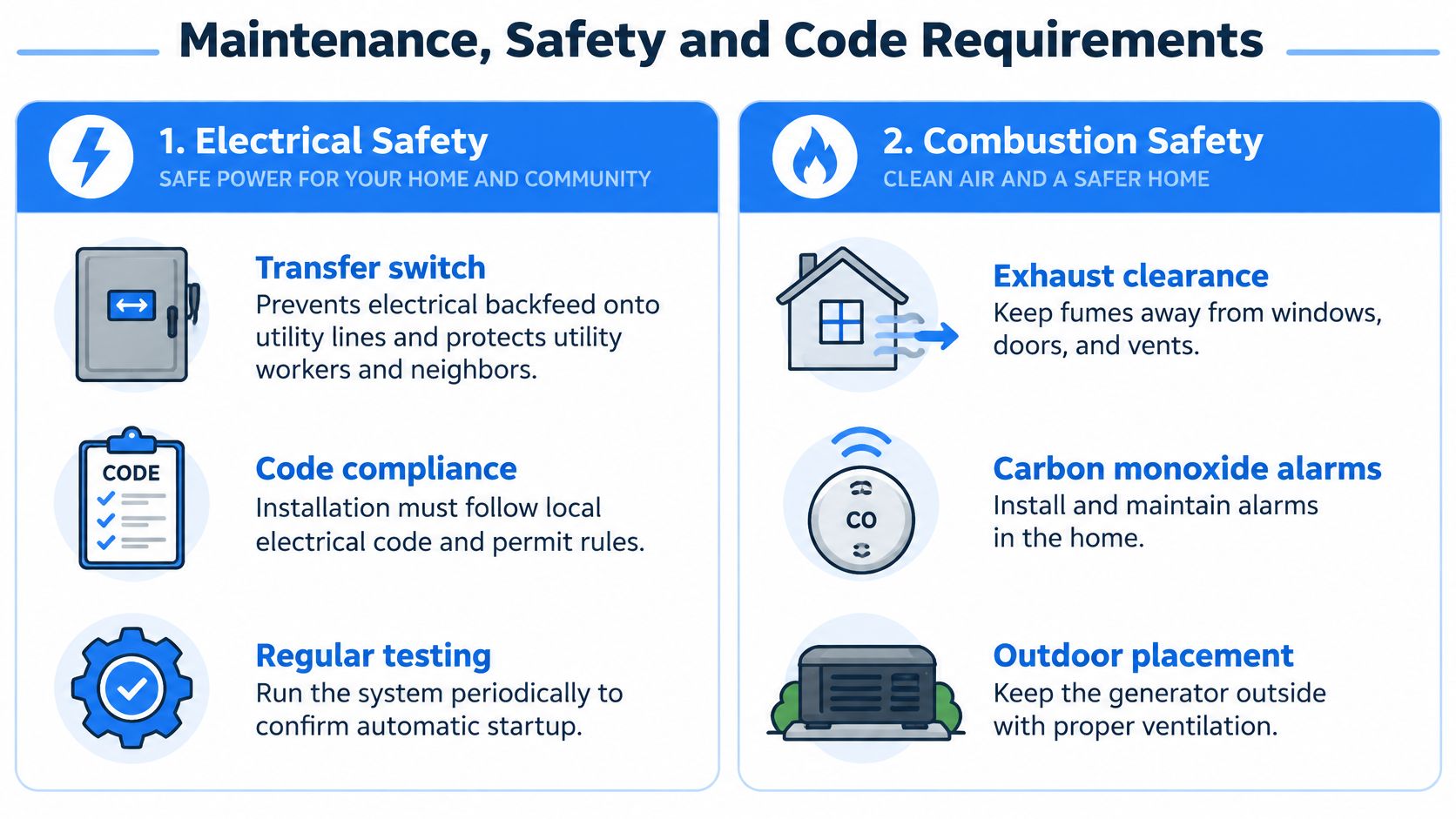
A generator that switches correctly can still endanger a home if it is sited poorly. The transfer switch and the exhaust system solve two separate safety problems.
The ATS isolates generator power from utility conductors. That protects utility workers and the public. Improper connections can backfeed energized lines and create electrocution hazards. Correct electrical transfer does not make combustion exhaust safe.
PNNL guidance on standby generators says exhaust must be directed away from building air intakes and occupied or gathering areas, with unobstructed cooling and ventilation air. It also calls for proper grounding, safe fuel conditions, and compliance with applicable permitting and emissions requirements. CPSC records identify stationary generators as the source of carbon-monoxide poisoning in 105 homes. Permanent installation is not the same as zero risk.
Placement, wind, doors, windows, soffits, and mechanical-air intakes can matter as much as the enclosure. A unit can sit outdoors and still push exhaust into a house or a neighbor's opening.
A routine you can actually keep
Exercise under load: Run the transfer monthly the way the commissioning plan describes, so a dead battery or a stuck switch shows up before a storm.
Oil and filters: Change them on the hour interval in the manual, not when the unit smells hot.
Battery and charger: Check age, terminals, and whether the charger is keeping the battery ready.
Fuel system: Look for leaks, a low propane level, or diesel that has sat too long.
Clearances: Keep cooling air and the exhaust path open. Do not store bins, snow, or a deck box against the enclosure.
Alarms and paper: Keep carbon monoxide alarms working, and save permits, inspection sign-offs, and each service record for the installer and the inspector.
A generator outdoors is not automatically a generator that stays out of your air.
Battery storage avoids on-site combustion during an outage, but it has different capacity and recharge limits. The electrical interlock and the exhaust path still have to be right if you choose an engine.
Confirm Your Setup Before You Buy
Bring your outage history and the list of circuits that must stay on. That list is what sizing is built from, whether the must-keep loads are a well pump and a furnace or a small set of lights and outlets.
Confirm the fuel next. A gas line already at the meter is a different project from a tank that needs clearance, fill access, and a safe path for the supply piping.
Ask how the transfer equipment is sized for those loads and for the panel you have now. A new generator on an undersized panel does not fix the weak point.
Then confirm exhaust placement, clearances from openings and air intakes, and whether carbon monoxide alarms are part of the job. Permits, inspection, and a written maintenance plan should be on the same conversation, not an afterthought once the pad is poured.
Amp'd Energy Solutions, a family-owned electrical contractor in Southeastern Pennsylvania, selects and installs whole-house generators, integrates them with automatic transfer equipment, and can pair that work with panel upgrades or battery options such as a Tesla Powerwall. A site assessment is the clean way to scope which of those pieces the house needs.
Amp'd Energy Solutions helps Southeastern Pennsylvania homeowners plan standby power that starts on its own, transfers loads safely, and keeps exhaust away from the house. If you are weighing a generator, a panel upgrade, or battery backup, start with a site assessment so the fuel, the switch, and the clearances match the circuits you care about. Visit Amp'd Energy Solutions to schedule that conversation.
Comments