

EV Charger Installation Cost Calculator for 2026
$860 to $7,400 per charging unit, for installation alone, was the range in a historical Houston example documented by the National Renewable Energy Laboratory, excluding charging equipment. That spread explains why the charger's retail price is a poor starting point for predicting the finished bill.
A useful EV charger installation cost calculator prices the electrical work your property needs. For a Southeastern Pennsylvania homeowner, the most important distinction is whether you're adding a circuit to a suitable electrical system or asking that system to carry more load than it can safely support. Those are different projects, and a larger panel isn't automatically the right answer.
Table of Contents
Typical Installed Costs by Project Type - Benchmark installed costs by project type
Site Factors That Push Your Estimate Up - Site factors, added cost and the trigger for each - Decide whether you need more capacity or better load planning
How to Run the Calculator Step by Step - Enter the physical scope before adjusting the budget
Five-Year Ownership Cost Versus Upfront Price - Design choices and their five-year effect - Compare designs using energy, not charging speed alone
Shared Infrastructure for Workplaces and Multifamily Sites - Separate shared construction from connector-specific work - Assign both construction costs and electricity costs
Worked Example for a Southeastern Pennsylvania Home - Illustrative home estimate, low to high - Read the scenarios as different scopes
What a Firm Quote Must Itemize - Require a comparable written scope - Bring information that resolves uncertainty
Typical Installed Costs by Project Type
$400–$1,800, excluding charger hardware, is the residential Level 2 installation labor and electrical-work range in an industry dataset published by LinkPower, covering more than 350 residential projects analyzed from Q3 2024 through Q1 2025. Treat that as a scope-specific benchmark, not an installed-price guarantee.
For homeowners, the first comparison should be between the equipment allowance and the electrical-work allowance. A quote that includes a charger, circuit, service replacement and restoration can't be judged against a labor-only benchmark.
Benchmark installed costs by project type
Project type | Equipment | Installation and labor |
|---|---|---|
Residential Level 1 (120V) | Portable or fixed charging equipment, priced separately | Existing receptacle assessment; dedicated circuit work if needed |
Residential Level 2 (240V) | Selected wall charger, priced separately | $400–$1,800 excluding hardware in the residential dataset |
Workplace or public Level 2 | Commercial charging equipment and any network features | Per-connector electrical work plus shared site infrastructure |
Multifamily Level 2, downstream of panel | Charger and mounting equipment | Downstream installation, with upstream service work identified separately |
Public DC fast charging | Fast-charging equipment and associated power equipment | Utility, electrical and civil construction priced as a separate scope |
The table deliberately separates items that contractors sometimes combine. Per connector, per station and per project aren't interchangeable units. A station can include multiple connectors, while a project can include construction that serves several stations.
A residential wall-mounted charger also shouldn't inherit a public-site budget. Public access can introduce parking-layout decisions, freestanding mounting, protection from vehicles, payment arrangements and ongoing management requirements. Those are scope questions to resolve before comparing bids.
Quote-check rule: Compare the same equipment boundary, construction boundary and unit of measurement. A cheaper number isn't necessarily a cheaper equivalent installation.
Find the row matching your property, then identify the missing column. If you already own the charger, you need an electrical scope, not another equipment estimate. If you're developing a workplace or multifamily site, you need an infrastructure allowance before a per-port price becomes useful.
Finally, ask whether ordinary wiring is already included in labor and electrical work. Adding a separate wiring allowance to an installation package that already covers the same route would overstate the budget.
Site Factors That Push Your Estimate Up
The cheapest charger doesn't necessarily produce the cheapest project. Moving its location, reducing its configured charging demand or changing the cable route may matter more than choosing a less expensive enclosure.
Approximately $1,000–$3,000 for a panel and utility-service upgrade associated with a 100-amp service, before site-specific complications, and roughly $400–$1,500 for load-management equipment illustrate the alternatives described in the Government Accountability Office cost material. Neither allowance establishes what a particular home needs.
Site factors, added cost and the trigger for each
Site factor | Added cost | When it applies |
|---|---|---|
Longer wire run | Itemized conductor, conduit and installation allowance | Charger sits farther from the panel |
Long underground route or trenching | Excavation, conduit, backfill and surface-restoration allowance | Detached garage or driveway crossing |
Panel and service upgrade on an existing 100A service | Approximately $1,000–$3,000 before site-specific complications | Load assessment identifies an unmet capacity requirement |
Load-management equipment | Roughly $400–$1,500 for equipment | Compatible controls can keep charging within available capacity |
Subpanel | Feeder, enclosure, breakers and installation priced together | Main panel lacks usable breaker space, but sufficient capacity exists |
Breaker space and electrical capacity are different problems. A panel can have empty spaces without enough capacity for the proposed charging load. Conversely, a full panel doesn't automatically mean the utility service is undersized.
A subpanel creates distribution space; it doesn't create additional incoming power. Its feeder and connection arrangement still need a suitable design.
Decide whether you need more capacity or better load planning
Load management can reduce or pause charging when other household loads need the available capacity. It's worth evaluating when the vehicle remains parked long enough to recover the energy you need despite interruptions.
That isn't the same as setting a timer and assuming other appliances won't run. The electrician needs to establish how the proposed controls operate and whether the installation meets applicable requirements.
Our electrical panel upgrade cost guide helps distinguish panel work from a broader service project. We offer 200- or 400-amp service upgrades for residential, commercial and industrial properties when the assessed scope calls for them.
Before requesting an estimate, photograph the panel with its cover closed, note the main-breaker rating and list electric heating, heat pumps, dryers, hot tubs and planned battery equipment. Count visible unused breaker positions without removing the cover. Mark the proposed cable route, including finished walls, outdoor sections and underground crossings.
An empty breaker position is an observation. Available electrical capacity is a calculation.
How to Run the Calculator Step by Step
About $1,300 per connector for residential Level 2 equipment, before labor and permitting, is the equipment benchmark reported by the Department of Energy's Alternative Fuels Data Center. The same guidance separates equipment from installation variables such as labor, trenching, existing wiring, electrical upgrades and permitting.
That separation should determine how you enter information. A calculator is useful when it exposes assumptions, not when it conceals them behind a single national average.
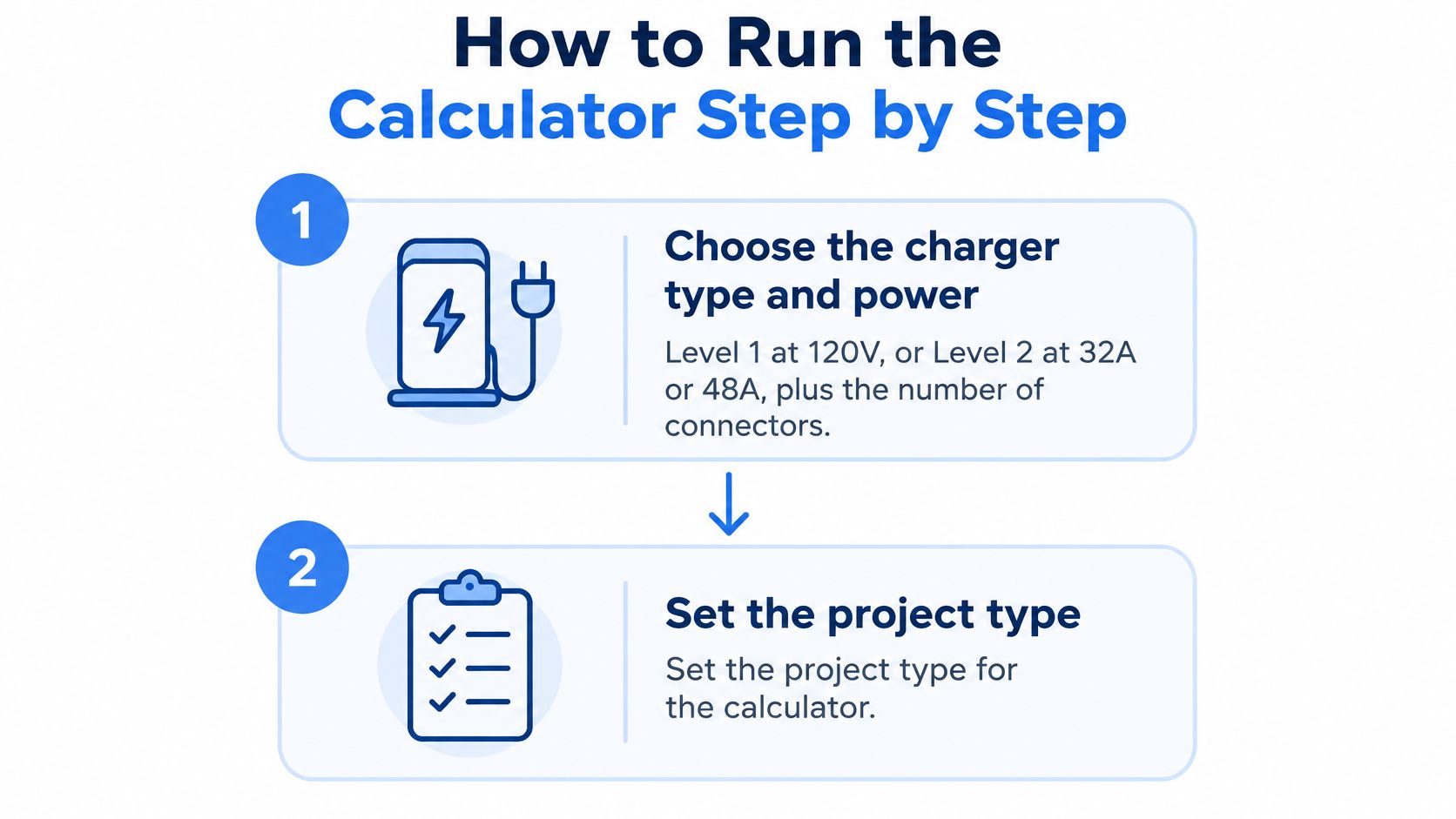
Enter the physical scope before adjusting the budget
Choose the charging equipment and intended setting. Record the charger category, connector count and proposed operating setting. Distinguish its maximum capability from the setting the electrician intends to commission.
Select the property type. Identify the project as residential, workplace, multifamily or public. Don't apply a household wall-charger allowance to a parking-lot installation with shared infrastructure.
Measure the installation route. Follow the likely cable path rather than measuring straight through walls. Identify penetrations, exterior conduit, underground sections and surfaces that must be restored.
Record the existing electrical system. Enter the main-breaker rating, visible spare positions and major electrical loads. Include planned additions so the estimate doesn't solve today's charging need while overlooking an already-planned renovation.
Enter the equipment price separately. Use the actual selected model's price when available. Identify mounting accessories and load-management components so they aren't hidden inside an unexplained equipment total.
Add labor, circuit materials and site work. Check what each allowance includes before adding another line. If the electrical-work quote already includes the full cable route, don't add that wiring a second time.
Select the capacity solution after assessment. Use an electrical load assessment and calculation to determine whether the proposed design fits the existing system. Price the feasible circuit-only, managed-load or upgrade solution rather than assuming the most extensive option.
Add permits, inspection and a stated uncertainty allowance. Identify which amounts are confirmed and which remain provisional. Keep contingency visible rather than embedding an unexplained margin in every line.
For electrical upgrades, we assess the current setup and explain panel-upgrade or full-service-replacement options. Our residential electrical upgrades are completed to ensure full compliance with local electrical codes.
Total estimated project cost = equipment + labor and circuit materials + additional site wiring + panel or service work + permits and inspection + contingency.
The most consequential input mistake is treating a charger's maximum advertised rating as the finalized design load. The electrician must account for the configured charging demand, applicable circuit requirements and any approved load controls.
A complete calculator result should show low, base and high estimates, each with its assumptions. If every scenario contains the same unexplained upgrade allowance, the calculator hasn't resolved the most important question.
Five-Year Ownership Cost Versus Upfront Price
An additional 21–50 feet of wiring may add about $400–$1,200, while a run exceeding 100 feet or trenching can add roughly $2,500–$6,500 or more, according to the published estimates in this installation-cost guide. The guide also reports that the federal 30C charger credit ends for property placed in service after June 30, 2026. Verify eligibility and current requirements before treating any incentive as money available to your project.
Installation cost and ownership cost answer different questions. The first tells you what it takes to start charging; the second tests whether the chosen design suits your driving, tariff and future plans.
Design choices and their five-year effect
Design choice | Upfront effect | Five-year effect |
|---|---|---|
Garage versus driveway | Price the actual route; driveway access may require trenching | Location alone doesn't establish an electricity-price saving |
Lower versus higher charging setting | Higher demand may require more circuit or service capacity | Faster replenishment matters only when your schedule needs it |
Off-peak versus unrestricted charging | Confirm compatible scheduling features and tariff requirements | Savings follow the electricity rate and when energy is delivered |
One charger versus future two-EV capacity | Reserve suitable pathways, distribution space or load controls | May reduce repeated construction, but future equipment still costs money |
Federal 30C credit | Don't deduct an unverified credit from the contractor's price | Evaluate state and utility eligibility separately |
A garage isn't automatically cheaper. A garage on the far side of finished rooms may require a more expensive route than an exterior driveway location near the electrical source. Compare measured routes, not location labels.
Likewise, higher-rated equipment doesn't automatically reduce your energy bill. It may help you complete charging during a favorable rate window, but only if the vehicle, tariff and available charging time support that outcome.
Compare designs using energy, not charging speed alone
Estimate expected annual charging electricity and multiply it by the applicable rate. For a time-of-use tariff, separate energy delivered in each rate period rather than applying the cheapest rate to all charging.
Then add installation cost, expected maintenance or subscription charges, and only incentives you've confirmed. Compare the alternatives over the same ownership period.
Budget safeguard: Keep the gross installation price and the expected incentive in separate lines. Conditional reimbursement shouldn't disguise the cash you need to complete the work.
Shared Infrastructure for Workplaces and Multifamily Sites
About $6,000 per connector in 2025 for multifamily Level 2 installations, including costs downstream of the electrical panel, is the benchmark in the Department of Energy's multifamily charging guide. The guide explains that upstream work can add tens of thousands of dollars, and utility-service upgrades can require months.
That distinction matters more than charger count alone. A parking area with adequate nearby supply is a different capital project from one requiring new feeders, switchgear or utility equipment.
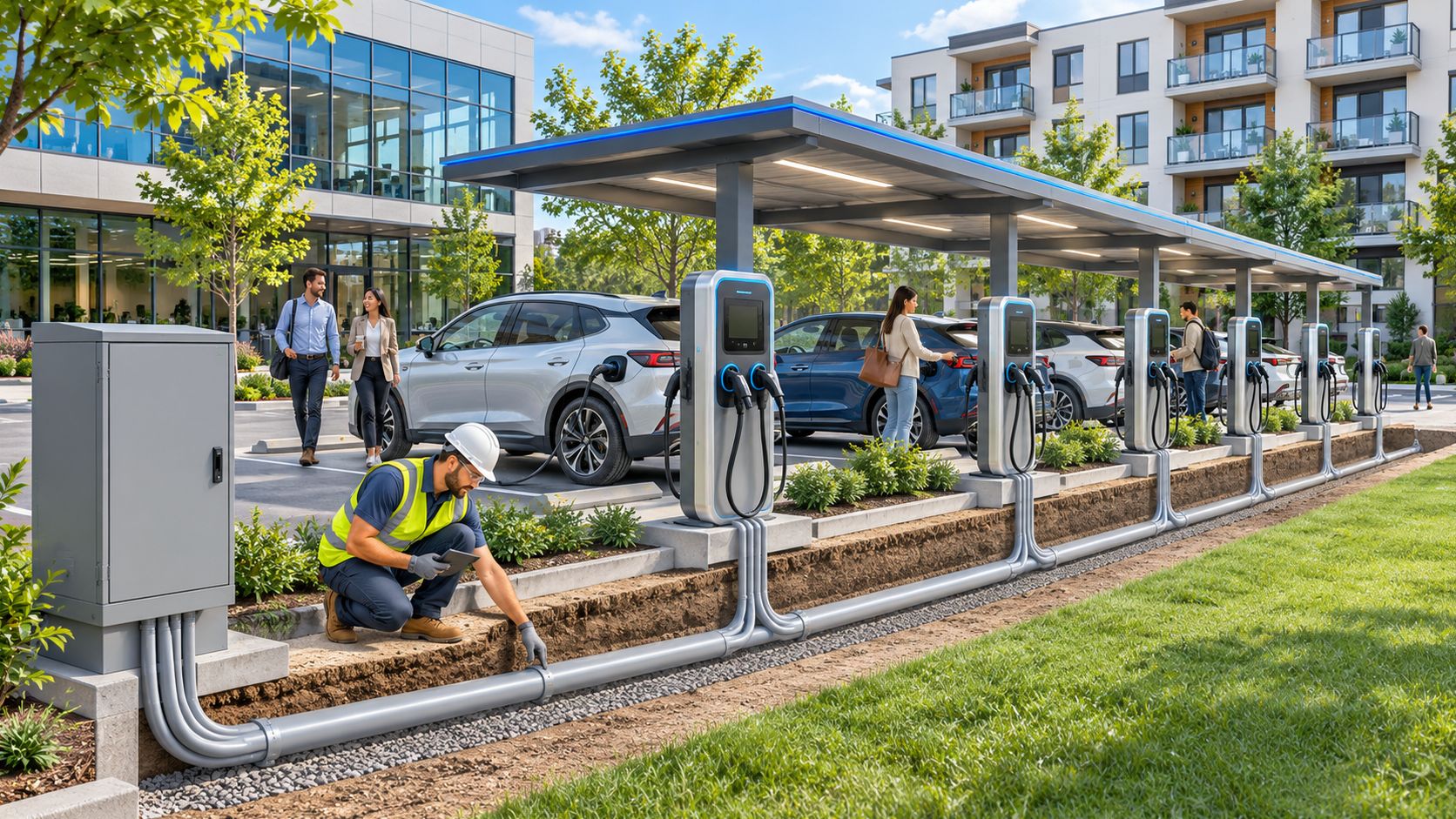
Separate shared construction from connector-specific work
Use this planning structure:
Total project cost = fixed site infrastructure + charger-specific cost × connector count + civil, permit and engineering allowances.
Shared trenching and distribution can make a coordinated installation more economical per connector than separate projects. But that improvement isn't unlimited: an added group of chargers may require a new capacity investment.
Test simultaneous demand, charging availability and departure needs together. Adding equipment nameplate ratings without considering the operating design can misrepresent the project, while assuming every vehicle can tolerate restricted charging can leave a fleet short of usable energy.
For workplace EV charging stations, establish who uses the equipment, how long vehicles remain parked and whether charging must be guaranteed by a particular departure time. We install chargers for all EV makes and models for residential and commercial use.
Assign both construction costs and electricity costs
Metering determines more than where the cable terminates. Decide whether energy is supplied through tenant meters, a landlord meter or another owner-controlled arrangement, then establish how charging expenses will be allocated.
Our electrical service upgrades include multi-tenant and meter separations and landlord/owner meters. Those arrangements belong in the initial scope, not as an unresolved billing question after installation.
Ask for scenario outputs that identify:
Low case: Existing supply and the proposed managed demand remain adequate.
Base case: Shared distribution and ordinary site construction are required.
High case: A defined service, utility or civil-work trigger changes the scope.
A per-port quote is useful only after those shared obligations have been assigned.
Worked Example for a Southeastern Pennsylvania Home
Consider a hypothetical Chester County home with a driveway-side garage, a proposed 48A Level 2 charger, a cable route of approximately 35 feet and an existing 100-amp service. These are scenario assumptions, not a claim about a typical local property.
The estimator hasn't established the available capacity yet. Instead of hiding that uncertainty inside a single total, the estimate prices alternative outcomes and labels what must be confirmed.
Illustrative home estimate, low to high
The following amounts are illustrative budgeting inputs, not local quotes or independently measured market averages. The middle allowances are selected scenario values, not statistical averages.
Cost line | Low | Base | High |
|---|---|---|---|
Charger equipment | $900 | $1,300 | $3,000 |
Labor and electrical work | $400 | $1,000 | $1,800 |
Wiring for the assumed route | $400 | $800 | $1,200 |
Panel or service upgrade | $0 | $1,000 | $3,000 |
Permit and inspection | Obtain municipal allowance | Obtain municipal allowance | Obtain municipal allowance |
Total before permits and contingency | $1,700 | $4,100 | $9,000 |
For this example, the labor allowance excludes the separately listed wiring allowance. A real contractor's labor-and-material package may already include that wiring, so its estimate needs a different allocation.
The low case assumes the assessment permits the proposed installation without panel or service work. It's not permission to omit the assessment, and it doesn't include an unpriced load-management device.
Read the scenarios as different scopes
The base case assumes limited panel work is appropriate and sufficient. The high case assumes a broader service-related scope; it adds more than a larger margin to the same job.
Those upgrade allowances are placeholders until the electrician identifies the actual work. A panel replacement and a utility-service increase shouldn't share a vague description merely because both involve the main electrical equipment.
Permits and inspection remain outside the displayed totals because no municipal fee has been established. Keep the contingency separate as well, with its amount tied to unresolved conditions rather than presenting it as a universal required percentage.
A newly discovered underground crossing would change the scenario itself. It shouldn't be absorbed into the high case, because excavation and restoration need their own scope.
To adapt the example, replace the assumed route, charger selection and electrical-system details with your property's information. The useful result isn't the widest possible range. It's a range whose endpoints correspond to specific, testable conditions.
What a Firm Quote Must Itemize
A firm quote should turn assumptions into assigned work. Before purchasing equipment or scheduling installation, make sure you can identify what's included, what's excluded and what would authorize a change in price.
Require a comparable written scope
Ask for these items separately:
Charging equipment: Manufacturer specification, model, proposed operating setting, mounting arrangement and owner-supplied components.
Circuit installation: Labor, conductors, protection, connections, testing and commissioning.
Cable route: Measured length, indoor and outdoor sections, conduit, penetrations and any trenching.
Capacity assessment: The documented design basis and whether the existing electrical system supports the proposed installation.
Capacity-related work: A clearly defined panel, subpanel or service scope, or the compatible load-management alternative.
Permits and inspection: Responsibility for applications, fees, inspection attendance and corrections within the contracted scope.
Exclusions and allowances: Restoration, utility work, unresolved conditions and the process for approving additional costs.
Don't accept “panel upgrade if needed” as a complete scope. The quote should explain what decision remains open, who will resolve it and how the price changes if that work becomes necessary.
Bring information that resolves uncertainty
Prepare a closed-cover panel photograph, main-breaker rating, visible spare-space count, proposed charger model and a sketch of the cable route. List major electrical appliances and planned additions, including heating equipment, a hot tub or battery system.
Our electricians are licensed. For a free consultation or quote, call 267-450-6992 or email sales@ampd.life with that property information.
Compare proposals by the work they deliver, not just their bottom lines. A well-scoped estimate should let you explain why the selected design costs what it does and which unresolved condition could change it.
Amp'd Energy Solutions installs residential and commercial EV chargers and assesses electrical upgrades for properties in Southeastern Pennsylvania. Visit Amp'd Energy Solutions to request an assessment and turn your calculator estimate into a defined scope for the charger, circuit and any necessary capacity work.
Comments