

Hardwired vs Plug in EV Charger: Costs, Speed and Safety
A 40-amp home charger does not sit on a 40-amp circuit. Federal guidance on residential charging, published through the National Renewable Energy Laboratory, places EV equipment on a dedicated branch circuit and sizes the wiring and overcurrent protection at 125% of the charger's continuous nameplate output, which means a 40-amp continuous charger implies a minimum 50-amp branch-circuit rating. Nobody prints that rule on the side of a charger box.
Buyers spend weeks comparing connectors, cord lengths and app features. The number that decides how fast the car fills is the amperage the circuit behind the unit can carry for hours without heat building in a terminal. That ceiling, not the shape of the plug, is what the hardwired vs plug in EV charger question is really about.
Both arrangements are the same animal underneath. Each is 208-volt or 240-volt equipment on a dedicated circuit, sized by someone who ran a load calculation against the panel first. What changes is the connection at the charger end, how much current that connection can pass for years, and where it fails when something goes wrong.
Table of Contents
How Installation Differs for Each Setup - One sequence, two endings
Charging Speed and the 20 Percent Power Gap - Why the ceiling sits where it does
Which Setup Fits Your Situation - When the charger has to travel - When the charger has a permanent home - When one circuit serves many vehicles - What to check before you commit - How to sequence the quotes
Hardwired vs Plug-In at a Glance
For a charger that stays mounted in one place, hardwiring usually wins. It supports a larger branch circuit, removes the plug-and-receptacle interface, and skips the GFCI receptacle protection an outlet pulls in with it. A plug-in setup wins when the charger has to travel, when a tenant wants to take it when they leave, or when the unit is likely to be replaced before the wiring is.
Nothing upstream changes between the two. A plug-in charger is still permanently wired to a breaker at the panel; only the last connection at the charger differs. Both need a load calculation, correctly sized conductors and an inspection.
Hardwired and plug-in Level 2 setups at a glance
Factor | Hardwired | Plug-in |
|---|---|---|
Installation | Permanent wiring to a dedicated branch circuit | Receptacle on a dedicated branch circuit, often NEMA 14-50 |
Portability | Fixed; relocating the charger needs an electrician | Charger can be unplugged, replaced or moved |
Failure points | Fewer, with no plug and receptacle interface | Receptacle can loosen or heat if poorly installed or repeatedly loaded |
Protection | Standard breaker where code allows, plus listed EVSE protection | GFCI breaker plus ground-fault monitoring in the EVSE |
Cost pattern | Labor depends on the run from the panel to a fixed mount | Adds receptacle and GFCI breaker parts and labor |
The connector style matters less than the maximum continuous current the connection can carry safely for years. A NEMA 14-50 receptacle and a hardwired whip can both be installed perfectly, and only one of them can feed the circuit a 48-amp charger needs.
Five criteria settle the decision: installation effort, charging speed, portability, protection and cost. Each gets its own treatment below, with the arithmetic attached. None of them can be answered from a charger spec sheet, because the panel and the existing service set the ceiling, and a licensed electrician with a load calculation is the only one who can confirm where that ceiling sits in your house.
How Installation Differs for Each Setup
Level 2 charging arrives in two configurations that share nearly all of their electrical work. One is hardwired directly to a dedicated branch circuit; the other connects through a compatible 240-volt receptacle. The Maryland Energy Administration guide for new EV owners describes a common residential case at up to 30 amps, about 7.2 kW on a 40-amp circuit, adding as much as roughly 35 miles of driving range per hour depending on the vehicle and charging conditions. Either way, the equipment runs at 208 or 240 volts and needs a dedicated circuit rather than a share of the general-purpose household load.
Before any cable gets pulled, someone licensed has to run a load calculation covering the service, panel, breaker, conductors and the installation location. That step is what stops a homeowner from buying a 48-amp unit for a panel that can feed 32.
Here is how the three common layouts look when the circuit is planned around the charger rather than the other way around.

One sequence, two endings
Confirm capacity at the panel. The load calculation decides the largest circuit the service can add. Every later decision follows from that number, including whether the job needs a panel upgrade first.
Set the route. Cable or conduit from the panel to the charging location, with the conductor matched to the breaker and the length checked for voltage drop on long pulls around a finished basement or across a garage.
Hardwired ending. Conductors land directly on a charger mounted to a wall or post. No plug, no receptacle, one less termination to torque. Hardwiring is generally favored for permanent installs, outdoors, and equipment that exceeds common 40-amp plug-in configurations.
Plug-in ending. A NEMA 14-50 receptacle on its own circuit, a GFCI breaker ahead of it, and a listed EVSE with a matching cord. The receptacle has to be rated, grounded, protected and installed for continuous EV charging, not for a welder that runs ten minutes a year.
Size to the continuous load. Charging runs for hours, so the breaker and conductors need margin. That 30-amp unit in the Maryland guide lands on a 40-amp circuit because 30 amps times 1.25 is 37.5, and 40 is the next standard breaker size.
Inspect and commission. Permit, inspection, a torque check on every termination, then a high-current session to confirm no terminal warms up under load.
Effort swings with three things, not with the connector: available panel capacity, distance from the panel, and whether a garage or exterior mount triggers extra requirements like weather-rated enclosures or a disconnect. Our electricians are licensed, and we install chargers for all EV makes and models on both residential and commercial jobs, so the site assessment is where the hardwired or plug-in call gets made.
Charging Speed and the 20 Percent Power Gap
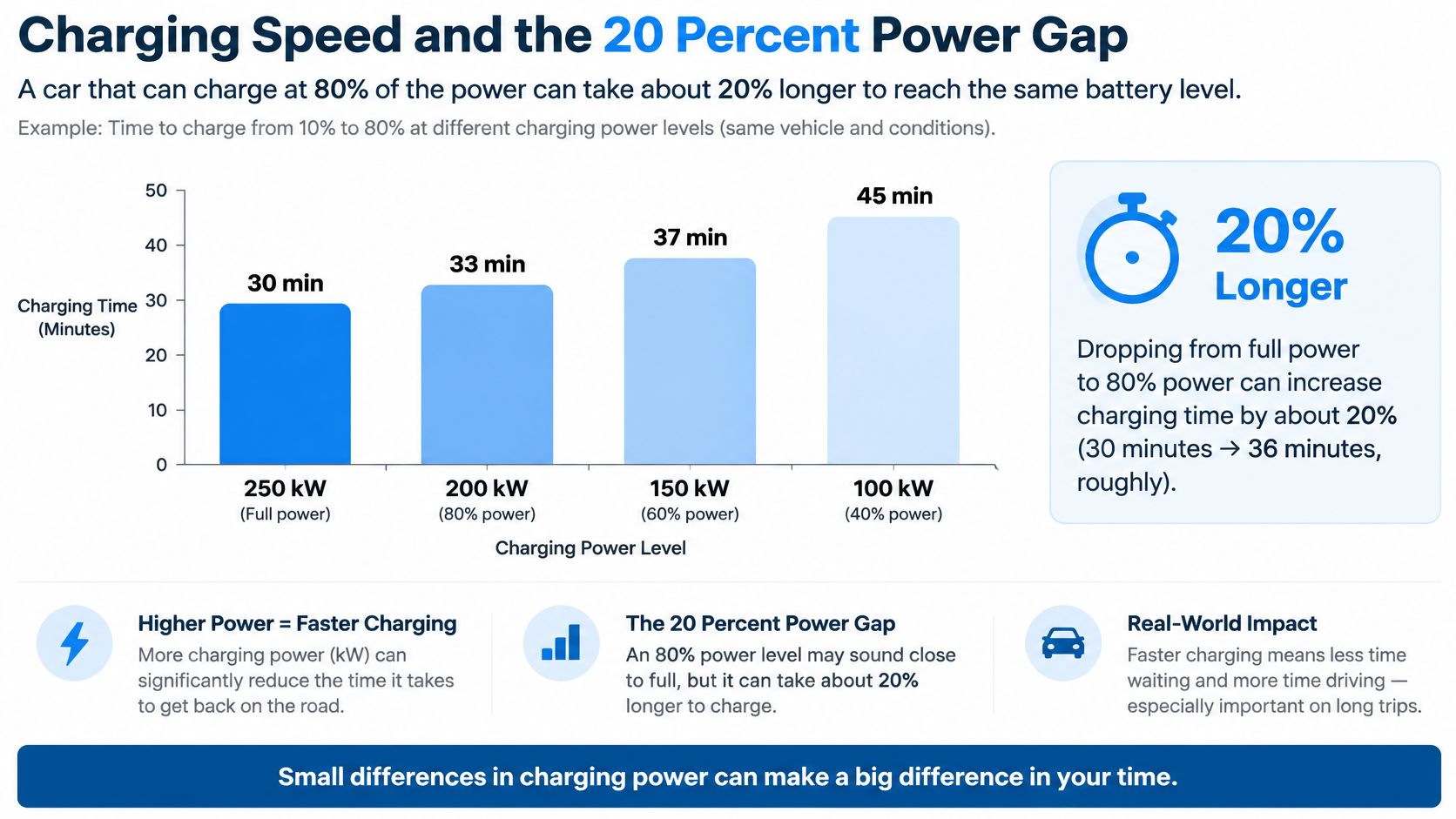
The arithmetic is simple enough to do in your head. Power equals volts times amps, so 240 volts at 30 amps is 7,200 watts. Push the current up and the power follows in a straight line. What complicates the picture is that the plug caps the current before the wiring does. A plug-in EVSE on a NEMA 14-50 receptacle is generally limited to 40 A continuous charging under the 80% continuous-load rule, approximately 9.6 kW at 240 V, while a hardwired EVSE on a properly sized 60 A circuit can commonly deliver 48 A, or about 11.5 kW, roughly 20% higher charging power, according to the hardwire vs plug-in comparison from Home Depot. That same 20 percent difference can reduce the time needed to replenish a 60-kWh battery by approximately one hour under ideal conditions.
The chart below shows where the three setups land once you convert current into range per hour of charging.
Charging power and time by setup
Setup | Continuous current | Power at 240 V | Time to add 60 kWh (ideal) |
|---|---|---|---|
30 A on a 40 A circuit | 30 A | 7.2 kW | About 8.3 hours |
Plug-in on a NEMA 14-50 receptacle | 40 A | 9.6 kW | About 6.3 hours |
Hardwired on a 60 A circuit | 48 A | 11.5 kW | About 5.2 hours |
Why the ceiling sits where it does
The 80% continuous-load rule is the reason a 50-amp receptacle doesn't hand you 50 amps of charging. A circuit loaded to its full rating for hours runs hotter than one loaded to four-fifths of it, so the code leaves the margin in. The 60-amp hardwired circuit flips the math around: 48 amps of charging is 80 percent of 60, and 60 is 125 percent of 48. Same rule, more headroom bought at the panel.
Three things shrink that gap in real life. The car's onboard charger may accept less than the wall unit can offer, and a 32-amp capable vehicle will not pull 48 amps no matter what is mounted on the wall. The battery tapers as it fills, so the last stretch of any session runs slower. Cold, heat and charging losses all take a bite. None of that favors one connection over the other. It just means the 20 percent is a ceiling on the advantage, not a guarantee.
On an overnight schedule, both setups usually finish long before the car is needed. Speed only changes the outcome when the window is short: a two-shift fleet, a delivery van that leaves again at noon, or several vehicles sharing one circuit.
For a walkthrough of what a Level 2 session adds to a typical overnight charging window, see our guide to Level 2 EV charger time.
Which Setup Fits Your Situation
The recommendation flips on the property, not on the charger. A renter who moves in eighteen months and a homeowner with a two-car garage on a 200-amp service are solving different problems, and the same answer would be wrong for one of them. Here's how the situations map out.
Best setup by situation
Situation | Better fit | Why |
|---|---|---|
Single EV with a garage charger that stays put | Hardwired | Higher-current circuit and no receptacle to wear |
Renter or likely to move within two years | Plug-in | The charger can travel and the install is not fixed |
Outdoor or weather-exposed mounting | Hardwired | Avoids a weather-exposed receptacle and cord |
Shared or high-use circuit, such as a workplace or fleet | Hardwired | Sustained high current with fewer failure points |
Panel near capacity, no 60 A circuit possible | Plug-in at 40 A, after a load calculation | Lower continuous draw fits the existing service |
When the charger has to travel
A plug-in unit is the only version that moves with you. Unplug it, cap the receptacle, and the next tenant inherits an outlet. A renter still needs the landlord's agreement for the circuit, and it needs to be a circuit installed for EV charging rather than a repurposed dryer outlet from 1994. The flexibility is real, but it comes from the receptacle, not from the charger.
When the charger has a permanent home
Hardwired, nearly every time. There's no cord to coil, no receptacle to loosen over a thousand plug cycles, and no chance of finding the unit half-seated after someone bumped it. The trade-off is that the mount position and cable length are fixed. Move a workbench or switch parking sides, and a hardwired unit may need an electrician. Tesla Wall Connector jobs are a good example: as a Tesla Certified Wall Connector contractor, we commission the unit to its configured current setting on the circuit that supports it, which is the part most buyers never think about until the first charge is slower than expected.
When one circuit serves many vehicles
Split by duty cycle rather than by preference. A workplace bank where employees plug in for four hours at a stretch behaves like a small fleet, and sustained high current on a shared circuit rewards fewer connection points. A property with one charger that maintenance swaps during repairs values the ability to unplug and replace it without a panel visit. Two chargers serving two households is a load management problem before it is a connector problem.
What to check before you commit
Panel capacity and open spaces. Two spaces and 60 amps of headroom is one conversation. A full 100-amp panel serving electric heat is a different project with a different budget.
The largest circuit the service can support. That single number eliminates options faster than any preference.
Whether the charger will ever move. A two-year horizon changes the answer completely.
Local code and permit requirements. Adoption varies by municipality, so the edition of the code your inspector enforces matters more than what a forum says.
The EVSE listing and current setting. A listed unit set to a lower current is a legitimate answer on a smaller circuit.
How to sequence the quotes
Get the load calculation first, before you shop. Then request two quotes at the same circuit size, one hardwired and one plug-in, so the comparison isolates the connection rather than the amperage. Compare the line items, not the totals, because a cheap quote that skips the panel work isn't cheaper. Decide the panel question first and the connector question second, and the rest usually answers itself. We offer a free consultation, which is typically where that panel question gets settled before anyone buys hardware.
Safety, Protection and Failure Points Compared
Hardwiring isn't automatically safer. It's differently safe, and the two setups fail in different places. That distinction gets lost in most comparisons, which treat "no plug" as a synonym for "no risk."
Start with what a plug-in install adds. Under NEC 625.54 as described in this comparison of plug-in and hardwired charger safety, receptacles used for EV charging require GFCI protection, which in a common plug-in setup means a dedicated 240-volt GFCI breaker feeding the NEMA 14-50 outlet while the EVSE may also carry its own ground-fault monitoring. Two layers watching the same leakage current can trip each other, and a nuisance trip at 2 a.m. is a diagnostic puzzle rather than a convenience.

The failure points line up like this.
Receptacle wear. Terminals loosen and heat when a high-duty-cycle receptacle is installed poorly or repeatedly loaded for hours at a stretch. This is the single most common hardware failure in plug-in charging.
Cord and plug damage. A cord pulled tight across a garage floor, pinched behind a bumper or left hanging under its own weight takes abuse that fixed conductors never see.
Accidental unplugging. In a shared garage, "someone else's charger" becomes "my charger" quickly.
Outdoor exposure. Weather-rated receptacles, covers and enclosures exist, but every one of them is a connection exposed to moisture, temperature swing and ultraviolet light.
Disconnect and inspection duties. These apply to both setups. Local code adoption, manufacturer instructions and listed-equipment rules still govern a hardwired install.
A hardwired charger has no user-accessible plug or receptacle and can use a standard breaker where the applicable code permits, provided the listed EVSE supplies its required internal personnel protection. That's a code permission, not an invitation to skip review. Residential electrical upgrades are done to ensure full compliance with local electrical codes, and the breaker sizing question deserves its own look, which we cover in what size breaker for an EV charger.
Three checks any homeowner can request: the EVSE listing and current setting documented on the invoice, a torque check on every termination at installation, and a thermal verification after commissioning, meaning someone puts a hand or an infrared thermometer on the terminations after a sustained high-current session.
Installation and Ownership Costs to Compare
Four lines carry nearly all the money on an EV charger installation: the charger itself, the receptacle and GFCI breaker if the setup is plug-in, the wire run and mounting labor, and any panel or service upgrade. The first three scale with the size of the job. The fourth can dwarf them, and it shows up under either setup. A home that fails the load calculation pays for panel work whether the charger is hardwired or plugged in.
That's why comparing quotes by headline price goes wrong so often. Two estimates that both read "EV charger install" can differ by a panel replacement buried in one of them.
Cost line items to compare in quotes
Cost item | Hardwired | Plug-in NEMA 14-50 |
|---|---|---|
Charger unit | Model-dependent price | Model-dependent price; confirm the unit is listed for plug-in use |
Receptacle and GFCI breaker | Not needed | Required, plus labor to install both |
Wire run and mounting | Cable or conduit from panel to a fixed mount | Shorter run to a receptacle near the panel or wall |
Branch circuit labor | Full circuit plus termination at the unit | Full circuit plus receptacle installation |
Panel or service upgrade | Needed only if the load calculation fails | Same trigger and the same check |
Future move or replacement | Electrician needed for removal and relocation | Unplug the charger; a new site needs its own receptacle |
Ask for this in writing: the circuit size in amps, the EVSE model and the current setting it will be commissioned to, and whether the permit and inspection are included. A quote missing any of those three isn't comparable to one that has all three.
A plug-in install adds receptacle and GFCI breaker parts plus the labor to fit them, and it often shortens the wire run because a receptacle can sit closer to the panel than a fixed charger mount. A hardwired install adds cable or conduit to a fixed mounting point, then saves the receptacle hardware. Which comes out ahead depends on distance and layout, not on a rule of thumb.
Three costs hide outside the quote. Relocation costs an electrician's visit on a hardwired unit and nothing more than an unplug on a plug-in, though the new location needs its own circuit either way. Compatibility matters when a future charger has a different plug or a different maximum current than the circuit was built for. Permit fees vary by municipality, and skipping the permit doesn't remove the requirement.
For electrical upgrades, we assess the current setup and explain panel upgrade or full service replacement options, with service upgrades offered at 200 or 400 amp for residential, commercial and industrial properties. For what the installation itself runs, see how much to install an EV charger at home. Whichever way the hardwired vs plug in EV charger decision lands, the panel work is the same conversation, and it's cheaper to have it before the hardware arrives.
Amp'd Energy Solutions installs Level 2 chargers across Southeastern Pennsylvania, hardwired on a dedicated circuit or on a NEMA 14-50 receptacle, and we run the load calculation before quoting so you know which one your panel can support. We're a father-and-son team, Tesla certified for Wall Connector work, and we handle the panel or service upgrade when the circuit math calls for one. Start with a free consultation at Amp'd Energy Solutions and get the ceiling on your own service before you buy a charger.
Comments