

Whole House Generator Worth It? a PA Homeowner's Guide
The most popular advice about backup power starts with the wrong question: how big a generator does your house need? First ask what happens when your house loses power. A dark living room, an idle well pump and an interrupted medical device are different problems, even when the outage lasts exactly as long.
Is a whole house generator worth it? For some Southeastern Pennsylvania homeowners, it's a defensible investment in continuity. For others, it's an expensive way to keep a refrigerator and router running. The decision turns on outage consequences, duration and the loads you need, not whether a generator can power everything you own.
Table of Contents
Which Homes Justify a Whole House Generator - Separate protection from convenience
How Outage Risk Changes the Math - Build a property-specific outage record
Generator, Battery or Portable Backup Compared - Compare stored energy with replenishable fuel - When a hybrid arrangement makes sense
Sizing the System to Your Real Loads - Build the load inventory - Use controls before buying excess capacity
Calculate the Breakeven on Outage Costs - Compare ownership costs with losses you can actually avoid - Apply the decision rule honestly
Maintenance, Fuel and Safety Realities - Match each failure point to a check - Treat exhaust as a separate safety requirement
Decide and Request a Sizing Quote - Request a design you can evaluate
Which Homes Justify a Whole House Generator
A whole-house generator is worth buying when losing power creates consequences your household can't reasonably absorb. Long outages strengthen the case, but duration alone doesn't decide it. A short interruption can be serious for a medically dependent resident, while a longer outage might be manageable for a household that can relocate.
Verdict by household situation
Household situation | Verdict | What decides it |
|---|---|---|
Brief, rare outages; only fridge and internet need backup | Usually not worth it | Battery or portable unit covers the essentials |
Medical equipment that needs continuous power | Strong case | Outage duration and the device's power needs |
Frequent storm-driven outages lasting a day or more | Strong case | Local outage history and multi-day exposure |
Well water or sump pump protecting the home | Strong case | Cost of water loss or basement flooding during an outage |
Frozen or refrigerated inventory for a home business | Strong case | Value of one lost day of stock |
Home office with few power-dependent tasks | Borderline | Hours of lost work versus installed cost |
A strong case for backup power isn't automatically a strong case for whole-home capacity. A home with a critical sump pump might need dependable automatic backup for selected circuits, not unrestricted operation of cooking equipment, cooling, water heating and vehicle charging.
Medical equipment requires another distinction. An engine-driven standby generator has a starting and transfer interval, so it shouldn't be treated as uninterrupted power. Confirm the device's requirements with its manufacturer and care team, including any dedicated battery bridge and emergency relocation plan.
Separate protection from convenience
Put each desired load into a practical category:
Protect people: Required medical equipment and temperature control that a resident needs for safety.
Protect the property: Sump pumps, heating controls and other equipment whose loss could cause damage.
Preserve income: Refrigeration for business inventory or equipment needed to complete paid work.
Maintain comfort: Entertainment, discretionary cooling and other loads you can temporarily suspend.
This sorting prevents an important budgeting mistake: using a genuine need for a critical circuit to justify powering every circuit.
Practical rule: First decide what you can't allow to stop. Then decide what you'd merely prefer to keep running.
Find your household's row, but treat the verdict as provisional. Local outage history, the consequence of a prolonged interruption and simultaneous electrical demand still have to support the purchase.
How Outage Risk Changes the Math
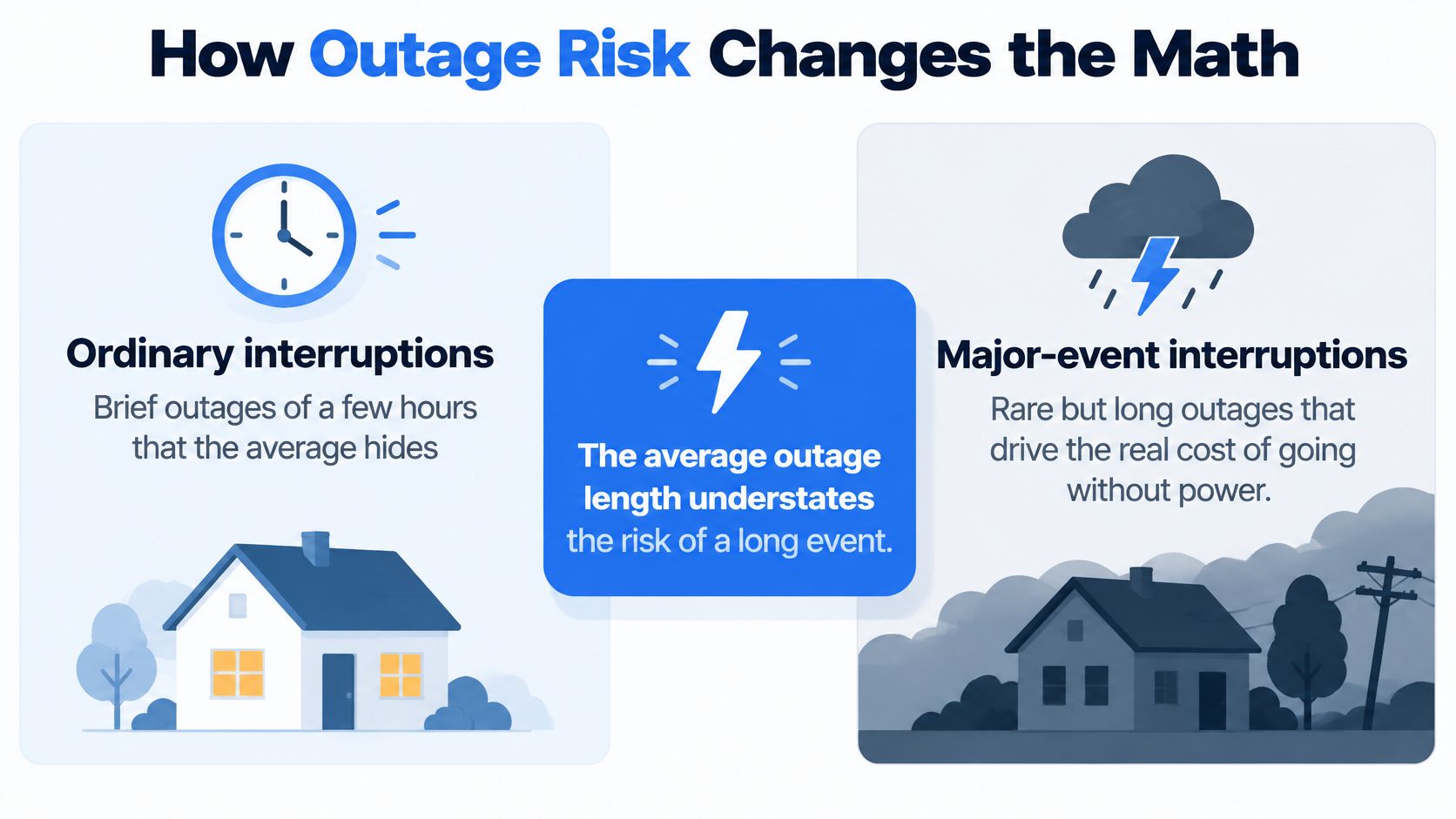
Ordinary service interruptions and major storms create different backup-power problems. In its electricity reliability analysis, the U.S. Energy Information Administration reported approximately 11 hours of interruptions per customer in 2024, nearly twice the preceding decade's annual average; Hurricanes Beryl, Helene and Milton accounted for about 80% of those lost hours.
The same EIA analysis separates roughly two hours of ordinary interruptions from nearly nine hours associated with major events in 2024, compared with approximately four hours annually from major events during 2014–2023. Those distinctions matter more than the headline average when you're choosing equipment.
Outage hours by event type
Measure | Value | Period |
|---|---|---|
Average interruption hours per customer | About 11 hours | 2024 |
Ordinary, non-major-event interruptions | About 2 hours | 2024 |
Major-event interruptions | About 9 hours | 2024 |
Major-event interruptions, annual average | About 4 hours | 2014–2023 |
Ordinary interruptions, annual average | Not separately stated in this historical comparison | 2014–2023 |
Share of lost hours from Hurricanes Beryl, Helene and Milton | About 80% | 2024 |
Figures summarize the EIA analysis linked above. The historical ordinary-interruption figure isn't inferred from rounded totals.
Build a property-specific outage record
A national customer average doesn't predict restoration time at your address. Your utility's distribution system, nearby vegetation, overhead-line exposure and storm history determine how useful that average is.
Pull your utility's outage records and combine them with household records: outage alerts, messages about restoration, hotel receipts or notes about discarded food. Record duration and consequence together, rather than keeping only a count of interruptions.
Use this sequence:
Request local history. Ask for reliability information relevant to your service territory or circuit where available.
Identify the longest interruption. Note whether you stayed home, relocated or lost access to water, heating or work.
Separate causes. Distinguish storm-related interruptions from ordinary equipment failures and brief service interruptions.
The longest outage deserves attention, but don't automatically assume it will recur annually. Use it as a stress test for your backup plan, not a guaranteed operating schedule.
The less obvious issue is that outage losses aren't necessarily proportional to time. A brief interruption may have little effect, while a prolonged interruption can cross a threshold at which refrigeration, indoor temperature or drainage becomes unacceptable.
That's why a generator's strongest role is often protection against an extended event, rather than an economical response to every flicker. You're purchasing the ability to remain functional when normal restoration takes longer than your household can tolerate.
Generator, Battery or Portable Backup Compared
Backup options compared
Option | Best for | Runtime limit | Noise and exhaust | Startup | Upkeep |
|---|---|---|---|---|---|
Whole-house generator | Multi-day outages and whole-home loads | Fuel supply and required service | Engine noise, exhaust outdoors | Automatic after starting and transfer | Scheduled service and fuel |
Battery storage | Short outages and quiet backup | Usable battery capacity and connected load | Quiet, no local combustion exhaust | Immediate backup when appropriately configured | Monitoring and manufacturer-specified checks |
Portable generator | Essentials on a budget | Stored fuel and manual refilling | Engine noise, outdoors only | Usually manual | Oil, fuel storage and cord safety |
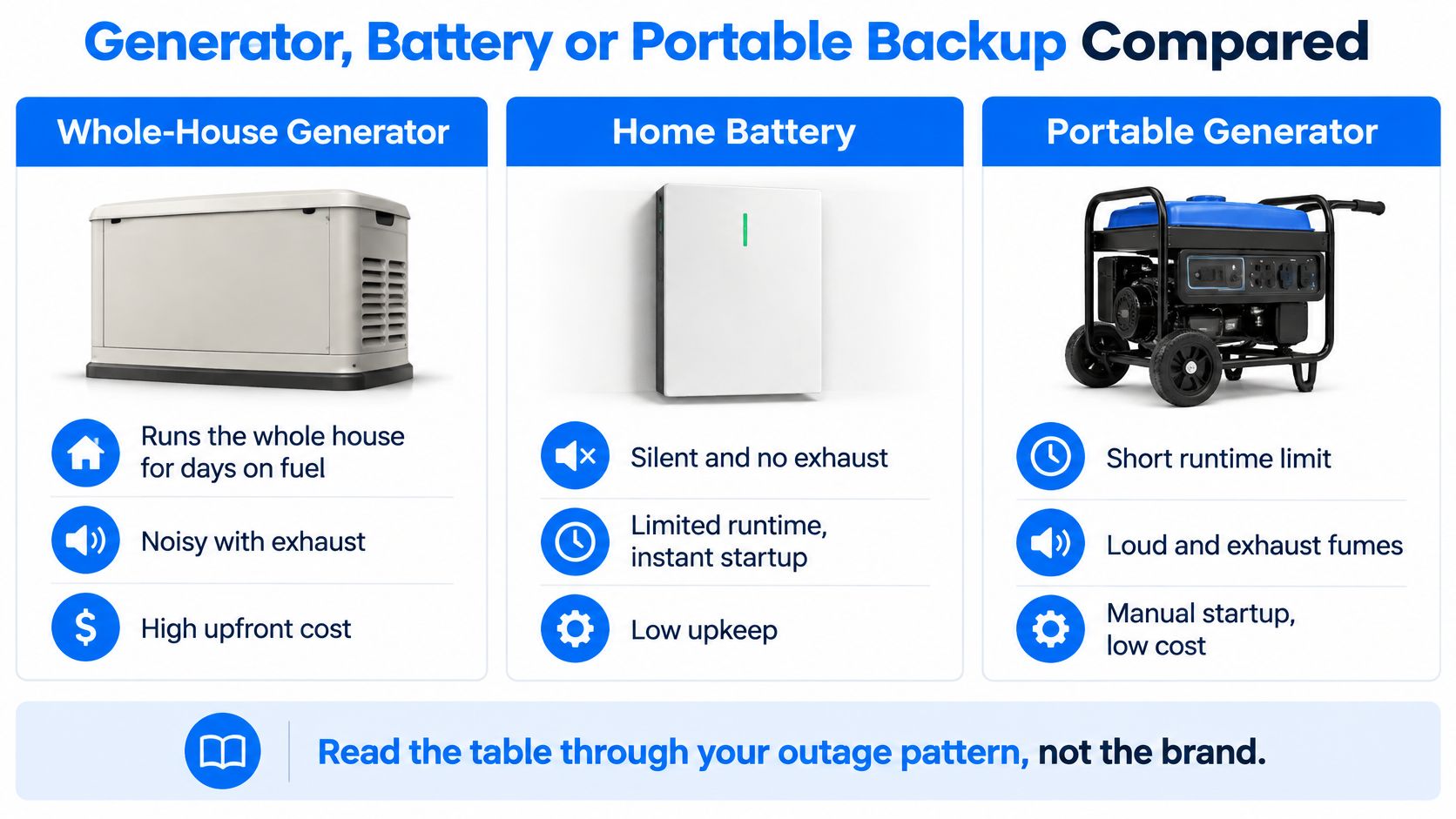
Read this comparison through your outage pattern, not the equipment category's reputation. ConsumerAffairs' whole-house generator assessment highlights the importance of comparing outage consequences, ownership costs and alternatives rather than assuming permanent standby equipment is always worthwhile.
A battery suits a household that wants brief interruptions handled without starting an engine. A generator suits an extended interruption when substantial loads must remain available and a dependable fuel supply exists. A portable unit can be appropriate when someone can safely deploy it and only selected essentials need power.
Compare stored energy with replenishable fuel
Battery runtime follows usable energy divided by connected demand. Reduce the backed-up load and the same battery can support it longer. However, don't assume rooftop solar will recharge a battery throughout a storm without examining system configuration and expected conditions.
A generator replaces that stored-energy limit with a fuel dependency. Natural gas requires an available supply; an on-site tank requires sufficient inventory and a credible refill plan. Neither arrangement should be described as unlimited runtime.
Portable equipment adds a human dependency. Someone must be present, able to start it and prepared to manage safe connections and refueling. It's a poor match for unattended property protection unless the proposed arrangement specifically addresses that limitation.
When a hybrid arrangement makes sense
A compatible battery-and-generator system can divide the jobs: the battery handles brief interruptions, while the generator supports longer operation when stored energy becomes insufficient. That can be useful when quiet backup matters but extended storm protection remains necessary.
Compatibility must be designed, not assumed. Transfer controls, charging behavior and load priorities need to work together without creating conflicting operating modes.
A hybrid system should solve a defined continuity problem. Buying both technologies without assigning each a job can simply duplicate expense.
Our battery backup versus generator guide provides another way to evaluate that split. Include vehicle charging in the comparison only if it's required during an outage; otherwise, treating it as discretionary can leave more backup capacity available for the home.
Sizing the System to Your Real Loads
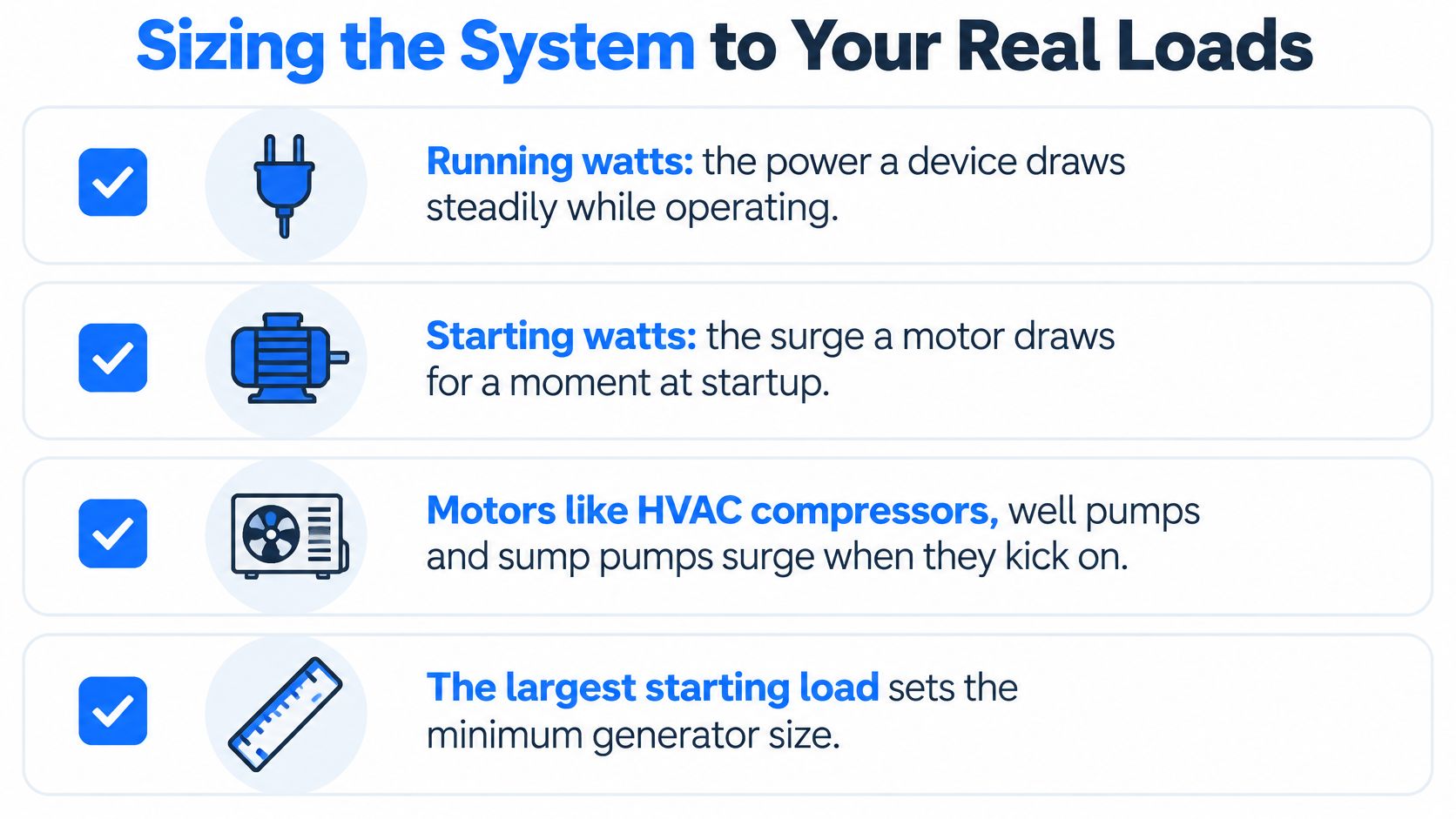
Generator sizing starts with running demand and motor-starting demand, not the number printed on your main breaker. The standby generator guide published by Fall River Electric explains the need to account for intended running loads and starting requirements, along with appropriate transfer equipment and installation design.
Running watts describe the power equipment needs while operating. Starting demand describes the additional electrical requirement when a motor accelerates, which matters for compressors and pumps.
The largest motor-starting requirement must be evaluated alongside loads already running. It doesn't, by itself, establish the complete generator size.
Build the load inventory
Collect equipment nameplate photographs and identify what must operate simultaneously:
Heating equipment: Record the fuel type and electrical needs of blowers, circulators, controls or heat pumps.
Well and sump pumps: Identify motor ratings and whether pumping could coincide with other large loads.
Refrigeration: Include household refrigerators, freezers and any business refrigeration.
Air conditioning: Capture compressor starting information, not just normal operating demand.
Electric water heating: Decide whether it must remain available throughout an interruption.
EV charging: Specify whether charging is essential, limited or disabled during backup operation.
Planned additions: Include a future heat pump, workshop equipment or other expected electrical changes.
A sizing proposal should explain the operating scenario it supports. “Everything connected” and “everything operating simultaneously” aren't equivalent promises.
Use controls before buying excess capacity
Undersizing can cause unstable voltage or frequency, nuisance trips and failed motor starts. Oversizing can increase purchase cost and leave the engine operating at an inefficiently light load.
Load management offers another route. Controls can prevent discretionary loads from operating when essential equipment needs capacity, or stagger motor starts so they don't coincide. That's often a better engineering response than increasing output without examining the load sequence.
A listed transfer switch prevents an unintended simultaneous utility-generator connection. It must be selected with the service arrangement, overcurrent protection and equipment ratings, rather than treated as a generic accessory.
For a sizing quote, bring your load inventory, panel photographs, equipment labels, proposed installation area and information about available fuel. Request a written calculation that also addresses permitting, exhaust placement, fuel delivery capacity and future loads. The useful deliverable is an operating plan, not merely a generator rating.
Calculate the Breakeven on Outage Costs
Consider a clearly illustrative budget, not a price quote or a predicted service life: assume an installed price of $18,000, maintenance of $350 annually, and a 15-year evaluation period. The arithmetic is $18,000 + ($350 × 15) = $23,250, or $1,550 annually, before fuel, financing, repairs and the time value of money.
Those assumptions sit within ConsumerAffairs' broad estimates of $10,000–$25,000 installed and $200–$500 in annual maintenance, cited in its assessment above. They aren't Southeastern Pennsylvania bids, and your site conditions can change the result.
Whole-house generator cost components
Cost item | Typical range or budgeting entry | What drives it |
|---|---|---|
Installed whole-house generator | $10,000 to $25,000 | Output size, transfer switch, permits, pad and fuel hookup |
Annual maintenance | $200 to $500 | Service visits, testing and parts |
Ten-year maintenance | $2,000 to $5,000, calculated from the annual range | Annual maintenance multiplied over ten years |
Fuel per outage | Enter a local fuel quote and model-specific consumption estimate | Fuel type, outage hours and load |
Cost of one 24-hour outage | $54 average for residential participants in the DOE-backed survey described below | Participant-specific outage consequences, not a property-damage allowance |
The maintenance total is simple multiplication, not a fixed-price service agreement. For installation scope, use the whole-house generator installation cost guide to identify items that should appear explicitly in a proposal.
Compare ownership costs with losses you can actually avoid
A Department of Energy article about a DOE-backed study reported that a 2025 survey of more than 1,300 electric-cooperative members found a 24-hour outage cost residential participants an average of $54. That finding describes those participants, not a Pennsylvania household's potential flood damage or medical risk.
Still, it illustrates why routine inconvenience alone may not support the illustrative ownership budget. A financial case usually requires more consequential exposure than occasional discarded groceries.
Build your avoided-loss estimate from specific categories:
Food and inventory: Count replacement cost, separating household groceries from business stock.
Property damage: Identify credible pump or heating failures and account for insurance deductibles and coverage.
Work interruption: Count income lost, not every hour spent away from a desk.
Temporary accommodation: Include relocation costs only where relocation would realistically be necessary.
Medical continuity: Treat safety requirements separately rather than forcing them into a speculative dollar figure.
The EIA's reliability explanation distinguishes SAIFI, interruption frequency; SAIDI, total interruption duration; and CAIDI, average restoration duration. Utility-level information helps you assess exposure, but it doesn't assign a value to your losses.
Apply the decision rule honestly
Expected annual avoided losses = the probability of each outage scenario multiplied by its avoidable loss, summed across scenarios.
Compare that estimate with annualized ownership and operating costs. Include fuel and realistic repair allowances, and don't credit the generator with preventing damage caused by a failed appliance it merely supplies.
Financial test: A large possible loss isn't the same as a large expected annual loss. Probability matters.
If avoided losses exceed costs, you have a payback-style case. If they don't, the purchase may still be reasonable protection against an unaffordable event, but call it risk reduction, not guaranteed savings.
Maintenance, Fuel and Safety Realities
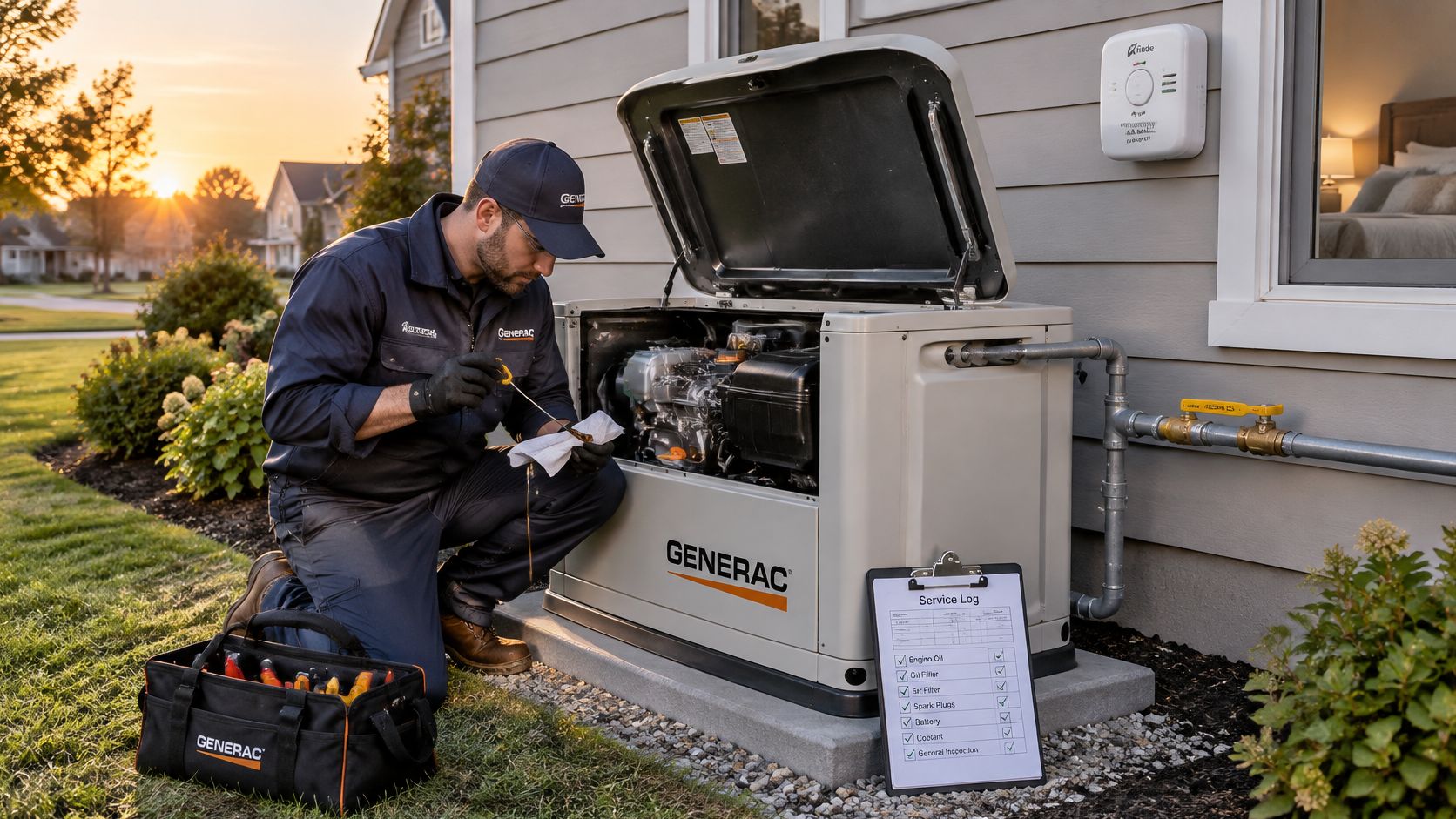
A standby generator can carry a full fuel supply and still sit silent during an outage. The common culprits are mundane: a weak starting battery, a transfer switch fault, or controls that stopped responding between exercise cycles.
Most standby systems run a scheduled exercise, but an exercise run isn't proof the home will transfer successfully under load. Follow the owner's manual for exercise settings and service intervals, and budget for scheduled maintenance as well as outage-related repairs.
Match each failure point to a check
Failure point | Scheduled check |
|---|---|
Generator fault or weak starting battery | Review exercise logs and arrange a starting-battery load test |
Transfer equipment fault | Have a qualified technician perform a transfer test under load |
Fuel restriction or degraded stored fuel | Inspect the supply arrangement and review fuel condition |
Empty propane or diesel tank | Check inventory and confirm refill arrangements |
Failed sump pump | Test the pump separately and maintain an independent alarm |
Blocked or unsafe exhaust area | Inspect clearance and keep openings and obstructions away |
A natural-gas connection avoids manual tank refilling, but it still relies on external infrastructure. Propane requires tank management, while stored diesel requires attention to fuel condition and the supplier's storage guidance.
Ask for the fuel consumption expected at your proposed operating load, then test whether delivery remains practical during a regional emergency. A refill plan built on normal road access and normal supplier demand is a plan for the days you least need the generator.
Treat exhaust as a separate safety requirement
Keep generator exhaust outside and away from windows, doors and vents. Portable generators must never operate inside a house, basement, garage or other enclosed area, and opening a door doesn't make indoor operation safe.
Maintain working carbon-monoxide alarms in the home. Have the installer document placement against the equipment instructions and applicable local requirements rather than estimating clearances yourself.
The generator maintenance cost guide gives you a structure for the service budget. Request a written maintenance schedule and warranty terms that identify parts coverage, labor coverage and any ownership-transfer conditions.
Put these tasks on your calendar:
Exercise review: Check the log and investigate fault messages.
Service appointment: Book the manual-specified inspection and maintenance.
Fuel check: Review inventory, condition and replenishment.
Safety checks: Test CO alarms and the sump pump.
Battery record: Track starting-battery testing and its planned replacement date.
Decide and Request a Sizing Quote
The most economical backup system is the smallest one that carries the required loads through the longest outage the household is planning for. Bringing a written operating requirement to each proposal keeps sizing honest, because every quote then competes on the same problem rather than on machine size.
Condense the earlier analysis into a one-page worksheet and use the same copy for every quote.
Worksheet field | What to record | Example entry |
|---|---|---|
Outage exposure | Longest outage duration from the property record and any events that made the home unsafe to occupy | Prolonged outages listed; vacated events flagged |
Required loads | Nameplate ratings for loads that must stay on, with discretionary loads marked for automatic management | Required loads totaled; discretionary loads tagged |
Interruption value | Expected losses per prolonged outage, with safety needs kept separate from convenience | Annual loss estimate; safety items listed apart |
Ownership cost | Installation, maintenance, fuel and service obligations set against that loss figure | Quote line items priced beside each assumption |
Fuel plan | Expected consumption at the proposed load and how refueling works during a regional emergency | Refill depends on emergency delivery |
Service and warranty | What the warranty covers and who services the unit after installation | Parts and labor scope; service provider named |
Request a design you can evaluate
When the worksheet supports a generator, request a proposal that includes a written load calculation, transfer-switch specification, permitting scope, exhaust location, fuel requirements and a maintenance plan. The proposal should also state what happens when demand exceeds available capacity and which loads are shed first.
Have each proposal answer the same questions. Would a battery better address the household's short interruptions? Battery backup runs on ordinary utility service, so solar panels are not a prerequisite. How will fuel remain available during a regional emergency? Who handles service once the installation crew leaves?
During our free consultation, we walk customers through their options and help them choose a backup system that fits their property, budget and peace of mind. Bring the worksheet so the discussion starts with your actual electrical needs instead of an assumed whole-home package.
The strongest decision might be a managed-load generator, a battery, a portable solution or no major purchase yet. Choose the least complicated system that meets the consequence and duration of the outages you need to withstand.
Amp'd Energy Solutions offers generator sizing, complete custom installation, troubleshooting and annual maintenance, along with custom battery backup systems. Bring your outage worksheet and equipment list to a free consultation with Amp'd Energy Solutions to compare a generator with the backup options that fit your property and budget.
Comments