

Battery Backup vs Generator: Which Fits Your Home in 2026
The lights flicker, the heating stops, and you're checking whether the sump pump is still running. You may already be comparing a wall-mounted battery with an outdoor standby generator, wondering which will keep your home comfortable through the next storm.
The useful question in battery backup vs generator isn't which runs longer on a sales sheet. It's which system can support your essential loads, handle their starting demand, and keep supplying energy through the outage you're planning for. That distinction can lead to a battery, a generator, or a combination that avoids the weaknesses of either alone.
Table of Contents
Battery Backup vs Generator at a Glance - Answer these questions first
How Each System Keeps Power On During an Outage - The wiring determines what stays powered
How Long Each Option Keeps the Lights On - Average consumption isn't the entire calculation - Generator endurance needs a fuel plan
Fuel, Emissions and Efficiency Trade-Offs - Fuel choice changes the failure mode
Upfront and Lifetime Costs Compared - Compare annual ownership costs
Which Backup Setup Fits Which Home or Business - Where a hybrid changes the answer
Get a Load Assessment Before You Choose - Make the assessment useful
Installation, Permits and Upkeep in Southeastern Pennsylvania - Keep responsibility clear
Battery Backup vs Generator at a Glance
Factor | Battery backup | Whole-house generator |
|---|---|---|
Power source | Stored electricity charged from the grid or solar | Natural gas, propane, or diesel burned on site |
Switchover | Near-instant discharge, with transfer performance set by system design | Engine startup and automatic transfer create an interruption |
Typical runtime | Hours, set by usable energy and average load | Extended operation, set by fuel supply and service requirements |
Noise and emissions | Quiet operation, no on-site combustion | Audible engine noise and exhaust, outdoor installation required |
Maintenance | Software updates and periodic inspection | Scheduled service, oil and filter changes, and self-test runs |
Best fit | Short interruptions, solar-equipped homes, and sensitive electronics | Multi-day outages and sustained high-demand loads |
A battery supplies stored electricity without waiting for an engine to start, but its usable kilowatt-hours limit how much energy it can deliver. A generator can continue producing electricity while fuel remains available and operating conditions permit, but startup and transfer aren't instantaneous. It also needs outdoor placement, exhaust planning, and regular mechanical service.
The practical takeaway is simple: batteries favor fast, quiet backup; generators favor endurance; coordinated systems can provide both.
The table compares operating models, not every product. Check the proposed equipment's continuous output, surge capability, transfer specifications, and approved installation conditions rather than assuming every battery or standby generator behaves alike. A whole-house connection also doesn't mean every appliance can run simultaneously.
Answer these questions first
Outage duration: What's the longest outage you've experienced, and what would happen if the next one lasted longer?
Essential equipment: Which circuits must remain available, including heating, water removal, refrigeration, communications, and medical devices?
Solar plans: Do you already have solar panels, or do you want the electrical design to accommodate them later?
Your answers establish the design priorities before equipment selection begins. A property that needs uninterrupted communications has a different backup problem from a house that needs sustained electric heating during a winter storm.
How Each System Keeps Power On During an Outage
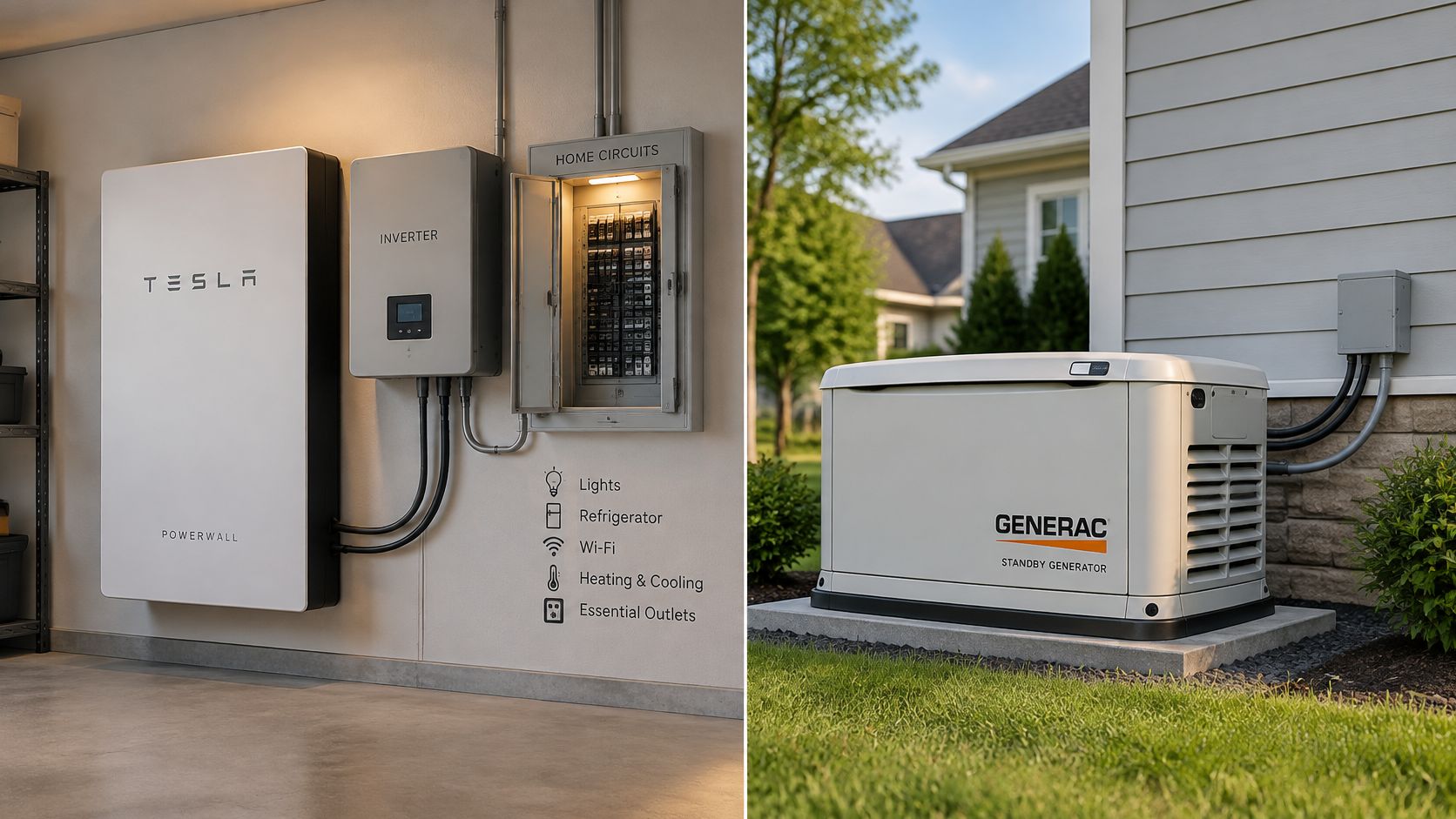
A battery is a pre-outage energy store. It charges beforehand, then supplies electricity through an inverter when utility power fails. A generator is a during-outage fuel converter, using an engine to turn fuel into electrical output.
That difference determines what you must replenish: battery energy or generator fuel.
The National Renewable Energy Laboratory's backup-system comparison modeled a generator-only installation with 5 days of outage survival, compared with 6 days for a design combining generation, solar, and storage. The useful lesson is architectural: adding storage and another energy source can improve endurance rather than merely duplicate equipment.
The wiring determines what stays powered
A battery installation can feed a dedicated critical-loads panel or use compatible controls to manage backed-up circuits. Refrigeration, sump pumps, communications equipment, heating controls, and selected outlets are sensible starting points. The final circuit arrangement should reflect what the property needs, not just what fits conveniently into a panel.
A standby generator connects through transfer equipment that separates the backed-up installation from utility power. It may supply the main panel, but the generator's output still limits simultaneous demand. Load controls can prevent large appliances from competing for unavailable capacity.
Solar isn't required for battery backup. We install battery systems that work with utility service, charging before an outage even when the property has no solar panels. These systems operate cleanly, without combustion fumes, fuel handling, or an engine-start delay.
Design distinction: Fast response and long endurance are separate requirements. Buying more stored energy doesn't automatically solve a motor-starting problem.
For solar-equipped properties, confirm that the proposed system can operate and recharge during an outage. Existing solar panels alone aren't proof of that capability; the inverter, controls, and isolation equipment must support it.
The deciding question is whether your greatest risk is running out of energy or losing power even briefly. Some properties need both problems solved.
How Long Each Option Keeps the Lights On
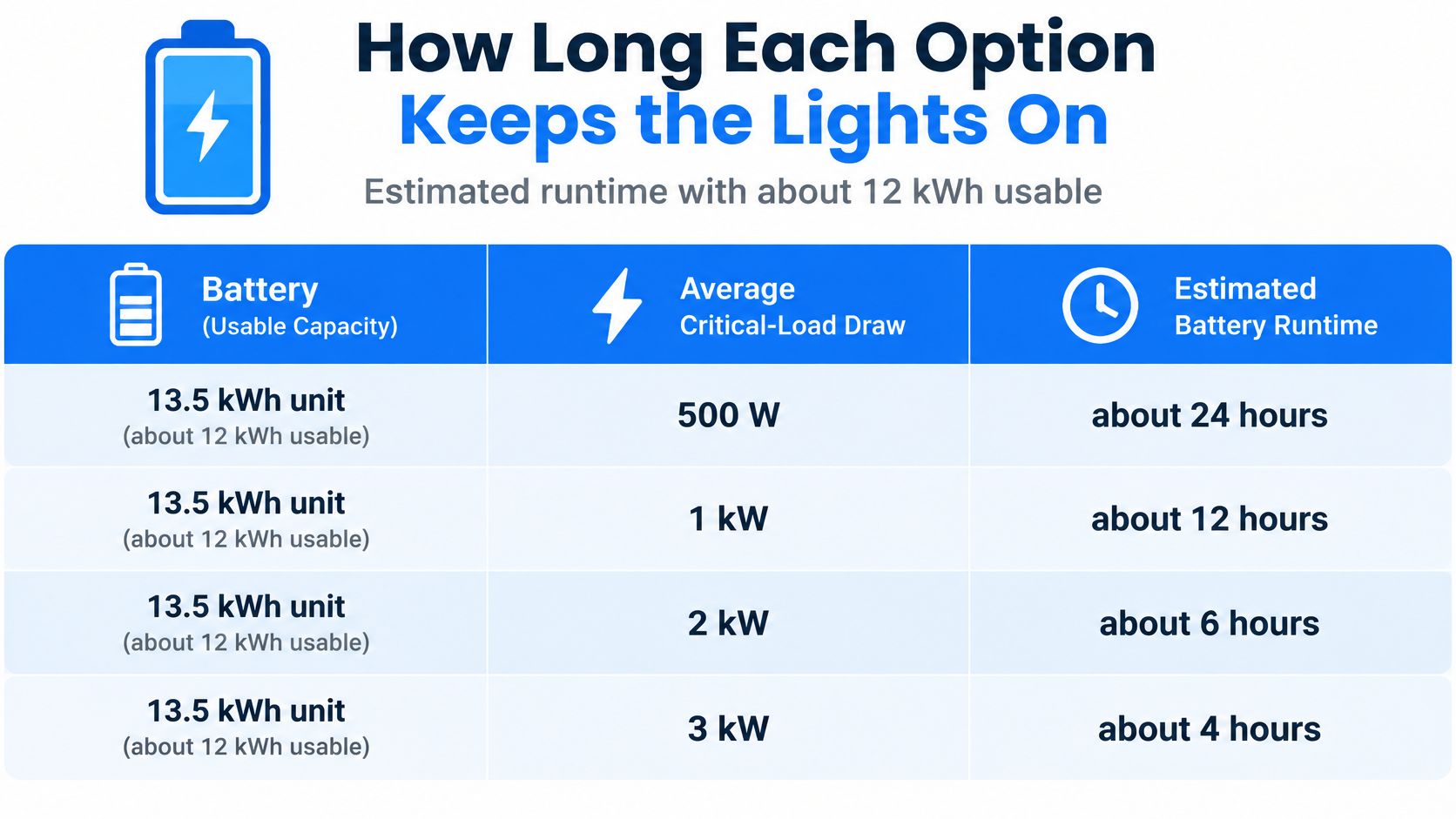
Average critical load | Estimated battery runtime | Typical loads at this level |
|---|---|---|
500 W | About 24 hours | Refrigerator, router, LED lights, and intermittent sump-pump use |
1 kW | About 12 hours | Refrigeration with cycling well pump and furnace blower |
2 kW | About 6 hours | A possible moderate heating scenario with refrigeration and controls |
3 kW | About 4 hours | A possible heavier heating scenario with pumping and lighting |
These are hypothetical calculations, not equipment guarantees: assume a battery with 13.5 kWh of nominal capacity and 12 kWh available for the example. The appliance combinations are illustrative load groupings, not measured consumption ratings.
Runtime equals usable kilowatt-hours divided by average kilowatts. Actual results require measured consumption, available charge, inverter specifications, and installation conditions.
Average consumption isn't the entire calculation
The DOE/Sandia energy-storage introduction characterizes lithium-ion storage as commonly configured for two to four hours at rated output. That doesn't mean every home battery empties within that period: reducing the connected load extends discharge time.
Several constraints can make an average-load estimate optimistic:
Starting demand: Heat pumps and well pumps can require a brief surge beyond their normal running draw. Enough stored energy won't help if the inverter can't start the equipment.
Temperature: Cold conditions can reduce available capacity or constrain operation. Use the manufacturer's operating limits for the proposed location.
Reserve settings: Energy held back by the control strategy isn't automatically available for ordinary discharge.
Initial charge: An outage can begin before the battery reaches its intended backup reserve.
Automatic load management helps by excluding discretionary equipment. EV charging, resistance heating, and large electric water heaters should have explicit backup priorities rather than remain connected by default.
Generator endurance needs a fuel plan
For generators, calculate fuel requirements against expected loading and the manufacturer's operating instructions. Propane and diesel installations need a replenishment plan that remains workable during a storm; natural-gas installations rely on continued gas service.
Don't describe either arrangement as unlimited. Fuel deliveries can become difficult, and engines still need attention during extended operation.
Before accepting a runtime promise, record a representative operating period that includes heating cycles, pump activity, and equipment startups. For Southeastern Pennsylvania homes, capture conditions that resemble the outage you're worried about, not just a mild day when the largest loads remain idle.
Fuel, Emissions and Efficiency Trade-Offs
An oversized generator isn't automatically an efficient generator. If it spends an outage supplying only modest household loads, the engine may operate far from its most efficient range.
A National Laboratory of the Rockies analysis places peak internal-combustion-engine efficiency at approximately 75–80% of maximum load; in a modeled example, adding a battery buffer reduced average emissions to 2.19 lb of carbon-dioxide-equivalent per kWh, about half the generator-only result. That's a modeled operating case, not an emissions rating for a residential installation.
Fuel choice changes the failure mode
Natural gas: Avoids routine tank refilling, but continued operation requires gas service. Review the supply arrangement when evaluating a whole-house gas generator.
Propane: Provides stored fuel on the property, but usable inventory and delivery access become part of outage planning.
Diesel: Requires appropriate storage, fuel-condition management, and an engine-specific service plan.
Generator exhaust includes combustion pollutants such as carbon monoxide and nitrogen oxides. Outdoor placement, exhaust clearances, working carbon monoxide alarms, and safe fuel procedures belong in the installation plan, not in a later maintenance conversation.
A battery produces no on-site combustion emissions, but that isn't the same as having no environmental impact. The source of charging electricity matters, and purchasing solar panels doesn't remove the need to evaluate actual energy availability during poor weather.
A generator can be valuable for endurance without being the best machine to supply every small load throughout an outage.
In a compatible hybrid system, the battery can serve lighter demand while controls reserve generator operation for charging or larger loads. That arrangement can reduce inefficient engine operation while preserving a fuel-powered fallback. Compatibility and control logic must be designed explicitly; owning both devices doesn't create an integrated system.
Upfront and Lifetime Costs Compared
Cost element | Battery backup | Whole-house generator |
|---|---|---|
Upfront installed cost | Itemized quote based on usable storage, output, controls, and electrical work | Itemized quote based on output, transfer equipment, site work, and fuel connection |
Energy or fuel during outages | Previously purchased grid electricity or stored solar production | Natural gas, propane, or diesel consumed during operation |
Annual maintenance | Monitoring, software support, and inspection allowance | Scheduled mechanical service, testing, and fuel-system checks |
Service-life comparison | Use product warranty, throughput limits, and replacement assumptions | Use engine warranty, operating-hour expectations, and service requirements |
A defensible price comparison needs equivalent performance requirements. A battery quote covering selected circuits isn't directly comparable with a generator quote designed for substantially more equipment.
There isn't a supported local installed-price range that can substitute for a property-specific estimate. We offer whole-house generator sizing, custom installation, troubleshooting, and annual maintenance, so those components can be evaluated as part of the same project rather than treated as unexpected extras.
Compare annual ownership costs
Use this screening calculation:
Annualized ownership cost = installed cost divided by planned service period, plus energy, maintenance, and replacement allowances.
This is a budgeting tool, not a complete financial model. Financing, future repairs, changing energy prices, and the value of avoiding an outage can alter the result.
Ask for itemized allowances covering transfer equipment, fuel piping, site preparation, electrical-panel changes, monitoring, and commissioning. For batteries, separate energy capacity from power output so you can see whether added spending buys longer operation, greater simultaneous demand, or both.
A solar-connected battery may also serve daily energy-management needs, but savings require a tariff-specific calculation. Charging losses, export compensation, reserve settings, and cycling must be included; daily use doesn't guarantee payback.
Generator fuel budgeting should include exercise runs as well as outages. Verify any current incentive directly before including it in a purchase decision, and don't assume storage and combustion equipment qualify for the same treatment.
The least expensive proposal is only useful if it meets the same outage scenario as the alternatives. Otherwise, the apparent saving may reflect less backup coverage.
Which Backup Setup Fits Which Home or Business
Home or site profile | Better fit | Why it matters |
|---|---|---|
Short outages with existing rooftop solar | Battery backup | Stores available solar production and supports selected circuits |
All-electric home with heat pump and well pump in a cold region | Generator or hybrid | Sustained heating creates a demanding energy requirement |
Home office or household with medical equipment | Battery backup, with device-specific continuity planning | Fast response supports sensitive loads |
Small business with refrigerated stock and long outage risk | Hybrid | Combines short-interruption support with fuel-powered endurance |
Townhouse or HOA with noise limits | Battery backup | Avoids combustion-engine noise and exhaust |
Multi-day outage exposure with on-site fuel storage | Generator with a fuel plan | Replenishable fuel supports extended operation |
Battery storage is established beyond isolated residential applications. The U.S. Energy Information Administration reported 1,094 megawatts of small-scale battery capacity associated with customer solar systems across 42 states in 2021. Deployment doesn't establish which option fits your property; load and outage requirements still decide.
Where a hybrid changes the answer
For a refrigerated business, a brief interruption and a prolonged outage create different risks. A battery can support controls and selected equipment during transfer, while a generator supplies the energy needed for an extended shutdown of utility service.
A National Renewable Energy Laboratory resilience analysis found that combining generation, photovoltaic solar, and storage added one day of modeled outage survivability while reducing lifecycle electricity cost in a site-specific scenario. That supports evaluating combinations, not promising the same result for every home.
Medical equipment requires a separate continuity discussion. Don't assume a house battery replaces a device's required backup supply; confirm transfer tolerance, equipment instructions, and the consequences of a failed start.
For EV owners, make charging an intentional decision. Exclude it during backup operation unless the design includes enough energy and output for it, and don't assume the vehicle can power the house without compatible equipment.
We can integrate batteries with existing solar panels and plan electrical systems for later storage, equipment, or additions. That lets you choose an appropriate first installation without ignoring the property's next electrical project.
Get a Load Assessment Before You Choose
Gather outage records. Record when outages occurred, how long they lasted, and whether road access or fuel deliveries were affected. Include the events that caused the most disruption, not only the most recent interruption.
Identify critical circuits. List refrigeration, sump and well pumps, heating equipment, communications, and medical devices. Separate essential equipment from conveniences you'd willingly leave off.
Measure average and peak demand. Use an energy-monitoring system or have an electrician record circuit loads. Don't remove panel covers or place a clamp meter around service conductors yourself.
Define the worst credible outage. Choose a scenario tied to the property, such as a storm that interrupts power while heating and pumping remain necessary.
Request comparable designs. Require each proposal to state backed-up circuits, startup capability, expected energy demand, and the assumptions behind endurance.
Make the assessment useful
A proper electrical load assessment distinguishes service capacity from backup requirements. Your utility service may support equipment that you don't need, or can't reasonably support, during an emergency.
Bring your utility bill, a panel photograph taken without removing covers, equipment nameplate details, outage notes, and any solar plans. Mark which appliances can be shed automatically and which must remain available.
Before approving a proposal: Ask what happens when the largest backed-up motor starts while the other essential equipment is already running.
Amp'd Energy Solutions offers a free consultation to walk through the options and help select a system that fits your property, budget, and peace of mind. We're also a Tesla-certified installer, with services covering battery backup and whole-house generators.
Request that consultation with your load information in hand. The discussion can then begin with what your home needs rather than a headline runtime or an assumed whole-house rating.
Installation, Permits and Upkeep in Southeastern Pennsylvania
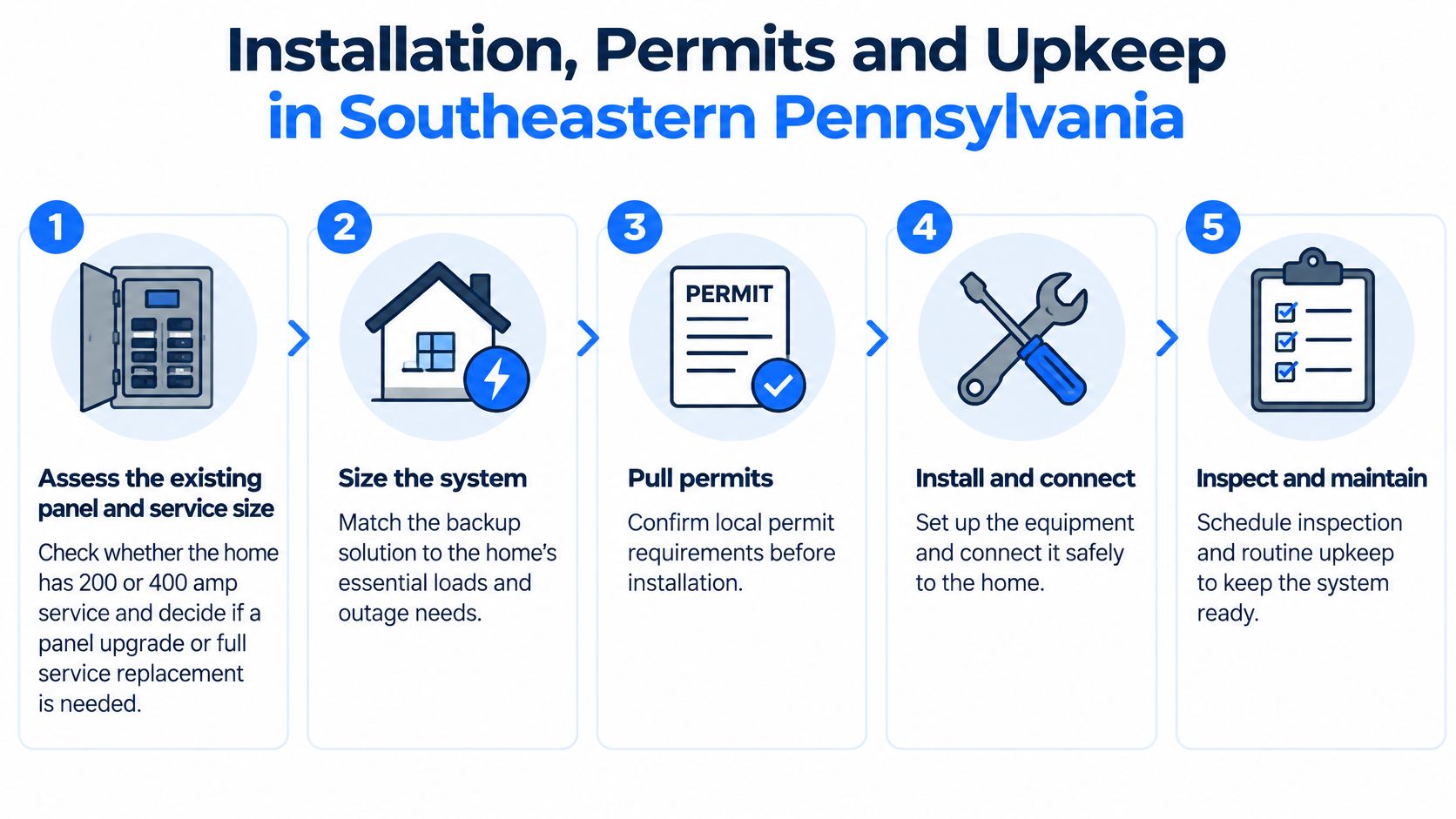
Installation should follow the load assessment, not precede it. Use the following sequence to connect equipment selection with safe operation and a clear handover.
Assess the existing panel and service. We review the current electrical setup and explain whether a panel upgrade or full service replacement is appropriate. Extra backup equipment doesn't automatically require greater utility-service capacity.
Finalize the backed-up loads. Size the system around measured demand, starting requirements, and the agreed outage scenario. Document any circuits excluded from backup.
Approve the equipment location. Generators need outdoor siting and appropriate exhaust clearances. Batteries need a manufacturer-approved location with required access, environmental conditions, and installation clearances.
Confirm permits and utility requirements. Identify municipal approvals, inspection requirements, and utility coordination for interconnected equipment before work begins.
Install and connect the system. Complete transfer or isolation equipment, circuit changes, fuel connections where applicable, and compatible solar integration.
Commission under realistic conditions. Test transfer operation, verify circuit assignments, exercise load controls, and explain monitoring and shutdown procedures.
Keep responsibility clear
In Southeastern Pennsylvania, confirm requirements with the municipality and serving utility rather than assuming a neighboring property's approval applies to yours. Our electricians are licensed, and our residential electrical upgrades are completed for compliance with local electrical codes.
For battery projects, we handle design, permitting, installation, and testing. Keeping those tasks together helps ensure the installed circuit arrangement matches the design and the homeowner understands its limitations.
Upkeep should follow the equipment's service instructions. A whole-house generator maintenance plan should address oil and filters, exercise runs, starting batteries, fault indications, fuel condition, and operating-hour service requirements.
Battery owners should review monitoring alerts, keep software current through the supported process, and arrange periodic inspection. Check reserve settings after changes to household routines or energy-management preferences.
The avoidable mistake is ordering equipment before defining the load. An undersized installation can require additional storage, revised controls, or changed circuit assignments before it delivers the protection you expected.
Amp'd Energy Solutions designs and installs battery backup and whole-house generator systems, with electrical upgrades and solar-storage integration where needed. Visit Amp'd Energy Solutions to request a free consultation, and bring your critical-load list, outage history, and panel photo so we can compare options against your property's actual needs.
Comments