

Should I Upgrade My Electrical Panel? How to Decide
You should upgrade your electrical panel only when a licensed load calculation shows the service cannot carry the planned loads, or when the panel or wiring is unsafe, obsolete, or the permit office requires replacement. Empty breaker spaces do not prove you have spare capacity.
Popular advice treats a 200-amp panel as the automatic answer to "should I upgrade my electrical panel." That advice skips the only test that matters: a dwelling-load calculation that includes what you already run and what you plan to add. Age of the box, a full directory of labels, or a contractor's habit of quoting 200 amps first are not that test.
A service is a pipe, not a calendar. The main breaker rating is the maximum flow the house can draw at once. Breaker spaces are only the number of taps on that pipe. A quiet 100-amp panel in sound condition can still be the right service. A newer 200-amp panel with scorched bus bars is not. The rest of this guide walks the checks in the order a careful electrician uses them, then separates the panel price from utility-side cost and schedule.
Table of Contents
Warning Signs Your Electrical Panel Is Outdated or Overloaded - Same-day danger - Schedule an inspection
How to Check Whether Your Service Can Handle New Loads - Eight steps that produce a load sheet
EV Charging and Backup Power Requirements for Your Panel - Three additions, three different jobs
Cheaper Alternatives to a Full Panel Upgrade - When the bigger service is the straighter path
Costs, Permits and Timelines for a Panel Upgrade - What a complete quote separates
The Short Answer on Whether You Need a Panel Upgrade
A 200-amp panel is not the automatic answer. The right choice depends on the home's calculated electrical demand, the service rating, and the condition of the equipment. A licensed load calculation that shows the service cannot carry planned loads can point to an upgrade; unsafe or obsolete equipment, or a utility or permit requirement, can also make replacement necessary.
Measured use offers useful context. A Lawrence Berkeley National Laboratory presentation on a 12,000-home dataset reports that most homes rarely exceeded 100 amps and typically operated at about 50% of available capacity. The presentation also reports that 31% of 100-amp homes and 48% of 200-amp homes had unused breaker space. Those figures describe observed homes, not a guarantee that any particular house has room for new equipment. IREC says most homes can be fully electrified with a 100-amp panel, depending on panel space, existing equipment, and actual capacity.
The loads in a home vary. A 2020 Energy Information Administration survey of residential electricity use identified 26 residential electricity end uses. Air conditioning was the largest use; lighting accounted for about 10%, clothes dryers about 5%, and cooking, dishwashers, and microwaves another 3% combined. That mix helps explain why an electrician calculates the likely combined demand before adding an EV charger, heat pump, electric water heater, battery, or generator.
Use the table to frame the decision. The service rating is the supply limit, the load calculation estimates demand, and the panel's condition shows whether the equipment is safe to keep using.
Situation | Likely Need | First Step |
|---|---|---|
Panel shows scorching, buzzing, or a known problem brand | Replacement likely | Arrange a licensed inspection |
Adding a Level 2 EV charger, no load study yet | Upgrade may be needed | Calculate the expected load |
Adding a battery backup or whole-house generator | Upgrade depends on calculated demand | Check demand and transfer equipment |
Breaker spaces are open, service rating is unknown | Capacity is unclear | Confirm service rating and calculated demand |
Adding a heat pump or electric range, no tripping | Upgrade may not be needed if the calculation allows | Confirm the calculated load |
Practical rule: Check the main breaker rating, list planned new equipment, and get a load calculation before buying a charger, heat pump, battery, or generator.
Warning Signs Your Electrical Panel Is Outdated or Overloaded
Sort what you see by urgency. Heat, smell, and noise come first. Age of the house does not.
Same-day danger
A warm, discolored, or scorched cover, a burning smell, or buzzing or crackling at the panel means stop using the affected circuits. Do not remove the deadfront or poke at the breakers. Photograph the directory label and the damage from a safe distance, then book a licensed inspection the same day. Those signs point to loose connections, overheating bus bars, or a breaker that is failing to open.
Treat documented problem equipment the same way even when it is quiet. Federal Pacific and Zinsco panels are replacement candidates because their breakers have a history of not opening under fault. A silent panel of either brand is not a clean bill of health.
Schedule an inspection
These signs need a licensed look, not an emergency shutdown, and each one means something different.
Flickering or dimming when a large appliance starts often means voltage drop under load, which can be a loose neutral, an undersized conductor, or a service that is near its limit.
A breaker that trips again and again, especially on one circuit, can be an overloaded circuit or a failing device. Resetting it without finding the cause hides the problem.
A fuse panel with no correct spare fuse is obsolete. It cannot accept modern branch protection, and it is a poor match for new 240-volt equipment.
Missing GFCI or AFCI protection where current code requires it is a shock and arc-fault gap. It does not, by itself, prove the service is too small.
Corrosion inside the enclosure, or a two-wire ungrounded service, raises shock risk and makes faults harder to clear.
An older 60-amp or 100-amp service becomes a constraint when several major loads operate together, not because the house was built before a certain year. The useful takeaway from a walk-through is a photo set and the number on the main breaker, not a verdict based on the home's age.
How to Check Whether Your Service Can Handle New Loads
A panel is like the water main feeding a house. The rating is the maximum flow. Breaker spaces are only the number of taps. You can have empty taps on a main that is already full when the shower, the washer, and the irrigation all run.
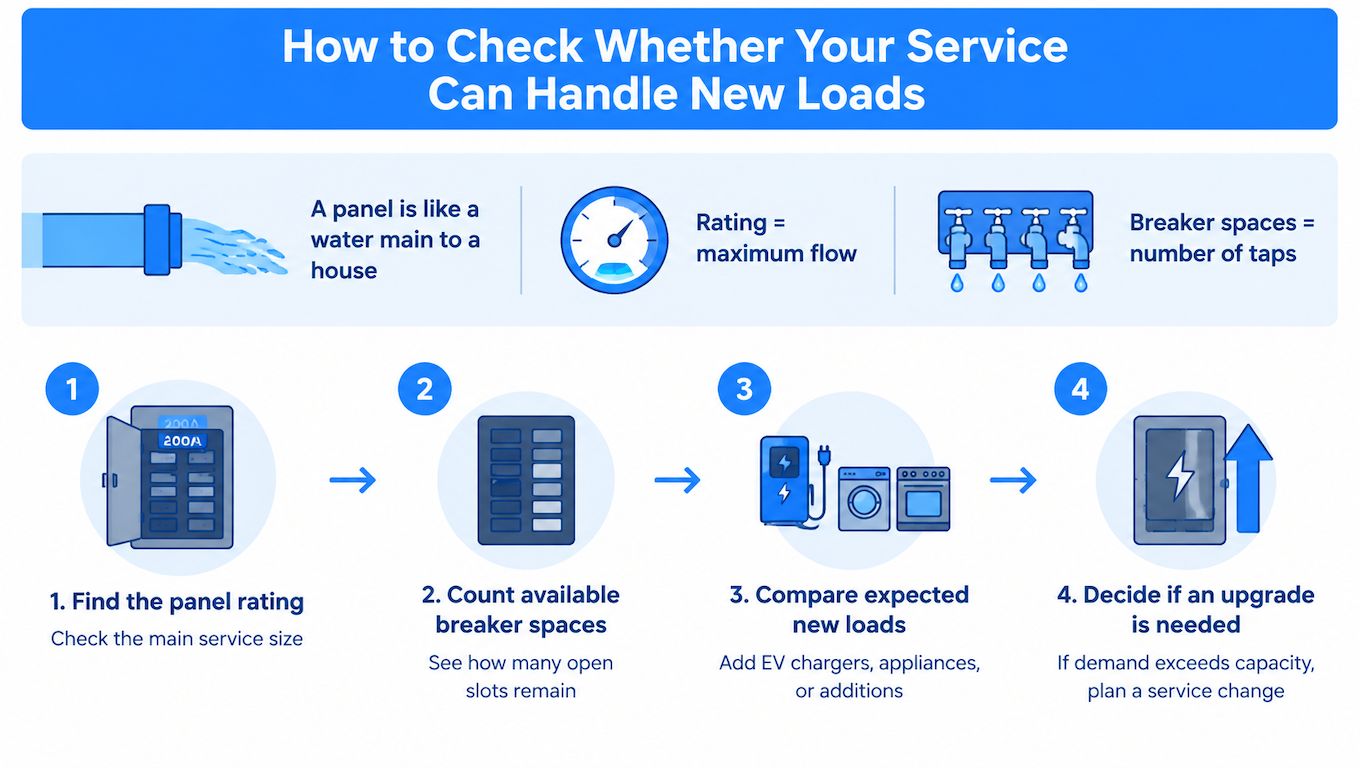
Eight steps that produce a load sheet
Read the main breaker and the service label. You are looking for 100, 150, or 200 amps, and for a separate bus rating if the label prints one. The main breaker is the pipe size, not the sum of the branch breakers.
Record the dedicated circuits already installed and the amp rating of each breaker. A 30-amp dryer breaker is not the same fact as a dryer that runs an hour a week.
List every planned load with its nameplate amps or kilowatts. Use the equipment label, not a sales brochure.
Apply demand, not a raw sum. Code load calculations assume some loads do not peak together. Adding every breaker at full nameplate overstates the house and pushes people into upgrades they do not need.
Size continuous loads at 125%. A charger that can run for hours is continuous. Overcurrent protection and conductor ampacity follow that rule, which is why the circuit is larger than the charger's output.
Compare the calculated total with both the service rating and the panel bus rating. Either one can be the limit.
Check spaces, conductor condition, and labeling. Melted insulation, aluminum service conductors in poor condition, or a directory that does not match the breakers changes the job even when the amps fit.
Choose the path. Adequate capacity, listed managed charging, or an upgrade. Do not pick the charger amperage until this step is written down.
The Pacific Northwest National Laboratory EV charging guide is clear that an upgrade is not automatic. The decisive issue is whether a documented dwelling-load calculation shows adequate service capacity after the charger and other major loads. For a typical Level 2 installation, the charger uses a dedicated 208/240-volt branch circuit, and protection plus conductor ampacity are sized at 125% of continuous output. A 32-amp continuous charger generally needs a 40-amp circuit. A 40-amp charger generally needs a 50-amp circuit. PNNL treats capacity for at least a 40-ampere, 208/240-volt branch circuit as an EV-ready benchmark, and notes that a load study may be necessary. Open breaker positions can still leave you short, because physical space is not spare ampacity.
A licensed electrician performs that formal calculation. If you want the worksheet logic before the visit, our guide to electrical load assessment calculations shows how nameplate data becomes a dwelling total. Your output from this section is a one-page load sheet: service rating, existing large loads, planned loads, and the circuit each new load expects.
Added Load | Typical Draw | Circuit Needed |
|---|---|---|
Level 2 EV charger, 32 A continuous | 32 A continuous | 40-amp dedicated 240 V circuit |
Level 2 EV charger, 40 A continuous | 40 A continuous | 50-amp dedicated 240 V circuit |
Electric range or cooktop | 8-12 kW | 40-50-amp dedicated circuit |
Electric clothes dryer | 5-6 kW | 30-amp dedicated circuit |
Electric water heater | About 4.5 kW | 30-amp dedicated circuit |
Central air conditioner, 3-ton | 3-4 kW running | 30-amp dedicated circuit |
EV Charging and Backup Power Requirements for Your Panel
A 100-amp service in a 1960s home with an electric dryer and central air does not automatically rule out EV charging. Level 1 uses a typical 120-volt household outlet; Level 2 uses 240 volts, the same voltage class as an electric dryer, according to the U.S. Department of Energy. Whether Level 2 fits depends on the home's calculated load, not just the service rating or the number of open breaker spaces.
Level 1 may work on an existing garage circuit if that circuit has capacity. Level 2 needs a dedicated branch circuit, and its demand must be included alongside heating and cooling, the range, dryer, water heater, and pool equipment. The circuit requirements are explained in this guide to EV charger installation requirements.
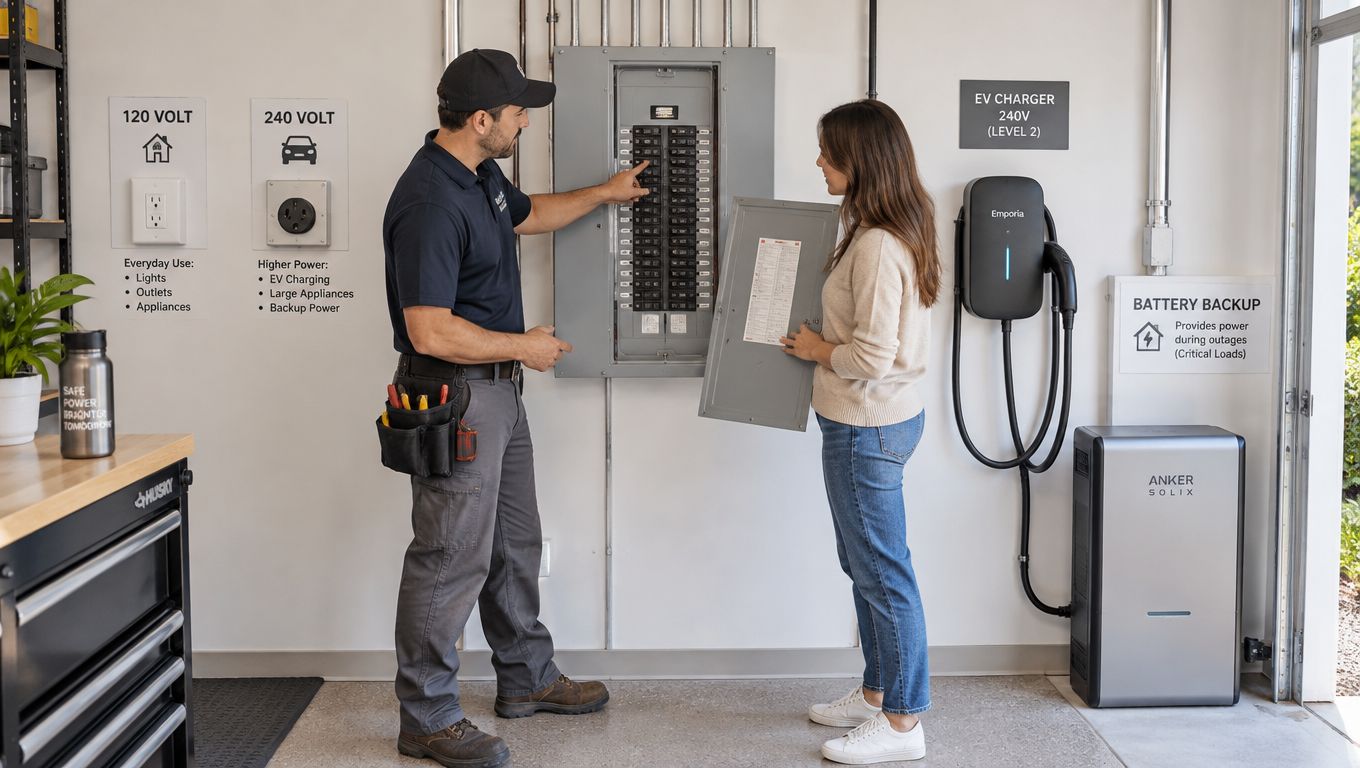
Three additions, three different jobs
EV charger. A Level 2 charger adds a dedicated 208/240-volt circuit and a sustained load. The load calculation determines whether the existing service can support it; circuit sizing follows the 125% rule covered in the previous section.
Battery backup. A battery can work with utility service even without solar, or integrate with solar panels already in place. Its charging demand still belongs in the load calculation. Storage shifts when electricity is used; it does not make the charging load disappear.
Whole-house generator. A generator supplies selected circuits during an outage through a transfer arrangement, rather than sharing the utility feed while operating. List the circuits you want powered and size the system to suit those loads.
If solar, storage, or another charger is planned, include it in the same service assessment. Otherwise, a system sized only for today's equipment may leave too little capacity for a later addition.
A panel upgrade may make sense if the calculated load exceeds service capacity, equipment is unsafe or obsolete, or local permitting requires replacement. Panel age alone does not settle the decision. The load calculation and the condition of the equipment do.
Cheaper Alternatives to a Full Panel Upgrade
A panel upgrade is not the only way to support a new EV charger. If the existing equipment is in good condition and the service has enough capacity for household loads, managed charging may help avoid a service change. It limits the charger's draw when other loads are running, so charging can take longer.
DOE EV-ready guidance%20EV-Ready%20Checklist_0.pdf) uses 6.2 kVA per charging space, about 30 amperes at 208/240 volts, when no energy-management system is used. For multiple spaces with an approved system coordinating charging loads, it allows 2.1 kVA per space. In a house tested by NREL, load management reduced charger current from 28 amperes to 6 amperes and measured peak current from 64 amperes to 42 amperes, a 35% reduction, according to the NREL report on managed EV charging. The system can also pause charging when household demand approaches its configured limit.
Option | Best When | Main Limit |
|---|---|---|
Load management for an EV charger | Service is sound and charging can pause | Needs listed equipment and utility or AHJ acceptance |
Circuit reconfiguration | Spare capacity exists on the bus | Does not raise the service rating |
Same-rating panel replacement | Panel is old, unsafe, or obsolete | Does not add capacity on its own |
200-amp service upgrade | Calculated load exceeds the existing rating | Can trigger utility-side work and higher cost |
Load management limits the charger's draw but does not increase service capacity. It is a practical option when slower charging is acceptable, such as while a dryer or heat pump is running. It cannot make damaged equipment safe or bring a service within its rating if ordinary household loads already exceed it.
When the bigger service is the straighter path
A panel or service upgrade may be the better route when equipment is obsolete, overheated, corroded, recalled, or rated below the calculated demand. A same-rating panel replacement addresses the condition of the panel but leaves service capacity unchanged. Circuit reconfiguration can help when there is enough capacity on the bus but too few suitable spaces or circuits are poorly grouped.
For an EV charger, battery storage, heat pump, or generator, the choices are to increase panel and service capacity or use listed load-control equipment. Confirm its ratings, control behavior, disconnecting means, and acceptance by the utility or authority having jurisdiction.
Check the equipment first, then the load:
Inspect the equipment for heat, corrosion, obsolete brands, and conductor condition.
Run a code-compliant load calculation that includes planned loads.
Measure demand if the calculation is close and recording actual peak use would help clarify the decision.
Consider managed charging only when the equipment is sound and charging can be throttled.
Investigate a panel or service upgrade if the evidence still shows insufficient capacity, unsafe equipment, or a code-compliance issue.
Costs, Permits and Timelines for a Panel Upgrade
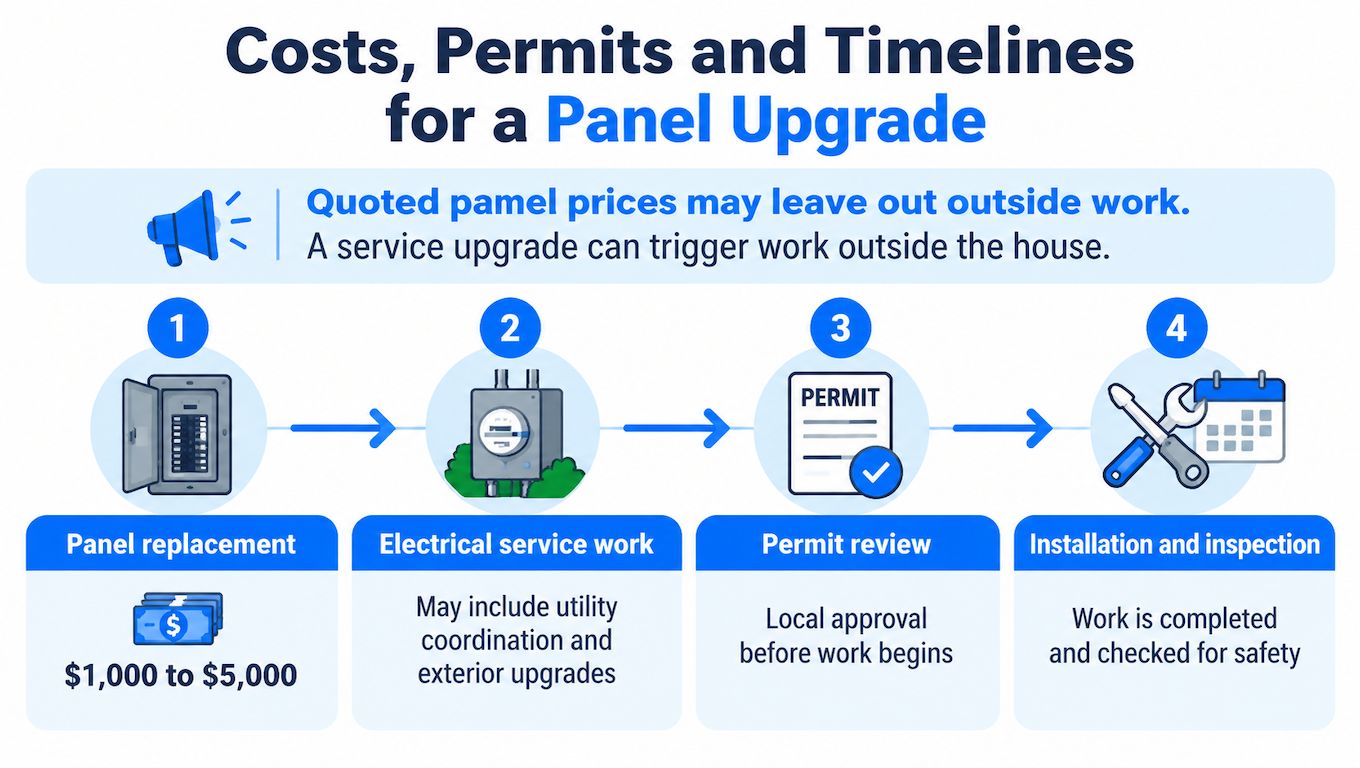
A panel replacement can cost far less than a full service upgrade, but the panel price alone may not reflect the project's total cost. Utility-side work can add expense and affect the schedule, especially if the service change requires transformer work.
The Lawrence Berkeley National Laboratory's analysis of panel upgrade costs reports panel replacement costs of about $1,000 to $5,000. Service upgrades may cost homeowners $1,000 to $25,000, with potentially comparable utility costs. Transformer work can range from $10,000 to $100,000.
Cost Item | Typical Range | Who Usually Pays |
|---|---|---|
Panel replacement | $1,000 to $5,000, scales with building size | Homeowner |
Service upgrade, homeowner side | $1,000 to $25,000 | Homeowner |
Service upgrade, utility side | Potentially comparable to the homeowner cost | Utility, depending on service territory |
Utility transformer work | $10,000 to $100,000 | Utility, often when a threshold is crossed |
What a complete quote separates
Ask for separate line items rather than one lump sum. A useful quote distinguishes the panel, service-entrance conductors, meter equipment, utility transformer capacity, trenching, permitting, and inspection. These costs belong to different parts of the job, and the utility's schedule for service changes or transformer work may differ from the electrician's installation schedule.
In Southeastern Pennsylvania, permits and utility approvals can add steps before installation. A typical sequence is load calculation, permit application, utility approval when needed, installation, and inspection. The timeline depends on the work involved, especially whether utility infrastructure needs attention.
Before signing, check that the proposal identifies who pays for meter or service-drop work and any transformer costs. Amp'd Energy Solutions offers a free consultation to discuss options for electrical upgrades. Its electrical panel upgrade cost guide explains the difference between a panel-only replacement and a full service change.
Three steps can make the quote easier to understand:
Separate homeowner and utility costs so you can see who pays for meter, service-drop, and transformer work.
Ask for the permit and inspection schedule in writing, including who will obtain the permit.
Confirm utility approval before ordering equipment so the proposed service size is accepted before installation begins.
A panel price without a utility line is only part of the budget. Confirm whether the existing transformer and service drop can support the planned service before treating the quote as a total.
Confirm the Panel Decision With a Licensed Electrician
A licensed electrician can turn the panel decision into a clear scope of work. For heat damage, buzzing or crackling, a burning smell, or a known problem panel such as Federal Pacific or Zinsco, seek an assessment promptly. Otherwise, use the visit to confirm which solution fits: no upgrade, load management, a same-rating panel replacement, or a service increase.
Bring questions, not another checklist of measurements. Ask what the load calculation supports, whether the work requires a permit, which items fall to the utility and who pays, and what inspection steps to expect. Request the answers in writing so you can compare the proposed scope with your plans.
Amp'd Energy Solutions assesses the existing setup and explains panel-upgrade or full-service-replacement options. Its licensed electricians complete residential upgrades to local electrical codes. For a free consultation or quote, call 267-450-6992 or email sales@ampd.life.
Amp'd also installs EV chargers, battery backup systems, and whole-house generators in Southeastern Pennsylvania. To discuss an electrical upgrade or related project, visit Amp'd Energy Solutions and schedule a free consultation.
Comments