

What Is a Transfer Switch for Generator Backup
A transfer switch for a generator is the device that connects your generator to selected circuits or to your whole home while keeping generator power off the utility lines. You're probably reading this after an outage, or while comparing a portable unit in the garage with a permanent standby system, and wondering why you can't just plug one in and run the house.
The short reason is control. Your panel normally has one source, the utility. Add a second source and you need equipment that guarantees only one of them feeds your wiring at a time, in the right order, at a rating your service can handle.
Table of Contents
What a Transfer Switch Does in an Outage - What To Decide Before You Buy
Manual Versus Automatic Transfer Switches - Manual Operation In Practice - Automatic Operation In Practice - Which Type Your Loads Require
Backfeed Safety and Why a Listed Switch Is Required - Improvised Connections That Create The Hazard - What Listed Equipment Changes
How the Switch Moves Power to the Generator - The Five Stages In Order - The Blink Is Not The Outage
Specs That Must Match Your Service and Loads - Reading The Nameplate Against Your House - Two Layouts That Use The Same Generator Differently - What To Request In A Site Assessment
Whole-House and Critical Circuit Examples - Whole Service On A Permanent Standby Generator - Critical Circuits On A Smaller Generator - Generator Plus Battery Or EV Charging
What a Transfer Switch Does in an Outage
A transfer switch is the controlled point between two power sources, normal utility electricity and emergency generator electricity, so your building can use the generator without sending that power back onto utility lines. On a winter night in Southeastern Pennsylvania, that definition stops being abstract fast.
The lights drop. The furnace blower stops mid cycle, the well pump can't refill the pressure tank, and the refrigerator goes quiet. You're not shopping for a gadget in that moment. You're trying to restore heat, water, food storage, and a few lights safely.
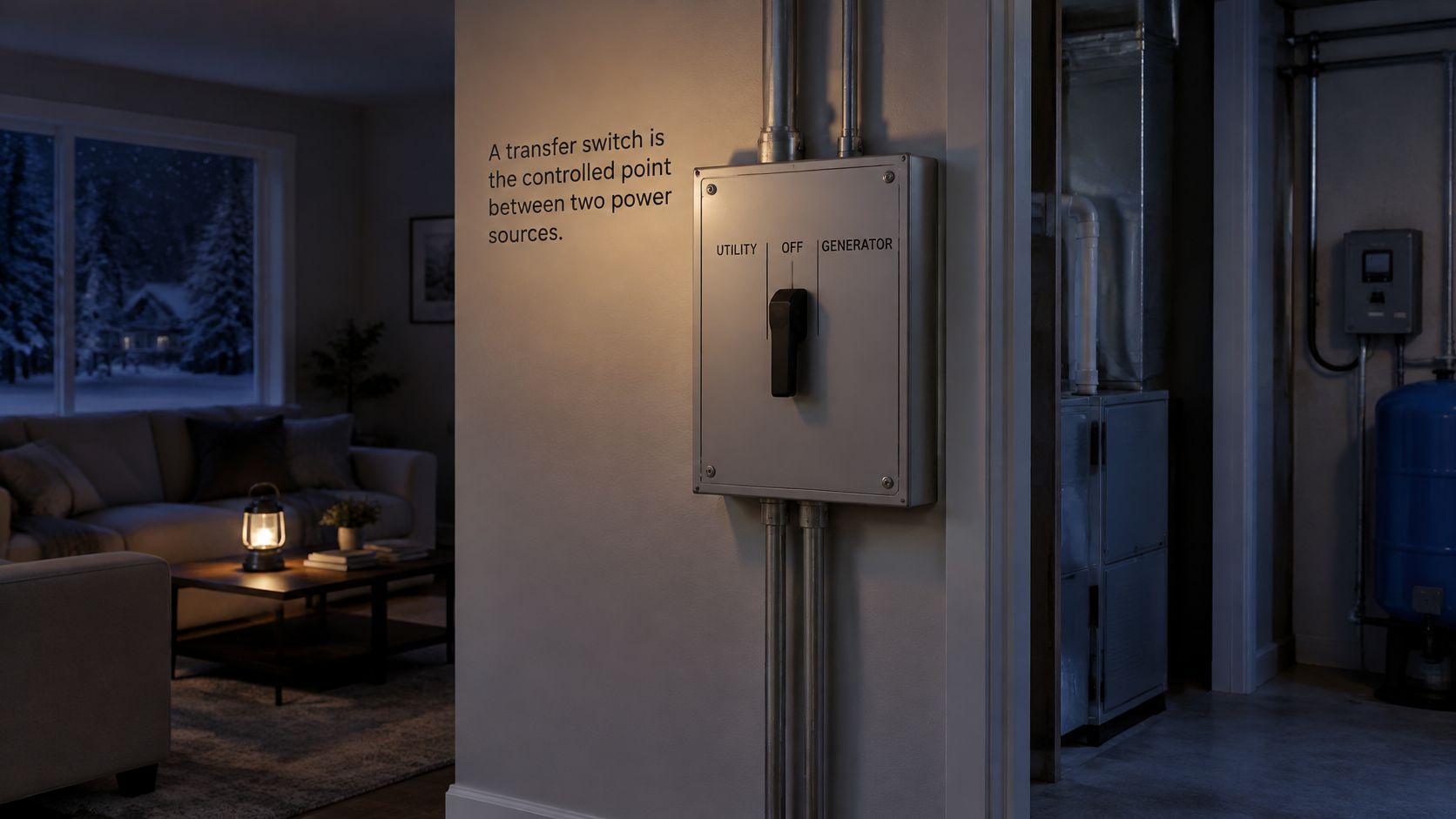
Think of a railroad switch feeding a station. Only one track can connect at a time, and the switch throws fully from one track to the other. Your transfer switch does the same job electrically, moving designated loads from the utility track to the generator track and back again.
How much of the house sits on that second track is a design choice. The same basic equipment may feed a small critical loads subpanel with a handful of circuits, or it may sit ahead of the entire service and carry the whole panel. Generator capacity and the written circuit list decide which layout you have.
Outages also last longer than the few minutes people plan for. U.S. customers experienced an average of approximately 5.1 hours without power in 2025, according to the EAGLE-I data analyzed in the 2025 U.S. Power Outage Report. That's long enough for a basement to take water without a sump pump and for a house to lose meaningful heat.
What To Decide Before You Buy
Four questions follow from that winter night. Which type of switch moves the load, and does anyone need to be home to do it. How many seconds the handoff really takes, and which devices can't tolerate the gap. Why improvised cords create a hazard outside your walls. And which ratings on the switch nameplate must match your panel, fault current, and simultaneous loads.
Start with the comparison of manual and automatic equipment. It's the choice you can make on paper, before an electrician opens your panel.
Manual Versus Automatic Transfer Switches
Trait | Manual transfer switch | Automatic transfer switch |
|---|---|---|
Who operates it | A person moves the switch after the outage and back when utility returns | A controller starts the generator and transfers without an operator |
What it watches | Nothing until someone notices the outage | Utility voltage and frequency continuously |
Return to utility | Operator switches back | Retransfer after stable utility power, then generator shutdown |
Best home fit | Portable generator and a short list of circuits with someone home | Permanently installed whole-house or standby generator, including unattended property |
Typical delay | Minutes, limited by the person on site | Seconds of start, acceptance, and transfer delay |
The table looks simple because the hardware difference is simple. Who throws the switch, a person or a controller, drives almost everything else about cost, convenience, and suitability.
Manual Operation In Practice
A manual transfer switch requires an operator to move your building's electrical load from utility power to generator power after an outage, and to move it back when utility service returns. You start the portable generator outside, connect its cord to a power inlet box, walk to the switch, and move the handle or breakers from utility to generator.
That sequence works well when someone capable is home, awake, and willing to go outside in the weather that caused the outage. It also suits a short circuit list: the refrigerator, furnace controls, a sump pump, and a few lights stay on while the electric range and dryer stay off, because a portable unit can't carry them anyway.
The failure point is the operator. A vacation trip, a 2 a.m. outage, or a household where nobody can safely run a portable generator leaves the switch untouched while pipes cool and the basement fills.
Automatic Operation In Practice
An automatic transfer switch, or ATS, works like a thermostat for your power supply. It watches utility voltage and frequency the way a thermostat watches room temperature, and it acts the moment the reading leaves its acceptable band. It signals a permanently installed generator to start, verifies the output is suitable, transfers the load, and later retransfers the building to utility power and shuts the generator down.
Nobody has to notice the outage for the sequence to begin.
That independence is why automatic equipment is the usual partner for a whole-house standby generator, for businesses, and for any property where occupants can't reliably operate equipment during an outage. A short start delay also keeps the controller from committing during a one second flicker, so the generator doesn't fire every time the lights blink.
An automatic switch takes the operator out of the sequence. Maintenance, testing, and load planning stay in it.
That caution matters. According to the FEMA technical job aid on generators, standby generators may have a 20% to 30% chance of failing to start initially. A dead battery, stale fuel, or a skipped exercise cycle can leave a healthy ATS with nothing to transfer to, which makes the switch one link in a chain rather than a guarantee of backup power.
Which Type Your Loads Require
For most houses, backup power is optional standby, and either type can serve it depending on the application. Loads that codes treat as required emergency power follow stricter timing rules, and the backfeed section below explains where codes draw that line.
The rest of the choice is compatibility: which operating style fits the generator you own and the loads that can't wait. A manual switch pairs with a portable generator you start and connect yourself. An ATS pairs with a permanently installed unit it can start, verify, and supervise on its own. Pick automatic for unattended or whole-house backup, for a sump or medical load that can't wait for someone to get home, and for any permanent standby generator. Pick manual only when a capable operator will realistically be present and your circuit list is short enough for a portable generator to carry.
Backfeed Safety and Why a Listed Switch Is Required
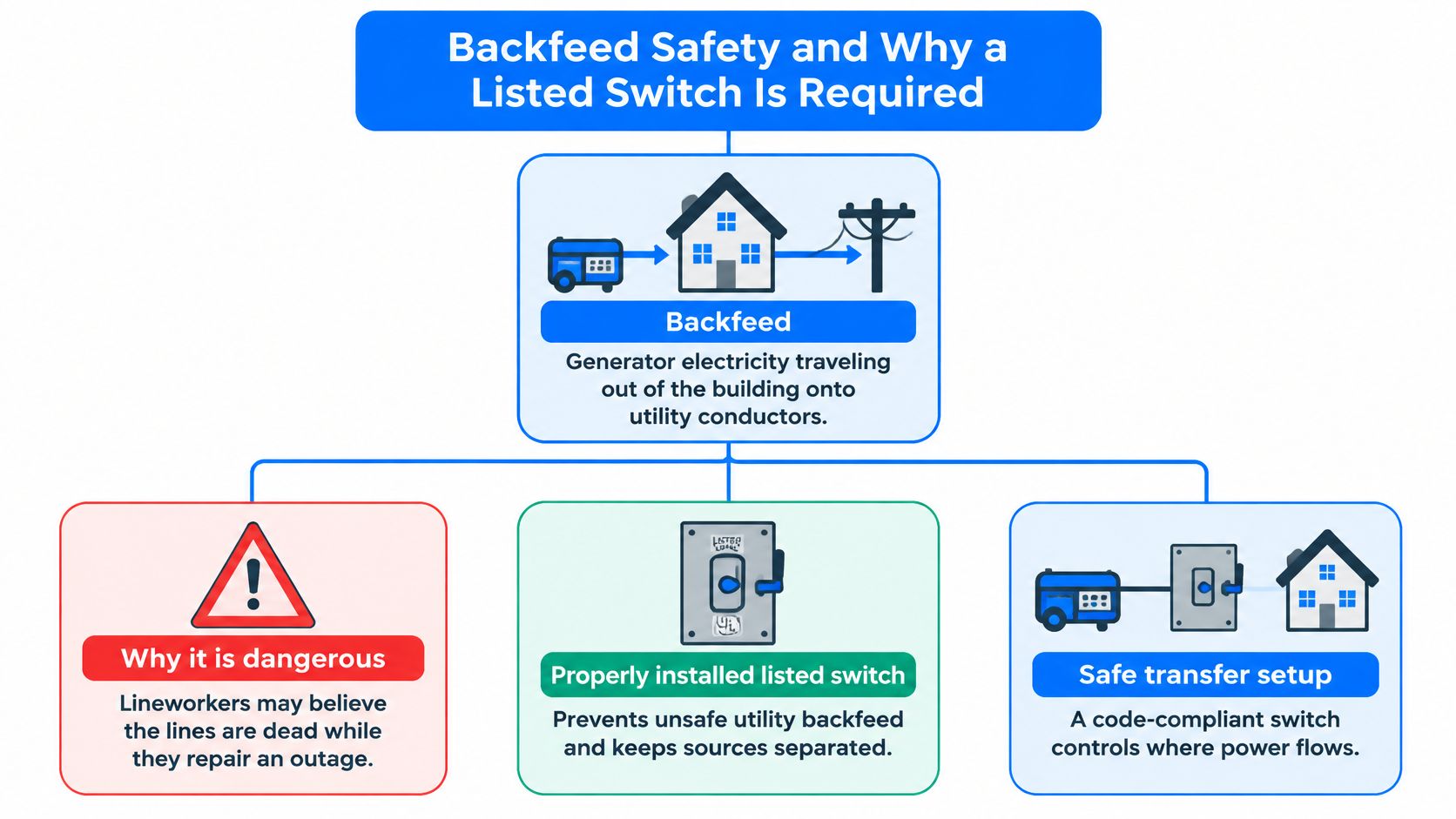
A storm outage makes the service drop look harmless. The lights are out, the neighborhood is quiet, and a lineworker may treat the line as dead while a crew opens a section, grounds it, and starts repairs. Backfeed breaks that assumption: generator electricity travels out of your building, through the panel and utility transformer, and onto conductors that can sit at far higher voltage on the street side.
A properly installed transfer switch disconnects the building from utility conductors when generator power is selected. It protects crews outside, and it also gives the house a controlled boundary so restoration surges and two live sources do not meet inside the panel. FEMA emergency power guidance warns that directly connecting a generator to a home power supply can send electricity onto outside power lines, bypass certain household circuit protection features, and cause injury or death.
Improvised Connections That Create The Hazard
Three habits produce that outcome, and all three still show up during storm season.
Double male cord: A cord with plugs on both ends runs from the generator into a dryer or range receptacle, energizing the panel backward with exposed live prongs.
Backfeeding any outlet: Plugging the generator into a wall receptacle feeds one circuit and, through the panel, potentially the service conductors.
Main breaker as a plan: Turning off the main by memory relies on a person remembering every step, in the dark, with no interlock to enforce it.
What Listed Equipment Changes
A listed transfer switch installed by a qualified electrician replaces memory with mechanism. The contact set behaves like a railroad interlocking: one route must be proven clear before the other can move. Electrically interlocked contacts keep utility and generator from closing onto the same conductors, while the enclosure and breaker coordination create a defined, protected path into the building distribution system.
The buying question is concrete: does the equipment make the wrong connection impossible? Refuse any plan that depends on remembering the main, matching cord ends, or promising that generator and utility will never share the same conductors.
How the Switch Moves Power to the Generator
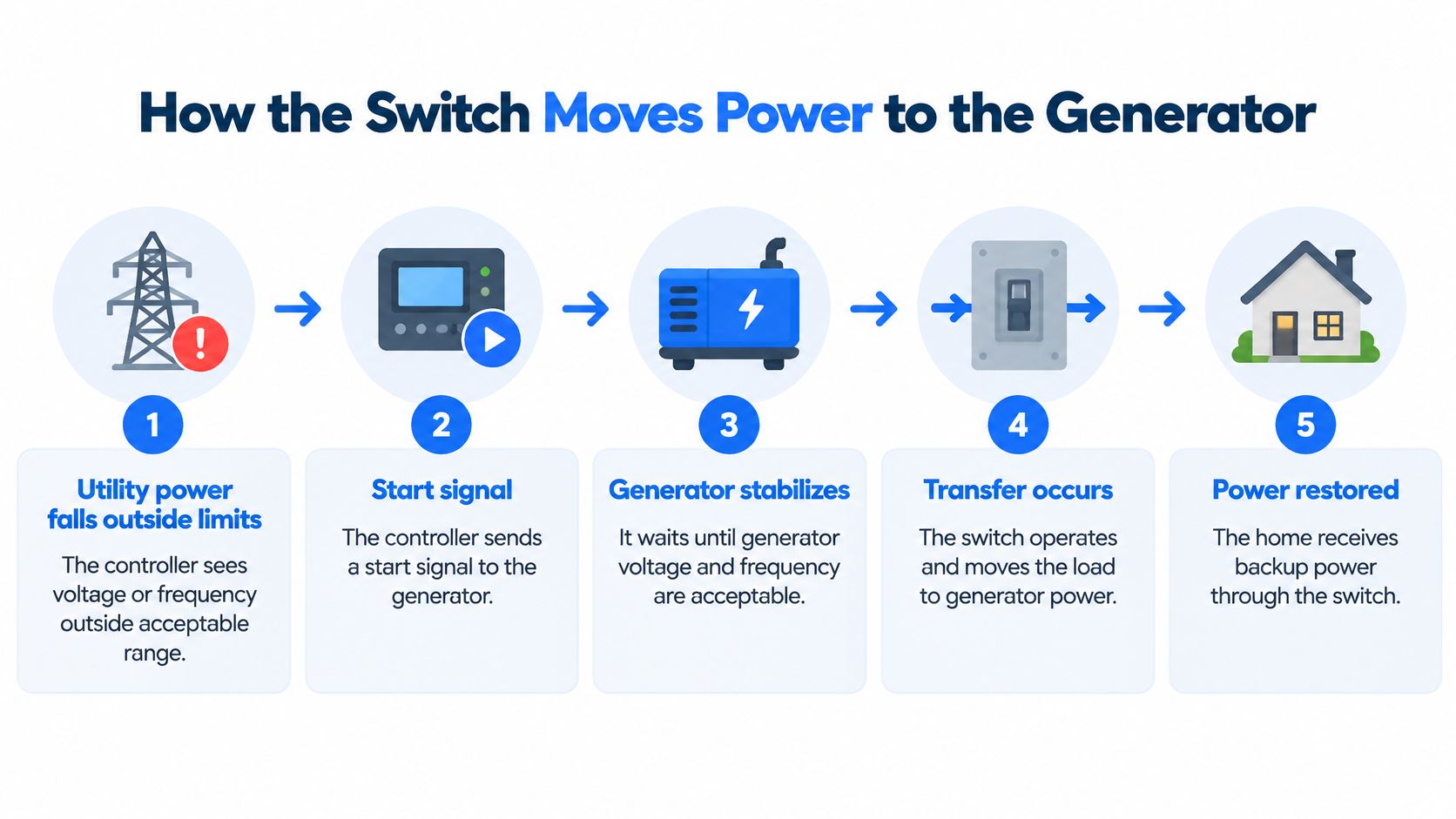
An automatic transfer follows a fixed order, and each stage exists for a reason. Rush or skip one and you transfer onto a generator that is still coming up to speed, or back onto a utility that has not yet stabilized.
The Five Stages In Order
First, the controller sees utility voltage or frequency fall outside its programmed limits and starts a short timer, so a momentary flicker never starts the engine. Second, it sends a start signal to the generator. Third, it waits until generator voltage and frequency are acceptable, because a cold engine still climbing to speed produces power your motors and electronics should not take.
Fourth, the switch transfers. Most residential equipment uses open transition, described as break-before-make: the utility side opens before the generator side closes, the way an airlock seals one door before the other opens. Electrically interlocked contacts enforce that order, so the two sources are never intentionally paralleled. Fifth, your designated loads run on generator power until utility service returns and holds stable.
Retransfer runs the same logic in reverse. The controller confirms stable utility power, moves the load back, then lets the engine run unloaded through a cool-down period before shutdown. That cool-down protects the engine from stopping hot under load.
Representative values documented in Eaton automatic transfer switch documentation:
Stage | Documented value |
|---|---|
Open-transition transition time, 120/240 V example | Under 100 milliseconds |
Switching duration, 40-200 A open-transition device | Maximum 0.025 seconds |
Engine-start delay, documented controller | 10 seconds |
Normal-to-emergency transfer delay | 3 seconds |
Retransfer delay to utility | 7 minutes |
Engine cool-down after retransfer | 5 minutes |
The Blink Is Not The Outage
Read the table carefully, because it corrects the most common misunderstanding. The contacts move much faster than the power comes back: under 100 milliseconds of transition time in the 120/240-V example, and a maximum 0.025-second switching duration for the documented 40 to 200-A open-transition devices. Your lights still stay off far longer than that.
Total outage time includes the 10-second engine-start delay, engine warm-up and voltage acceptance, the 3-second normal-to-emergency delay in the same documented example, and the generator's load-dependent response. Several seconds of darkness is the expected result of engine start time. If you want the broader engine and exercise picture, our guide on how a standby generator works through an outage walks through what the generator itself is doing during those seconds.
Design rule: A furnace control board, computer, or medical device that can't tolerate a several-second gap needs a UPS or battery to bridge it. A faster switch claim doesn't remove engine start time.
One more demand hides inside this sequence. If a short circuit occurs during or after transfer, the closed contacts must carry the available fault current until a breaker clears it, and a switch chosen only for the generator's kilowatt rating can be undersized for that moment. The transfer point is where generator, panel, and simultaneous loads either fit together or fail together.
For a Southeastern Pennsylvania home, the practical question is narrow: which loads can ride through that gap and restart cleanly, and which ones need a battery bridge in front of them.
Specs That Must Match Your Service and Loads
A generator can start perfectly and still fail your house if the switch between them is wrong. Compatibility is the key spec. Voltage, amperage, fault current, neutral arrangement, enclosure, and the loads running at the same moment all have to agree with each other and with your service equipment.
Item to match | Why it matters | What to confirm |
|---|---|---|
Voltage and phase | A 120/240 V single-phase home cannot use a mismatched commercial switch | Service voltage and single- or three-phase |
Ampere rating | The switch must carry the transferred load, not just the generator kW label | Switch amps versus service and load calculation |
Neutral and bonding | Wrong neutral-ground bonding can create shock and nuisance paths | Whether the generator or the service bonds the neutral |
Fault current | An undersized withstand rating can fail during a short circuit | Available fault current versus switch withstand rating |
Enclosure | Indoor and outdoor gear are not interchangeable | NEMA or location rating for the install spot |
Service-entrance rating | Some installs need the switch to be the service disconnect | Whether a service-rated switch is required |
Load scope | Whole service and a critical subpanel are different designs | Written list of circuits that stay on |
Reading The Nameplate Against Your House
Every practical installation has to match the switch to system voltage, phase, neutral configuration, ampere rating, available fault current, enclosure environment, and whether the switch is service-entrance rated. A typical home is 120/240 volts, single phase, so the first row of the table usually settles itself. The rows after it take real measuring.
Amperage is where buyers go wrong. Sizing a switch off the generator's advertised kilowatts is like rating a bridge for the one truck that crosses on weekends. The switch carries full utility power every normal day of its life, so its amp rating has to cover the transferred load and line up with your service equipment.
Fault current sounds like a commercial concern, yet it applies at house scale. The Eaton power frame transfer switch catalog lists representative equipment up to 600 Vac and 5,000 A, with short-circuit withstand and closing ratings as high as 100 kA for 0.05 seconds or 85 kA for 0.5 seconds. Your service sits far below those numbers, and the principle still holds: the switch needs a withstand rating at or above the fault current your utility can deliver.
Neutral-ground bonding is an electrician decision, not a field guess. Either the service or the generator bonds the neutral in a given configuration, and the switch's neutral arrangement has to match that plan. Bond in both places, or neither, and you get shock paths and nuisance tripping that are hard to trace later.
Two Layouts That Use The Same Generator Differently
A service-rated switch sits ahead of your whole panel and doubles as the service disconnect. Every circuit is available on generator power, which sounds ideal until simultaneous loads collide. A heat pump starting, a well pump kicking on, an EV charger drawing at full rate, and a battery system charging in the same window can trip a generator that looked large enough on paper.
A switch feeding a critical-loads subpanel takes the opposite approach. Only listed circuits move to the generator, and everything else stays dark by design. You give up the range and the charger during outages, and in exchange a smaller generator carries its assigned loads without staggering tricks. A documented electrical load assessment and calculation is what separates those two designs from guesswork.
Backup design is a load management problem. The circuit list is the design.
What To Request In A Site Assessment
Ask for these items in writing before anyone quotes equipment:
Load calculation: Running and starting watts for every circuit you expect to keep, including motor loads.
Service details: Utility service size in amps and the available fault current at your panel.
Equipment match: Generator starting watts next to the proposed switch rating, enclosure, and service-entrance status.
Circuit list: A written list of circuits that will remain energized, and which loads are locked out or managed.
A whole-house label is only real if that list and the generator both support it. If a quote can't show you the list, it hasn't designed your system yet.
Whole-House and Critical Circuit Examples
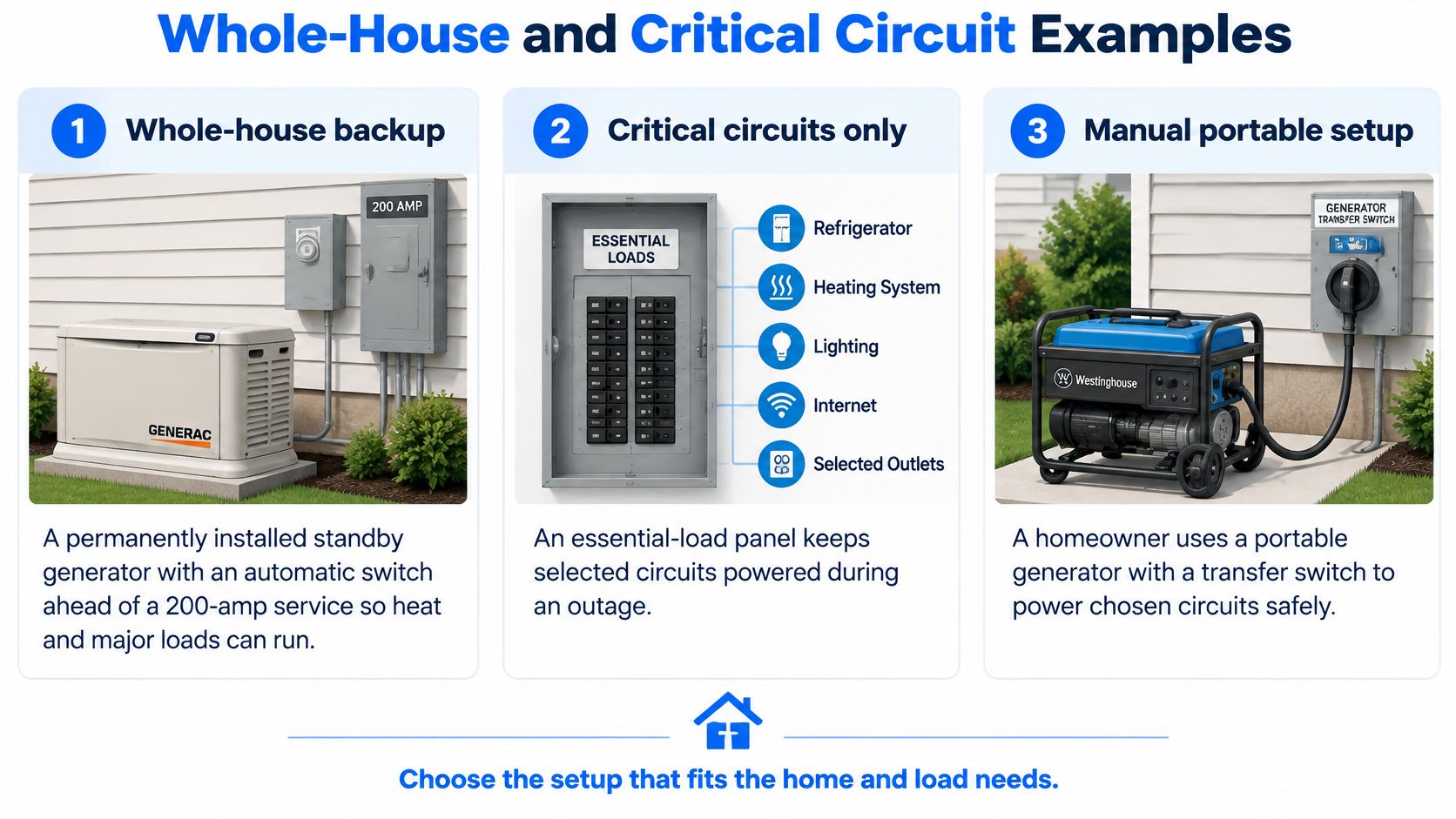
Three layouts cover most Southeastern Pennsylvania homes. Each one below states what stays on, what gets managed, and the specific way it fails.
Whole Service On A Permanent Standby Generator
A house with a permanently installed standby generator and an automatic, service-rated switch ahead of a 200-amp service gets heat, refrigeration, the well or sump pump, and lighting back after the start and acceptance delay, without anyone going outside. Large motor loads are staggered or managed so they don't start in the same second, the same simultaneous-load problem covered in the specs discussion.
This layout fails a different way: neglect. A standby unit that skips its exercise cycle can sit for months with a dead starting battery or a sticking component, and the first real outage reveals it. The switch does its job perfectly and transfers to a generator that never starts. Weekly self-tests, an annual maintenance visit, and load management modules that delay the EV charger and second motor are what make this layout honest.
Critical Circuits On A Smaller Generator
A second house uses a smaller generator with a manual or automatic switch feeding only a critical subpanel. The refrigerator, furnace controls, a few lights, the sump pump, and the internet equipment stay on. The range, dryer, and EV charger stay off for the duration, and the owners know that before the storm, not during it.
This layout breaks through wishful additions. Move the heat pump onto the subpanel because it would be nice to have, without recalculating starting watts, and the first cold night outage trips the generator that ran fine in a mild weather test.
Generator Plus Battery Or EV Charging
A third house pairs the generator with a home battery and an EV charger. The battery works off ordinary utility service, so no solar panels are required, and it carries quiet overnight loads that would waste generator runtime. The generator covers longer outages and the heavy loads the battery shouldn't drain itself on.
Coordination is the work here. The charger should pause or reduce rate on generator power, and the battery shouldn't try to recharge at full power from the generator while the heat pump starts. Unmanaged, three good systems trip each other. Managed, each one covers the other's weak moment.
Whatever layout you choose, an exercise cycle that only starts the engine proves little. Testing should eventually include real load, because a no-load start doesn't prove the switch, interlocks, timing, and generator can carry your house together. Watch for delayed transfer, buzzing, discoloration, nuisance trips, or failure to return to utility power, and report them. Observing is your job. Opening service equipment or improvising a connection isn't.
Match yourself to one of these three layouts. That decision matters more than any brand comparison.
Confirm Fit Before You Buy or Install
The decision compresses to three rules. Choose automatic, often service-rated equipment for unattended whole-house standby. Choose a smaller switch and an essential loads subpanel when your generator can't carry everything. Never use a cord into an outlet, under any time pressure.
A switch that passes all three rules can still be the wrong box. Its rating has to match your service size, and the circuits it carries have to match what starts at the same moment, which is why the circuit list matters more than the sticker on the generator. Bring that list and your site assessment questions to a licensed electrician, who handles permitting, utility disconnect logic, bonding, and commissioning. Ask for a load-tested start, not only a no-load start, before you trust the system with a January outage. If your panel is undersized or aging, review whether you should upgrade your electrical panel as part of the same project, since the electrician will assess the current setup and explain panel upgrade or full service replacement options before new backup loads land on it.
One careful check up front costs less than one bad night in January.
If you're planning generator backup in Southeastern Pennsylvania, Amp'd Energy Solutions can size the generator, match the transfer switch to your service and load list, and install and maintain the complete system. Bring the circuits you want to keep running to a free consultation, and we'll walk you through your options and turn that list into a design that holds up on the coldest night of the year.
Comments