

What Is a Load Center and Does Your Home Need One
A load center is the compact residential electrical panel that receives power from the utility service and distributes it to branch circuits, each protected by its own circuit breaker.
But if there's room for another breaker, does that mean your home can support an EV charger or electric heat? Not necessarily. Understanding what is a load center means looking beyond the box on the wall to the electrical supply, connected equipment, and capacity available for your next project.
Table of Contents
What a Load Center Is in Plain Terms - What the enclosure contains
How Power Flows From the Grid to Your Outlets - Look up the service rating safely
How a Load Center Differs From an Electrical Panel - Compare specifications, not names
Why Empty Slots Do Not Mean Spare Capacity - Separate the physical opening from the electrical limit - Request a documented capacity assessment
Signs and Additions That Call for an Upgrade - Match the addition to its actual requirements - Decide what needs changing
Why a Bigger Panel Does Not Mean Whole-Home Backup - Choose the outage operating plan
Confirm Your Load Center Before You Plan the Upgrade - Turn the assessment into a clear scope
What a Load Center Is in Plain Terms
A load center is the residential and light-commercial form of an electrical panelboard. Think of it as the distribution point between the electricity entering your property and the equipment using it.
A water-supply analogy helps explain the arrangement:
The incoming water pipe supplies the house, much like the electrical service.
A manifold divides that supply into separate lines, much like the load center divides electricity into circuits.
Each line has a valve. A circuit breaker has a related role, but it also opens automatically when an overload or short circuit occurs.
That last distinction matters. A breaker protects the circuit wiring, not just the appliance plugged into an outlet. If excessive current flows, the breaker interrupts it rather than allowing the wire to continue carrying an unsafe load.
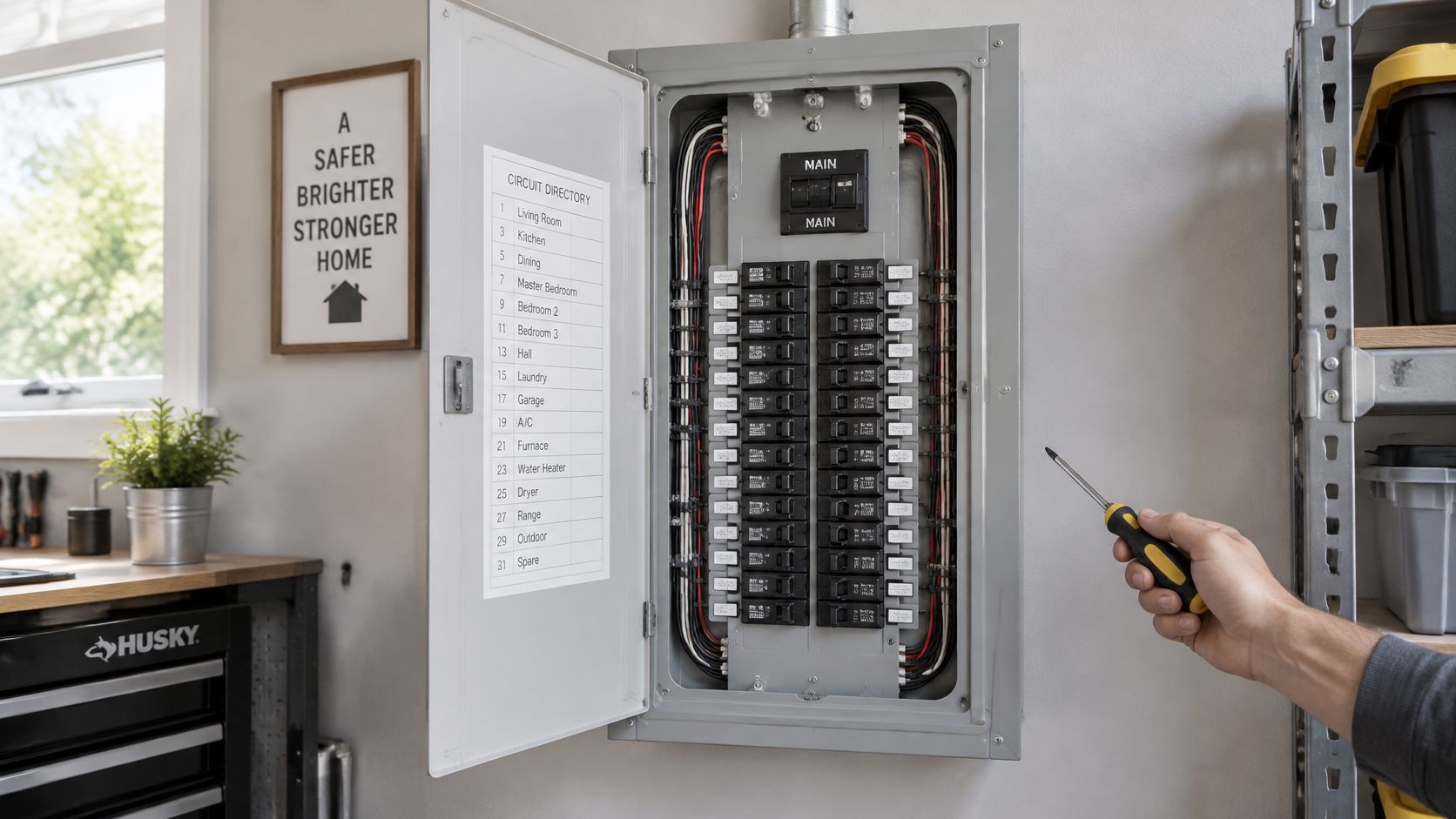
What the enclosure contains
Behind the front cover are breakers, conductive distribution bars called busbars, and wiring connections. Load centers generally have wall-mounted enclosures, front access, and plug-on breakers.
According to Eaton's load center fundamentals, typical applications extend up to 240 volts, with many residential models rated up to 225 amperes. Those are equipment ratings, not a promise that every home has that much available service capacity.
The naming is less formal than homeowners might expect. The National Electrical Code and Underwriters Laboratories don't establish a separate technical category for load centers. It's an industry label for smaller, lower-cost panelboards used chiefly in homes.
A load center is the point where the home's supply is divided into the circuits that power it.
You'll usually find yours in a basement, garage, or utility room. Open only the normal hinged door to view labels and breaker handles, not the screwed-on protective cover.
How Power Flows From the Grid to Your Outlets
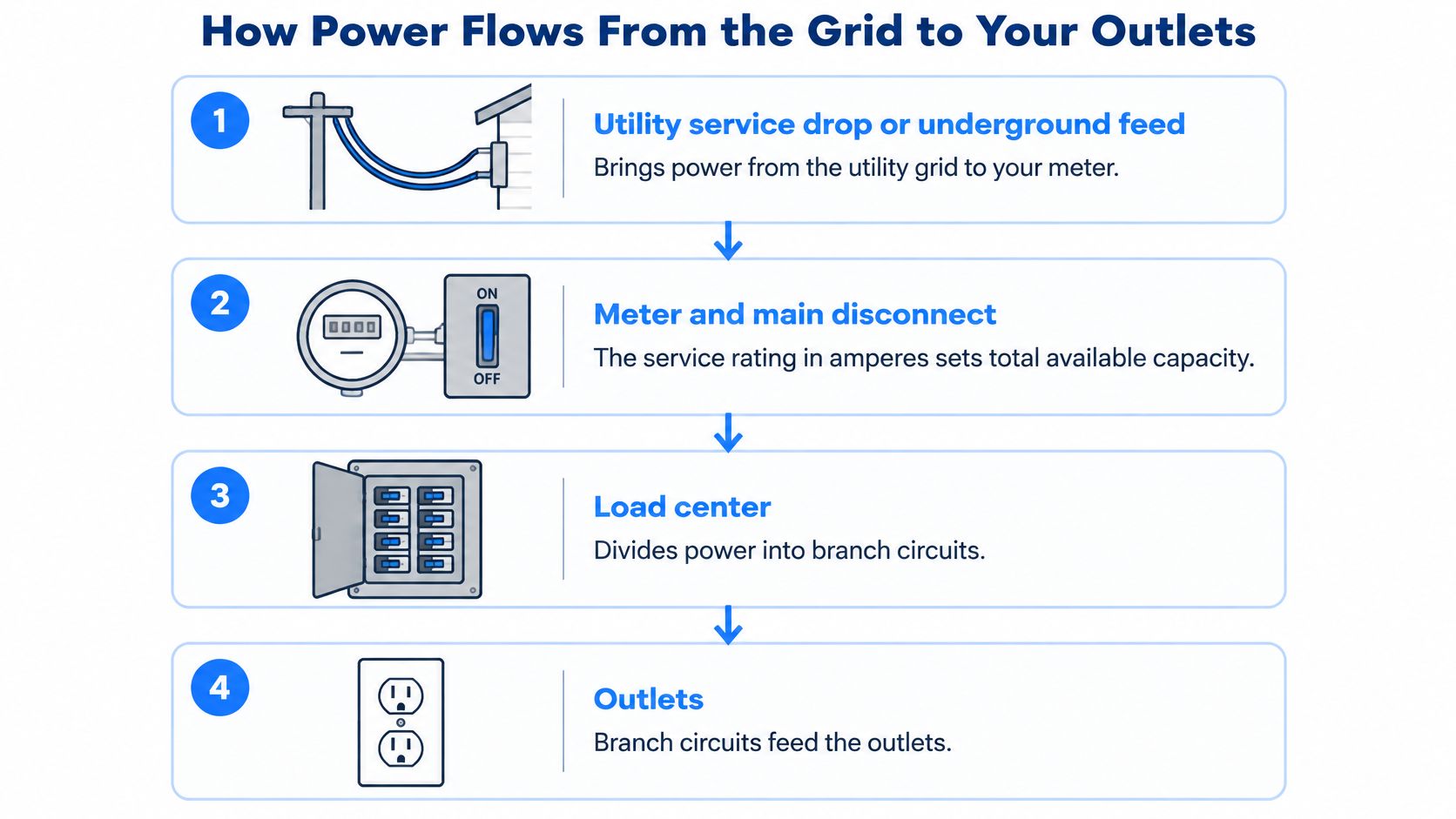
Electricity reaches your appliances through a connected system, not through the load center alone. Following that path helps explain why replacing a panel doesn't automatically increase the supply available to the property.
The utility connection brings power to the building. An overhead service drop or underground feed connects the property to the utility system and meter.
The meter records consumption, and the main disconnect provides isolation. Their arrangement differs between properties. The meter itself doesn't establish usable capacity because its label shows a rating.
The load center distributes incoming power. Its busbars provide connection points for the branch breakers. Some installations include a main breaker in this enclosure; others have an upstream disconnect.
Each branch breaker protects its circuit. The electrician selects protection appropriate for the conductors and connected equipment.
Branch wiring reaches the loads. Cables and conductors run to lights, receptacles, and equipment such as a range or heat pump.
The neutral carries return current during normal operation on circuits that use it. Equipment grounding conductors provide a fault-current path that helps protective devices operate. Neutral and grounding connections aren't interchangeable, and their bonding arrangement belongs in an electrician's assessment.
Look up the service rating safely
Start with the ampere marking on the main breaker, if it's visible. Record the enclosure's rating separately, and note whether the main disconnect sits elsewhere.
Service rating reference | Typical property context | What it means for added loads |
|---|---|---|
Existing service serving a single-family home | Homes with household appliances and proposed charging | Confirm the actual rating and calculated demand before selecting equipment |
Higher-capacity service arrangement | Large homes, commercial properties, and multi-tenant buildings | Evaluate the service and each feeder serving the proposed installation |
The enclosure rating and service rating aren't necessarily the same. A replacement enclosure can have a higher rating without increasing the capacity of the conductors, disconnect, or utility connection feeding it.
Treat visible labels as starting information. If they conflict, are unreadable, or don't identify the main disconnect, have an electrician verify the service rather than removing covers yourself.
How a Load Center Differs From an Electrical Panel
The difference is practical, not a separate code classification. An electrical panel is the broader everyday term. A load center describes the compact distribution equipment commonly installed in homes.
That's why a contractor might call the same residential enclosure a panel, breaker panel, or load center. None of those names, by itself, tells you whether the proposed equipment is suitable.
Feature | Load center | Commercial panelboard |
|---|---|---|
Typical use | Homes and light-commercial properties | Commercial, industrial, and larger buildings |
Breaker type | Generally plug-on breakers | May use bolt-on breakers |
Enclosure | Compact, wall-mounted, front access | Often deeper and larger |
Voltage rating | Commonly suited to residential distribution | Higher-voltage configurations available |
Current capacity | Suited to smaller distribution applications | Greater-current-capacity configurations available |
Plug-on breakers connect to the panel's bus assembly through a manufacturer-designed contact arrangement. Bolt-on breakers use a fastened connection. Neither connection style makes a breaker universally interchangeable, and neither substitutes for selecting equipment with the correct ratings.
Compare specifications, not names
When reviewing a replacement quote, check these details:
Ampere rating: Identify the proposed equipment rating and whether the work changes the service capacity.
Breaker compatibility: Confirm that the breakers are listed or otherwise specifically approved for the installed panel.
Equipment identification: Look for the manufacturer, model, listing marks, and installation instructions.
Scope of work: Establish whether the proposal covers a replacement enclosure, an added distribution panel, or a broader service upgrade.
A larger commercial panelboard isn't automatically a better choice for a house. Its configuration, dimensions, protection, and installation requirements must match the project.
Likewise, a familiar-looking breaker isn't necessarily the right replacement. Physical fit is only part of compatibility. The panel's labeling and approved equipment documentation matter more than the color of the handle or the name used in a conversation.
Why Empty Slots Do Not Mean Spare Capacity
A homeowner opens the load center, counts three blank positions, and treats the next charger or range circuit as a simple snap-in. Those blanks are open parking spots on the bus. The service rating is the size of the supply feeding the whole building. The load center is the decision point: a new load is allowed only when both the physical opening and the calculated spare capacity say yes.
An empty breaker position shows that the enclosure has physical room for another breaker. Whether the service can safely supply another major load is a separate question, answered by ratings and a load calculation.
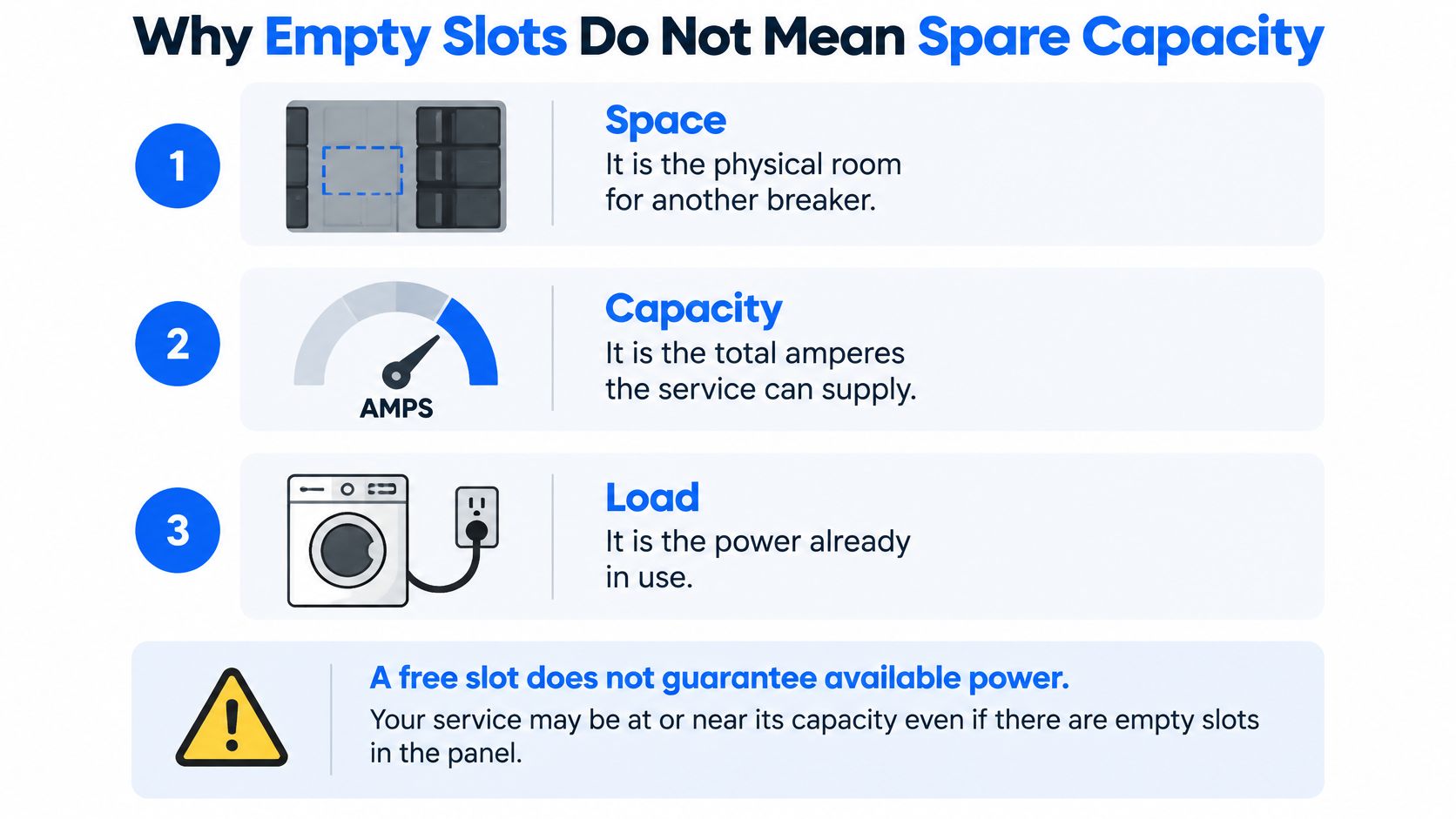
Separate the physical opening from the electrical limit
Space is the physical position available for a compatible breaker. Ampacity is the current-carrying capability of conductors and busbars under their installation conditions. Calculated capacity is what remains after existing demand is compared with the service.
A house can still have several unused positions while the range, dryer, heat, and other appliances already account for most of the calculated service allowance. The charger breaker would fit. The calculation can still show that the service cannot carry that extra load at the same time as everything else. EV charging runs for long stretches, so it is treated as a continuous load: the check looks at sustained demand, not a brief spike. Existing building demand, the proposed charging demand, service and feeder capacity, and any energy-management controls all belong in that check. Managed charging can sometimes hold simultaneous use inside the service limit. That result is a capacity decision, not proof that an open slot was enough.
The reverse trips people up just as often. A crowded enclosure may need more distribution space even when the calculated service still has room. A full box and a service that is already spoken for are different problems, and they call for different work.
Request a documented capacity assessment
Before you approve replacement work, ask for the record that separates those two problems:
Service and equipment ratings: Include the service, feeder, busbars, and protective equipment.
Existing load calculation: Include proposed equipment and the assumptions about simultaneous operation.
Panel schedule: Identify what each circuit supplies.
Breaker compatibility: Verify approved breaker types and relevant fault-current ratings.
Conductor condition: Check sizing, terminations, and visible deterioration.
Demand-control details: Establish what any charging or energy-management system limits and how it operates.
A guide to electrical load assessments and calculations explains how that evaluation turns equipment ratings and operating assumptions into a figure you can compare with the service rating.
Practical rule: Do not approve a panel replacement only because someone counted empty spaces or added the numbers printed on breaker handles.
For electrical upgrades, Amp'd Energy Solutions assesses the current setup and explains panel upgrade or full service replacement options.
Signs and Additions That Call for an Upgrade
Repeated breaker trips, persistent flickering, or lights dimming when equipment starts deserve investigation. They aren't proof that the entire service is undersized. A faulty appliance, loose connection, or overloaded individual circuit can produce symptoms that a larger panel alone won't correct.
Scorch marks, unusual heat, buzzing, or a burning smell require prompt professional attention. Don't remove the cover or repeatedly reset a breaker to keep equipment operating. If there's smoke or an active fire, move away and contact emergency services.
Match the addition to its actual requirements
Breaker size comes from the equipment's installation requirements and applicable circuit-sizing rules, not a universal appliance chart.
Addition | Typical breaker selection basis | Upgrade signal |
|---|---|---|
Residential EV charger | Charging output, continuous-load requirements, and installation instructions | Needs a service and capacity check |
Electric range | Appliance rating and applicable circuit-sizing requirements | Check spare calculated capacity |
Electric dryer | Nameplate and installation instructions | Verify the existing circuit and service allowance |
Heat pump or electric heat | Equipment's specified circuit and overcurrent-protection requirements | Include auxiliary or resistance heat in the calculation |
Battery backup system | Inverter output, connection method, and approved design | Requires coordinated interconnection and backup planning |
A heat-pump project illustrates why the details matter. The assessment must account for the actual equipment configuration, including any supplemental electric heat, rather than treating every heat pump as the same load.
Decide what needs changing
If the calculation permits the addition and compatible equipment can accommodate it, a new circuit may be sufficient. If the calculated demand exceeds the available allowance, consider a service upgrade or an appropriate load-management approach.
An enclosure without room for the planned circuits presents another decision: additional distribution space may be necessary without increasing the service.
Our guide to whether you should upgrade your electrical panel helps frame that choice. Before work starts, identify what you're adding, its sustained electrical demand, and whether the existing calculation reflects the property today.
Have a licensed electrician complete the calculation and diagnose any symptoms before choosing equipment.
Why a Bigger Panel Does Not Mean Whole-Home Backup
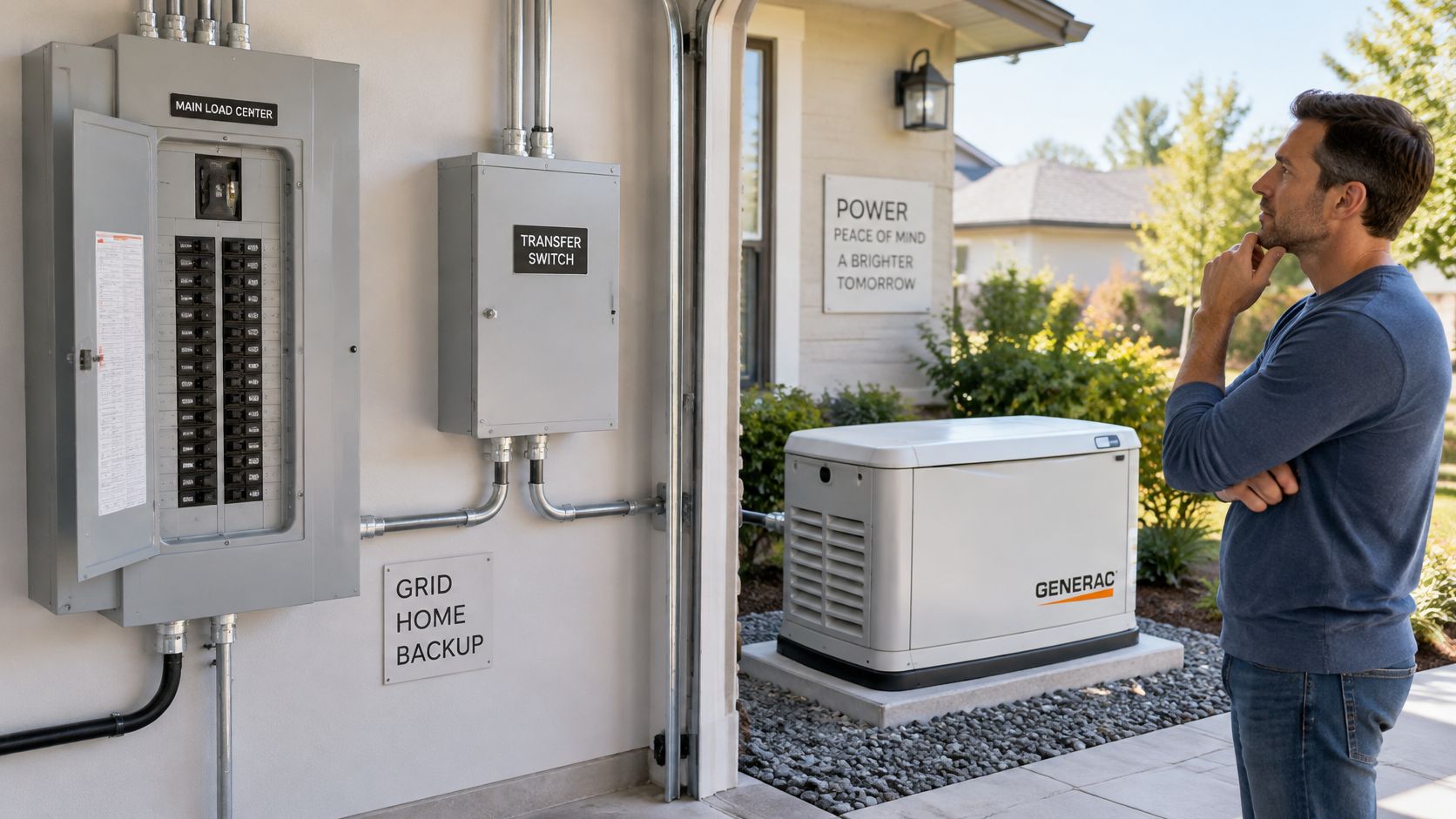
A newer or larger load center provides backup only when the generator or battery and its transfer equipment can carry the chosen loads. During an outage, that source has its own output limit. It must connect through transfer or backup equipment rated for the connection.
A load center works like a hallway of doors to the circuits. Extra space in the hallway lets you add another door. The generator or battery is the temporary power plant, and the transfer equipment is the gate that chooses whether the utility or the backup source feeds those doors.
The Department of Energy's electrical energy storage report describes storage across distributed and grid-scale applications. For a homeowner, the useful question is narrower: which equipment can the proposed system run when utility power is unavailable?
Choose the outage operating plan
The load center is the decision point: it can distribute whatever the backup source is allowed to supply, but the operating plan decides which loads get that supply.
Whole-home backup: Connects the home's distribution system, subject to the backup source's operating limits.
Critical-loads subpanel: Supplies selected circuits, such as refrigeration, communications, and essential lighting.
Managed load shedding: Temporarily disables high-demand equipment so priority loads can remain powered.
Power output and stored energy answer different questions. Output determines what can run together. Usable stored energy, compared with average demand, helps determine how long battery backup can last.
Prioritizing refrigeration and lighting produces a different runtime estimate than operating electric heat while charging a vehicle. The designer also accounts for starting demands, conversion losses, reserve settings, and the system's usable energy.
Storage can sometimes reduce peak demand and help avoid an unnecessary distribution upgrade, but only with a coordinated design. A home battery backup guide explains those planning considerations.
Ask the designer which loads stay powered, how long they can operate, and how the controls coordinate charging, generation, and backup demand.
Confirm Your Load Center Before You Plan the Upgrade
Good upgrade decisions start with accurate identification, not a shopping list of panels. Collect information you can access safely, then have an electrician verify the installation.
Locate the equipment. Record visible enclosure and main-breaker markings. Note any separate disconnect, but don't remove protective covers or open utility equipment.
Describe your planned additions. Include charging, heating, cooking, and backup equipment. Bring model information or installation documents when available.
Gather the assessment documents. Use the capacity checklist above when requesting records from your electrician or property files. An outdated schedule or calculation needs verification.
Ask for a specific recommendation. The assessment should establish whether the project needs another circuit, additional distribution space, demand management, or a service upgrade.
Confirm installation responsibilities. Use licensed electricians and establish who handles applicable permits, utility coordination, and inspections.
Turn the assessment into a clear scope
The proposal should distinguish equipment replacement from increased supply capacity. It should also identify which planned additions are included, so a future charger or heating conversion doesn't get overlooked.
We're a family-owned electrical contractor serving Southeastern Pennsylvania, and our electricians are licensed. We assess the current setup and explain the appropriate upgrade or replacement options rather than treating the enclosure's appearance as a capacity test.
Call 267-450-6992 or email sales@ampd.life to schedule a free consultation or request a quote. The load center is your decision point for new electrical loads, so confirm what the system can support before approving the installation.
At Amp'd Energy Solutions, we help homeowners plan electrical service upgrades, EV charging, and backup power around the property's actual electrical capacity. Bring your planned equipment and visible panel information to a free consultation so we can assess the setup and explain your next steps.
Comments