

8 Level 2 EV Charger Reviews for Every Home
The highest charging rate isn't automatically the best purchase. A charger can advertise impressive output and still be a poor fit if your panel, circuit, vehicle, parking layout, or future expansion plans can't use it. The most useful Level 2 EV charger reviews therefore start with the installation scenario, not the headline amperage.
This roundup compares seven charger models and one readiness assessment across charging output, vehicle compatibility, smart controls, portability, installation demands, and long-term fit. A Tesla-focused household has different priorities from a mixed-brand family, a renter, or a workplace adding several charging points. In Southeastern Pennsylvania, Amp'd Energy Solutions can help determine whether the property needs a dedicated circuit, panel upgrade, load-management strategy, or a simpler installation.
Table of Contents
1. Tesla Wall Connector - Where the Wall Connector fits best
2. Leviton EVB32-D Level 2 EV Charger - Installation priorities for mixed-brand properties
3. Wallbox Pulsar Plus Level 2 EV Charger - Smart controls need a sound electrical plan
4. ChargePoint Home Flex Level 2 EV Charger - A phased installation can prevent overbuying
5. Eaton Wallbox Level 2 EV Charger - A practical fit for workplaces
6. Webasto TurboCord Level 2 EV Charger - Portability doesn't remove electrical requirements
7. ABB Terra AC Wall-Mounted Level 2 EV Charger - Plan the building, not just the charger
8. Level 2 EV Charger Installation Readiness Assessment - What the assessment should answer
1. Tesla Wall Connector
The Tesla Wall Connector makes the most sense when the home already revolves around Tesla vehicles and the owner values a tightly integrated charging experience. It delivers up to 11.5 kW, or 48A at 240V, and its Tesla ecosystem integration, sleek design, and built-in diagnostics reduce friction for daily charging. Those capabilities are useful, but they don't eliminate the need to confirm that the home's electrical service can support the selected circuit.
A Tesla owner in a high-demand neighborhood may charge overnight and have ample time before the next departure. In that situation, the charger's practical value comes from dependable scheduling, clean installation, and convenient cable placement rather than from pursuing the maximum possible output. Tesla's app scheduling can also help coordinate charging with off-peak utility periods where those tariffs apply.
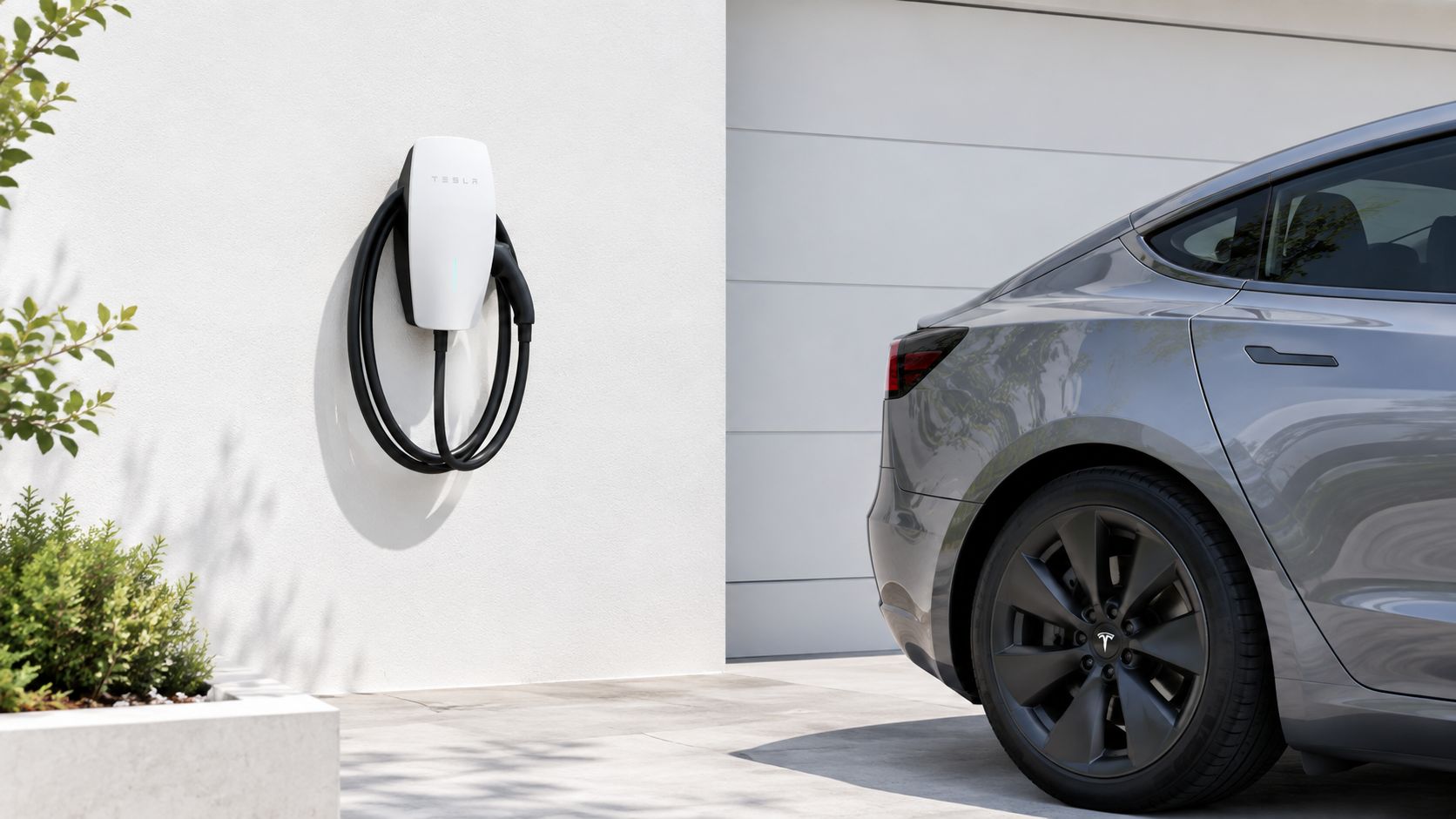
Where the Wall Connector fits best
Amp'd Energy Solutions' Tesla-certified installers can configure a dedicated circuit and assess panel readiness, which is especially useful when installation coincides with a broader electrical project. A Southeastern Pennsylvania homeowner planning a service upgrade can address the charger and future household loads in one scope instead of treating the Wall Connector as an isolated appliance.
Practical rule: Confirm panel capacity and circuit feasibility before ordering the charger. If the property may add another EV, discuss that scenario during the assessment rather than sizing only for today's vehicle.
The installation approach also matters. A homeowner comparing a plug-in and hardwired Level 2 EV charger installation should consider whether permanent mounting, weather exposure, cable routing, and future expansion favor a dedicated hardwired circuit. For a Tesla-only home, the Wall Connector is a focused choice. For a mixed-EV household, connector compatibility deserves equal attention before purchase.
2. Leviton EVB32-D Level 2 EV Charger
The Leviton EVB32-D takes a less aggressive approach to output, delivering up to 7.7 kW at 32A and 240V. That can be a sensible match for a household that wants dependable Level 2 charging without building the installation around the highest available amperage. Its hardwired design, weather-resistant construction, safety systems, and broad vehicle compatibility make it more naturally suited to mixed-brand homes than a vehicle-specific charger.
Consider a family with a Tesla and a non-Tesla EV sharing one charging location. A universal charger avoids making one driver depend on an adapter or a separate charging setup. The same logic applies to a small business adding employee charging, where vehicle brands may change over time and straightforward operation matters more than close integration with one manufacturer's app.
Installation priorities for mixed-brand properties
A dedicated 40-amp circuit is the practical target described for this charger, but the electrician still needs to verify the service, panel, breaker arrangement, wire path, and local requirements. The charger should sit close enough to the parking position to keep cable routing practical, while avoiding a location where the cord becomes a trip or vehicle-contact hazard.
Check utility programs: Verify whether the local utility offers an installation rebate before work begins, because eligibility can depend on equipment, permits, and professional documentation.
Plan the parking position: Choose the mounting location based on where the charging port sits, not where the panel is located.
Discuss expansion: If a second EV is likely, ask whether the current service can support another charging load or whether load management would be more appropriate.
The EVX Home Charging Study shows that permanently mounted Level 2 chargers scored 733 out of 1,000 in 2025, compared with 714 for portable Level 2 units, according to J.D. Power's 2025 home charging study. That difference reinforces the Leviton's core appeal, a permanent installation can prioritize daily dependability and broad compatibility over maximum output.
3. Wallbox Pulsar Plus Level 2 EV Charger
The Wallbox Pulsar Plus is aimed at owners who want charging to participate in the home's wider energy system. It offers up to 11.5 kW at 48A, supports multiple EV brands, and adds connected controls, load balancing, and energy-management capabilities. Those features become more valuable when charging shares an electrical service with solar, batteries, or other substantial household loads.
A tech-forward homeowner with a Tesla Powerwall may want the charger to respond intelligently to available capacity rather than drawing its configured maximum. A business installing several chargers also needs a management approach that can coordinate demand across units. In both cases, the central question isn't just whether the charger can deliver high output. It's whether the property can use that output without creating conflicts elsewhere.
Smart controls need a sound electrical plan
Load balancing can help a property manage competing demand, but it doesn't replace a proper site assessment. Amp'd Energy Solutions can review Powerwall compatibility, charger placement, service capacity, and the way the system should behave during normal operation or grid events. That coordination matters more than selecting a charger solely because its maximum output matches another model.
Wallbox's app scheduling can shift charging to periods that better align with the home's energy plan or applicable utility rates. A homeowner with solar may also want charging to coincide with generation, while a business may prioritize access control and centralized oversight.
A connected charger is only as useful as the electrical strategy around it.
The Wallbox is therefore a strong scenario-based choice for homes with storage, solar, or plans for multiple charging points. It may be unnecessary for an owner who wants a basic overnight charger and has no interest in app controls. Its advantage appears when software and power management solve a real property constraint.
4. ChargePoint Home Flex Level 2 EV Charger
The ChargePoint Home Flex stands out because its output can adapt to the installation rather than forcing the homeowner to build the installation around the charger's maximum setting. It supports a broad power range from 2 to 19.2 kW, with the actual usable rate determined by the circuit, configuration, and vehicle. It can be installed as a plug-in unit or hardwired, giving owners a path from temporary convenience to a more permanent arrangement.
That flexibility is useful in a home with limited present capacity and a planned future upgrade. An owner with a 100-amp main service might begin with a lower configured output, then revisit the charger after a panel upgrade. In a condominium or apartment where hardwiring isn't permitted, the plug-in option may provide a workable installation path if the property already has a suitable outlet and the rules allow it.
A phased installation can prevent overbuying
The right first step is an assessment of the current panel, circuit, outlet, parking location, and likely charging schedule. The ChargePoint Home Flex can scale as conditions change, but the homeowner still needs the installation configured safely for the present electrical system. A lower setting isn't a shortcut around inadequate wiring or an unsuitable receptacle.
For a permanent residential installation, hardwiring generally creates a cleaner long-term arrangement than relying on a receptacle. Plug-in capability has value when the charger may move or when the property limits permanent work, but the outlet and circuit must be treated as charging infrastructure, not as an ordinary garage receptacle.
Owners can use the ChargePoint app to review charging activity and identify patterns that support off-peak scheduling. For detailed planning around circuit requirements and project scope, Amp'd Energy Solutions' guide to how much it costs to install an EV charger at home can help frame the questions to ask before requesting an installation.
5. Eaton Wallbox Level 2 EV Charger
The Eaton Wallbox is suited to owners who prefer durable, direct operation over a feature-heavy user experience. It delivers up to 9.6 kW at 40A and uses a hardwired installation, making it a reasonable candidate for residential properties, small businesses, and workplace charging where standardized equipment and straightforward maintenance matter.
A small company might install it for employees who need reliable daytime charging without requiring a complex customer-facing network. A homeowner may reach the same conclusion for a different reason. If the household doesn't need extensive app controls, solar coordination, or elaborate user management, a simpler charger can keep attention on the electrical installation, cable reach, safety, and serviceability.
A practical fit for workplaces
Eaton's electrical-equipment background makes the model attractive to contractors and property managers who value familiar engineering standards. That doesn't mean every site can accept the charger's highest configuration. The electrician must still evaluate the panel, circuit, conductor sizing, disconnect requirements, mounting surface, and permitting conditions.
A dedicated 50-amp circuit is the recommended installation direction in the supplied specification brief, subject to site verification and applicable code. A commercial property adding more than one charger should examine the combined load rather than approving each unit independently. The property may need a coordinated design, load management, or service work before installation.
Installation insight: For workplace charging, standardization can matter more than advanced features. A clear electrical design and repeatable maintenance process often simplify ownership across several parking spaces.
The Eaton Wallbox also leaves room for a later monitoring or scheduling layer if the property's needs change. That makes it a good fit for a business that wants reliable charging now and can evaluate smart controls separately, instead of paying for features the current operation won't use.
6. Webasto TurboCord Level 2 EV Charger
The Webasto TurboCord is the most scenario-specific choice in this roundup because portability is its defining advantage. It delivers up to 7.2 kW at 30A and can operate with a suitable 240V residential circuit or a NEMA 14-50 outlet. That makes it useful for renters, second homes, and owners who need Level 2 charging before committing to a permanent wall-mounted installation.
An apartment resident with access to a permitted 240V outlet may prefer a charger that can move when the lease ends. A homeowner who spends time at a second property may also value carrying one charger between locations, provided each site has the correct electrical infrastructure. During a panel-upgrade project, the TurboCord can serve as an interim solution while the permanent circuit and charger plan are developed.
Portability doesn't remove electrical requirements
The charger still needs a verified outlet, correct circuit capacity, and a safe parking arrangement. A homeowner shouldn't treat any convenient-looking receptacle as suitable for sustained EV charging without an electrician's review. The outlet location also needs to protect the cable from vehicle traffic, moisture exposure, and repeated strain.
Confirm the circuit: Verify that the 240V outlet and its circuit are appropriate before using the charger.
Protect the equipment: Store the unit indoors during severe weather or when it isn't needed.
Plan the next step: If daily charging becomes routine, ask whether a hardwired installation would offer a better permanent arrangement.
The home charging research cited by Wirecutter's EV charger review found that 88% of EV owners said they charge at home “often” or “always.” That makes portability valuable for some households, but daily users should judge the TurboCord against the convenience of a fixed charger at the primary parking location. It solves a mobility problem. It isn't automatically the best permanent infrastructure.
7. ABB Terra AC Wall-Mounted Level 2 EV Charger
The ABB Terra AC is positioned for properties that want commercial-grade construction and a longer-term infrastructure plan. It offers up to 11 kW at 48A, includes communication protocols and safety systems, and is appropriate for owners who see charging as part of a broader building-energy strategy rather than as a standalone garage accessory.
A premium home with battery storage may value the Terra AC when the owner wants charging, backup power, and electrical capacity planned together. Commercial real estate presents another use case. A property manager may need equipment that fits an enterprise-level design, supports future expansion, and can participate in a more coordinated energy or demand-response program.
Plan the building, not just the charger
ABB's strength in this scenario is less about a single charging session and more about infrastructure continuity. A site assessment should account for current service capacity, future EV adoption, parking layout, conduit routes, network requirements, and the possible interaction with a Powerwall or other energy equipment. Installing a high-output charger first and considering those issues later can create avoidable redesign work.
The public charging experience provides a useful warning against spec-sheet thinking. J.D. Power recorded public Level 2 satisfaction scores of 633 in 2022, 614 in 2024, 607 in 2025, and 595 in 2026, a 38-point decline from 2022 to 2026, in its U.S. EVX Public Charging Study. The 2026 findings identified ease of payment and ease of charging as major drivers of the decline. For an ABB installation, communication, access, and operating simplicity deserve the same attention as electrical output.
8. Level 2 EV Charger Installation Readiness Assessment
A readiness assessment isn't a charger model, but it may be the most important purchase decision on the list. The assessment determines whether the chosen unit matches the property's panel, existing circuits, anticipated charging load, parking arrangement, code requirements, and expansion plans. It can also reveal that the homeowner needs a service upgrade, load management, or a lower-output charger instead of the highest-rated model.
Consider a home where a planned 11 kW charger exposes insufficient panel capacity. The appropriate response may involve an upgrade, a different circuit strategy, or a staged installation. A property with a Tesla Powerwall may need a load-balancing review so the charger and battery operate within the service's limits. A commercial site with several chargers may require coordinated load planning rather than separate residential-style installations.
What the assessment should answer
Amp'd Energy Solutions evaluates panel capacity, existing circuits, expected charging demand, future EV expansion, and code compliance. The written scope should identify the electrical work required before the charger is installed, including any service or panel changes, dedicated circuits, equipment locations, and permitting responsibilities.
Assess before purchase: Schedule the evaluation while planning the EV, not after buying equipment that may not fit.
Model expansion: Ask how the property would support two or more EVs, even if only one vehicle is planned today.
Coordinate energy systems: Include Powerwall, solar, generator, or backup-power plans in the same electrical discussion.
Document the work: Request a written scope that separates the charger from all supporting electrical upgrades.
The homeowner can use those findings to investigate utility rebates, since some programs require professional installation records or specific equipment. For a practical overview of the process, Amp'd Energy Solutions explains how to install an EV charger, including the importance of matching the charger to the electrical system rather than treating the device as a simple appliance.
Top 8 Level 2 EV Charger Comparison
Item | Implementation complexity | Resource requirements | Expected outcomes | Ideal use cases | Key advantages |
|---|---|---|---|---|---|
Tesla Wall Connector | Moderate, hardwired 240V install; may need panel upgrade; Tesla-certified installers recommended | Dedicated 48A circuit (configurable 6–32A), professional hardwiring, Tesla app setup | Fastest home charging for Tesla vehicles; seamless Tesla ecosystem integration | Tesla owners, single‑family homes seeking high overnight charge | High power (11.5 kW), OEM support, aesthetic design |
Leviton EVB32-D | Moderate, hardwired 240V installation with weatherproof enclosure | 32A-rated circuit (install on 40A circuit recommended), professional installation, UL/ISO certifications | Reliable, code‑compliant Level 2 charging for mixed EV fleets | Mixed-brand households, installers seeking value and rebates | Universal compatibility, robust safety certifications, good value |
Wallbox Pulsar Plus | Moderate–high, hardwired with smart energy integration and load balancing | Up to 48A circuit, stable WiFi, integration with home energy systems (solar/Powerwall) | Smart, optimized charging with load balancing and off‑peak scheduling | Tech-forward homeowners, solar/Powerwall integration, managed commercial sites | Advanced smart features, dynamic load balancing, high charging speed |
ChargePoint Home Flex | Low–moderate, plug‑in or hardwired options; configurable power post‑install | NEMA 14‑50 outlet or hardwired circuit, WiFi, installer for hardwiring if chosen | Flexible/scalable charging that can be adjusted as service is upgraded | Renters, phased panel upgrades, multi‑vehicle households needing flexibility | Adjustable power range, plug‑in option, ChargePoint network integration |
Eaton Wallbox | Moderate, straightforward hardwired install; industrial‑grade enclosure | 40A nominal (50A recommended for future‑proofing), professional hardwiring, stainless enclosure | Durable mid‑range charging with long service life and simple maintenance | Commercial fleets, workplaces, homeowners preferring reliability over smart features | Proven industrial reliability, competitive pricing, easy maintenance |
Webasto TurboCord | Low, plug‑and‑play portable solution; no permanent wiring required | NEMA 14‑50 outlet, no electrician for typical use, carrying case for transport | Portable Level 2 charging for temporary or multi‑location needs | Renters, second homes, temporary charging during upgrades | Portability, low upfront cost, no permanent installation |
ABB Terra AC | High, professional hardwired install with advanced grid integration | 48A circuit, advanced comms protocols (ISO 15118), professional commissioning | Commercial‑grade, grid‑interactive charging with predictive diagnostics | High‑end residential, commercial sites, properties in demand‑response programs | Industrial reliability, advanced communication, predictive maintenance |
Level 2 EV Charger Installation Readiness Assessment | Service level, site survey and load study required before installation | Electrician site visit, panel/load calculations, permitting and documentation, possible upgrades | Accurate scope, correct charger selection, identification of necessary upgrades and rebates | Any property planning Level 2 charging, homes with uncertain service capacity | Risk mitigation, ensures code compliance, enables rebate and integration planning |
Choose the Charger That Fits the Circuit
The best Level 2 charger depends on the property's constraints and the owner's charging routine. Maximum output matters only when the vehicle can accept it, the circuit can deliver it, and the household benefits from faster replenishment. A charger with excellent software may be a poor fit if the property has no reliable connectivity, while a simpler hardwired unit may serve a workplace better than a connected residential model.
Choose the Tesla Wall Connector for a Tesla-focused home that values direct ecosystem integration and a clean permanent installation. Select the Leviton EVB32-D or Eaton Wallbox when broad compatibility, durable equipment, and straightforward operation matter more than advanced energy controls. The Leviton's lower output can still suit overnight residential charging, while Eaton's commercial orientation fits businesses that want a practical standardized installation.
The Wallbox Pulsar Plus and ABB Terra AC make more sense when charging must work alongside solar, batteries, demand management, or a broader property-energy plan. Their value comes from connectivity and coordination, not just the ability to deliver high power. Owners should ask whether those controls solve an actual problem at the site.
The ChargePoint Home Flex is the clearest choice for phased capacity. Its adjustable configuration can suit a property that needs to begin conservatively and revisit output after an electrical upgrade. The Webasto TurboCord fits renters, second homes, and temporary installations where portability is more important than a permanent wall-mounted system.
A readiness assessment should come first when panel capacity is uncertain, multiple EVs are possible, a Powerwall or other energy system is involved, workplace charging is planned, or local permitting may affect the project. Home charging satisfaction is shaped by convenience and reliability. The later EVX Home Charging research found that permanently mounted Level 2 chargers produced 39.0 problems per 100 chargers, with about 31% of those issues connected to Wi-Fi or app connectivity, as reported in J.D. Power's home charging findings. That evidence points to a broader conclusion. The installation and software experience can matter as much as the hardware rating.
For Southeastern Pennsylvania homeowners and businesses, Amp'd Energy Solutions can assess the electrical service, plan dedicated circuits, coordinate panel upgrades, and integrate EV charging with Powerwall or other backup-power projects. Start with the circuit and the property plan, then select the charger that fits both.
Amp'd Energy Solutions provides home and workplace Level 2 EV charger installations, site assessments, dedicated circuits, panel upgrades, and Tesla Powerwall integration for homes and businesses in Southeastern Pennsylvania. Visit Amp'd Energy Solutions to discuss your property, charging goals, and the electrical work required for a safe, future-ready installation.
Comments