

Level 2 EV Charger Plug Explained for Every EV
You're standing in the garage with a new EV, a charger still in its box, and one practical question: will this plug fit my car? The product listing says Level 2, the cable looks substantial, and the electrical panel is somewhere on the other side of the wall. But “Level 2” describes the charging method, not one universal plug.
That distinction saves frustration. A plug connects to the vehicle, a charger, more accurately the EVSE, controls the safe delivery of electricity, and the car's inlet and onboard charger determine whether the connection works and how much power the battery can accept. A setup that fits today may also need to serve a different EV later, especially as NACS adoption changes the North American market.
This guide starts with the physical basics, then separates J1772, NACS, adapters, cable formats, amperage, and circuit requirements. If you're comparing a 240-volt home charging station, the aim is simple: help you choose one circuit and one charging arrangement that remain useful as your household's vehicles change.
Table of Contents
Introduction to Level 2 Charging at Home - Start with the vehicle inlet - Think beyond today's car
What a Level 2 EV Charger Plug Actually Is - Separate the four parts - Why the handshake matters
How J1772 and Other Plug Standards Evolved - Europe followed a different path - Why NACS is changing buying decisions
J1772 vs NACS and Adapter Compatibility Explained - Match the inlet to the connector - Choose a future-proof path
Tethered vs Socketed Level 2 Charger Options - Tethered works well for one regular vehicle - Socketed favors changing vehicles
How Plug Choice and Power Affect Real Charging Speed - The breaker must exceed the charging current - Calculate the useful speed
Introduction to Level 2 Charging at Home
Level 2 charging uses a 208 or 240 volt AC supply instead of the 120 volt supply used by Level 1 charging. The electricity travels through the EVSE and connector into the vehicle, where the onboard charger converts AC electricity for the battery. Government guidance describes Level 2 as common for home, workplace, and public charging, and says it can add roughly 80% charge in 4 to 10 hours for battery electric vehicles and 1 to 2 hours for plug-in hybrids. (U.S. Department of Transportation charging-speed guidance)
The phrase level 2 EV charger plug creates confusion because people use “charger” for several different parts. They may mean the wall-mounted EVSE, the cable attached to it, the connector in the cable's hand, or the inlet built into the vehicle. These parts have to cooperate, but they aren't interchangeable terms.
Start with the vehicle inlet
Look at the charging port on the car before shopping. In North America, most non-Tesla Level 2 vehicles use a J1772 Type 1 AC inlet, while vehicles designed around Tesla's connector use a proprietary interface or the newer NACS/J3400 path. The inlet tells you which connector can physically lock into the car.
The charging station's output must match that inlet, either directly or through an appropriate adapter. A J1772 plug won't become an NACS plug because the station advertises a higher amperage, and an adapter won't make the car accept more power than its onboard charger allows.
Think beyond today's car
A homeowner installing a dedicated circuit is making an infrastructure decision, not just buying a cable. If your next EV uses a different inlet, you may want a station with a replaceable cable, a dual-standard approach, or a reliable adapter path rather than replacing the wiring and wall equipment.
Garage rule: Identify the vehicle inlet first. Then choose the connector, amperage, and installation method that fit both your present car and your likely vehicle plans.
What a Level 2 EV Charger Plug Actually Is
A Level 2 plug is the vehicle-side AC connector on an EV charging cable. In a North American J1772 setup, it connects the EVSE to the car's inlet and supports single-phase AC charging at the voltage and current the equipment advertises. The J1772 connector itself is AC-only, so it isn't the same thing as the larger combined connector used for DC fast charging. (EV connector overview from Wevolver)
A useful garage analogy is a garden hose. The plug is the nozzle, the EVSE is the valve and safety controller, the electrical circuit is the water supply, and the vehicle's onboard charger is the part that determines how much flow the car can process. A wide nozzle doesn't guarantee that the household supply or the receiving equipment can use maximum flow.
Separate the four parts
Electrical circuit: The breaker, conductors, voltage, and installation method deliver power to the charging equipment.
EVSE: The wall unit or portable unit monitors the connection, communicates the permitted current, and opens or closes the power path safely. People commonly call it the charger, although the vehicle performs the AC-to-DC battery conversion.
Connector: This is the handle attached to the cable. Its shape and communication protocol must match the vehicle inlet, directly or through an approved adapter.
Onboard charger: The car's onboard charger receives AC power and converts it for the battery. It can limit charging even when the EVSE and circuit offer more.
The plug therefore determines interoperability, not the complete charging result. Two stations can use the same J1772 connector while delivering different current levels because their internal controls and branch circuits differ.
Why the handshake matters
The connector also carries control and safety signals. The car and EVSE establish that the plug is seated, that the vehicle is ready, and that the station may deliver the current it has been configured to provide. That communication is why a Level 2 cable is not merely a heavy extension cord.
For a buyer, the practical lesson is straightforward. First verify the connector and inlet. Then confirm the EVSE's current setting, the circuit available at the installation location, and the vehicle's onboard charging limit. Treating the plug as the entire charger hides the decisions that affect safety and real charging speed.
How J1772 and Other Plug Standards Evolved
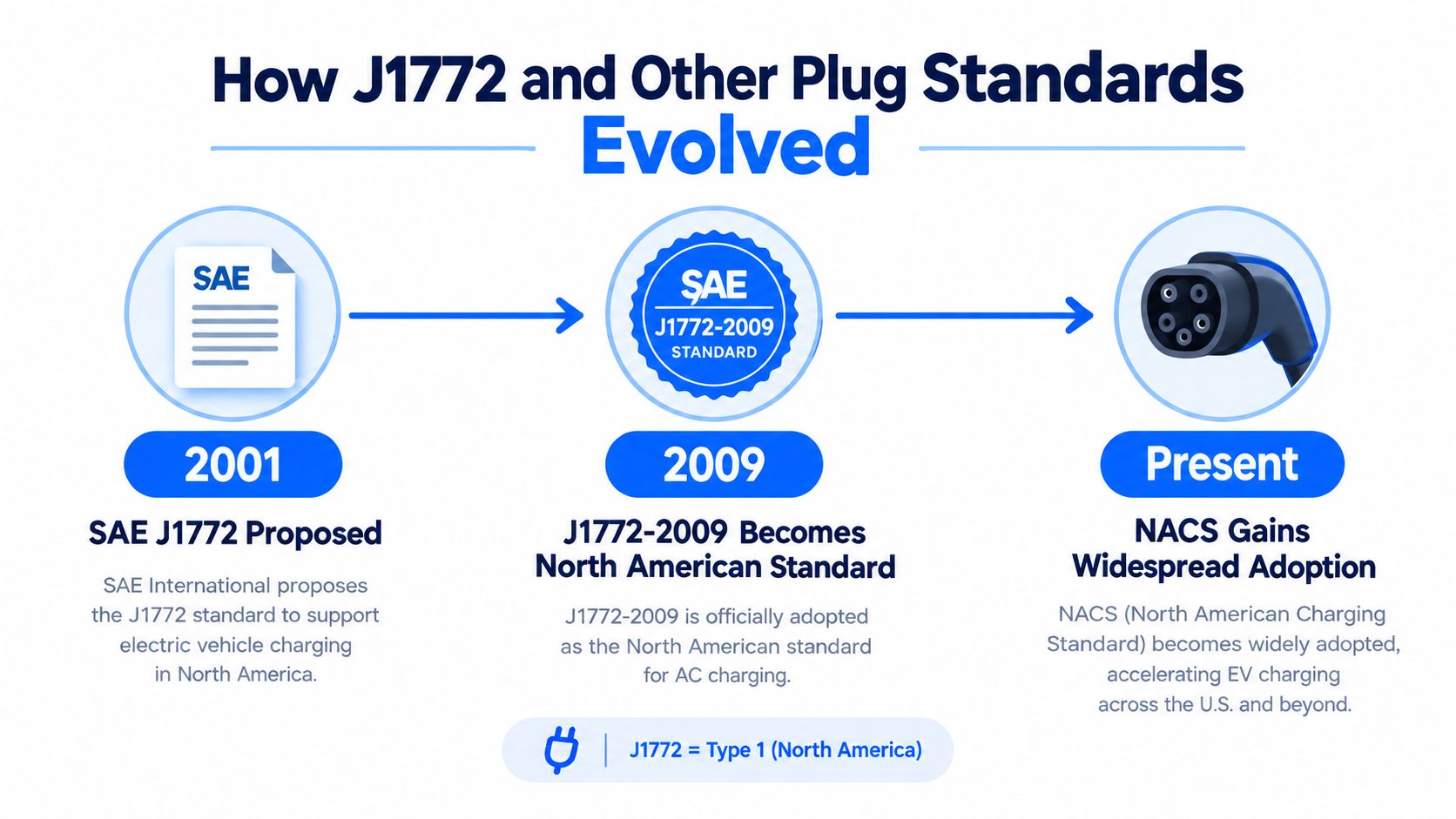
North America's familiar Level 2 connector grew from SAE J1772. The standard was first described in 2001, and the connector became the de facto AC charging interface for non-Tesla vehicles after SAE voted it into standard status in July 2009. The same connector supports single-phase AC charging from 120 to 240 volts and up to 80 amps, which produces a theoretical maximum of 19.2 kW. (J1772 history and specifications)
That history explains why a J1772 handle appears on so much North American Level 1 and Level 2 equipment. Regulatory activity also pushed the market toward a common interface. In California, CARB moved the market away from earlier connector concepts by 2001 and later mandated the J1772-based approach in 2012, helping standardize Level 2 charging across a major EV market. (J1772 standardization background)
Europe followed a different path
European AC charging developed around Type 2 under IEC 62196. The connector was proposed in 2009, selected by the European Commission as the official AC charging plug in January 2013, and mandated across the European Union from 2014, with full compliance required by 2025. (Type 2 connector history and specifications)
Type 2 supports up to 70 amps single-phase and 63 amps three-phase at voltages up to 480 volts AC. That enables common domestic 7 kW arrangements and public 22 kW AC charging. Type 2 is consequently the dominant Level 2-style AC connector across Europe and many other markets, while J1772, also called Type 1, remains the familiar North American pattern. (Type 2 connector history and specifications)
Why NACS is changing buying decisions
Tesla historically used a proprietary connector in North America. The market is now moving toward NACS/J3400, and major automakers are adopting NACS for 2025 and later models, while home Level 2 equipment is available with either J1772 or NACS output options. This creates a transition period for homeowners who may keep one charging circuit while changing vehicles.
The important point isn't that one plug makes every other plug obsolete. J1772 remains useful for many vehicles, and adapters can connect compatible AC systems. The point is that vehicle inlet decisions are becoming less predictable over a normal home-equipment lifespan, so the cable format deserves as much attention as the breaker.
J1772 vs NACS and Adapter Compatibility Explained
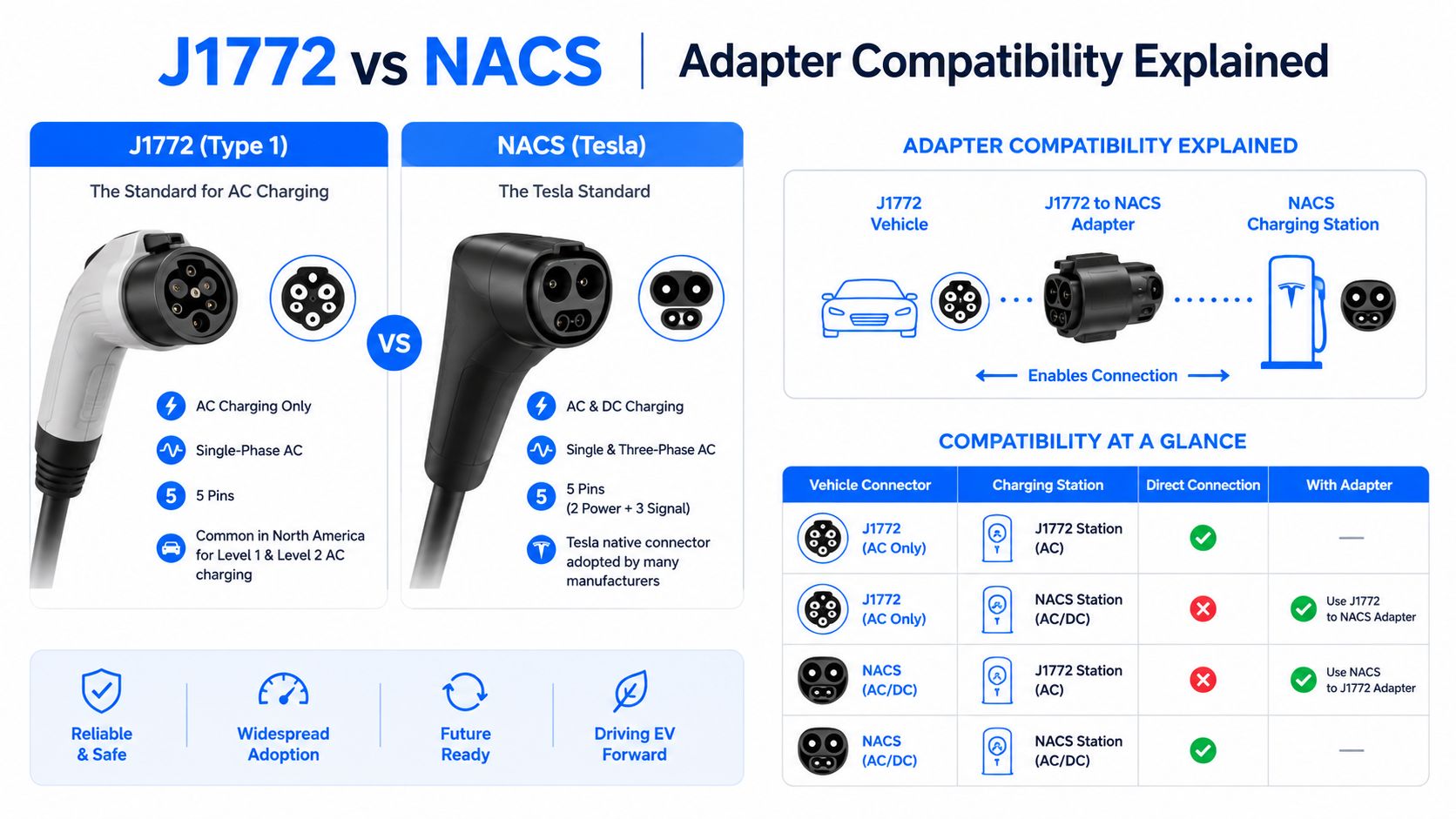
Start with the inlet on the car, then inspect the connector on the charging station. A J1772 vehicle needs a J1772 connector unless the equipment uses a suitable adapter path. A vehicle with an NACS inlet needs an NACS connector or an adapter designed to connect it to a J1772 station. The adapter changes the physical interface, but it doesn't rewrite the electrical limits set by the EVSE, circuit, or onboard charger.
That makes adapter use practical for many AC Level 2 situations, but it shouldn't be treated as a power upgrade. If the station supplies a particular current, the adapter passes along a compatible connection within its rating. It won't turn a modest circuit into a higher-capacity installation.
Match the inlet to the connector
Vehicle inlet | Compatible charger plug | Adapter needed | Best use case |
|---|---|---|---|
J1772 Type 1 AC | J1772 | Usually no | A North American EV with a J1772 inlet and a dedicated home station |
NACS/J3400 AC | NACS | Usually no when the station has NACS output | A vehicle intended for the NACS charging ecosystem |
NACS/J3400 AC | J1772 | A compatible J1772-to-NACS adapter | Keeping a J1772 home or workplace station while using an NACS vehicle |
J1772 Type 1 AC | NACS | An adapter only if the vehicle and equipment maker approve that path | A household planning around a newer NACS-output station |
Use a Level 2 EV charging cable guide to check cable format, connector choice, and installation context before ordering.
Choose a future-proof path
A homeowner with a current J1772 vehicle has three sensible directions:
Stay with J1772: This is simple when your present vehicle is the only consideration and you expect the next vehicle to use the same inlet.
Choose NACS output: This fits a household already committed to an NACS vehicle or planning to standardize around that connector.
Use a flexible or adapter-based arrangement: This can keep one circuit useful across different vehicles, provided the station, adapter, and vehicle manufacturers support the connection.
The strongest decision depends on more than the shape of the handle. Consider whether the cable can be replaced, whether the station supports load management, how exposed the connector will be outdoors, and whether every intended vehicle can use the arrangement without improvised parts.
Future-proofing means preserving options, not chasing the highest-rated plug. A well-sized circuit with a supported connector path can outlast a fashionable cable choice.
Tethered vs Socketed Level 2 Charger Options
The connector standard answers what fits the car. The tethered or socketed design answers how the cable lives at the station.
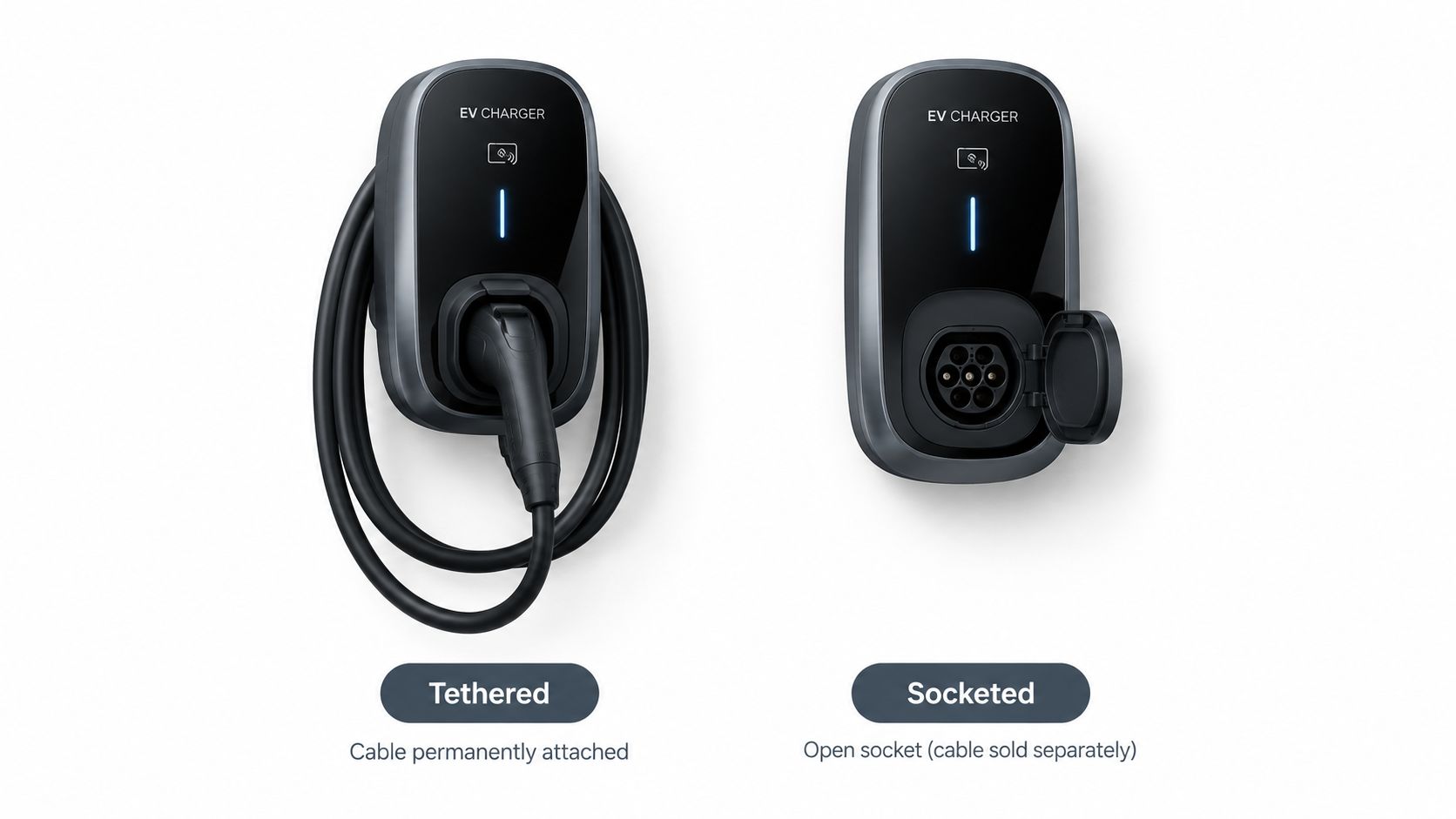
A tethered station has a permanently attached charging cable. You lift the handle, plug it into the vehicle, and return it to a holster when finished. A socketed station has a receptacle instead. You bring a separate cable and connect it between the wall unit and the vehicle.
Tethered works well for one regular vehicle
A tethered unit is convenient when one car uses the same inlet every day. There's no separate cable to store, and the connector is always ready beside the parking space. That reduces the number of steps between arriving home and starting a charge.
The tradeoff is less flexibility. If the household changes from J1772 to NACS, the permanently attached cable may no longer be the preferred match. The electrical circuit can remain suitable, but the station or cable arrangement may need to change.
Socketed favors changing vehicles
A socketed design separates the wall equipment from the vehicle cable. A family with one J1772 EV today and an NACS vehicle later may find that arrangement easier to adapt, because the cable can be selected for the vehicle rather than replacing the entire wall-mounted unit.
That flexibility introduces daily handling. Someone must store the cable, protect its connectors, and make sure the cable rating suits the station and car. A workplace or small business may value socketed equipment when different employees bring different EV brands, but it also needs a clear storage and access plan.
Situation | Tethered choice | Socketed choice |
|---|---|---|
One vehicle, one connector | Simple and convenient | Flexible but requires a separate cable |
Multiple connector types | May require equipment changes | Easier to support with compatible cables |
Outdoor home parking | Ready for every session | Cable storage needs attention |
Future NACS transition | Attached connector may become limiting | Replaceable cable can preserve options |
For a Southeastern Pennsylvania home, weather exposure, parking distance, and the likelihood of changing vehicles matter as much as connector preference. Don't buy a socketed station for theoretical flexibility if the cable will be left in rain or dragged across a walkway. Don't choose tethered equipment solely for convenience if two vehicles will share the circuit.
How Plug Choice and Power Affect Real Charging Speed
The plug doesn't determine charging speed by itself. Real output is limited by the lowest of three ceilings:
The EVSE's configured amperage.
The vehicle's onboard charger.
The electrical service and branch circuit.
At 240 volts, common home tiers include 32 amps at roughly 7.7 kW, 40 amps at roughly 9.6 kW, and 48 amps at roughly 11.5 kW. A 48 amp unit can provide roughly 20% more power than a 40 amp unit, but the vehicle must be able to accept that power and the installation must support the continuous load. (Level 2 current and power guidance)
The breaker must exceed the charging current
EV charging is treated as a continuous load, so the branch circuit must be sized above the charger's continuous draw. The widely used 80% loading practice means a 32 amp charger needs a 40 amp breaker, a 40 amp charger needs a 50 amp breaker, and a 48 amp charger needs a 60 amp breaker. (EV charger breaker-sizing guidance)
That relationship affects more than the breaker label. Higher current can require larger conductors, a different installation method, and a hardwired connection. A 48 amp Level 2 unit is generally hardwired instead of connected to a receptacle because the circuit and equipment must sustain the load safely.
Calculate the useful speed
Suppose your vehicle can accept 11.5 kW, but the EVSE is configured for 40 amps on a suitable circuit. The car won't receive 11.5 kW just because its onboard charger can handle it. The EVSE and circuit establish the lower ceiling, so the vehicle receives approximately the station's available 9.6 kW before normal charging conditions and conversion losses.
The reverse can also happen. A high-capacity circuit and a 48 amp station won't make a vehicle with a lower onboard charging limit accept more power. The car remains the final gatekeeper.
The best upgrade is often the right circuit and load management, not the largest connector.
Single-phase Level 2 charging can range from about 3 kW to 19.2 kW, but many home installations operate around the lower current tiers rather than the theoretical maximum. (Level 2 power-range guidance) Check your driving pattern first. A lower-power installation may restore enough energy overnight, while a higher-current design may require service work that adds little practical value.
For a clearer explanation of the electrical relationship between voltage, current, and charging equipment, review this guide to Level 2 charger voltage.
Choosing the Right Level 2 Plug for Your Home
Choose the connector only after answering four questions:
What inlet does your current EV use? Confirm whether it accepts J1772, NACS/J3400, or an approved adapter path.
Who might use the circuit later? A second EV or a replacement vehicle may favor socketed equipment, a replaceable cable, or a dual-standard solution.
How much power can the home support? Have the panel, service, branch circuit, conductor size, and installation method evaluated before selecting a current tier.
What does your driving require? Match charging power to the energy you need to restore between trips, rather than assuming the highest rating is necessary.
A J1772 station remains a practical choice for many North American EVs. NACS output may make sense for a vehicle already using that inlet. An adapter-based path can preserve compatibility, but only when the adapter is designed and approved for the intended AC Level 2 connection.
In Southeastern Pennsylvania, a certified electrician should assess the installation location, panel capacity, routing distance, grounding, outdoor exposure, and local permitting requirements. That site review is also the right time to discuss load management and whether a dedicated circuit can serve more than one vehicle over time.
Amp'd Energy Solutions installs residential and commercial EV charging equipment, evaluates panel readiness, and handles electrical service upgrades when a home or workplace needs additional capacity. The practical goal is one safe, code-compliant installation that matches your current EV without closing off sensible future options.
Ask Amp'd Energy Solutions to assess your vehicle inlet, charging connector, panel capacity, and future EV plans before you buy equipment. Their Southeastern Pennsylvania team can plan and install a Level 2 charging setup for homes and workplaces, including dedicated circuits and related electrical upgrades.
Comments