

Level 2 Charging Outlet: Types, Wiring, and Installation
You've parked your new EV in the garage, found an open section of wall, and started comparing charging stations. One product needs a NEMA 14-50 receptacle, another can be hardwired, and a third advertises a higher amperage. The confusing part is that the visible outlet is only the final piece of the installation. The breaker, conductors, panel capacity, charger, and vehicle all determine what that outlet can safely deliver.
Table of Contents
What a Level 2 Charging Outlet Actually Is - The connector isn't the outlet
How Voltage and Amperage Become Real Miles Per Hour - Why the breaker rating matters
Circuit, Breaker, and Wire Sizing Rules - Dedicated means dedicated
When You Can Skip the Panel Upgrade - What the assessment should identify
What a Professional Installation Looks Like - From assessment to rough-in - Inspection and commissioning
Choosing the Right Outlet for Your Home - Three practical paths
Level 2 Charging Outlet FAQs - Can a Tesla use a J1772 or NEMA 14-50 outlet? - Does an outdoor outlet need different protection? - Is a portable EVSE better than a hardwired wall unit? - What code and permit rules apply?
What a Level 2 Charging Outlet Actually Is
A Level 2 charging outlet is a 240-volt AC receptacle used to supply a Level 2 EVSE, or Electric Vehicle Supply Equipment. Unlike a regular household outlet used for Level 1 charging, it uses a dedicated higher-voltage circuit. It also isn't the same as DC fast charging, where the charging station supplies direct current through commercial equipment.
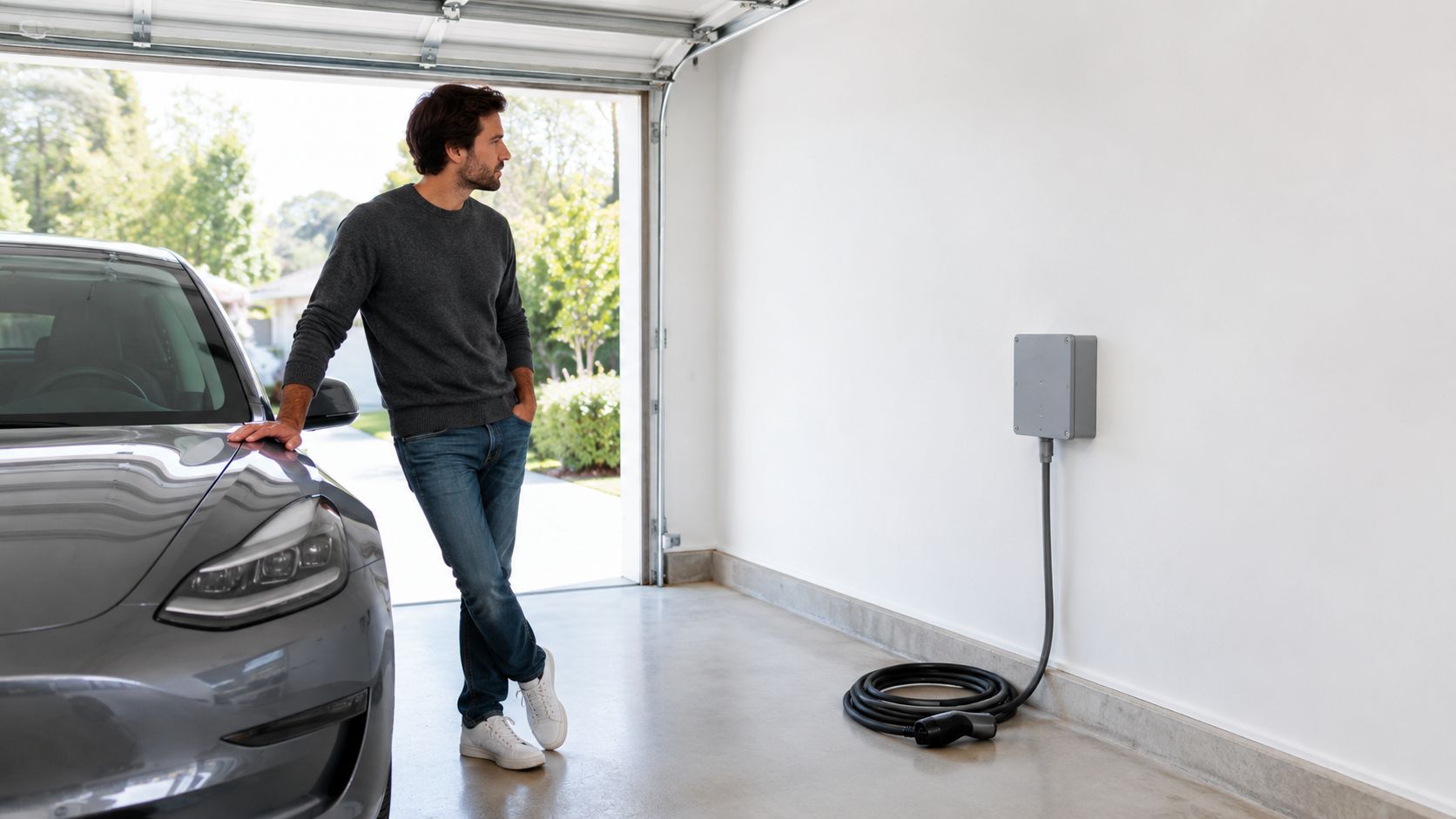
Think of the installation as a chain:
Electrical panel: The circuit begins here.
Two-pole breaker: It connects the charging circuit to both sides of the 240-volt supply.
Conductors: The wire carries power from the panel to the garage or parking location.
Receptacle or hardwired connection: This is the point where the EVSE receives power.
EVSE and vehicle connector: The EVSE controls access to power, while the vehicle's onboard charger converts AC power for the battery.
The wall outlet itself doesn't decide how quickly your vehicle charges. A receptacle can only safely support the circuit and equipment it's designed for. If the panel, wire, or breaker is undersized, installing a higher-rated outlet won't create more capacity.
In North America, Level 2 charging is generally associated with approximately 240 volts AC and can support up to 80 amps, or as much as 19.2 kilowatts at the upper end of the standard, as described in the SAE J1772 charging coupler standard. SAE J1772 also formalized the conductive connection used by Level 1 and Level 2 charging.
The connector isn't the outlet
The J1772 connector is the plug that goes into the vehicle. It isn't the wall receptacle. A portable EVSE may plug into a NEMA receptacle, while a wall-mounted unit may be hardwired and use a J1772 cable at the car.
Tesla vehicles may use a native Tesla connector and a Tesla-specific wall unit, or they may use a compatible adapter with a J1772 EVSE. The correct choice depends on the vehicle inlet, the EVSE, and the circuit design.
Practical rule: Choose the charging output and circuit first. Then choose the receptacle that matches that equipment.
How Voltage and Amperage Become Real Miles Per Hour
Charging power comes from a simple relationship:
Volts × amps = watts
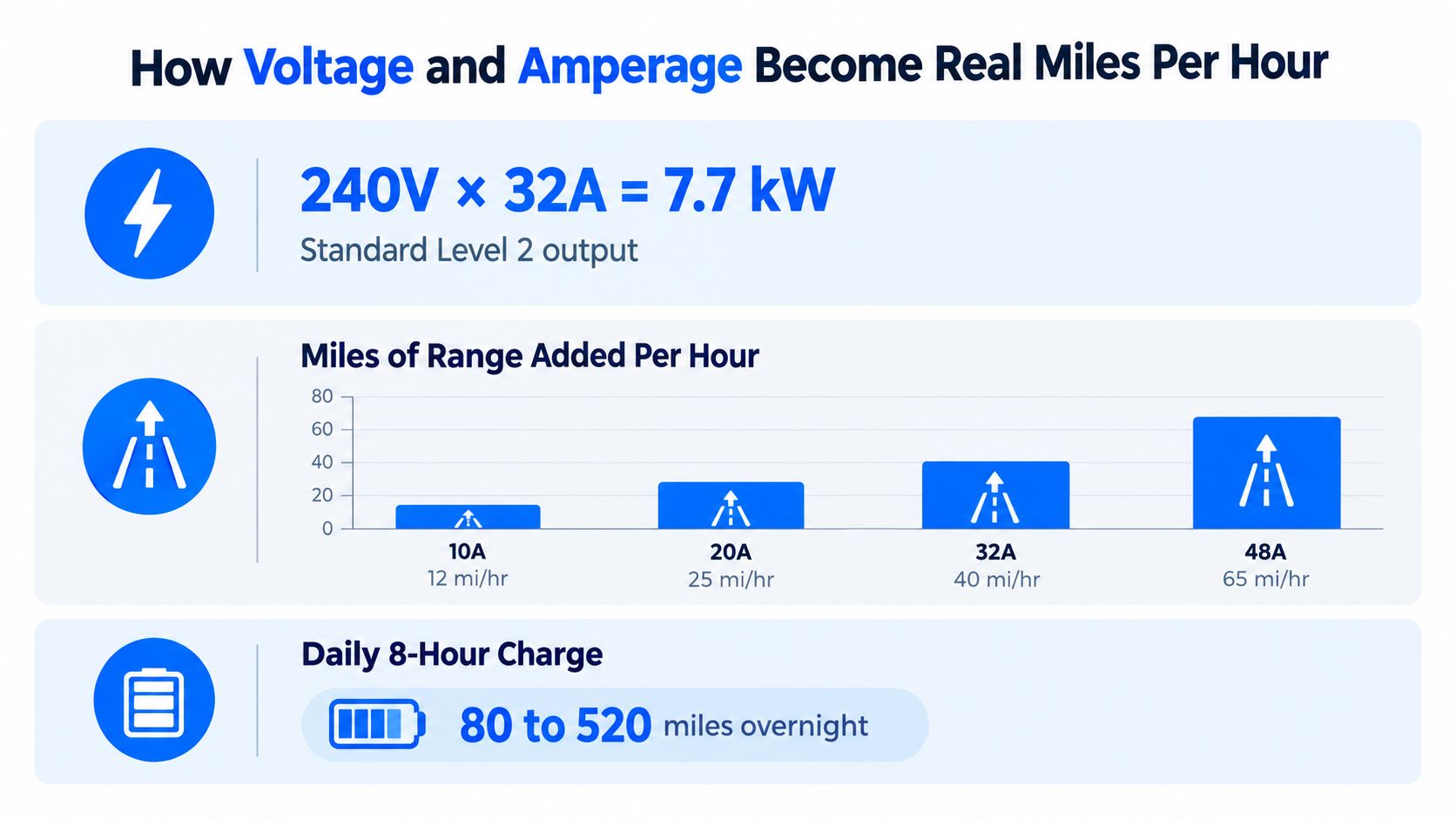
Divide watts by 1,000 to express the result in kilowatts. For example, a 240-volt circuit supplying 40 amps provides 9.6 kilowatts before normal charging losses. A 240-volt circuit supplying 32 amps provides about 7.7 kilowatts.
The U.S. Department of Energy describes Level 2 charging as adding roughly 10 to 65 or more miles of range per hour, depending on the equipment and vehicle. The Department of Energy comparison of Level 1 and Level 2 charging explains why the actual result varies with circuit output and the vehicle's onboard charger.
A useful estimate is:
Kilowatts × charging hours ÷ vehicle efficiency = energy or range added
The vehicle's efficiency is the missing variable. Two EVs connected to the same outlet may gain different mileage because one uses more energy per mile. The car may also limit incoming power if its onboard charger accepts less than the EVSE can provide.
Why the breaker rating matters
A 50-amp receptacle doesn't mean the vehicle will receive 50 amps continuously. EV charging is treated as a continuous load, so the circuit is normally sized to provide only 80% of the breaker rating for ongoing charging. A 40-amp EVSE therefore commonly uses a 50-amp breaker, while a 32-amp EVSE commonly uses a 40-amp breaker, as explained in this EV charger breaker sizing guide.
That relationship affects every component. The charger setting determines current, the continuous-load rule determines breaker size, and the breaker determines the conductor and installation requirements. The receptacle must then be compatible with that circuit.
A practical comparison looks like this:
32 amps at 240 volts: about 7.7 kilowatts
40 amps at 240 volts: about 9.6 kilowatts
48 amps at 240 volts: about 11.5 kilowatts
Those power figures come from the voltage-and-amperage calculation. Your vehicle may accept less, and charging efficiency will affect the final range added.
For a deeper explanation of the electrical relationship, see this guide to Level 2 charger voltage.
The Main Outlet and Connector Options Compared
There isn't one universal Level 2 outlet. The right choice depends on whether the EVSE needs a neutral conductor, whether you want a plug-in or hardwired installation, how much capacity the panel has, and whether another appliance already uses the circuit.
The NEMA 14-50 is a common general-purpose choice for plug-in EV charging. It has two hot conductors, a neutral, and a ground. The neutral may not be needed by every EVSE, but the receptacle is familiar to many installers and can offer flexibility for compatible equipment.
The NEMA 6-50 also provides 240-volt power but doesn't include a neutral. That can simplify the conductor run when the selected EVSE doesn't need one. It must still be installed on a properly sized dedicated circuit, not treated as a shortcut around breaker or wire requirements.
A NEMA 14-30 is associated with lower-current 240-volt appliance circuits. It may make sense where an existing circuit and approved load-sharing arrangement are available, but an installer must verify that the circuit, receptacle, and EVSE are compatible. Never assume a dryer receptacle can be repurposed while the appliance remains connected.
A hardwired J1772 EVSE has no wall receptacle. The equipment connects directly to the branch-circuit conductors, which removes the plug and receptacle as connection points. Hardwiring can be useful for a permanent installation, outdoor equipment, or a higher-output unit.
Tesla households may choose a native Tesla wall connector or a compatible plug-in EVSE with an approved adapter. The adapter must match the equipment and vehicle connection. Avoid unverified adapters that lack clear ratings, instructions, or manufacturer support.
Outlet / Connector | Amperage | Neutral Required | Typical Use |
|---|---|---|---|
NEMA 14-50 | Selected by EVSE and circuit design | Receptacle includes neutral | Flexible plug-in home charging |
NEMA 6-50 | Selected by EVSE and circuit design | No | Plug-in EVSE where no neutral is needed |
NEMA 14-30 | Lower-current appliance-style circuit | Receptacle includes neutral | Existing compatible circuit or approved sharing |
J1772 hardwired EVSE | Set by hardwired EVSE | Depends on equipment | Permanent installation without a receptacle |
Tesla native connector | Set by wall unit and circuit | Depends on equipment | Tesla-focused installation |
The Level 2 EV charger plug guide provides further connector context. The important decision isn't which outlet looks most familiar. It's whether the outlet matches the EVSE, wiring method, breaker, and vehicle.
Circuit, Breaker, and Wire Sizing Rules
The circuit must be designed around the charger's maximum continuous current, not just the shape of the receptacle. Electrical rules generally require the branch circuit to have additional capacity above the charger's operating current because EV charging can continue for hours.
For example, a 32-amp Level 2 EVSE commonly requires a 40-amp breaker. A 40-amp EVSE commonly requires a 50-amp breaker. A hardwired 48-amp unit commonly requires a 60-amp breaker. These relationships follow the continuous-load rule described in the breaker sizing reference.
The conductor size can't be selected from amperage alone. The electrician also checks conductor material, insulation temperature rating, installation method, ambient conditions, conduit fill, terminal ratings, and the local electrical code.
Charger Amperage | Breaker Size | Min. Copper Wire Gauge | Typical Outlet / Connection |
|---|---|---|---|
16 amps | Sized for the EVSE and continuous load | Determined by code and installation method | Plug-in or hardwired |
32 amps | Commonly 40 amps | Determined by code, equipment, and run | Plug-in or hardwired |
40 amps | Commonly 50 amps | Determined by code, equipment, and run | Plug-in receptacle |
48 amps | Commonly 60 amps | Determined by code, equipment, and run | Usually hardwired |
Dedicated means dedicated
A Level 2 circuit normally shouldn't share power with a dryer, range, garage receptacle, or lighting circuit. A dedicated branch circuit lets the breaker, wire, EVSE, and vehicle operate within the intended design.
In a basement or unfinished utility area, an electrician may route individual conductors through conduit. In an accessible framed wall, a cable assembly may be suitable if the cable type and local rules permit it. The conductor count also changes depending on whether the EVSE needs a neutral or only hot conductors and ground.
Receptacles require careful terminations, box sizing, strain relief, and protection. Hardwired units require secure lugs, correct torque, and a weather-appropriate enclosure when installed outside. Current code requirements may also require GFCI protection for receptacle installations, so the electrician should confirm the applicable local edition and inspection requirements.
When You Can Skip the Panel Upgrade
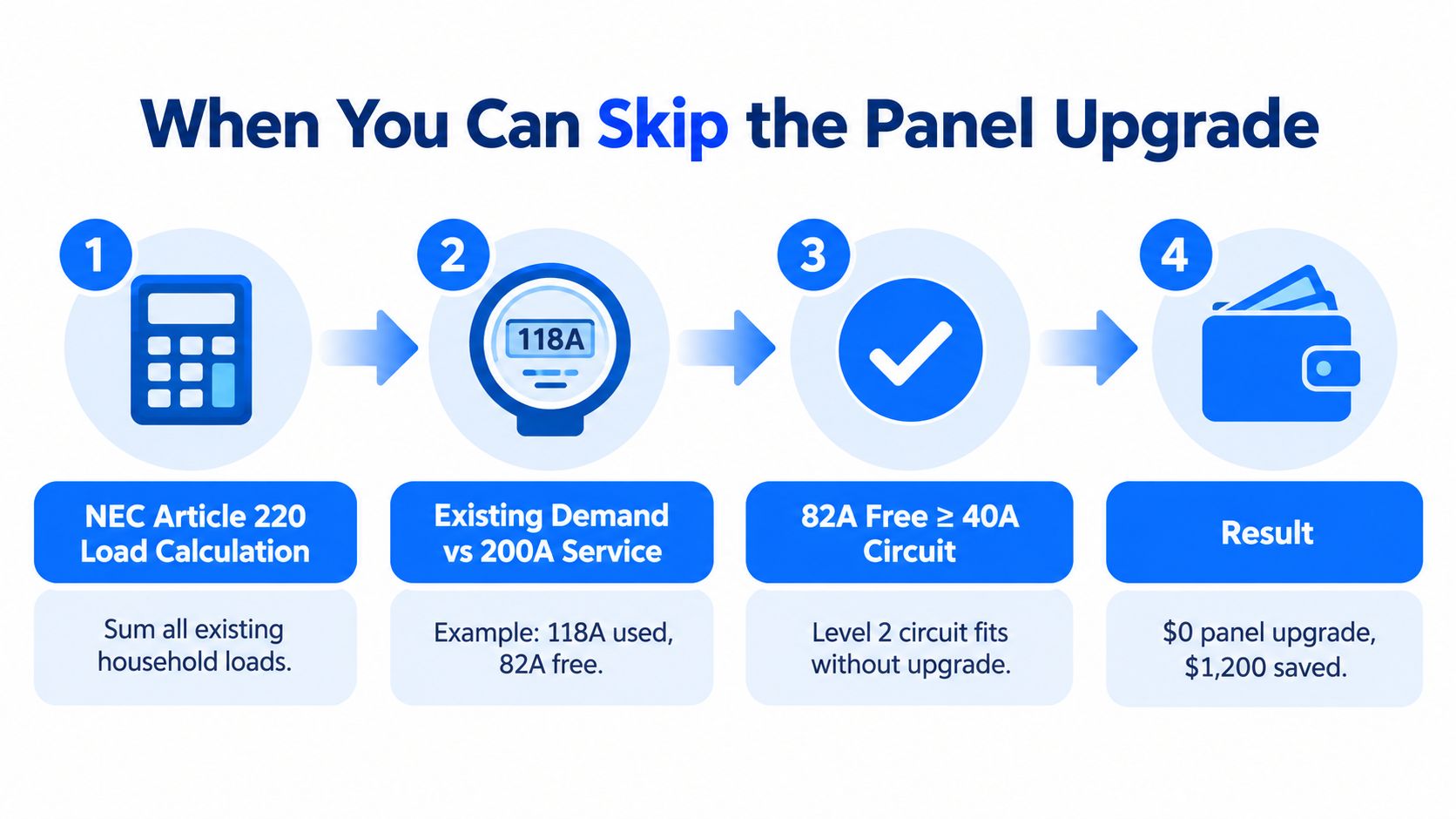
A Level 2 installation doesn't automatically require a full service upgrade. The electrician should begin with a load calculation, not a sales assumption. That calculation compares the home's existing demand with the panel and service capacity available for a new EV circuit.
Some homes need only a new two-pole breaker and branch circuit. Others may need load management, a subpanel, or a service upgrade. The result depends on the existing service, panel condition, heating equipment, cooking appliances, water heating, workshop loads, and future plans.
One industry estimate places the share of homes needing electrical work beyond basic charger installation at about 20%, meaning many installations don't require that additional work. The estimate and the distinction between a circuit addition and a full panel upgrade are discussed in this panel upgrade guidance.
What the assessment should identify
Available capacity: The panel rating doesn't tell the whole story. The calculation must account for the home's actual demand and connected loads.
Condition and space: A panel may have physical breaker space but still have damaged components, obsolete protection, or insufficient service capacity.
Future demand: A second EV, electric heat pump, workshop equipment, or electric water heater may change the sensible charger size.
Control options: A load-management device can reduce or pause EV charging when other household loads rise.
A 60-amp fuse service or a heavily loaded older panel may need corrective work before charging equipment is added. A modern panel with available capacity may accept a new circuit without replacement.
A load calculation protects your budget as well as your home. It can identify when an upgrade is necessary, and when it isn't.
A subpanel can sometimes provide a practical routing solution, but it doesn't create additional service capacity by itself. It still has to be supplied and protected correctly. Ask for the calculation and the proposed circuit design before approving a panel replacement.
For more detail on the decision process, review this guide to a home electrical panel upgrade.
What a Professional Installation Looks Like
A proper installation starts before anyone opens the panel. The electrician locates the service equipment, checks its rating and condition, measures the route to the parking space, and looks for access through a basement, attic, crawlspace, or finished wall.
The mounting location matters. The EVSE should be reachable without placing strain on the vehicle cable, blocking working space, or creating a trip hazard. Outdoor installations also require equipment and enclosures rated for the environment.
From assessment to rough-in
The contractor typically confirms the equipment specifications, completes the load review, identifies the required circuit, and handles the permit process required by the local authority having jurisdiction. The rough-in then follows the planned route.
That work may include:
Routing conductors: The installer runs approved cable or individual conductors in an approved raceway.
Preparing the mounting point: A backplate, electrical box, or EVSE enclosure is secured to suitable framing or masonry.
Installing protection: The correct two-pole breaker and any required GFCI or other protection are fitted.
Terminating conductors: Each conductor lands on the specified terminal, and the installer verifies torque.
Labeling the circuit: The panel directory identifies the EV charging circuit for future service work.
For a short panel-to-garage route through an open basement, the physical work may take two to four hours. Longer attic routes, finished walls, difficult access, surface repair, or exterior trenching can extend the project to a full day or more. The route, access, equipment, permits, and panel work usually affect the price more than the receptacle itself.
Inspection and commissioning
The inspector may check working clearances, conductor terminations, grounding, protection, enclosure suitability, labeling, and the installation's general code compliance. After approval, the electrician commissions the EVSE, confirms the vehicle starts charging, and verifies that the equipment operates at its configured current.
A receptacle should be checked for secure mounting and proper polarity before the EVSE is used. If the plug or receptacle becomes unusually hot, smells scorched, or shows discoloration, stop charging and have the circuit inspected.
Choosing the Right Outlet for Your Home
Start with the vehicle, not the product box. Check the vehicle's maximum AC charging acceptance, then compare that limit with the EVSE output and the electrical capacity available at the home.
A smaller circuit may be completely adequate for a driver who charges overnight and doesn't need rapid daily replenishment. A larger circuit may add little value if the vehicle's onboard charger can't accept the extra power. The goal is to match equipment instead of paying for unused capacity.
Three practical paths
A lower-current plug-in setup can suit a home with limited panel capacity or modest driving needs. A compatible NEMA 14-30 arrangement may work when the circuit and EVSE are designed for it, but an electrician must confirm the circuit isn't being overloaded or improperly shared.
A NEMA 14-50 setup is a flexible default for many plug-in installations. Pair it with an EVSE configured for the circuit, commonly in the 32-amp or 40-amp range, and verify that the receptacle, breaker, conductors, and panel all match.
A hardwired installation makes sense when you want a permanent wall unit, an outdoor setup, a long cable route, or higher charging output. It eliminates the receptacle connection, but it also makes relocating or replacing the EVSE less convenient.
A plug-in receptacle may be attractive for future flexibility or resale, while hardwiring can reduce connection points and suit a dedicated permanent installation. Neither approach is automatically safer. Correct sizing, installation, protection, and inspection matter more than the label on the outlet.
Before buying the receptacle, ask for three answers:
What does the vehicle accept?
What current will the EVSE draw continuously?
What does the panel load calculation support?
That sequence prevents a common mistake, buying an outlet first and discovering that the upstream circuit can't support it.
Level 2 Charging Outlet FAQs
Can a Tesla use a J1772 or NEMA 14-50 outlet?
It can, provided the vehicle and EVSE connections are compatible and the adapter is approved for that equipment. A Tesla may use a native wall unit or connect to a J1772 EVSE through a suitable adapter. The adapter should have clear ratings, secure connections, and manufacturer support. Avoid counterfeit or unverified products, especially those that don't identify their current limits.
Does an outdoor outlet need different protection?
Yes. Outdoor equipment must be rated for moisture, sunlight, impact, and the installation location. An enclosure such as a NEMA 3R or NEMA 4 design may be appropriate depending on exposure and equipment requirements, and an in-use cover may be needed for an outdoor receptacle.
A garage outlet generally isn't exposed in the same way as an exterior outlet, but the electrician still needs to follow local requirements and use equipment listed for the environment.
Is a portable EVSE better than a hardwired wall unit?
A portable unit gives you flexibility. You can remove it, store it, or use a compatible receptacle at another location. The trade-off is that the plug and receptacle become additional connection points, and frequent plugging can create wear if the equipment isn't designed for that use.
A hardwired unit is more permanent and can reduce receptacle-related heat or wear. It may also be preferable for an exposed installation, but relocating it later requires electrical work. Your insurer, manufacturer, and local authority may also have requirements for the installation method.
What code and permit rules apply?
EV charging installations commonly fall under NEC Article 625, along with local amendments and permitting rules. Protection requirements can evolve with newer code cycles, and the exact GFCI or AFCI requirements depend on the equipment, location, and jurisdiction.
A permitted installation gives the authority having jurisdiction an opportunity to verify the work. Unpermitted electrical changes can create problems during a property sale, inspection, or insurance claim. Confirm the permit and inspection requirements before work begins.
Amp'd Energy Solutions can assess your panel capacity, design a dedicated Level 2 circuit, and install plug-in or hardwired charging equipment for residential and commercial properties. If you're planning EV charging in Southeastern Pennsylvania, visit Amp'd Energy Solutions to arrange a site assessment and discuss the right outlet, breaker, wire route, and panel solution for your home.
Comments