

Level 2 Charger NEMA 14-50: Amps and Circuit Fit
A NEMA 14-50 names the plug and receptacle, not a 50-amp charging rate or a ready-to-use circuit. The 40-amp ceiling on a 50-amp circuit comes from EV charging being a continuous load. A matching plug alone says nothing about whether the wiring is suitable.
The common advice to add a range outlet overlooks the important decision: choosing charging equipment that matches the electrical installation. A plug may fit an unsuitable circuit, and an open breaker position does not indicate that the service has capacity for the added load.
Choose the charging current and connection method before buying a receptacle. A plug-in setup can suit some garages; hardwiring or managed charging can be the better choice in others. The right option depends on the circuit and the home's electrical capacity.
Table of Contents
What a NEMA 14-50 Means for Level 2 Charging - The plug is only the connection
How Many Amps a 50 Amp Outlet Actually Delivers - Follow the current through the equipment - Correct setting versus misleading capability
Plug In, Hardwire, or Manage the Load - Plug-in convenience comes with another contact point - Hardwiring removes the plug interface - Load management solves a different problem
Circuit Wire and Panel Requirements - Establish the design before running cable - Build and verify the connection
Garage Setups That Fit or Fail a 14-50 - The garage where portability earns its place - The spare slot that doesn't settle capacity - The household sharing equipment
Confirm the Panel Before You Buy the Outlet - Build a pre-purchase checklist - Compare complete circuit plans
What a NEMA 14-50 Means for Level 2 Charging
Say you buy a plug-in charger and recognize its heavy plug from an electric range. Your garage already has a matching receptacle, so plugging in seems like the last step.
It isn't. The receptacle tells you what connection fits, not what condition the wiring is in or what charging load the house can accept. An existing installation needs to be checked before it becomes part of your nightly charging routine.
The EPA's home EV charging guidance gives the practical example: a 40-amp Level 2 charger requires a dedicated 50-amp circuit. That's the distinction a buyer needs, rather than an assumption that the number on the outlet equals charging current.
The plug is only the connection
The range-outlet analogy helps explain the layout. The receptacle has hot connections, a neutral, and an equipment ground, with neutral and ground serving different purposes. Most EV charging equipment doesn't use the neutral for charging power, but that doesn't make an incomplete or improvised receptacle installation acceptable.
EVSE is the electrical vehicle supply equipment, commonly called the wall charger. It communicates available current to the vehicle; the vehicle's onboard charger converts incoming AC power for the battery.
A matching plug establishes compatibility at the connection. It doesn't establish electrical readiness.
Before reusing a garage outlet, have an electrician identify its breaker, trace the circuit, inspect the conductors and terminations, and evaluate the home's available capacity. Don't judge it by the faceplate or the previous owner's description.
The important purchase question isn't whether a Level 2 charger has a NEMA 14-50 plug. It's whether the vehicle, EVSE, branch circuit, and service can work together at the intended setting.
How Many Amps a 50 Amp Outlet Actually Delivers
A NEMA 14-50 identifies the receptacle, not the charging rate. With a 50-amp circuit, the continuous-load limit sets the practical ceiling for a plug-in charger at 40 amps, or about 9.6 kW at 240 volts. The table shows calculated power at 240 volts using that 80% relationship.
Level 2 settings a NEMA 14-50 circuit can and cannot support
Charger setting | Minimum circuit | Calculated power at 240 V | Connection that fits |
|---|---|---|---|
16 amps | 20 amps | 3.8 kW | Smaller dedicated circuit; a 14-50 requires an approved reduced-current installation |
24 amps | 30 amps | 5.8 kW | Appropriately rated connection; a 14-50 requires an approved installation configured to this setting |
32 amps | 40 amps | 7.7 kW | Properly designed circuit; a 14-50 is usable only with the EVSE held at this setting |
40 amps | 50 amps | 9.6 kW | Standard match for a NEMA 14-50 on a correctly sized circuit |
48 amps | 60 amps | 11.5 kW | Normally hardwired; a standard 14-50 does not support this setting |
The continuous-load rule limits EV charging to 80% of the circuit rating. Applied at 240 volts, a 50-amp branch circuit supports up to 40 amps and about 9.6 kW, as described in NFPA's electrical-code development document. The other table values are calculated from the same relationship.
Circuit sizing still has to match the receptacle, conductors, EVSE instructions, and local approval. A lower charging setting works only when the equipment installation is approved for that configuration. A temporary adjustment in an app does not establish that the circuit is suitable.
Follow the current through the equipment
Start with the vehicle's onboard AC charging limit. The vehicle cannot accept more AC charging power than its onboard charger allows. Check the specification for the actual vehicle and configuration, rather than relying on a public fast-charging figure.
Next, find how the EVSE sets its installation limit. Some units use internal switches; others use a protected installer configuration. A driver's temporary charging preference may differ from the installation setting that determines circuit requirements.
Then match the breaker and conductor ampacity to the configured load. The breaker protects the circuit conductors. A larger breaker is not an upgrade unless the wiring, terminals, and equipment ratings support it.
Finally, confirm the receptacle and connection method are rated for the installation. The receptacle cannot increase the capacity of the circuit behind it, and the EVSE's maximum rating cannot raise the receptacle's limit. For a clearer explanation of how these limits affect actual charging current, see this guide to Level 2 EV charger amps.
Correct setting versus misleading capability
A plug-in unit can be a good fit when its commissioned setting stays within the supported continuous load and the circuit and equipment are compatible. Choose based on that setting, not the largest number printed on the charger box.
An adapter or replacement cord does not authorize a higher current setting. Do not convert a hardwire-only model into a plug-in unit or assume that a cord change makes the receptacle and circuit suitable for more current.
Practical rule: Set the EVSE to the approved circuit design, and keep that installation limit distinct from everyday charging preferences.
Before handoff, ask the installer to demonstrate the installation setting and show where it is recorded. Confirm whether ordinary user controls can change it.
Plug In, Hardwire, or Manage the Load
Many garages shouldn't get a NEMA 14-50 just because the charger shipped with that plug. Choose the connection around how you'll use the equipment, where it will sit, and what the house can support.
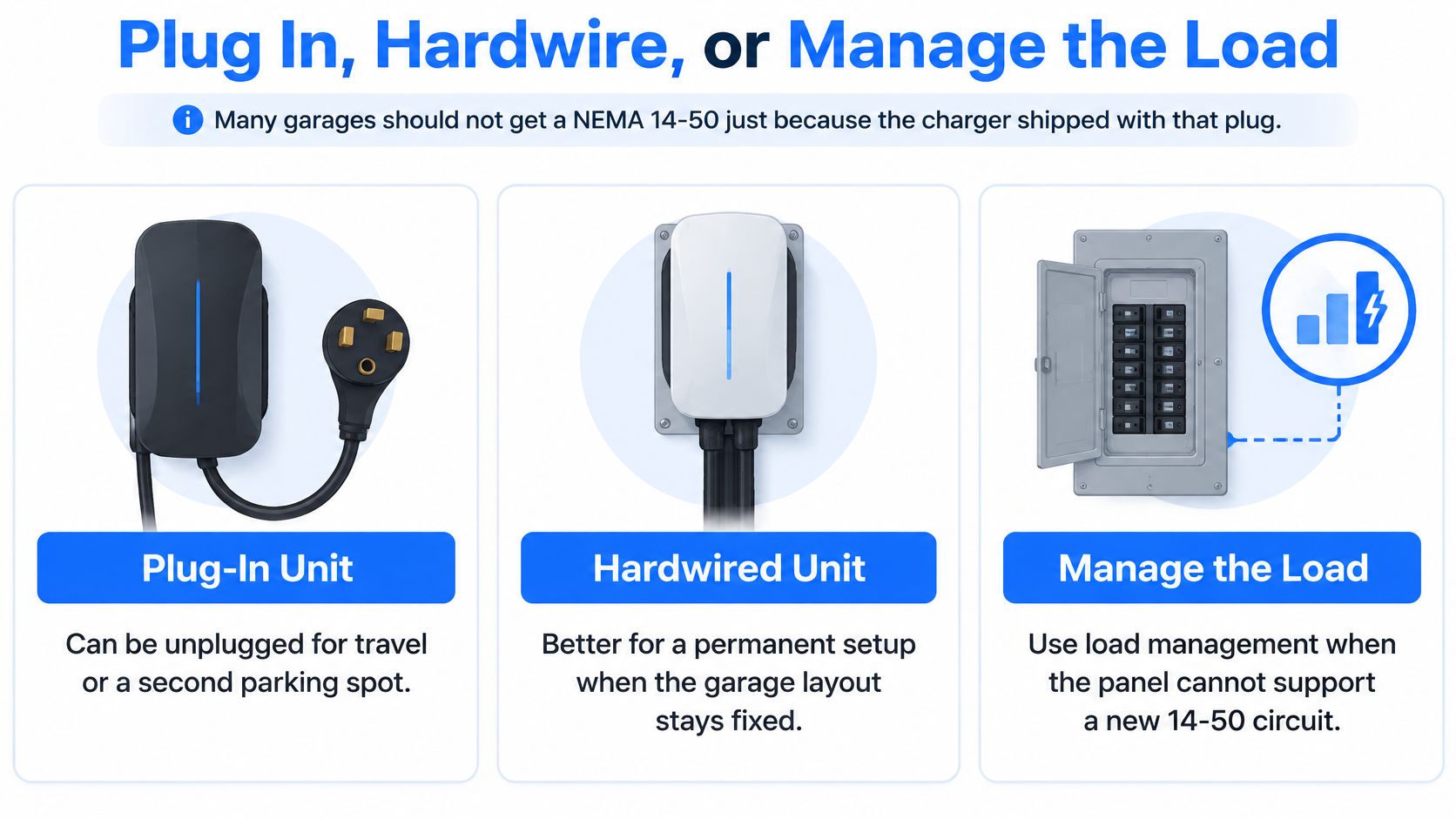
Plug-in 14-50, hardwired EVSE, and managed charging
Approach | Practical ceiling | Flexibility | Main risk | Fits when |
|---|---|---|---|---|
NEMA 14-50 plug-in | Receptacle-compatible continuous-load setting | Unplug to move or swap the EVSE | Heat from a loose or low-quality receptacle | A suitable dedicated garage circuit exists and portability matters |
Hardwired EVSE | Approved circuit and equipment capacity | Fixed mount | Less convenient to relocate or lend out | The parking spot is permanent or exposed to weather |
Managed charging | Current drops as available capacity decreases | Can be plug-in or hardwired | Incorrect control design or commissioning | Existing household loads constrain charging capacity |
ENERGY STAR's EV-ready homes guide supports evaluating load management as part of the home's electrical design rather than automatically assuming that added charging requires a service upgrade. The controls, equipment, installation requirements, and inspection need to work together.
Plug-in convenience comes with another contact point
A portable EVSE is useful if you'll take it elsewhere, move it between approved locations, or replace it without changing permanent wiring. That flexibility is real, but unplugging should serve an actual need rather than an imagined benefit.
The receptacle adds a high-current contact interface. Weak contact pressure, a partially seated plug, or a loose terminal can produce localized heating. The charging session may slow, stop, or trip protection, and the owner may initially blame the vehicle.
Don't choose a receptacle solely because it's the cheapest range outlet available. Specify a quality device identified by its manufacturer as suitable for EV charging, with terminals compatible with the selected conductors. Support the EVSE so its weight doesn't pull against the plug.
Match the supply plug exactly. Some charging cords use a no-neutral receptacle configuration rather than the neutral-equipped connection discussed here. Buy equipment that matches the approved installation instead of solving a mismatch with an improvised adapter.
Hardwiring removes the plug interface
For a permanent wall installation, I generally prefer hardwiring. It removes the receptacle contacts from the charging path and avoids managing a bulky supply plug behind the unit.
It doesn't remove the need for workmanship. The installer still needs proper conductor preparation, compatible terminals, strain relief, and manufacturer-specified torque. A badly terminated hardwired unit can overheat too.
Outdoor placement strengthens the case for a fixed connection, but hardwiring alone doesn't make equipment weatherproof. The enclosure, cable entries, mounting arrangement, and exposure must suit the location. Apply the GFCI protection required by the locally adopted code and the selected equipment instructions.
Load management solves a different problem
Managed charging isn't a competing plug type. It can work with either connection method when compatible equipment and approved controls are used.
A properly designed system monitors available capacity and reduces charging when other household loads need it. That can make charging practical without replacing the service merely to accommodate the EVSE's maximum output.
However, batteries and generators need special attention. The designer must establish how charging behaves during backup operation, whether the EV load is excluded, and how the controls respond when the available supply changes.
Load management never excuses undersized wiring. It needs a defined maximum current, appropriate conductors and protection, and documented behavior if sensing or communication fails.
Choose plug-in equipment when portability earns its extra connection. Choose hardwiring for a fixed installation. Add managed charging when capacity, rather than connection convenience, is the decisive constraint.
Circuit Wire and Panel Requirements
Complete the load calculation and confirm the EVSE configuration before ordering the breaker, cable, or receptacle. Working backward from hardware already purchased can leave you paying for equipment the house can't use.
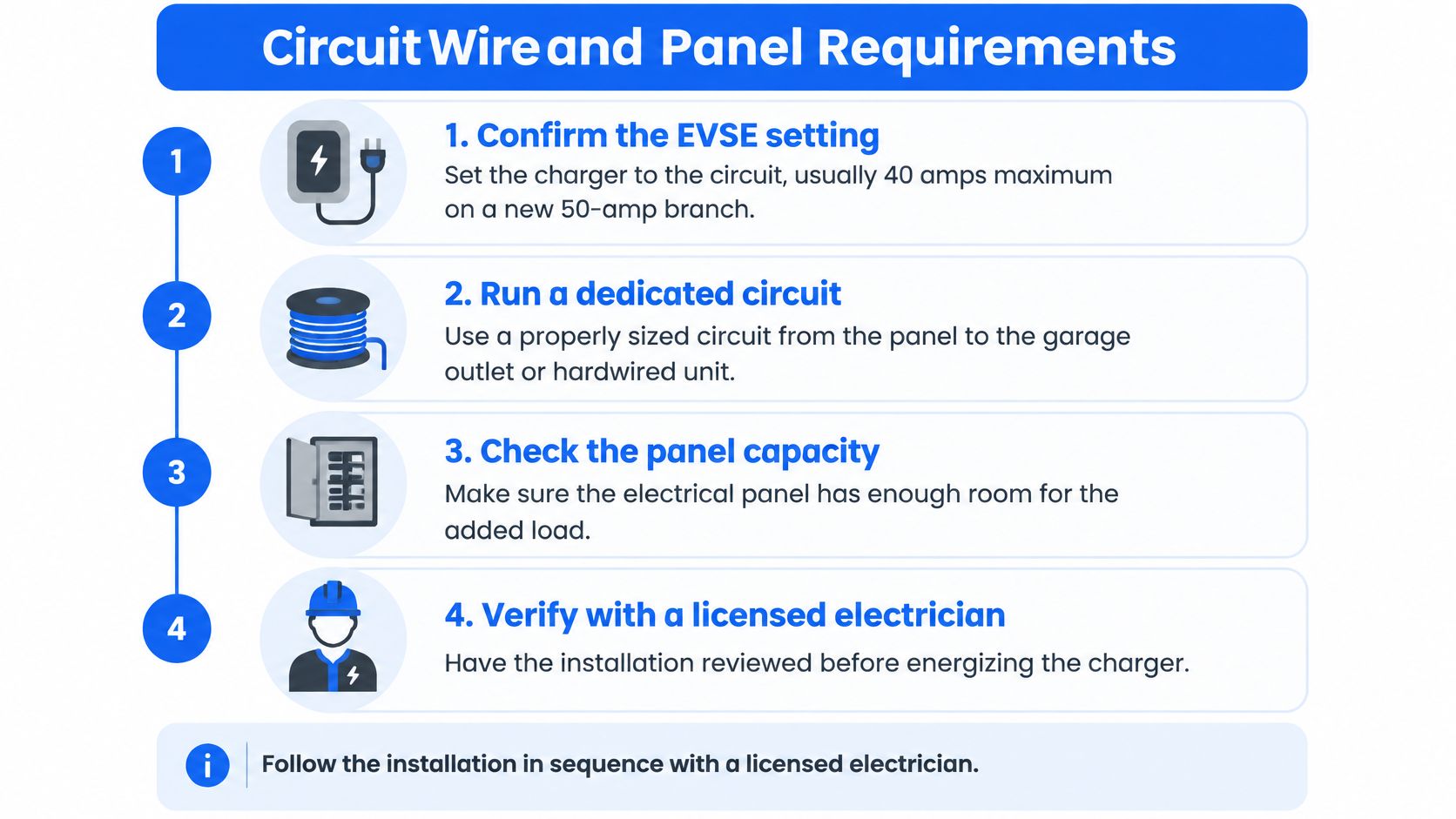
Establish the design before running cable
Ask your licensed electrician to document the proposed connection, maximum charging setting, and available service capacity. An empty breaker space is useful, but it doesn't establish whether the service can carry another continuous load.
The installation sequence should include these decisions:
Assess the whole service. Account for existing heating, cooking, laundry, cooling, and other significant electrical loads. Include planned electrification rather than designing around equipment you're about to remove.
Establish the charging limit. Select the manufacturer's approved configuration method and decide whether load management is part of the design.
Provide a dedicated charging circuit. Don't casually repurpose a circuit that still serves cooking, laundry, or workshop equipment. A dedicated circuit breaker is part of a complete branch-circuit design, not a substitute for one.
Select compatible protection and conductors. Use a breaker approved for the panel and size the conductors for their actual installation conditions.
There's no responsible universal wire-size answer based only on the receptacle name. Cable type, conductor material, terminal temperature ratings, routing, ambient conditions, and other installation details affect selection. A long route may also warrant a voltage-drop evaluation.
Build and verify the connection
At the receptacle, keep neutral and equipment ground on their intended terminals. Don't bridge them to make an incomplete cable appear suitable.
The electrician should prepare conductors without damaging strands, use the required connectors, and tighten terminals with a calibrated torque tool to the equipment's specifications. Guessing by feel isn't a substitute for a specified torque value.
Location deserves equal attention. Park the vehicle in its normal position and check the charge-port reach before mounting anything. Keep the supply plug away from door swings, storage impacts, and places where the cord will be pulled sideways.
Avoid extension cords. Position the equipment so its approved charging cable reaches naturally.
Manage water and strain. Arrange cables and entries to shed water where appropriate, and follow enclosure and mounting instructions.
Confirm protective requirements. Have the installer identify applicable garage, outdoor, and GFCI provisions before choosing equipment.
Arrange permit and inspection. Verify local requirements early so inspection doesn't become a surprise after the walls are closed.
Before normal use, the installer should confirm the configured current, inspect terminations, and verify operation under load. Keep the installation instructions and configuration record with the panel documentation.
Garage Setups That Fit or Fail a 14-50
A NEMA 14-50 identifies the plug and receptacle, not a guaranteed charging rate or a panel ready for the added load. The right garage setup depends on portability, connection condition, and available electrical capacity. These households show how those factors shape the choice.
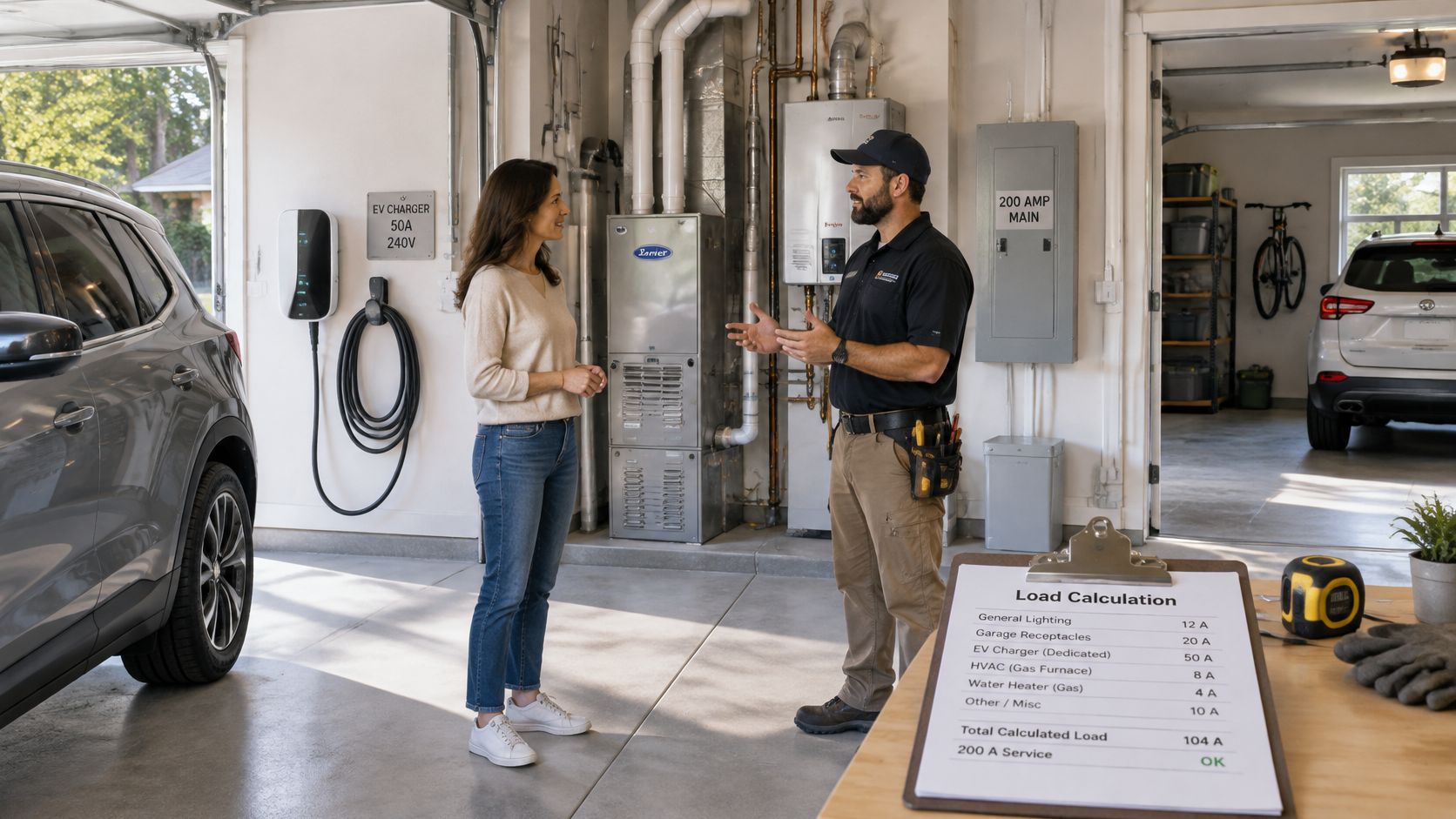
The garage where portability earns its place
A homeowner has gas heat, an accessible cable route, and enough calculated electrical capacity for the planned charging load. The vehicle parks near an interior wall, and the owner wants to take the EVSE elsewhere when a verified compatible supply is available.
A receptacle can make sense here. It gives the owner a useful way to disconnect portable equipment, and the cable route does not require awkward placement or an exposed plug. The installer still needs to use an approved dedicated circuit and suitable receptacle, then commission the EVSE at its designed setting. Check that the expected charging window meets the household's driving needs. An overnight session does not automatically guarantee a full battery.
Inspect the plug and receptacle with charging stopped, and have the circuit safely de-energized when appropriate. Discoloration, melting, a burnt smell, or loose plug retention calls for professional attention. A connection that still passes power can still be unsafe to use.
The spare slot that doesn't settle capacity
An older Southeastern Pennsylvania home has electric cooking and a heat pump. Its panel has an unused breaker position, so the owner expects an easy outlet addition.
That open position does not establish that the panel or service can handle the charging load. An electrician's load calculation may show that unrestricted charging does not fit. Adding a receptacle cannot resolve a capacity shortfall, and replacing the panel enclosure by itself may leave the utility service capacity unchanged.
Evaluate managed charging and the existing service before approving an upgrade. If more capacity is needed, define the service work separately so the outlet proposal reflects the actual scope.
The household sharing equipment
A renter expects to move, or a household wants charging access for multiple vehicles. Portability may help, but vehicles can have different onboard charging capabilities and parking arrangements.
Check that the proposed EVSE supports each vehicle and that its cable reaches each charge port without crossing a walking path. Portable equipment does not necessarily charge multiple vehicles simultaneously. Any shared-capacity setup needs compatible equipment and a deliberate design.
Choose equipment for the vehicles, parking positions, and permitted installation the household has. A higher theoretical charging speed is not useful if the connection or parking arrangement cannot support it.
Confirm the Panel Before You Buy the Outlet
A NEMA 14-50 describes the connection, not whether the panel can support the charging load. Before choosing a receptacle, give the electrician the details that determine the circuit design: the vehicle, where it parks, the EVSE settings, and the household's electrical loads.
Start with the vehicle's maximum AC charging capability and the EVSE installation manual. The home charging rate depends on the vehicle, the EVSE setting, the circuit, and available panel capacity. For the continuous-load limit and how it applies to a 50-amp circuit, see the earlier section on actual outlet output.
Build a pre-purchase checklist
Gather these details before requesting installation quotes:
Vehicle information. Record the model, configuration, charge-port location, and onboard AC charging specification.
EVSE configuration. Identify the supply connection, available installation settings, and any compatible load-management equipment.
Parking requirements. Note where the vehicle normally sits, whether it will charge outdoors, and whether portable equipment matters.
Major household equipment. Include heating, cooking, laundry, cooling, backup power, and planned electrical additions.
Existing electrical details. Share accessible panel labels and service information. Do not remove covers or expose energized parts.
For a home with substantial existing electric loads, request a written electrical load assessment and circuit calculation. The assessment should identify the charging load the house can support and whether load controls or electrical-capacity work are needed.
Compare complete circuit plans
A useful quote identifies the connection method, cable route, protective equipment, permitting responsibility, and final EVSE setting. If managed charging is proposed, ask what it monitors, what happens if the control fails, and how backup operation affects charging.
Compare the full scope, not just the receptacle price. A quote for outlet installation alone does not cover the same work as one that includes load evaluation, controls, and inspection.
Amp'd Energy Solutions provides site assessments and charging-circuit planning in Southeastern Pennsylvania. Ask the contractor to explain why the proposed connection suits your vehicle, parking arrangement, and electrical capacity. A plug-in receptacle is one option; hardwiring or managed charging may better fit the installation.
After the design is settled, choose equipment that matches it. Have the permitted work inspected, then keep a written record of the EVSE setting, breaker identification, circuit details, and inspection date. The goal is dependable charging at a supported setting.
For a home charging project in Southeastern Pennsylvania, Amp'd Energy Solutions offers site assessments, dedicated EV charging circuits, and electrical service upgrades when needed. Visit the Amp'd Energy Solutions website to discuss your vehicle, parking location, and existing household loads, so the proposed connection fits both the charger and the home's capacity.
Comments