

Dedicated Circuit Breaker Guide for Homes and Businesses
You've replaced a gas car with an electric vehicle, mounted a Level 2 charger in the garage, and found an open breaker position in the electrical panel. It's tempting to assume the project is simple: install a breaker, connect the charger, and start charging.
That assumption confuses two separate questions. Can the panel accept a new breaker? And can the home's electrical service safely support the new load? A dedicated circuit answers the first circuit-level problem by separating one major appliance from unrelated equipment. It doesn't automatically solve the second, whole-panel capacity problem.
Table of Contents
What a Dedicated Circuit Breaker Actually Does - Why separation matters
Everyday Equipment That Already Relies on a Dedicated Circuit - Follow the load through the house
Dedicated Circuit Breaker Requirements for EV Chargers - Separate the circuit from the service
Backup Power, Powerwall, and Generator Circuits - Treat the backup panel as a smaller electrical system
Codes, Permits, and Inspection Basics in Southeastern Pennsylvania - What the inspector is checking
Warning Signs You Need a Dedicated Circuit - Read the household clues
Right-Sizing the Circuit Without Overspending - Four ways to manage demand - Plan beyond today's equipment
When to Call a Licensed Electrician - What a proper visit includes
What a Dedicated Circuit Breaker Actually Does
A dedicated circuit breaker is a breaker that supplies one appliance, charger, or receptacle without sharing its branch-circuit wiring with other loads. The breaker sits in the electrical panel, and a dedicated set of conductors runs from that breaker to the equipment.
Think of a shared circuit as a public road. Several homes use the same road, and traffic from one home can affect everyone else. A dedicated circuit is a private lane. The charger, freezer, heat pump, or other major load has its own route from the panel, so lamps, microwaves, and unrelated receptacles aren't competing for the same conductors.
The arrangement has three basic parts:
The breaker protects the circuit conductors. Its rating must match the permitted capacity of the wiring and the equipment.
The conductors carry current to the appliance. Their size, insulation, length, installation method, and other conditions all matter.
The appliance uses that circuit without sharing it. A motor starting, a heater running, or a charger drawing continuously won't be combined with unrelated loads on the same branch circuit.
The breaker isn't there to make the appliance use less electricity. It also doesn't increase the amount of power available from the utility. Its job is to disconnect the circuit when conditions exceed safe limits, while the dedicated wiring prevents ordinary equipment from piling additional demand onto that branch.
Why separation matters
Homes now combine electric vehicle chargers, battery systems, heat pumps, generators, electric ranges, dryers, and other continuous or high-amperage equipment. The National Fire Protection Association's electrical safety guidance reports that, from 2020 through 2024, U.S. local fire departments responded to an estimated annual average of 46,652 home structure fires involving electrical failure or malfunction, or electrical distribution, lighting, or power-transfer equipment. Those fires caused approximately 527 civilian deaths, 1,580 civilian injuries, and $2.4 billion in direct property damage annually.
A dedicated circuit doesn't eliminate every electrical hazard. Correct breaker and conductor sizing, grounding, disconnecting means, and installation under the locally adopted electrical code still matter.
Practical rule: An open breaker position tells you that space exists in the panel. It doesn't tell you that the service has enough capacity for the new equipment.
That distinction will keep coming up because it causes many unsafe installations. A homeowner can have an empty slot and still need a load calculation, managed charging, a subpanel, or a service upgrade.
Everyday Equipment That Already Relies on a Dedicated Circuit
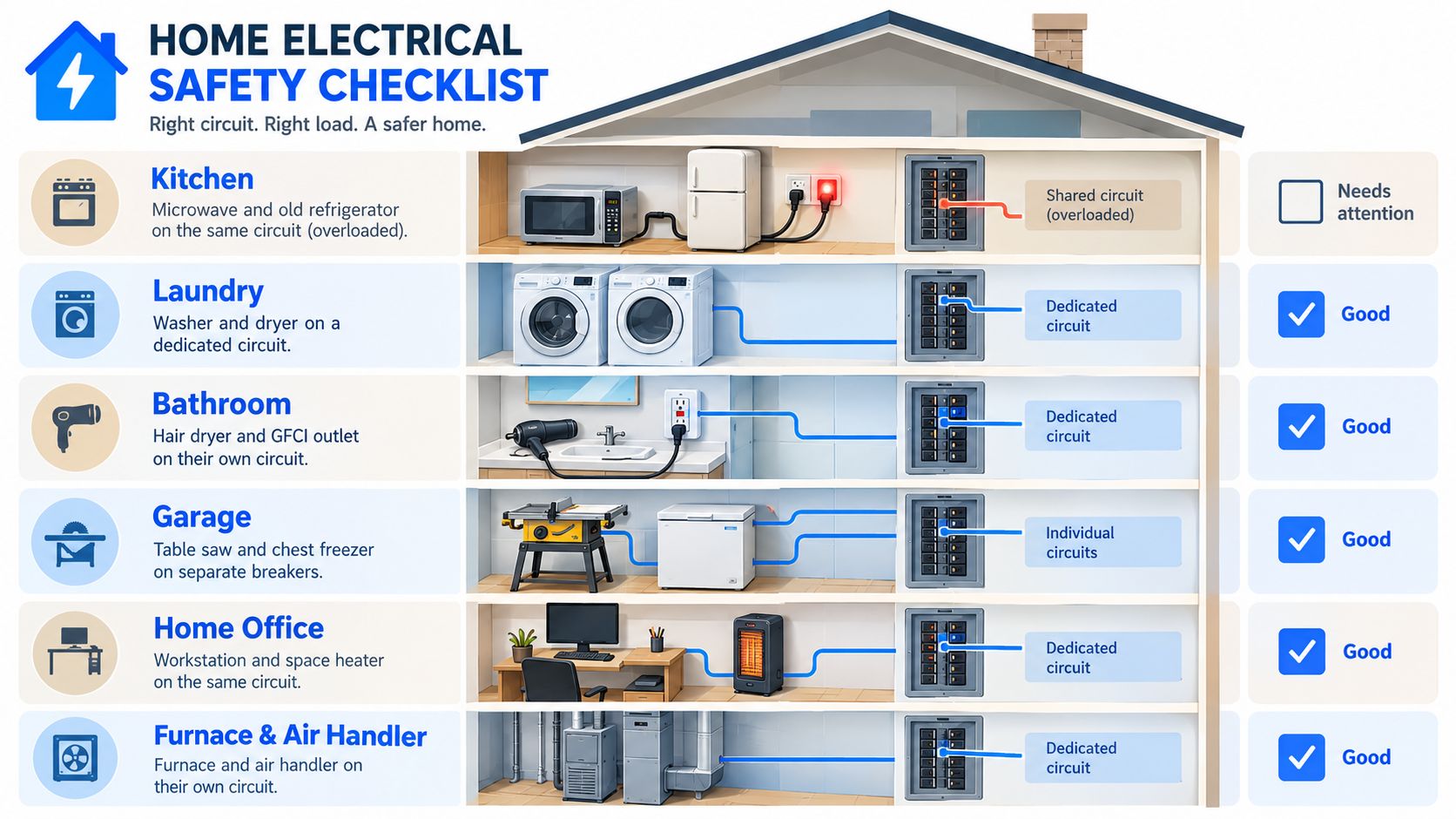
The kitchen provides an easy example. An older home may have a refrigerator and microwave sharing a general-purpose circuit. Add a toaster oven during a holiday meal, and the breaker trips. The recurring problem isn't necessarily a defective microwave. The branch circuit may be carrying several substantial loads that work better when separated.
A properly planned small-appliance circuit gives countertop equipment suitable capacity without forcing the refrigerator to share every surge or heating cycle. The takeaway is simple: heavy or frequently used kitchen equipment shouldn't be treated like a lamp.
Follow the load through the house
In the laundry room, the dryer receptacle normally sits alone on its branch circuit because the appliance uses a substantial 240-volt load. The washer may have its own arrangement as well, depending on the installation and local requirements. When the dryer runs, its breaker and conductors serve that appliance rather than competing with bedroom receptacles or a nearby workbench.
In a basement, a chest freezer can operate for years without anyone thinking about its circuit. That steady motor-driven load deserves attention, especially if the same receptacle also serves a sump pump, dehumidifier, or portable heater. A freezer that never gets unplugged is not an ordinary temporary load.
Bathrooms bring another concern. Hair dryers and curling tools can draw significant power, while water makes ground-fault protection particularly important. A bathroom circuit must use the protection required by its location and equipment, not merely a convenient receptacle connected to the nearest available wiring.
A window air conditioner, tankless water heater, furnace, air handler, table saw, or workshop compressor may also need a dedicated branch circuit. Each has a different electrical profile, so the correct design depends on the nameplate, installation conditions, and applicable code.
Household situation | What the symptom usually means |
|---|---|
Microwave and toaster oven trip the same breaker | The shared kitchen circuit may be overloaded |
Dryer receptacle is warm or discolored | Stop using it and arrange an inspection |
Freezer shares a garage outlet with a sump pump | Motor loads may be competing on one branch circuit |
Tankless water heater is added to general-purpose wiring | The equipment likely needs a separately designed circuit |
Window air conditioner relies on extension cords | The receptacle arrangement may not suit the continuous load |
The repeated lesson is that heavy, continuous, and motor-driven loads behave best when they are the only significant equipment on the breaker. A dedicated circuit is a design decision, not just a spare slot occupied by a larger breaker.
Dedicated Circuit Breaker Requirements for EV Chargers
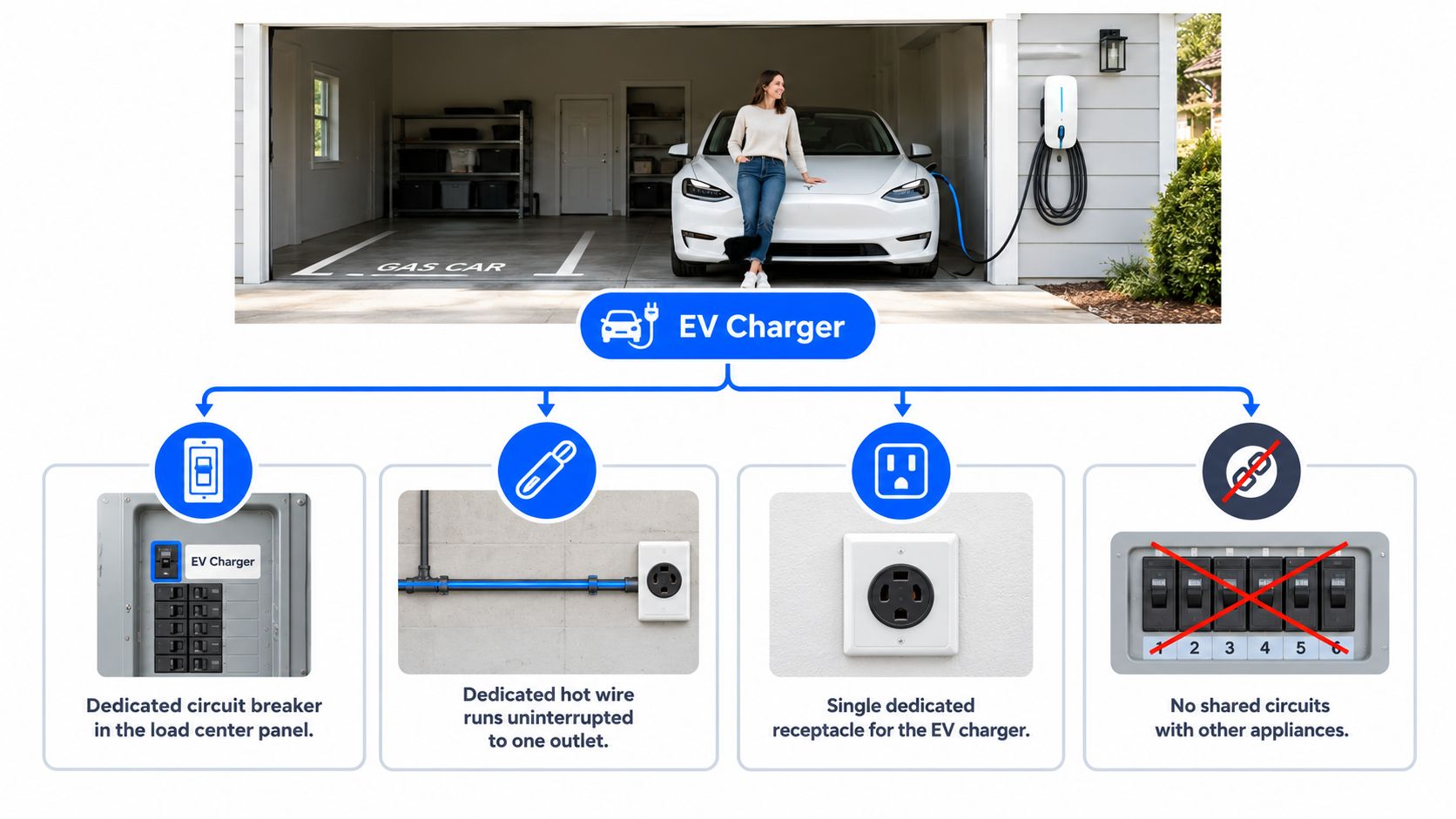
A Level 2 EV charger is more demanding than a typical plug-in appliance because it can draw current continuously while the vehicle charges. The U.S. Department of Energy describes a typical residential Level 2 installation as a dedicated 40-ampere, 208/240-volt branch circuit, and its guidance explains that EV equipment belongs on a separate branch circuit with conductors and overcurrent protection sized at 125% of the charger's continuous output. See the DOE guidance on EV charging installations for the underlying installation principles.
The 125% rule is easier to understand as a design calculation than as a slogan. If a charger is configured to draw 40 amps continuously, the branch-circuit design uses a breaker rated for 50 amps, with conductors selected for that installation. If a charger is configured to draw 48 amps, the corresponding breaker is commonly 60 amps, again with conductors and equipment selected by a qualified electrician.
Charger Amperage | Breaker Size | Wire Gauge (Copper) | Continuous Load |
|---|---|---|---|
40 amps | 50 amps | Determined by ampacity and installation conditions | Charger output, designed at 125% |
48 amps | 60 amps | Determined by ampacity and installation conditions | Charger output, designed at 125% |
The wire gauge can't be chosen from amperage alone. Conduit fill, ambient temperature, conductor length, termination ratings, insulation type, voltage drop, and the locally adopted code can all affect the final selection. A larger breaker on existing wire is not an upgrade. It can remove the protection the conductor needs.
Separate the circuit from the service
A true EV charger installation usually includes a new breaker, a new cable or conduit run, a suitable receptacle or hardwired connection, equipment grounding, and any required disconnecting means. The circuit must serve the charger alone. A charger sharing its branch circuit with a garage receptacle or another appliance is more than just inconvenient. It can create an unsafe and noncompliant installation.
The service calculation is a different exercise. A 100-amp service with an empty breaker position may not have enough available capacity for a new EV circuit if the home already has electric heat, a range, dryer, heat pump, water heater, battery, or generator. A load calculation can show whether the charger can operate at its intended setting, needs managed power, or requires a service change.
Some installations use a subpanel, load-shedding equipment, or an approved energy-management system instead of immediately increasing the service. The right choice depends on the home's existing demand and future plans. For practical installation considerations, review this guide to EV charger installation requirements.
Backup Power, Powerwall, and Generator Circuits
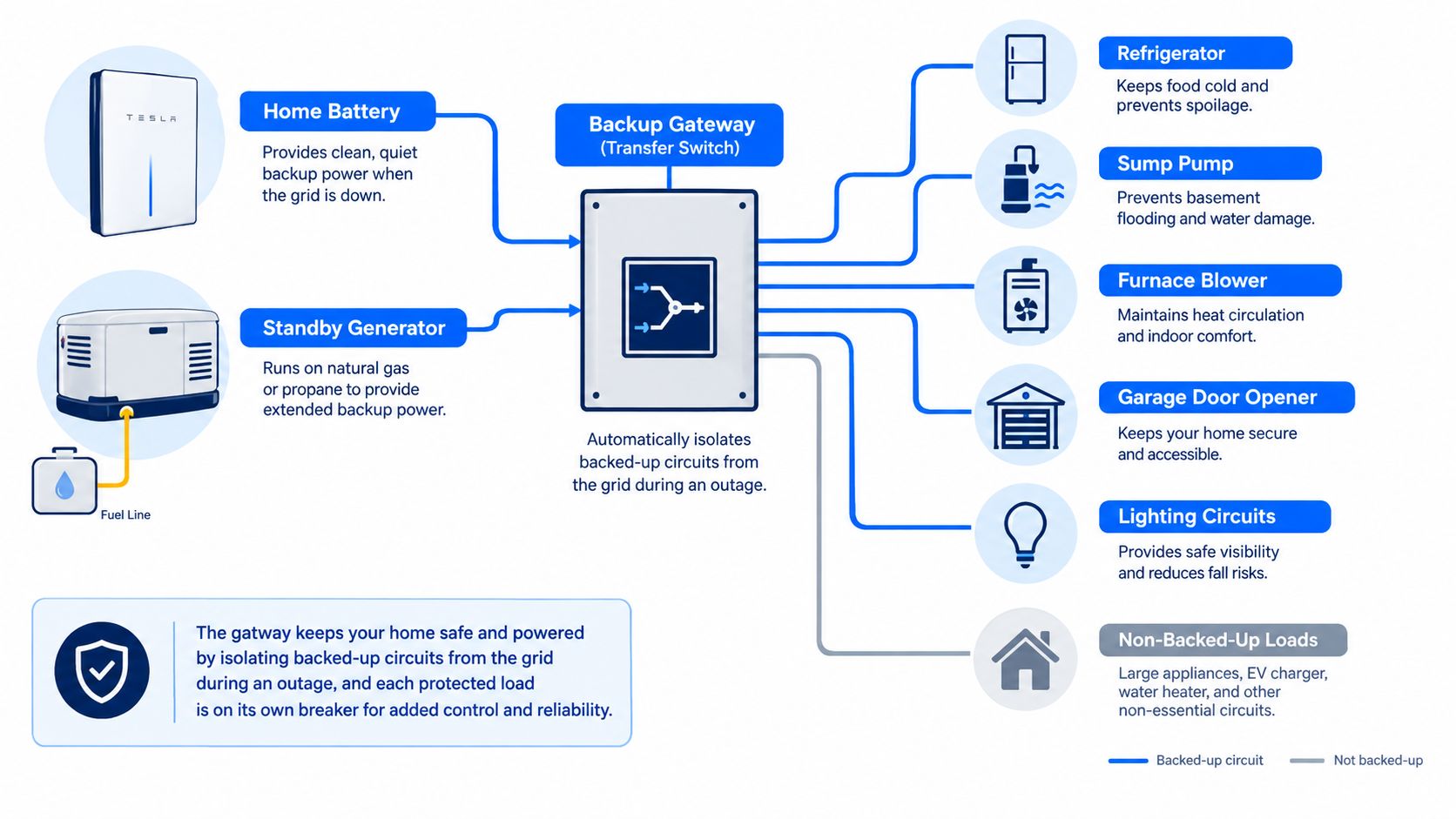
A battery or generator doesn't magically energize every circuit in a house. The backup system must disconnect protected loads from the utility and supply them through equipment designed for that purpose. A gateway, transfer switch, or related control equipment determines which circuits receive backup power and which remain off during an outage.
A typical Powerwall arrangement uses a gateway or backup gateway connected to a protected load center. Selected branch circuits move to that backed-up panel. The refrigerator may be protected because food storage matters, while a sump pump, furnace blower, garage door opener, or selected lighting may be included for practical reasons. An EV charger can be included only when the system and service design can support it without consuming backup capacity needed elsewhere.
Treat the backup panel as a smaller electrical system
The protected side has its own breakers, conductors, grounding and bonding arrangements, labeling, and load limits. A major appliance that was poorly shared in the main panel doesn't become well designed merely because its circuit was moved behind a gateway. The electrician may need to rewire or separate loads before placing them in the backup panel.
A standby generator uses similar principles. An automatic transfer switch isolates the home from the utility before the generator supplies selected circuits. A manual interlock kit can provide another approach where permitted and properly installed, but it must prevent unsafe backfeeding. The generator or inverter breaker must be approved for the application, matched to the conductor, and installed according to the equipment instructions and code.
Backup planning starts with a load list, not with the size of the battery or generator.
Write down what must operate during an outage, what can wait, and what should remain disconnected. Kitchen refrigeration, a sump pump, heating controls, medical equipment, internet equipment, and lighting may have different priorities from an electric range, dryer, or EV charger.
A dedicated circuit makes that prioritization easier because the electrician can move a defined load without accidentally transferring unrelated receptacles with it. More detail on selecting and arranging protected loads appears in this overview of home power backup solutions.
Codes, Permits, and Inspection Basics in Southeastern Pennsylvania
The National Electrical Code provides the technical baseline, while Pennsylvania and local municipalities determine how projects are permitted and inspected. In Southeastern Pennsylvania, the process can vary among townships, boroughs, and cities. A project in West Chester may follow a different administrative path from one in Media, Phoenixville, King of Prussia, or another nearby municipality.
A new dedicated branch circuit generally needs an electrical permit before work begins. If the installation requires opening walls, the local authority may require a rough-in inspection before the wiring is concealed. A final inspection normally follows after the equipment, panel labeling, terminations, and protective devices are complete.
What the inspector is checking
The township building department or its contracted inspection agency may review:
Breaker sizing: The overcurrent device suits the circuit and equipment.
Conductor selection: The wiring is appropriate for the load and installation method.
Equipment labeling: Disconnects, panels, and circuits are identified clearly.
Terminations: Connections are properly made, and required torque markings or documentation are present.
Protection: Grounding, bonding, ground-fault, arc-fault, and other protective features match the location and equipment.
Permit paperwork protects more than the municipality. It creates a documented path showing that the work was reviewed. Unpermitted panel modifications can complicate an insurance claim after a fire, particularly when investigators find altered wiring or improperly protected conductors.
The homeowner shouldn't assume that a contractor will use the same process everywhere. Ask who files the permit, who schedules inspections, and whether the final approval is included in the project. Amp'd Energy Solutions pulls permits for homeowners as part of turnkey electrical installations, so the property owner doesn't have to handle every local filing alone.
Warning Signs You Need a Dedicated Circuit
A breaker that trips whenever the microwave and toaster oven run together is giving you useful information. The kitchen branch is likely carrying more simultaneous demand than it can safely handle, and repeatedly resetting the breaker doesn't solve the underlying arrangement.
A warm or discolored outlet deserves more urgency. So does buzzing from a panel position, a burning smell near the breaker face, or heat around a receptacle. Those symptoms can point to a loose connection, damaged device, poor termination, or conductor that isn't suited to the load.
Read the household clues
Look for these patterns before adding another appliance:
Repeated trips: The circuit may be overloaded, or the equipment may have a fault that needs diagnosis.
Daisy-chained power strips: Temporary distribution has become a substitute for proper branch-circuit planning.
Frequent extension-cord use: The existing receptacles may not be located or rated for the equipment.
One crowded garage outlet: A freezer, sump pump, air conditioner, and tools may be sharing a circuit never intended for them.
Visible heat damage: Discoloration, melted plastic, or a loose-fitting plug requires the equipment to be taken out of service until inspected.
An EV charger sharing its circuit: A Level 2 charger should have its own branch circuit, not a receptacle arrangement shared with other loads.
The absence of a tripped breaker doesn't prove that the installation is safe. A loose termination can heat without immediately producing an overcurrent condition, and a damaged receptacle can continue to supply power until the fault becomes more serious.
If an outlet is hot, discolored, buzzing, or producing a burning odor, stop using it. Don't install a larger breaker to keep it running.
Any warning sign deserves a licensed electrician's attention before you add an EV charger, heater, battery, or other substantial appliance. The electrician needs to identify whether the problem is overload, wiring damage, a failing device, or an installation error.
Right-Sizing the Circuit Without Overspending
A dedicated circuit is one load-management option, not an automatic reason to install the largest possible breaker or replace the entire service. The right solution matches the equipment's actual demand with the home's present capacity and likely future needs.
Option | Typical Cost Range | Install Time | Best Fit For |
|---|---|---|---|
Lower-current equipment setting | Project-specific, based on existing wiring and equipment | Usually shorter when no new service work is required | Homes that can charge more slowly within available capacity |
Scheduled charging | Project-specific, based on existing EVSE and controls | Often limited to configuration and verification | Owners who can shift charging to periods with fewer household loads |
Approved energy-management system | Project-specific, based on equipment and installation | Depends on wiring, controls, and commissioning | Homes sharing limited capacity among managed loads |
Service or panel upgrade | Project-specific and subject to utility and permit requirements | Longer because it can involve utility coordination and inspections | Older or heavily loaded properties planning several major additions |
These are not price estimates. Electrical projects vary with panel condition, wire distance, access, equipment, permits, and utility requirements. A professional assessment should establish the actual scope before anyone promises a fixed amount or schedule.
Four ways to manage demand
A lower-current setting can work when the charger supports it and the home's load calculation allows it. The tradeoff is slower charging. Downsizing a breaker without correctly configuring the EVSE is not a safe workaround.
Scheduled charging shifts vehicle demand to a time when other large appliances are less likely to operate. It can help a suitable installation, but it doesn't make an overloaded service adequate at every moment.
An approved energy-management system can monitor selected loads and reduce or pause a lower-priority load when the home approaches its limit. The system must be compatible with the charger and installed under the applicable requirements. It should be treated as engineered equipment, not as a casual plug-in accessory.
A full service or panel upgrade adds broader capacity and may make sense when the property also needs a battery, generator, electric heating, a second EV charger, or other major equipment. It usually involves more coordination and can require utility work, so it shouldn't be chosen merely because a larger breaker sounds convenient.
For the calculation that identifies existing demand and future headroom, use a documented electrical load assessment.
Plan beyond today's equipment
The useful decision rule is to size the system for the home you expect to operate, not only the appliance sitting in the driveway today. A homeowner who plans another EV, electric heat, a battery, or a generator may choose a different approach from someone adding one modest charger to a lightly loaded service.
When to Call a Licensed Electrician
Call a licensed electrician before starting any new 240-volt appliance, EV charger, subpanel, battery backup, generator interlock, or repeated-breaker investigation in Pennsylvania. These projects involve conductor protection, load calculations, equipment compatibility, permits, and inspection. A DIY approach can expose you to shock and fire hazards, and unpermitted work can create insurance and resale problems.
Three situations should end the homeowner's troubleshooting:
You're adding capacity. A new charger or appliance needs a documented assessment of the panel and service.
You're moving or extending a circuit. Changing the route, device, conductor, or panel connection can alter how the circuit must be protected.
The existing system shows symptoms. Trips, warm panel faces, buzzing, discoloration, and burning odors require diagnosis before additional load is connected.
What a proper visit includes
A qualified electrician should identify the panel type and condition, inspect existing terminations, review the appliance or charger specifications, and perform a load calculation when needed. The scope may include selecting a breaker, sizing conductors, planning a disconnect, checking grounding and bonding, and deciding whether a subpanel or energy-management system is appropriate.
For a service upgrade, the contractor may coordinate with the utility, such as PECO or Met-Ed, and handle the local permit and inspection process. In Southeastern Pennsylvania, the responsible township or borough should be identified before work begins because administrative requirements differ by municipality.
Amp'd Energy Solutions handles load assessments, EV charger circuits, backup power installations, generators, and service upgrades for homeowners and small businesses across Bucks, Montgomery, Chester, and Delaware counties.
Have these details ready when you call:
Panel photos: Include the front, interior if safely accessible, labels, and service rating without removing the dead front.
Equipment information: Provide the charger or appliance make and model, along with its installation instructions if available.
Usage context: Explain which large appliances operate together and whether you plan future additions.
Recent electric bills: These can help show seasonal usage, although they don't replace a formal load calculation.
Property access details: Mention finished walls, detached garages, long cable runs, or known prior electrical work.
A good first visit should produce more than a glance at an empty breaker slot. It should establish whether the circuit, panel, service, protection, permits, and future load plan all fit together safely.
Amp'd Energy Solutions can assess your panel, design and install a properly sized dedicated circuit for EV charging or major equipment, and coordinate backup power or service-upgrade work. Visit Amp'd Energy Solutions to request a project assessment for your Southeastern Pennsylvania home or business.
Comments