

Level 2 EV Charger Amps: Choose the Right Amp
The most popular advice about Level 2 EV charger amps is also some of the least useful: install the highest amperage your house can support. That approach confuses maximum capability with practical value. A charger that draws more current can demand a larger circuit, more panel capacity, and more extensive electrical work, while your vehicle may not accept the additional power.
The smarter question is simpler: How much charging do you need between parking sessions, and what can your vehicle and electrical system support safely? For many Southeastern Pennsylvania homes, a properly selected 30- or 40-amp setup handles routine overnight charging without consuming capacity that may be needed for a heat pump, electric water heater, battery system, or a future EV.
Table of Contents
Why Maximum Amps Is Not Always the Smart Choice - Match the charger to the driving routine
Understanding How Voltage and Amperage Determine Charging Speed - Use the actual site voltage - Calculate before selecting equipment
The NEC 125 Percent Rule and Circuit Requirements - Translate charger rating into circuit design - Why the setting matters
Comparing 30, 40, and 80 Amp Installation Options - 30 amps for predictable overnight charging - 40 amps as a practical middle ground - 80 amps for a narrow use case
Assessing Your Electrical Panel for Level 2 Capacity - What a proper assessment checks - Look beyond unused breaker spaces
Making Your Level 2 Installation Decision with Confidence - Use this decision path - Questions worth asking the electrician
Why Maximum Amps Is Not Always the Smart Choice
Higher amperage sounds better because it promises faster charging. In practice, the charger is only one part of the system. Your vehicle's onboard AC charger sets a ceiling on how much current the car can accept, so an oversized EVSE may sit ready to deliver power the vehicle can't use.
The U.S. Environmental Protection Agency's home charging guidance indicates that residential Level 2 equipment commonly ranges from 16 to 80 amps, with 30 to 40 amps among the most typical choices. The same guidance explains that a vehicle accepting only 32 or 48 amps won't gain meaningful speed from a 60- or 80-amp unit.
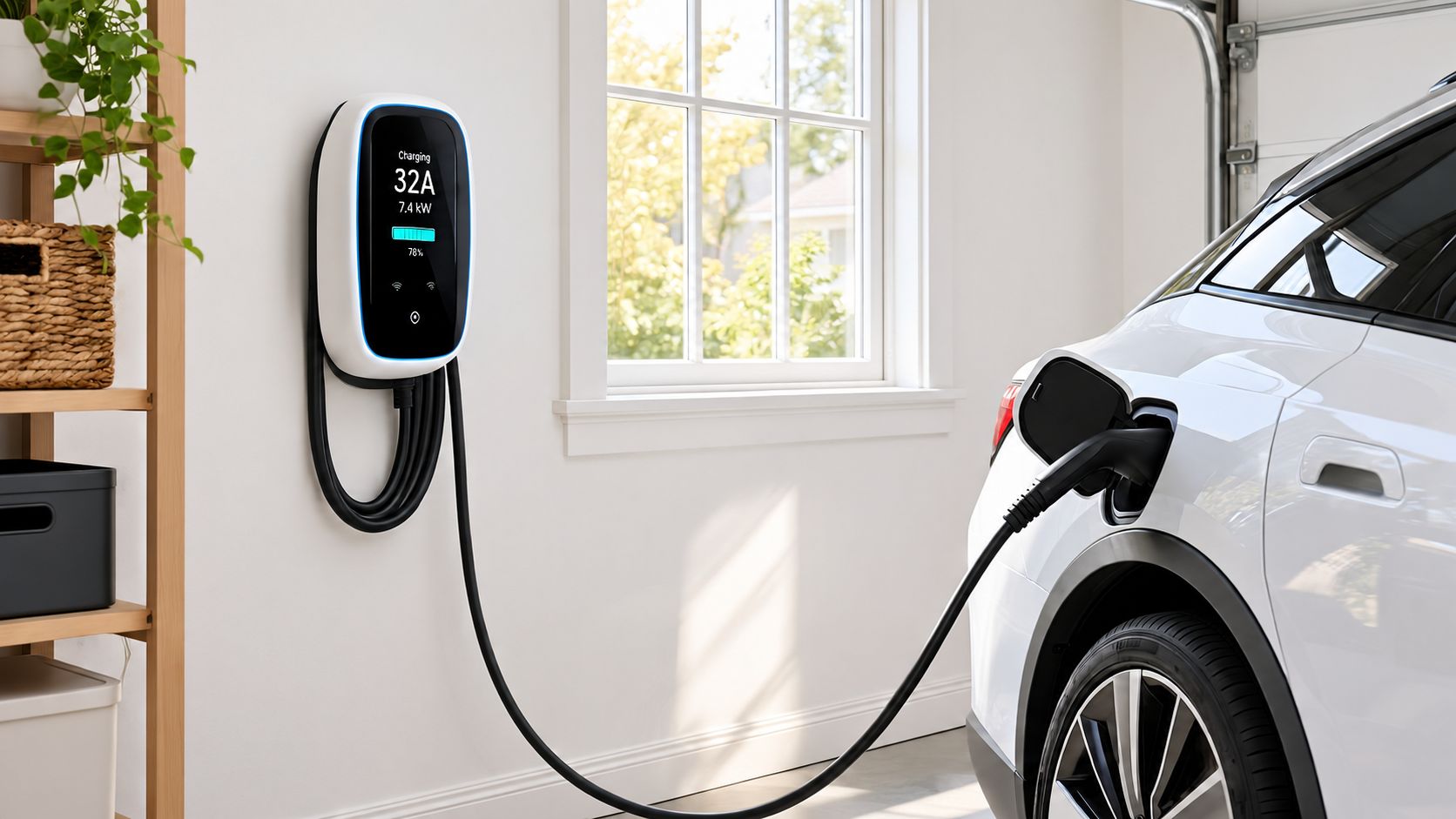
Match the charger to the driving routine
A homeowner who parks overnight has a different electrical need from a driver who returns home briefly between long trips. If the car sits for many hours, a moderate charger can replace the energy used during the day without demanding the largest possible circuit.
That distinction matters in older Southeastern Pennsylvania housing stock, where a panel may already serve electric heat, a heat pump, water heating, cooking equipment, or backup power equipment. Reserving capacity for those loads can be more valuable than shaving charging time that you don't routinely need.
Practical rule: Choose the smallest charger that comfortably replaces your regular driving energy during the time your vehicle is parked.
A 30- or 40-amp configuration often makes sense for a single EV with predictable overnight parking. A higher-current installation becomes more compelling when the household has multiple EVs, unusually high daily mileage, limited parking time, or a vehicle with a larger AC acceptance rate. Even then, the electrician should verify the complete electrical path instead of treating the charger label as the design target.
The right installation isn't the one with the biggest number. It's the one that delivers dependable charging while leaving room for the rest of the property's electrical future.
Understanding How Voltage and Amperage Determine Charging Speed
Charging speed depends on two electrical values, voltage and amperage. Multiply volts by amps to get watts, then divide by 1,000 for kilowatts. The vehicle may accept less power than the EVSE can offer, so a larger charger does not automatically produce faster charging.
At a residential 240 volts, a 32-amp charger supplies approximately 7.7 kilowatts. At a commercial 208 volts, the same charger supplies approximately 6.7 kilowatts, as documented by the Department of Energy Alternative Fuels Data Center. The amperage setting is unchanged, but the available power drops because the site voltage is lower.
Use the actual site voltage
Level 2 equipment spans approximately 2.9 to 19.2 kilowatts, with equipment-level current ranging from 40 to 80 amperes, according to the same federal reference. Homes commonly use 240-volt service. Workplaces may use 208-volt branch voltage from a three-phase system.
Amperage | 240V Output | 208V Output | Miles Per Hour |
|---|---|---|---|
32 amps | Approximately 7.7 kW | Approximately 6.7 kW | About 10 to 20 miles, depending on the vehicle and conditions |
40 amps | Approximately 9.6 kW | Approximately 8.3 kW | Varies by vehicle efficiency and acceptance rate |
48 amps | Approximately 11.5 kW | Approximately 10.0 kW | Varies by vehicle efficiency and acceptance rate |
80 amps | Approximately 19.2 kW | Approximately 16.6 kW | Varies by vehicle efficiency and acceptance rate |
The range added per hour depends on the vehicle, not just the charger. A vehicle that uses roughly 3 miles per kilowatt-hour could gain around 23 miles of rated range during a 7.7 kW session before charging losses. A less efficient vehicle, cold battery, or lower onboard charging limit will reduce that result. Federal workplace guidance places typical Level 2 output at about 10 to 20 miles of driving range per hour and explains the factors behind that variation in the workplace charging program guide.
Calculate before selecting equipment
For a 32-amp charger, the residential calculation is 240 × 32 = 7,680 watts, or approximately 7.7 kilowatts. At a 208-volt workplace connection, 208 × 32 = 6,656 watts, or approximately 6.7 kilowatts.
Use this explanation of Level 2 charger voltage when checking how site voltage changes output. Then confirm the vehicle's AC acceptance rate and the property's available capacity. In many homes, a 30- or 40-amp setup supplies enough energy overnight while preserving panel capacity for heat pumps, future vehicles, and other large loads.
The NEC 125 Percent Rule and Circuit Requirements
The charger's advertised amperage isn't the same as the circuit rating. EV charging is treated as a continuous electrical load, meaning the branch circuit and overcurrent protection must be designed for the charger's maximum continuous current with the required margin.
The Department of Energy EV charging installation template states that overcurrent protection for EV supply equipment must be rated at not less than 125% of the equipment's maximum load. The calculation is straightforward. Multiply the charger's maximum current by 1.25, then select the appropriate circuit rating and conductors under the applicable code and local requirements.
Translate charger rating into circuit design
Charger Rating | Minimum Circuit | Conductor Size | Breaker Size |
|---|---|---|---|
32 amps | 40 amps | Must be sized for the calculated load and installation conditions | 40 amps |
40 amps | 50 amps | Must be sized for the calculated load and installation conditions | 50 amps |
48 amps | 60 amps | Must be sized for the calculated load and installation conditions | 60 amps |
The conductor-size column can't be filled responsibly from amperage alone. Wire ampacity depends on the installation method, conductor material, terminal ratings, ambient conditions, conduit fill, distance, and locally adopted requirements. A qualified electrician must make that selection rather than copying a generic wire size from a product listing.
A 32-amp charger therefore isn't installed on a 32-amp breaker. It generally requires a dedicated 40-amp circuit. A 40-amp charger generally requires a 50-amp circuit, while a 48-amp charger generally requires a 60-amp circuit.
Why the setting matters
Many wall-mounted EVSE units can be configured for different current levels. The electrical design follows the maximum configured continuous current, not the average energy the vehicle happens to draw during a session. If a charger is limited to 40 amps, the system is evaluated as a 40-amp load. If that setting is later raised to 48 amps, the branch circuit must support the higher demand.
That change can affect conductors, breaker size, terminations, conduit, panel capacity, and service calculations. A dedicated circuit also needs proper grounding, appropriate disconnecting means where required, and installation that satisfies the adopted electrical code.
For a homeowner preparing for an electrician's visit, this overview of a dedicated circuit breaker can help frame the conversation. Panel space alone doesn't prove that a charger is suitable. The electrician must evaluate capacity and the complete load calculation.
Comparing 30, 40, and 80 Amp Installation Options
The best amperage depends on how the vehicle is used, not on which specification looks most impressive. A moderate-current charger often handles overnight parking well, while higher output serves drivers with demanding schedules and vehicles that can accept more power. Right-sizing can also preserve panel capacity for a heat pump, electric appliances, or a future vehicle.
30 amps for predictable overnight charging
A 30-amp charger is a sensible fit when the vehicle is parked overnight and daily mileage is moderate. At 240 volts, it delivers approximately 7.2 kilowatts. Compared with a higher-current installation, it places less demand on the electrical system and may leave more capacity for other substantial household loads.
This option works best when the car has a long dwell period and the household does not need to recover a large amount of energy during a short parking window. It is not suitable for every vehicle or driving pattern, but it avoids installing capacity that may rarely be used.
40 amps as a practical middle ground
A 40-amp charger produces approximately 9.6 kilowatts at 240 volts and generally requires a 50-amp circuit because charging is a continuous load. It recovers energy faster than a 30-amp setup while placing materially less demand on the property than an 80-amp design.
For a household with one EV, overnight parking, and a vehicle capable of accepting the available current, 40 amps is often the balanced choice. It provides useful charging headroom without consuming as much panel capacity as the largest option.
A 30- or 40-amp circuit can also make more sense when the home may later add a heat pump, electric water heating, or another major load. The right charger is the one that meets the driving requirement while fitting the home's broader electrical plan.
80 amps for a narrow use case
An 80-amp installation can produce approximately 19.2 kilowatts at 240 volts. That output is useful only when the vehicle can accept it and the property can support the required electrical infrastructure. It may suit a high-mileage driver, a compatible large-battery vehicle, or a location where vehicles must recharge during short dwell periods.
It is excessive when the vehicle accepts less current or remains parked overnight. Installing the largest available EVSE does not override the vehicle's onboard charger. It can also consume capacity better reserved for heating, appliances, energy storage, or another vehicle.
Amperage | kW Output | Miles/Hour | Installation Cost | Best For |
|---|---|---|---|---|
30 amps | Approximately 7.2 kW at 240V | Varies by vehicle | Depends on circuit length, equipment, and site conditions | Moderate daily driving with overnight parking |
40 amps | Approximately 9.6 kW at 240V | Varies by vehicle | Depends on circuit length, equipment, and site conditions | Many single-EV households seeking a balance |
80 amps | Approximately 19.2 kW at 240V | Varies by vehicle | Depends on larger circuit and service requirements | High demand with a vehicle that accepts the output |
Installation cost cannot be stated accurately without seeing the property. A short run from a suitable panel differs from a long route through finished spaces or a project requiring service work. A quote based only on charger amperage leaves out the circuit route, equipment, and site conditions that determine the actual work.
Assessing Your Electrical Panel for Level 2 Capacity
A panel can have open breaker spaces and still lack the capacity for a Level 2 charger. The key question is whether the service, feeder, panel, conductors, and overcurrent protection can support the new continuous load alongside the equipment already operating in the home.
An electrician starts with the existing electrical system, not the charger brochure. The assessment should account for HVAC equipment, electric resistance heat, water heating, cooking appliances, battery systems, generators, and other significant loads. The electrical load assessment guidance provides useful background on the calculations involved.
What a proper assessment checks
The electrician should verify:
Service capacity: The service rating and calculated demand must support the proposed charger alongside existing loads.
Panel condition: Age, bus condition, terminations, grounding, available spaces, and compatibility all matter.
Circuit path: Conductor ampacity, breaker rating, voltage, route length, and voltage drop where relevant affect the installation.
Charger configuration: The EVSE's maximum current must match the circuit design, not merely the vehicle's usual draw.
Local requirements: Permitting, inspection, utility conditions, and locally adopted code requirements may affect the project.
A panel upgrade isn't automatically necessary. Some homes can support a moderate-current charger after a load calculation confirms adequate capacity. Other properties need a subpanel, revised circuit arrangement, service upgrade, or a different charger setting.
Look beyond unused breaker spaces
An open slot only tells you that a breaker may physically fit. It doesn't show whether the service can supply the added demand or whether the panel and conductors are suitable for the planned circuit.
The assessment should also consider future loads. A homeowner planning a heat pump, battery storage, electric cooking equipment, or a second EV may prefer a right-sized charger today rather than using all available capacity immediately. That choice can avoid forcing the electrical system into a more expensive configuration later.
A good load calculation protects more than the charger. It protects the capacity you'll need for the rest of the home.
For Southeastern Pennsylvania properties, the electrician should also confirm the applicable permit and utility process before work begins. Conditions vary by municipality and service arrangement, so the installation plan must reflect the actual address rather than a generic national checklist.
Making Your Level 2 Installation Decision with Confidence
Choose the charger by working through four facts: your driving pattern, your vehicle's AC acceptance rate, your site voltage, and your available electrical capacity. That sequence prevents the common mistake of choosing equipment first and discovering afterward that the car or panel can't use it.
Start with the vehicle. Find its maximum AC charging acceptance rate in the manufacturer's documentation, then compare that limit with the EVSE options. An 80-amp-capable EVSE won't make a vehicle charge at 19.2 kilowatts if the onboard charger accepts only 48 amps, as explained in the Department of Transportation charging-speed guidance.
Use this decision path
Measure the routine. Consider daily mileage and how long the vehicle normally remains parked. Overnight parking supports a different choice from short workplace or home dwell times.
Set the vehicle ceiling. Don't specify more current than the car can accept unless future vehicle use justifies the additional infrastructure.
Confirm the voltage. Use the property's actual 208- or 240-volt supply when estimating output.
Complete the load calculation. Have the electrician evaluate service capacity, panel condition, existing major loads, conductors, grounding, and code requirements.
Compare future needs. Leave room for heating equipment, appliances, energy storage, a generator, or another EV.
Review the quote. Ask what charger setting, breaker, conductor path, permits, and potential upgrades are included.
Questions worth asking the electrician
Ask whether the proposed amperage reflects the vehicle's onboard limit and your parking schedule. Ask which breaker and conductor arrangement the design requires, whether the panel needs remedial work, and whether a future change in charger setting would require new wiring or protection.
For Southeastern Pennsylvania projects, a site assessment should verify EVSE current, vehicle acceptance, voltage, available service capacity, and utility or permitting requirements. That assessment is more valuable than selecting a charger solely from its advertised amperage.
The practical conclusion is clear. Right-sizing usually beats maxing out. A 30- or 40-amp installation can provide dependable overnight charging for many households while preserving electrical capacity for the equipment that will shape the property's next several years.
Amp'd Energy Solutions evaluates Level 2 charger requirements, performs panel and service assessments, and installs dedicated circuits for homes and workplaces across Southeastern Pennsylvania. Visit Amp'd Energy Solutions to discuss your vehicle, parking routine, and electrical capacity before choosing the charger amperage.
Comments