

Home Battery Inverter: What It Does and How to Choose
You're watching the radar, the wind picks up, and the neighborhood goes dark. Your refrigerator keeps running. Your Wi-Fi stays up. The lights don't even flicker. That steady moment isn't luck, and it isn't the battery alone doing the work. It's your home battery inverter, the component most homeowners never think about, deciding where power comes from and where it goes.
Table of Contents
What a Home Battery Inverter Actually Does - The Four Jobs It Does Quietly
The Four Main Inverter Types Explained Simply - AC-Coupled - DC-Coupled
Choosing Between AC-Coupled, DC-Coupled, and Hybrid Setups - Comparing Home Battery Inverter Architectures
How Integrated Systems Like Powerwall Handle the Inverter - What Happens When the Grid Drops
Sizing the Inverter to Your Home and Loads - Continuous Output and Surge Capacity
Why Real-World Efficiency Is Lower Than the Datasheet - The Small-Load Problem in Numbers
What a Home Battery Inverter Actually Does
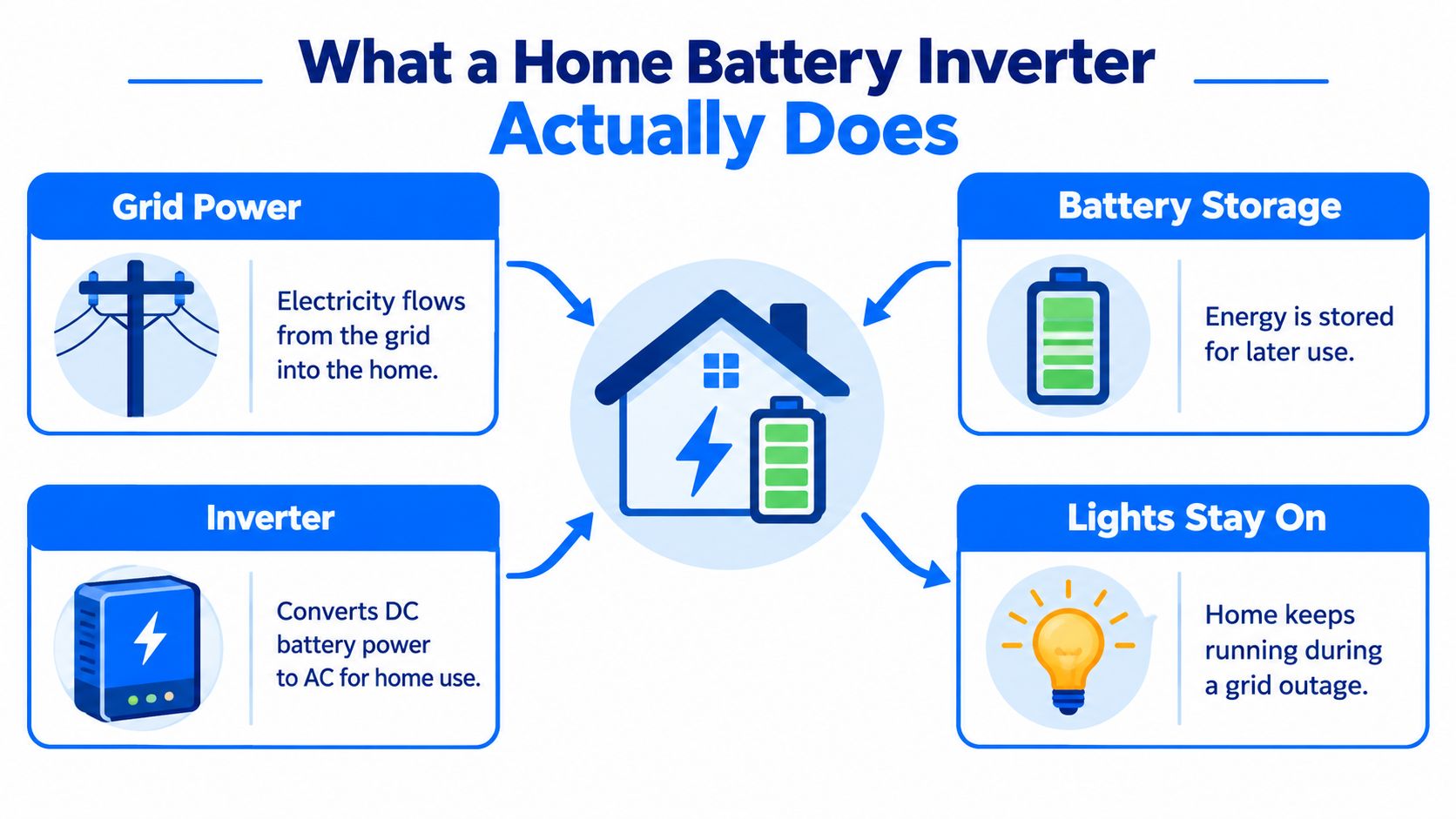
A battery by itself can't run your house. Batteries store and release direct current (DC), while your outlets, lights, and appliances run on alternating current (AC). The inverter sits between them and translates. When your home needs power, it converts DC from the battery into AC for your circuits. When the battery needs charging, from solar or the grid, it can run the conversion the other way.
That translation job is why storage growth has meant so much inverter growth behind the scenes. Installed U.S. residential storage rose from 29 megawatt-hours in 2017 to 540 megawatt-hours in 2020, and the share of solar installations paired with storage rose from 7% to 20% over the same period, according to a U.S. International Trade Commission analysis of residential storage installations. Every one of those systems needed power conversion and control, not just battery cells.
The Four Jobs It Does Quietly
Think of the inverter as both translator and traffic cop:
Converting for loads: DC from the battery becomes AC your home can use.
Converting for charging: AC from the grid or solar becomes DC the battery can store.
Managing flow: Its controls decide whether your home pulls from battery, solar, or grid at any given moment.
Protecting you in an outage: It disconnects safely from the failed grid and forms its own local supply for backed-up circuits.
Because it touches every part of the system, the inverter shapes decisions far beyond its own price tag. Panel capacity, which circuits get backup, how solar behaves during an outage, and whether an EV charger can share the system all run through it. If you're planning a full home energy storage system, start with the inverter. It's the brain and the gatekeeper, not just a box on the wall.
The Four Main Inverter Types Explained Simply
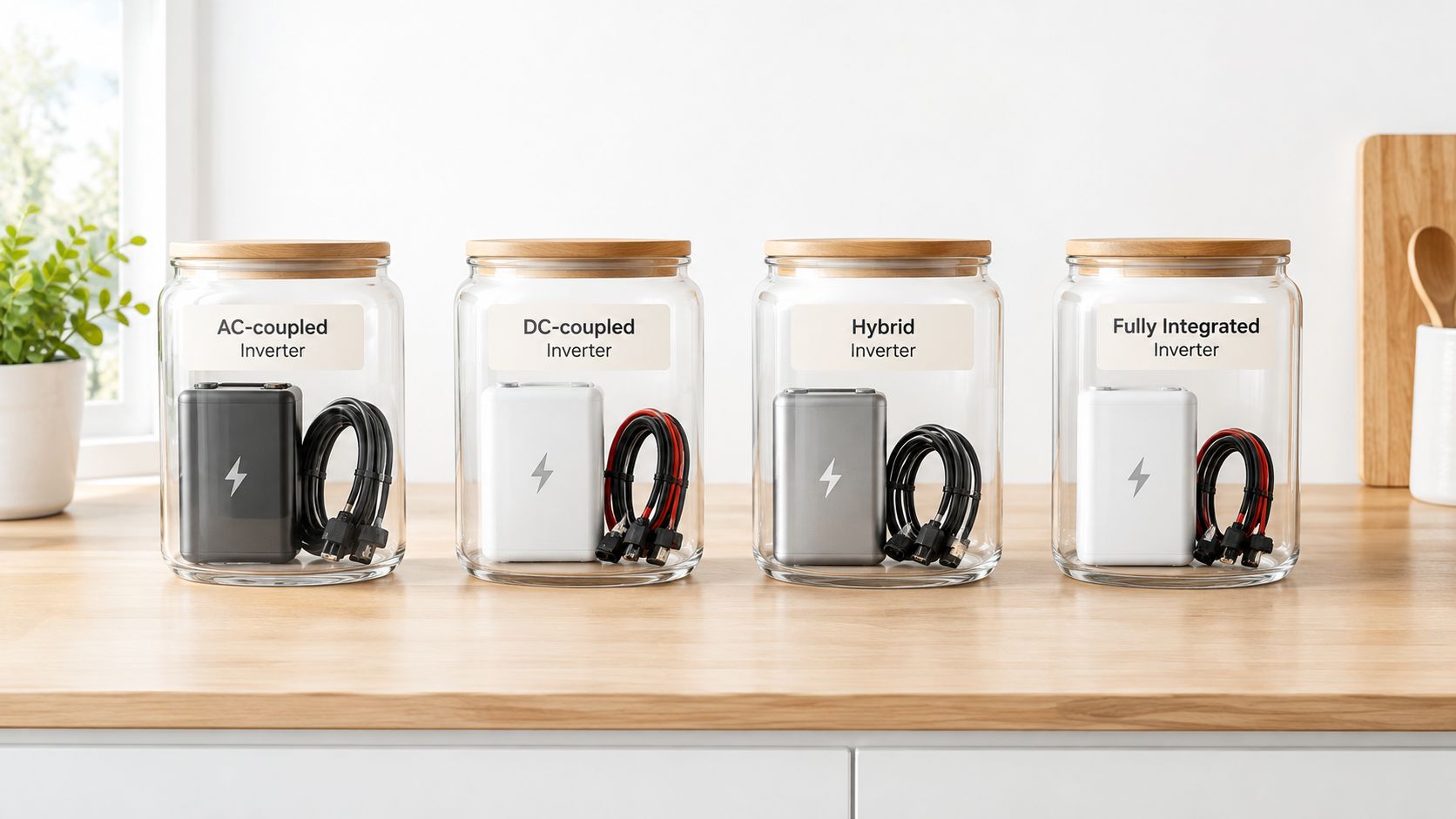
Use a kitchen to picture this. The battery is your pantry. Solar is the garden. The grid is the grocery store. The inverter is the kitchen itself, the place where raw ingredients get turned into a meal you can eat. Every architecture below is just a different kitchen layout.
AC-Coupled
In an AC-coupled setup, solar has its own inverter and the battery has a separate one. They meet on the AC side, at your electrical panel. Each unit does its own conversion independently. This is the layout you'll most often see when storage is added to a home that already has solar, because nothing about the existing solar wiring has to change.
DC-Coupled
In a DC-coupled setup, solar and battery meet on the DC side, before power reaches the panel. One inverter handles the conversion for both. Fewer hand-offs between components is the appeal here, though the controls have to coordinate solar production and battery charging together.
A hybrid inverter takes that idea further. It's a single unit built to manage solar input, battery charging and discharging, grid connection, and backup output all at once. One box, one set of controls, fewer separate devices for an installer to wire and configure.
Fully integrated systems go one step beyond hybrid. The battery, inverter, and control electronics are sealed into a single appliance. You don't choose the inverter separately at all. You choose the whole unit, and its inverter behavior comes with it.
Which layout fits your house usually comes down to three things: whether solar is already installed, what your panel can safely accept, and whether backup power during an outage is essential or just welcome. Answer those clearly and the right category usually identifies itself.
Choosing Between AC-Coupled, DC-Coupled, and Hybrid Setups
The table below isn't exhaustive. It's a starting point for a conversation with an installer, not a substitute for one.
Comparing Home Battery Inverter Architectures
Architecture | Conversion Stages | Best Fit For | Retrofit Friendly | Backup Behavior |
|---|---|---|---|---|
AC-coupled | More, since solar and battery convert separately | Adding storage to existing solar | Yes | Battery inverter forms backup supply independently |
DC-coupled | Fewer, solar and battery share a path | New solar plus storage together | Less so | Shared inverter manages solar and backup together |
Hybrid | Fewer, handled in one unit | New installs or solar inverter replacement | Sometimes | Built-in backup output, configured by installer |
Fully integrated | Internal to the unit | Homeowners wanting one appliance | Yes | Gateway manages islanding and load flow |
Here's how that plays out in practice. If you already have solar and you're adding a battery, AC-coupled is usually the path of least disruption. Your existing solar inverter stays, and a battery inverter joins it at the panel.
If you're installing solar and storage together, a DC-coupled or hybrid design often makes more sense. You're not working around existing equipment, so you can take the more direct conversion path from the start. And if your solar inverter is aging anyway, replacing it with a single hybrid unit consolidates two jobs into one purchase and one installation.
Integrated all-in-one systems involve the least electrical complexity for the homeowner. The trade-off is real, though. One unit does everything, so one fault can take everything offline, and the product makes more decisions for you about how the system behaves.
Cost context helps here too, even if it's historical. A 2016 benchmark modeled a battery-based inverter at $0.59 per watt in ex-factory pricing, as documented in a National Renewable Energy Laboratory residential storage benchmark. That's not a current quote. It shows the inverter has never been a minor line item.
Keep returning to one question: what does your home already have, and what do you need the system to do when the grid goes down?
How Integrated Systems Like Powerwall Handle the Inverter
With a Powerwall-style system, you won't find a separate inverter box to point at. It's sealed inside the unit with the battery cells, thermal management, and control software. A dedicated gateway device works alongside it, watching the grid, your solar production, and your home's demand, then directing power accordingly.
On a normal day, the internal inverter charges the battery from excess solar and discharges it in the evening so your home draws less from the grid. On a sunny afternoon, solar can serve your loads directly while surplus tops off the battery. The gateway orchestrates all of it without you touching anything.
What Happens When the Grid Drops
The gateway detects the outage and disconnects your home from the utility lines. The integrated inverter then forms an island, creating its own stable AC supply from the battery. Your backed-up circuits keep running, and if you have solar, the inverter can keep the array producing to extend your backup. When grid power returns and stabilizes, the system reconnects and recharges.
Modular systems take the opposite approach. The inverter is a separate, serviceable component. If it fails years from now, an installer can replace that one unit and leave the battery in place. You gain flexibility and repairability. You also accept more wall space, more wiring, and more components to coordinate.
Integrated systems reduce complexity and look cleaner on the wall, but the inverter's lifespan is tied to the battery's. A fault in either one can sideline the whole unit.
That's why an installer might recommend integrated storage for a clean, straightforward install, and a modular setup when your home has mixed-vintage equipment or future expansion in mind. Neither answer is wrong. It depends on what you're optimizing for.
Sizing the Inverter to Your Home and Loads
Homeowners confuse two numbers constantly, so separate them now. The battery's kilowatt-hours (kWh) tell you how much energy you have stored, like fuel in a tank. The inverter's kilowatts (kW) tell you how fast that energy can flow into your home. A big tank with a narrow pipe still leaves you short when several loads run at once.
Continuous Output and Surge Capacity
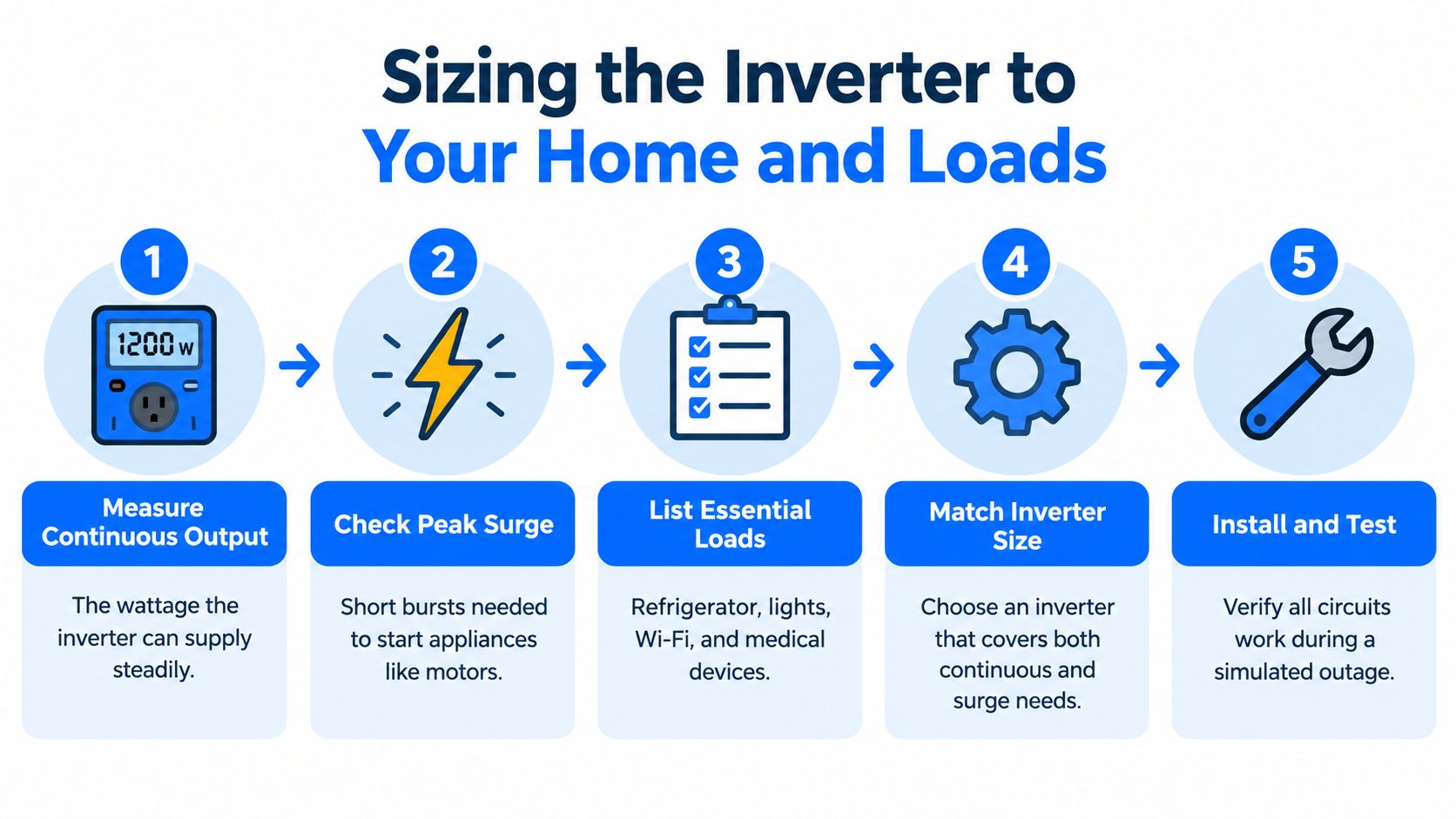
Continuous output is the wattage the inverter can deliver indefinitely. This number decides whether your well pump, refrigerator, and router can all run together during an outage.
Surge capacity is the brief extra punch needed to start motors. HVAC compressors, sump pumps, and similar loads draw far more for a moment at startup than they do while running. An inverter that handles your steady loads can still trip on a motor start if its surge rating is too low.
Control behavior matters alongside those ratings. In testing of a 6.6 kW / 11.6 kWh PV-battery system, researchers evaluated four operating modes covering inverter efficiency, battery use, and control response, as reported in an NREL-validated PV-battery inverter study. The lesson for homeowners is simple: nameplate kilowatts alone don't describe how a system behaves.
Consider a worked example. A three-bedroom home backing up critical loads might pair a modest continuous-output inverter with a mid-sized battery. Refrigeration, lighting, internet, and a sump pump fit comfortably. Add an EV charger to that same backup panel, and the charger alone can exceed what the inverter can sustain, even with plenty of stored energy remaining. The energy is there. The flow isn't.
An undersized inverter can also clip solar production, wasting energy your panels could have captured. An oversized one adds cost without benefit if the battery can't feed it. Getting this right starts with honest math, which is why electrical load assessment calculations come before equipment selection. And sometimes the true prerequisite is a panel or service upgrade, because the right inverter size only works if your service equipment can accept it.
Why Real-World Efficiency Is Lower Than the Datasheet
The most common disappointment with home batteries sounds like this: the brochure implied more hours of backup than the home gets. Usually nobody lied. The gap lives in how efficiency is measured.
Datasheets advertise peak efficiency, achieved under favorable lab conditions at substantial power levels. Your home rarely operates there. Overnight, your battery feeds small, always-on loads: a router, refrigerator controls, a security panel, heat-pump electronics idling. That's partial-load territory, and inverters perform noticeably worse there.
The Small-Load Problem in Numbers
Independent testing makes this concrete. In the 2025 HTW Berlin Energy Storage Inspection, one system delivered only 54% discharge efficiency at a 100 W household load, meaning the battery had to supply 186 W to deliver 100 W to the home, according to reporting on the 2025 HTW Berlin Energy Storage Inspection results. Nearly half the energy was lost in conversion at exactly the load level homes sit at for hours every night.
The same testing found reference-case system performance ranging from 92.6% to 96.4%, and one hybrid inverter averaged only 92% efficiency during charging despite higher datasheet claims. Variation between systems is real, and it doesn't show up in a single headline number.
Two other penalties add up:
Standby consumption: The inverter draws power for itself around the clock, even when your home draws almost nothing.
Extra conversion stages: AC-coupled systems convert solar DC to AC, then back to DC to charge the battery, losing energy at each step.
Broader modeling supports the caution. AC-coupled and hybrid home storage systems commonly show roughly 80% to 95% efficiency depending on system boundaries and conditions, as summarized in NREL modeling of home battery conversion losses. So a nominal 10 kWh system working at 90% usable efficiency delivers roughly 9 kWh before load-dependent effects shrink it further.
Ask this instead: How much usable energy actually reaches my loads at ordinary small loads, not how big is the battery?
Request measured efficiency at several load levels, not just the peak. If a sizing estimate ignores partial-load behavior, treat its backup-duration promise as optimistic.
A Homeowner's Checklist Before an Inverter Is Installed
Bring these questions to a site visit. They turn a sales conversation into a working session.
Which loads must stay on: List them by name, including motor loads like pumps and HVAC, not just total wattage.
Can the panel accept it: Confirm your service equipment and critical-load panel can handle the inverter's continuous output, or whether an upgrade comes first.
Where does solar fit: State whether solar exists today, arrives soon, or isn't planned, since that drives the coupling choice.
What happens in an outage: Verify islanding behavior, transfer timing, and whether solar keeps producing while off-grid.
Where's the efficiency evidence: Ask for measured performance at low loads, not only peak datasheet figures.
What's the reserve setting: Decide how much battery stays held back for outages versus cycled daily for savings.
Keeping a larger reserve means stronger outage protection and less daily cycling for bill savings. The inverter's controls decide where that line sits, so set it deliberately.
Plan for aging, too. Technical modeling shows deep cycling and high temperature can accelerate capacity fade, with reported losses of up to 15% over 90 days under high-depth-of-discharge cycling at 60°C, while representative assumptions model residential storage around a 15-year operating life at 85% round-trip efficiency, per NREL's 2025 residential battery storage assumptions. Southeastern Pennsylvania temperature swings and your reserve settings will shape your actual results. If your panel is the bottleneck, reviewing what's involved in a home electrical panel upgrade is the right first step.
The inverter is the part of the system you'll never see working. It's also the part that determines whether everything else does what the brochure promised.
If you're weighing a home battery inverter, Tesla Powerwall, or the panel upgrade that makes either one possible, Amp'd Energy Solutions designs and installs battery backup and electrical service upgrades for Southeastern Pennsylvania homes. Visit Amp'd Energy Solutions to schedule a site assessment and get an inverter sized to your actual loads, not a datasheet.
Comments