

Home Standby Generator Diesel: Fuel, Safety and Trade-offs
It's 2 a.m., the wind has been pulling at the trees for hours, and the furnace just went quiet. You reach for your phone, check the utility outage map, and see a number you don't like: restoration estimated in three days. If you've been pricing a home standby generator diesel system, this is the moment you're buying against, and it's also the moment when vague promises about "reliable backup" stop being useful.
A diesel standby unit can carry a house through a multi-day outage. It can also sit outside for eleven months, accumulate water in its tank, and refuse to start on the twelfth. The difference isn't the brand on the enclosure. It's three things you can check before you sign anything: a load-and-runtime worksheet, a fuel-testing calendar, and an exhaust-path survey. Every claim a dealer makes should end in a number, a date, or an inspection you can demand.
Table of Contents
How a Diesel Standby Generator Works - The three parts you'll actually see - What happens in the first minute
Diesel Compared with Gas, Propane and Battery Backup - Fuel supply is the row that decides most purchases - Runtime limits aren't the same kind of limit
Sizing a Diesel Generator to Your Real Load - A worked example at house scale
Fuel Storage, Testing and Maintenance Schedule - The calendar to demand in writing - Four habits that make the calendar real
Exhaust Safety, Placement and Permits - Walk the exhaust path before anyone pours a pad - The rules that apply to the machine itself - Five things to confirm before signing
What a Diesel System Costs to Buy, Fuel and Maintain - Do the running-cost arithmetic yourself
How a Diesel Standby Generator Works
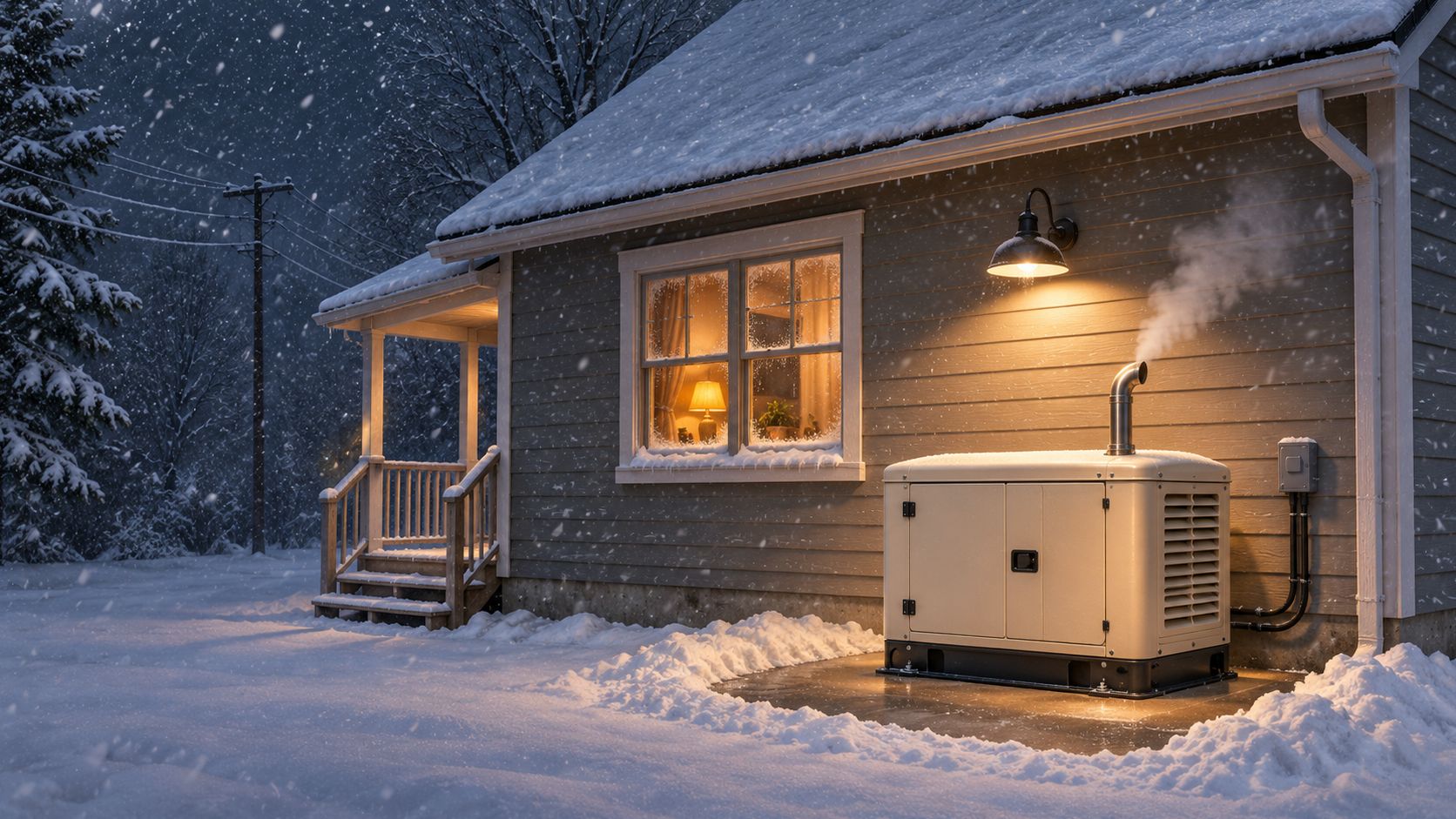
Take that same winter storm. The grid drops, and about ten seconds later you hear a low mechanical rumble outside the side wall. The lights come back, the furnace blower restarts, and the sump pump keeps doing its job while the road is still dark. Nobody in the house touched a pull cord or ran an extension cord through a window.
The three parts you'll actually see
The engine and alternator set is the box on the pad. The diesel engine spins the alternator, and the alternator makes the electricity. That's the whole conversion: fuel into rotation, rotation into current.
The automatic transfer switch is the part most homeowners never look at, usually mounted beside the main panel. It watches utility voltage, tells the engine to crank when voltage disappears, and physically moves your circuits from grid to generator. It also prevents the two sources from ever being connected at once, which is what keeps lineworkers safe.
The fuel tank is either a belly tank tucked under the enclosure or a separate above-ground tank nearby. That choice affects refueling access, containment requirements, and how much runtime you have.
What happens in the first minute
Utility voltage drops and the transfer switch signals a start.
The engine cranks, fires, and settles at governed speed while voltage stabilizes.
The switch transfers the backed-up circuits to generator power.
When the grid returns and holds, the switch transfers back and the engine runs a cool-down cycle before shutting off.
Diesel isn't a fringe choice here. The global home standby gensets market was valued at USD 11.57 billion in 2024, and diesel-powered units represented the largest fuel segment, according to Polaris Market Research. Diesel engines are built stoutly, they absorb heavy motor-starting loads without stumbling, and the fuel sits on your property instead of arriving through a pipe.
A standby generator is only as ready as its fuel, its transfer equipment, and its last real test.
Diesel Compared with Gas, Propane and Battery Backup
Factor | Diesel | Natural gas or propane | Battery backup |
|---|---|---|---|
Fuel supply | On-site tank that needs rotation and testing | Utility gas line, or on-site propane tank | None; charged from the grid or solar |
Long outage runtime | Limited by tank size and fuel age | Gas line runs while supply holds; propane limited by tank size | Limited by battery capacity, usually hours |
Starting load capacity | Strong; handles motor starting surges well | Good for most homes; depends on unit size | Limited by inverter rating |
Noise and exhaust | Loud; exhaust must be vented outdoors | Quieter than diesel; exhaust still vented outdoors | Silent; no exhaust |
Maintenance | Oil, filters, fuel tests and hour tracking | Oil and spark plug service on a set schedule | Software and battery checks; little mechanical work |
Best fit | Multi-day outages, large loads, homes without gas | Homes with reliable gas service | Short outages and homes with solar |
Fuel supply is the row that decides most purchases
A diesel tank makes you independent of the gas main, which matters on a rural road where the utility line ends a mile away. That independence is conditional. You own the fuel, so you own its age, its water content, and its turnover schedule.
Natural gas hands that responsibility to the utility, and that's a real convenience when the line is reliable and sized to feed the generator at full load. Where gas service doesn't exist, propane fills the gap, and the trade shifts back toward tank capacity and delivery access. Our comparison of whole-house generator gas options walks through what a gas line has to deliver before a unit will hold its rated output.
Runtime limits aren't the same kind of limit
Read the runtime row carefully, because each column is capped by something different. Diesel is capped by gallons and by how long that fuel has been sitting. Propane is capped by tank size and whether a truck can reach your driveway in a storm. Batteries are capped by stored kilowatt-hours, and a single unit carrying a furnace blower and a well pump will empty in hours, not days, unless solar recharges it.
Noise and exhaust deserve equal weight in a tight subdivision. A diesel running through a three-day outage is audible at the property line, and batteries are silent with no combustion products at all. Amp'd designs and installs custom battery backup systems for homes and businesses, and battery backup works with utility service even without solar panels, so "no solar" doesn't rule that column out.
Practical rule: choose diesel when the outage plan is measured in days, the home has large motor loads, or gas isn't available. Choose batteries when outages are short and the roof already carries panels.
Sizing a Diesel Generator to Your Real Load
Size the unit to the surge, not the average. Start with a load-and-runtime worksheet, then demand fuel-burn and commissioning numbers before signing a quote. That keeps the conversation tied to checks a homeowner can perform.
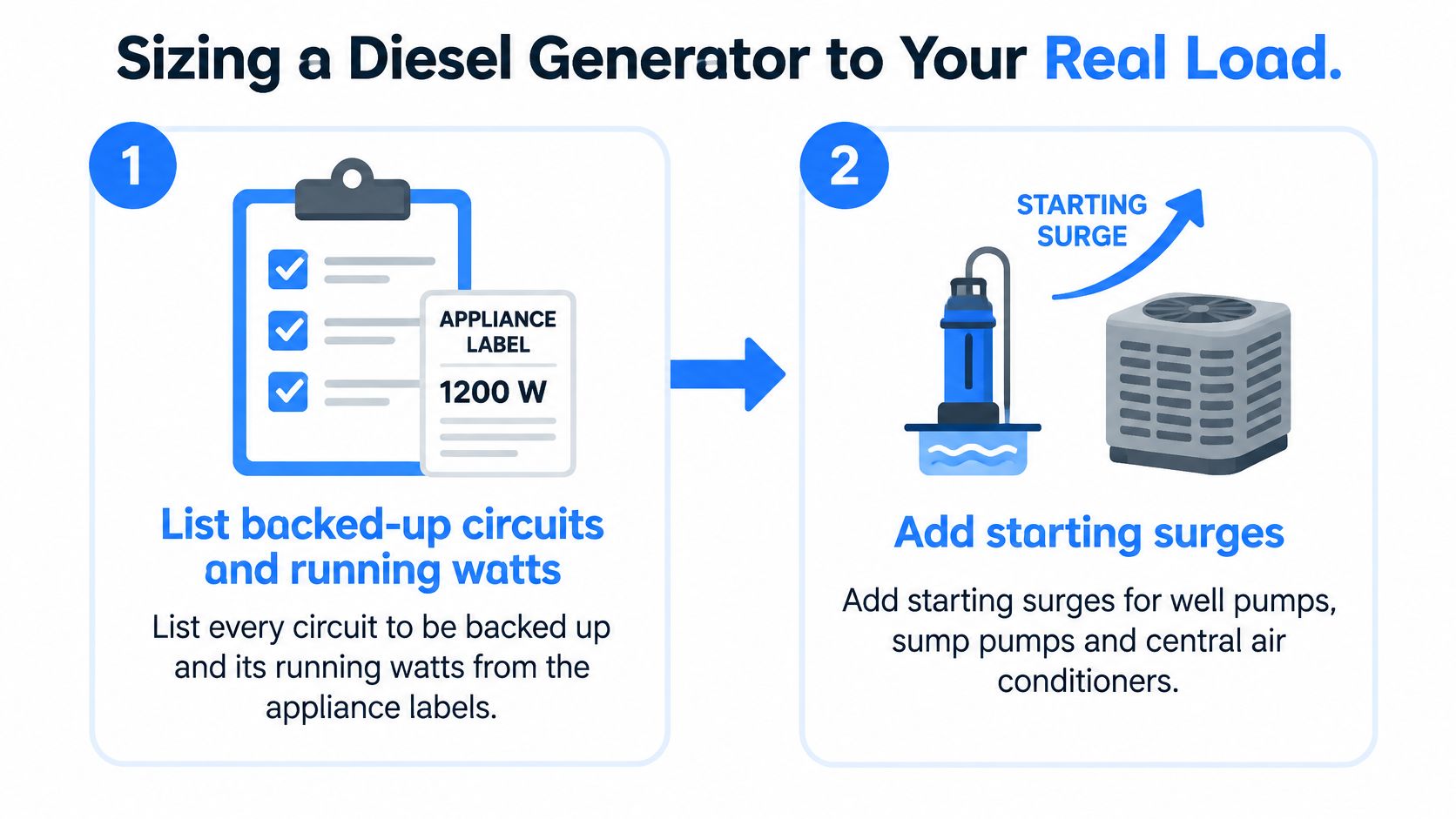
List every backed-up circuit and its running watts. Read the appliance labels and write the numbers down, including the furnace blower, refrigerator, well pump, sump pump, and the outlets you need.
Add starting surges. Motors draw several times their running watts for a moment on start, so a well pump or central air conditioner can dictate the size even when the steady load looks modest.
Set the runtime you're buying. Decide whether the plan covers 24 hours or several days, because that choice drives tank capacity more than anything else.
Get fuel-burn rates at multiple load points. Ask the dealer for manufacturer consumption data at 25%, 50%, 75%, and 100% load, since a diesel burns differently at each point.
Multiply, then add margin. Rate at your expected load times runtime gives gallons, then add allowance for cold weather, future load growth, unusable tank volume, and a reserve you never plan to burn.
A worked example at house scale
Say the essential circuits in a Southeastern Pennsylvania home add up to about 7 kW while everything is running: sump pump, refrigerator, furnace blower, and lighting. Once the sump pump starts while the blower is already running, the momentary demand rises above that steady figure, and the unit has to carry the surge without dropping voltage. Our whole-house generator sizing calculator guide shows how to build that worksheet circuit by circuit.
The method is the same at much larger scale. A U.S. Department of Energy technical report uses eight hours of continuous operation at a maximum steady-state load of 574 kW as an illustration of fuel-quantity math, not a residential load. That report also points to NFPA 110 installation guidance including a two-hour full-load bank test with data trended for future comparison, so ask for the commissioning readings, not just a verbal "it ran fine."
Load | Starting behavior | Sizing note |
|---|---|---|
Well pump | Several times running watts on start | Often sets the minimum generator size |
Sump pump | Brief surge at each start | Size for the surge, not only the average |
Central air conditioner | High surge when the compressor starts | Stage it after other loads or add soft-start equipment |
Refrigerator and freezer | Modest surge on compressor start | Include with running loads |
Electric water heater | No surge, steady heavy draw | Large running load, often left off the backup circuit |
Staging is the lever you can pull without buying a bigger unit. Leaving the water heater and range off the backup panel, or delaying the air conditioner until other loads settle, can drop the required unit size considerably without giving up anything you'd miss in a storm. Treat that choice as part of the worksheet: list what runs immediately, what waits, and what stays off during an outage. The final quote should match that list, the fuel table, and the inspection you demand before payment.
Fuel Storage, Testing and Maintenance Schedule
Outage failures often start in the tank. Stored diesel collects water from condensation, sediment, oxidation products, and microbial growth. Any of those can plug a filter, corrode a component, or upset the injection system at the exact moment the transfer switch calls for power. Treat the tank like a small fuel pantry: the generator may be new, but the diesel sitting inside it has its own clock.
Many first-time owners assume diesel keeps for years; it does not. The Pacific Northwest National Laboratory standby generator guide advises keeping fuel cool and dry, and it places usable diesel storage life around 6 to 12 months. Longer storage calls for controlled conditions, testing, treatment, or fuel polishing. That is why the purchase should include a fuel-testing calendar, not just a tank size.
The calendar to demand in writing
NFPA 110 guidance treats degradation testing as a recurring requirement, with diesel fuel tested at least twice annually and no more than six months between tests, and fuel stored 12 months or longer also requiring an annual stability test. Put those dates on paper before you sign. A verbal promise to "check it" does not tell you who tests, what test is run, or when the next result is due.
Task | Interval | Purpose |
|---|---|---|
Fuel quality test | At least twice a year, no more than six months apart | Finds water, sediment and microbes before they reach the engine |
Fuel stability test | Annually once fuel has been stored 12 months or longer | Checks for oxidation in aged fuel |
Oil and filter change | Per manufacturer, tracked with the hour meter | Keeps the engine ready for a start |
Hose and belt inspection | Per manufacturer schedule | Prevents a failure at the moment of transfer |
Fuel turnover | Roughly every 6 to 12 months | Avoids running on old diesel |
The table works best as a wall chart beside the tank or in the same folder as the warranty. Write the completed date, the next due date, and the person responsible. If the generator is installed for a property you do not visit often, make the calendar part of the service agreement so a missed season does not become a missed start.
Four habits that make the calendar real
Write the delivery date on the tank. A strip of tape and a marker beside the fill cap solves the most common problem in residential diesel: nobody knows how old the fuel is. Log every top-up too, because a partial fill mixes new fuel with old.
Pull a sample from the low point. Water sits at the bottom. Ask your service provider to draw from the tank's lowest point into a clear glass jar, let it settle, and look for a distinct water layer or dark slime at the interface. ASTM-based lab testing is the formal version of the same question.
Track hours, not just calendar dates. EPA stationary-engine guidance emphasizes operating and maintaining the engine per the manufacturer's instructions, keeping maintenance records, and using hour-meter tracking on emergency engines. A home unit that exercises briefly may log very few hours a year, which is exactly why time-based fuel work matters more than the hour total. Our whole-house generator maintenance checklist covers what belongs in that logbook.
Plan the exit for bad fuel. Ask, before you buy, who removes contaminated diesel and how it is disposed of. Also ask how the fuel is treated for winter, since cold-weather operability is a fuel-specification question, not a hope.
If you can't produce a fuel date and a recent test result, you don't have a ready generator. You have an untested one.
Exhaust Safety, Placement and Permits
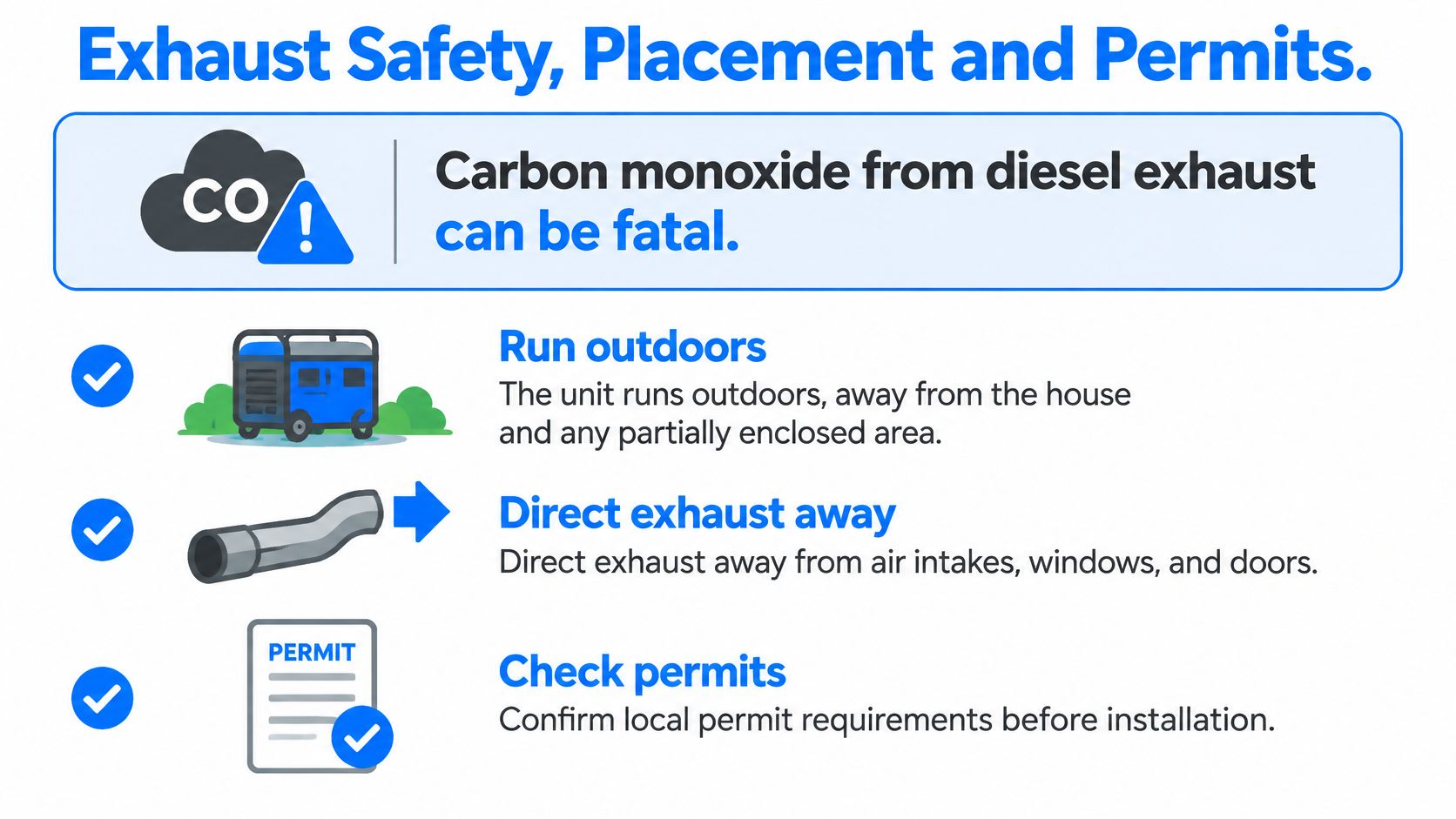
Diesel's storage advantage does nothing to reduce its exhaust hazard. Carbon monoxide from diesel engines can be fatal, so FEMA guidance calls for generators to operate outdoors, away from homes and partially enclosed areas. The same guidance says diesel and other flammable fuels should be stored outside living areas in properly labeled, non-glass safety containers.
Telling an owner to put the unit outside is not a placement plan. The useful question is where the exhaust goes after it leaves the outlet. Pacific Northwest National Laboratory guidance says exhaust should be directed away from building air intakes and places where people gather, with adequate ventilation and applicable permits. Treat that as a walk-through survey with your installer, not a checkbox on a quote.
Walk the exhaust path before anyone pours a pad
Trace the plume against every opening. Stand at the proposed pad and sight the exhaust outlet toward windows, doors, basement wells, dryer vents, and HVAC fresh-air intakes. Anything on that line is a problem.
Account for wind and neighbors. Prevailing winter wind direction can push exhaust toward your own bedroom window or the house next door, and a fence or solid enclosure can trap it instead of dispersing it.
Plan for snow. A drift against the enclosure blocks cooling air and can bury the exhaust outlet. Ask where snow will pile after a plow passes the driveway, and set the pad height accordingly.
Treat outbuildings as a separate engineering question. A detached garage, shed, or enclosure only works with approved ventilation and exhaust routing, never as a parking spot for a running unit.
Set alarms and a family procedure. Put carbon monoxide alarms near sleeping areas and on every level, and agree out loud what everyone does when one sounds: get out, call for help, don't go looking for the generator.
The hard case is the side yard beside a basement window. It is a common spot because it is close to the panel and shortens the conduit run, and it is frequently wrong because a basement window well sits low and can collect exhaust. An installation can be electrically flawless and still unsafe purely because of air movement and intake position. That is why the exhaust-path survey belongs before the pad, not after the machine arrives.
The rules that apply to the machine itself
Federal emissions limits tightened in phases. The EPA Tier 4 framework was announced in 2004 and phased in from 2008 through 2015, tightening limits for nitrogen oxides, particulate matter, carbon monoxide, and hydrocarbons, according to an EPA diesel emission standards white paper for stationary generators. The same document notes a related standard applying to stationary generators rated at 50 kilowatts or more installed on or after January 1, 2005.
Operation category matters as much as size. Emergency units may run during power failures plus limited testing and maintenance, while non-emergency units face stricter operating and emissions requirements. That distinction is what makes an older used unit a gamble: it may not carry the certification your township expects.
Ask the seller to show the label, not just describe it. A homeowner can hold the machine to the same standard used for any other major appliance: identify what it is rated for, where it may run, and who will sign off on the installation.
Five things to confirm before signing
Photograph the certification label and the manufacture date.
Ask whether the unit is emergency-rated and what that permits.
Confirm with the township whether the tank, placement, or unit size triggers a permit, and check noise limits and setbacks.
Ask the fire or building official to review the exhaust path before installation, not after.
Ask how testing hours will be logged and who keeps the record.
What a Diesel System Costs to Buy, Fuel and Maintain
Split the money into two piles: what the installer quotes once, and what the household pays every year afterward. Quotes that blur the two are the ones that surprise people in year three.
Cost item | What it covers | What moves it |
|---|---|---|
Generator and transfer switch | The engine-alternator set plus the automatic transfer switch | Unit size and whether the plan is whole-house or essential circuits |
Tank and containment | Belly tank under the unit or a separate above-ground tank | Capacity, double-wall containment and distance from the house |
Site and electrical work | Pad, conduit, wiring and the load study | Distance to the service panel, trenching and any load-staging equipment |
Permits and inspections | Township, fire and air-quality approvals | Local rules, larger units and proximity to neighbors |
Fuel and first fill | Initial fill, treatment and testing | Tank size, local diesel price and testing frequency |
Annual upkeep | The recurring pile priced as a yearly figure, either per visit or under contract | Hours run, fuel condition and whether a service contract is included |
Do the running-cost arithmetic yourself
You already have the two inputs from your sizing worksheet: the manufacturer's burn rate at your expected load, and the outage length you're planning for. Multiply gallons per hour by outage hours, then by the delivered diesel price in your area. That gives the fuel cost of the outage you're insuring against.
Now put that arithmetic into the quote request itself. Ask the dealer for the burn rate at your expected load rather than at full load, and ask for it in writing. A quote that lists only equipment and labor has left out the recurring pile entirely, so ask for a yearly service figure at the same time: a per-visit price or a contract rate, on paper before you sign. Two numbers, burn rate and annual service, tell you more about the actual price than the equipment total does.
Commissioning belongs on the quote as its own line. A load-bank run with recorded voltage, frequency, and temperature readings gives you a baseline to compare against every year after, and it's the only proof the unit performs under real load rather than in a driveway idle.
Some costs aren't cash. Noise at the property line, exhaust clearance that rules out the most convenient wall, and yard space for a tank you must rotate all shape whether this system fits your property. The exhaust-path survey you already walked tells you which walls still qualify, so price the pad, trenching and conduit for the location that passes, not the one that looked convenient on paper.
Deciding Whether Diesel Backup Fits Your Home
A diesel unit earns its place on your property only when honest answers to a short set of questions all point the same direction. Work through them before you ask for a quote.
Outage length: how many days must the house keep running, based on what your road experienced last winter?
Measured loads: what are the running watts and the worst simultaneous motor start, written down?
Gas availability: is there a utility gas line, and is it sized to feed a generator at full output?
Placement: can a tank and enclosure sit outdoors with a clean exhaust path away from every opening?
Fuel plan: who tests, who rotates, and who takes away contaminated diesel?
Local approval: do setbacks, noise rules, and neighbors allow the location you want?
Budget: does it cover installation, transfer equipment, and annual upkeep, not just the box?
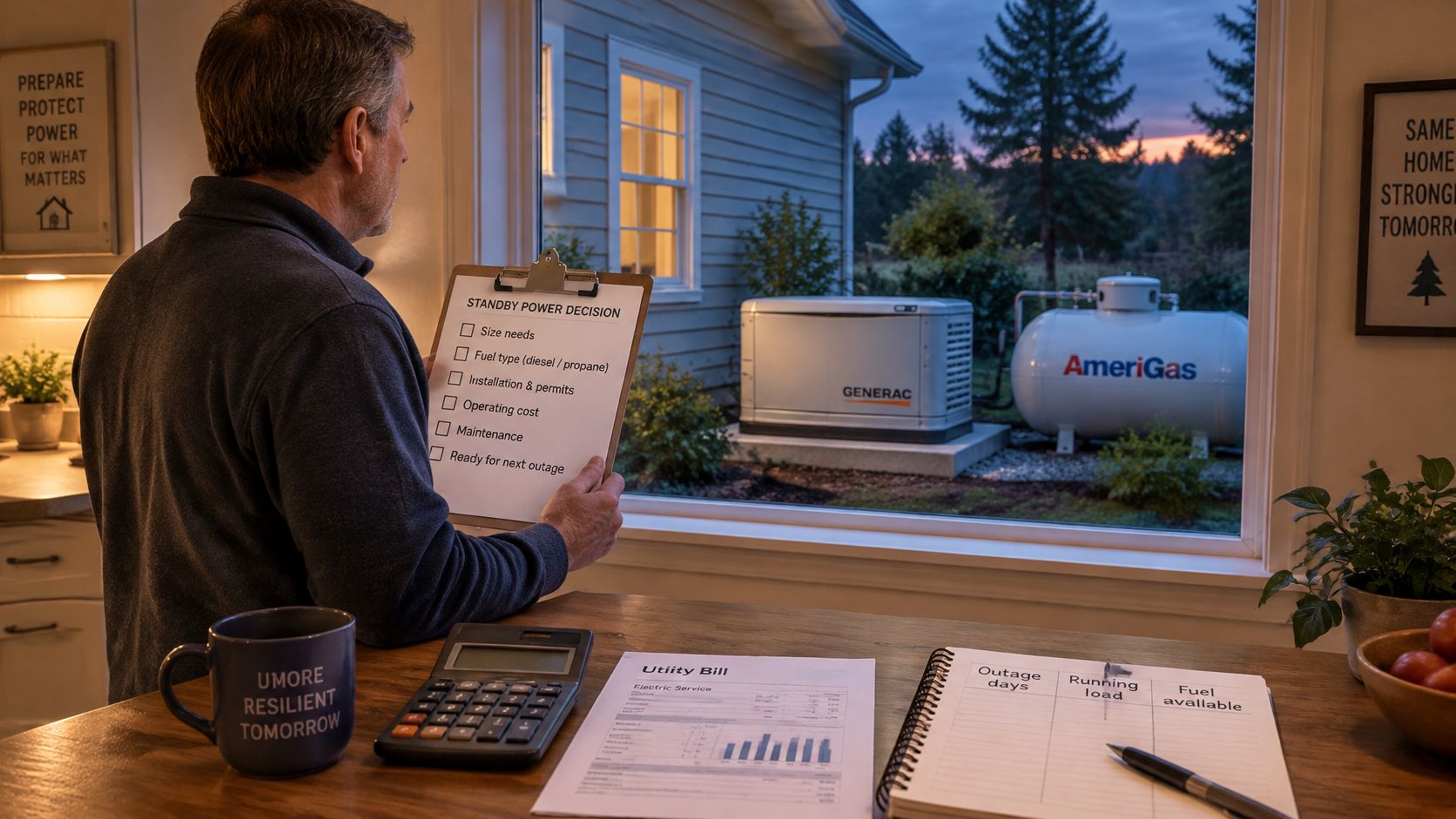
Long outages, heavy motor loads, and no gas service make diesel a strong fit, and the fuel calendar becomes the price of admission. Short, infrequent outages push the other way. A battery backup system asks less of you every year, runs with no fuel to test or rotate, and works with ordinary utility service even if your home has no solar panels.
Bring your three documents to a free consultation with Amp'd Energy Solutions: the load-and-runtime worksheet, the fuel-testing calendar you intend to keep, and a photo of the wall where you want the unit to sit. Amp'd is a family-owned electrical contractor serving Southeastern Pennsylvania, and its licensed electricians handle whole-house generator sizing, complete custom installation, troubleshooting, and annual maintenance. The consultation walks your property, your budget, and your peace of mind through this checklist so you choose the backup system that fits your home.
Comments