

Workplace EV Charging Stations Planning Guide
The most common advice about workplace EV charging is also the fastest way to overspend. You're told to count the electric cars in the lot, buy a charger for each one, and pick the highest power your budget allows. That treats a parking lot like a gas station, where speed matters because nobody wants to stand by a pump.
Your employees aren't standing anywhere. They're working for hours while the car sits still, and that dwell time changes every decision that follows. Workplace EV charging stations work best as a managed, long dwell energy service, not as a row of rapid fueling stops. You spread a modest amount of energy across a shift, cap the total electrical demand, and write clear rules for who gets a stall and for how long.
Done that way, you can often serve more drivers on the electrical service you already own. Done the gas station way, you'll price a service upgrade you didn't need and still end up with arguments over occupied stalls.
Table of Contents
Hardware and Port Counts to Plan First - Why networked load sharing changes the math - Counting ports from behavior, not from the vehicle roster
How to Size the Electrical Load - Why the ceiling comes before the upgrade quote - What to require from the control platform
Access Rules That Keep Charging Fair - Six decisions to write down and post
Hardware and Port Counts to Plan First
Start with the comparison below before you call an electrician. It matches hardware to how long a vehicle stays, which is the only question that matters at this stage.
Option | Typical power | Range added | Best workplace use | Phase-one density |
|---|---|---|---|---|
Level 1 | About 1.4 kW | 3 to 5 miles per hour | All-day plug-in hybrids only | Rarely worth a dedicated stall |
Level 2 | 6.6 to 19.2 kW | About 20 to 60 miles per hour | Employee cars parked 4 to 9 hours | 1 port per 8 to 12 EVs if home charging is common |
Networked Level 2 with load sharing | Shared power under a site cap | Same energy spread over the dwell | Tight panels and many simultaneous arrivals | Same stall count, lower simultaneous kW |
DC fast charging | 50 kW and up | Large top-up in tens of minutes | Fleet turnaround between routes | Few dedicated bays, not one per employee |
Level 1 runs on 120 volts and adds range so slowly that it's only useful for a plug-in hybrid with a small battery left parked all day. For a full battery electric car with a real commute, it won't replace what the drive in used. Don't build dedicated stalls around it.
Level 2 runs on 208 or 240 volts, and it's the default for one simple reason. The car is parked through a shift anyway, so moderate power delivered for several hours covers a typical round trip with room to spare. The U.S. Department of Energy Alternative Fuels Data Center report listed 9,894 workplace electric-vehicle supply-equipment ports in the Station Locator at the end of the first quarter of 2021, and by the fourth quarter of 2023, 95.1% of privately designated workplace charging ports in the Station Locator were Level 2. Treat those counts as a documented minimum rather than a complete census, since they only cover ports recorded in that locator. The direction is still clear. Employers have standardized on Level 2 because long parking times make high power unnecessary for most commutes.
Think of a Level 2 stall as a parking meter that delivers kilowatt-hours across the dwell, not a hose that empties a tank in ten minutes. That mental shift is what keeps the project affordable. A driver who needs, say, enough energy to cover the trip home doesn't need it in the first half hour. They need it by the time they leave, and that's a much cheaper promise to keep.
Why networked load sharing changes the math
A non-networked charger delivers its full rated output whenever a car plugs in, whether or not five other cars plugged in at the same moment. Networked Level 2 with load sharing works differently. The stations talk to each other, divide a fixed pool of power, and slow down together during the morning rush. Each car still receives the energy it needs over the full shift, but the site never draws the combined nameplate total at once.
That distinction is the difference between using spare capacity in your existing panel and paying for new capacity. It also affects the cable and connector choices you'll live with daily, so it's worth reviewing how a Level 2 EV charging cable is specified before you settle on hardware. Cable length, connector type, and retractors sound like details until a driver can't reach a charge port from the stall you painted.
DC fast charging sits at the other end of the table for a reason. It turns a vehicle around in tens of minutes, which is exactly what a fleet needs between routes, and exactly what an office worker parked for eight hours does not. It also demands dedicated electrical capacity that most buildings don't have sitting idle. Buy it for turnaround problems, not for commuters.
Counting ports from behavior, not from the vehicle roster
Now for the question every facilities manager asks first. How many ports do you need? The honest answer starts with a short survey, not a headcount of EVs in the lot.
Commute distance: Ask how many miles each driver covers each way, since that sets the energy they need to replace.
Days on site: Ask how often they come in, because a hybrid schedule means the same stall serves different people on different days.
Home charging access: Ask who can charge where they live, because drivers without it will use your stalls far more often.
Arrival state of charge: Ask how full the battery usually is when they arrive, and don't assume it's nearly empty.
That last item trips up most first estimates. A 2025 UC San Diego study analyzed behavioral data from more than 800 EV drivers and charging records from 439 workplace stations and found that drivers commonly plugged in while their batteries were still above 60%. The same work found that designing around observed driver behavior could require up to three times as many chargers as models based on national averages. People plug in out of habit and range comfort, not because the battery is flat. If you size the system as if every driver arrives empty and never tops up casually, you'll underestimate how often stalls are occupied.
Planning heuristic: Start near one Level 2 port per 8 to 12 EVs where home charging is common, and nearer one per 4 to 6 where many drivers rent or vehicles must leave full. It's a starting point for budgeting, not a standard.
Install that first phase, run conduit and leave panel space for the next one, and then grow from measured utilization rather than from the EV roster alone. Session data will show you when stalls fill, how long cars sit after charging finishes, and whether the queue is a hardware problem or a policy problem. That's cheaper and more accurate than doubling the installation on day one because the parking lot survey scared you.
How to Size the Electrical Load
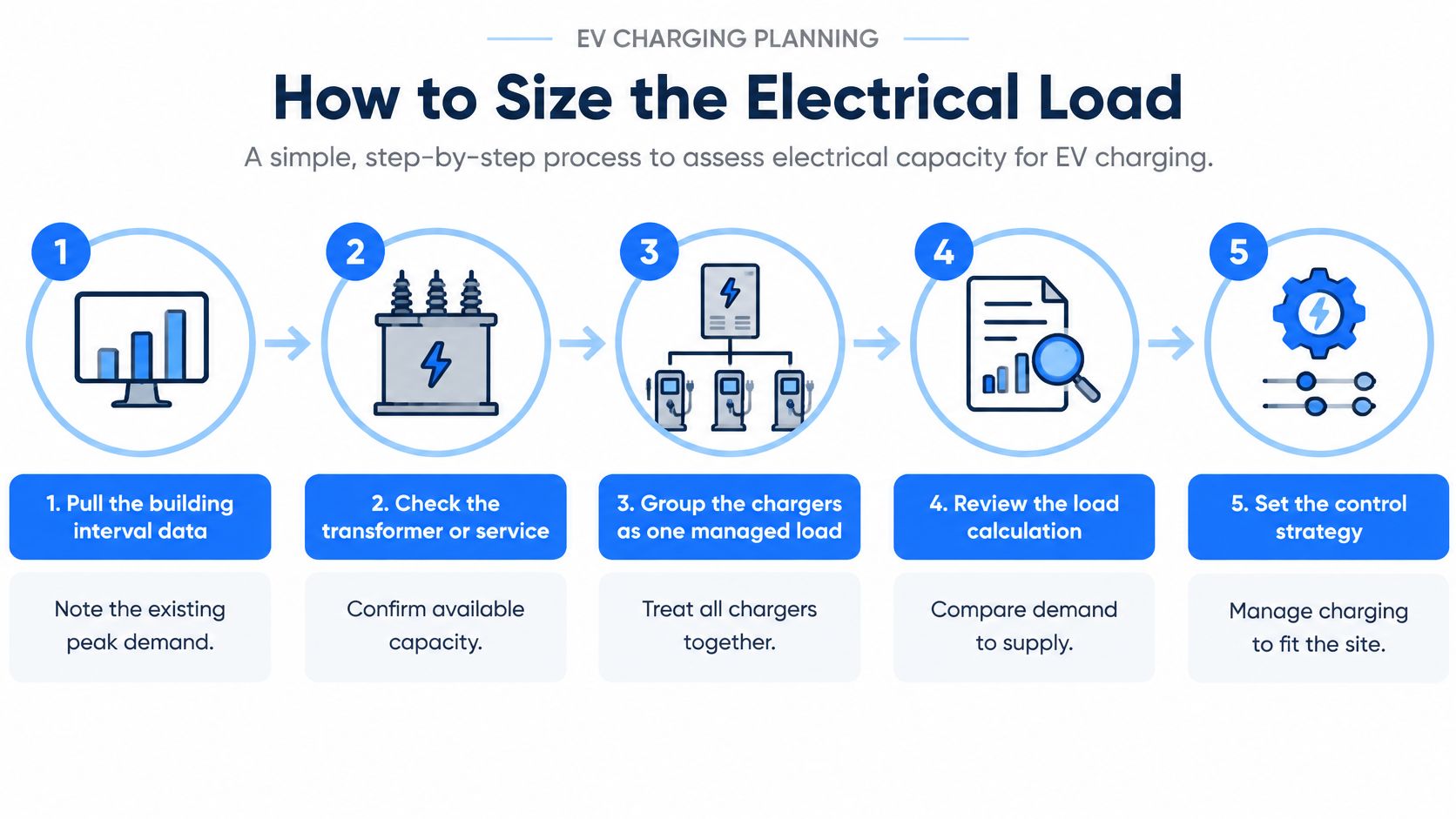
On a cold Monday, twelve cars plug in at 8:00, while the building is already using power for heating, lighting, and equipment. The question is not how many chargers fit in the lot. It is how much power the site can supply at that busy moment, and how charging can share that capacity across vehicles that will remain parked for hours.
Start with the building's interval data. Check its existing peak demand, the transformer or service rating, and the spare capacity available during the busiest hours. Then list each proposed charger's maximum current, circuit requirements, panel space, and expected vehicle dwell time. Together, these details show whether charging can fit within the existing electrical service.
Next, model a demanding period. Account for multiple vehicles arriving close together, each needing energy before departure. Set a site import ceiling, then use networked controls to distribute available current according to departure times or a minimum energy guarantee. This makes the system a managed, long-dwell service: a car can charge more slowly while parked, as long as it receives the required energy in time.
Compare that controlled design with a panel or service upgrade before committing to either. Include utility coordination and project timing in the comparison. If the constraint is a short morning spike, a larger service may be the wrong first spend. A guide to electrical load assessment calculations explains how to build up demand figures before adding new loads. The goal is to distinguish a true capacity limit from a peak that controls can manage.
Why the ceiling comes before the upgrade quote
Transformer heating and demand charges are shaped by the coincident maximum load, meaning the power used at the same time, rather than by the number of pedestals alone. Ten chargers sharing power at different times can place less strain on equipment than four chargers drawing full output together. The electrical assessment should therefore focus on overlapping demand, not count ports alone.
A U.S. Department of Energy supported workplace pilot with more than 250 active daily commuters demonstrated scheduled, demand-controlled charging that managed total charging power to avoid new infrastructure investment and mitigate peak demand charges. Related modeling using real workplace charging data found that a billing-aware control strategy incorporating demand charges could support over 67% more vehicles than uncontrolled charging, while also reducing transformer-aging impacts. Treat that figure as a scoping benchmark, not a forecast for your building. Results depend on arrival patterns, charger ratings, the tariff, and how much energy each battery requests.
A static design that assumes every port runs at full output can overstate the service needed. Unmanaged charging can create coincident peaks that raise demand charges or push existing equipment beyond its rating. A site ceiling sets the maximum power available to charging and helps avoid both problems.
What to require from the control platform
Specify controls before pricing the hardware, since adding them later can be difficult. Require dynamic current limiting to enforce the site cap in real time, and user authentication to identify who is charging. Session logs support billing and utilization reporting. Set a defined fallback state too, so that if communications fail, stations switch to a safe, reduced output instead of shutting off or running without limits.
Controls manage demand; they do not change the physical requirements of the installation. Circuits, conductors, grounding, and any applicable ventilation rules still need to be designed and inspected to meet code. The control platform is like a traffic signal for available power: it can regulate how vehicles take turns, but it cannot make an undersized electrical path safe.
Access Rules That Keep Charging Fair
A full lot with reliable equipment looks like success. It can still be failing the people who need it most.
A 2025 nationwide workplace-charging survey found that roughly half of respondents had access to charging at work, but satisfaction with accessibility was only about 63%, compared with 76% satisfaction with reliability. The same survey found that 11% of respondents did not know whether their organization offered charging incentives. So the equipment usually works. Getting a turn, and even knowing the program exists, is where things break down.
Consider who depends on your stalls. A homeowner with a garage charger uses workplace charging as a convenience. A renter in an apartment building with no assigned parking may have no other practical place to charge at all. A first come, first served lot favors whoever arrives earliest and has the shortest commute, which is often the opposite of who needs the energy. Restrict the benefit to senior staff, or charge a flat fee that ignores how long a car sits, and you've built a small charging desert inside your own building.
Six decisions to write down and post
You don't need a long policy. You need a one-page set of decisions that every driver can read before they enroll.
Publish who is eligible. State whether stalls serve all employees, specific shifts, visitors, or company vehicles first.
Reserve priority for drivers without home charging. Give them a share of stalls or first claim on sessions, since they have no fallback.
Set a session limit tied to an energy target. Once a car has taken the energy it needs, the driver moves it, so a topped-off car doesn't hold the space all afternoon.
Price transparently. Charge by kilowatt-hour, or by time after the target is met, and publish the rate before anyone signs up.
Cover shift workers. Second and third shifts need their own access windows, not whatever is left after the day shift finishes.
Repeat the rules in onboarding. A sign on the pedestal isn't communication. Put eligibility, pricing, and time limits where new hires can see them.
Full stalls and high interest can hide exclusion. If your longest commuters and your renters can't get a turn, the program isn't working, however busy it looks.
Close the policy with a named contact for overrunning sessions and a simple way to report a blocked or broken stall. That one line prevents the slow buildup of resentment that turns a popular benefit into a daily grievance.
Permits Incentives and Utility Steps
Projects rarely stall on the chargers themselves. They stall on approvals, and usually in a predictable order, so work through these steps in sequence.
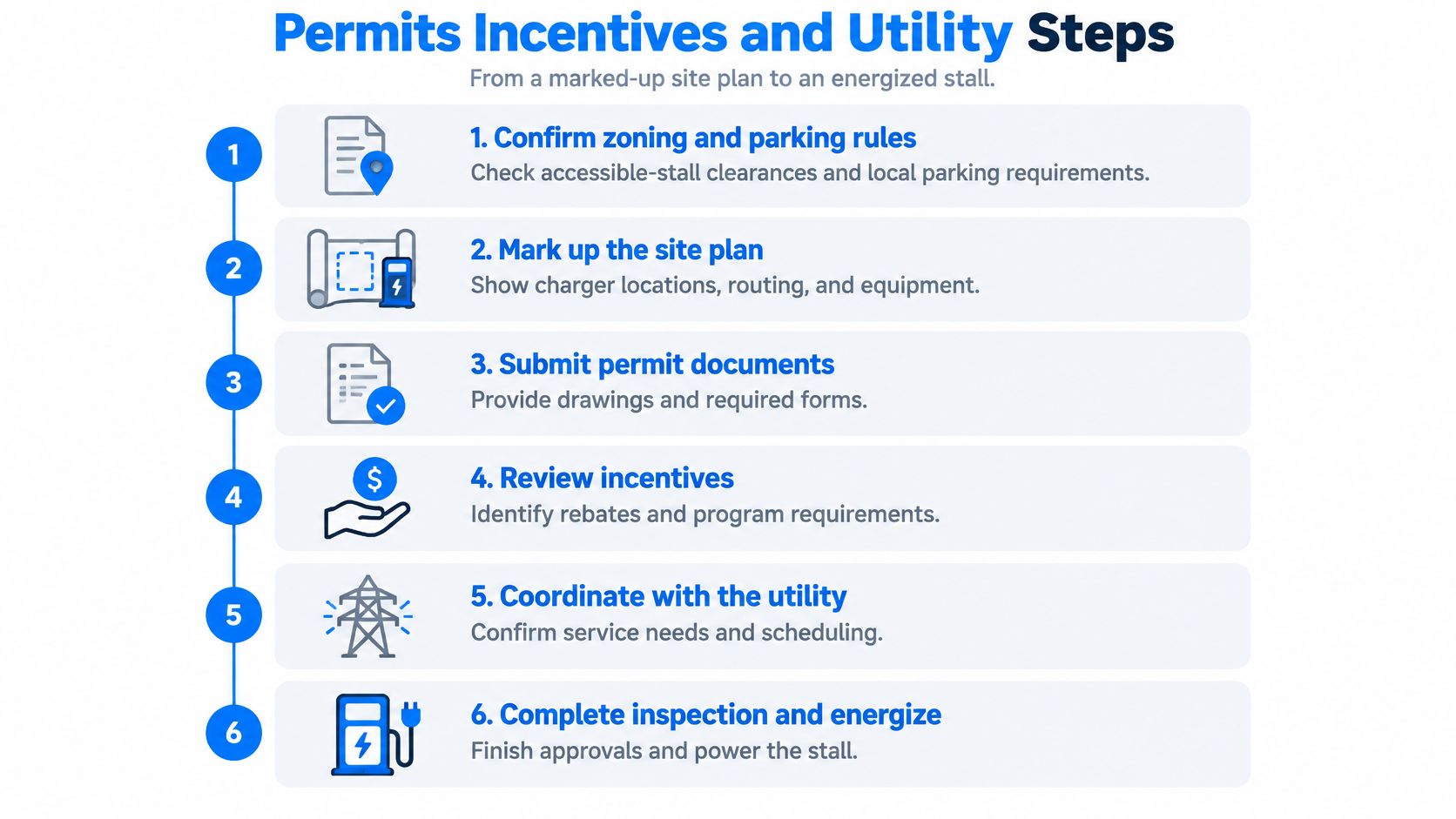
Confirm zoning and parking rules. Check accessible stall clearances and whether adding chargers changes your required parking count.
File the electrical permit. Submit a one-line diagram, the load calculation, and equipment listings with the application.
Talk to the utility early. Ask about service capacity, a separate meter if charging should be split from house load, and any make-ready or demand-response program.
Check incentives before buying gear. Verify current federal, state, and utility eligibility, credit rates, and caps with a tax adviser and the program administrator.
Decide ownership and payment. Settle who owns the stations, who pays for electricity, and whether employees charging personal cars creates a taxable benefit.
Schedule inspection and commissioning. Test load sharing and the network fallback before you announce the stalls to staff.
Two gates deserve emphasis because people blow through both. Many utility rebates require pre-approval and networked, qualified equipment, which means gear bought first may not qualify at all. Ordering pedestals before the utility has answered your capacity question is the most common avoidable delay, since you may be storing hardware you can't energize. Incentive rules also change, so a figure quoted from last year's program material isn't a number you can budget against today.
Keep the budget honest on one more point. In a tight urban service territory, an incentive may not cover a transformer upgrade, and that gap can be large. Keep your managed load comparison in the same spreadsheet as the incentive estimate, so you're deciding between real alternatives rather than hoping a rebate covers a design you didn't need.
Your working checklist is short. Survey, load calculation, permit set, incentive pre-approval, utility application, and commissioning sign-off. If any one of those is missing, you're not ready to order equipment.
Employee Charging Versus Fleet Depots
A workplace charger is a managed, long-dwell energy service, not a miniature gas station. The right setup depends on how long vehicles stay plugged in, when they must leave, and which drivers need access. A commuter parked through the workday can share charging time; a delivery van due back on route soon cannot.
At an office where most employees charge at home, a few shared Level 2 stalls may cover the need. Set a clear priority for employees who cannot charge at home, and use load sharing to keep demand within the existing service's capacity. The constraint is fair access during the workday, not giving every vehicle its own port.
Pool cars call for a different rule. Reserve stalls for vehicles with scheduled departures, and set an energy target tied to when each car is needed. A car leaving for an afternoon sales call should not have to wait behind a commuter who will stay until evening. Without assigned access, the charging schedule can conflict with the vehicle schedule.
At a delivery depot, the van timetable drives the design. When vehicles return with only 30 to 90 minutes between routes, high-power Level 2 charging or a limited DC charging area may be appropriate. The site may also need a dedicated service rather than relying on spare panel capacity. Load sharing controls total demand, but it cannot make a short dwell time equivalent to a full workday.
Site job | Typical dwell | Who gets priority | Electrical approach |
|---|---|---|---|
Employee commuters | 6 to 9 hours | Drivers without home charging | Shared Level 2 under a site import cap |
Pool and sales cars | 2 to 4 hours between calls | Vehicles with a set departure | Reserved stalls and an energy target |
Delivery or service fleet | 30 to 90 minutes between routes | The next route on the board | High-power Level 2 or limited DC, often a dedicated service |
Overlapping shifts | Two arrival peaks | The shift about to leave | Same ports, a tighter schedule and ceiling |
A site can serve both employees and a fleet, but the access rules should reflect their different needs. Commuters generally have a longer parking window; fleet vehicles may have a firm departure time. Put those priorities into the charging schedule so a shared electrical supply does not become an unplanned first-come, first-served queue.
The scale of destination charging helps explain why workplace ports should be treated as part of a broader charging system. The U.S. Department of Energy National Laboratory of the Rockies estimates that the country could have 33 million electric vehicles on the road by 2030 and require 28 million charging ports. Of those ports, approximately 2.1 million, or 7.6% of the projected total, are expected to be public or private Level 2 chargers at multifamily housing, workplaces, stores, restaurants, and hotels. The estimate groups workplaces with other destination sites, so it does not set a workplace-only target. It does show why a workplace design should match actual parking behavior instead of assuming one port for every EV.
Shift overlap needs its own operating rule. If the outgoing shift is still plugged in when the incoming shift arrives, two groups need charging at once. An import ceiling keeps total draw within the transformer rating, while the schedule assigns charging to the vehicles with the more immediate departure.
Before setting policy, decide whether the site is supporting employee charging, fleet operations, or both. A commuter who can stay plugged in for hours and a van due out shortly do not have the same charging requirement. Treating them as one group can leave commuters without fair access and fleet vehicles short of the energy they need.
Book a Site Assessment Before You Buy Ports
Write down four numbers before anyone orders equipment. First, how many EVs are on site today, and how many do you expect in three years? Second, how many of those drivers can't charge at home? Third, what's your longest dwell and your shortest? Fourth, are any of these vehicles a fleet that has to leave on a schedule?
Those four answers do most of the design work. They pick your phase-one row in the tables above, set your access priority, and tell you whether your first electrical question is load sharing or a service upgrade. If you can't answer them yet, that survey is your next step, not a hardware quote.
Then bring in a licensed electrician who can read your existing service rather than a catalog. For businesses in Southeastern Pennsylvania, we install EV chargers for all EV makes and models, for residential and commercial use, and for electrical upgrades we assess the current setup and explain panel upgrade or full service replacement options, including where an electrical design consulting conversation should happen before conduit is run. When managed charging can't hold your import ceiling, that's the point where a larger service becomes an honest conversation rather than a default upsell.
To start, call 267-450-6992 or email sales@ampd.life to schedule a free consultation or request a quote. Send your interval demand data if your utility already provides it, a sketch of your preferred stalls, and your four planning numbers. That short packet lets us give you a real answer on the first visit instead of a ballpark.
A good proposal states a site power ceiling, a phase-two conduit path, and a written access rule. If it only lists a pedestal count, it hasn't answered your actual questions.
If you're planning workplace charging in Southeastern Pennsylvania, we can assess your existing service, size a managed Level 2 layout to your dwell times, and tell you plainly whether load sharing avoids an upgrade or a larger service is the right spend. Visit Amp'd Energy Solutions to book a site assessment before you commit to ports, conduit, or a utility application.
Comments