

Electric Service Upgrade 200 Amp: Steps, Costs and Permits
The most common advice on this job is also the least useful. People tell you to just get an electric service upgrade 200 amp and move on, as if the number on the main breaker settles the question. It doesn't. A 200-amp label doesn't mean 200 amps are available for your new charger, heat pump, range and dryer at the same time.
What matters is calculated simultaneous demand. That's the load your house will place on the service after the code's demand factors are applied, checked against your panel bus, your service conductors, your meter equipment and the utility's ability to feed you. If a quote skips that calculation, it's a guess with a price attached.
Table of Contents
Does Your Home Need a 200-Amp Service? - Service Capacity Before Demand Factors - Signs the Upgrade Is Likely
Calculate Your Load Before You Request a Quote - The Six Steps - Where Homeowners Get This Wrong
Panel Replacement or Full Service Upgrade - Scope Options for a 200-Amp Project - Planning for What Comes Next
Permits, Utility Coordination and Scheduling - Pre-Project Checklist
Timeline From Quote to Energized Service - The Six Stages in Order
What a 200-Amp Upgrade Costs - Cost Components to Compare - A Simple Budgeting Method
Book a Load Assessment Before You Sign - What to Gather First - Three Questions for Every Bidder
Does Your Home Need a 200-Amp Service?
Your 100-amp service runs out of room long before it looks full, because capacity is measured in volt-amperes, not breaker spaces. As this guide to whether a 200-amp breaker box is now required explains, a 200-amp, 120/240-volt single-phase service represents up to 48,000 volt-amperes of service capacity before applying demand factors, compared with 24,000 volt-amperes for a 100-amp service. The same source notes that a 200-amp service is not universally mandated for every U.S. home, since the National Electrical Code bases service sizing on a calculated dwelling load rather than a blanket national requirement.
That distinction matters. There's no single federal deadline forcing you to upgrade. The pressure comes from loads added after the old panel went in, such as central air-conditioning, an electric range, a clothes dryer, a heat pump, an EV charger and battery storage stacking up on a service that was sized for lights and a few appliances.
Service Capacity Before Demand Factors
Service rating | Capacity before demand factors | Typical situation |
|---|---|---|
100-amp, 120/240 V single-phase | 24,000 VA | Older homes with few large loads and no planned EV charger, heat pump or battery |
200-amp, 120/240 V single-phase | 48,000 VA | Homes adding EV charging, heat pumps, electric ranges or battery storage |
Those figures are starting points, not usable headroom. Continuous loads are generally evaluated at 125% of their rated value, so a continuous 40-amp load can require 50 amps of calculated capacity before other household demand is included. One charger can consume a quarter of a 200-amp service on paper, and half of a 100-amp service, before the dryer starts.
Say you've got a 1960s house on a 100-amp panel. The gas furnace is being replaced by a heat pump that will run for hours, and you're planning a Level 2 charger for overnight charging. Neither load is unreasonable on its own. Together, added to the range, dryer, water heating and general lighting load, they can push the calculated demand past what the service can carry. The calculation decides, not the age of the panel and not the number of empty slots.
Signs the Upgrade Is Likely
Breakers trip under normal use: You're not abusing the system, you're exceeding what it was sized for.
No room for a new two-pole breaker: A charger or heat pump needs two adjacent spaces you don't have.
A new appliance quote stalls: The installer won't proceed because the existing service can't support the load.
Managed charging can sometimes avoid the upgrade when calculated demand stays within limits, so don't assume 200 amps is automatic. We offer electrical service upgrades for residential, commercial, and industrial properties at 200 or 400 amp, but I'd want the numbers first either way.
Calculate Your Load Before You Request a Quote
A quote without a load calculation is just a panel price. The calculation tells you whether you need an electric service upgrade 200 amp at all, whether load management would work, or whether 200 amps still won't be enough for what you're planning. Do this work before you call for bids and you'll be able to check every bid line by line.
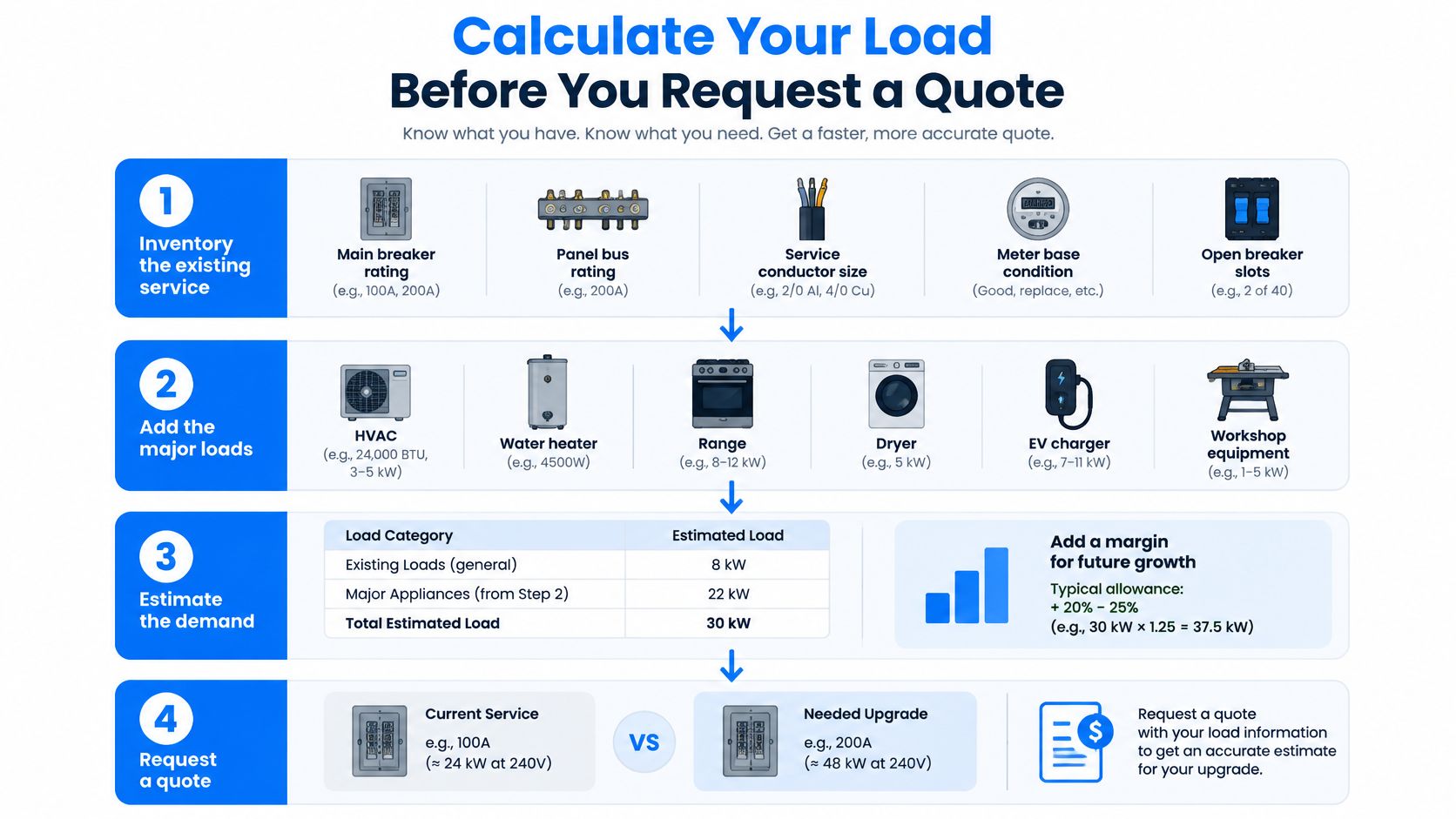
The Six Steps
Inventory the existing service. Write down the main breaker rating, the panel bus rating from the label inside the door, the service conductor size, the condition of the meter base and how many breaker slots are open. This tells the contractor what you have, because a panel that's been modified over decades often doesn't match what the homeowner assumes.
List every proposed load and how it runs. A charger that runs all night and a heat pump that runs for hours behave differently from a microwave. Duty matters because long-running loads get treated more conservatively in the math, and loads that run at the same time of day stack.
Build the load total. As this walkthrough of dwelling unit service load calculations using the standard method sets out, the designer totals general lighting and receptacle load using at least 3 volt-amperes per square foot, then adds appliance, cooking, dryer, HVAC, water-heating, EV-charging, storage and generator-related loads. That's the raw connected load, before any relief.
Apply demand factors and convert to amps. Not everything runs at full draw at once, so the permitted demand factors reduce the total to a realistic figure. Then divide the calculated volt-amperes by 240 volts to get amperes. That single number gets compared to your service rating.
Check the result against two ratings, not one. The total must fit both the service rating and the panelboard bus rating. A panel with spare spaces isn't automatically capable of accepting additional demand, because the bus has its own limit stamped on the label.
Apply the 125% rule to continuous loads. EV charging equipment is sized at 125% of nameplate output, so a 32-amp continuous EV load requires a 40-amp branch circuit, while a 40-amp EV load requires a 50-amp circuit. Skip this step and the whole calculation understates your biggest new load.
Our own guide to electrical load assessment calculations walks through how that math gets documented. For electrical upgrades, we assess the current setup and explain panel upgrade or full service replacement options based on what the numbers show, not on what we happen to sell.
Where Homeowners Get This Wrong
The most common slip is counting empty breaker positions as capacity. An open slot is physical space. It says nothing about whether the bus, the service conductors or the utility feed can carry another large load. I've seen plenty of panels with room to land wires and no headroom to feed them.
The second slip is leaving out a future load. If a heat pump conversion is two years away, put it in the calculation now. Sizing a service twice costs far more than sizing it once with the next project included.
The third is confusing a 200-amp main breaker with a 200-amp utility service. Someone can install a bigger breaker and panel while the meter base, service conductors and utility drop remain sized for less. The label inside your house doesn't change what's on the pole.
Practical rule: Ask for the calculation in writing, with the loads and demand factors listed. If a contractor can't show you the math, the price is a guess.
Panel Replacement or Full Service Upgrade
Which scope does your calculation support? That's the only question worth answering here, because the three options you'll be offered solve different problems and leave different problems behind. Buying the biggest scope isn't automatically the safest choice, and buying the smallest isn't automatically the smart one.
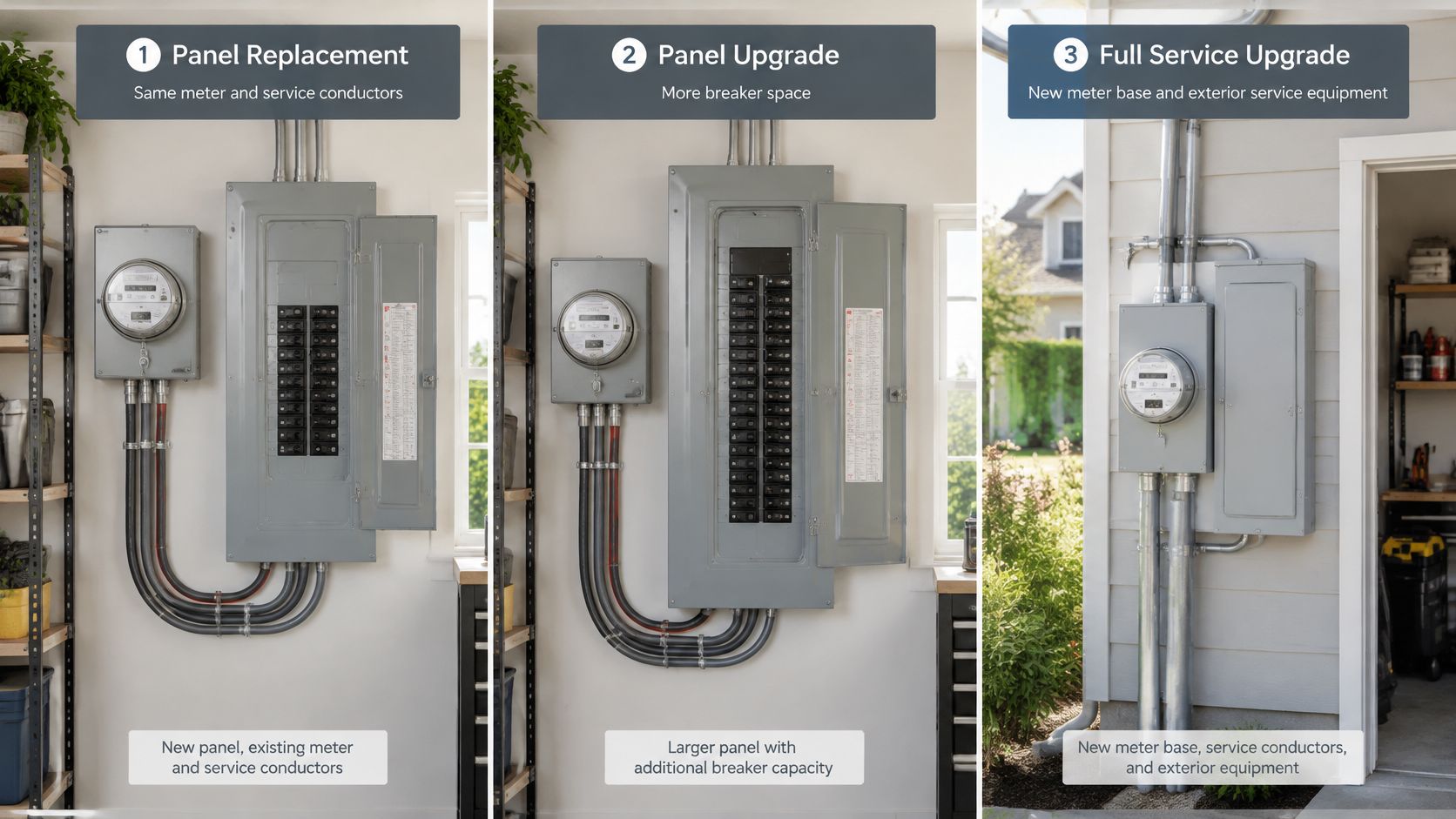
Scope Options for a 200-Amp Project
Option | When it fits | What it does not solve |
|---|---|---|
Panel replacement only | Meter, service conductors and utility service are adequate | Utility capacity and an undersized service entrance |
Full service replacement | Service conductors, meter base or entrance are undersized or unsafe | Utility scheduling and the transformer check still apply |
Load management on 100-amp service | Calculated simultaneous demand stays within 100-amp limits | High simultaneous loads such as EV charging while a heat pump runs |
A panel replacement only makes sense when everything upstream is already adequate and the panel itself is the problem. Residential electrical upgrades can replace aging or unsafe electrical panels, and that's the right scope when the equipment is deteriorated, damaged or no longer trustworthy. What it won't do is create capacity that doesn't exist at the meter or in the service entrance.
A full service replacement is the electric service upgrade 200 amp job. The service conductors, meter base and service entrance all get sized for the new rating, along with grounding and bonding brought up to current requirements. It's more money and more coordination, but it's the only option that changes what the house can draw. Even then, the utility still has to schedule its side and confirm its equipment can support you.
Load management on the existing 100-amp service is the option most guides underplay. If your calculated simultaneous demand stays within limits, an approved energy management system can hold a charger back while the dryer or heat pump runs, then release it when there's room. You avoid the service work entirely. The trade-off is real, though. It cannot add several high loads at once, so a home planning a heat pump, a charger and an electric range together will outgrow it.
Planning for What Comes Next
Many households add solar, batteries or a heat pump conversion after the electrical work is done. A panel chosen with spare capacity and the right breaker space makes those additions simpler and cheaper later. We future-proof electrical systems so they're ready for added solar, battery backup, new equipment, or additions, which mostly means leaving room in the panel and the calculation for the next project instead of maxing out on day one.
Ask the contractor which option the calculation supports and why the other two were ruled out. If you can't get a clear answer, you're being sold a scope, not a solution.
Permits, Utility Coordination and Scheduling
The panel inside your house is only part of this job, and it's the part your electrician controls. A service upgrade can also involve meter equipment, service conductors, the attachment point where the utility's wires meet yours, the utility's transformer and distribution capacity, municipal inspection, and the utility disconnect and reconnect. Most schedule surprises come from those pieces, not from the work in your basement.
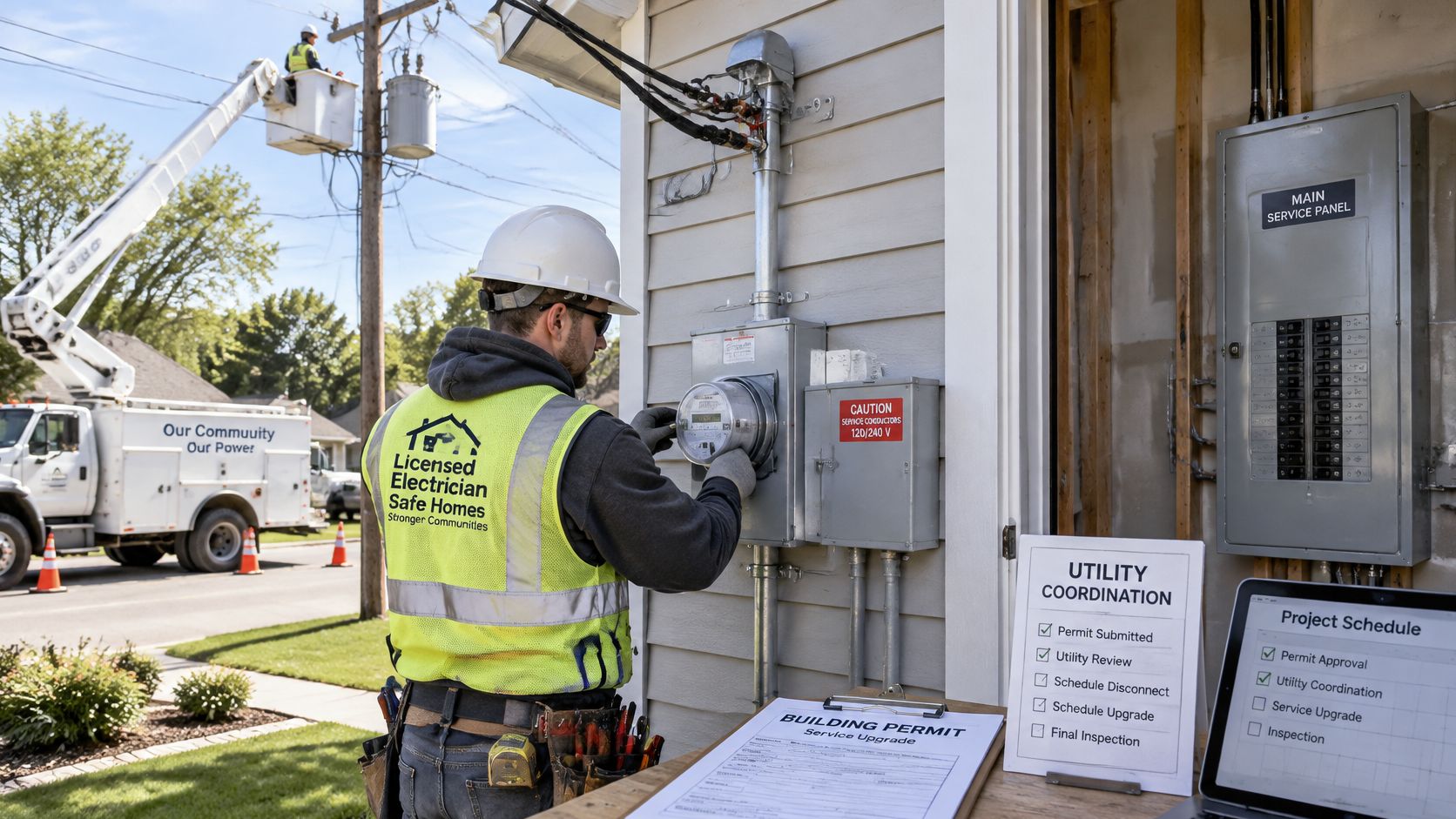
Permit fees are a good example of why you shouldn't copy numbers from another state. According to this breakdown of electrical permit costs, a 200-amp panel or service permit can range from about $79 in one Oregon state program to roughly $365 in Seattle, while Philadelphia's listed panel-upgrade permit fee is $82.50. Those fees are only one part of the project, and yours has to be confirmed with your own municipality.
Our page on the electrical panel replacement permit process covers what the application typically requires. The fee itself is minor. The review and inspection sequence is what affects your calendar.
Pre-Project Checklist
Get the written load calculation before you apply. The permit application and the utility review both lean on it.
Identify utility-owned versus customer-owned components. That split decides who pays for what and who schedules what.
Confirm permit requirements with your local municipality. Don't rely on a neighboring township's rules.
Ask whether the meter or service drop must be altered. A meter base change adds utility involvement.
Ask whether an EV charger, battery or generator triggers separate requirements. Interconnection and transfer equipment can add their own review.
The utility may also need to confirm that the neighborhood transformer and its distribution facilities can support the higher rating. Older streets weren't built for every house to charge a car and run a heat pump at the same hour. If the transformer is already loaded, your project waits on utility work that no electrician can accelerate.
A higher customer-side panel rating does not necessarily mean the grid connection is immediately available.
That's the sentence to keep in mind when a quote promises a fast finish. Ask the utility early whether its equipment can support the new rating, before you've paid for customer-side work. A project that's finished inside the house but waiting on the street is the outcome you're trying to avoid.
Timeline From Quote to Energized Service
The stages happen in a fixed order, and each one is controlled by a different party. Knowing who owns each stage tells you where the calendar can slip.
The Six Stages in Order
Load calculation and written quote. Your contractor documents the loads and the scope. Every later step depends on this being right, so rushing it costs time downstream.
Permit application and approval. The municipality reviews the panel and service design. Its lead time has to be confirmed locally, since review queues differ by township.
Utility scheduling. The utility reviews the meter, service drop and transformer capacity, then places you in its own queue for disconnect and reconnect work.
Customer-side installation. Your electrician replaces the panel or service entrance. This can sometimes proceed while utility work is still pending.
Inspection. The municipal inspector checks the completed work. The utility generally won't reconnect until the inspection passes.
Utility disconnect, meter set and reconnect. The utility energizes the new service and your electric service upgrade 200 amp is live.
The utility stage usually sets the final date. Your electrician can finish everything inside the house and then wait on the street, which is frustrating but normal. Ask each party for its current lead time in writing and build your schedule around the longest one, not the shortest promise you heard.
Plan for the outage itself, too. Power will be off while the service is changed over, so think about refrigerated food, medical equipment, working from home and anything else that can't sit dark for hours.
Don't commission the new equipment early. An EV charger, heat pump or battery should be brought online only after the new service is energized and inspected, not plugged in the day the panel goes on the wall.
What a 200-Amp Upgrade Costs
Start with the components, because a single total tells you almost nothing. Two quotes can differ by thousands and both be honest, because one includes utility-side items and the other doesn't.
Cost Components to Compare
Cost line | What drives it |
|---|---|
Home EV charging equipment and installation | Available panel capacity |
Added panel capacity | Scope of new loads being accommodated |
Permit | Your municipality's fee schedule |
Utility-side work | Meter changes, service conductors, transformer check |
The EV line moves the most. The U.S. Department of Energy evaluation of EV charging impacts and customer charging behaviors states that installing home charging equipment could add about $600 to $3,600 depending on the available electrical-panel capacity. A home with room in the panel stays near the low end. A home that needs its service increased first moves toward the top.
Added panel capacity is the second big variable. The U.S. Department of Energy residential energy-code analysis estimates that as many as 48 million U.S. households could require panel upgrades to fully electrify end uses, with an incremental panel-capacity cost of roughly $1,000 to $5,000 per installation. Read that as a typical per-installation range for making room, not a fixed price for your house. The same analysis notes that most all-electric homes require at least 200-amp service, which is why this question comes up so often in Southeastern Pennsylvania homes converting to heat pumps.
Permit fees sit in a much narrower band than equipment and labor, though they do vary by municipality. They're rarely the reason a budget breaks. Utility work is the line most often missing from early quotes, since meter changes, service conductors and transformer checks may be priced separately and can change the total after you've already committed.
It's also worth checking whether any incentive applies to your project before you sign, since our overview of the electrical panel upgrade rebate explains what to verify. Confirm eligibility yourself rather than assuming a credit will cover part of the bill.
A Simple Budgeting Method
Start with the labor and equipment quote: Make sure it names the panel, meter equipment and service entrance work included.
Confirm the utility items: Ask directly which ones are in the price and which are billed separately.
Add your permit line: Use your municipality's actual fee, not an average from another state.
Hold a contingency: Set money aside for a utility-side surprise you can't see yet.
Compare quotes on the same scope, not on the total price alone. A quote covering only the panel swap is incomplete if the service entrance or utility items are excluded, and it'll look cheaper right up until the change order arrives.
Book a Load Assessment Before You Sign
You can make the first conversation far more useful with an hour of preparation this week. Contractors give better answers when you hand them facts instead of a general description of the house.
What to Gather First
Panel label details: Photograph the label inside the panel door showing the main breaker rating and panel bus rating.
Panel face and open slots: A clear photo with the door open shows breaker arrangement and available spaces.
Meter base and attachment point: Photograph the meter and where the service drop attaches to the house.
Planned loads with run times: List each one and when it runs, such as a charger overnight, a heat pump through the day, or a future battery.
That last item matters more than people expect. Two large loads that never run at the same time produce a very different calculation from two that overlap every evening. Bring your actual habits, not the equipment brochure.
Three Questions for Every Bidder
Will you provide a written load calculation listing the loads and demand factors? This is the document everything else rests on.
Which upgrade items are utility-owned and which are customer-owned? This tells you where separate charges and delays can appear.
Which permits and utility steps are included in your price? This is how you find out whether you're comparing the same job.
Compare bids only on the same scope. A quote that leaves out meter work or a transformer check isn't cheaper, it's shorter. When the scopes match, price differences usually come down to equipment choices, panel size and how much future capacity is built in, and those are worth discussing openly.
Amp'd Energy Solutions is a licensed electrical contractor serving Southeastern Pennsylvania, and our electricians are licensed. We offer a free consultation in which we review your current setup and walk through panel upgrade or full service replacement options for your electric service upgrade 200 amp project. You can call 267-450-6992 or email sales@ampd.life to schedule that consultation or request a quote.
Bring the photos and load list to that conversation and you'll get a straight answer on whether you need the full upgrade, a panel replacement, or load management instead. I'd rather tell you the smaller job works than sell you capacity you'll never use.
Confirm the load calculation before agreeing to any scope or price.
If you're planning an electric service upgrade 200 amp for a charger, heat pump or battery in Southeastern Pennsylvania, start with a documented load assessment so you're buying capacity you'll use. Visit Amp'd Energy Solutions to schedule a free consultation and get your current service reviewed before you commit to a scope.
Comments