

Dedicated Circuit Cost: What Homeowners Really Pay
A basic dedicated circuit installation in the United States typically costs roughly $250–$900, while an EV charger's circuit portion usually runs about $300–$1,000 because Level 2 charging generally requires a 240-volt installation. The difference comes down to what the electrician has to install, where the wiring must travel, and whether your existing electrical system can support the load.
You may already have a charger picked out and a parking spot ready, only to discover that the installation quote is harder to pin down than the equipment price. For a Southeastern Pennsylvania homeowner, the useful question isn't just what a circuit costs. It's what your quote includes, what the contractor has checked, and what could change after work begins.
Table of Contents
Why Two Quotes for the Same Charger Can Differ by $1,500 - Compare the scope before the total - Treat an online range as a screening tool
The Six Cost Drivers Behind Every Dedicated Circuit Quote - Separate installation effort from infrastructure work - Read permit terms as carefully as material terms
Dedicated Circuit Cost by Load Type - Typical Dedicated Circuit Cost by Load Type - Buy the equipment and circuit as a coordinated project
How Distance and Routing Multiply the Price - Measure a buildable path - Understand why longer runs change more than wire quantity
When the Panel Becomes the Project - Ask for the calculation behind the recommendation - Know when an upgrade is unavoidable
Building a Realistic Estimate Before the Site Visit - Gather the equipment and route information - Record visible panel details safely
Pulling the Numbers Together for Your Project - Build a budget around a defined scope
Why Two Quotes for the Same Charger Can Differ by $1,500
You ask for an estimate, then compare it with your neighbor's installation. Same charger, similar garage, noticeably different price. Before assuming someone is charging too much, compare the electrical work behind each proposal.
A dedicated circuit is a separate electrical branch circuit serving a single high-demand load, such as an EV charger, electric range, dryer, or hot tub. The equipment at the end of the wire is only part of the project. The contractor also has to evaluate the supply, select the circuit components, and establish a workable route.
Compare the scope before the total
A lower proposal might assume accessible wiring and sufficient panel capacity. A higher proposal might include an exterior conduit route, permitting, or electrical work that the other contractor hasn't evaluated yet. Neither number tells you much without its assumptions.
Ask each contractor to identify:
The starting point: Which panel will supply the circuit, and has its capacity been evaluated?
The proposed route: Where will the wiring travel, and will finished surfaces need to be opened?
The endpoint: Does the proposal include the charger, its connection, or only the circuit?
The exclusions: Who handles wall repairs, permit fees, and additional work if concealed conditions change the plan?
Practical rule: Compare completed scopes, not isolated totals. A cheaper proposal with unresolved assumptions isn't necessarily a cheaper finished project.
Treat an online range as a screening tool
A national price range helps you recognize a straightforward circuit installation. It doesn't establish the price of a particular Pennsylvania property.
A garage beside a suitable panel presents a different job from a detached garage reached through finished living space. Even neighboring houses can have different electrical services, existing loads, and accessible wiring paths.
That's why a site assessment matters. A useful estimate should describe the actual installation rather than attach a price to the charger model. If a contractor hasn't reviewed the panel or discussed the route, treat the number as preliminary.
The Six Cost Drivers Behind Every Dedicated Circuit Quote
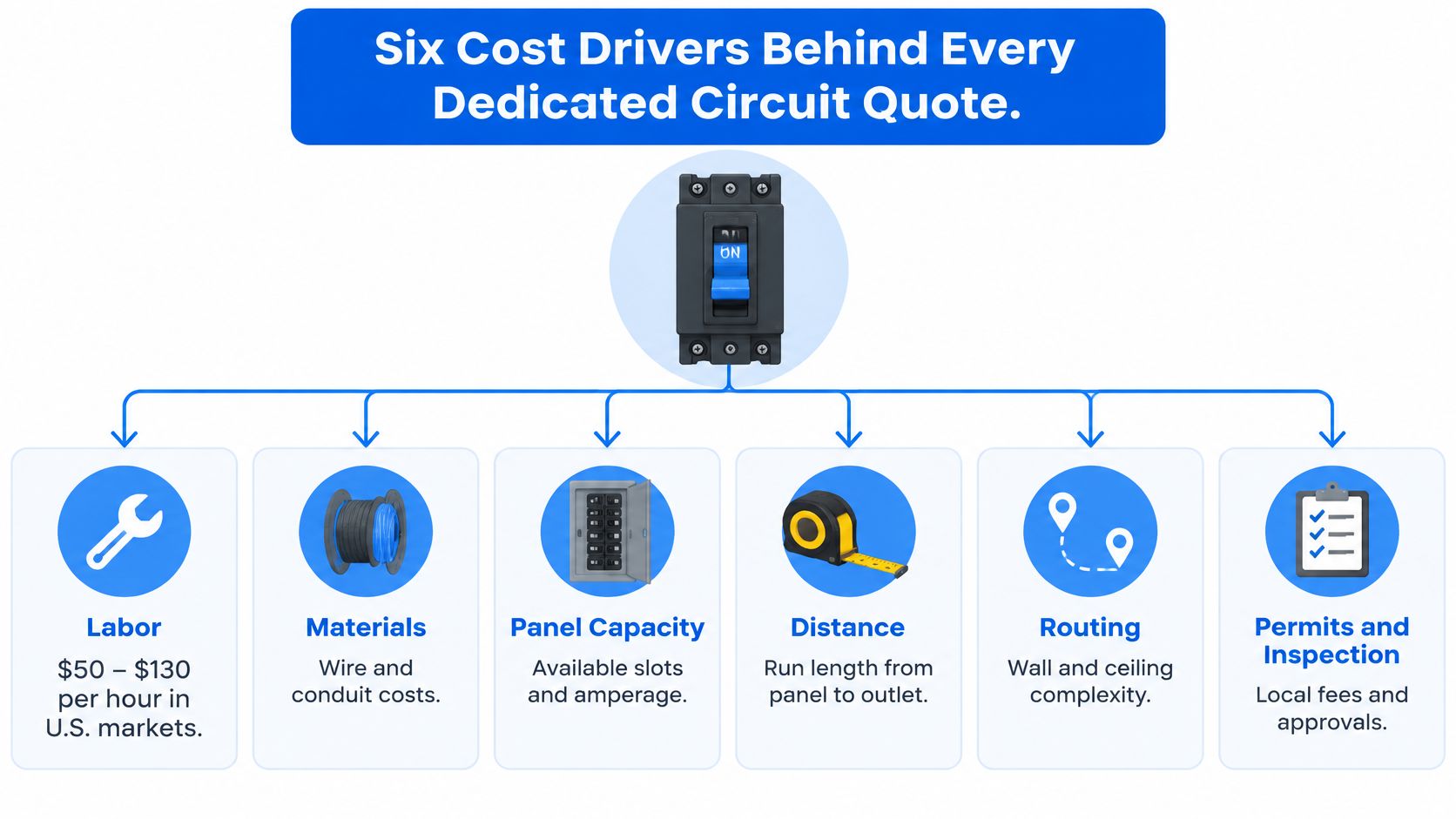
A contractor builds a dedicated circuit cost from materials, installation effort, approvals, and any changes needed to the existing electrical system. These categories overlap, so don't assume every listed factor becomes a separate surcharge.
Separate installation effort from infrastructure work
The national baseline of $250–$900 reflects differences in amperage, wire length, accessibility, breaker selection, and local labor costs; the same guide places rough-in electrical labor at approximately $50–$130 per hour, according to this electrical wiring cost breakdown.
Use these categories to read a proposal:
Labor: Accessible work and difficult concealed routing aren't equivalent. Ask what installation conditions the labor allowance assumes.
Materials: The breaker, conductors, conduit, fittings, and connection equipment should match the planned load and location. An outdoor installation may require a different material package from an interior one.
Permits and inspection: Ask whether the contractor includes applications, fees, inspection scheduling, and any required return visit.
Distance and routing: Cable length affects materials, while access affects how the electrician installs them. A short concealed route can be harder than a longer exposed route.
Existing panel capacity: The electrician must evaluate both the physical arrangement and the electrical demand.
Panel or service changes: If the existing supply can't support the project as proposed, that work belongs in a clearly identified additional scope.
Read permit terms as carefully as material terms
For Southeastern Pennsylvania projects, ask which township or borough requirements apply to your address. Don't assume a permit allowance includes every inspection-related task, or that neighboring municipalities follow identical procedures.
A well-written quote should distinguish included work, allowances, and exclusions. An allowance is a budget assumption, not necessarily a fixed final charge. If the permit cost hasn't been confirmed, the proposal should say how the actual fee will be handled.
Also clarify restoration. Opening a finished ceiling to install wiring and repairing that ceiling are different tasks. Get responsibility for patching and painting in writing rather than discovering the gap after installation.
The strongest quote isn't necessarily the longest. It's the one that lets you understand what the contractor will deliver and which conditions could change the price.
Dedicated Circuit Cost by Load Type
The load type establishes the starting requirements, but it doesn't create a reliable appliance-by-appliance price list. A range, dryer, spa, and charger can require different circuit designs, even when homeowners describe all of them as “a new outlet.”
For EV charging, national planning estimates place the dedicated circuit or outlet portion at $300–$1,000 and a complete home Level 2 installation at roughly $1,200–$2,500 before incentives, with permits estimated separately at $50–$350, according to this EV installation cost guide.
Typical Dedicated Circuit Cost by Load Type
Load Type | Voltage | Circuit Cost Range | Common Notes |
|---|---|---|---|
Level 2 EV charger | Generally 240 volts | EV-specific planning range noted above | Keep circuit pricing separate from charger hardware and electrical-system changes. |
Electric range | Confirm the appliance requirements | Site-specific quote | Supply the exact appliance specifications before comparing proposals. |
Electric dryer | Confirm the appliance requirements | Site-specific quote | Identify the intended installation location and existing connection. |
Hot tub or spa | Confirm the equipment requirements | Site-specific quote | Exterior routing and connection conditions need to be evaluated. |
Other high-draw appliance | Equipment-dependent | Site-specific quote | Don't assume an existing nearby receptacle establishes a suitable circuit. |
The table deliberately avoids assigning unsupported price bands to individual appliances. A general circuit range isn't an appliance-specific guarantee, and voltage alone doesn't determine the installed cost.
Buy the equipment and circuit as a coordinated project
Send the contractor the manufacturer's installation information before finalizing the scope. A product name or photograph of the front of an appliance doesn't communicate every electrical requirement.
For a charger, specify whether you want the contractor to supply the equipment or install equipment you've purchased. Ask whether the quote covers the complete working installation or ends at a circuit connection point.
For other appliances, identify any existing wiring the contractor is expected to reuse. Don't count that reuse as a saving until it has been evaluated.
An electrical load assessment and calculation helps establish whether the proposed load fits the property's electrical system. That question should be resolved before treating the equipment purchase and circuit installation as separate decisions.
Choose the circuit for the actual load, not for an assumed appliance category. That keeps a seemingly simple purchase from turning into an avoidable change order.
How Distance and Routing Multiply the Price
Measure the path the wiring can follow, not the distance between the panel and charger across the floor. The practical route may rise into a ceiling, turn around an obstruction, cross a basement, and then exit through an exterior wall.
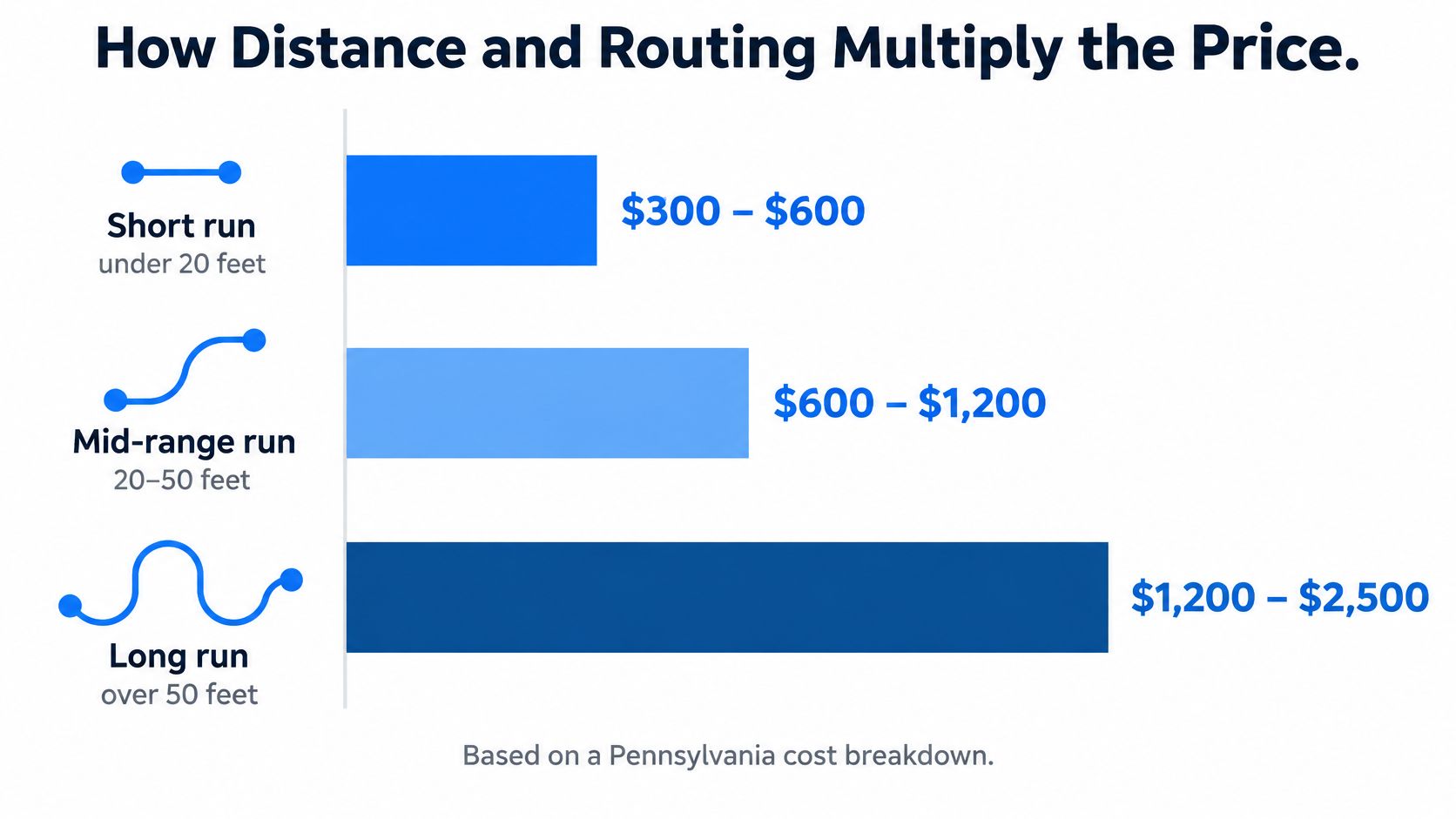
A Pennsylvania cost breakdown places runs under 20 feet at approximately $300–$600, 20–50 feet at $600–$1,200, and 50–100 feet at $800–$2,500; those estimates accompany the broader guidance on circuit length and wall access in this home electrical-readiness resource.
Measure a buildable path
Start at the panel and sketch the likely route to the intended connection. Include vertical travel and changes in direction. Mark where the route passes through finished ceilings, masonry, crawlspaces, attics, or exterior surfaces.
Then identify the practical choice you're asking the contractor to make:
Concealed routing: You may prefer the appearance, but ask what access openings and restoration it involves.
Exposed routing: An accessible surface route may avoid opening finished areas, although you should agree on its appearance and location.
A different equipment position: Moving the endpoint may simplify the installation, provided it still works for parking or appliance use.
The shortest route on a sketch isn't always the least expensive route to install. Access matters as much as distance.
Understand why longer runs change more than wire quantity
Longer routes add material and installation effort. They can also require the electrician to consider voltage drop and select larger conductors, which affects material cost and the space needed within conduit.
Exterior and detached-building installations introduce additional questions about the route, equipment exposure, and suitable installation materials. Don't ask for a flat price per foot without also describing those conditions.
A useful preliminary sketch doesn't need construction-level detail. Its purpose is to show the contractor where the obvious obstacles are and where alternative paths might work.
Leave the final conductor selection and routing approval to the electrician. Your contribution is accurate information about access and preferences, not an attempt to engineer the circuit before the assessment.
When the Panel Becomes the Project
Available breaker space and available electrical capacity are different questions. A panel can appear to have room for another circuit without having sufficient calculated capacity for the proposed load.
A Pennsylvania installation analysis reports a median installed EV-charging cost of $1,096 without panel work, compared with $2,744 when a panel upgrade is required, using a benchmark based on residential charging cost data. It also places a panel upgrade allowance at approximately $1,500–$3,000, as described in this Pennsylvania home charging installation analysis.
Ask for the calculation behind the recommendation
An older service, or one already supplying substantial heating, cooling, cooking, and water-heating loads, may not have enough capacity for continuous EV charging. That doesn't mean every older home automatically needs a replacement panel.
The contractor should explain what the assessment establishes:
Finding | What the proposal should address |
|---|---|
Suitable capacity and usable circuit space | The dedicated circuit installation itself |
Capacity is available, but the panel arrangement needs work | The specific panel or distribution changes proposed |
Calculated capacity is insufficient | A service change, load-management approach, or revised charging plan |
Existing information is incomplete | Further assessment before committing to a final scope |
A subpanel can be part of a distribution solution, but don't treat it as proof that the home has additional supply capacity. Ask what limitation the proposed equipment solves.
Know when an upgrade is unavoidable
If the load calculation doesn't support the requested charging arrangement, adding a breaker alone isn't an acceptable substitute. The design must change, whether through an appropriate load-management solution, different equipment settings, or a service upgrade.
If the proposed load still can't be accommodated after suitable alternatives are evaluated, the electrical supply needs to be upgraded before proceeding as planned. That decision should follow the assessment, not a blanket claim that every charger requires a new panel.
Use this electrical panel upgrade cost guide to prepare questions about the infrastructure portion of the quote.
Before signing: Request a documented explanation of why panel or service work is required and what alternatives were considered.
Keep the circuit-only scope and the infrastructure scope distinguishable. That makes a substantial quote easier to evaluate without pretending the necessary work is optional.
Building a Realistic Estimate Before the Site Visit
You don't need to open the electrical panel or select wire sizes to prepare for an estimate. Your job is to collect the information that lets the contractor assess the project without guessing.
Gather the equipment and route information
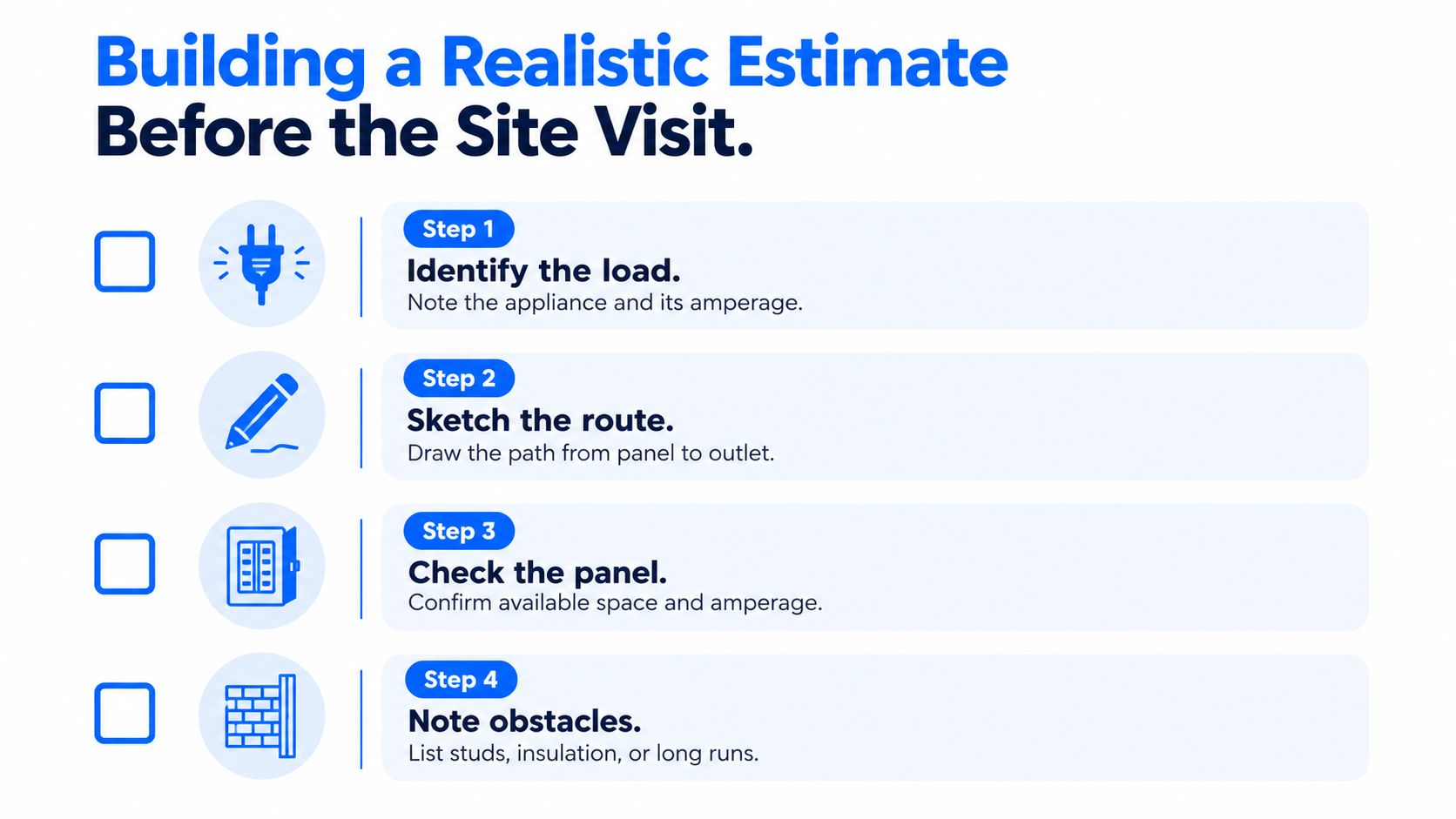
Begin with the actual appliance or charger specifications. Record its stated electrical requirements and send the installation documentation with your estimate request. If you haven't chosen the equipment, say so.
Next, sketch the proposed route and note its approximate measured length. Take photographs of the intended equipment location, accessible route areas, and visible obstacles. Mark whether you prefer concealed wiring or would consider an exposed installation.
For a charging project, review the decisions involved in a Level 2 EV charger installation before choosing the final mounting location.
Record visible panel details safely
Photograph accessible labels and the panel exterior. Note the rating if it's clearly identifiable, but don't assume an unfamiliar label tells the whole story.
Don't remove the panel cover or reach inside. Apparent open spaces and visible breaker labels are useful preliminary information, not a homeowner load calculation.
Contact your township or borough office to ask about permit requirements and inspection sequencing. Then confirm with the contractor who will handle those tasks and whether their price includes them.
Bring this checklist to the assessment:
Equipment information: Manufacturer's specifications and intended operating requirements.
Panel details: Accessible photographs, visible rating, and any known previous electrical work.
Route sketch: Approximate installed path and preferred endpoint.
Access conditions: Finished surfaces, exterior sections, masonry, and difficult spaces.
Project boundaries: Equipment supply, permits, inspections, and surface restoration responsibilities.
Better inputs won't eliminate every concealed condition. They will help the contractor separate a reasonable fixed scope from work that needs further investigation.
Ask for any unresolved assumptions to appear in the written proposal. That's more useful than receiving a confidently precise number based on incomplete information.
Pulling the Numbers Together for Your Project
Different quotes for the same charger aren't automatically evidence of inconsistent pricing. They may reflect different routes, different infrastructure assumptions, or different definitions of a completed installation.
The comparison becomes meaningful when each contractor addresses the same equipment, endpoint, electrical assessment, and permit responsibilities. If the proposals still differ, ask the contractors to explain the installation methods rather than negotiate the total.

Build a budget around a defined scope
Keep the project organized into distinct decisions:
The required installation: The work needed to connect the selected equipment at the agreed location.
Conditional electrical work: Changes supported by the panel assessment and documented calculations.
Owner preferences: Concealed routing, equipment placement, and restoration choices that affect the scope.
For EV projects, ask about applicable federal incentives, but don't subtract an assumed credit from the contractor's bill. Eligibility, eligible expenses, and applicable rules need to be confirmed separately. Treat the installation price and potential tax benefit as different parts of your planning.
In Southeastern Pennsylvania, a defensible budget comes from a measured route, a verified electrical assessment, and confirmed local approval requirements. Online averages help you prepare for that conversation; they don't replace it.
The most useful dedicated circuit cost is a price tied to a clear, buildable scope. Before authorizing work, make sure you understand what's included, what remains conditional, and who is responsible for completing each part of the project.
Amp'd Energy Solutions offers dedicated-circuit planning and installation for EV charging, along with panel-readiness assessments and electrical service upgrades in Southeastern Pennsylvania. Visit Amp'd Energy Solutions to request a site assessment, and have your equipment specifications, panel photographs, and proposed route ready so the team can develop a quote around your property's actual requirements.
Comments