

Electrical Design Consulting: What It Is and Why It Matters
You've picked out an EV charger, battery, or generator, then discovered the electrical panel may not support it as planned. Perhaps an installer has mentioned a service upgrade, or a permit reviewer wants drawings you weren't expecting. That's where electrical design consulting earns its keep: it turns an equipment idea into a coordinated plan that fits the property, the intended use, and the approval process.
For homeowners, businesses, and contractors in Southeastern Pennsylvania, the job isn't just to produce paperwork. A thoughtful design can show when a service upgrade is necessary, when managed charging can avoid one, and what to resolve before installation begins.
Table of Contents
What Electrical Design Consulting Actually Does - Design first, installation second - Where early scoping matters most
The Core Deliverables a Consultant Produces - The calculations that establish capacity - Drawings that guide construction
How a Consultant Assesses and Plans Your Project - Start with the site and the operating goal - Calculate, select, and document
Modeling Coincident Load Before You Buy Equipment - Model actual demand, not just equipment labels - Decide whether to upgrade or manage
Code Compliance, Permits, and Utility Coordination - Prepare the permit package around the work - Coordinate with the utility before scheduling the work
The Real Benefits for Homeowners, Businesses, and Contractors - Value shows up before and during construction
What Electrical Design Consulting Actually Does
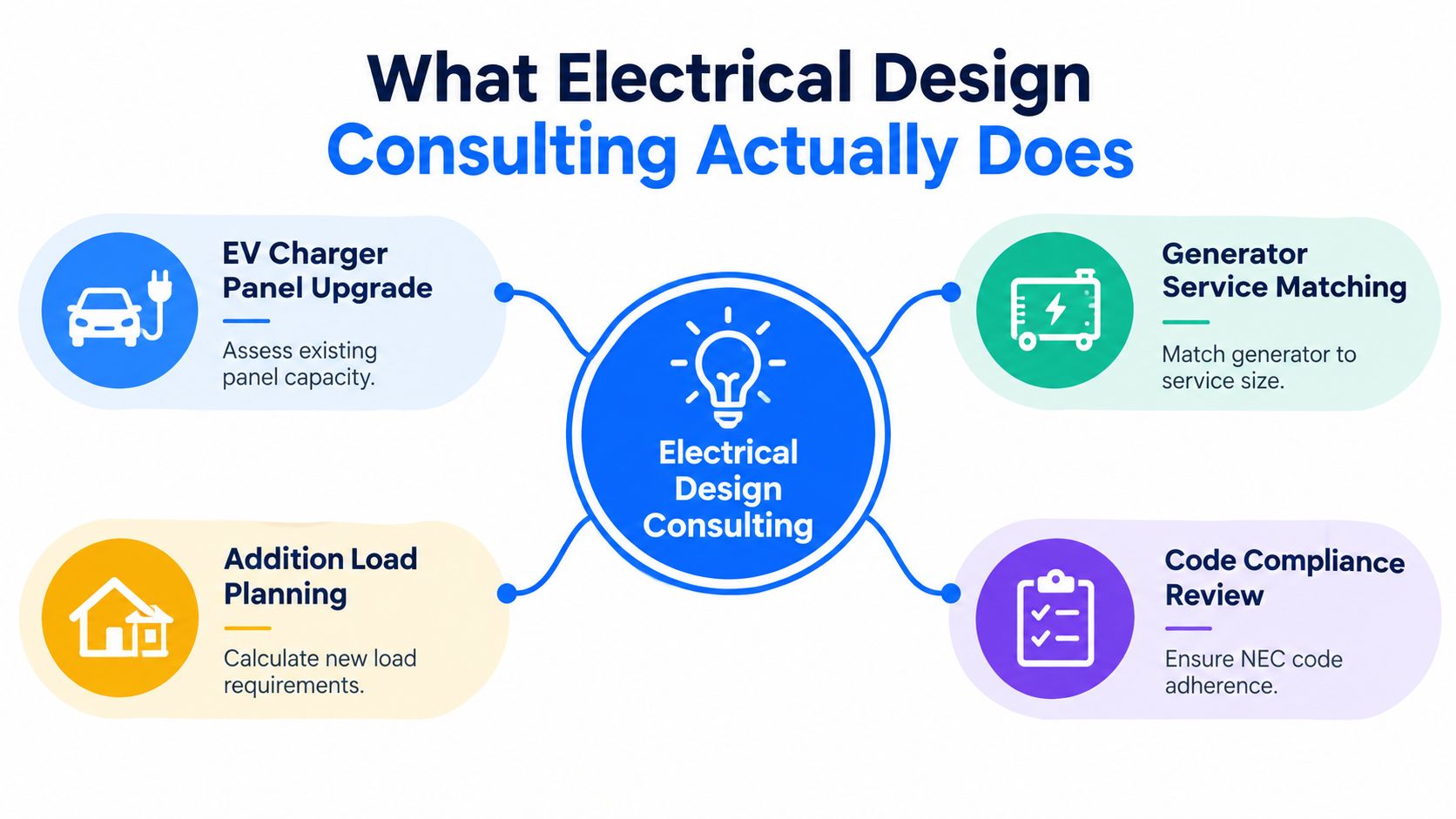
A project often hits its first snag before anyone pulls a wire. The charger needs more capacity than the panel can provide, the generator doesn't match the intended backup loads, or a planned addition pushes demand beyond what the existing service can handle. Electrical design consulting connects the future load, selected equipment, existing infrastructure, and applicable code requirements so the installation can be scoped before construction begins.
Design first, installation second
An installer builds the system in the field. A consultant determines what that system needs to be: how much capacity the equipment requires, whether the existing service can support it, how circuits and protective devices should be arranged, and what drawings or calculations are needed for permitting and construction.
The work commonly starts with a review of existing conditions, followed by load calculations, equipment selection, and design documents. For a homeowner adding a Level 2 charger, that might mean checking panel and service capacity, then weighing a dedicated circuit against managed charging or a service upgrade. For a business, it may mean planning charging alongside building loads, or defining which circuits a battery and generator should support.
Practical rule: Don't choose the equipment first and ask whether the electrical system can accommodate it afterward. Establish the project's loads and operating goals before locking in a purchase.
Where early scoping matters most
The need for consulting tends to grow when a project combines several high-demand systems, requires a service change, or depends on reliable backup. Electrical-engineering services are part of a large and expanding global market: Grand View Research estimates approximately US$921.1 billion in global electrical-engineering services revenue in 2024 and projects a 4.6% compound annual growth rate through 2030, reaching about US$1.1975 trillion; the report identifies Asia-Pacific as the largest regional market in 2024 (Grand View Research's electrical-engineering services market estimates). The category covers more than design alone, but the scale underscores how central electrical planning is to infrastructure and building projects.
In Southeastern Pennsylvania, early coordination can help avoid a design that looks workable on paper but stalls when local permitting or utility requirements enter the picture. A complete scope gives homeowners a clearer buying decision, helps businesses plan around operating needs, and gives contractors a buildable design instead of leaving key decisions to the field.
The Core Deliverables a Consultant Produces
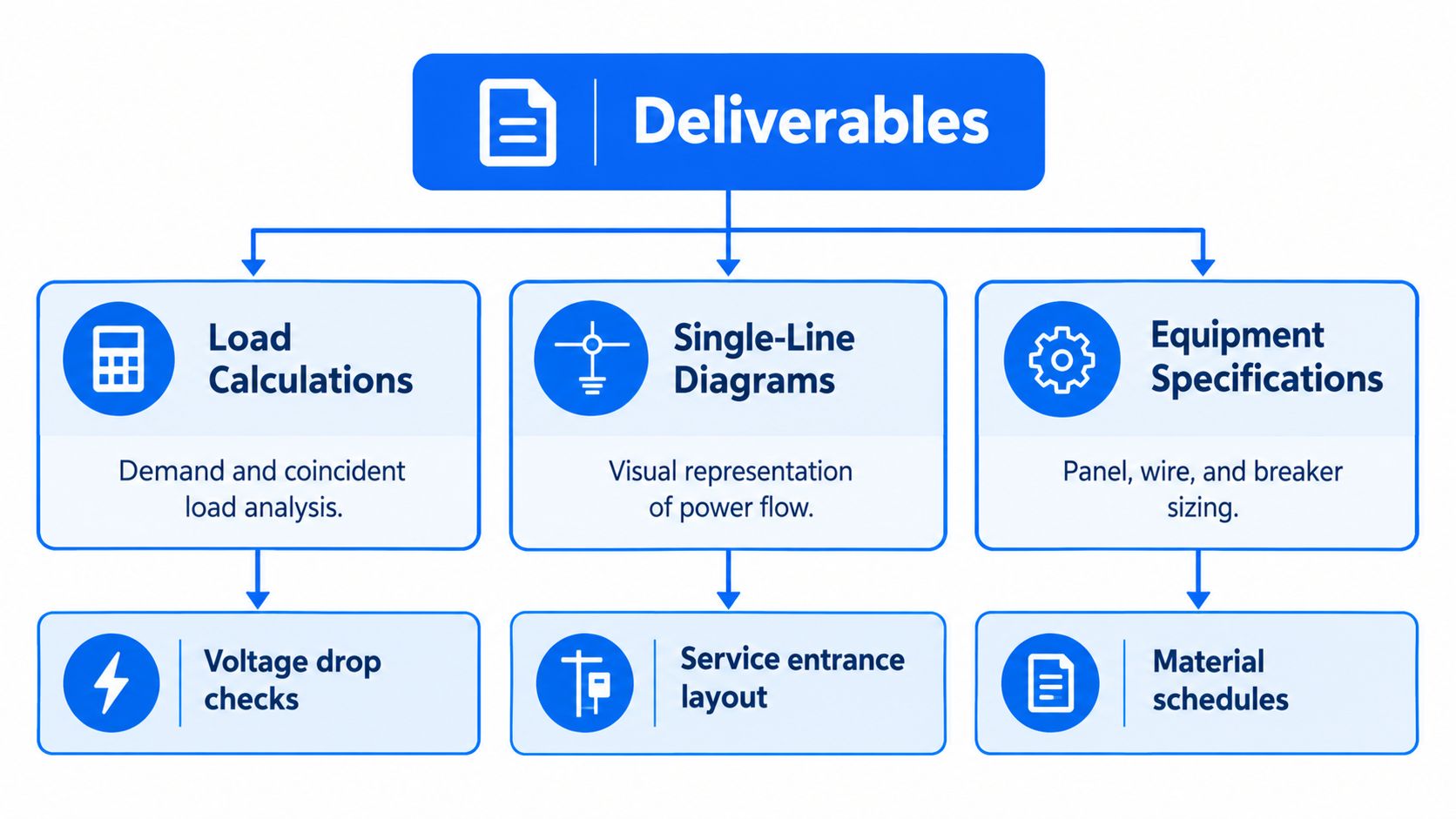
A useful design package is more than a quote or a sketch of where equipment might go. It gives the owner, installer, and reviewer enough information to understand the electrical approach and identify conflicts before construction. Ask for the deliverables by name, then confirm they match the scope of work.
The calculations that establish capacity
A load calculation documents the electrical demand the system is expected to serve and compares it with available service and equipment capacity. For an EV project, the calculation should address both existing building demand and the charger load. For backup power, it should distinguish the loads the owner wants to run from those that can be shed or delayed.
A calculation helps prevent a common downstream problem: selecting equipment or conductors based on an assumption that doesn't hold once the actual loads are considered. If a project depends on managed charging or staged backup, the design should state those operating assumptions rather than treating them as guaranteed.
Drawings that guide construction
A single-line diagram shows the major electrical components and how power flows between them. Depending on the project, it can represent the utility service, main distribution equipment, protective devices, transfer equipment, generator or battery, and the panels or loads they serve. It gives the installer and reviewer a shared view of the system, which is especially useful when several sources of power or distribution points are involved.
Equipment schedules and specifications identify the intended equipment and its electrical requirements. They help prevent substitutions that don't match the design, such as a breaker or transfer device with unsuitable ratings. The construction documents should also clarify conductor sizing, protection, connection details, and any relevant installation requirements.
For a broader picture of what a documented property review can include, see this electrical assessment report overview.
Before approving a proposal, check that it identifies which calculations, drawings, and specifications are included, as well as whether revisions for permit comments or field changes are covered. A design that leaves equipment ratings or operating assumptions unclear can shift decisions back to the installer at the point when changes are most disruptive.
How a Consultant Assesses and Plans Your Project
Good planning begins with the actual property and the way its occupants intend to use it. A consultant shouldn't size a charger, battery, or generator from a brief product description alone. The assessment needs to connect existing conditions with future demand and the owner's priorities.
Start with the site and the operating goal
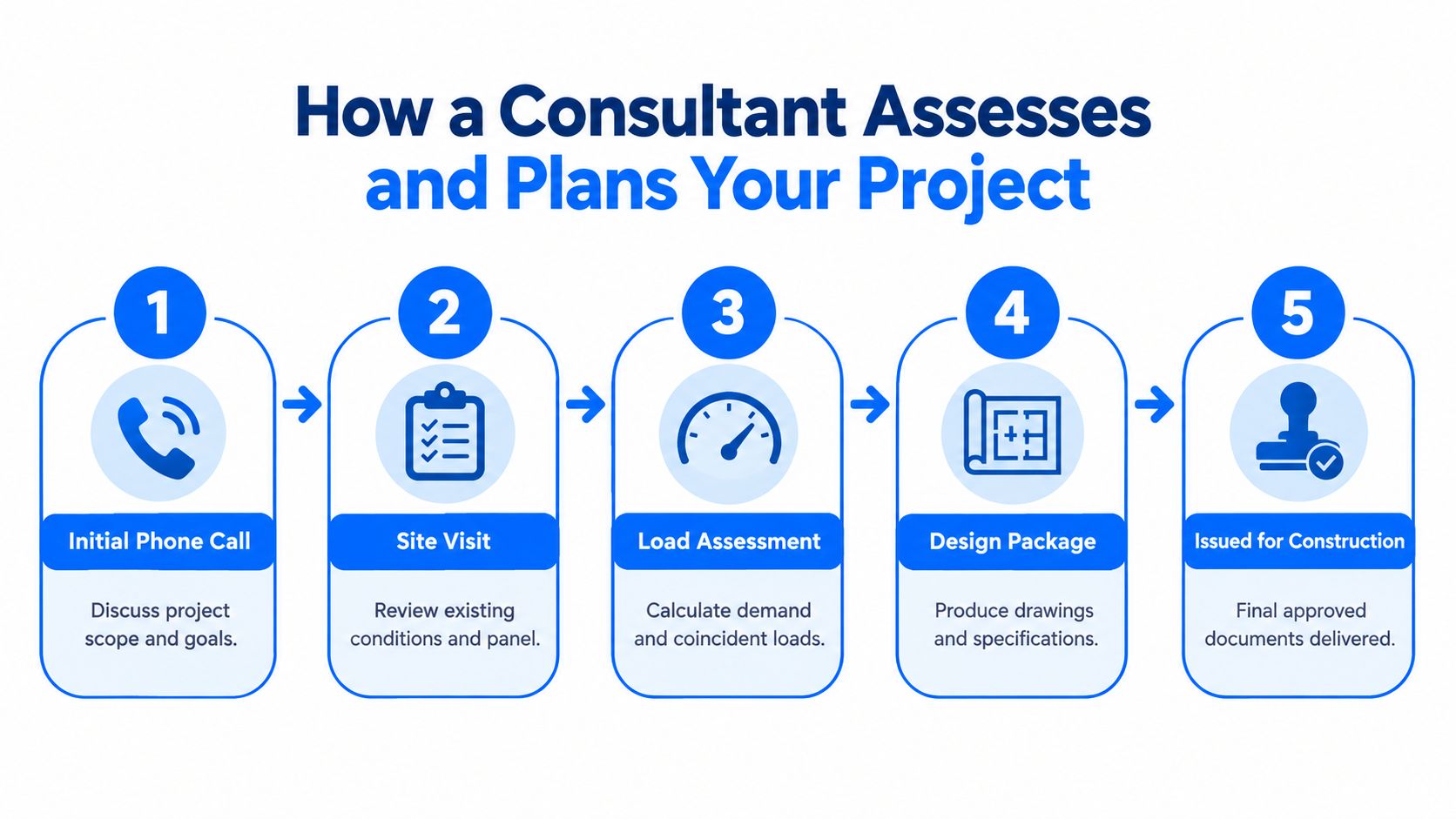
The first conversation should establish what the project must accomplish. A homeowner planning a Level 2 charger needs to explain expected charging use and where the vehicle will park. A small business considering battery-and-generator backup needs to identify what must stay operational during an outage, how long continuity matters, and whether some loads can pause.
The site review then checks existing equipment and the physical route for the proposed work. The consultant may need panel and service information, equipment labels, available drawings, and access to the location of the proposed charger, battery, generator, or transfer equipment. Missing records aren't unusual; field verification helps replace assumptions with observed conditions.
Calculate, select, and document
With the site information in hand, the consultant models existing and proposed loads. For the charger, that means considering the service, panel, feeder, and intended charging operation. For backup, it means distinguishing starting demand from running demand and sorting loads by priority. Equipment selection follows the load analysis, not the other way around.
The consultant then prepares the drawings and specifications that the installer can use. A permit-ready package should make the intended connections, protective devices, equipment ratings, and operating strategy understandable to the people reviewing and building the project. If the owner changes the equipment or adds loads, the design may need to be revisited.
A well-run planning process leaves the client with clear answers:
Existing conditions: What service, panel, and distribution equipment are already in place?
Design assumptions: Which loads are included, and what operating controls does the design rely on?
Installation scope: What equipment, circuits, and construction work are needed?
Approval path: What documents are expected for the applicable permit and utility review?
Handoff: Can the installer build from the package without guessing at critical ratings or connections?
The final milestone isn't a stack of drawings. It's a design that reflects the site, the client's operating priorities, and the realities of construction.
Modeling Coincident Load Before You Buy Equipment
Adding charger nameplate ratings to a building's service and treating that total as the project load can lead to an unnecessary upgrade. The better question is how much building and charging demand will occur at the same time. A site can use plenty of energy over a month and still have a short period when the combined load strains a service, feeder, or transformer.

Model actual demand, not just equipment labels
For EV charging, the analysis should consider facility demand, vehicle arrival and departure patterns, required energy delivery, charger power, panel capacity, feeder limits, and transformer loading during the site's highest combined-demand interval. The National Renewable Energy Laboratory recommends evaluating maximum charging power across the EVSE and identifying the site's coincident peak, when building and charging loads are simultaneously highest (NREL's guidance on coincident EV charging loads).
That analysis can show whether simultaneous charging would require an electrical upgrade or whether a managed-charging system can hold the chargers within a defined power ceiling. Managed charging can shift charging to lower-cost periods, reduce the combined facility and EV peak, and help avoid overloading equipment. It also needs a failure plan: the design should say what happens if communications or load-management controls aren't available.
Decide whether to upgrade or manage
Federal energy-code guidance distinguishes between EV-capable spaces and spaces designed around energy management. It provides for a calculated EV load of at least 2.1 kVA per space where energy management is used; without that approach, EV-capable spaces use 7.2 kVA or the equipment nameplate rating, whichever is larger (federal energy-code guidance for EV charging). Those values aren't a substitute for a project-specific analysis, but they show why the design approach matters.
A service upgrade is usually the stronger choice when the existing infrastructure can't safely support the required loads, when the owner needs chargers to operate simultaneously at full power, or when future demand would make managed limits unacceptable. Managed charging, load sharing, or phased installation can make more sense when charging can be scheduled and the service can support the controlled demand. In either case, plan pathways and distribution capacity for likely expansion.
For a deeper explanation of how the service and proposed loads fit together, review this guide to electrical load assessment calculations. The practical aim is not to avoid every upgrade. It's to avoid paying for an upgrade that a properly designed operating strategy could have made unnecessary.
Code Compliance, Permits, and Utility Coordination
A design becomes buildable only when it fits the applicable electrical requirements and can move through the relevant approval process. In Southeastern Pennsylvania, the details depend on the municipality, project scope, and utility service. A regional consultant can help identify those requirements early, but the owner should still expect the local authority and utility to make their own review decisions.
Prepare the permit package around the work
The design review should identify the applicable code requirements and show how the proposed equipment and connections address them. A service upgrade may need a different approval path from a dedicated charger circuit. Backup power can add transfer equipment and interconnection details that reviewers need to understand.
A permit package may include drawings, equipment information, load calculations, and details of the proposed work. If the submission doesn't explain the design clearly, reviewers may ask for revisions, delaying the start of construction. For panel work, this electrical panel replacement permit guide can help property owners understand why permit requirements belong in the scope from the outset.
Coordinate with the utility before scheduling the work
When the project changes the service, the utility's requirements and timing matter alongside the municipal permit. The consultant should determine what information the utility needs and coordinate the service details before an installer commits to a construction sequence. Waiting until the permit is approved to begin utility coordination can create avoidable scheduling pressure.
A permit approval doesn't automatically settle the utility's requirements. Treat municipal review and utility coordination as related tasks that may have separate information needs and schedules.
The design package should also support inspection. Clear equipment ratings, circuit identification, transfer arrangements, and connection details help the inspector verify what was approved and what was installed. Ask the consultant who will respond to plan-review comments, whether revisions are included, and what must be completed before the installation can be scheduled.
How Consultants Price Their Work
Consulting proposals commonly use a flat fee, hourly billing, or a percentage of construction cost. None is automatically the right choice. The best fit depends on how clearly the scope is defined, how likely it is to change, and whether the consultant is responsible for a narrow design task or broader project coordination.
Pricing Model | Best Project Fit | Key Advantage | Watch For |
|---|---|---|---|
Flat-fee design package | A defined residential charger, panel, or backup-power scope | Clear fee tied to stated deliverables | Confirm what revisions, site visits, and permit responses are included |
Hourly consulting | Early feasibility work or a project with changing requirements | Client pays for the work actually performed | Agree on an estimate, reporting cadence, and approval process for added hours |
Percentage of construction cost | A broader project with design and coordination responsibilities | Fee scales with the overall project scope | Clarify what construction costs count and how scope changes affect the fee |
For a single-family EV charger project with a known location and straightforward scope, a flat-fee package can make budgeting easier. If the panel condition is uncertain or the owner is still deciding between an upgrade and managed charging, an hourly assessment may be more appropriate because the design direction isn't settled.
A battery-and-generator project can require more coordination, especially when the client hasn't decided which loads must remain on during an outage. In that situation, the proposal should explain whether the consultant will help define the outage objective and revise the design as equipment choices change. For a workplace-charging rollout, a percentage-based arrangement may align with broader design oversight, but only if the fee basis and responsibilities are explicit.
Compare proposals by deliverables, assumptions, exclusions, and revision terms, not just the bottom line. One proposal may include permit responses and coordination while another ends at the initial drawing package.
The Real Benefits for Homeowners, Businesses, and Contractors
A design is valuable when it helps people make better decisions before equipment is purchased and construction is underway. Homeowners can find out whether an existing panel can support a new load or whether the project needs a different approach. Businesses can define which circuits matter during an outage before choosing backup equipment.
Backup power illustrates why product capacity alone doesn't answer the question. A 2025 nationwide study of more than 500,000 U.S. households found that approximately 63% could potentially withstand local or regional blackouts with solar-plus-battery systems, but those systems would meet only about half of average electricity needs during an outage (Stanford's summary of the 2025 solar-and-battery blackout study). That finding doesn't determine what any one property needs. It reinforces the need to define the loads, duration, and recharge conditions that the system is meant to handle.
Value shows up before and during construction
A consultant can help a homeowner distinguish critical circuits from discretionary loads, prevent a business from selecting backup capacity without a clear operating target, and give a general contractor a more complete electrical scope to coordinate with the installer. Those decisions can reduce the risk of late design changes, unsuitable equipment, and permit revisions.
The value isn't a guarantee that the project will avoid every change or cost increase. It's a way to expose the important choices while they're still easier to adjust. The best design balances safety, required performance, future plans, and construction cost instead of maximizing equipment size by default.
Choosing a Regional Consultant You Can Trust
Ask how the consultant has handled projects like yours. Have they modeled coincident demand for EV charging? Can they explain the difference between a service upgrade and managed charging? For backup power, will they identify critical loads and transfer arrangements before recommending equipment?
In Southeastern Pennsylvania, ask about familiarity with PECO and Met-Ed coordination, township permit review, and the integration of EV charging, batteries, generators, and service upgrades. Request a load calculation and single-line diagram when the scope calls for them, and confirm who will address permit comments or changes in the field.
A simple appliance circuit may not need a separate consulting engagement if the existing panel has sufficient capacity and the installer can verify the conditions. A combined charger, battery, generator, or service-upgrade project deserves more deliberate planning. Before your next meeting, write down the loads you want to add, the outcome you expect, and the documents you need to make a sound decision.
Amp'd Energy Solutions assesses and installs EV chargers, Tesla Powerwall and other battery backup systems, whole-house generators, and electrical service upgrades for homes and businesses in Southeastern Pennsylvania. If you're weighing a service upgrade against managed charging or planning backup around specific loads, visit Amp'd Energy Solutions to discuss the project and its electrical requirements.
Comments