

What Is the Best Whole House Generator: A Practical Guide
The power's out, the basement sump pit is filling, and you're checking whether the heating system will restart before the house gets cold. A neighbor recommends the generator they bought. Another says you should buy the biggest unit you can afford. Neither recommendation tells you whether your electrical service, fuel supply, or property can support it.
If you're asking what is the best whole house generator, my recommendation is straightforward: choose the backup system that carries your essential loads for the outages you face. That might be a permanently installed generator. It might be a battery with load management. Don't buy either until someone checks the house.
Table of Contents
Why the Largest Generator Is Rarely the Right Answer - Match the system to the outage - Make the property drive the recommendation
Sizing the Generator to the Loads It Will Actually Run - Build the load schedule in stages - Use load management instead of buying around every appliance
Comparing Fuel Options for Whole-House Backup - Natural gas and propane require different operating plans - Diesel and batteries deserve a practical comparison
Why the Automatic Transfer Switch Changes the Whole Decision - Automatic doesn't mean uninterrupted - Full-service transfer isn't always the sensible choice
When a Battery Backup Beats a Fuel Generator - Where batteries make more sense - Where the argument shifts back toward fuel
Installation Safety and Site Constraints You Cannot Ignore - What a credible walkthrough should cover - Older homes need an electrical assessment, not assumptions
Your Decision Path to the Right Whole-House Generator - Follow the decision sequence - Evaluate the installer alongside the equipment
Why the Largest Generator Is Rarely the Right Answer
Consider a hypothetical Chester County homeowner after a prolonged winter outage. They want the furnace, refrigerator, sump pump, and internet working. But they're shopping for a generator sized to run every appliance simultaneously because a neighbor said anything smaller would be a mistake.
That's buying capacity before defining the job. The right starting point isn't the largest number on the enclosure. It's deciding what must operate, what can wait, and how long the backup needs to last.
Match the system to the outage
The distinction matters because outage averages hide very different problems. U.S. customers experienced approximately 11 hours of interruptions in 2024, nearly twice the annual average during 2014–2023; major events accounted for about 80% of interruption hours, according to EIA electricity reliability data.
A household protecting against extended storm damage has different requirements from someone who mainly wants to avoid resetting clocks and losing internet during brief interruptions. Neither should buy equipment based on national averages alone.
Backup approach | Strongest reason to consider it | Main constraint to investigate |
|---|---|---|
Managed standby generator | Essential equipment must operate through prolonged outages | Fuel availability and safe outdoor placement |
Broad-coverage standby generator | High-demand appliances genuinely need simultaneous backup | Starting capability, service integration, and total project cost |
Battery with load management | Critical loads need backup without routine engine operation | Stored energy and recharge opportunities |
Integrated battery and generator | Short interruptions and extended outages both matter | Compatibility, controls, and installation complexity |
Make the property drive the recommendation
I'd apply these filters before discussing a model:
Load: What equipment must run, including its starting demand?
Fuel autonomy: What keeps the system operating when roads or utilities are disrupted?
Transfer behavior: What happens automatically, and what still requires your attention?
Installation safety: Can the property accommodate the equipment without compromising clearances or access?
Buying rule: Pay for useful backup capability, not unused nameplate capacity.
A bigger generator can be appropriate. But the installer should be able to explain exactly which requirement justifies it. “You might need it someday” isn't a load calculation.
Sizing the Generator to the Loads It Will Actually Run
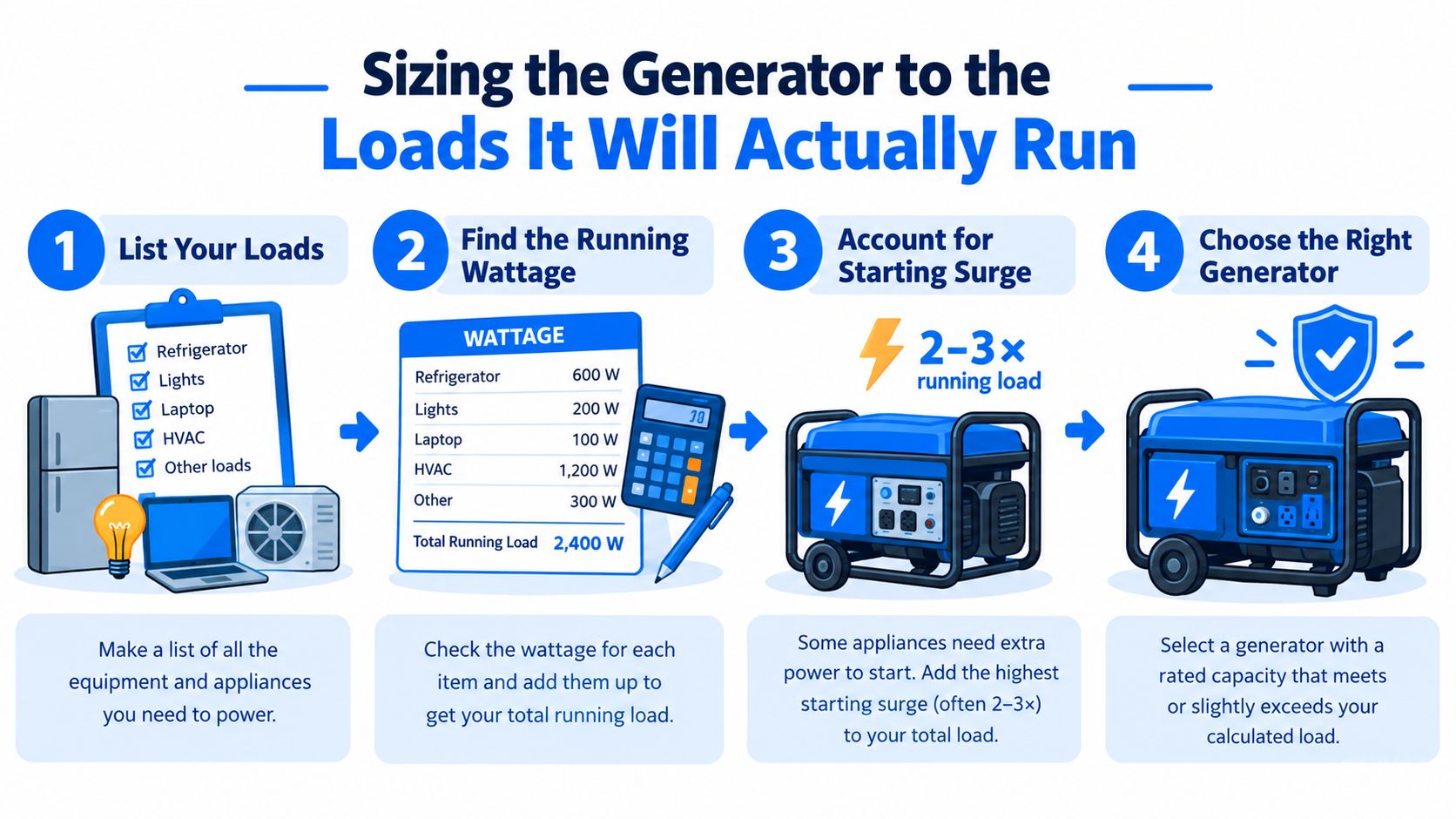
Square footage isn't a generator-sizing method. A house with fuel-fired heating and carefully managed appliances can have a very different backup requirement from a similarly sized house with electric heat, electric water heating, and vehicle charging.
Start with equipment nameplates, circuit information, and a professional electrical load assessment and calculation. The deliverable should be a written load schedule, not a capacity recommendation scribbled on an estimate.
Build the load schedule in stages
Identify operating loads. List the heating system, refrigeration, pumps, lighting, internet equipment, water heating, and cooking appliances you intend to use. Separate essential operation from convenience.
Check motor starting. A compressor or pump may need substantially more power to start than to keep running. Motor inrush can reach approximately 2.5–3.5 times rated kVA, making the largest starting event a separate sizing check, according to standby-generator sizing guidance.
Account for charging equipment. Decide whether the generator must supply an EV charger or charge a backup battery while carrying household loads. Don't let either become an unplanned addition.
Document future changes. Tell the electrician about planned heating conversions, kitchen work, or vehicle charging before approving the design.
Use load management instead of buying around every appliance
Take a hypothetical Pennsylvania home with a heat pump, electric range, and EV charger. The owners want heat, refrigeration, basement protection, and normal lighting during an outage. They don't need unrestricted vehicle charging while cooking and heating water.
An installer can evaluate controls that defer charging or other discretionary loads when essential equipment needs capacity. That may allow a smaller generator to serve the required circuits, but the actual size still depends on the calculation and starting-performance check.
Ask the installer to show which loads are shed, which receive priority, and what happens when they request power together. “Whole-house coverage” shouldn't hide those operating rules.
Oversizing adds equipment, installation, fuel, and maintenance expense without necessarily improving useful resilience. Undersizing creates the opposite problem: nuisance shutdowns or failed starts when the equipment you bought the generator to protect needs it most.
Comparing Fuel Options for Whole-House Backup
Fuel determines whether your backup system remains useful after the first stretch of an outage. Don't accept a runtime claim without knowing the load, available fuel quantity, and conditions behind it.
Fuel Options for Whole-House Backup Compared
Fuel | Typical Runtime | Refuel Need | Noise/Emissions | Best Fit Outage Profile |
|---|---|---|---|---|
Natural gas | Extended operation while adequate service remains available | No on-site tank refill, but supply and pressure need verification | Engine noise and combustion exhaust | Prolonged outages where gas service is dependable |
Propane | Limited by usable tank contents and operating load | Delivery access and refill planning | Engine noise and combustion exhaust | Extended outages with practical on-site fuel storage |
Diesel | Limited by usable stored fuel and operating load | Fuel delivery, storage, and condition management | Engine noise and combustion exhaust | Properties where the selected equipment and fuel-storage plan justify it |
Battery plus inverter | Limited by stored energy and connected loads | Electrical recharge rather than fuel delivery | No combustion exhaust at the home; equipment sound varies | Shorter outages with controlled essential loads |
Natural gas and propane require different operating plans
Natural gas avoids managing a fuel tank, but the installer still needs to verify supply capacity and pressure. Don't treat a connection to the gas utility as a guarantee of unlimited operation during a regional emergency.
Propane provides stored fuel on your property. The trade-off is responsibility for tank capacity, delivery access, and refill timing.
For scale, published guidance describes typical whole-house generator output of 8–22 kW and daily consumption of roughly 13–48 gallons of liquid propane or equivalent natural gas, depending on load and model, in its comparison of standby and portable generators. That range is a warning against casual tank estimates, not a prediction of your consumption.
Diesel and batteries deserve a practical comparison
I wouldn't make diesel the default residential recommendation. Ask what advantage the proposed system offers that outweighs its storage, fuel-condition, and servicing requirements. If the contractor can't explain that clearly, keep comparing.
A battery eliminates fuel deliveries and engine exercise, but it replaces those concerns with energy budgeting and recharge planning. Its output capability and stored energy must both match the intended use.
For any fuel generator: Request consumption information at the expected operating load, not merely maximum output.
For stored fuel: Confirm usable capacity and how deliveries would reach the property during difficult weather.
For batteries: Request an operating scenario showing what remains powered and what recharges the system.
Choose the fuel arrangement you can maintain, not the one that looks simplest in a sales brochure.
Why the Automatic Transfer Switch Changes the Whole Decision
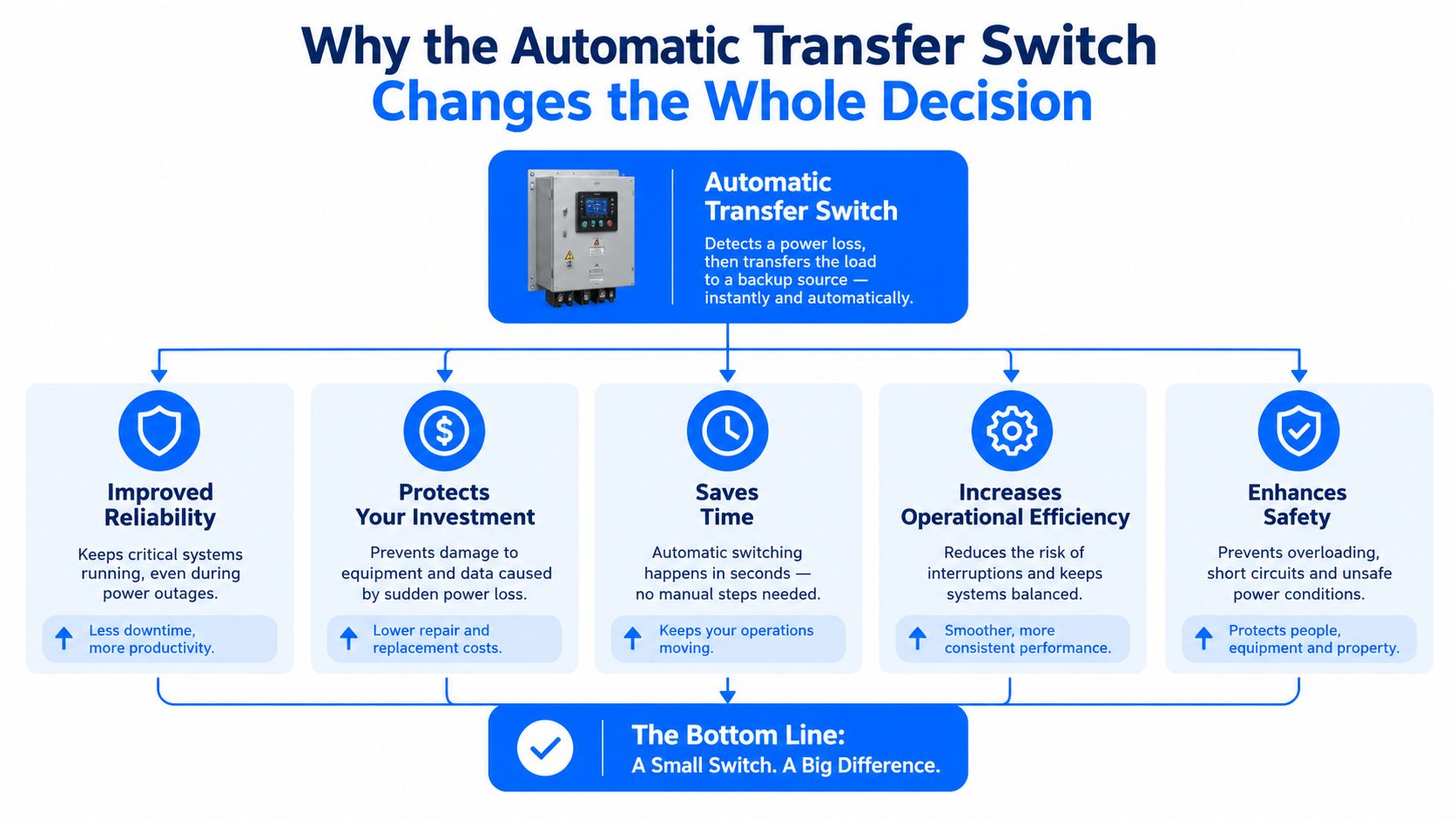
The automatic transfer switch belongs in the original design and quote. It isn't an accessory to choose after buying the generator.
The transfer system coordinates the change from utility supply to backup power. Its essential safety job is to keep those sources properly isolated so the generator doesn't energize utility wiring. The installation must address the switch's ratings, service compatibility, grounding, and inspection requirements alongside the generator itself.
Automatic doesn't mean uninterrupted
The intended sequence is straightforward: detect a utility failure, command the generator to start, and transfer the selected loads once backup power is ready. When utility power returns, the controls manage the return to normal supply.
That process isn't the same as uninterrupted power. If medical equipment or other sensitive loads cannot tolerate a break, tell the designer explicitly. Don't assume that the word “automatic” settles the continuity requirement.
For a practical explanation of the equipment, review how an automatic transfer switch works, then ask the installer to identify the proposed configuration on your quote.
Ratings and listing: Obtain the actual switch specification and confirmation that it suits the installation.
Service arrangement: Establish whether the design transfers the broader household supply or a dedicated backup panel.
Controls: Document exercise scheduling, load priorities, and responses to fuel-pressure or operating faults.
Verification: Require an operating demonstration that includes transfer, return to utility supply, and the intended load-management behavior.
Full-service transfer isn't always the sensible choice
A service-level transfer arrangement can make broad coverage convenient, but it doesn't create additional generator capacity. The supported loads still need to follow the sizing plan.
A dedicated critical-load panel offers a different proposition: clearly defined backup circuits and fewer opportunities to overload the system with discretionary appliances. I favor that arrangement when the homeowner's priorities are narrow and predictable.
Buy the coverage you need, then choose transfer equipment that makes that coverage clear and dependable.
The safety history supports treating integration seriously. The NFPA's winter fire-safety guidance, citing a consumer-safety report, notes that half of generator-related deaths occurred during November through February. A generator purchase must include a safe operating system, not just an engine and an enclosure.
When a Battery Backup Beats a Fuel Generator
A fuel generator isn't automatically the better investment because it can run longer with adequate fuel. If your objective is refrigerator, internet, lighting, and heating-control backup through shorter interruptions, a managed battery system deserves a serious quote.
The useful comparison is required service versus installed complexity. Buying broad generator coverage for a small critical-load requirement can leave you maintaining an engine for a job a battery system could handle.
Where batteries make more sense
Battery backup is especially worth evaluating when the household wants to avoid combustion exhaust, fuel storage, or routine engine operation. It also belongs in the conversation when the property cannot safely accommodate an outdoor generator.
That doesn't excuse batteries from careful design. Medical equipment needs a documented continuity plan, not a general promise of backup power. The designer must verify the equipment's demand, acceptable transfer behavior, and required operating duration.
Short, manageable interruptions: Prioritize essential circuits rather than every appliance.
Placement-constrained properties: Evaluate battery installation requirements instead of squeezing a generator into an unsuitable location.
Fuel-averse households: Compare recharge requirements with the fuel logistics you're trying to avoid.
Existing or planned storage: Check whether coordinated load management can meet the actual backup requirement.
For homeowners considering storage independently of rooftop generation, battery backup without solar is a legitimate design path. The important question is how the battery will recharge after it has supplied the house.
Where the argument shifts back toward fuel
Extended outages combined with sustained heating demand, pumping, or other heavy loads can make a fuel generator the more practical backbone. A battery won't keep supplying energy because the outage lasts longer than expected.
The distinction between ordinary interruptions and major-event outages is central to evaluating outage duration and backup needs. Your own outage history should decide how much weight each scenario receives.
Design test: Ask what happens when the battery reaches its reserve limit and utility power still hasn't returned.
An integrated battery-and-generator arrangement may address both needs, but don't assume any generator can connect to any storage system. Require a documented compatibility and controls plan.
My recommendation is to compare a critical-load battery proposal against a managed-generator proposal before committing. Judge both on the same load list and outage assumptions, not on unequal promises.
Installation Safety and Site Constraints You Cannot Ignore
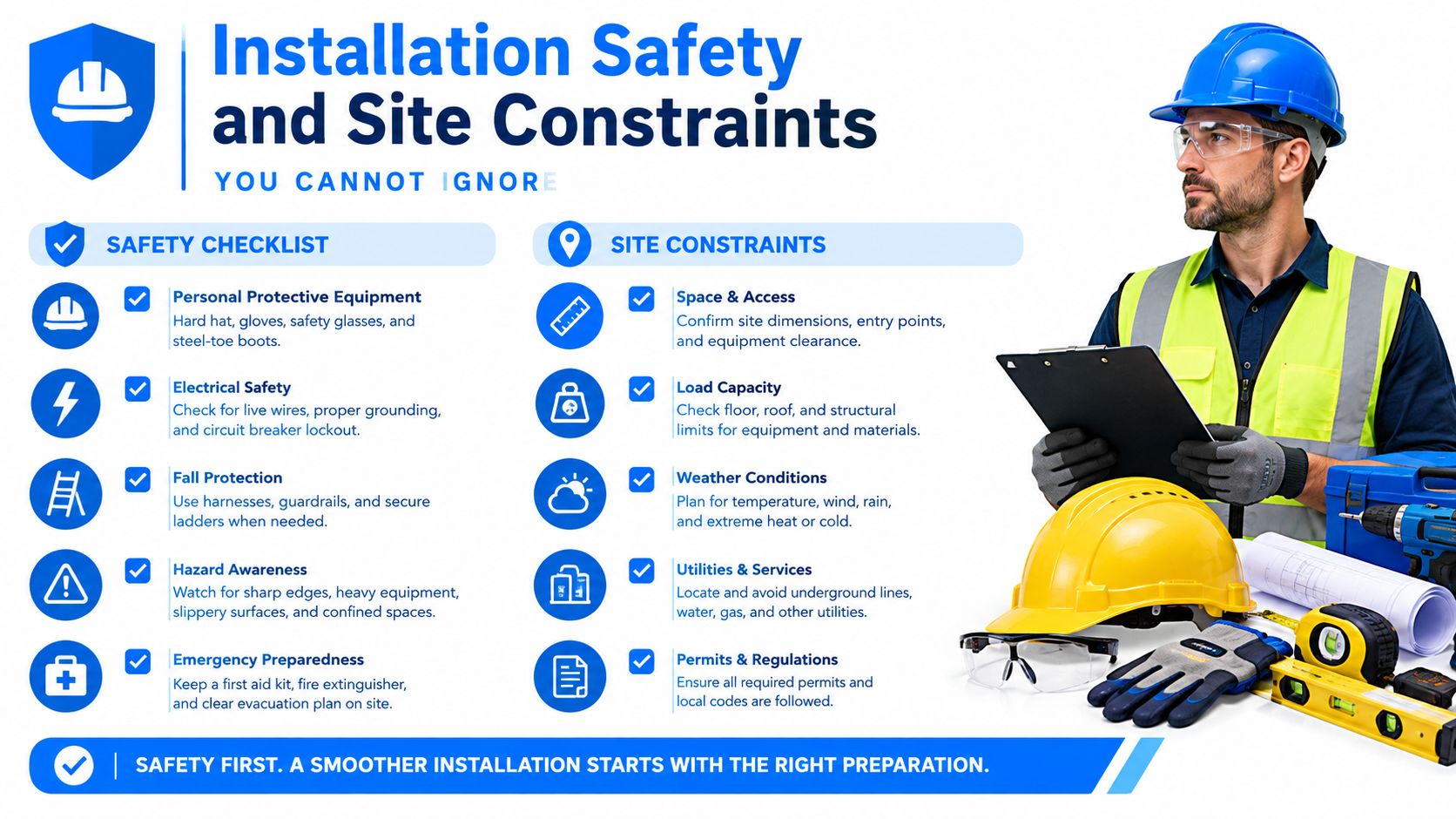
Reject any generator recommendation made without a site walkthrough. A suitable electrical rating doesn't make an unsuitable location safe.
Exhaust placement is a life-safety issue. CDC guidance says generators must operate outdoors more than 20 feet from windows, doors, and vents, and must never operate inside homes, garages, or carports; review its generator carbon-monoxide precautions before considering an installation location.
For a permanent standby installation, require the contractor to document the applicable placement requirements, manufacturer instructions, and local approval. A weather enclosure doesn't make exhaust harmless, and an open garage door isn't a substitute for outdoor placement.
What a credible walkthrough should cover
The contractor should inspect the proposed location and the route between the generator, fuel supply, transfer equipment, and electrical service. Looking only at the backyard leaves too much unresolved.
Openings and air paths: Identify windows, doors, vents, and other routes through which exhaust could enter.
Weather exposure: Consider prevailing wind, drifting snow, drainage, and conditions that could obstruct equipment.
Working access: Preserve required clearances and practical maintenance access.
Fuel connections: Verify supply suitability and a compliant installation route.
Electrical service: Inspect existing equipment, conductor routing, grounding, and transfer-equipment placement.
Approvals and alarms: Establish permitting, inspection responsibilities, and a carbon-monoxide alarm strategy.
Older homes need an electrical assessment, not assumptions
In an older Pennsylvania house, don't assume the existing panel can accept the proposed work because there's an empty breaker position. Ask the electrician to document whether the equipment's condition, arrangement, and capacity suit the design.
A panel replacement or service modification may become part of the project. That isn't automatically an upsell, but it does require a specific explanation. The quote should identify the deficiency, the proposed correction, and how it affects the installation.
Maintenance access matters, too. A location that meets the installation drawing but becomes inaccessible after landscaping or snow accumulation deserves another look before work begins.
If the property cannot safely support the proposed generator, change the design. Choose another location, reduce the backup scope, or evaluate storage. Don't let a preferred model dictate an unsafe installation.
Your Decision Path to the Right Whole-House Generator
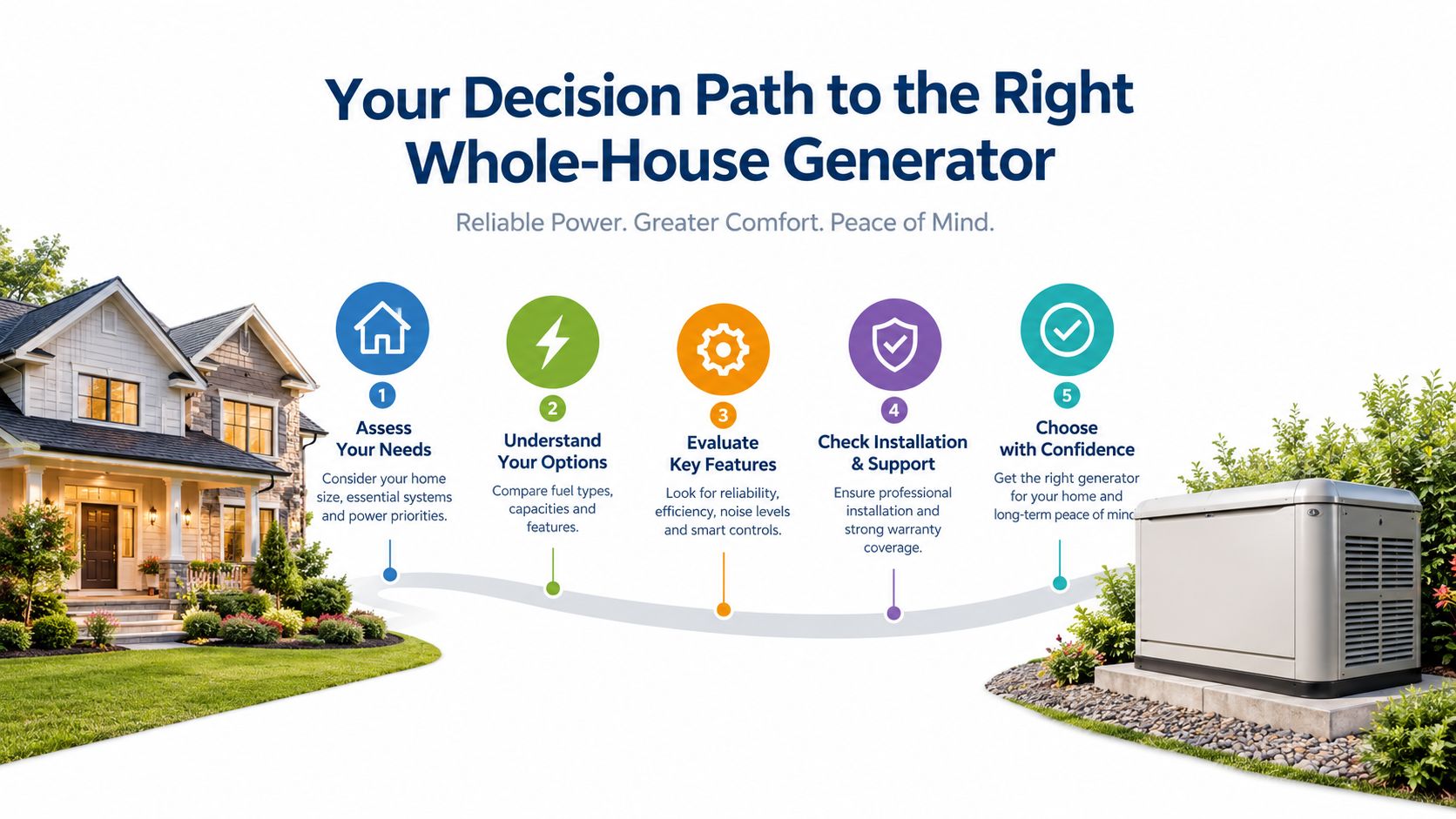
The right purchase starts with a written scope. Before comparing equipment, decide what a successful outage response looks like for your household: protected basement, functioning heat, refrigerated food, communications, and any equipment that cannot be allowed to stop.
Then make every proposal answer that same requirement. Otherwise, a lower quote may buy less coverage, while a higher quote may include work another contractor hasn't addressed.
Follow the decision sequence
Prepare the load list. Mark each appliance or circuit as essential, deferrable, or unnecessary during an outage. Include equipment you plan to add.
Choose the coverage arrangement. Decide between broader household coverage and managed critical circuits. Get the operating limitations in writing.
Set the autonomy requirement. Use your outage history and household consequences to decide how long the system must function without outside help.
Approve the site and service plan. Resolve placement, fuel arrangements, transfer equipment, and electrical modifications before selecting the final unit.
Compare complete proposals. Require equivalent scope, documented equipment ratings, commissioning, inspection responsibilities, and maintenance provisions.
Evaluate the installer alongside the equipment
Ask who performs warranty work, who answers service calls, and what routine maintenance involves. A familiar badge on the enclosure doesn't tell you whether someone will support the installation when you need help.
The handover should include the load schedule, equipment documentation, operating instructions, and a clear explanation of alarms and shutdown conditions. Ask the installer to demonstrate the system with the intended loads rather than treating a successful engine start as the entire acceptance test.
Don't accept “it runs the whole house” as the final description. You should know what runs, what gets deferred, and what action you'll need to take during a prolonged outage.
My recommendation is a professionally installed, automatically integrated system that passes the home's load and safety checks. Choose fuel generation when extended operation justifies its obligations. Choose managed storage when it meets the requirement with less operational burden. Choose neither until the property has been assessed.
As one local option, Amp'd Energy Solutions offers generator selection and installation, battery backup, automatic transfer integration, and electrical service upgrades in Southeastern Pennsylvania. Visit to request a site assessment and compare a managed-generator design with a battery-based alternative against your home's actual loads.
Comments