

Whole House Generator Propane Usage Explained Simply
A 22 kW whole-house generator typically uses about 2.0–2.5 gallons of propane per hour at half load and roughly 3.5–4.2 gallons per hour at full load. Your actual whole house generator propane usage depends on what's running, how the electrical load changes, and whether the tank can deliver fuel reliably in cold weather.
When a storm approaches Southeastern Pennsylvania, a homeowner may check the radar, look at the gauge on a 500-gallon propane tank, and wonder whether the fuel will last until the power comes back. The gauge alone can't answer that. A generator powering lights and a refrigerator draws fuel differently from one also running electric heat, a well pump, central air, or an EV charger.
The useful approach is to connect the generator's fuel curve to your home's likely outage load, then compare that demand with the tank's usable capacity and the conditions around the installation. By the end, you'll have a practical way to estimate runtime and identify where the estimate could fall short.
Table of Contents
The Outage Question Every Homeowner Asks First - Why a single runtime number misleads
How Propane Use Works in a Standby Generator - Reading the fuel table
What Drives Fuel Use Up in a Real Home - Watch for large and changing loads - Audit the loads your backup system serves
Tank Size and the Usable Capacity Trap - Turn usable gallons into a rough estimate - Treat the result as a planning ceiling
Realistic Outage Scenarios for Modern Homes - Winter heating and household demand - Summer cooling, pumps, and EV charging
Cold Weather, Vaporization, and Storage Safety - Check the fuel system as well as the tank
The Outage Question Every Homeowner Asks First
The homeowner checking the propane gauge isn't really asking how many gallons the tank holds. They're asking whether the fuel will last through the outage they're facing. That depends on the generator's size, the electrical load it serves, the tank's starting level, and whether cold weather limits how quickly the propane can reach the engine.
A generator's kW rating tells you how much electrical power it can supply, not how much propane it will burn every hour. Fuel use rises and falls with demand. A house running essential circuits may draw much less fuel than the same house with electric resistance heat, water heating, cooking, or vehicle charging active.
Why a single runtime number misleads
Online runtime calculators can be useful for a first estimate, but they often assume a steady load. A real home doesn't behave that way. A heating system cycles, a well pump starts when water is used, and someone may switch on a large appliance just as the generator is already working hard.
Tank capacity creates another point of confusion. A tank's nameplate volume isn't the same as the propane available for use, and a cold, nearly depleted tank may not vaporize fuel fast enough to meet high demand. The practical question is therefore not just, “How many gallons are in the tank?” It's also, “How much fuel is usable, and can the system deliver it when the generator needs it?”
Practical rule: Estimate the load you expect to run, use the generator's manufacturer fuel table for that load, then compare the result with usable tank capacity and a realistic refill plan.
That method gives a better starting point than treating a tank gauge or a single gallons-per-hour estimate as a promise. In the sections ahead, the numbers are best understood as planning examples, not guaranteed runtimes for every home. The useful takeaway is simple: match the generator, the backed-up circuits, and the propane supply as one system.
How Propane Use Works in a Standby Generator
A standby generator's fuel use changes with the electrical load it serves. For example, a generator backing up a refrigerator, lights, and a few outlets has less work to do than one also powering electric heat, an EV charger, or a well pump. The generator's rated size sets its maximum capacity; the circuits in use determine how hard it runs.
Manufacturer fuel tables give homeowners a starting point. Air-cooled generators in the 10–16 kW range are listed at about 0.97–1.70 gallons per hour at 50% load and 1.48–2.99 gallons per hour at full load, depending on the model (manufacturer specifications for 10–16 kW generators). For 16–22 kW models, published figures are approximately 2.37–2.53 gallons per hour at 50% load and 3.56–3.90 gallons per hour at full load (manufacturer specifications for 16–22 kW generators).
Reading the fuel table
Find the exact generator model and check its propane use at the load levels in the specification sheet. Units with the same kW rating may have different fuel-use figures. If the table gives only selected load points, treat them as guideposts. A qualified installer can help assess a household load that changes throughout the day.
The arithmetic is straightforward: multiply the listed gallons per hour by the operating hours. A generator using 2.5 gallons per hour at a particular load would use 60 gallons in 24 hours if it stayed at that load the whole time. That is a steady-load example, not a promise of daily consumption. In practice, backing up only selected circuits can reduce demand, while adding high-draw loads can raise it.
Fuel delivery must also support the generator's full-load requirement, even if the home usually draws less. Undersized piping or regulators can cause pressure drops, unstable operation, or shutdown during peak demand. Homeowners can review how the generator connects to the home's circuits and whole-house generators and transfer switches as part of planning the backup system.
What Drives Fuel Use Up in a Real Home
The generator doesn't know which appliance is convenient or essential. It responds to the combined electrical demand. A refrigerator and lights create one kind of load; electric heat, a water heater, a well pump, and an EV charger operating together create a much heavier one.
Watch for large and changing loads
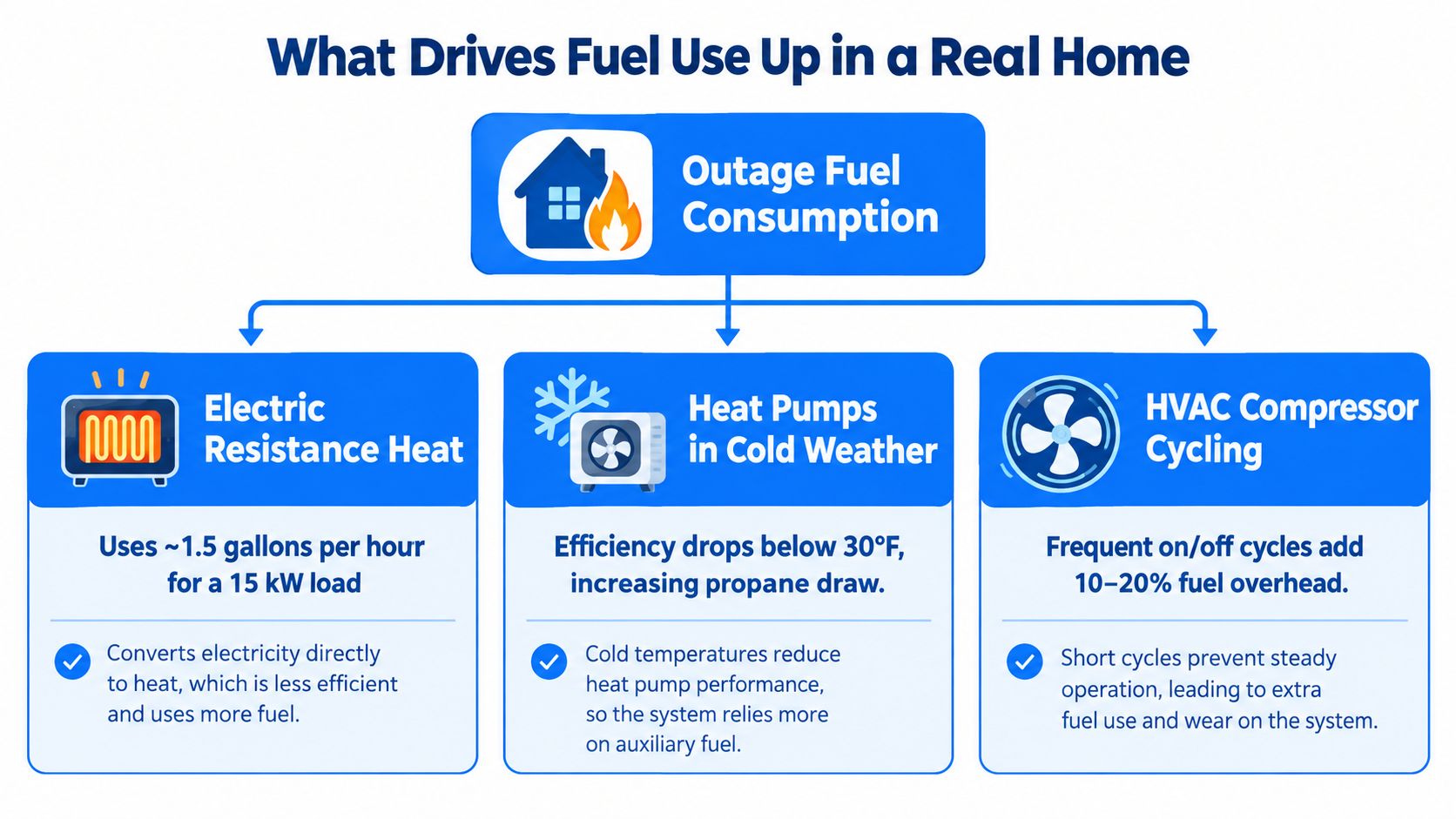
Electric resistance heat can place a substantial, sustained demand on a generator. Heat pumps also draw electricity, and cold-weather heating may increase demand as the system works harder or uses supplemental heat. Central-air compressors add another significant load when they cycle on.
A well pump doesn't run constantly, but it needs power when it starts and whenever water demand triggers it. Water heaters, electric ranges, dryers, and EV chargers can add further demand, especially if several operate at once. An EV charger can be a particularly important choice to plan around: decide whether charging will be disabled during an outage rather than assuming the generator can supply it without affecting runtime.
Motors also draw a brief surge of power at startup. That temporary demand can coincide with other appliances already running, so the generator may face a higher peak than its steady operating load suggests. Two people showering while a dryer runs and supplemental heat engages is a practical example of several demands arriving together.
Audit the loads your backup system serves
Walk through the electrical panel and note which circuits the transfer equipment backs up. Mark major heating and cooling equipment, pumps, water heating, cooking appliances, and charging circuits. Then decide which ones should be available during an extended outage and which can be switched off or managed.
For a structured look at how home circuits and equipment affect demand, see this guide to electrical load assessment calculations. The goal isn't to guess the fuel use of every appliance independently. It's to identify which combinations can push the generator toward a higher load, then use the manufacturer's fuel table to estimate what that means for propane.
Tank Size and the Usable Capacity Trap
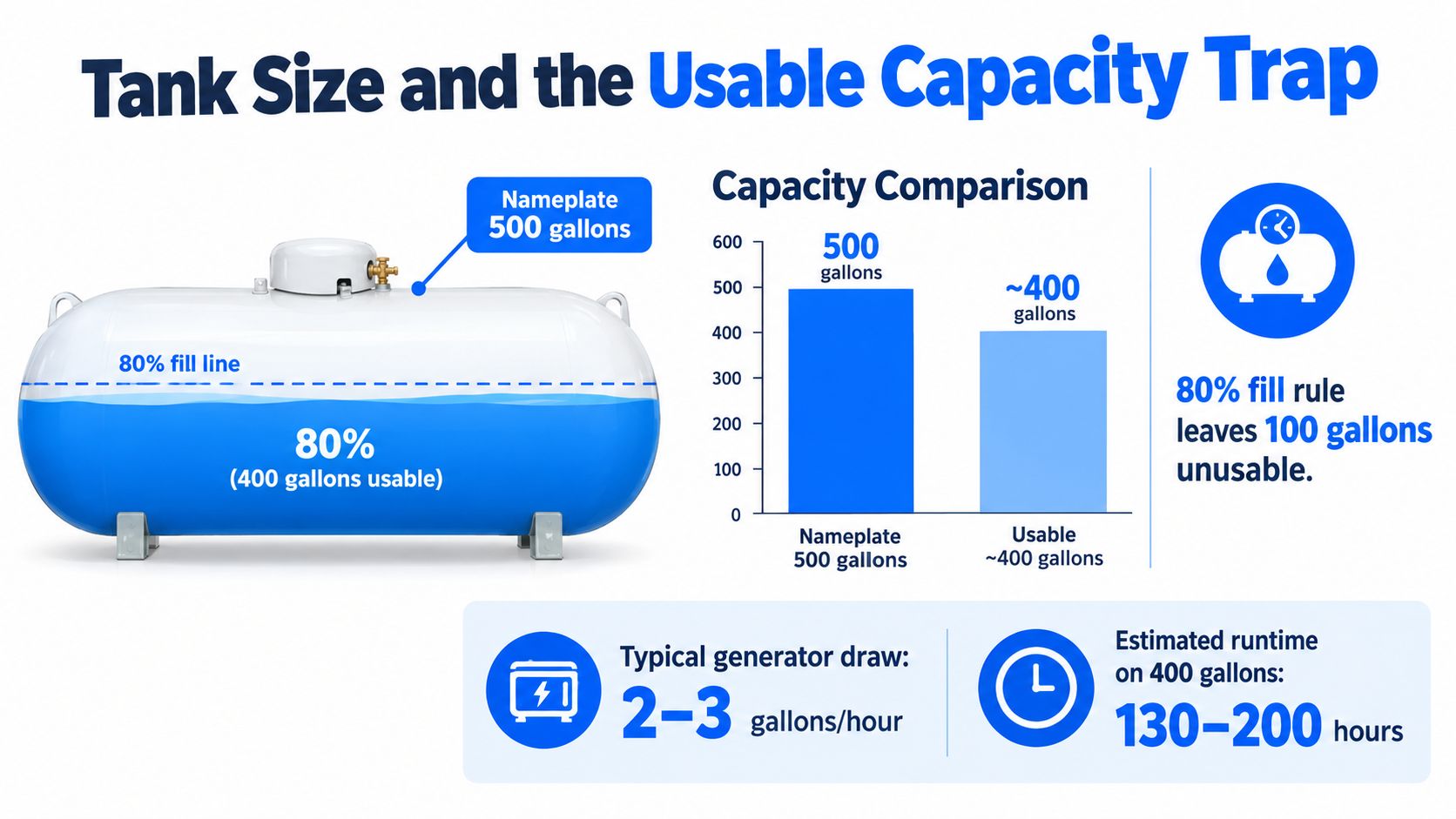
A tank label can make the fuel supply look larger than it is. The stated capacity measures how much water the tank could hold, not how much propane is available for normal use. A nominal 500-gallon tank is commonly filled to about 80%, leaving approximately 400 gallons of usable propane. For generator planning, use that usable amount, not the number printed on the tank.
Turn usable gallons into a rough estimate
Divide usable gallons by the generator's hourly fuel consumption. At 2.5 gallons per hour, 400 gallons would last about 160 hours, or 6.7 days, if the generator ran continuously at that rate. At 3.9 gallons per hour, the same supply would last about 103 hours, or 4.2 days. These examples use the 16–22 kW fuel range from the manufacturer specification cited earlier and a nominal 500-gallon tank.
That arithmetic gives a ceiling, not a promise of outage runtime. The generator's load affects its fuel rate, so the same tank may last longer when it serves selected circuits than when it backs up high-demand equipment such as electric heat or EV charging.
Tank size (nominal) | Usable gallons (~80%) | Hours at half load (~2.5 gal/hr) | Hours at full load (~3.9 gal/hr) |
|---|---|---|---|
250 gallons | ~200 | ~80 | ~51 |
500 gallons | ~400 | ~160 | ~103 |
1,000 gallons | ~800 | ~320 | ~205 |
The 250- and 1,000-gallon rows are arithmetic examples using the same 80% assumption, not recommendations for a particular property. Tank choice also depends on the generator's demand, other propane appliances sharing the supply, delivery access, and whether the system can vaporize fuel under local conditions.
Treat the result as a planning ceiling
Actual runtime may be shorter. Cold conditions, a low liquid level, heavy electrical demand, or other appliances drawing from the same supply can limit the fuel available to the generator. Keep a reserve in the plan rather than counting on every estimated gallon. The tank sets the amount stored; the loads you choose to run help determine how quickly that supply is used.
Realistic Outage Scenarios for Modern Homes
The same generator and tank can produce very different runtimes depending on what the homeowner chooses to run. A half-load estimate is a useful reference, but it doesn't describe every winter storm, hot-weather outage, or charging plan.
Winter heating and household demand
In a winter outage, the key question is what kind of heating the home uses and which circuits the generator backs up. Electric resistance heat can create a heavy, sustained load. A heat pump may also draw more power in cold weather, particularly if supplemental electric heat runs. Add a well pump or electric water heater and the generator may move well beyond an essential-circuit load.
Rather than assigning an unsupported hourly figure to each appliance, compare the likely combined demand with the generator's manufacturer fuel table. If your projected use is near the full-load range, estimate runtime using that higher consumption rate, not the half-load figure. A winter plan should also account for whether the tank and piping can supply fuel under cold conditions.
Summer cooling, pumps, and EV charging
Central air and a well pump can create a different pattern. The compressor cycles, while the pump runs when water is needed. That means demand changes over time, and the generator may use fuel at varying rates rather than staying at a steady half load.
EV charging changes the calculation again. A Level 2 charger running alongside HVAC and a well pump could push a generator toward high demand. The provided fuel figures don't establish a precise hourly rate for that exact combination, so it's better to model the load with an installer than to claim a specific runtime.
For a first estimate, consider three separate cases: essential circuits only, seasonal heating or cooling with pumps and water heating, and those loads plus EV charging. Calculate each case with the appropriate manufacturer fuel rate, then divide usable tank capacity by that rate. This makes clear why a generic calculator can be optimistic for a home that backs up many high-draw circuits.
Why Load Management Often Beats a Bigger Generator
A larger generator can supply more power, but it doesn't automatically solve fuel-planning problems. If the house uses more electricity because it backs up more equipment, the generator still has to meet that demand. Load management often offers a more direct way to reduce fuel consumption: choose which circuits stay active, prevent avoidable high-draw loads, and stagger equipment where practical.
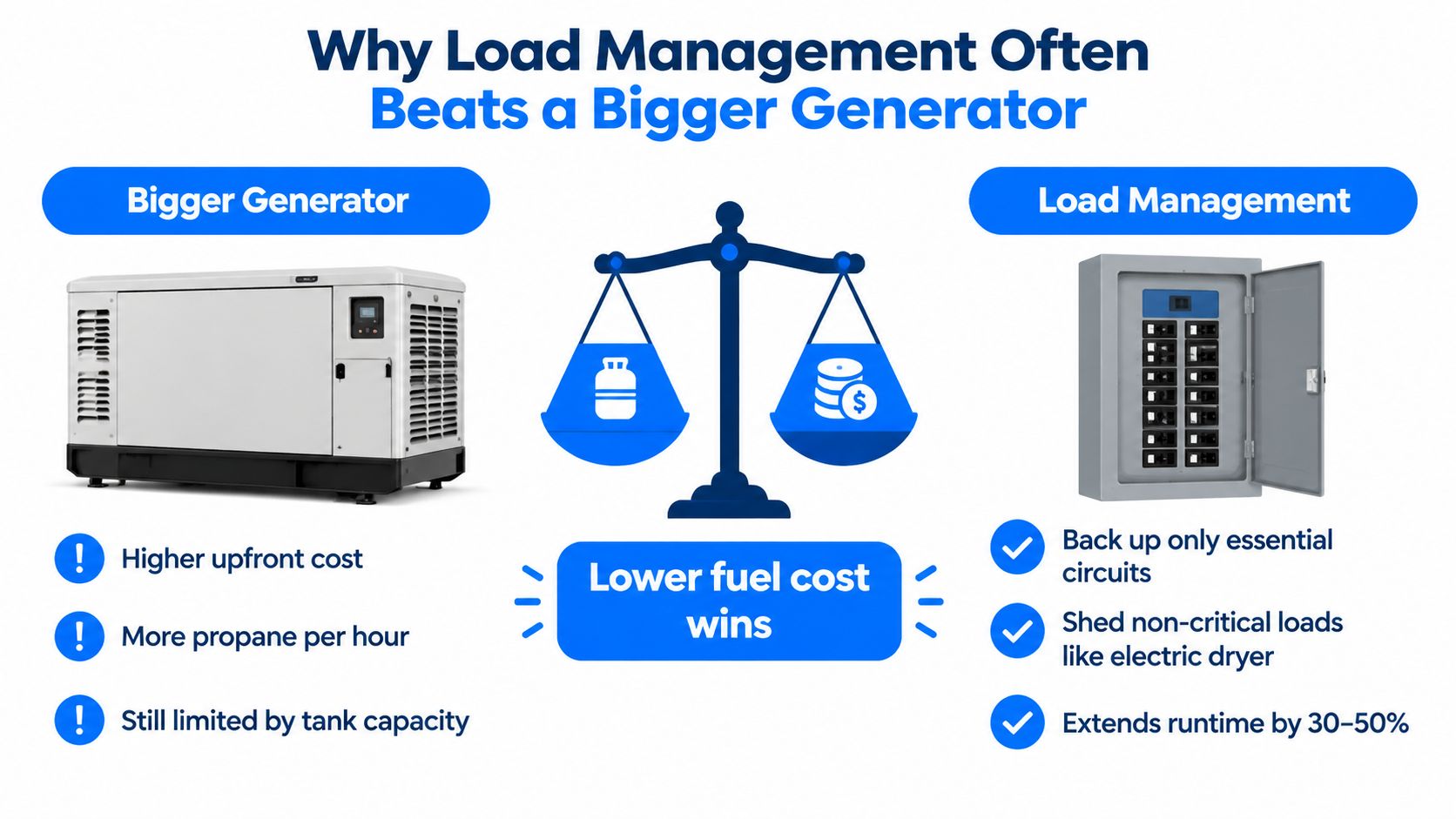
For example, a homeowner might keep refrigeration, lighting, communications, and selected heating or water systems online while disabling EV charging and avoiding simultaneous use of other large appliances. Automatic load management can help control which equipment runs when generator capacity is limited. The important point is to plan those choices before an outage, not improvise while the system is under strain.
The generator's size sets what it can supply. Your circuit choices help determine how hard it has to work.
Homeowners comparing a propane generator with battery backup or a hybrid system should compare what each setup can support during an outage, how long it can support those loads, and how the household will manage high-demand equipment. This overview of residential battery backup can help frame that decision.
A bigger unit may still be appropriate if a home has substantial electrical demand or needs broader backup coverage. But buying more capacity without addressing which loads operate can leave the central fuel question unresolved. Start with the outage priorities, then select the equipment and tank arrangement that can support them.
Cold Weather, Vaporization, and Storage Safety
Propane has to vaporize before the generator can burn it. That makes tank performance part of the runtime plan, not just a storage detail. Cold temperatures and a low liquid level can reduce vaporization capacity, and smaller containers may struggle to supply enough vapor during high demand.
A tank that can support a particular load in milder weather may not deliver fuel at the same rate in a freezing outage. The exact result depends on conditions such as outdoor temperature, tank surface area, liquid level, and the generator's demand. That's why a runtime estimate based only on gallons can overstate what the system can deliver.
Check the fuel system as well as the tank
Ask a qualified installer to confirm that the regulator and propane piping are sized for the generator's full-load requirement. A system designed around average demand may not maintain adequate fuel flow when several backed-up appliances operate at once. The manufacturer's fuel specifications provide the demand figures the installer needs to consider.
Before storm season, make sure the generator and tank area remain accessible and that snow won't block equipment or interfere with service access. Arrange annual leak checks and generator maintenance, and discuss how propane delivery works during severe weather.
Delivery matters: Check whether a truck can reach the property after snow or ice, and confirm how you'll request a refill during a prolonged outage.
A useful safety and logistics review asks whether the tank starts the storm with an adequate reserve, whether the fuel system can supply expected peak demand, and whether delivery remains possible if the outage lasts several days. Those checks can matter as much as the arithmetic on a runtime estimate.
Planning Your Own Propane Budget
Use a simple planning sequence. First, find the generator's propane fuel curve in its specification sheet. Next, list the circuits and appliances the transfer equipment will back up, including heating, pumps, water heating, and EV charging.
Then estimate usable tank gallons and divide by the fuel rate that best matches the expected load. Treat the result as a planning estimate, add a reserve, and make a delivery plan for an outage lasting five to seven days. A site assessment can evaluate generator size, transfer equipment, tank capacity, piping, and delivery access together. Amp'd Energy Solutions provides generator planning alongside electrical and backup-power services for Southeastern Pennsylvania homes.
Ask Amp'd Energy Solutions to assess your circuits, propane supply, and outage priorities before choosing between essential-circuit backup, whole-house coverage, or a battery-and-generator setup. Visit Amp'd Energy Solutions to discuss a backup plan that fits your home and the loads you want to keep running.
Comments