

Battery Backup for Sump Pump: Sizing, Runtime and Costs
Seven to eight hours of active pumping is the figure a fully charged deep-cycle battery is usually credited with, according to Consumer Reports' sump pump buying guide. That number is where most backup planning goes wrong, and not because it's inaccurate. It describes a pump running flat out the entire time, and almost no storm asks for that.
Real runtime comes from four variables: how fast water enters the pit, how high the pump has to lift it, how often the pump cycles, and how much of the battery you're willing to drain. Change one and the hours move. A system marketed as several days of backup and a system that quits on the second night can be the same battery under different inflow.
This is a working guide to battery backup for sump pump systems. It covers the five ways to build one, the duty-cycle math that predicts honest runtime, the factors that drive installation cost, and the failures a battery will never cover. Where a battery is the wrong answer, I'll say so.
Table of Contents
Inside a Sump Pump Battery Backup System - From grid failure to recharge
What Affects Installation Cost and Complexity - Battery siting and chemistry - Plumbing - Electrical work and permits
Maintenance, Safety and Failure Modes to Plan For - The monthly routine that actually catches failures - What a battery will not fix
Why Sump Pumps Stop When the Power Does
The motor stops the moment the line goes dead. Water does not. The 2024 U.S. Census Bureau survey data puts a size on that gap: an estimated 343,000 U.S. households reported water collecting in a basement or crawl space because a sump pump stopped during a power outage, about 1 in 4 households reported a power outage in the previous 12 months, and roughly 673,000 housing units were hit by frozen pipes. The pump didn't wear out. It had nothing to run on.
Outages are frequent enough to keep that risk live. Frozen pipes on that scale show how far a grid failure reaches past the pit. A cold house and a dark house often arrive together.
Timing is what makes it expensive. Thunderstorms and nor'easters that drive groundwater toward a foundation are the same events that drop lines and trip reclosers. The pump takes its heaviest shift while the utility is off.
A backup has to clear three hurdles: start without anyone home, run for the length of the outage, and move enough water at the home's actual vertical lift. Plenty of units on the shelf clear the first and fail the other two. I would not count a setup that needs someone on site to start it, or a runtime claim that ignores how high this house has to lift water.
The practical case for battery backup during a power outage is the short list of what dies with the grid: the primary pump, its charger, and any alarm plugged into the same circuit.
Battery Backup Options at a Glance
Five backup types cover most basements, with different trade-offs in runtime, pump coverage, and dependence on fuel or municipal water. Choose by the outage and failure risks you need to cover, then check capacity against the pump's actual duty cycle.
Option | Typical runtime | Best for |
|---|---|---|
Dedicated DC backup pump + AGM battery | 4–6 hours continuous, days intermittent | Automatic unattended protection |
Inverter + deep-cycle battery on existing pump | 5–8 hours continuous | Reusing the main pump |
Lithium battery or power station | 6–12+ hours, size-dependent | Long runtime and app monitoring |
Water-powered backup pump | Days while municipal water flows | Long outages with city water |
Portable or standby generator | Hours to days with fuel | Whole-home outage coverage |
A dedicated DC backup pump is a practical default for automatic protection. It sits in the pit beside the primary pump, with a separate float set a few inches higher, its own check valve, and a charger maintaining the AGM battery. It starts when water rises above the primary pump's activation level, so it can help if either the grid fails or the primary pump stops working. Listed runtime depends on how long the pump runs: the stated 4 to 6 hours of nonstop pumping can stretch across days when the pump cycles intermittently. Inflow, vertical lift, and battery capacity determine how closely a real basement matches that estimate.
An inverter supplies AC power from a battery to the existing pump. This approach suits a newer, reliable primary pump when you prefer one larger battery bank over a second pump. Its limit is coverage: it can keep a functioning pump running during an outage, but cannot clear a clog or restart a seized motor. Inverter losses also use some stored energy before it reaches the pump.
Lithium (LiFePO4) packs and power stations offer more usable capacity per pound than lead-acid batteries, since a greater share of the stored energy can be used. They generally cost more. App monitoring can help track battery status, but check what the system reports and whether it alerts you to a fault. A battery can fail without any warning light or sound, so use monitoring or a separate high-water alarm that does not depend on the backup system's electronics.
A water-powered backup pump uses municipal water pressure to drive a venturi pump. It has no battery to recharge and can continue operating while the water supply remains available, making it an option for extended outages in homes on city water. The trade-offs are slower pumping, water use that appears on the utility bill, and no operation on a private well.
A portable or standby generator can supply power to more than the sump pump, with runtime limited by available fuel. Portable generators require someone to handle placement and refueling, and must never run indoors or under a deck. Battery systems can start automatically during an overnight outage, but their protection still depends on usable capacity and the pump's cycling demand. Compare the options by the risk each one covers, then size the backup around expected inflow, lift, and runtime rather than relying on a headline hour figure.
Inside a Sump Pump Battery Backup System
Strip off the labels and there are only four moving parts, plus a box of electronics doing quiet maintenance work in the corner.
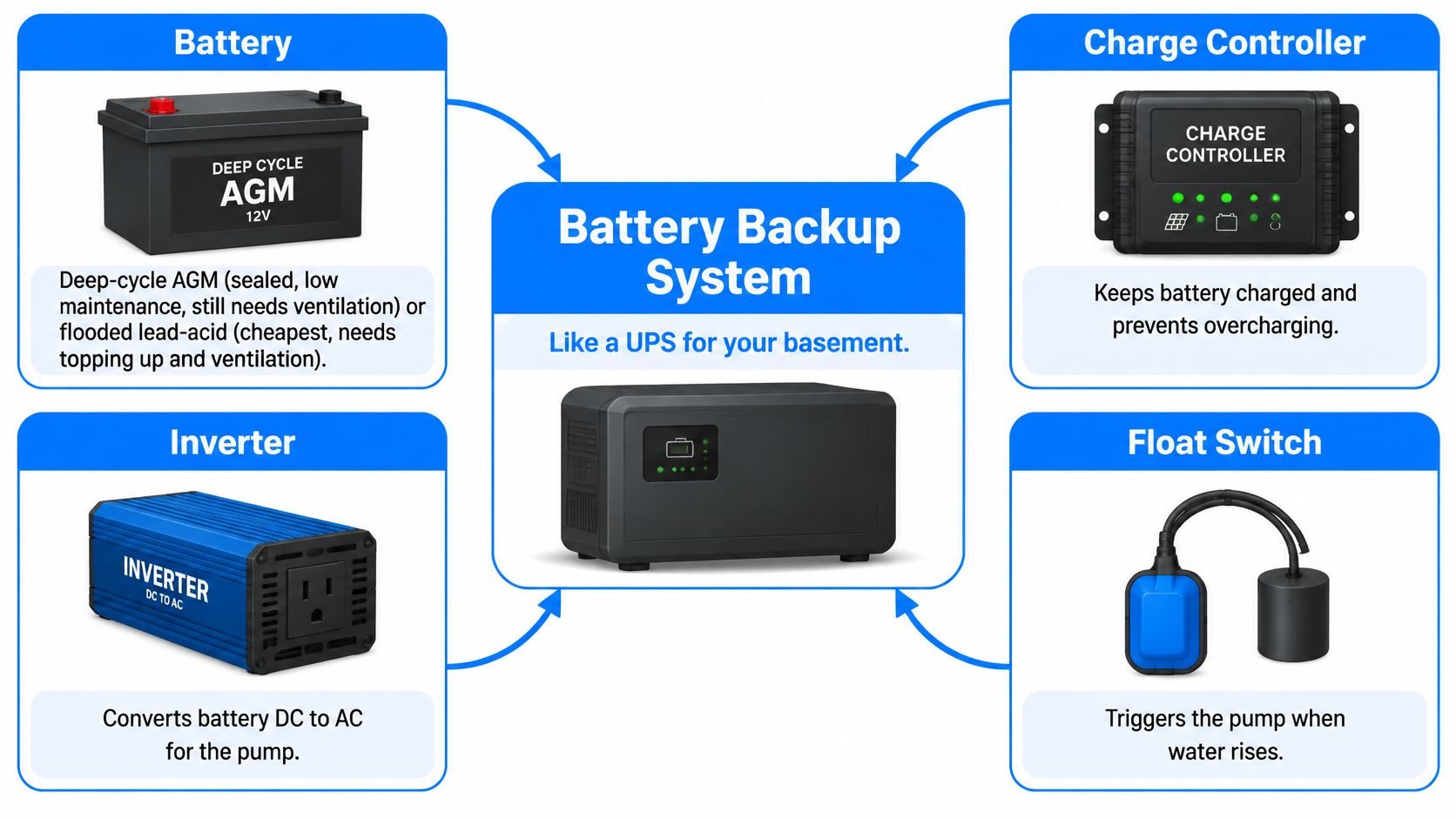
Think of it as a small uninterruptible power supply pointed at one appliance. The battery is a deep-cycle 12-volt, either sealed AGM, flooded lead-acid you top up, or lithium. The charger is a maintainer that holds it at float voltage so it's full the day the grid drops. The pump is either a dedicated 12-volt DC unit plumbed alongside the primary, or an inverter converting battery DC to AC for the existing pump. The controls are a secondary float switch set above the primary's, a high-water alarm, and check valves that stop the two pumps pushing water backward through each other.
Chemistry | Upkeep | Usable capacity | Charger and siting |
|---|---|---|---|
AGM sealed lead-acid | Low maintenance; terminals stay clean and dry | About 50% | Simple float maintainer; still ventilate |
Flooded lead-acid | Top up fluid and vent | About 50% | Cheapest; needs ventilation because charging can release flammable gas |
Lithium LiFePO4 | No watering | 80–90% | Compatible charger and a low-temperature cutoff; higher cost, lighter, longer cycle life |
From grid failure to recharge
The grid drops and the primary pump stops mid-cycle.
Water keeps arriving, and the pit climbs past the primary float, which now switches nothing.
The backup float trips, and the DC pump or the inverter starts drawing from the battery.
The alarm sounds, so the event is audible instead of silent.
Utility power returns, the charger refills the battery, and the system resets for the next storm.
Every hour figure quoted for that sequence is really a statement about five things sized together: pump draw, battery capacity, usable depth of discharge, vertical lift, and duty cycle.
How to Estimate Runtime and Battery Capacity
A 100Ah battery and a 10-amp DC pump do not buy a fixed storm window. Treat runtime as arithmetic you can check: amps, duty cycle, usable watt-hours, then a margin for cold, age, and lift.
1. Find the pump's draw. A 12-volt DC backup pump is the easy case. Say yours pulls 10 amps. At 12 volts that is 120 watts, and the number stays stable because nothing sits between the battery and the motor. Route the primary through an inverter and the draw climbs, because the inverter has to cover the motor's starting surge as well as its running load.
2. Time the pump in a real storm. During the next heavy rain, clock how long it runs per cycle and how long it rests. One minute on every five or six minutes works out to roughly a 17.6% duty cycle, the figure runtime comparisons use for storm inflow. Lift changes that ratio. More head means fewer gallons per minute, longer run times, and a higher duty cycle than a short, straight discharge.
3. Convert capacity correctly. Watt-hours equal amp-hours times volts, so a 100Ah battery at 12 volts holds 1,200 watt-hours on the label. Plan on about half of that for AGM and flooded lead-acid, and 80 to 90% for lithium. That leaves roughly 600 usable watt-hours in this example. Depth of discharge is the limit you own.
4. Divide, then divide again. 600 watt-hours divided by 120 watts gives about 5 hours of continuous pumping. Spread across a 17.6% duty cycle, the same charge covers roughly 28 hours, because the pump sits idle most of each cycle. Run your own inflow and rest times through that same division before you trust any box.
5. Cross-check the product sheet. Published continuous ratings sit in the same territory: one DC backup pump is listed at roughly 5.5 hours at a stated 10-foot lift, another at about 4.25 hours under its own test conditions, per Basement Watchdog's runtime comparison. Both assume the pump never stops. Use those hours as the continuous-run floor, then scale them by the duty cycle you measured.
6. Add margin, and know its limit. Cold cuts lead-acid capacity, batteries age, and extra lift shaves gallons per hour. Budget for all three. If inflow outruns the pump, raise pump capacity before you add amp-hours. Storage only covers the hours the pump can move water, so the battery is one layer in the flood defense, next to pump size, discharge, and an alarm you will hear.
Battery | Chemistry | Continuous pump time | Intermittent storm coverage |
|---|---|---|---|
75Ah AGM | Lead-acid (50% usable) | ~4 hours | ~1 day |
100Ah AGM | Lead-acid (50% usable) | ~5 hours | ~28 hours, ~7,500 gallons |
120Ah AGM | Lead-acid (50% usable) | ~6 hours | ~34 hours, ~9,000 gallons |
100Ah lithium | LiFePO4 (80–90% usable) | ~8 to 9 hours | ~2 days |
The rows above all assume that 120-watt draw and a 17.6% storm cycle. Change either number and every hour in the table moves with it. If the outage plan also includes a generator, size that supply the same way in generator sizing for a well pump: running watts plus starting surge, against your motor.
What Affects Installation Cost and Complexity
A quote for a sump pump battery backup is really four quotes stapled together: battery and charger, pump and controls, plumbing, and electrical work. The hardware is predictable. The labor is where two bids for identical equipment split apart.
Battery siting and chemistry
The battery needs a spot that's dry, off the concrete, above the pit's overflow level, and temperature-stable. It also needs ventilation, because lead-acid charging can release hydrogen, and it needs to stay plugged into its maintainer. A finished basement corner works. A sealed cabinet beside the boiler doesn't. Lithium adds two requirements: a charger rated for LiFePO4 and a low-temperature cutoff, since charging a cold lithium pack damages it.
Plumbing
The backup tees into the existing discharge line through its own check valve, so neither pump pushes water back through the other. Vertical lift is the number that eats output. Every extra foot of head reduces gallons per hour, and a long horizontal run with several elbows does the same damage. If the discharge exits high on the foundation wall, the pump has been working harder than its rating suggests since day one.
Electrical work and permits
Chargers and inverters need proper circuits, GFCI protection where the code requires it, and panel capacity that isn't already committed. Permanent wiring and new circuits usually require a permit and an inspection, and that's a line item homeowners forget to ask about until the quote arrives.
Where the DIY line sits: swapping a battery, clearing a float, and running the monthly test are homeowner jobs. Cutting into the discharge line, pulling a new circuit, and opening a panel are not. Amp'd Energy Solutions designs and installs custom battery backup systems, and for those projects we handle system design, permitting, installation and testing, with licensed electricians doing the electrical work. For a sense of how the categories compare once you scale past one appliance, this breakdown of home battery backup system cost walks the same line items at whole-home scope.
Maintenance, Safety and Failure Modes to Plan For
The most common way a backup fails is simpler than any electrical fault: nobody looked at it for two years.
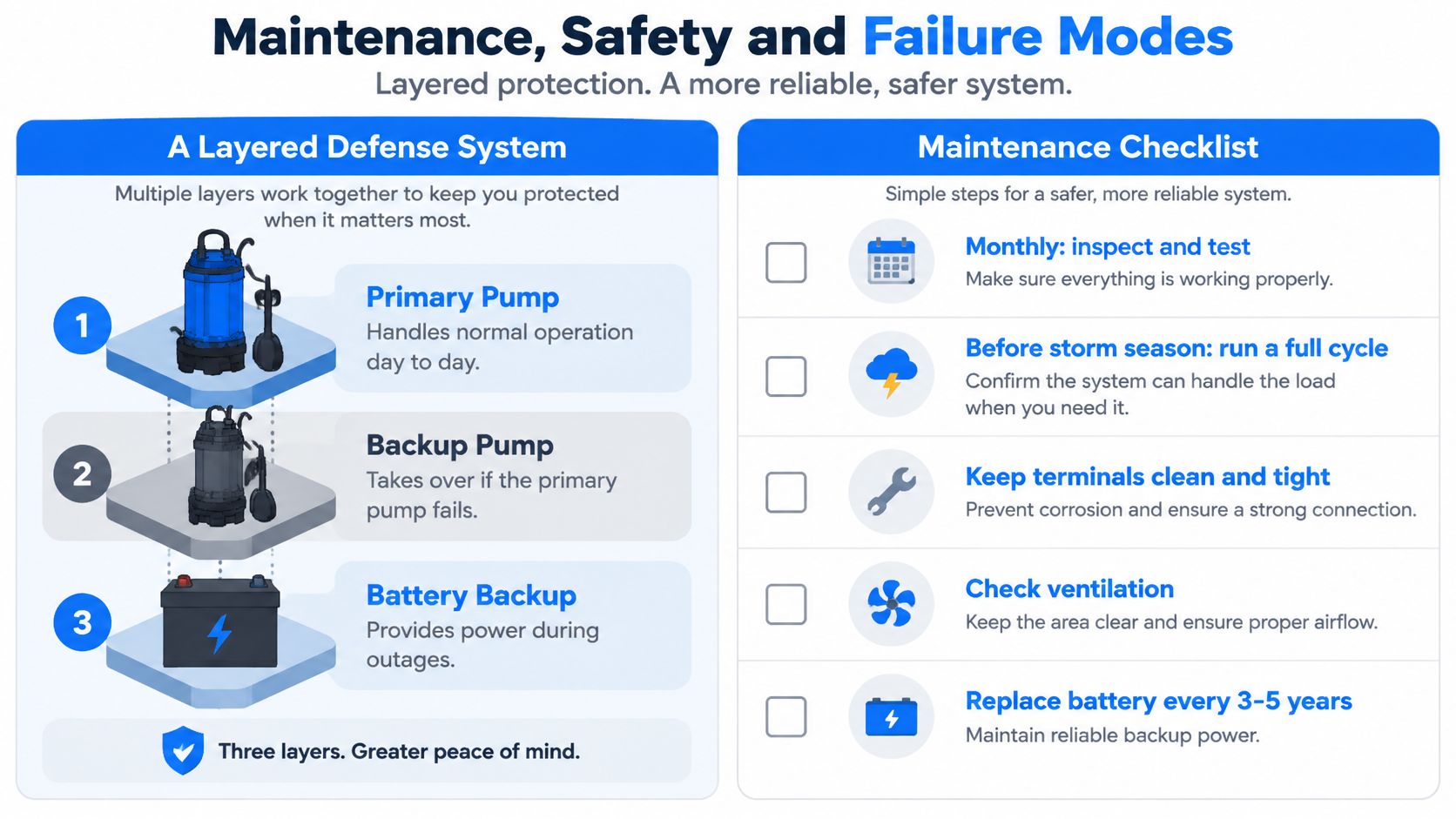
A backup is one layer, and its own documentation is blunt about the discipline it demands. Liberty Pumps' backup system installation manual calls for monthly inspection and testing, debris and float-switch checks, clean and dry terminals, correct battery voltage, and ventilation because lead-acid batteries can produce flammable gas. The same manual states plainly that a backup is temporary protection and not a substitute for the primary pump.
The monthly routine that actually catches failures
Test under load, not at rest. A battery that reads fine sitting idle can collapse the instant a motor draws on it.
Kill the primary on purpose. Unplug the main pump and pour a bucket into the pit. If the backup doesn't start, you found the problem on your own schedule.
Clear the pit and both floats. Gravel and silt jam a float open or hold it shut, and either one ends the conversation.
Check terminals and ventilation. Clean, tight, dry connections, with the enclosure vented and the charger still powered.
Treat the battery as a consumable. Replace it on the manufacturer's stated service life rather than waiting for a load test to fail, because a weak battery picks the worst night to announce itself.
What a battery will not fix
A backup answers one failure: loss of utility power. It does not clear a clogged or frozen discharge line, rescue a failed check valve, unstick a float, or compensate for a pump that's too small for the inflow. It won't help if the charger died months ago and left the battery flat, and it won't help if rising water reaches electrical equipment first.
Backup power is a layer, not a guarantee. The homeowners who stay dry are the ones who treat the primary pump, the backup activation, the discharge path, the battery, the alarm and a long-duration plan as six separate things to verify.
Choosing the Right Backup for Your Outage Risk
Four questions settle the choice: how long your outages run, how fast water arrives during the storms that cause them, whether you're on city water or a well, and how old the primary pump is.
Scenario | Water inflow | Recommended setup |
|---|---|---|
Short summer storm, 1–2 hours without power | Light to moderate | DC backup pump on the smaller AGM class from the runtime table |
Overnight storm, 8–12 hours of heavy rain | High | The next battery class up from that table, AGM or lithium, plus an alarm |
Multi-day ice storm, 2–3 days grid-down | Sustained | Lithium bank sized with the same duty-cycle math, or generator integration plus a second pump |
Frequent brief outages, well-water home | Light | Inverter plus a deep-cycle battery on the main pump |
I would not buy the largest bank for a two-hour summer flicker and a slow trickle into the pit. Use the smaller AGM class, put it on a DC pump, and stop. An overnight storm is the common middle case. Each float cycle spends amp-hours against your lift, so heavy inflow empties a small bank before morning. Step up to the next class on the runtime table, add the alarm, and know the vertical rise from pit floor to discharge exit before you spend.
Count starts during one hard rain. Cycles times lift is the duty cycle. Depth of discharge then shows whether that bank still has reserve at hour ten, or whether you bought a lab-hour figure that a wet basement will not deliver. On city water, a water-powered backup can sit beside that battery as a second layer. A well has no municipal pressure to drive one, so an inverter on the existing pump is the practical route.
A multi-day ice storm on saturated ground outruns a single battery. Plan a long-duration source, or a second pump behind the first, using the same inflow and cycle count rather than a bigger nameplate.
For a typical basement with a primary pump under five years old, a dedicated DC backup pump and a battery matched to that duty cycle is the right match. It starts on its own, and it is a second pump, so a dead primary does not leave the pit open. A generator earns its cost once outages stretch past a day and you also want the heat and the well pump back.
Before you buy, note the pump model, measure that lift, and log the cycles. Have a licensed electrician check capacity against the duty cycle and verify the wiring.
Amp'd Energy Solutions designs and installs custom battery backup systems for homes in Southeastern Pennsylvania. In a free consultation they walk through the options and help you choose a system that fits your property, your budget, and your peace of mind. They handle design, permitting, installation, and testing. Visit Amp'd Energy Solutions, call 267-450-6992, or email sales@ampd.life.
Comments