

Generator for Well Pump: How to Size It Right
The standard advice for sizing a well pump generator comes down to one rule of thumb: add up the running watts, add some headroom, buy that size. It is tidy, it is easy to repeat and it fails often enough to cost homeowners real money. A well pump is a motor, and a motor does not ask for its running watts when it starts. It asks for several times that, for a fraction of a second, and the generator either delivers that burst or the pump never reaches full speed.
That single fact reshapes the whole purchase. The number that matters is the volt-amps the pump demands in the instant the pressure switch closes. Your motor nameplate gets you closest to that figure, since locked-rotor current is the published stand-in for the starting surge. Once you know how to read it, the price you pay and whether the pump survives the outage both follow from how well the generator covers that demand.
Running watts still count, just as the second question rather than the first. Once the pump is spinning, the load drops back to the running figure and holds there. The surge is the wall the generator has to climb before the easy part begins.
Table of Contents
Generator Size for Common Well Pump Motors
Find the row that matches your motor. These are the numbers a sizing decision turns on, and they're the numbers a horsepower label alone can't give you.
Pump motor | Running load | Starting load | Basis |
|---|---|---|---|
1/2 hp submersible, 240 V | 900-1,200 W | 2,000-3,000 W | CDC private-well emergency guidance |
3/4 hp submersible | Between roughly 1,200 and 1,800 W | Roughly 3,000-4,500 W | Interpolated between the adjacent rows; confirm on the motor nameplate |
1 hp submersible, published guidance | About twice the 1/2 hp figure, roughly 1,800-2,400 W | 4,500-5,000 W | CDC private-well emergency guidance |
1 hp submersible, 230 V Franklin motor data | About 1.9 kVA, from 8.2 A at full load | 9.6-11.0 kVA, from 41.8-47.6 A at locked rotor | Franklin Electric AIM manual motor data |
The published-guidance figures come from the CDC's private-well emergency guidance, which is direct about the requirement: a generator for a private well pump must be sized for both continuous operating demand and the motor's brief starting surge. Well-pump motors commonly run at 240 volts, with starting current several times higher than the running load.
Why the running-watt rating misleads
Read your row again and compare the two load columns. A 1/2 hp pump that draws about 1,000 watts while running may pull 2,000 to 3,000 watts to get moving. The advertised running-watt rating covers the left column. The inrush lives in the right column, and it repeats every time the pressure switch closes through the whole outage.
The generator has to cover that surge on top of whatever else is already running at that moment: a refrigerator, a furnace blower, lighting, or the pressure-system controller itself. A unit sized to the left column alone has nothing left when the motor kicks.
The one-line test: if the generator's surge rating falls below the starting figure in your row, the unit is undersized for that pump, no matter how healthy its running watts look on the box.
Why the two 1 hp rows don't match
The two 1 hp rows disagree by thousands of volt-amps, and that gap is the most useful thing in the table. Generic horsepower tables describe an average motor. The Franklin Electric AIM manual describes a specific motor at a specific voltage and wiring configuration, and the arithmetic shows where the surge figure comes from: 8.2 full-load amps times 230 volts gives about 1.9 kVA running, while 41.8 to 47.6 locked-rotor amps times the same voltage gives 9.6 to 11.0 kVA at start. That is the demand the generator has to meet, before power factor and the generator's own transient response enter the picture.
So treat the horsepower label as a way to find the right row. The locked-rotor amps printed on the nameplate, multiplied by the supply voltage, settles the choice. If your pump is 3/4 hp, interpolation gets you a range to sanity-check against, then the nameplate or the installer's record gives you the actual number.
Single-Phase and Three-Phase Well Pumps Compared
Phase decides whether a generator can run the pump at all. That's a different question from how large the generator needs to be, and it's the one that ruins purchases.
Most residential well pumps in the region are single-phase, wired at 230 or 240 volts, and the motor nameplate confirms it. Single-phase power arrives in pulses, so these motors rely on a starting winding or capacitor to get the rotor moving. A generator with a matching single-phase 240 V output covers that motor, provided its surge rating clears the locked-rotor figure, and a correctly rated transfer switch handles the connection.
Three-phase motors run on three overlapping waveforms that produce smooth, continuous torque the instant power is applied. They show up on larger agricultural, irrigation and commercial wells, where the motor needs three legs of power at the right voltage and frequency. Put a single-phase generator in front of one and nothing good happens: the motor won't start, and the attempt stresses both the windings and the generator's own output stage.
A farm well running a 3 hp three-phase submersible needs a three-phase generator rated for the motor's starting kVA, before a single house load enters the math. A 240 V single-phase home generator parked in the same shed is the wrong machine at any wattage.
A variable frequency drive changes the equation too. It reshapes the starting profile and can cut inrush, but the drive itself has to be evaluated for compatibility with the generator's output waveform and sized as its own load.
Two checks settle phase before money moves. The motor nameplate states phase and voltage directly, and the controller or control box confirms what the motor needs to start. Have the installer verify both before any generator is ordered, because wrong phase is a purchase error that extra wattage cannot fix.
How to Calculate Starting and Running Loads
Take a 240 V submersible drawing 5 full-load amps. It runs near 1,200 W, yet a generator rated well above that figure can still fail to start it. The gap is the startup surge, and the worksheet below exists to measure it. The Ontario farm generator guidance puts a floor under the estimate, recommending motor startup be figured at no less than four times operating watts. Single-phase induction motors routinely demand more than that floor during the first moments of acceleration, which is why a real nameplate figure beats any multiplier.
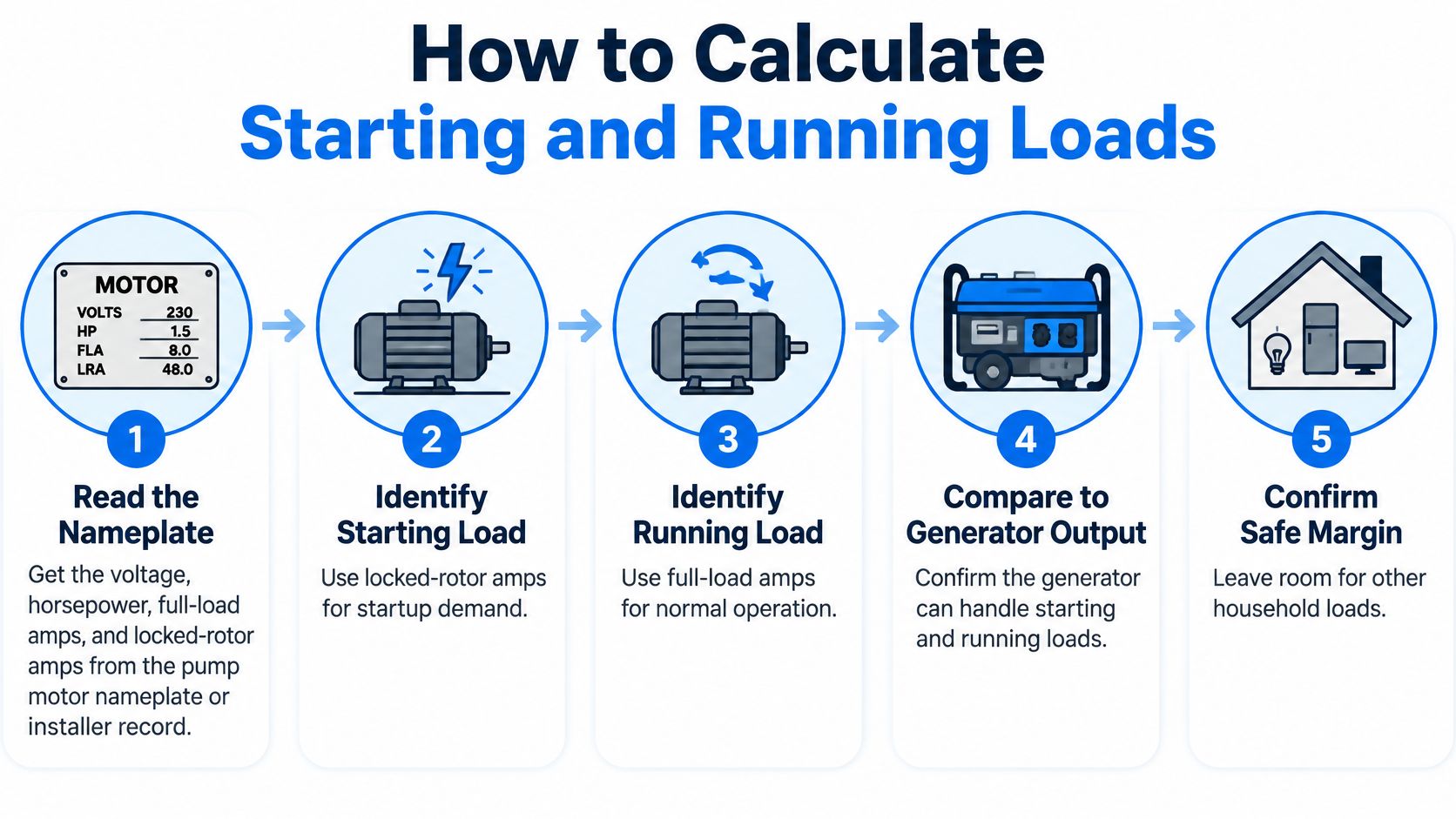
The sequence takes about twenty minutes with a flashlight and a photo of the nameplate.
Read the nameplate. Pull voltage, horsepower, full-load amps and locked-rotor amps from the pump motor nameplate or the installer's record. Locked-rotor amps is the current the motor draws in the first instant of a start, electrically the same as holding the rotor still, and it is the number the whole worksheet depends on. If the plate is buried down the well casing, get the figure from the contractor who set the pump.
Convert running load to watts. Multiply volts by full-load amps. A 240 V motor drawing 5 A runs at about 1,200 W, which is the number you'll carry forward as continuous demand.
Estimate the startup demand. Use locked-rotor amps times voltage where that data exists; it beats any horsepower table. Where it doesn't, apply the four-times-running-watts minimum and treat it as a floor rather than a target. On the 1,200 W example, the floor alone means roughly 4,800 W of surge demand, before a single household load joins in.
List every load that could run during an outage. Refrigerator, furnace blower, lighting, pressure controller, booster pump, septic pump, heat pump. Write them down rather than holding them in your head, because the ones you forget are the ones that start at the same second as the pump.
Add continuous load, then the largest surge. Total the running watts of everything that stays on, then add the single biggest motor-starting surge plus the running watts of whatever else is running at that instant. You're sizing for the worst overlap, the moment everything coincides.
Match the generator to both columns. Continuous rating above the total running load, surge rating above the combined startup demand, and the correct voltage and phase for the pump. A generator that wins on running load and loses on surge is the wrong unit.
Add margin and verify. Leave engineering headroom, then have a licensed well contractor, electrician or power company confirm the number before connection. A full electrical load assessment is the professional version of this same worksheet and catches shared circuits you'd miss.
A finished worksheet shows the pump's voltage, horsepower, full-load amps and locked-rotor amps, the running and starting watts, every other load with its own running and surge figures, the combined totals, and the generator's continuous and surge ratings beside them. If any line is blank, the number isn't ready.
Portable Versus Standby for a Well Pump
Surge capacity separates these two categories far more than price or brand. Portable units are built to a running-watt headline, and their surge headroom is usually thin. Standby units are sized against your actual load, pump startup included, because the installer does the worksheet before the order.
Criterion | Portable generator | Standby generator |
|---|---|---|
Surge capacity for pump startup | Often too low for deep-well starts unless deliberately oversized | Sized for the whole load, including pump surge |
Transfer method | Manual transfer switch or inlet box | Automatic transfer switch |
Placement | Outdoors, at least 20 feet from doors, windows and vents | Installed outside per local code and permit |
Runtime | Limited by fuel on hand | Continuous on a fuel line |
Effort during an outage | Move, connect and refuel by hand | Starts automatically |
Typical fit | One occasional outage, modest pump | Frequent outages, deep well, high startup surge |
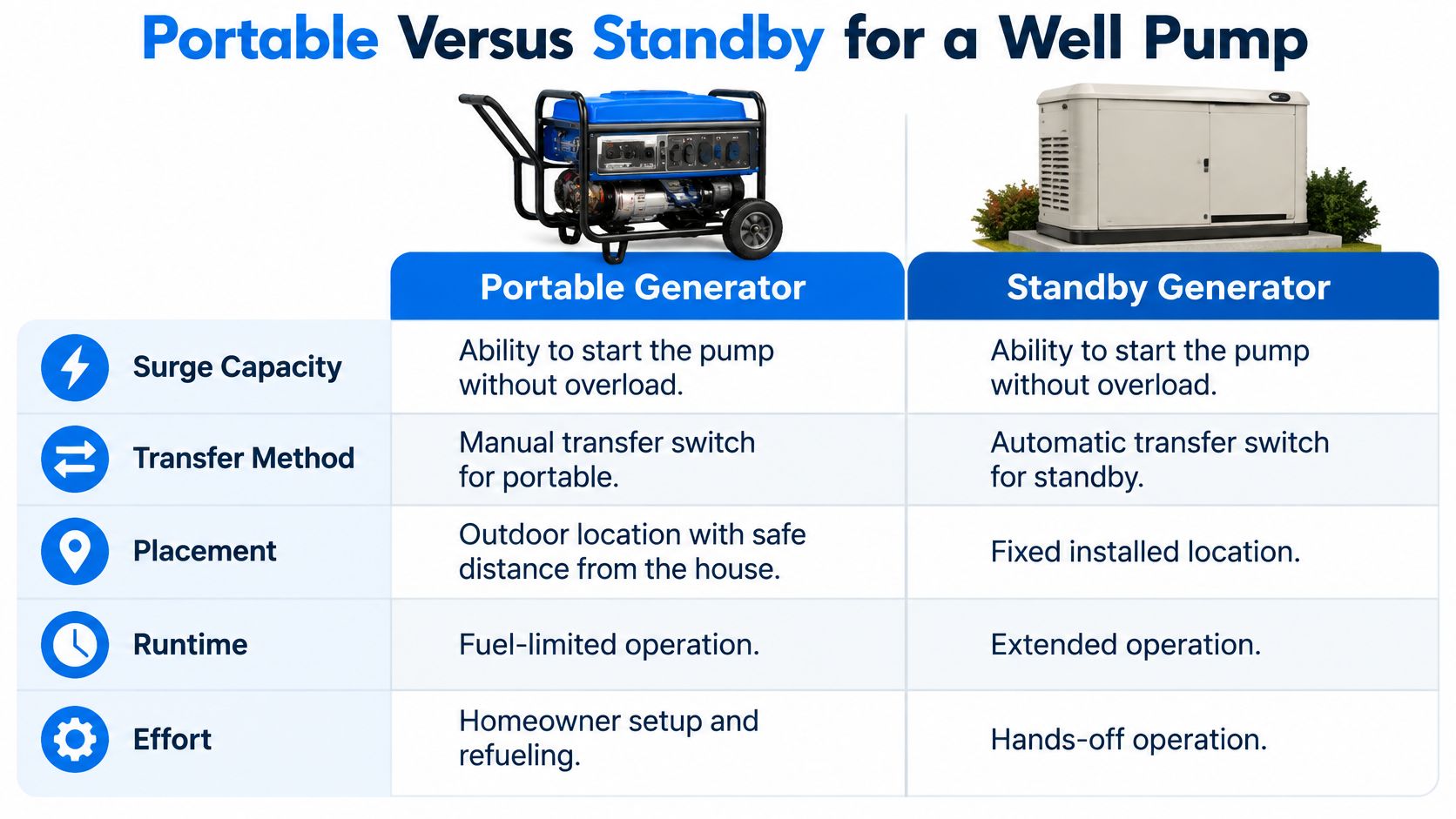
What the table can't show is the second outage. A portable unit means hauling it out in the dark, connecting it, fueling it in bad weather and doing it again at 3 a.m. when the tank runs dry. A standby unit does all of that without you, which matters more when the pump is deep and the pressure tank empties fast.
The differentiator worth remembering: surge capacity matters more than running watts, in either category. A cheap portable with honest surge headroom beats a larger one that sags.
Here's the situational read. A homeowner with one occasional outage and a 1/2 hp pump can often manage with a correctly sized portable unit wired through an inlet box and manual transfer switch. A rural property with frequent multi-day outages and a deep-well pump with a high startup surge is a standby job. Permanent installs generally require local permits, and how to choose a whole-house generator covers the sizing conversation in more depth.
Transfer Switches and Backfeed Safety for Well Pumps
A line worker restoring power two streets over is the reason transfer equipment exists. While your home is still connected to the utility, generator power flowing into a hard-wired pump circuit sends current backward up the service line, and that backfeed can injure the person repairing it.
The protection is a transfer switch or a properly designed interlock, which disconnects your home from the grid before generator power reaches any circuit. The second hazard is quieter. Carbon monoxide has no smell, and the placement rule for generators and gas-powered equipment is strict about it: outdoors, at least 20 feet from doors, windows and vents, and never inside a home, garage, basement or other enclosed space, even with the doors or windows open. Twenty feet is not a suggestion you can trim on a cold night.
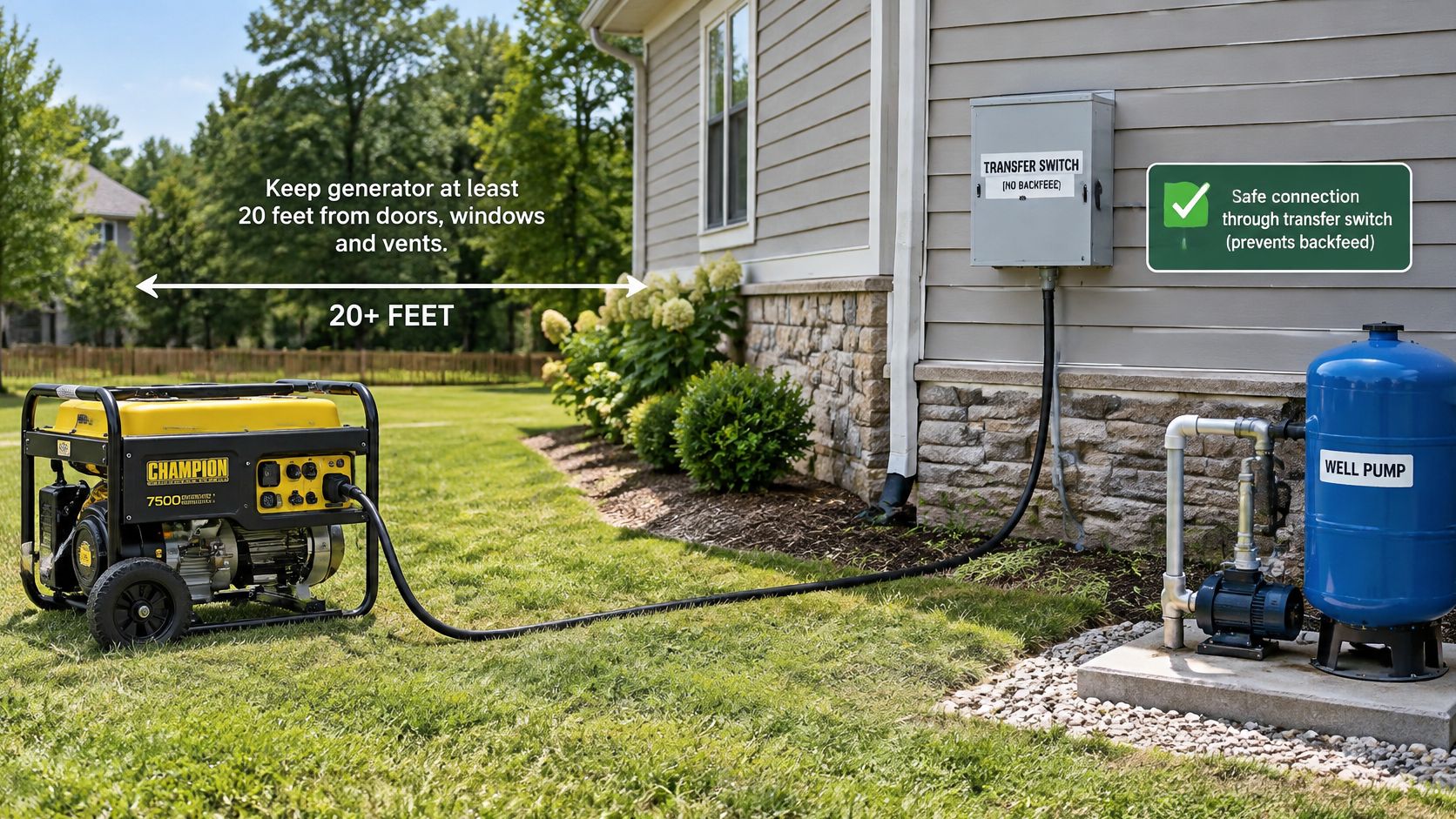
For a portable unit, that protection is a manual transfer switch fed by a generator inlet and sized for the pump circuit. For a standby unit, it is an automatic transfer switch rated for the load. Either way, the switch has to match the pump's voltage, and the breaker and conductor gauge have to be chosen for a motor rather than a generic household circuit. A pump motor pulls far more current in the first seconds of startup than it does while running, so a breaker or wire run sized to the running load alone can trip or sag even when the generator itself has enough surge capacity. If you are still deciding which type belongs on your panel, this guide to what a transfer switch for a generator does explains the difference between manual and automatic switching.
Before you connect anything:
Confirm the transfer equipment's voltage and amperage rating against the pump circuit.
Verify the breaker and wiring are sized for the motor's startup demand rather than its running load alone.
Have a licensed electrician inspect the installation.
Run the pump under load once, before the first storm, and listen for it to reach speed while you watch the pressure gauge climb.
The sequence that keeps this safe is size, select, inspect, then test under real load. Do the test on a calm afternoon when the pump can cycle several times and you can hear it start cleanly, not at 2 a.m. during the first outage of the year.
Why Undersized Generators Fail to Start a Well Pump
An undersized generator fails a well pump in a specific way: the generator runs, the lights stay on, and the pump hums or clicks without moving water. The failure happens inside the first second of the start, when the motor's locked-rotor demand arrives all at once and the engine and alternator have to answer it mechanically.
Take a real unit: Pentair's Simer 2860G is a 1 hp, 230 V, 60 Hz, single-phase submersible rated at 10 gallons per minute. Its running draw is modest, while its starting draw runs several times higher, and the figures worked through in the sizing section above show the same pattern across motor sizes. Two motors carrying identical horsepower labels can demand very different surges, because winding design and wiring configuration change what the generator has to absorb. Running watts set the continuous rating. The starting surge decides whether the pump ever reaches running speed.
What voltage sag does to the motor
When the surge exceeds what the generator can supply, output voltage drops. A motor under low voltage behaves like a car starter on a weak battery: it turns slowly and pulls even harder to compensate. The pump sits below its rated voltage, draws more current, heats up, and either stalls or stumbles up to speed. Every pressure-switch call repeats the cycle, and the insulation inside the windings takes cumulative damage. The pump may limp through the outage and fail months later, which is why the generator rarely gets blamed for it.
Symptom | Likely cause | Fix |
|---|---|---|
Generator runs, pump does not start | Starting surge exceeds generator surge rating | Upsize the generator, or confirm locked-rotor data before buying |
Lights dim and pump stalls | Voltage sag under inrush current | Choose a unit with stronger surge capacity and voltage regulation |
Breaker trips when the pump starts | Undersized output, or a long thin conductor run | Check locked-rotor amps and conductor gauge, then correct the run |
Pump starts, then cycles repeatedly | Other large loads starting at the same moment | Stagger the loads, or add capacity for the combined start |
Works in a test, fails at night | Another large motor starts during the outage | Recalculate with every motor that can run together |
The sizing method the trade uses converts nameplate amps to kW, accounts for starting kVA and how many motors may start at the same moment, then adds resistive loads on top rather than summing full-load amps across the panel. Soft-start equipment can reduce the startup stress, but it has to be evaluated against your specific motor and control system, so a generic off-the-shelf unit is a gamble.
The site checks that catch a bad match
Before anyone quotes a generator, verify four things: whether the motor is two-wire or three-wire, which determines control-box requirements; the pump's depth and pressure settings, which shape how hard it works; whether another large motor, such as a booster or septic pump, can start at the same moment; and the generator's own surge and voltage-regulation capability, the spec-sheet line buyers most often skim past.
What Undersizing and Oversizing Cost You
Both errors carry a bill, and the cheapest generator on the lot can end up the most expensive one in the yard.
Oversizing has the easier costs to see. A higher surge rating raises the purchase price, the unit burns more fuel per hour at light load, and a standby install adds transfer equipment, a fuel line, permits and labor on top. Money spent on capacity your pump never calls for sits idle between outages.
Undersizing hides its bill until the worst moment. A pump that stalls or trips protection on every start heats its windings repeatedly, and a motor that fails means pulling the pump from the well, replacing it and reconnecting the system. That work costs far more than adequate surge capacity would have, which is why the expensive sizing error is the one made against the starting load rather than the running load.
The break-even test is a multiplication, not a guess. Take the outage hours you expect in a year, multiply by what each hour without water costs you in hauling, lost work or a household on hold, then compare that figure against the capital, fuel and maintenance cost of the unit under consideration. When the first number exceeds the second, the system pays for itself; when it stays below the price of a smaller portable unit, the portable wins. A deep well with a large motor pushes the starting-watt requirement up on the cost side, while a long outage history pushes the loss side up, and the formula weighs both at once.
Get quotes only after the load worksheet is finished, so every bid covers the same running load and the same surge rating.
Confirm Your Pump Specs Before You Buy a Generator
The purchase decision comes down to seven lines on a page, and you can assemble them before you call anyone. Five come off the motor nameplate: voltage, horsepower, full-load amps, locked-rotor amps and phase. Pump depth and pressure settings come from the installation record. The last line is the list of loads you want running during an outage, written out rather than estimated.
That locked-rotor figure deserves the most attention. Running watts tell you whether the pump keeps turning once it is up to speed; locked-rotor amps tell you whether the generator can get it turning at all.
What should come back from a provider is equally specific. Ask for a load calculation showing running and starting watts, the recommended generator's continuous and surge ratings, the transfer equipment specified for the pump circuit, and a placement that respects required exhaust clearances. A written bid states all six.
Amp'd Energy Solutions offers whole-house generators, including generator sizing, complete custom installation, troubleshooting and annual maintenance. The company serves Southeastern Pennsylvania and works through a free consultation that walks a homeowner through the options that fit the property, the budget and peace of mind. Call 267-450-6992 or email sales@ampd.life to schedule that consultation or request a quote.
One thing holds regardless of who does the work. A licensed well contractor or electrician confirms the final size before the generator is connected, because the nameplate reading, the load math and the phase check are what stand between a working pump and a stalled one.
If your well pump is the load that decides whether an outage is an inconvenience or a day without water, Amp'd Energy Solutions can size the system around it. The team handles generator sizing, custom installation, troubleshooting and annual maintenance, and serves homeowners across Southeastern Pennsylvania. Visit Amp'd Energy Solutions to schedule a free consultation and talk through the options for your pump's starting surge, not just its running watts.
Comments