

Whole House Generator Transfer Switch Installation Guide
You've picked out a standby generator, found a place beside the house, and started comparing installation quotes. Then an electrician looks at the panel and asks whether the transfer switch will replace the service disconnect, which loads must stay on, and how the generator will handle the air conditioner starting.
Those answers can change the equipment order. A successful whole house generator transfer switch installation starts with the electrical service and backup priorities, not with buying the largest generator that fits the budget.
Table of Contents
The Installation Sequence From Survey to Sign-Off - Plan the system before ordering equipment - Avoid designing around a purchase
How to Size the Switch From Your Load Calculation - Build a usable backup-load list - Match the configuration to the calculation
Automatic or Manual Transfer Switch, and What Each Costs - Compare operation and installed scope - Buy the response you actually need
How to Wire the Transfer Switch and Panel - The electrician's installation sequence - Resolve the neutral before energizing
Common Problems and How to Fix Them - Recheck after electrical changes
When to Hire a Licensed Electrician for Your Transfer Switch - Questions to ask before signing
The Installation Sequence From Survey to Sign-Off
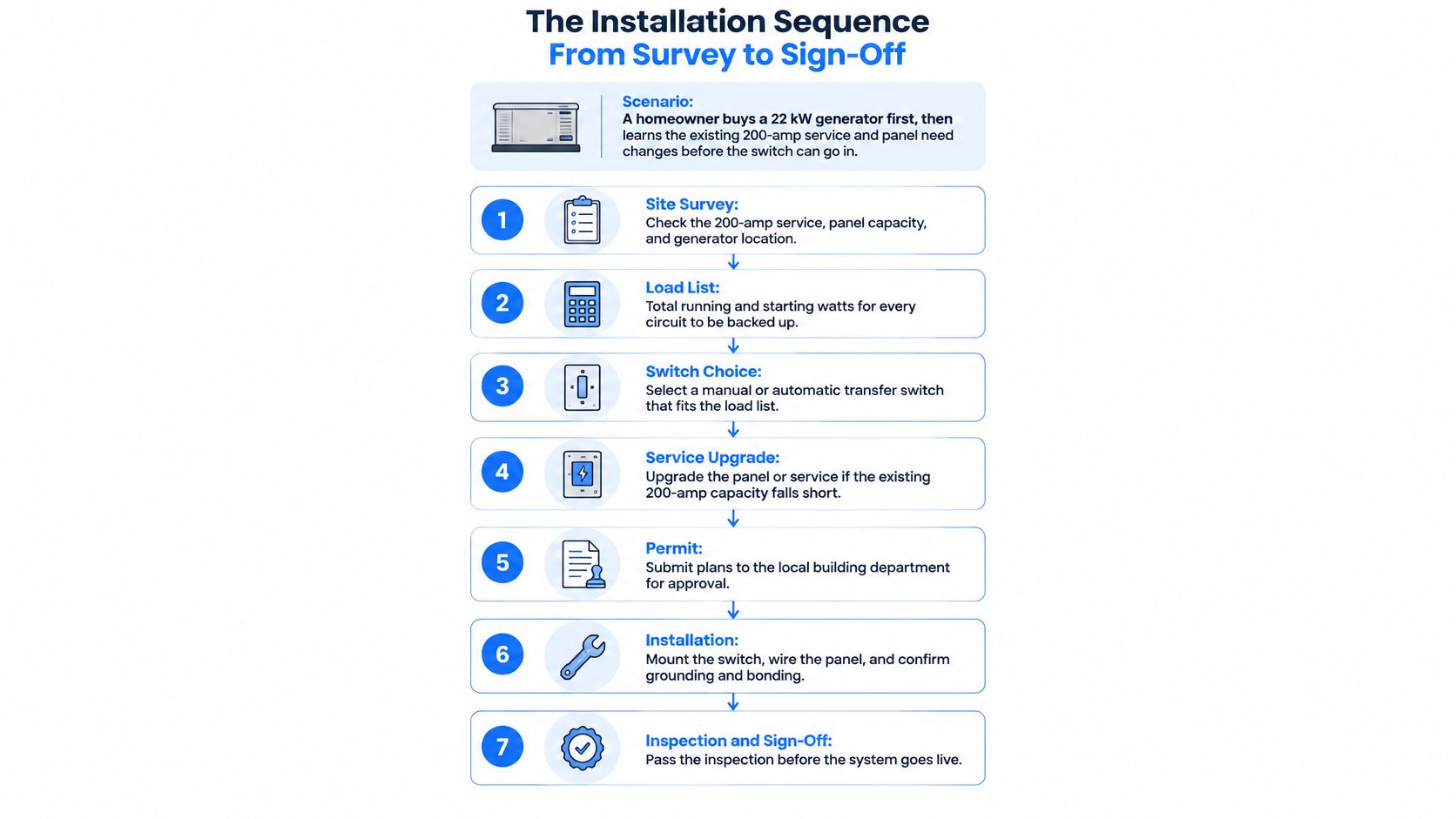
Say you buy a generator before anyone checks the existing service. The installer then discovers that the proposed switch requires a different disconnect arrangement, the panel needs changes, and the generator needs load controls. You're now paying to redesign a project around equipment you already own.
The transfer switch determines which circuits change sources and where the generator connects to the building. That makes it a planning decision, not an accessory added at the end.
Plan the system before ordering equipment
Follow this sequence with the contractor:
Survey the site. Locate the utility meter, service disconnect, electrical panels, proposed generator pad, and fuel supply. Check equipment access, cable routes, drainage, and manufacturer clearances before committing to a location.
Calculate the load. Identify the circuits that need backup and evaluate their calculated demand and motor-starting requirements. Compare those requirements with the existing service and proposed generator.
Select compatible equipment. Choose automatic or manual operation and determine whether the switch will serve as service equipment. Match voltage, phase, frequency, neutral configuration, and generator controls.
Complete permit and utility review. Have the contractor confirm the local submission requirements and arrange any utility disconnect or service-equipment approval. Electrical approval doesn't replace fuel-system or placement approvals.
Install the switch and panel changes. The electrician mounts equipment, installs conductors and controls, makes terminations, and labels the completed system. Any necessary service changes belong in this coordinated scope.
Commission and close out. Simulate an outage, verify the intended loads receive power, and document the return to utility operation. Complete the required inspections and retain the approved paperwork.
Avoid designing around a purchase
Ordering equipment before the load calculation is the expensive mistake to avoid. A discounted generator isn't a bargain if making it work requires an unexpected service alteration or a replacement transfer switch.
A service upgrade isn't automatic, either. The contractor should distinguish a genuine capacity problem from a switch-placement problem, an outdated panel, or a backup plan that needs only fewer simultaneous loads.
Ask for a system proposal, not separate prices for a generator and a switch with the connection details left unresolved.
You can prepare useful information without opening electrical equipment. Draw a site sketch, list the appliances you want during an outage, and update the panel's circuit directory using accessible breaker labels and normal circuit checks. Photograph equipment labels only where they're visible without removing covers.
How to Size the Switch From Your Load Calculation
Start with a load list, but don't confuse that list with the final electrical calculation. Adding appliance labels helps establish priorities; the electrician must then apply the appropriate calculation method and assess how the equipment actually starts and operates.
Build a usable backup-load list
Use this routine before requesting a final equipment proposal:
List the circuits and equipment. Record running demand and available starting information for the well pump, sump pump, refrigeration, heating equipment, and air-conditioning compressor. Include appliances that start automatically, not just those you expect to turn on.
Account for motor starting. Evaluate the largest likely starting event alongside loads already running. Don't just add a motor's full starting demand to its running demand twice, or assume every motor starts simultaneously.
Compare demand with both capacities. Generator output and service rating describe different limits. The electrician must compare compatible electrical quantities, not compare a kilowatt number directly with an ampere number.
Choose loads that can wait. Decide whether cooking, clothes drying, water heating, or EV charging can pause. Identify whether a load must remain disconnected throughout an outage or can return when capacity becomes available.
Under the 2023 National Electrical Code's Article 702, the Inspection Bureau emergency-systems guide explains that standby capacity must cover the transferred load unless an approved load-management approach controls that demand.
A promise to avoid using the dryer isn't the same as automatic load management. Equipment that starts without anyone's permission needs a deliberate place in the design.
For help organizing the inputs, use this electrical load assessment and calculation guide.
Match the configuration to the calculation
The switch must carry the current passing through it during normal utility operation, not merely the generator's output. A smaller generator doesn't justify undersizing a switch installed in the full-service path.
Sizing paths for whole-house transfer
Configuration | When it fits | Service work | Main trade-off |
|---|---|---|---|
Service-rated whole-home transfer | Generator meets the calculated transferred load | Switch may replace the service disconnect; existing equipment must be suitable | Higher generator cost to support unrestricted backup |
Load-managed whole-home backup | Demand exceeds generator capacity, but heavy loads can be controlled | Load controller or managed circuits; no capacity upgrade solely because the generator is smaller | Selected appliances pause or remain unavailable |
Critical-load subpanel | Only essentials such as heat, refrigeration, and pumps need backup | Subpanel and a dedicated transfer arrangement | Narrower coverage in exchange for a smaller backup system |
Service upgrade plus whole-home transfer | Existing service cannot support the building's calculated demand | Service or panel capacity increase coordinated with transfer installation | Broadest construction scope and greater future capacity |
A critical-load subpanel often reduces equipment scope, but moving many awkwardly routed circuits can consume labor. Likewise, a service-rated switch doesn't necessarily require a larger generator; approved load controls may allow a smaller unit to supply the connected panel safely.
Buying rule: Choose the backup loads first, then the transfer arrangement, then the generator that can support that arrangement.
Before ordering, get a written answer to the central question: can the existing service accept the proposed backup configuration, or must panel, service, or load changes come first? The largest generator isn't automatically the most economical solution when managed loads preserve what matters.
Automatic or Manual Transfer Switch, and What Each Costs
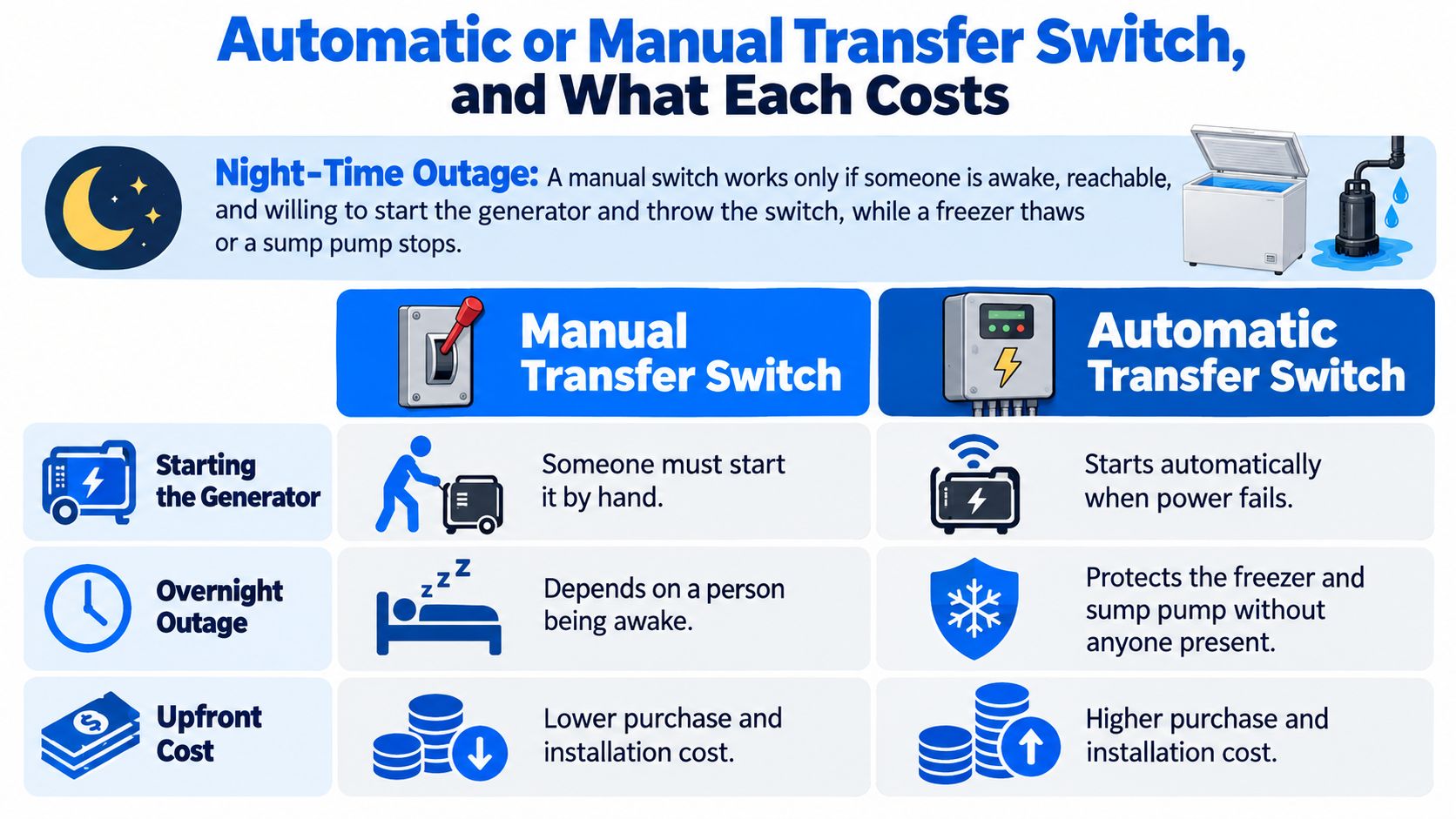
The power fails while everyone's asleep. A manual switch won't respond until someone notices, starts the generator, and operates the transfer equipment. That matters when a sump pump needs to run or refrigeration must stay available while you're away.
An automatic transfer switch, or ATS, performs the handoff without an operator. In exchange, it adds controls, sensing connections, and starting-system dependencies that need testing.
Compare operation and installed scope
Manual vs automatic transfer switch
Feature | Manual transfer switch | Automatic transfer switch |
|---|---|---|
Operation | Owner starts the generator and operates the handle | Compatible controls detect utility failure, start the generator, and transfer |
Installed cost in Bizzfactor's 2024 guide | $1,400–$2,000 | $2,500–$4,000 or more |
Installed cost in A.E. Heating & Cooling's 2024 guide | No manual-system figure stated | $600–$2,500, averaging about $1,450 |
Outage response | Requires an available operator | Transfers after the programmed sequence and acceptable generator output |
Best fit | Budget-conscious projects with a capable owner on site | Unattended homes, frequent outages, and loads needing prompt restoration |
Main pitfall | Nobody responds when needed | A control or charger fault remains unnoticed without operational testing |
These published prices aren't interchangeable bids for a Southeastern Pennsylvania home. Neither range tells you whether your particular job needs a service disconnect change, long conductor runs, load controls, or substantial panel work.
The price gap can reflect differences in switch amperage, enclosure, service-equipment capability, installation labor, and included electrical modifications. Don't assume the cheaper figure covers the same scope as the higher one.
Buy the response you actually need
Ask each bidder to separate the switch, installation labor, service alterations, load-management equipment, permit handling, and commissioning. Confirm whether the generator, pad, fuel work, and utility coordination are included or excluded. An automatic transfer switch cost breakdown can help you organize those questions.
Manual operation works when someone can reliably respond and follow the shutdown and transfer procedure. It becomes a poor compromise when the household regularly travels or when the person expected to operate it can't safely reach the equipment during bad weather.
Automatic transfer is the stronger choice for unattended protection. However, it isn't uninterrupted power: sensitive equipment may need a separate short-duration backup during generator startup and transfer.
Automatic operation removes the need for an operator. It doesn't remove the need for maintenance or a backup plan for essential medical equipment.
I would choose automatic transfer for a frequently vacant home, recurring outages, or medical-related backup needs, with the medical equipment's own continuity requirements addressed separately. Manual transfer makes sense when outages are manageable and a capable on-site owner accepts responsibility for responding.
How to Wire the Transfer Switch and Panel
This is professional service-equipment work, not a homeowner wiring project. Turning off the main breaker may leave incoming service conductors energized, and an automatic generator can introduce another source unless its starting and output circuits are properly isolated.
The installation should follow a documented verification sequence. The Tri-County Technical College transfer-switch specification addresses equipment compatibility, conductor installation, interlocking, controls, and acceptance testing as connected parts of the work.
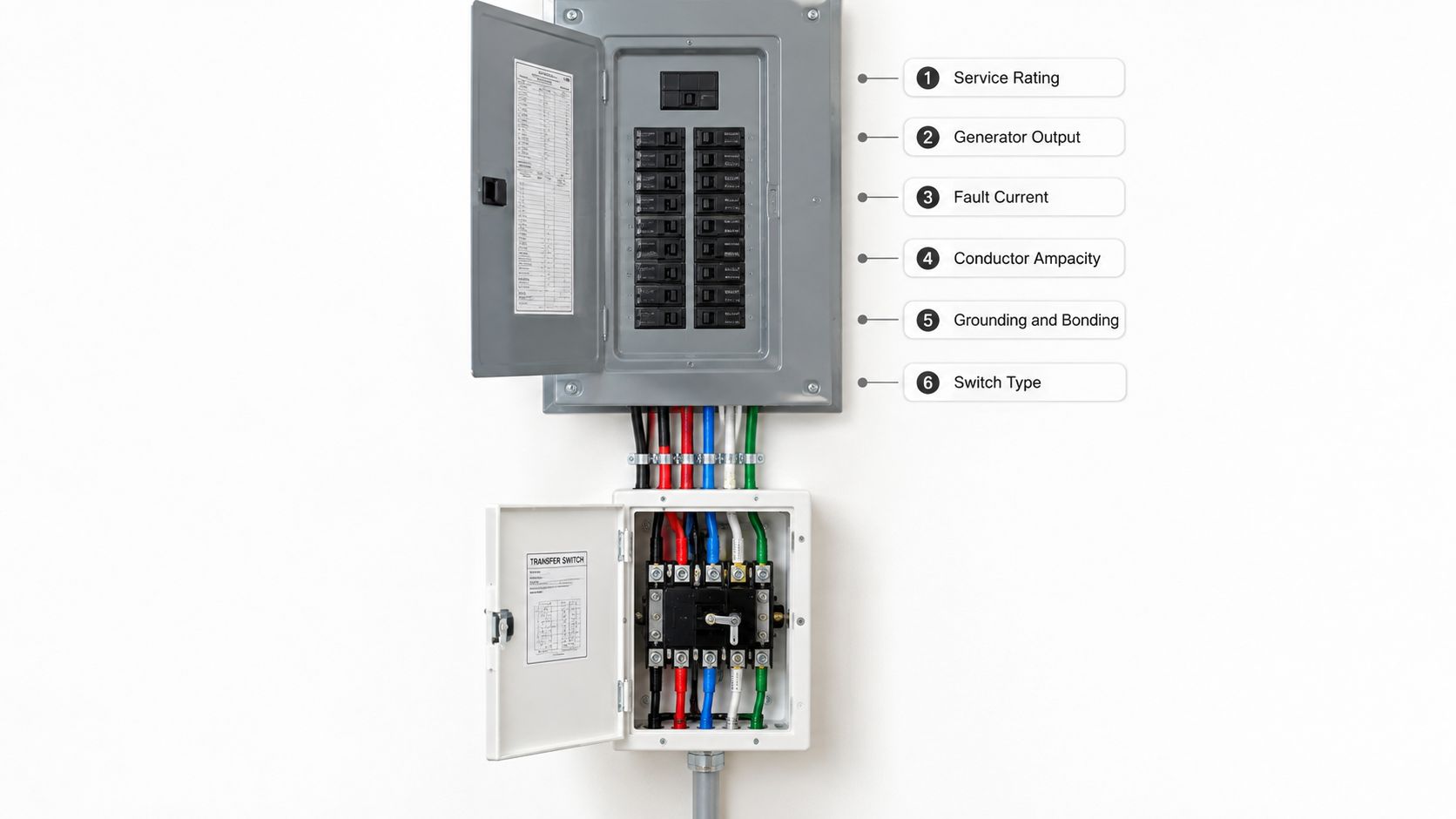
The electrician's installation sequence
Verify the existing system. Check service rating, generator output, available fault current, conductor ampacity, and the grounding and bonding arrangement. Establish whether the proposed switch location makes it service equipment and whether its fault-current rating is adequate with the specified protection.
Confirm equipment compatibility. Match the switch to the application, voltage, phase, frequency, neutral arrangement, and generator controller. A switch with suitable power terminals can still be incompatible with the generator's start and sensing signals.
Secure approval before physical work. Obtain the required permit and resolve utility disconnection arrangements before altering service conductors or mounting equipment in a final location. Confirm inspection stages so work isn't concealed before the inspector needs to see it.
Mount for access and environment. Use an enclosure appropriate for indoor or outdoor exposure and preserve applicable working space. Avoid roof runoff, standing water, obstructed doors, and locations where future shelving would block servicing.
Install and terminate the power conductors. Route utility, generator, and load conductors with proper support, bend space, and no mechanical strain on terminals. Use the specified conductor material and preparation method, then tighten connections with a calibrated torque tool to the equipment's listed values.
Connect the control system. Install sensing, remote-start, charger, and load-management wiring according to the matched equipment diagrams. Maintain required separation from power conductors and label conductors at both ends so future troubleshooting doesn't become guesswork.
Verify operation before placing the system in service. Check mechanical and electrical interlocking, control logic, and phase rotation where applicable. Phase rotation isn't a routine residential split-phase measurement, but it matters when the installation includes multiphase equipment.
Resolve the neutral before energizing
Neutral switching and bonding must be designed together. A solid-neutral transfer arrangement and a switched-neutral arrangement don't use interchangeable grounding assumptions.
Whether the generator is a separately derived system depends partly on whether its grounded conductor remains connected to the utility-supplied system. The electrician must confirm the generator's bonding provisions, the switch's pole arrangement, and the location of the system bonding connection against the actual design.
Adding a neutral-to-ground bond wherever a terminal is available can create parallel current paths. Removing a bond without understanding the source arrangement can leave fault protection ineffective.
The termination, control-wiring, and verification stages deserve particular scrutiny. Hidden shortcuts here include incompatible conductor lugs, unverified torque, missing start leads, and incorrect neutral connections that don't become obvious during an unloaded engine run.
Before covers go back on, the electrician should check conductor identification, barriers, enclosure bonding, feeder arrangements, and warning labels identifying alternate power sources. If the transfer switch becomes the service disconnect, downstream panel bonding must also be reviewed rather than left as it was.
Ask for an updated wiring diagram and equipment settings with the closeout documents. Those records help the next electrician distinguish the intended design from a later alteration.
How to Test the Installation Before the First Outage
A running engine doesn't prove that the house has reliable backup power. Commissioning must demonstrate the complete sequence under meaningful load, with the electrician controlling the utility-loss simulation.
Simulate utility failure. Confirm automatic starting, acceptable generator output, transfer, and power at the intended circuits.
Apply load. Watch voltage and frequency during motor starting and load-management operation, not just at idle.
Restore utility power. Verify stable-source recognition, retransfer, cooldown, and shutdown.
Repeat and measure. Follow the equipment's commissioning procedure for repeated cycles and professional contact-resistance testing.
Record the results. Log transfer time, electrical readings, battery condition, alarms, engine parameters where applicable, and retransfer behavior.
Acceptance and routine test checks
Check | Target | Why it matters |
|---|---|---|
Simulated utility loss | Generator starts and carries intended loads | Tests the complete start-and-transfer chain |
Transfer time | Meets the installation's applicable classification and equipment settings | Residential optional standby isn't automatically an emergency system |
Transfer cycles | Complete the specified repeated-cycle acceptance procedure | Exposes intermittent operation |
Contact resistance | Meets equipment acceptance limits, with consistent pole readings | Identifies connections or contacts needing investigation |
Retransfer and shutdown | Returns to utility and completes cooldown | Verifies restoration controls |
Monthly generator exercise under Cummins' NFPA 110 training guidance | At least 30 minutes, using manufacturer-recommended exhaust temperature or at least 30 percent of standby nameplate kW when applicable | Establishes meaningful exercise conditions |
Monthly switch operation | Electrically operate normal to alternate and back under the applicable maintenance plan | Verifies the transfer mechanism, not just engine starting |
The cited exercise guidance concerns emergency and standby systems; have the installer establish the applicable residential schedule with the manufacturer. Keep the successful commissioning log with the permit file and use an automatic transfer switch maintenance plan to assign ongoing checks.
Common Problems and How to Fix Them
A generator that starts from its exercise control but doesn't transfer during an outage may have a sensing, start-signal, or control problem. Don't assume the engine is at fault or repeatedly operate breakers to force a transfer.
Transfer switch symptoms, causes and fixes
Symptom | Likely cause | First check |
|---|---|---|
Generator starts but switch doesn't transfer | Control connection or source-acceptance problem | Electrician compares terminals and settings with the diagram |
Switch transfers but generator keeps running | Normal cooldown, timer setting, or sensing fault | Check controller status before treating continued running as a fault |
Generator doesn't start during outage | Battery, charger, or remote-start fault | Review accessible status indicators; technician tests the circuits |
Breaker trips at transfer | Excess load, motor surge, or wiring fault | Electrician investigates before resetting repeatedly |
New buzz or hum from switch | Loose connection or mechanism problem | Stop operation and call; don't open or retighten energized equipment |
Lights flicker after retransfer | Possible neutral, bonding, or connection fault | Stop using backup operation and request professional diagnosis |
Recheck after electrical changes
Mecklenburg County's generator safety guidance emphasizes isolation from utility power to prevent backfeed and the need for permits and inspections when connecting to permanent wiring. Preserve that protection after panel renovations, generator replacement, or solar and battery additions.
A later battery installation can change source-control behavior or require a different neutral arrangement. Have the electrician re-verify the integrated system rather than relying on the original sign-off.
Homeowners can review exercise logs and accessible battery or charger displays. Measurements inside electrical enclosures, lug work, and neutral or bonding changes belong to a qualified electrician.
When to Hire a Licensed Electrician for Your Transfer Switch
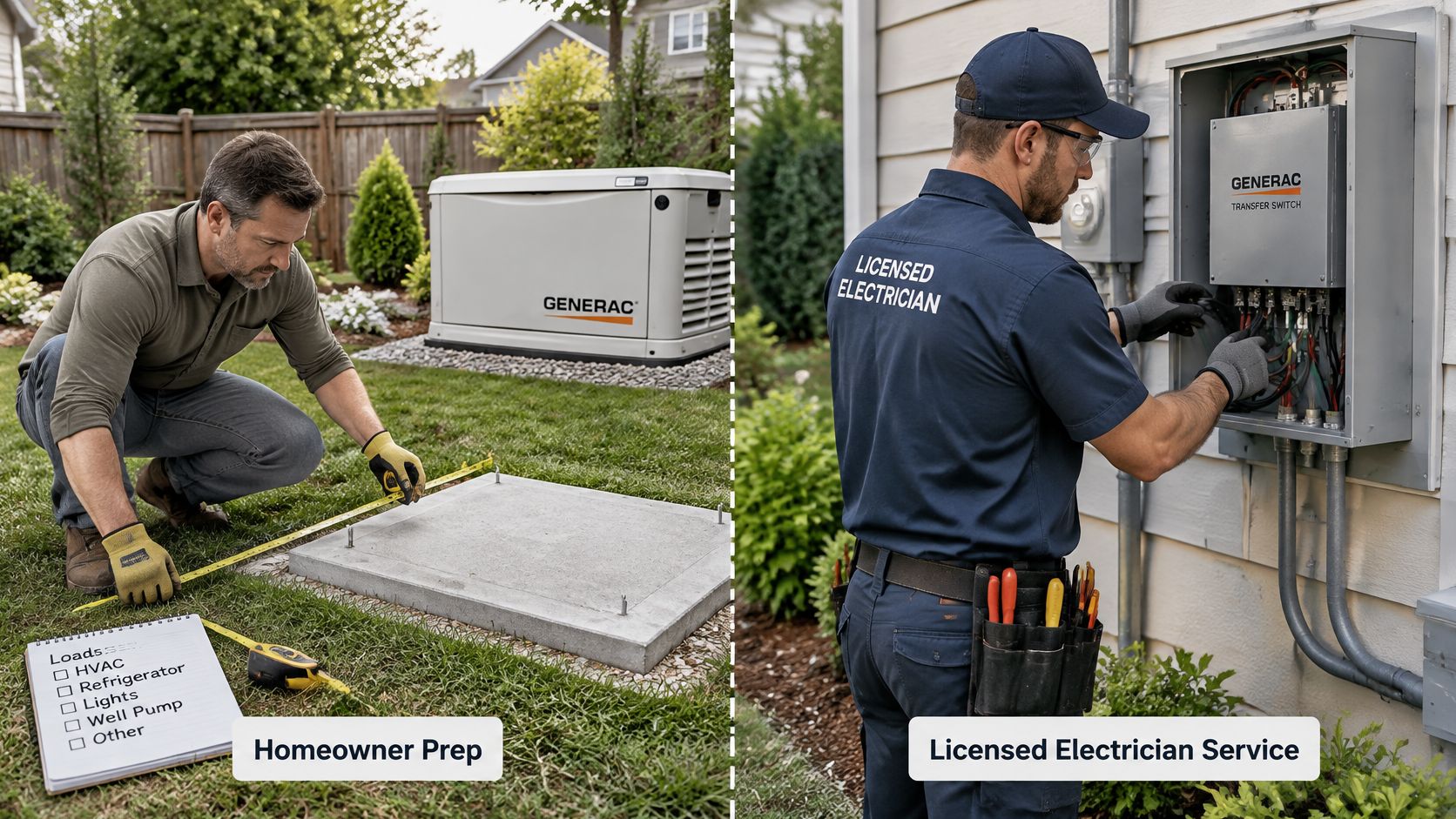
Bring the electrician in before the generator or switch is ordered. The transfer switch is the decision point: it drives the load calculation, permit path, utility coordination, and test plan, so buying equipment first can turn a simple scope into rework.
Hold off on preparing the generator pad until the installer approves its location and fuel routing. A pad set too early can lock in awkward access for electrical routes and fuel lines.
Questions to ask before signing
Qualifications and insurance. Are you appropriately licensed or registered for this municipality, and can you provide insurance documentation?
Permits and inspection. Who submits the application, coordinates the utility, and schedules sign-off?
Written sizing. Will you provide a load calculation and explain any load-shedding priorities?
Commissioning records. Does the price include a simulated outage and a written operating-test log?
Future changes. Will you explain maintenance responsibilities and what must be reassessed after panel, EV charging, or battery work?
Ask for the proposal to name the permit filer, utility contact, load calculation, simulated-outage test, and the documents you will receive at handover. A complete scope also states what later panel, EV charging, or battery work must be rechecked.
For whole-house generator selection, transfer-switch integration, and electrical service upgrades in Southeastern Pennsylvania, visit Amp'd Energy Solutions. Request a site assessment to review your panel, backup priorities, and any planned EV charging or battery additions before choosing equipment.
Comments