

Residential Battery Backup: Sizing and Setup
More than one in five occupied U.S. homes experienced an outage lasting at least 24 hours in 2024, according to data summarized from the U.S. Energy Information Administration's residential energy survey. That changes the residential battery backup conversation. This isn't a luxury reserved for unusual properties, and it isn't enough to ask how many “days of backup” a battery promises.
The practical question is narrower and more useful: which loads must run, how much power do they need to start, and how long must they operate under the worst seasonal conditions? A refrigerator, internet equipment, medical device, sump pump, well pump, heat pump, and EV charger create very different demands. Good design accounts for those differences before anyone recommends a battery size.
Table of Contents
The Reality of Grid Outages and Home Resilience - From utility storage to household resilience - What resilience requires
Sizing Your System for Capacity and Power Output - Start with the circuits that matter - Capacity and power must agree
Calculating Realistic Outage Runtimes - Build scenarios instead of promises - Protect the reserve
Comparing Battery Technologies and the Tesla Powerwall - Look beyond the battery cell - The Powerwall question
Evaluating Costs and the Resilience Tradeoff - Decide what you're buying - Compare the tradeoffs honestly
Installation Requirements and Local Permitting - The installation sequence
Choosing Between Batteries and Standby Generators - Use the household's vulnerability as the filter
The Reality of Grid Outages and Home Resilience
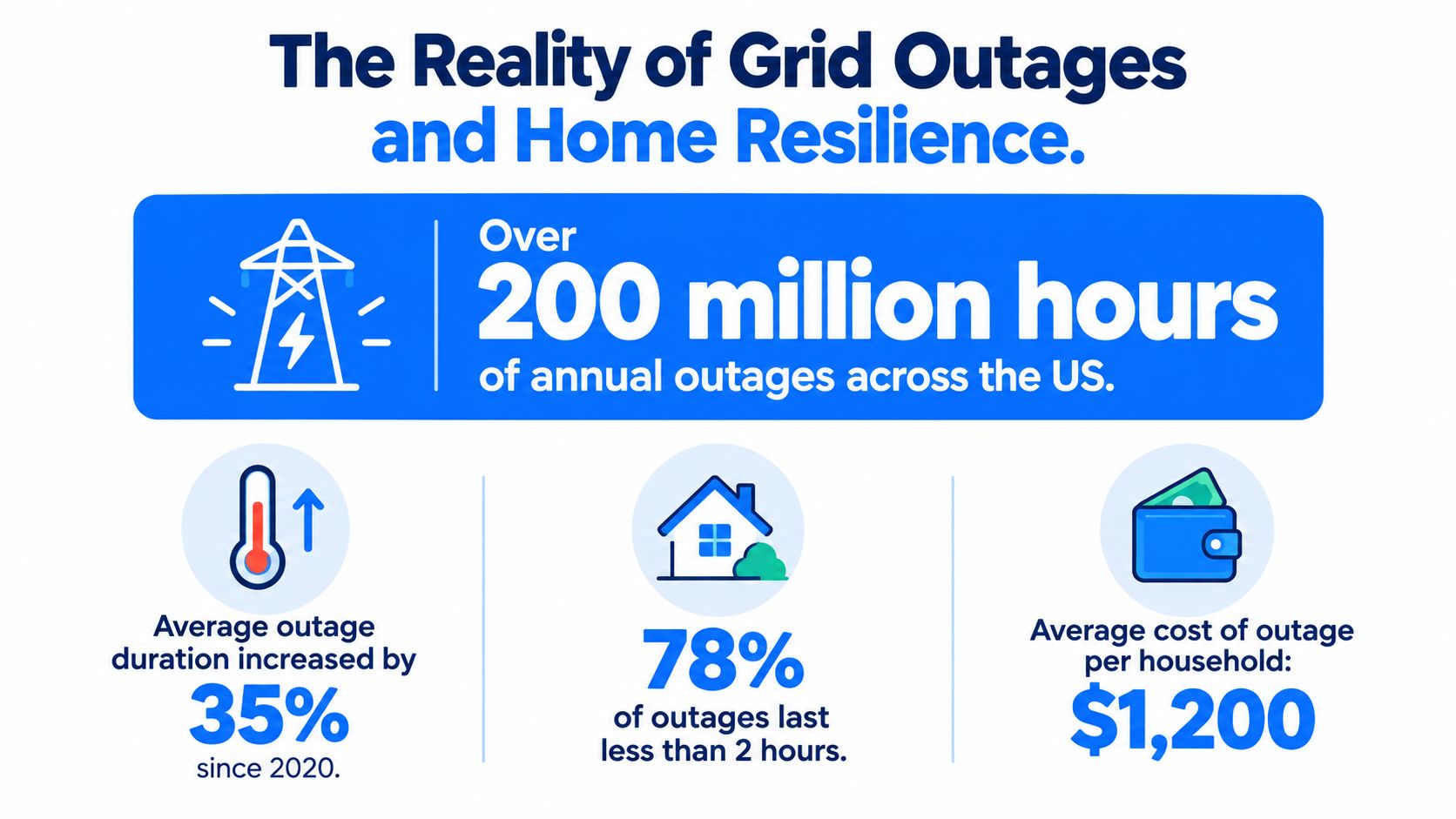
About 28.72 million of 132.54 million occupied U.S. primary residences had an outage lasting 24 hours or longer in 2024, or roughly 21.7% of households, based on survey data summarized by Solar Waypoint. Weather and natural disasters accounted for an estimated 24.4 million homes affected at that duration.
Those numbers matter because outage planning at home is usually framed the wrong way. Homeowners hear broad claims about how many days a battery can run, then assume resilience is mostly a question of buying more stored energy. In practice, outage performance depends on which circuits are backed up, what they draw at startup, and whether the system is designed for storm conditions instead of mild-weather averages.
A flooded basement, a dead well pump, spoiled food, or interrupted medical equipment can turn a routine outage into an expensive problem fast.
From utility storage to household resilience
Battery storage is no longer limited to utility projects. In 2023, worldwide battery-storage deployment more than doubled year over year, adding about 42 GW of new capacity, and the market exceeded 90 GWh, according to the International Energy Agency's battery storage analysis. Behind-the-meter systems at homes and customer sites made up roughly 35% of average annual additions.
The same analysis reported that European Union battery-storage capacity grew by 70% in 2023, with nearly 6 GW of annual additions. About 90% of that growth came from behind-the-meter systems, especially in Germany and Italy. That shift shows how storage is being used at the building level for continuity and load control, not only at large grid facilities.
Price declines helped push that change. The IEA reported lithium-ion prices fell from about $1,400 per kWh in 2010 to below $140 per kWh in 2023, a drop of more than 90%. Lower costs make residential batteries more attainable, but affordability alone does not guarantee useful backup. A battery chosen mainly for daily bill savings may be set up very differently from one intended to carry a home through a long outage.
Practical rule: A battery should be treated as part of the home's electrical infrastructure, not as a large appliance you plug into the wall.
What resilience requires
A battery backup system has to do more than store energy. It needs transfer equipment that isolates the home from the utility, an inverter that can support the intended loads, enough panel capacity for the selected circuits, and a control strategy for what stays on and what shuts off. It also has to work when solar production is poor, which is common during the same storms that cause longer outages.
Here, trade-offs show up.
Homes with heat pumps, electric water heating, well pumps, sump pumps, or Level 2 EV charging need careful design because those loads can drain stored energy quickly or create startup demands the inverter cannot carry. In many houses, the right answer is a critical-loads subpanel, load shedding, staged motor starts, or a service upgrade. Buying the largest battery available is sometimes part of the solution, but it is rarely the whole solution.
Sizing Your System for Capacity and Power Output
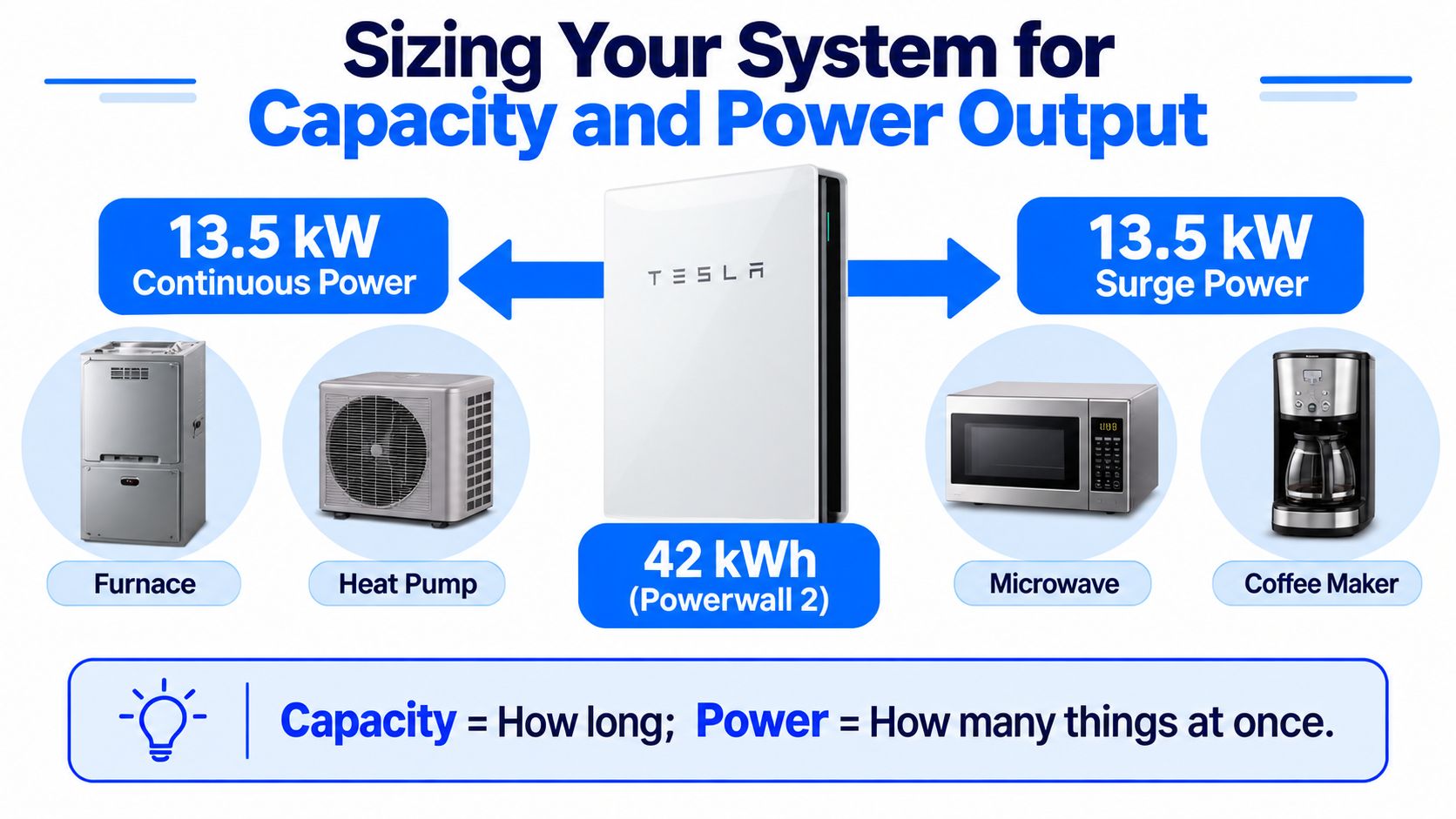
Battery sizing has two separate parts. Energy capacity, measured in kilowatt-hours, determines how long the system can supply loads. Power capability, measured in kilowatts, determines how many loads can run at once and whether motors can start.
Think of capacity as the fuel tank and power output as the pipe. A large tank doesn't help if the pipe can't deliver enough flow when a well pump or heat pump starts.
Start with the circuits that matter
Begin with a circuit inventory, not your whole-home average. Separate loads into three groups:
Life-safety and continuity loads: Medical equipment, refrigeration, lighting, communications, alarms, and a sump pump may belong here.
Comfort loads: Heating, cooling, cooking, and selected outlets can be included if the inverter and battery bank support their demand.
Deferrable loads: EV charging, electric resistance water heating, laundry, and other high-consumption circuits should usually be disabled during an outage unless the system was specifically sized for them.
Measure or estimate both running load and starting load. A refrigerator may draw modest power after it starts but require a brief surge. A well pump, sump pump, or heat-pump compressor can create a much more demanding start. The system must handle the combined starting event if two motors operate at the same time.
Capacity and power must agree
A system can carry enough stored energy for an overnight outage yet still trip when a pump starts. The reverse also happens. An inverter may run several appliances simultaneously, but a modest battery bank can empty quickly if heating or cooling remains active.
A national-laboratory simulation found that storage requirements for a three-day interruption ranged from approximately 10 kWh in temperate conditions to 90 kWh in hot climates for baseline homes, based on climate, outage duration, household loads, and the chosen backup scope. The National Renewable Energy Laboratory study also found that photovoltaic generation may not fully replenish a battery during a prolonged outage.
For a Southeastern Pennsylvania property, test at least two operating cases:
Winter case: Heating equipment, refrigerator, lighting, communications, and pumps.
Summer case: Air conditioning or heat-pump operation, refrigeration, pumps, and essential electronics.
A load-management controller can prevent an EV charger or water heater from competing with a medical device or sump pump. That control strategy often improves resilience more effectively than adding storage without changing the load profile.
Calculating Realistic Outage Runtimes
A battery that takes in 10 kWh does not give your house 10 kWh back. Under NREL's 2024 residential-storage assumptions, a system operating at 85% round-trip efficiency returns about 8.5 kWh before you account for inverter standby consumption and other real-world losses. That gap is why “days of backup” claims fall apart once you put actual household loads on paper.
Runtime is a load-planning exercise, not a marketing label. Usable capacity matters, but so do inverter losses, battery condition, ambient temperature, reserve settings, and short high-demand events such as a pump or compressor starting. A battery that carries lighting, refrigeration, and internet gear through the night may shrink to a much shorter window once space conditioning, a sump pump, or a well pump joins the outage plan.
Build scenarios instead of promises
Use a simple planning equation:
Usable runtime equals usable battery energy divided by average load, with additional allowance for inverter consumption, motor starts, temperature, aging, and reserve settings.
Run that equation for each backup scenario, not for the house as a whole. A refrigerator and communications circuit can be fairly predictable. Heating and cooling loads are not. Pump loads can look modest on average, then spike under storm conditions when runtime matters most.
That is why I recommend building outage cases around what the home must do, not around a single headline runtime.
Load Scenario | Average Draw (kW) | Estimated Runtime (Hours) |
|---|---|---|
Refrigeration, lighting, internet, device charging | Site measured | Calculate from usable capacity and measured draw |
Critical loads with medical equipment | Site measured | Calculate with medical equipment duty cycle |
Critical loads plus sump or well pump | Site measured | Calculate with pump starting and running demand |
Critical loads plus heating or cooling | Site measured | Calculate using seasonal HVAC demand |
Whole-home operation with EV charging | Site measured | Usually requires dedicated load management and a larger design |
The table is a planning framework, not a quote. The draw and runtime values have to come from a site load calculation because appliance mix, control settings, weather, and occupant behavior change the result.
That variation shows up in research as well. A 2025 residential PV-and-battery study reported that energy supplied during a simulated 48-hour outage ranged from 14 kWh to 26.7 kWh, depending on household demand and operating strategy, as reported in the study proceedings. Same outage length, very different outcome.
Protect the reserve
Set the emergency reserve first, then decide how much daily cycling you want for bill savings. Homeowners often focus on evening discharge to reduce grid purchases, but every kilowatt-hour used for arbitrage is one less kilowatt-hour sitting ready for a storm outage. The trade-off is real, and it should be set intentionally in the controls.
An EV charger usually should stay locked out during an outage unless the design specifically budgets for it. The same goes for other discretionary loads. Refrigeration, communications, medical equipment, and water management generally deserve priority over convenience loads.
Battery performance also changes with age, charge rate, and temperature. Placement, ventilation, and thermal management affect the runtime you can count on, especially when the battery is no longer new. The practical question is not how many days the brochure suggests. It is how long this system will run your specific loads, in your season, with reserve left for the part of the outage you cannot predict.
Comparing Battery Technologies and the Tesla Powerwall
Residential systems commonly use lithium-ion chemistries, but chemistry is only one part of the decision. The enclosure, inverter, controls, thermal management, warranty terms, solar compatibility, and service process can matter just as much.
Nickel manganese cobalt, or NMC, offers high energy density, which can help where wall or floor space is limited. Lithium iron phosphate, or LFP, generally offers a different balance, with strong thermal stability and suitability for frequent cycling. The right choice depends on installation conditions and the operating strategy, not on chemistry labels alone.
Look beyond the battery cell
A residential battery must form a stable microgrid when utility power disappears. Ask how the system handles:
Grid forming: Can the inverter establish and maintain the home's isolated electrical system?
Motor starts: Does the power electronics support the surge from pumps and compressors?
Solar operation: Can the solar array continue operating safely while the grid is down?
Load control: Can the system disconnect an EV charger or other discretionary circuit?
Reserve management: Can the owner set a minimum emergency state of charge?
Expansion: Can additional storage or generation be added later?
An integrated system can simplify coordination between the battery, inverter, solar array, gateway, and monitoring software. That can be useful for a home with existing solar or a planned EV charger, but integration doesn't remove the need for a load calculation.
The home energy storage system guide can help homeowners understand how storage, solar generation, and electrical service fit together before requesting a design.
The Powerwall question
A Powerwall installation can make sense when the homeowner wants a coordinated system for backup and everyday energy management, particularly where solar and EV charging are part of the long-term plan. Its value depends on the selected backup circuits, available power output, reserve settings, and the home's panel capacity.
Don't choose it solely because the name is familiar. Compare the complete design, including usable energy, continuous and surge power, transfer equipment, thermal location, warranty conditions, and future service. A lower-cost battery can be appropriate when the home needs only critical-load backup. A more integrated system may justify its complexity when the property needs coordinated solar operation, load shedding, and broader coverage.
Evaluating Costs and the Resilience Tradeoff
A battery can serve two purposes, and they can conflict. Daily cycling may reduce electricity purchases or shift energy away from expensive periods. Holding energy in reserve improves outage readiness but leaves less capacity available for bill management.
NREL's residential-storage methodology models approximately one cycle per day and links degradation to usage rate. It also notes that a system may require replacement during the analysis period, as described in the NREL residential battery-storage assumptions. The important point isn't a universal payback period. It's that operating strategy changes the asset's long-term condition.
Decide what you're buying
Ask which of these benefits matters most:
Energy management: The battery shifts electricity use and may support a time-based tariff.
Resilience insurance: The battery protects essential services when the grid fails.
Solar utilization: The battery stores onsite generation for later use.
Continuity protection: The system reduces disruption to medical care, remote work, food storage, or property protection.
A 2025 study found that explicitly accounting for degradation maintained a higher state of charge and increased the modeled share of adopting households by 21.5 percentage points when outage-mitigation benefits were included, according to the published study. That finding supports a broader evaluation. A battery may look weak if judged only by bill savings yet make sense for a household facing high interruption costs.
Compare the tradeoffs honestly
Aggressive daily cycling can improve immediate energy savings while using more of the battery's available life. A higher emergency reserve can preserve outage capability but reduce the amount of energy available for routine arbitrage. Neither strategy is automatically correct.
A useful quote for the design meeting is:
Ask what you're paying for: energy savings, backup insurance, or both.
For a home with critical medical equipment, a basement vulnerable to flooding, or work that can't pause during an outage, resilience may carry more value than a spreadsheet payback. For a home with mild loads and rare interruptions, a smaller critical-circuit system may be more sensible than whole-home coverage.
Review the home battery backup system cost discussion as a starting point, then replace generic assumptions with your tariff, load profile, reserve requirement, maintenance plan, and likely replacement timing.
Installation Requirements and Local Permitting
A battery installation is an electrical project, not a simple equipment delivery. In Southeastern Pennsylvania, the design must account for the home's service rating, panel condition, grounding, conductor routes, equipment location, utility requirements, and applicable fire-code clearances.
The installation sequence
First, complete a site assessment. The installer should inspect the service equipment, identify critical circuits, review solar equipment if present, and locate high-demand loads such as heat pumps, pumps, water heaters, and EV chargers.
Next, choose the transfer architecture. A critical-loads subpanel may protect selected circuits, while an automatic transfer arrangement can support broader coverage and controlled load shedding. The equipment must prevent unsafe backfeed into the utility system.
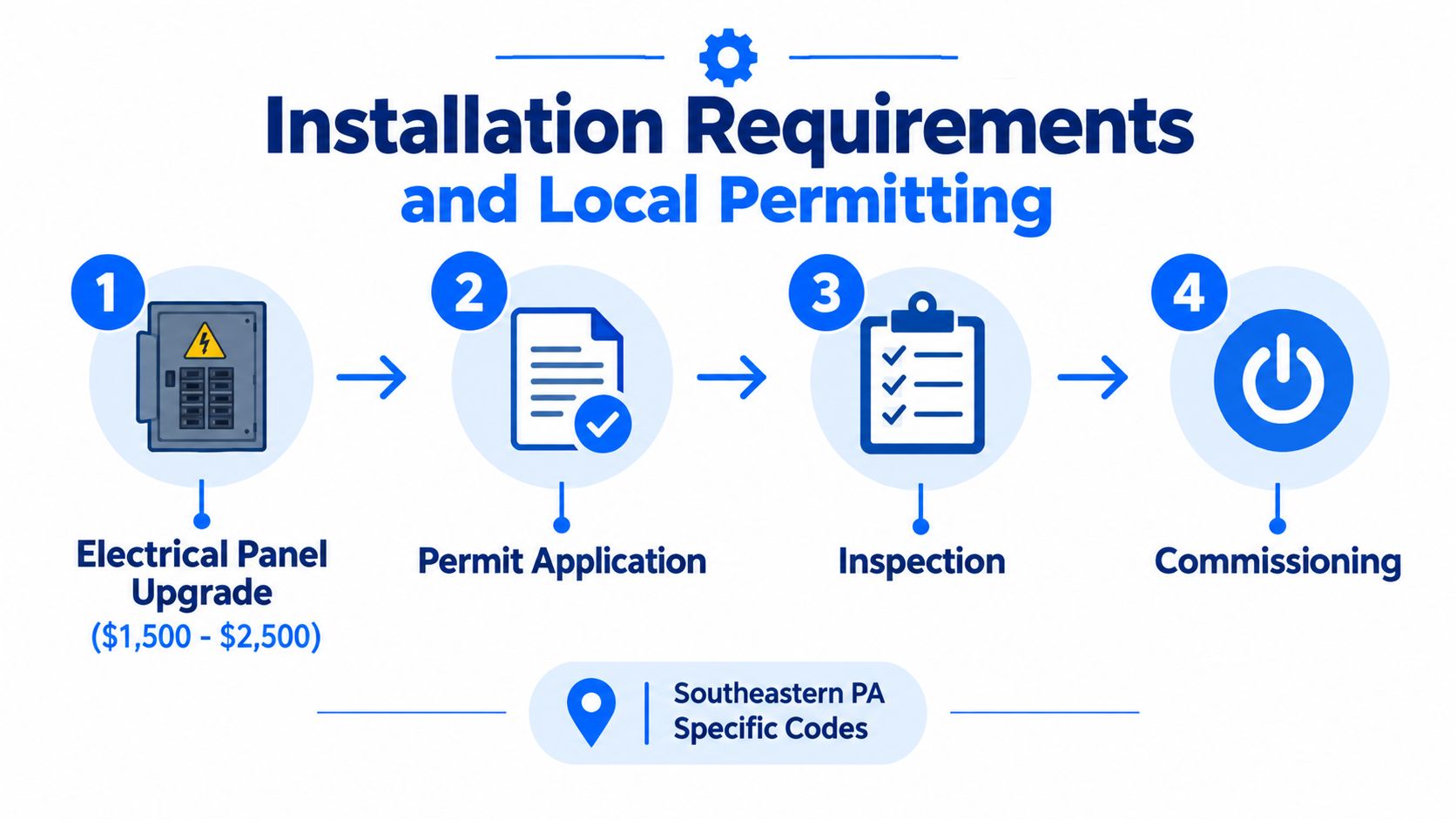
Then, address physical placement. Batteries need an approved location with suitable clearances, environmental conditions, access, and mounting support. A wall that appears solid may not provide the required structure once equipment weight, conduit, and service access are considered. Masonry, framing, garage conditions, and indoor temperature all affect the installation details.
Finally, complete permitting, inspection, and commissioning. The installer submits the electrical plans, coordinates utility requirements where applicable, schedules inspection, tests the transfer behavior, verifies the backup circuits, and explains shutdown and restart procedures.
The system isn't commissioned when the lights turn on. It's commissioned when the homeowner understands what stays on, what turns off, and how the reserve is protected.
Panel upgrades aren't universal, but an older or undersized service can limit the project. Adding storage beside an EV charger and electric heating may require capacity increases or managed loads rather than just connecting equipment to the existing panel.
Homeowners should ask for the permit scope, inspection responsibility, equipment clearances, warranty registration, maintenance instructions, and a written list of backed-up circuits. An automatic transfer switch overview can clarify why transfer equipment is central to safe backup operation.
Choosing Between Batteries and Standby Generators
A battery and a standby generator solve the same broad problem through different operating models. The battery stores electricity before the outage. The generator produces electricity during the outage by consuming fuel.
For short interruptions and homes that value quiet operation, automatic response, solar integration, and low routine maintenance, a battery may fit well. It can also provide everyday energy-management value when the grid is operating. Its limitation is stored energy. Once the battery is depleted, continued operation depends on solar recharge, another charging source, or a second generation system.
A generator is often stronger for extended operation and high surge demand. As long as fuel remains available and the equipment receives proper maintenance, it can continue supplying heavy loads. The tradeoffs include noise, combustion, exhaust, fuel logistics, outdoor placement, and ongoing servicing.
Use the household's vulnerability as the filter
Choose a battery-focused design when:
Quiet operation matters: The system has no combustion noise at the point of use.
Solar integration matters: The battery can be designed to work with onsite generation.
Critical loads are clear: The household can identify what must run and can shed discretionary demand.
Daily energy management has value: The battery will perform a useful role between outages.
Consider generator coverage when:
Outages may last beyond stored energy: Fuel availability supports the required duration.
Large motor loads are essential: Pumps, heating, cooling, or other equipment need substantial starting power.
Whole-home continuity is essential: The design must support broad loads without relying on strict behavior.
The property can meet placement and fuel requirements: Outdoor clearance, ventilation, and service access are practical.
A hybrid approach can also be rational. A battery can handle automatic, silent coverage for essential loads and preserve power during the initial outage, while a generator provides extended support when the event lasts longer than the storage plan. That arrangement requires careful controls so the generator and battery don't operate against each other.
The right decision starts with an outage scenario, not a product brochure. List the loads that protect health and property, test winter and summer demand, decide how much reserve must remain, and compare fuel logistics against storage limitations. A licensed electrical contractor can then design the transfer equipment, load management, permits, and commissioning around those requirements.
Amp'd Energy Solutions designs and installs residential battery backup systems, including critical-circuit and whole-home configurations, with support for system design, permitting, installation, and testing. Visit Amp'd Energy Solutions to request a Southeastern Pennsylvania site assessment that accounts for your panel, seasonal loads, EV charging plans, and realistic outage runtime.
Comments