

Best Whole House Generator for the Money
The most popular advice about buying a whole-house generator is to compare models by price and power rating. That's a costly way to choose. The best whole house generator for the money isn't the cheapest unit or the largest one. It's the system that protects the loads you care about at a total ownership cost that makes sense for your home and outage risk.
For Southeastern Pennsylvania homeowners, that means looking beyond the equipment quote. Fuel access, motor-starting demands, transfer equipment, permits, installation, maintenance, and how often your home loses power all affect value. Start with the comparison below, then make the decision from your actual loads rather than a sales pitch.
Backup approach | Strongest value when | Main trade-off |
|---|---|---|
Right-sized standby generator | You face recurring or lengthy outages and want automatic operation | Higher installed cost and ongoing fuel and service needs |
Large portable generator | You need occasional backup for selected circuits and can manage setup | Manual operation, refueling, and more limited coverage |
Battery-generator hybrid | You want quiet battery backup for shorter outages with generator support for longer ones | More equipment and integration decisions |
Table of Contents
Why Purchase Price Misleads Whole House Generator Buyers - Judge the complete system, not the equipment
Sizing a Whole House Generator Without Overbuying - Build a load list - Separate must-run loads from convenience loads
Natural Gas vs Propane vs Diesel for Standby Generators - Let consumption inform the choice
Installation Costs and the 10-Year Ownership Math - Build a household ownership estimate - Compare capacity against actual use
Right-Sizing for Three Southeastern PA Home Profiles - The suburban colonial - The rural home with pumps - The household with an EV charger
Choosing an Installer in Southeastern Pennsylvania - Check accountability, not just the quote
Standby Generators vs Portable Units vs Battery Hybrids - Use batteries for a different job
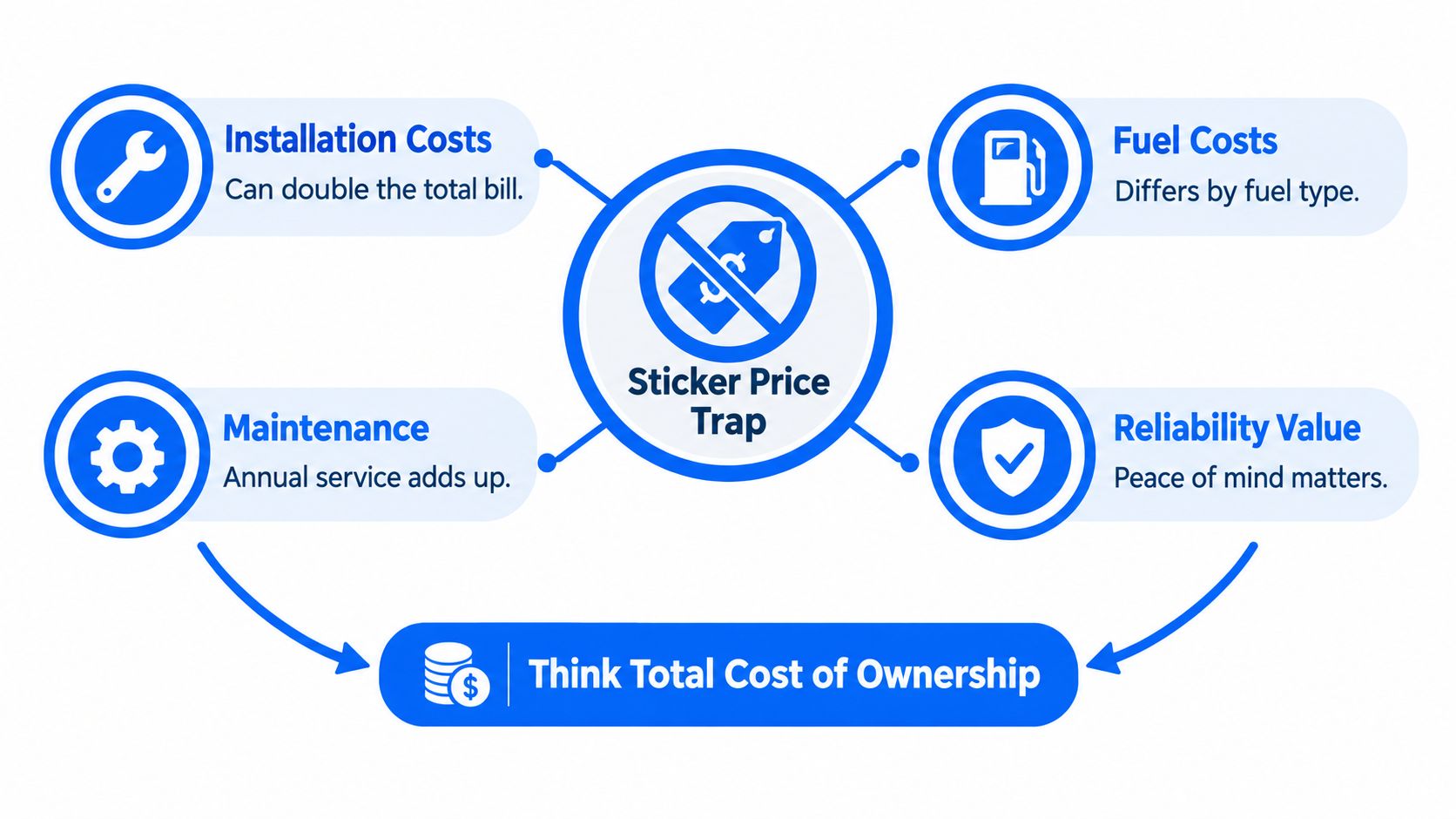
Why Purchase Price Misleads Whole House Generator Buyers
The cheapest generator quote can lock you into the more expensive project. Equipment price leaves out transfer equipment, electrical work, fuel connections, permits, and site preparation. Tested whole-house generator equipment costs approximately $3,400 to nearly $7,000, while installation may add about $5,000 to $10,000 or more, according to Consumer Reports' generator cost and comparison guidance.
Compare ownership costs over 10–15 years, including fuel, scheduled maintenance, and the work required to deliver the coverage you expect.
Your outage history should determine how much that coverage is worth. U.S. electricity customers averaged approximately 11 hours of interruptions in 2024, nearly twice the preceding decade's annual average, with roughly 1.5 interruptions; major weather events, including Hurricanes Beryl, Helene, and Milton, accounted for about 80% of outage hours (EIA reliability data for 2024). These national averages don't predict outages on your street. Use your household's experience to decide whether automatic backup justifies its ongoing expense.
Judge the complete system, not the equipment
A permanent standby system starts automatically and supplies selected loads through transfer equipment. That convenience earns its keep when outages threaten heat, refrigeration, medical equipment, sump pumping, or work. Paying to run every circuit makes less sense when prioritized coverage protects those needs.
For a Southeastern PA home, have the installer check heating equipment, well and sump pumps, air-conditioning startup demands, fuel access, and local approval requirements before recommending capacity. Ask which discretionary loads can be shed during an outage. Keeping those loads from running together can avoid buying capacity you rarely use.
Cheaper proposals fall short when they omit necessary site work or promise coverage without accounting for motor startup. Require those details before accepting the price.
Practical rule: Compare complete, itemized proposals. Ask each installer to separate equipment, transfer equipment, fuel work, electrical work, permits, commissioning, and maintenance assumptions, and identify which circuits remain available when loads are shed.
Sizing a Whole House Generator Without Overbuying
Square footage isn't a load calculation. A smaller home with a well pump, electric heating, or demanding air conditioning can require more generator capacity than a larger home with fewer high-demand loads. Size the system around the equipment you want available during an outage, then account for the temporary surge when motors start.
Build a load list
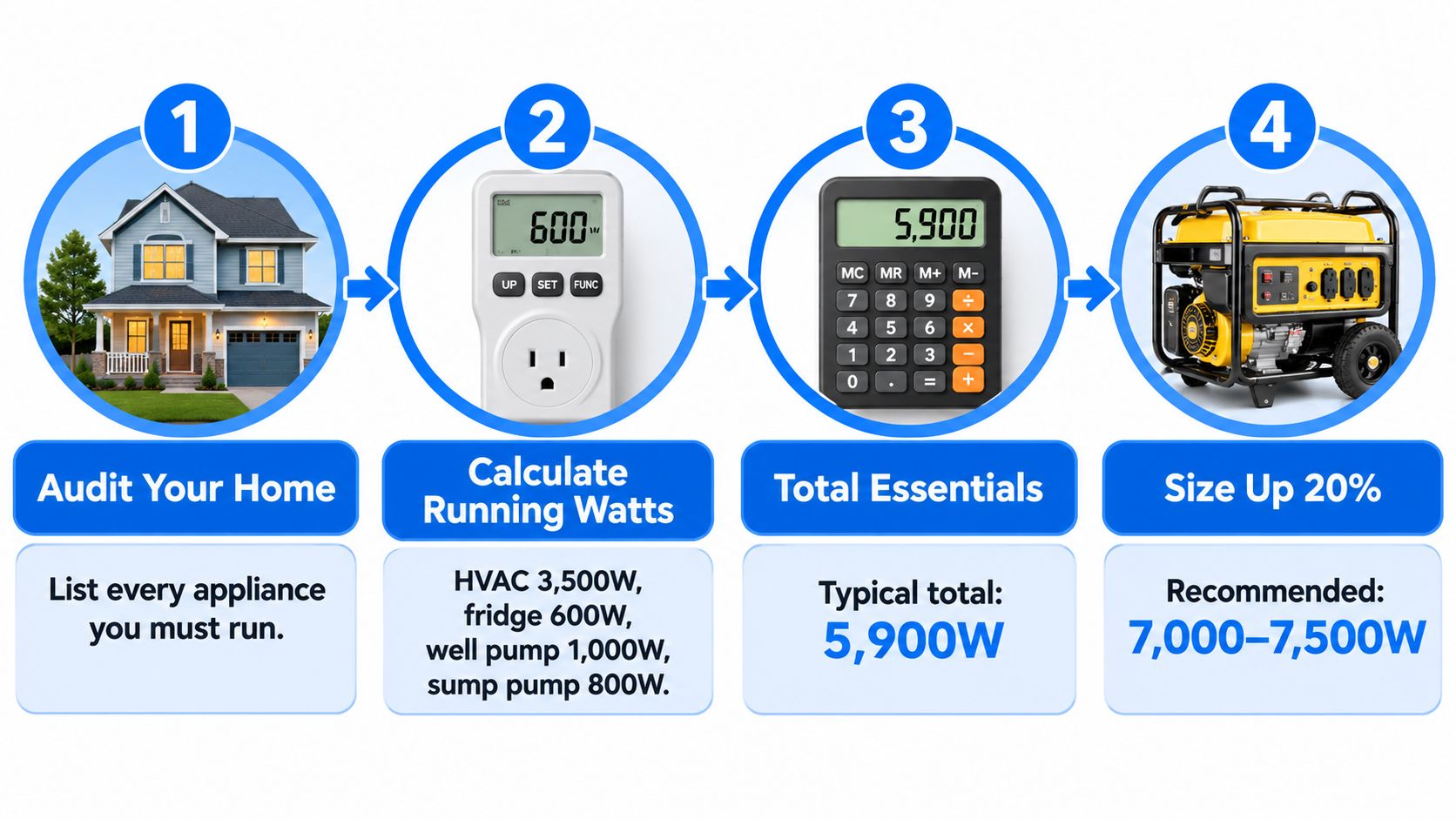
Start with the essentials: heating or cooling, refrigerator and freezer, well and sump pumps, lighting, communications, medical equipment, and any other circuit you can't afford to lose. Record each appliance's running watts and starting watts from its label or documentation. If the data isn't clear, have an electrician measure or verify it rather than relying on a guess.
Next, identify the largest motor-starting demand. Refrigeration compressors, air-conditioning systems, heat pumps, and pumps can briefly draw more power at startup than they use while running. Consumer Reports tests generators with appliance loads, including refrigerators, space heaters, and air conditioners, and evaluates whether they handle compressor-start voltage spikes when operating near capacity. That's why a nameplate rating alone doesn't establish whether a unit will handle your home's toughest startup.
Separate must-run loads from convenience loads
A defensible calculation adds the running demand of the loads you plan to run together, then checks whether the generator can handle the largest relevant starting surge. Don't add every appliance's starting watts as if every motor starts at once. Instead, ask the installer to document which loads can run simultaneously, which are managed, and what happens if two high-demand devices call for power together.
A load-management strategy can make a smaller system more useful. For example, you might prioritize refrigeration, a heating system, lights, and a sump pump while delaying or disabling another large load. That's a better conversation than sizing for every possible appliance without considering whether your family would use them all at once.
For a typical home, the right answer depends on the inventory, not a generic claim that a certain kilowatt band suits every property. Use the whole-house generator sizing calculator as a starting point, then ask a qualified electrician to verify running watts, starting watts, voltage, phase, and managed loads before you approve equipment.
Natural Gas vs Propane vs Diesel for Standby Generators
Choose the fuel supply before shopping for a generator. A cheap unit can become an expensive purchase if your property needs substantial fuel infrastructure or frequent deliveries. Fuel availability, connection requirements, and outage duration should drive the choice.
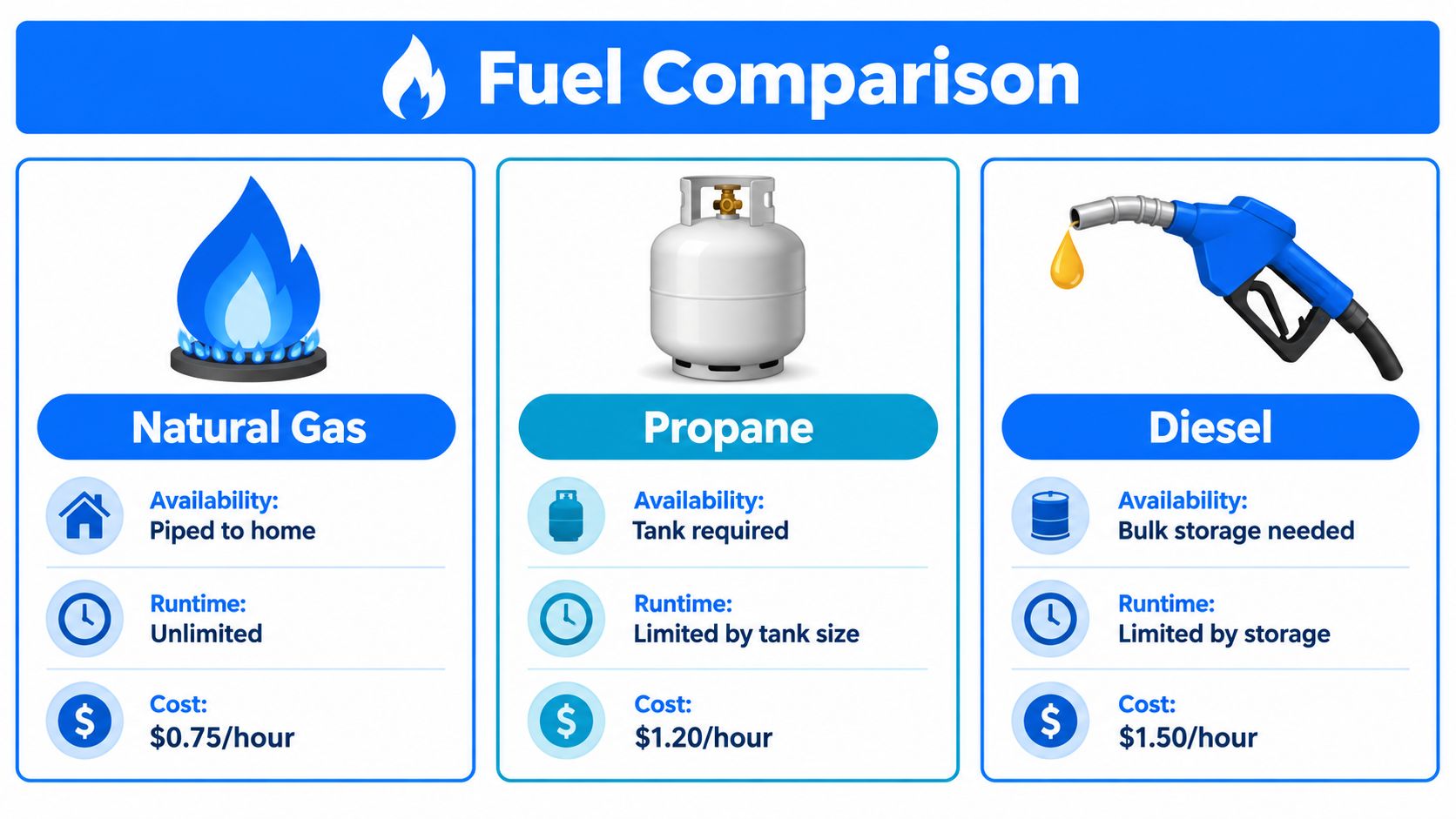
Fuel | Supply arrangement | Value consideration |
|---|---|---|
Natural gas | Connects to an available gas service | Avoids onsite fuel storage when service and required flow are suitable; depends on the gas connection remaining available |
Propane | Requires an onsite tank and refill planning | Gives you stored fuel, but tank size, electrical load, and delivery access determine practical runtime |
Diesel | Requires bulk fuel storage and handling | Consider for specific site requirements, with storage, upkeep, and fuel planning included in the decision |
For Southeastern Pennsylvania homes with suitable natural-gas service, start by evaluating that connection. Have the installer confirm available flow and connection requirements before committing to equipment. Rural properties in parts of Chester, Lancaster, and Berks counties may need propane storage and delivery instead. Choose diesel only when the site's requirements justify its storage and handling obligations.
Get the fuel assumptions in writing.
Your site checklist should cover available service, equipment compatibility, tank placement where applicable, refill access, and the supply plan for an extended outage. For propane, ask how the proposed tank supports your intended coverage. Prioritized circuits and load shedding belong in that discussion because the loads you keep running affect consumption.
Let consumption inform the choice
According to Consumer Reports' standby-versus-portable comparison, consumption can reach approximately 13 to 48 gallons of liquid propane per day, or an equivalent natural-gas requirement, while larger tested models producing more than 15,000 watts can run approximately 120 to 250 hours on a propane tank, depending on tank size, load, and consumption.
Treat those ranges as context. Require a fuel estimate for your proposed generator operating under your household's expected outage loads. A larger unit can cover more equipment and consume more fuel; true whole-house coverage deserves scrutiny when prioritized circuits would meet your needs. Reject per-hour cost comparisons that omit load and fuel assumptions, and judge the supply arrangement over your intended ownership period.
Installation Costs and the 10-Year Ownership Math
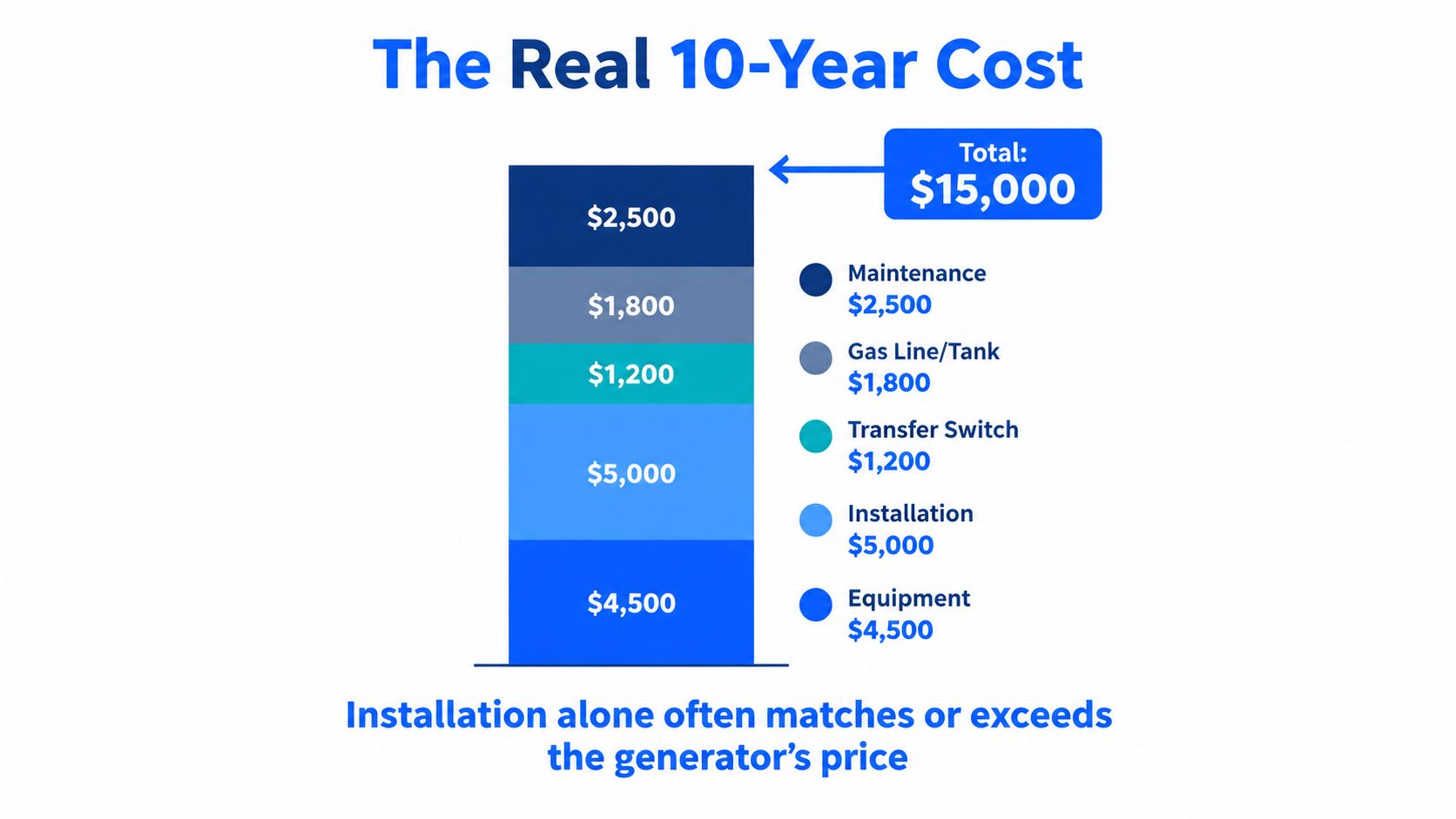
A cheap generator quote can become an expensive backup system. Use the equipment-to-installation ratio discussed earlier in Consumer Reports' generator cost and installation overview as a warning: the equipment price leaves much of the project unpriced. Judge the finished installation and its ownership costs.
Request an itemized scope: generator, transfer equipment, panel work, fuel connection or tank, pad and placement, permits, inspections, startup, and testing. Require the installer to identify exclusions and change-order triggers before you sign. Difficult access, placement constraints, and electrical changes deserve written allowances rather than surprises after work begins.
Permits, placement rules, noise restrictions, and experienced electrical installation can affect project cost, as explained in Consumer Reports' generator buying guide). For a Southeastern PA home, resolve the proposed location, access, panel work, and local approval requirements during the site visit.
Build a household ownership estimate
Compare proposals over the same ownership period, whether you expect to keep the system for 10–15 years or another interval. Record these categories separately:
Installed project cost: Equipment, transfer equipment, labor, fuel work, electrical changes, permits, and inspection. Check that competing quotes include the same work.
Scheduled service: Required maintenance, battery replacement, and repair allowances. Use a written schedule and current service pricing.
Outage fuel: An estimate tied to your selected loads and expected outage use. Continuous full-load operation is a poor default assumption.
Coverage trade-offs: Loads you will exclude, manage, or delay, including what happens when several appliances demand power together.
Treat the chart below as an illustrative ownership breakdown, not a quote for your property.
Compare capacity against actual use
Price a prioritized-circuit or load-shedding option alongside true whole-house coverage. Compare installed cost, fuel setup, service, and outage fuel using identical assumptions. Require documented startup capability and a clear description of which loads can run together.
Reject savings that depend on untested capacity.
A smaller system earns its lower price only when it supports the agreed loads. A larger system earns its premium only when the additional coverage matters to your household.
Use the whole-house generator maintenance cost guide to frame service questions, then obtain system-specific tasks, timing, and prices. Choose the proposal with a credible ownership estimate and acceptable coverage, rather than the lowest equipment line item.
Right-Sizing for Three Southeastern PA Home Profiles
Three homes can need three different backup plans, even when their floor plans look similar. The decisive details are the heating and cooling equipment, fuel access, pumps, and whether the household expects to run high-demand loads at the same time.
The suburban colonial
A 2,000-square-foot colonial with natural gas and central air might seem like an obvious candidate for a large standby system. Don't size it by the home's area alone. Check the air conditioner's starting demand, heating system, refrigeration, and any circuits the household considers essential. If the owners are comfortable managing other loads, a smaller, load-managed system may offer better value than full simultaneous coverage.
The rural home with pumps
A rural home with a well pump and sump pump needs special attention to motor starts and water protection. Frequent storms can make reliable pumping a priority, but the generator must be able to support both the home's selected circuits and the relevant pump startups. The owner should also consider where fuel will be stored and how it will be replenished during a prolonged outage.
The household with an EV charger
An EV charger changes the load conversation because charging adds a substantial electrical demand that may compete with household loads. Don't automatically size a standby generator to charge the vehicle during an outage. Decide whether charging is a backup requirement, then ask the electrician to account for it as a managed or excluded load.
A strong proposal explains what the system won't run. If the installer can't identify those limits, you can't make an informed value comparison.
For each profile, request a load calculation that lists running and starting demand, explains simultaneous loads, and identifies any managed circuits. That gives you a defensible system choice without pretending one generator size fits every Southeastern Pennsylvania home.
Choosing an Installer in Southeastern Pennsylvania
A generator is only useful if the electrical and fuel work are properly designed, permitted, installed, and tested. Don't choose an installer solely by the equipment brand or the first quote. Ask the person responsible for the work to explain the system in terms you can check.
Use this checklist during a site visit:
Local requirements: Ask who will handle permits and inspections for your township, and how placement, noise, and setback requirements will be checked.
Transfer equipment: Have the installer explain the automatic transfer setup, what it will power, and how the system will be tested after installation.
Fuel coordination: Confirm who will verify gas capacity or plan propane storage and connection work.
Load documentation: Request the load calculation, including startup demands and any managed circuits.
Service after commissioning: Ask who supports maintenance, troubleshooting, repairs, and warranty questions once the system is running.
A contractor familiar with Southeastern Pennsylvania's utility territories and municipal processes may be better prepared to coordinate local requirements than a provider who treats every site the same. Make sure that familiarity is demonstrated through a clear project scope, not just a sales claim.
Check accountability, not just the quote
A larger dealer network and a family-run electrical contractor can offer different service experiences. Focus on who will be your point of contact, who performs the installation, who responds if the system has a problem, and whether the same team remains involved after commissioning. Amp'd Energy Solutions is a family-owned electrical contractor serving Southeastern Pennsylvania and offers generator selection, installation, and related electrical services.
Get comparable written proposals from more than one qualified installer. A lower bid deserves scrutiny if it leaves out permits, fuel coordination, transfer equipment, testing, or post-installation support. Installation quality affects whether the system works as intended when the grid fails, so make accountability part of the value calculation.
Standby Generators vs Portable Units vs Battery Hybrids
A permanent standby generator isn't the right answer for every home. Choose between standby, portable, and battery-based backup by asking how often outages affect you, which loads must stay on, and how much manual involvement you're willing to accept.
Option | Advantages | Limits to account for |
|---|---|---|
Automatic standby | Starts and transfers power automatically; can support larger household loads | Requires permanent installation, fuel planning, and ongoing maintenance |
Large portable unit | Lower equipment cost and flexible use for selected loads | Requires manual setup, approved connection, fuel management, and supervision |
Battery-generator hybrid | Battery can cover selected loads quietly, with a generator available for longer outages | Requires careful electrical integration and a clear plan for which system serves which loads |
A portable generator can make sense when outages are occasional and the homeowner is prepared to start, connect, monitor, and refuel the unit safely. It's less appealing when no one will be home during an outage or when the household depends on automatic backup. A standby system offers greater convenience, but that convenience isn't worth paying for if a simpler setup adequately protects the loads that matter.
Use batteries for a different job
A battery and generator can complement each other. The battery may cover quiet, short-duration needs, while the generator can provide support when an outage lasts longer or the home requires more sustained power. The combination needs deliberate planning, including which circuits each system will serve and how the equipment will interact.
Battery systems also have limits. High-demand appliances can draw stored energy quickly, and the amount of backup depends on the battery capacity, inverter output, and household load. Review the home energy storage system overview when comparing battery-based backup with a generator-only installation.
The right choice is the one that matches your outage pattern and operating preferences. Don't buy a permanent, high-capacity system just because it sounds all-encompassing. Decide first which failures would cause real harm or disruption, then choose the simplest setup that reliably addresses them.
Putting It Together and Choosing Your Next Step
Set your backup priorities before you compare equipment. Define the loads you need, account for motor starts, choose fuel that fits your property, and compare installed price, maintenance, and outage fuel as one ownership estimate. Then ask qualified installers for written proposals based on the same load plan.
Prioritize value over sticker price, sizing over brand, and installation quality over a polished sales pitch. A site assessment can also identify whether electrical service work or a future EV charger should be planned alongside the generator project.
Contact a qualified regional contractor with your load priorities and questions about fuel, permitting, and maintenance. Ask for a documented site assessment and an itemized proposal before you commit.
If you're planning backup power in Southeastern Pennsylvania, Amp'd Energy Solutions offers generator selection, sizing, installation, and transfer-equipment integration, along with electrical service upgrades and battery backup solutions. Request a site assessment to compare a right-sized generator with your home's actual loads, fuel access, and long-term ownership costs.
Comments