

What Size Generator for Whole House? Calculate It Right
A well pump can start while the air conditioner is already running, pushing the generator's demand sharply higher for a moment. An EV charger adds a sustained load that can leave less capacity available when a compressor starts. These overlaps often set the minimum generator size.
Choose a generator for the loads permitted to run together during an outage. Load management can limit competing equipment while keeping essential circuits available, so the system may not need to support every appliance starting at once. The right size depends on that operating plan and a load calculation, not the home's floor area.
Table of Contents
Typical Generator Sizes by Home Load Profile - Why the monthly bill misleads
Inventory Every Load Before You Pick a Size - Use equipment data, not generic appliance estimates
How to Calculate Running and Starting Watts - Keep watts and apparent power separate
Standby Generator, Portable Unit or Battery Backup - Match the system to the outage - Plan the fuel and recharge path
Planning for Heat Pumps, EV Charging and Future Loads - Control the load that changes the answer - Know where management stops helping
Get a Signed Load Calculation Before You Buy - Check the complete installation - Require a functional handover
Typical Generator Sizes by Home Load Profile
Load profile | Typical generator size | Loads covered | Usually needs |
|---|---|---|---|
Essential circuits only | Size to the selected circuits and largest motor start | Refrigerator, furnace fan, lights, internet, sump pump | Dedicated critical-load panel and transfer switch |
Managed whole home, gas heat | Size to permitted simultaneous loads and compressor starting demand | Most circuits plus a central air conditioner, with competing loads controlled | Load management module and staggered starts |
Whole home, electric heat or heat pump, well pump, EV charging | Size to calculated heating demand, motor starts and permitted charging | All requested loads, including water heating and charging only where capacity allows | Formal load calculation and service-rating check |
Use the row that describes how you want the house to operate during an outage, rather than choosing by floor area. Essential-circuit coverage accepts that some appliances won't work. Managed whole-home coverage keeps more circuits available but prevents selected equipment from operating together.
Unrestricted whole-home coverage is a different promise. If you expect electric heating, cooking, laundry and vehicle charging to operate without coordination, the electrician must design for that demand rather than assume someone will remember to turn things off.
Why the monthly bill misleads
The U.S. Energy Information Administration reported that the average American residential customer used 10,791 kWh in 2022, approximately 899 kWh per month. Spread evenly across the year, that works out to roughly 1.2 kW of continuous demand, but a household doesn't use electricity evenly.
A utility bill measures energy consumed over time. A generator must supply the power appliances demand at a particular moment, including short motor-starting events. A modest monthly bill can still belong to a house with a demanding well pump or compressor.
Practical rule: Choose your coverage profile before you choose a generator model.
In Southeastern Pennsylvania, look closely at the heating system and water supply. A house with fuel-fired heat and municipal water presents a different backup problem from one with electric heat and a well.
The table is a starting point, not a purchase recommendation. Service equipment, transfer arrangements and fuel delivery can change what's practical even after the electrical demand is established.
Inventory Every Load Before You Pick a Size
Start with a written worksheet and photographs of equipment labels. Don't remove the electrical panel cover or reach into energized equipment to gather information. The panel directory and accessible appliance nameplates are enough for your preparation; an electrician can verify anything missing.
Map the circuits. Record the breaker description, the equipment it serves, whether the load is fixed or plug-in, and whether it belongs in the outage plan. Mark uncertain labels instead of treating them as accurate.
Photograph nameplates. Capture rated voltage, current, input power and phase where listed. For motors, include horsepower and any starting-current information.
Write down actual use. Note combinations such as heating during breakfast, laundry while cooking, or charging when everyone gets home. Separate what you normally do from what you must do during an outage.
Flag motors and controls. Identify compressors, pumps and fans separately. Record installed soft starters, variable-speed equipment and existing load-management devices.
Use equipment data, not generic appliance estimates
The following reference identifies what belongs in the starting-load column. It deliberately avoids universal surge wattages, because equipment with the same everyday description can have different starting characteristics.
Load | Starting watts | Voltage |
|---|---|---|
Refrigerator | Use compressor starting-current or manufacturer data | Verify nameplate |
Sump pump | Use pump motor starting data | Verify nameplate |
Lighting and electronics | Usually no motor-starting allowance; check electronic inrush where relevant | Verify circuit and device labels |
Central AC | Use compressor locked-rotor and manufacturer starting data | Verify outdoor-unit nameplate |
Heat pump | Use compressor starting data; inventory auxiliary heat separately | Verify equipment nameplates |
Well pump | Obtain pump and control-box starting data | Verify motor documentation |
Electric water heater | No compressor surge for resistance elements; assess heat-pump models separately | Verify nameplate |
Electric range | Account for permitted heating demand | Verify nameplate |
Electric dryer | Include heating demand and motor starting where applicable | Verify nameplate |
Level 2 EV charger | Use configured continuous charging demand, not a motor-starting multiplier | Verify charger and circuit documentation |
Breaker ratings aren't appliance wattages. A breaker protects the circuit; it doesn't tell you how much electricity the connected appliance normally consumes.
The Mike Holt standby-power guide describes dwelling-load calculations and existing-demand methods, including 15-minute demand records collected over at least 30 days, subject to the applicable conditions. A normal billing statement usually doesn't provide that level of detail.
Measured demand can help an electrician assess an existing house, but it doesn't replace the motor-starting check. It also needs context: records collected when heating equipment wasn't operating may not represent the outage conditions you're planning for.
Your deliverable should be a signed load worksheet that identifies covered equipment, permitted simultaneous operation and any required load shedding. Keep the nameplate photos with it so a future equipment replacement can be checked against the original design.
How to Calculate Running and Starting Watts
A useful calculation describes a specific operating event: which appliances are already running, which motor starts next, and what the generator must deliver during that transition. A single total of appliance watts doesn't describe that event.
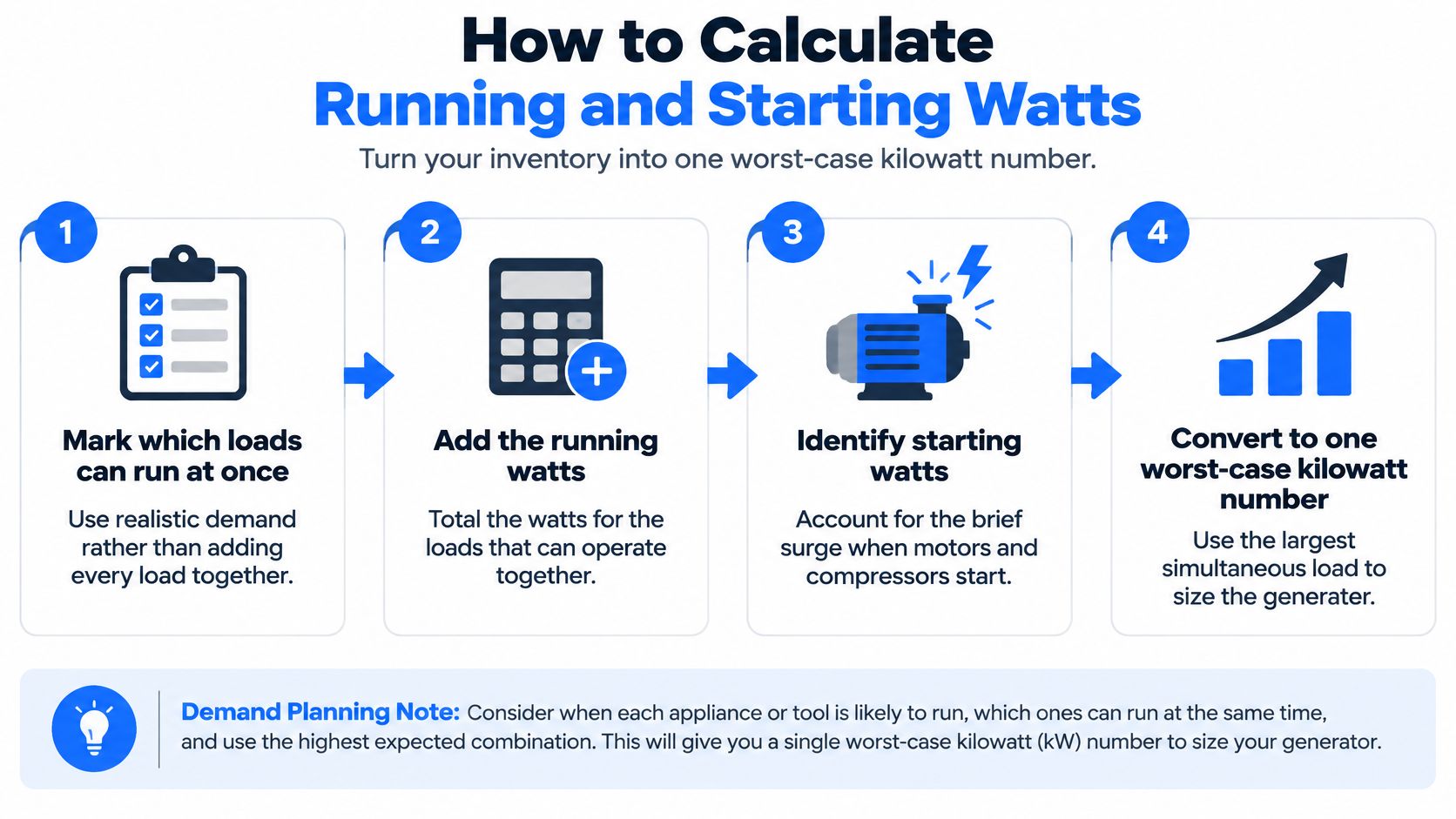
Define permitted combinations. Mark the loads that can operate together under the proposed design. Any exclusion that the calculation relies on should be enforced by controls, not just a household agreement.
Total their running demand. Use electrical input data rather than heating or cooling output ratings. Keep real power and apparent power clearly identified instead of treating them as interchangeable.
Evaluate the starting event. Add the largest applicable motor-starting requirement to the other loads already operating. If the running total already includes that motor, subtract its running contribution before adding its starting requirement.
Check overlapping starts. Consider what happens when power returns to the backed-up circuits and several thermostats or pressure controls are calling. Verify any programmed restart delays.
Compare the result with generator capability. Check continuous output, motor-starting capability and acceptable voltage and frequency response. A nominal power rating alone doesn't establish whether a compressor will start successfully.
Apply design allowances. Include reserve capacity and manufacturer-required environmental derating, then verify the proposed unit against the completed calculation.
The common error is stopping after the running-watt total. A generator can support the steady load yet fail to accelerate a compressor, causing voltage dips, stalled motors or unsuccessful starts.
The technical guide to sizing generators for motor starting notes that single-phase motors can require roughly three to five times running watts during startup, while three-phase motors can require approximately seven to twelve times. Those are screening ranges, not substitutes for the installed equipment's starting data.
Motor type | Starting multiple | Typical home loads | Design note |
|---|---|---|---|
Single-phase induction | Use the screening range above, then verify equipment data | Refrigerator, sump pump, conventional compressor | Common residential starting-load concern |
Three-phase induction | Use the screening range above, then verify equipment data | Large pumps and commercial equipment | Less common in homes |
Compressor with soft starter | Use documented performance for the installed combination | Central AC or heat pump | Confirm hardware compatibility and settings |
Variable-speed drive | Obtain manufacturer starting data | Some well pumps and heat pumps | Don't apply a generic induction-motor multiplier |
Keep watts and apparent power separate
For a single-phase load, voltage multiplied by current gives volt-amperes, not automatically watts. Motor power factor and generator capability matter, so the final design should retain the manufacturer's starting-current or starting-kVA information.
A sound electrical load assessment and calculation separates the dwelling demand calculation from the generator's transient-performance check. Both must pass.
Don't add a motor's full starting demand on top of a total that already counts that same motor at full running demand.
The generator load-calculation guidance identifies 10–20% spare capacity as common design practice and 20–25% where future growth or uncertainty warrants it. Reserve capacity is an allowance after the load analysis, not a way to repair missing equipment information.
Finish with a documented worst-case event, the motor responsible for it and the control sequence used to keep that event within the selected generator's capabilities.
Standby Generator, Portable Unit or Battery Backup
Option | Coverage | Runtime limit | Installation and fuel | Best fit |
|---|---|---|---|---|
Standby generator | Whole-home or managed coverage with automatic transfer | Fuel availability and equipment operating requirements | Permanent installation, commonly natural gas or propane | Long or frequent outages |
Portable generator | Selected appliances or circuits | Tank capacity, refueling and operating requirements | Outdoor operation; fuel specified by the model | Occasional outages and limited loads |
Battery backup | Selected circuits or broader coverage with suitable system design | Stored energy, inverter output and recharging | Permanent electrical installation, no combustion fuel | Short outages and compatible solar applications |
Capacity sets what can run at once. Stored fuel or energy sets how long it can run. A system can have enough output for its permitted loads and still stop when its fuel or charge runs out.
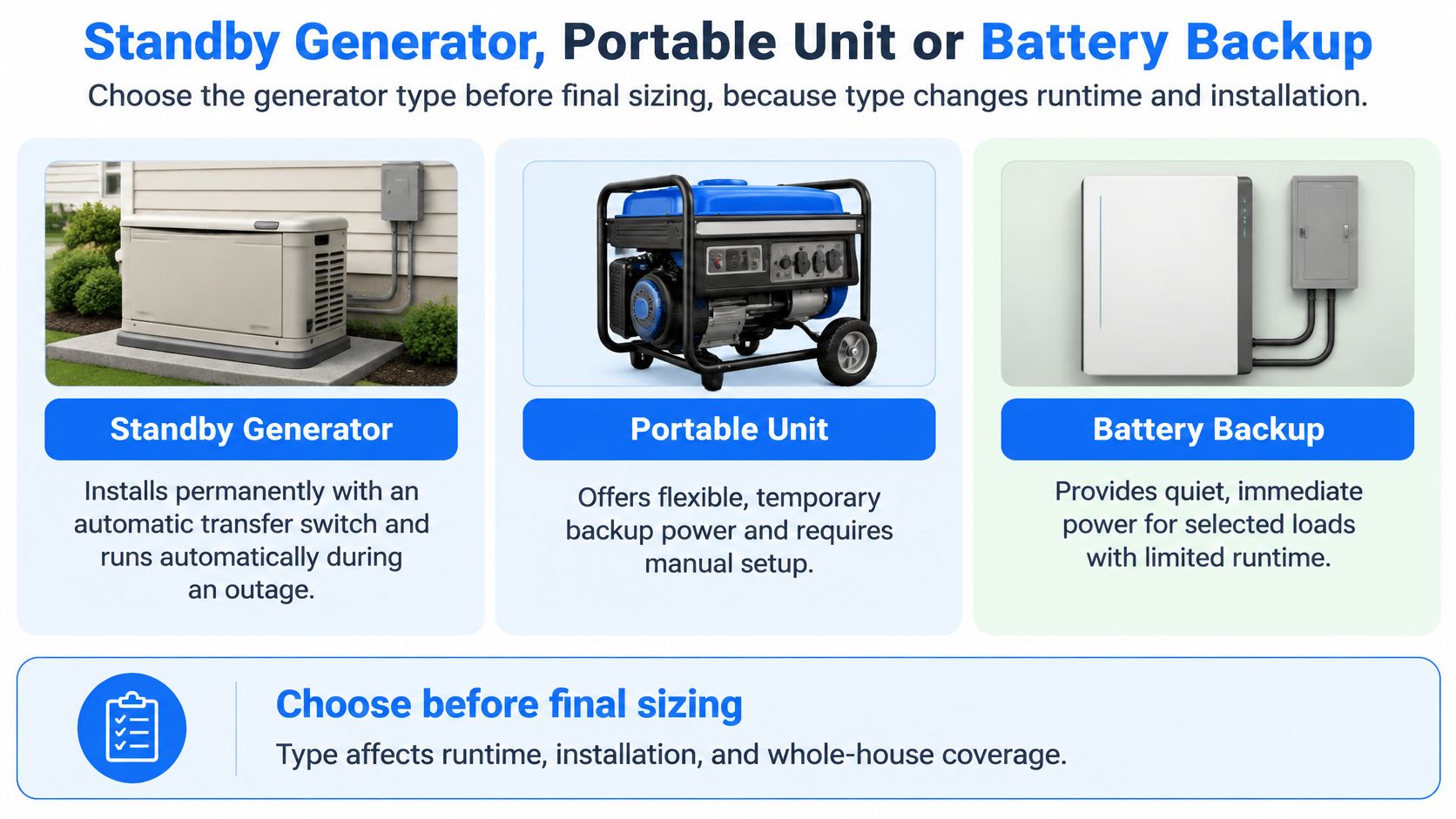
Match the system to the outage
A permanently installed standby generator suits a household that needs automatic operation, including when nobody is home. Check that the natural-gas supply can support the generator alongside other connected appliances. With propane, confirm the tank capacity and delivery plan.
A portable unit suits limited coverage when someone can set it up safely and refuel it. It is a poor fit for a plan that depends on immediate, unattended operation.
Batteries provide quiet backup without combustion at the house. The inverter must support the permitted loads, and usable stored energy determines how long they can run between charging opportunities. Homes without rooftop generation can still use battery backup without solar, but the system needs a defined way to recharge during an outage.
Plan the fuel and recharge path
For a long outage, answer the endurance question before choosing equipment: How often will the propane tank need refilling for the expected outage length? For natural gas, confirm that the connection can supply the generator while other appliances are running. For batteries, establish when and how they can recharge while supplying essential loads.
Keep combustion generators outdoors, never in a home, garage, or other enclosed space. Follow the equipment's placement requirements and keep exhaust away from doors, windows, and air intakes.
A generator connected to building wiring needs proper transfer equipment. OSHA's generator-safety guidance explains that a properly installed transfer switch prevents dangerous backfeeding into utility lines. Never connect a generator through a household receptacle.
Choose standby equipment for automatic, extended backup; a battery for quiet operation where its output and recharge plan fit the outage; or a portable unit when limited coverage and manual operation are acceptable.
Planning for Heat Pumps, EV Charging and Future Loads
Electric resistance backup heat can change the entire design. A heat pump's compressor load doesn't tell you what the system will demand when auxiliary heating elements energize. The electrician and HVAC contractor need to identify those elements and decide whether the outage plan permits them.
Locking out auxiliary heat may reduce electrical demand, but it's not automatically a satisfactory winter plan. The house still needs enough heating capacity under the conditions you expect during an outage. A control setting that keeps the generator running while leaving the house inadequately heated isn't a successful design.
Control the load that changes the answer
An EV charger creates a different problem from a compressor. It generally adds a sustained charging load, rather than the locked-rotor event associated with an induction motor. That sustained demand can consume the capacity a pump or compressor needs when it starts.
Choose whether charging is essential during an outage. If it is, specify an approved charging limit or automatic management arrangement and verify that the setting persists after power interruptions. The EV charger installation requirements also need to be considered alongside the service and backup design, not treated as a separate appliance purchase.
Load or conflict | Practical control | What must be checked |
|---|---|---|
Auxiliary resistance heat | Approved lockout or staged operation | Adequate heating remains available |
EV charging during heavy household demand | Automatic shedding or approved current limit | Controls work without manual intervention |
Competing compressor and pump starts | Restart delays and staggered starts | The sequence covers outage restoration |
High compressor starting demand | Compatible soft starter or variable-speed equipment | Documented starting performance |
Discretionary cooking and laundry loads | Priority controls or exclusion from backup | The coverage agreement is clear |
Know where management stops helping
Load management works when a load can wait. A water heater can often be deferred while another appliance operates; a sump pump protecting the basement may need immediate priority.
A soft starter can reduce a compatible compressor's starting burden, but it doesn't erase the compressor's running demand. Likewise, shedding an EV charger won't solve a system that lacks enough capacity for the house's essential heating load.
Design test: Every deferred load needs an acceptable waiting period, and every essential load needs a defined priority.
For future solar, storage or an addition, give the electrician the actual project intentions. Battery integration requires compatible operating controls, not just spare generator capacity. Leave practical access for equipment changes, document control assumptions and have the service reviewed before committing to new electrical loads.
Get a Signed Load Calculation Before You Buy
Ask a licensed electrician to sign the load calculation and state the equipment, operating assumptions and control scheme behind the generator recommendation. The answer should be a documented design with a defined operating profile and a signed calculation.
Check the complete installation
Confirm output and starting performance. The proposal should state calculated demand, reserve allowance, relevant derating and the motor-starting event used to validate the unit. Check the rating for the fuel you plan to use.
Verify transfer and service equipment. Confirm transfer-switch ratings, conductor sizing, grounding, bonding and compatibility with the existing service. The transfer equipment must suit its location and role.
Approve the fuel design. Have the installer confirm gas-line capacity or propane storage and delivery requirements for the intended operating load. Account for other appliances using the same supply.
Confirm placement and protection. Review manufacturer clearances, exhaust direction, building openings, maintenance access and carbon-monoxide protection. The equipment should not be placed solely to hide it.
Identify permits and inspection. Establish who handles applications and inspections, and retain the completed documentation with the installation records.
Require a functional handover
A startup demonstration should cover more than the engine running. Ask the installer to show transfer operation, load priorities and how controlled equipment responds when loads compete for power.
Have the installer explain what can run, what will be deferred and what to do after an alarm. Keep operating instructions, control settings and maintenance requirements together so household members can find them.
The signed calculation gives you a record of the installed system that can help with permitting and future equipment changes. It may also help explain the system if an insurer requests information, but it does not guarantee coverage or claim approval.
Before requesting a quote, gather the circuit inventory, equipment-label photos and a clear list of what must remain operational. Homeowners in Southeastern Pennsylvania can contact Amp'd Energy Solutions for a free consultation or quote.
Complete the inventory and worksheet, then request the signed calculation before comparing brands or prices. That way, each proposal can be assessed against the same operating requirements and expected coverage.
At Amp'd Energy Solutions, we offer whole-house generator sizing, complete custom installation, troubleshooting and annual maintenance. Call 267-450-6992 or email sales@ampd.life to schedule a free consultation or request a quote.
Comments