

Best Home Battery Backup Without Solar: A Practical Guide
A winter outage in Southeastern Pennsylvania rarely arrives at a convenient time. The basement sump pump starts cycling, the refrigerator is holding food for a family of four, the router needs to stay alive for work and emergency updates, and the house gets cold as soon as the heating system loses power. You don't necessarily need to run every appliance. You need the right ones to keep working for long enough.
That makes the best home battery backup without solar a different purchase from a solar-plus-storage system. The battery charges from the utility, protects selected circuits when the grid fails, and may shift consumption under a time-of-use tariff. It also starts with a finite charge and can't recharge itself during a prolonged outage. The right answer depends on your outage profile, your critical-load list, and your utility tariff, not on the largest number printed on a product brochure.
Table of Contents
Why a Battery Without Solar Is a Real Decision - A winter storm shows what the battery must do
How to Decide What Needs to Stay On - Separate power from energy - Build the list before requesting a quote
Sizing the Battery to Your Outage Profile - A usable sizing exercise
Comparing Battery-Only System Types - Match the system type to the home
The Honest Economics of a Battery Without Solar - Value resilience honestly
What a Proper Site Assessment Should Cover - The pre-installation checklist
When a Battery Alone Is Not Enough - Four practical backup paths
Why a Battery Without Solar Is a Real Decision
A battery-only system can be a sound resilience investment, not an unfinished solar project. Utility reliability changes with region and storm exposure. U.S. Energy Information Administration data recorded an average of 250 minutes, about 4.2 hours, without electricity in 2016 when major events were included, with customers experiencing an average of 1.3 interruptions that year. Excluding major events, average outage time fell to 112 minutes, about 1.9 hours, and the average customer experienced one outage. The EIA reliability data also shows how widely conditions can vary by location.
For a Southeastern Pennsylvania homeowner, the useful question is practical: can the system keep the sump pump, refrigerator, communications equipment, lighting, medical devices, and heating controls operating during the outages your property faces?
A winter storm shows what the battery must do
A winter storm takes down a local line. The utility was still operating, so the battery began fully charged. Transfer equipment isolates the home, the critical-load panel takes over, and the battery supplies the selected circuits. The refrigerator cycles, the router and modem remain available, the basement pump can respond to water intrusion, and necessary lights stay on.
That is a legitimate use for battery storage without rooftop solar. It provides continuity, not indefinite off-grid operation. Once the stored energy is depleted, the system needs utility power or another charging source. Berkeley Lab's analysis of long-duration interruptions explains why the storage requirement changes substantially when heating and cooling loads are included.
Practical rule: Buy battery-only backup for continuity and control, not for unlimited off-grid living.
Use three filters before choosing equipment: your outage profile, your critical-load list, and your utility tariff. First, identify the circuits that deserve backup. Then size the battery for their actual consumption and the outage duration you want to cover. Finally, check whether the tariff creates enough rate separation to provide financial value beyond resilience.
A battery that passes only one of those tests is a poor purchase. The right system matches how your home fails, what must keep running, and how your utility bills you.
How to Decide What Needs to Stay On
A winter outage becomes manageable when the backup system serves the right circuits. Start with the circuits your household cannot reasonably lose, then choose equipment that can support them.
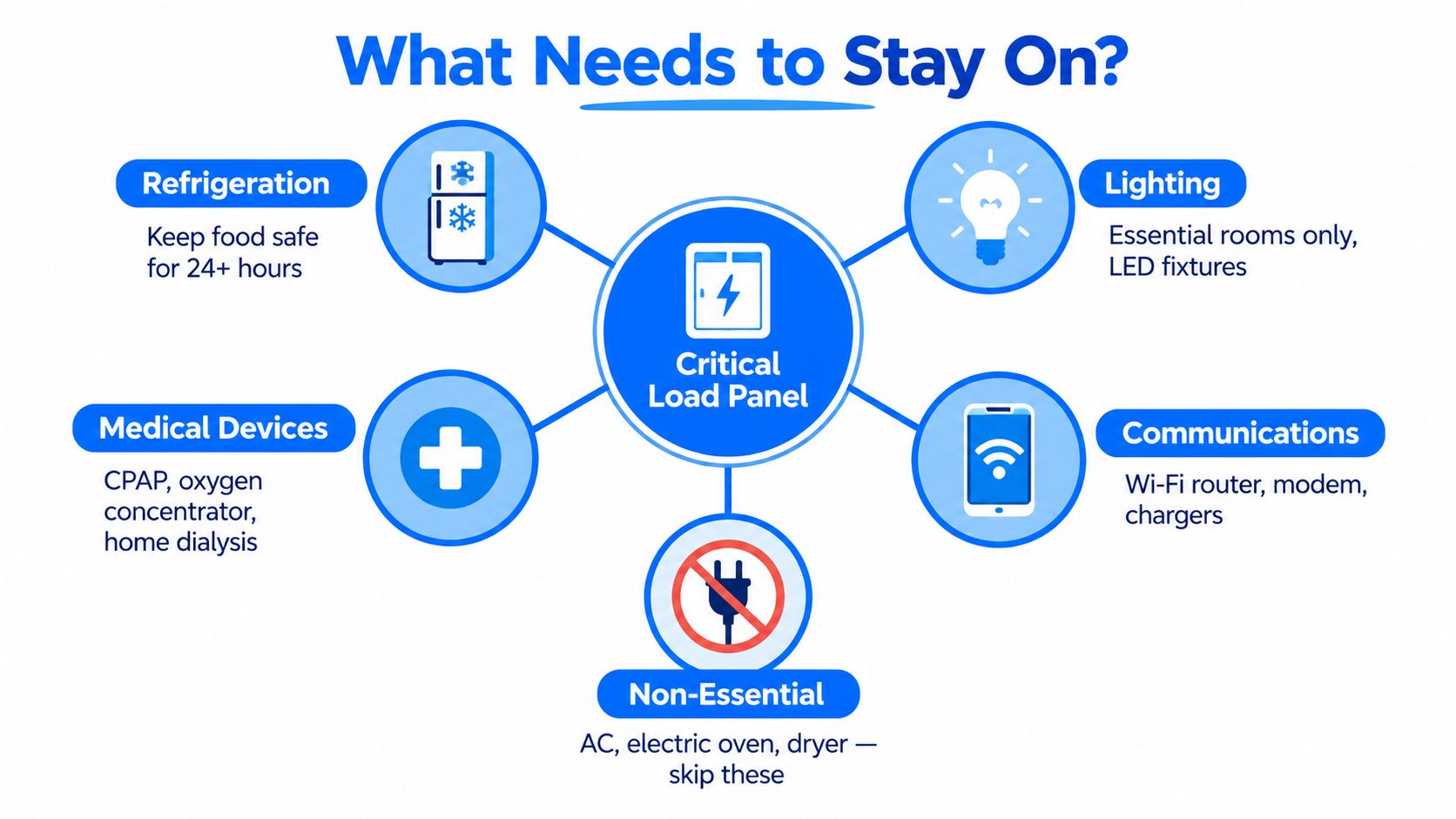
A refrigerator, internet equipment, lighting, medical equipment, security equipment, and a sump pump usually rank high. Furnace controls may also matter in winter, depending on the heating system. A gas or oil furnace may need modest electrical power for controls and a blower. Electric resistance heat can drain a battery quickly. Central air conditioning, electric water heating, an oven, a dryer, and EV charging generally belong outside a tightly scoped battery-only plan unless the system was designed for those loads.
Separate power from energy
Two ratings determine whether the system will perform as expected:
Continuous power, measured in kilowatts: This sets the load the inverter can serve at one time.
Stored energy, measured in kilowatt-hours: This sets how long the battery can serve that load.
A battery can hold enough energy for a target runtime and still fail when a motor or compressor starts. Refrigerators, sump pumps, well pumps, and some heating equipment may draw a short surge far above their running demand. Your installer must verify inverter surge capability and determine whether load shedding is required.
Heating and cooling deserve separate scrutiny. They can dominate household demand, while insulation, appliance efficiency, thermostat settings, and controls change how long the battery lasts. The Berkeley Lab analysis discussed earlier found that storage requirements rise when heating and cooling loads are included. Its modeled results also show why a battery sized for selected circuits should not be presented as a whole-home solution.
Build the list before requesting a quote
Use a worksheet that reflects how the home operates:
List essential circuits. Include refrigeration, communications, lighting, medical equipment, pumps, and selected heating controls.
Mark high-demand loads. Identify HVAC, electric heat, water heating, cooking equipment, and motors.
Estimate running consumption. Record expected wattage and operating duty cycle for each selected load.
Model different outages. Request one-day, three-day, and severe-weather scenarios.
Decide what gets shed first. A smart panel or control strategy can preserve the circuits that matter most.
This turns “whole-home backup” into a defined operating plan. Selective backup often provides more useful runtime than sending battery power to every circuit, and it gives the installer a defensible basis for sizing the system and reviewing the utility tariff.
Sizing the Battery to Your Outage Profile
A battery's nameplate capacity overstates the energy your home receives. Charging and discharge losses reduce delivered power. NREL's residential battery-storage assumptions use approximately 85% round-trip efficiency as a representative value. Under those modeled conditions, a 13.5 kWh nameplate battery may provide roughly 11.5 kWh to the loads. Size from usable energy, not the figure printed on the cabinet.
Start with the circuits you intend to protect. Add the refrigerator, router and modem, lighting, sump pump, furnace controls, medical equipment, and selected receptacles. Then check two separate limits:
Simultaneous load against the system's continuous kW output.
Daily energy use against usable kWh.
In field practice, a 10 to 20 kWh battery typically covers essential loads for one to three days, depending on duty cycle and load management. Treat that range as an installer rule of thumb, not a promise. Test both one-day and three-day outage scenarios before approving a design. This battery backup during a power outage guide provides further planning context.
A usable sizing exercise
A battery serving modest critical loads may spend hours in standby or handle only brief refrigerator and pump cycles. Enable central air conditioning or electric resistance heat, and the same battery can drain rapidly. Large loads may exhaust stored energy before the outage ends, even if the inverter can start them.
I size battery-only systems in this order:
Protect the critical circuits.
Calculate their running demand.
Check motor and compressor starting requirements.
Convert nameplate capacity into realistic usable energy.
Test one-day and three-day operating assumptions.
Post-outage behavior changes the result. Conservation settings, scheduled load shedding, and a critical-load panel can extend autonomy. The defensible purchase is the one that matches your outage profile, critical-load list, and local utility tariff, rather than the system with the most impressive specification sheet.
Comparing Battery-Only System Types
A battery-only purchase should follow three filters: your outage profile, your critical-load list, and your local utility tariff. Once those are clear, compare system types by output, usable capacity, warranty coverage, and expansion options. Spec-sheet rankings alone miss how the home behaves during an outage.
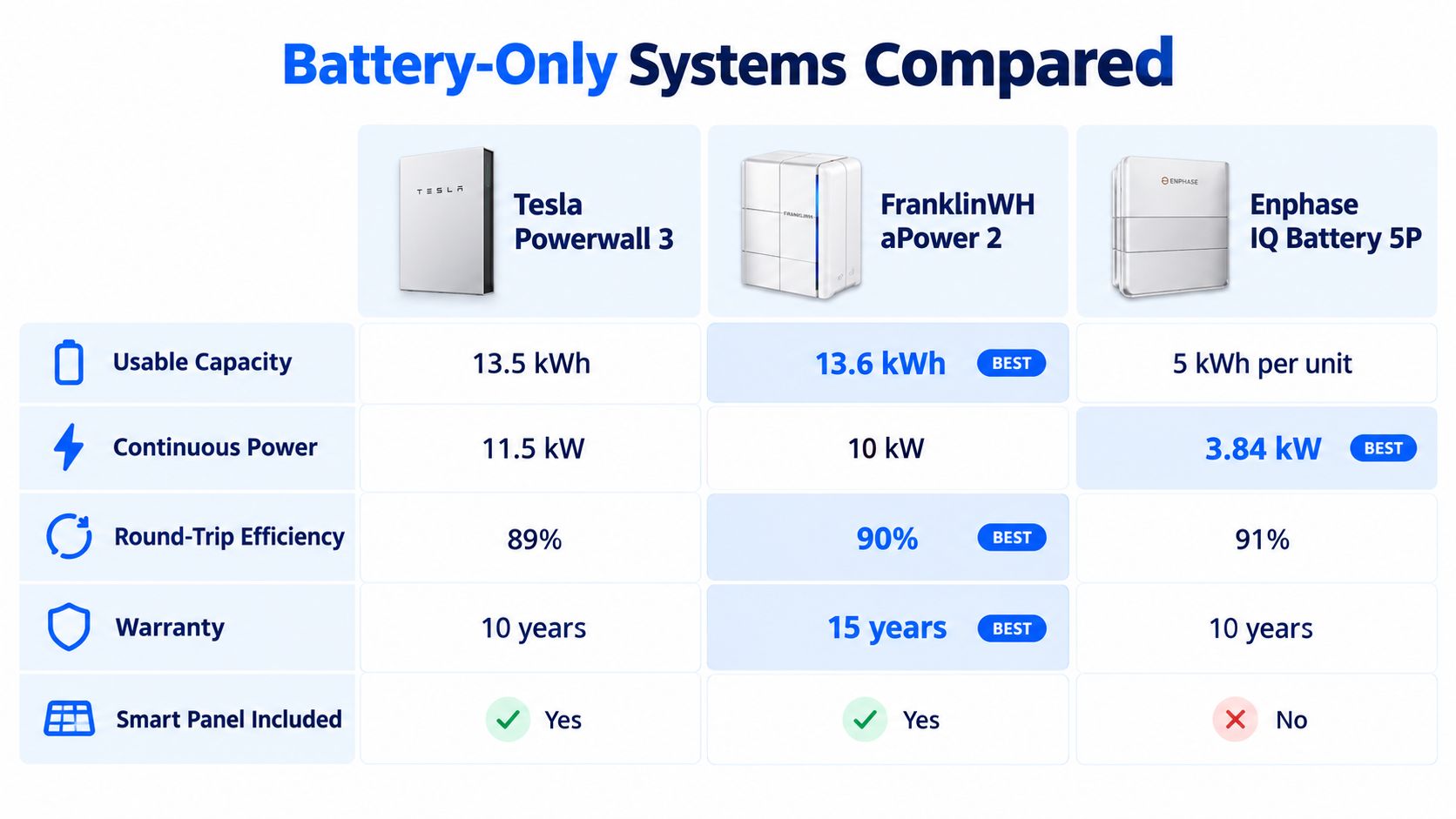
System type | Usable capacity | Continuous output | Warranty tier |
|---|---|---|---|
High-output single-unit system | 13.5 kWh | 11.5 kW | 10 years |
High-capacity long-warranty system | 15 kWh | 10 kW | 15 years or 60 MWh |
Modular expandable system | 5 kWh or 10 kWh | 3.84 kW or 7.08 kW | 15 years or 6,000 cycles |
The figures above come from this technical comparison of grid-charged battery systems. Treat them as comparison points, not installation promises. Gateway equipment, service capacity, local code, transfer hardware, and the installer's design determine actual performance.
Match the system type to the home
High-output single-unit systems fit homes where simultaneous demand matters. Their stronger continuous output can support broader circuit coverage, but only if the electrical service, transfer equipment, and motor loads are compatible. A large inverter does not guarantee that a well pump or compressor will start cleanly.
High-capacity long-warranty systems prioritize stored energy and warranty duration. Choose this type when the critical-load list favors longer runtime over maximum instantaneous output. It is a better match for extended refrigeration, communications, and moderate pump loads than for a home with several large motors starting together.
Modular expandable systems suit staged projects. Start with a smaller configuration, then add units as the critical-load list or budget changes. Expansion improves capacity, but each added unit affects space, wiring, controls, and installation cost. Confirm how the units share output before assuming capacity and power increase in equal measure.
Grid charging means solar is optional. Before signing, require documentation for black-start behavior, automatic transfer time, reserve settings, permitted charging modes, cold-weather derating, service compatibility, and surge support. A battery should be chosen for the loads it can start and sustain, not for the most attractive row in a table.
The Honest Economics of a Battery Without Solar
A battery-only system doesn't automatically reduce your electric bill. It can charge from the grid and discharge during expensive periods, but the financial value depends on the tariff. Published comparisons identify peak and off-peak spreads of about $0.26 per kWh for PG&E, $0.18 per kWh for Massachusetts Eversource, and $0 for many flat-rate Texas and Florida plans. The tariff comparison for battery storage without solar illustrates why geography and rate design matter more than a generic payback claim.
In a flat-rate territory, the battery has little arbitrage value. You pay roughly the same rate regardless of when the system charges or discharges, while round-trip losses still reduce the energy returned to the home. A battery may participate in demand-response programs where available, but you shouldn't build the purchase around hypothetical revenue.
Value resilience honestly
The financial question isn't only “Will this pay for itself?” Ask what an outage costs your household. Spoiled food, missed work, flooded basement contents, interrupted medical equipment, frozen pipes, and a temporary relocation all have practical consequences. A battery can reduce some of those risks, but it may not eliminate them during a multi-day outage.
For context on installation economics, see this breakdown of home battery backup system cost. Treat any national price range as a starting point, not a quote. Electrical upgrades, transfer equipment, permitting, critical-load wiring, and the number of batteries can change the project substantially.
My recommendation is blunt. If your utility has a meaningful time-of-use spread and you can use the battery for both outage protection and load shifting, the economics deserve a detailed calculation. If your plan is flat-rate, buy battery-only for quiet automatic resilience, not for promised bill savings.
What a Proper Site Assessment Should Cover
A battery is only as reliable as the electrical integration around it. A serious installer should inspect the home before recommending capacity, equipment, or a whole-home configuration.
The pre-installation checklist
Service compatibility comes first. The installer should confirm the home's service size, panel condition, available capacity, grounding, and the proposed backup gateway's limits. A battery may have impressive output, but the installation still has to work within the service equipment and applicable electrical requirements.
The critical-load panel needs a real circuit plan. Decide whether the system will back up selected circuits, a managed whole-home panel, or a combination. The panel location should support safe maintenance, practical wiring, and clear separation between protected and unprotected loads.
Transfer equipment must match the outage strategy. Ask how the system detects the grid failure, isolates the home, and restores power. The installer should explain automatic transfer behavior, black-start operation, minimum reserve settings, and whether selected loads can start without nuisance trips.
Motor loads deserve their own test. Pumps, compressors, and some heating equipment can create starting surges. The design should account for those surges or apply load shedding so one motor doesn't interrupt every other protected circuit.
Cold-weather performance needs a written assumption. Southeastern Pennsylvania winters can affect battery performance and equipment location. Ask how the system is protected, whether output is derated in cold conditions, and how the proposed design handles the lowest expected operating temperatures.
Permitting and inspection are part of the system. Local requirements vary across municipalities and utility territories. The installer should identify the permit path, utility coordination, inspection steps, and commissioning process before work begins.
A quote that contains only battery capacity and an installation price is incomplete. You should receive a load strategy, transfer-equipment description, operating assumptions, and a clear explanation of what happens when the battery reaches its reserve limit.
When a Battery Alone Is Not Enough
A battery-only system handles short outages well when you protect a limited set of circuits. It becomes a poor fit when your outage profile includes several days without grid power, electric resistance heat, or continuous central HVAC.
The runtime gap is substantial. A 10 to 14 kWh battery supporting refrigeration, lighting, internet, and medical-device loads may provide roughly 12 to 24 hours, while central air conditioning or electric heat can reduce that window to approximately 4 to 8 hours. This comparison of battery-only backup during extended outages shows why the critical-load list matters more than the battery's headline capacity.
Four practical backup paths
Battery-only: Choose this for a home with relatively stable grid service, modest critical loads, and short interruptions as the expected use case.
Battery with a critical-load panel: This fits many Southeastern Pennsylvania homes. Keep refrigeration, communications, lighting, pumps, medical devices, and selected controls powered, while leaving high-demand circuits outside the backup system.
Battery with supplemental recharge or a generator: Use this when outages may last multiple days, the home depends on electric heat, or a well and sump system must keep operating. The battery provides quiet immediate backup, while the supplemental source restores longer-duration capability.
Generator-led backup: A generator is the more practical choice when sustained operation of large loads matters most and fuel can be supplied reliably. Battery systems generally last about 10 years, while standby generators can operate for 20 years or more with maintenance, according to manufacturer warranty documentation.
The right path depends on the worst outage you intend to handle, not on whether batteries or generators sound better in isolation. Review power backup solutions for a home, then match the equipment to your outage profile, critical-load list, and utility tariff. If those three filters point beyond battery-only backup, specify the recharge method before approving the installation.
Choosing the Right Path for Your Home
Answer three questions before choosing equipment.
How long do outages typically last at your property? Short interruptions favor battery-only backup. Repeated or extended outages justify a recharge strategy.
Which loads must stay on? Refrigeration, communications, lighting, medical devices, pumps, and heating controls create a manageable design. Electric heat, central HVAC, and water heating can change the project entirely.
Does your tariff offer a meaningful peak and off-peak spread? If yes, model load shifting. If not, treat resilience as the primary value.
That produces three defensible paths:
Grid-stable home with selective needs: Install a battery-only system connected to a tightly scoped critical-load panel.
Longer outages or major electric loads: Use battery backup with supplemental recharge, additional storage, or a generator.
Flat-rate plan with bill savings as the only goal: Wait, or invest elsewhere. A battery may protect you from outages, but it won't automatically create a compelling financial return.
The best home battery backup without solar isn't the unit with the biggest capacity or the most impressive app. It's the system that matches your outage history, carries the circuits you need, and makes sense under your utility's rate structure. Get those three filters right, then compare equipment.
Amp'd Energy Solutions designs and installs battery backup systems for Southeastern Pennsylvania homes, including utility-charged configurations without solar, critical-load planning, transfer equipment, permitting, and electrical upgrades. Share your outage history and essential-load list with Amp'd Energy Solutions to request a site assessment and a battery-only recommendation built around how your home operates.
Comments