

What Is a Level 2 EV Charging Station
A Level 2 EV charging station is a 240-volt AC charger that typically adds roughly 10 to 40 miles of range per hour. It sits between a slow household outlet and a commercial DC fast charger, but the right choice depends just as much on your home's electrical system and driving routine as it does on charging speed.
You've brought home your first electric vehicle, plugged its portable cable into the regular garage outlet, and gone to bed expecting a full battery by morning. Instead, the dashboard has barely moved. That moment is when many new owners start asking what they're buying when they shop for a Level 2 charger.
The answer involves more than a wall-mounted box. You need to understand the 240-volt supply, the charger's practical output, the EV's onboard charging limit, and whether your electrical panel can support a new high-demand circuit. You'll also find Level 2 charging at workplaces, apartment buildings, parking facilities, hotels, restaurants, and shopping destinations.
By the end, you'll know how Level 2 works, what charging speeds feel like in daily life, what installation requires, when a panel upgrade may be necessary, and how to match the equipment to your home, driveway, and daily miles.
Table of Contents
A First Look at Level 2 EV Charging - The four questions that matter
How Level 2 Charging Works in Plain English - The weakest link controls the rate - The connector and the current path
Charging Speeds You Can Expect in Real Life - A practical comparison - Match speed to your routine
What It Takes to Put Level 2 in Your Home - The panel assessment
Where Else Level 2 Charging Shows Up - Three common settings
Common Misconceptions About Level 2 Charging - Myth one, more kilowatts mean lower cost - Myth two, Level 1 is obsolete - Myth three, every Level 2 installation needs a new panel - Myth four, faster is always better
Choosing the Right Level 2 Setup for You - Plug-in or hardwired
A First Look at Level 2 EV Charging
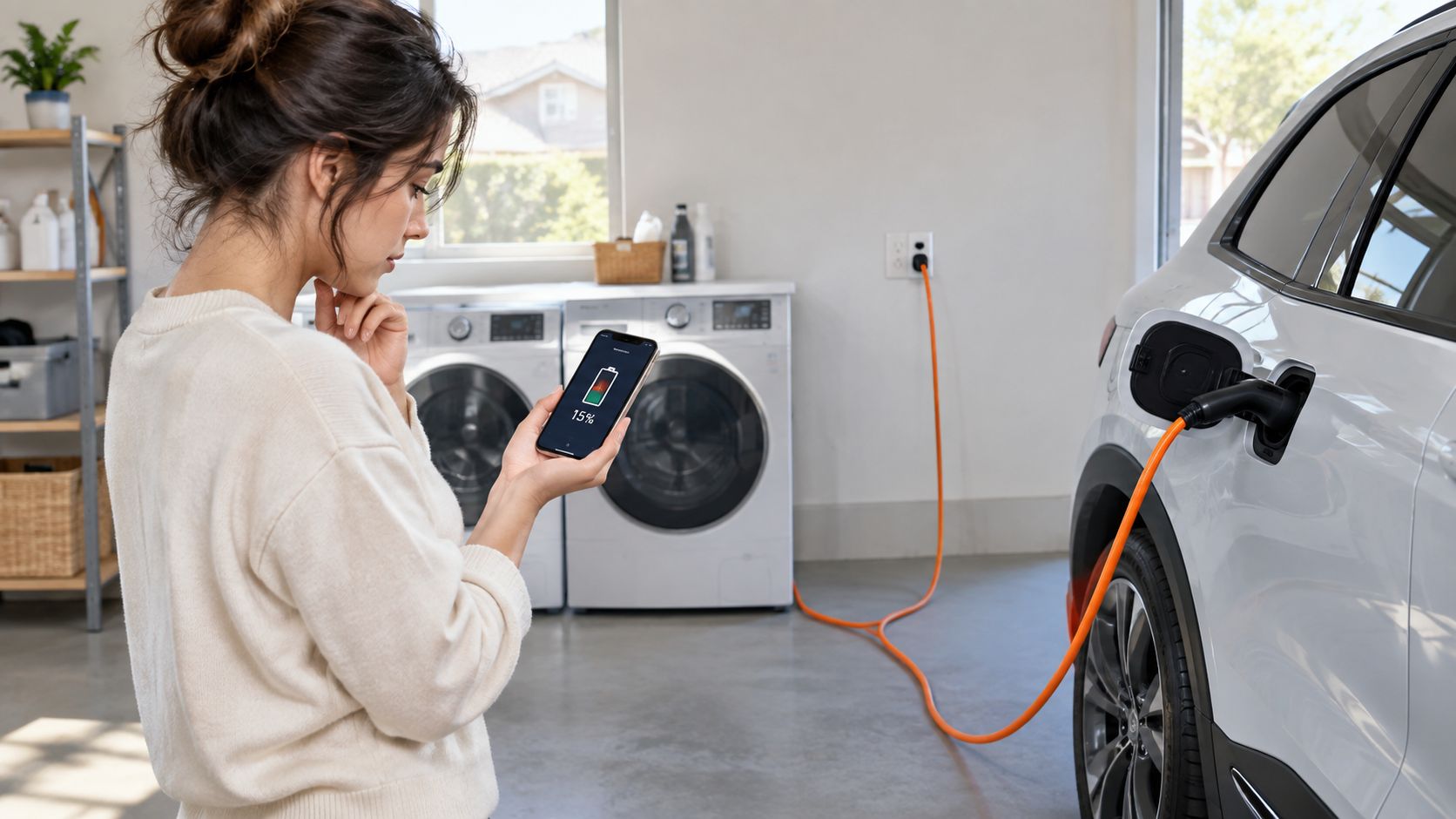
A standard household outlet provides Level 1 charging. It's convenient because you can use equipment you may already have, but the charging rate can feel painfully slow when your EV has a large battery or you drive every day. A Level 2 station uses a dedicated 240-volt alternating-current circuit, giving the vehicle substantially more electrical power during the hours it's parked.
The practical difference is easy to understand. Level 1 may work for an owner with a short commute and plenty of overnight parking time. Level 2 makes it easier to recover a day's driving between errands, after work, or while the vehicle sits in the garage overnight. A DC fast charger is designed for a different setting, usually a quick stop during a longer trip, because it sends converted direct current to the battery at the station.
The four questions that matter
When homeowners ask what is a Level 2 EV charging station, they usually need answers to four practical questions:
What powers it? A 240-volt AC supply, normally installed as a dedicated branch circuit.
How fast is it? The equipment can commonly add roughly 10 to 40 miles of range per hour, depending on the vehicle, charger, battery state, and efficiency. (U.S. Department of Transportation charging-speed guidance)
Can my home support it? An electrician needs to evaluate the panel, service capacity, wiring route, protection, and local requirements.
Where else will I use it? Level 2 is common at workplaces, multifamily properties, and destination locations where vehicles remain parked for a while.
Choosing Level 2 isn't a contest between the biggest numbers on a specification sheet. It's a decision about how many miles you drive, how long the car sits, where the charger can be installed, and whether your electrical system has room for the load.
How Level 2 Charging Works in Plain English
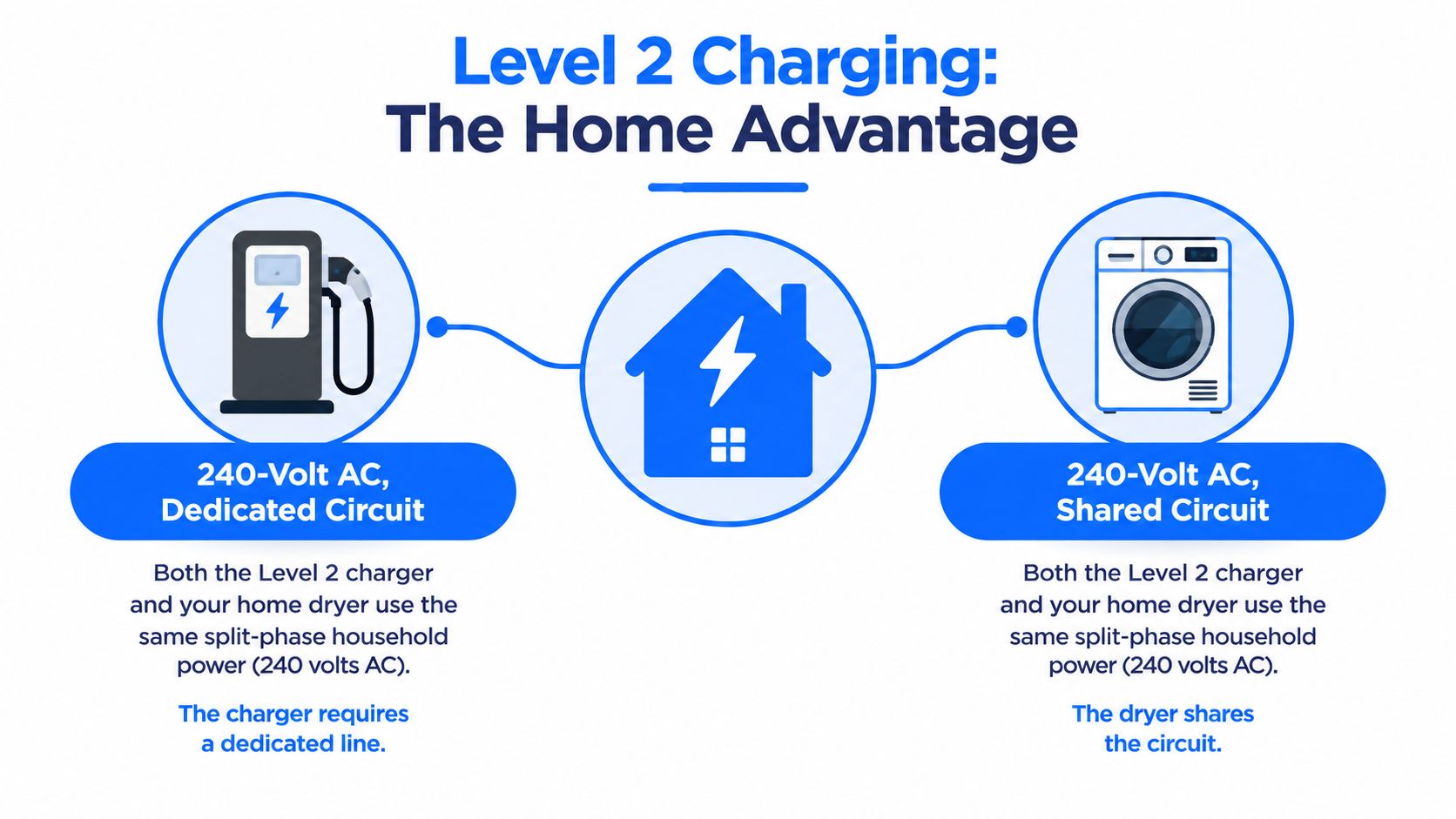
Level 2 charging uses the same general type of split-phase household power that supplies equipment such as an electric dryer or oven. The important difference is that an EV charger normally needs its own 240-volt branch circuit, rather than sharing an existing appliance circuit.
The charger controls the connection and communicates with the vehicle, but the vehicle still plays a major role. Grid power arrives as AC. The EV's onboard charger converts that AC into DC, the form the battery stores. This conversion happens inside the car, which is one reason Level 2 is slower than DC fast charging.
The U.S. Department of Transportation describes Level 2 equipment across a broad output range, from 2.9 kW to 19.2 kW, with residential equipment often operating at up to 30 amps and around 7.2 kW. (Federal charging-speed information) Higher-power J1772 implementations can support up to 19.2 kW at 240 volts and 80 amps, although your vehicle and home wiring may not be able to use that maximum.
The weakest link controls the rate
Think of charging as water moving through a pipe. The flow is limited by the narrowest part of the system. In an EV charging setup, that limiting point may be:
The station's maximum output
The circuit and breaker serving it
The vehicle's onboard AC charger
The battery's current ability to accept power
A high-capacity wall unit won't force a vehicle to charge faster than its onboard system allows. Likewise, an appropriately rated vehicle can't receive the advertised output if the circuit or charger has a lower limit.
The connector and the current path
The technical standard behind much North American Level 2 equipment is SAE J1772. It established conductive AC charging for broad use and helped create a common connector design for many non-Tesla vehicles. Tesla vehicles can use the same charging approach with the appropriate adapter or compatible connector equipment.
For a homeowner, the key point is simple. Level 2 doesn't send raw DC directly into the battery. The car performs the AC-to-DC conversion, while the wall equipment manages safe delivery of electricity. For a more focused explanation of the electrical side, see this guide to Level 2 charger voltage.
Charging Speeds You Can Expect in Real Life
Kilowatts describe electrical power, but drivers usually care about miles of range added per hour. A Level 2 station can typically add roughly 10 to 40 miles of range per hour, while a Level 1 setup is much slower. (U.S. Department of Transportation charging-speed guidance)
Your actual result depends on vehicle efficiency, battery temperature, the current state of charge, the vehicle's onboard charger, and the station's output. Two vehicles connected to the same wall unit may add different amounts of range because one uses more energy per mile or accepts less AC power.
A practical comparison
The figures below use only the verified charging ranges and representative electrical configurations. The time-to-80% column should be treated as a planning guide, not a guarantee. Battery size, charging losses, vehicle limits, and the taper near a high state of charge all affect the session.
Charger Type | Voltage / Amperage | Approx. kW Output | Miles of Range per Hour | Time to 80% (60 kWh battery) |
|---|---|---|---|---|
Level 1 | 120V household outlet | Qualitatively low | Slower than Level 2 | Often requires substantially longer parking time |
Level 2 | 240V, 16A | About 3.8 kW | Lower end of Level 2 range | Several hours, depending on vehicle |
Level 2 | 240V, 32A | About 7.7 kW | Midrange Level 2 performance | Commonly suitable for overnight charging |
Level 2 | 240V, 40A | About 9.6 kW | Higher Level 2 performance | Shorter than a 32A setup, vehicle permitting |
Level 2 | 240V, 48A | About 11.5 kW | Near the upper home-charging range | Faster when the vehicle can accept the output |
A 60 kWh battery is a useful illustration, but charging isn't a simple division from empty to full. The car may reduce power as the battery approaches a high state of charge, and the last portion can take noticeably longer. The U.S. Department of Transportation gives a typical Level 2 range of about 4 to 10 hours to reach 80%, depending on the vehicle and equipment. (Federal charging-speed information)
Match speed to your routine
Suppose you drive about 30 miles per day. A moderate Level 2 station may replace that energy during an ordinary evening, so moving to a much larger unit may not change your routine in a meaningful way. A household with longer commutes, irregular driving, or multiple EVs may benefit more from additional output, provided the panel and vehicle can support it.
Level 1 isn't automatically a poor choice. If the car remains parked for long periods and your daily use is modest, the slower method may meet your needs. The right question is whether your charger reliably restores the energy you use before the next trip.
What It Takes to Put Level 2 in Your Home
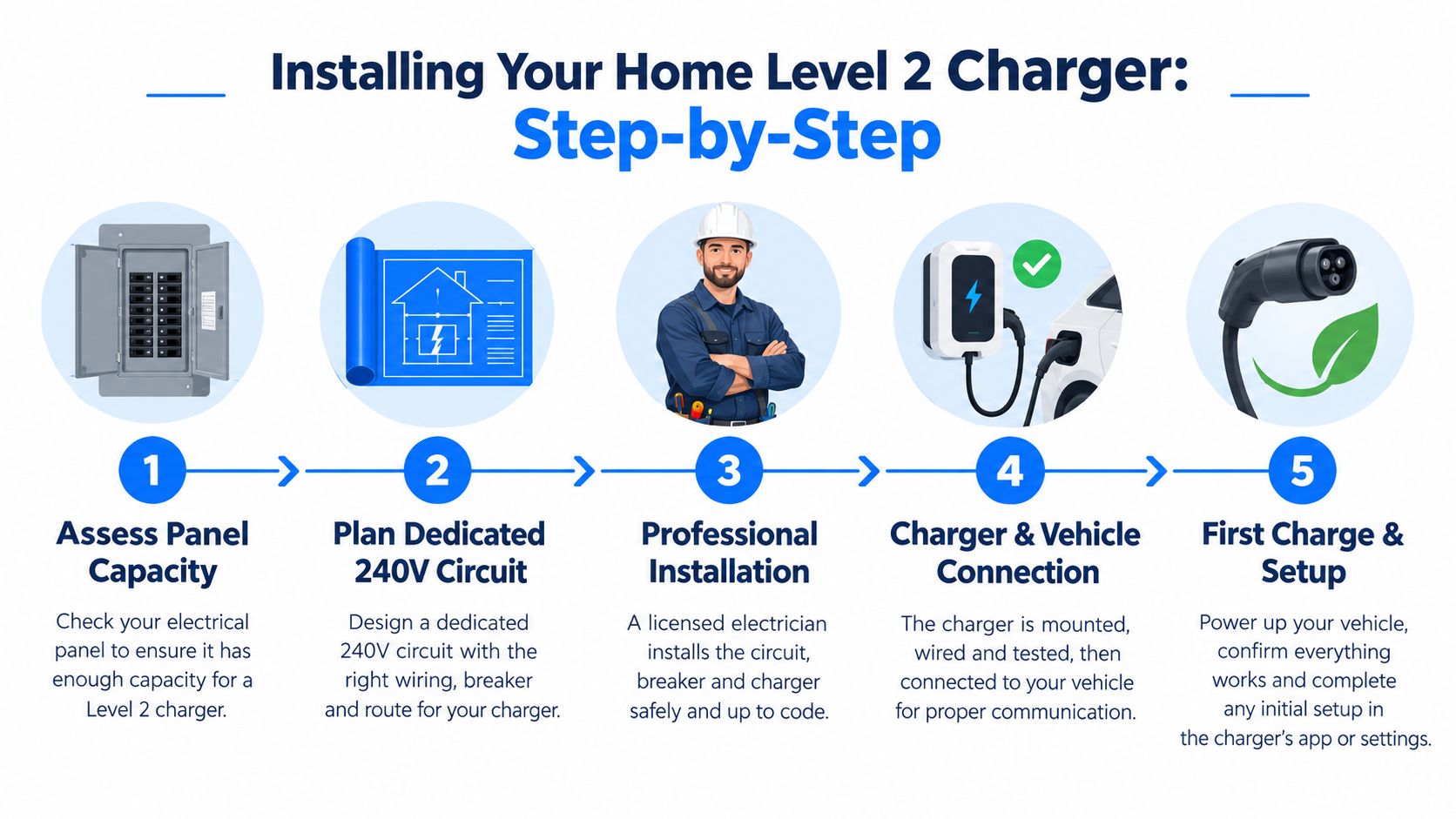
A safe installation begins at the electrical panel, not at the charger box. A licensed electrician normally plans a dedicated 240-volt circuit from the panel to the charging location. Sharing that circuit with a dryer, oven, water heater, or other appliance can overload conductors and protective equipment, so it isn't an acceptable shortcut.
The electrician selects the circuit and charger together. A charger that draws 48 amps generally needs a 60-amp breaker when applying the continuous-load rule that limits the operating load to 80% of the breaker rating. Other common configurations may use 40-amp, 48-amp, or 60-amp breakers, but the correct choice depends on the station's nameplate, vehicle requirements, conductor sizing, installation method, and local code.
The panel assessment
Before recommending an upgrade, an electrician examines several conditions:
Available breaker space: The panel needs a suitable way to add the new two-pole circuit.
Service and bus capacity: The panel's rating and internal equipment must support the proposed load.
Whole-home load calculation: Existing heating, cooling, cooking, water heating, and other equipment count toward the electrical demand.
Physical routing: The distance from panel to garage or driveway affects conduit, conductor sizing, and installation complexity.
Outdoor exposure: A driveway installation needs equipment and protection suitable for the location.
Many homes with a 200-amp panel can accommodate one Level 2 charger without a service upgrade, but an electrician still has to verify the actual load. Older homes with a 100-amp panel are more likely to need a panel upgrade or a load-management device, especially when the property already has several large electric loads.
Practical rule: A panel upgrade isn't determined by the charger alone. It depends on the charger plus every other significant load your home may run at the same time.
The final steps include choosing a garage wall or exterior location, installing the circuit and station, obtaining required permits, and completing inspection. This home EV charger installation guide provides additional context, but an on-site electrical assessment remains essential.
Where Else Level 2 Charging Shows Up
Level 2 is not just a private-garage technology. As of June 22, 2026, the United States had 178,936 public Level 2 ports across 68,370 locations, with 1.8% temporarily unavailable, according to reported public-network data. (U.S. public charging port data)
That scale reflects how well Level 2 fits places where cars sit for extended periods. A workplace can charge employee vehicles during the workday. A multifamily property can offer shared charging without treating every parking space as a private electrical project. A hotel, restaurant, shopping center, or office destination can provide useful energy while the driver attends to something else.
Three common settings
Workplaces often benefit from scheduled or shared charging. Drivers may not need maximum power if their vehicles remain parked for much of the day. Property managers can use access controls, pricing, and load management to coordinate several vehicles without installing the largest possible circuit for every port.
Multifamily buildings face a different set of questions. The owner or manager may need to decide who pays for electricity, how tenants reserve ports, whether spaces are assigned, and how installation costs are allocated. A separate 2025 industry report found that multifamily and fleet projects drove 72% of Level 2 installations during one reported period, indicating that commercial demand is an important part of the category. (Industry installation data)
Destination locations work because dwell time matters more than peak speed. A charger at a shopping or hospitality destination can add useful range while the vehicle is already parked, without requiring the larger equipment associated with DC fast charging.
The J1772 standard supports broad compatibility across many non-Tesla vehicles, while adapters and changing connector standards affect how specific sites serve different vehicles. The charging tier remains Level 2 even when the connector arrangement changes.
Context | Typical Power | Dwell Time | Best For |
|---|---|---|---|
Workplace | Moderate AC output | During working hours | Employee and fleet top-ups |
Multifamily property | Shared Level 2 capacity | Overnight or resident parking | Tenant access and managed charging |
Destination site | Moderate AC output | While shopping, dining, or staying | Convenient opportunity charging |
Availability can matter more than advertised speed. The average U.S. public Level 2 site has 2.6 ports, so port sharing, utilization, and load management can shape the driver's experience as much as the station's maximum output. (Public charging network data)
Common Misconceptions About Level 2 Charging
Level 2 discussions often focus on speed and overlook system design. That creates several misleading assumptions for homeowners.
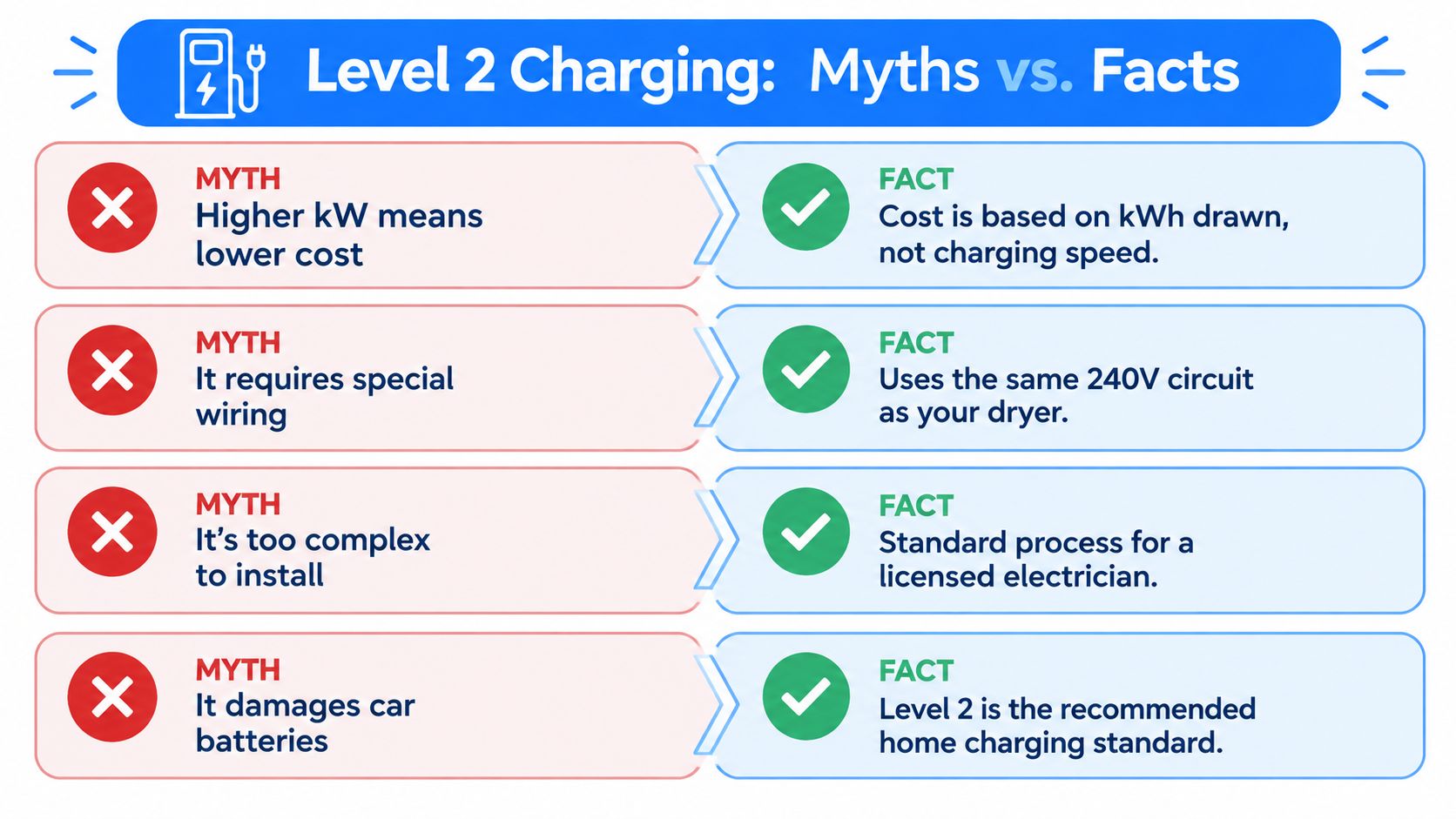
Myth one, more kilowatts mean lower cost
A higher-output charger can finish sooner, but it doesn't automatically use less energy. Electricity is generally billed according to the energy drawn, so charging speed and charging cost are separate questions. A higher-power session may also create a larger instantaneous load on the home, even when the vehicle ultimately receives the same usable energy.
Myth two, Level 1 is obsolete
Level 1 remains a reasonable fit for some drivers. J.D. Power has reported signs of slowing Level 2 adoption among owners, alongside increasing Level 1 usage among owners of 2023-and-newer model-year vehicles. (J.D. Power adoption signals reported in charging-network coverage)
That pattern supports a more useful conclusion. Drivers with short commutes, efficient vehicles, and long parking periods may prefer the simplest setup. A homeowner shouldn't install a faster circuit merely because Level 2 is available.
Myth three, every Level 2 installation needs a new panel
Some homes need an upgrade, but others can use load management or a smart charger to coordinate EV charging with existing demand. The decision requires a load calculation and equipment review. Installing a larger breaker without confirming panel and service capacity is unsafe.
Myth four, faster is always better
A charger with a maximum output of 19.2 kW may exceed what a low-mileage driver needs, particularly when the vehicle spends most nights parked. (Federal charging-speed information) More power can be useful for high-mileage households, larger batteries, or multiple vehicles, but unused capacity doesn't improve a routine that already meets its daily needs.
The better buying question is not “What is the fastest charger I can install?” It's “What setup restores my normal driving energy safely, conveniently, and without paying for electrical capacity I won't use?”
Choosing the Right Level 2 Setup for You
Start with your driving pattern. A lower-output station may suit an owner who drives short distances and parks overnight, while a higher-output unit can make sense for longer commutes, irregular schedules, larger batteries, or more than one EV. The vehicle's onboard charger sets a firm ceiling, so confirm that specification before paying for additional circuit capacity.
A 16-amp, approximately 3.7 kW station can suit lighter daily use. A 32-amp, approximately 7.4 kW or 40-amp, approximately 9.6 kW unit may better fit longer commutes or a household that needs more recovery between trips. A 48-amp, approximately 11.5 kW installation can provide more headroom for compatible vehicles and larger future battery packs, but only after the electrician verifies the circuit and panel.
Plug-in or hardwired
A plug-in station can offer portability, particularly when the home already has a correctly installed receptacle and the equipment is compatible with that circuit. A hardwired unit can provide a permanent connection and may be preferable for an outdoor location or a high-output installation. Don't assume an existing receptacle is suitable without an electrician checking its wiring, protection, condition, and rating.
Bring these questions to the site visit:
Panel capacity: What is the service rating, and does the load calculation support the proposed charger?
Circuit design: What breaker, conductors, conduit, and protection will the station require?
Location: How far is the route from the panel to the garage or driveway, and could the distance affect the design?
Controls: Will Wi-Fi reach the charger, and do you need scheduling or load management?
Approvals: Which permits and inspections apply in your municipality?
Electricity planning: Does your utility offer a rate plan or incentive that affects charging schedules?
Future loads: Could solar, battery storage, a heat pump, or another EV change the panel decision?
Installation pricing varies with the electrical route, equipment, permits, and whether service work is needed. This guide to home EV charger installation costs can help you prepare questions, but a written site assessment is the right basis for a project decision.
Amp'd Energy Solutions provides residential and commercial EV charger installation, dedicated circuits, panel-readiness assessments, and electrical service upgrades for EV charging projects in Southeastern Pennsylvania.
If you're planning Level 2 charging, Amp'd Energy Solutions can assess your panel, design the dedicated circuit, handle permitting and installation, and help determine whether load management or a service upgrade makes sense for your home or workplace. Schedule a site consultation before purchasing equipment so your charger matches both your vehicle and your electrical system.
Comments