

Tesla Powerwall Installation: Costs, Permits and Timelines
It's a late-autumn Friday night in Chester County, and a storm has just knocked out the power. You're not worried about running every appliance. You're thinking about the freezer downstairs, the sump pump, and whether the internet router will stay on long enough to check the outage map.
That's a useful starting point for Tesla Powerwall installation. Before choosing equipment, decide what your household needs to keep running, then ask an installer to show how the electrical design will support it.
Table of Contents
Why Tesla Powerwall Installation Starts Before the Battery - Start with the outage you want to handle - Know what a complete proposal should answer
Electrical Requirements and Panel Capacity - Read the ratings correctly - Build a household load profile
Permits, Inspections, and Utility Approval - Establish who handles each approval - Agree on a correction process
How Long Installation Takes and What It Costs - Follow the project from design to operation - Compare what each price includes
Common Installation Problems and How to Prevent Them - When the backup promise is too vague - When construction reveals missing decisions
How to Choose a Certified Powerwall Installer - Compare qualifications, then compare process - Look for a consistent handover process
Taking the Next Step With a Site Assessment - Gather information without taking anything apart - Ask for a decision-ready assessment
Why Tesla Powerwall Installation Starts Before the Battery
A battery can hold energy without being able to run everything connected to it at once. That distinction explains why a sensible backup project starts at the kitchen table, not at the mounting wall.
Think of stored energy as water in a tank. The amount of water determines how long you can draw from it, while the pipe size limits how much can flow at once. Valves determine where that water goes. In a home backup system, the battery, electrical equipment, and backed-up circuits perform comparable jobs.
Start with the outage you want to handle
For the storm-night household, keeping the freezer cold and the sump pump available may matter more than charging the car. Another household might prioritize a well pump, heating equipment, or a home office. Those choices should appear in the design rather than remain an informal conversation.
A Powerwall project involves more than mounting the battery. The installer must coordinate backup-control equipment, the service panel, electrical protection, wiring, and communications. Each connection needs to suit the equipment and the home.
Practical rule: Ask what the system will power during an outage before asking how many batteries you need.
Powerwall isn't an early pilot product anymore. Tesla reports more than 1 million units installed across 30 countries, demonstrating broad deployment, but not guaranteeing that any particular home can use a standard installation layout (Tesla's global installation milestone).
Know what a complete proposal should answer
A useful proposal connects your priorities to specific work:
Backup scope: Which circuits remain available, and which are excluded or managed?
Physical layout: Where will the battery and associated equipment go?
Electrical work: What changes are necessary at the panel or service?
Project responsibilities: Who handles design, approvals, installation, and commissioning?
You should leave the planning conversation knowing both what you're buying and what you'll need to do differently during an outage. A promise of backup power is less useful than a clear description of how your household will use it.
Site Assessment and Wall Placement Checks
A wall beside the house may look like an easy place for a Powerwall, until the installer checks its structure, clearances, weather exposure, and route back to the electrical equipment. Those details help determine whether the proposed location can support a workable installation for your home.
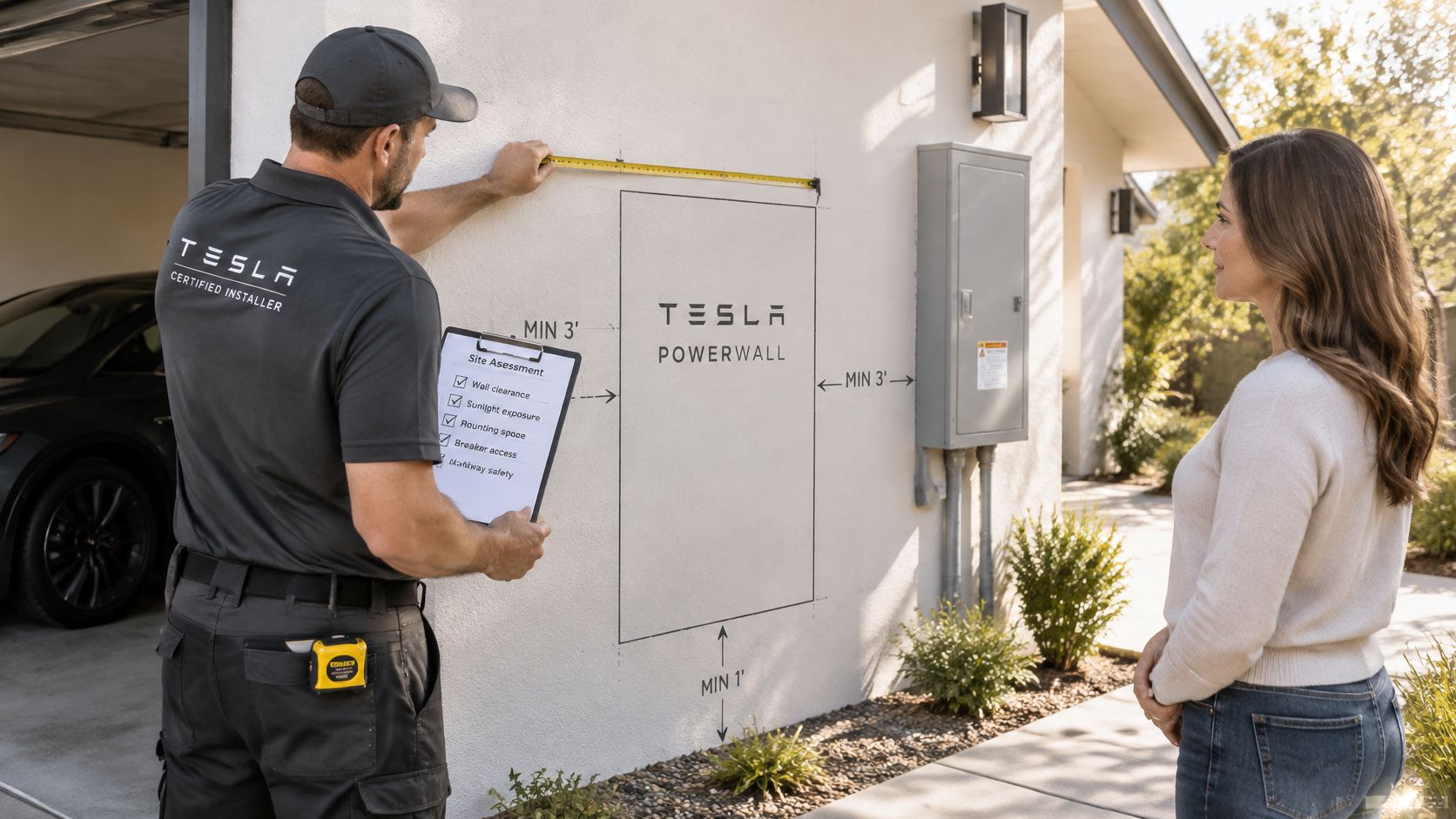
Tesla's Powerwall placement and connectivity guidance specifies a flat, structurally sound mounting surface, open airflow, and clearances of 100 mm on each side, 50 mm above, 20 mm below, and 300 mm in front. It also sets out mounting height and slope requirements. The system needs active internet connectivity for monitoring. Wired networking is preferred, with cellular connectivity available when a wired connection isn't available.
Treat those measurements as part of the layout, not as a guarantee that any wall will work. An older masonry surface may need closer inspection to confirm its condition and suitable anchors. In a narrow side yard, shrubs or a gate can take up the space needed for front clearance and service access.
Weather matters, too. Ask the installer to check drainage and where snow tends to gather. A wall that appears sheltered may still be exposed to water or blocked by snow.
The route to the electrical equipment can change the project as much as the mounting spot. At a detached garage, ask how power and communications will reach the battery. The answer may depend on whether wiring crosses a driveway, passes through finished rooms, or needs underground work.
For a wall near a basement, discuss possible water exposure, wall penetrations, and access to the service equipment. Before approving the layout, ask the installer to mark or photograph the proposed wiring route. That gives you a clear picture of where conduit will be visible and can prevent surprises once work starts.
Before the visit, walk the area together. Photograph cracks, uneven masonry, or damaged siding, and point out doors, shrubs, downspouts, low spots, and places where snow collects. Move stored items if they block access, and ask how networking will reach the installation location. Nearby Wi-Fi alone may not provide a reliable connection.
Monitoring is separate from backup power: the battery may still operate during an outage even if app access is inconvenient. A dependable connection makes it easier to check system status when the household needs reassurance.
Electrical Requirements and Panel Capacity
A panel with an open breaker position can still be unsuitable for a Powerwall connection. Before choosing how to connect the battery, the electrician checks the panel's ratings and condition, the proposed connection method, the conductors between components, and the backup-control equipment. An empty slot is only one detail in a larger power-delivery design.
Read the ratings correctly
Kilowatts describe power, or how quickly electricity can be delivered. Stored energy describes how much electricity is available over time. Those are different limits: a battery may hold energy for later use, while its power rating determines which appliances can run together. A load calculation helps connect those figures to the home's actual needs.
The values below are from the Powerwall 3 electrical datasheet.
Powerwall 3 Key Electrical Ratings and Planning Implications
Specification | Powerwall 3 Value | Planning Implication |
|---|---|---|
On-grid continuous discharge | 11.5 kW | Use the configured rating when evaluating power delivery. |
Conditional off-grid continuous discharge | Up to 15.4 kW, only with the 11.5 kW on-grid rating and applicable mode enabled | The higher value applies only under the stated conditions and mode. |
Breaker and conductors | 80 A breaker and appropriately sized conductors | The panel, wiring route, and protection must suit the specified design. |
The breaker rating protects the relevant circuit. It does not mean the home needs a service of that same size. The electrician determines how the circuit fits within the full system, including the home's service capacity and the intended backup configuration.
Backup-control equipment switches the home between utility power and backup operation. Its location and wiring must match the design. Choosing a connection just because it seems easier may leave the system unable to deliver power as intended.
Build a household load profile
Begin with an appliance inventory, then have the electrician complete the formal calculation. This guide to electrical load assessment and calculations explains the information that may be useful to gather.
Essential loads: List refrigeration, pumping, lighting, communications, and other household priorities.
Large loads: Flag the electric range, heat pump, water heater, and EV charger.
Likely overlap: Describe what commonly runs at the same time, especially during storm conditions.
Future changes: Include equipment you expect to add, as well as appliances already installed.
The pattern matters as much as the appliance list. If a heat pump and water heater often run together, tell the electrician. That helps them assess which loads the system can support at once and whether the proposed backup arrangement matches your priorities.
Panel replacement and a service-capacity upgrade address different issues. The panel may need work if it lacks compatible breaker space, has unsuitable equipment, or cannot support the proposed connection. A service upgrade is a separate consideration if the service calculation shows insufficient capacity. Neither decision can be made reliably from the panel's age or a photograph alone.
Permits, Inspections, and Utility Approval
A Powerwall can be installed and still be waiting for permission to operate. The project may involve three distinct checks: a local permit, an electrical inspection, and utility authorization. Each serves a different purpose, and the requirements depend on your address and the system design.
In Southeastern Pennsylvania, neighboring townships or utility territories may follow different processes. Ask your installer to map the approval steps for your property before setting an installation date. That way, you know which decisions can proceed and which must wait.
Establish who handles each approval
The installer should prepare the drawings and equipment details needed for permit and utility applications, then confirm what the local authority requires. Your part may be providing account information, signing forms, or obtaining property approval where applicable. Agree in writing on who submits each item and tracks its status.
Panel work can bring its own permit requirements. Use this guide to electrical panel replacement permits to prepare questions about that portion of the project.
After installation, an inspection may identify corrections before the system can be approved. Utility authorization may also be required before the battery is energized for normal operation. Ask the contractor to explain the order, including which steps can happen at the same time. A battery delivered to your home is not, by itself, approval to turn it on.
Project responsibility | What to clarify before signing |
|---|---|
Design and applications | Who prepares the drawings and submits supporting documents? |
Homeowner information | Which account details, signatures, or property approvals must you provide? |
Inspection coordination | Who schedules the inspection and arranges access? |
Corrections | Who completes and pays for work required after review? |
Activation | Who confirms that all required approvals are in place? |
Agree on a correction process
If an inspection or application review calls for changes, you should already know how those changes will be handled. Ask the installer to describe correction work, resubmissions, added costs, and possible schedule changes in the contract.
Before signing, get clear answers on permit filing and closeout, utility questions, and how requested scope changes will be documented. Also ask which approval records you'll receive at handover. You may need to supply utility account details, property documents, or homeowners association approval, where applicable. Providing paperwork and managing the technical process are separate jobs, so the contract should name who is responsible for each.
How Long Installation Takes and What It Costs
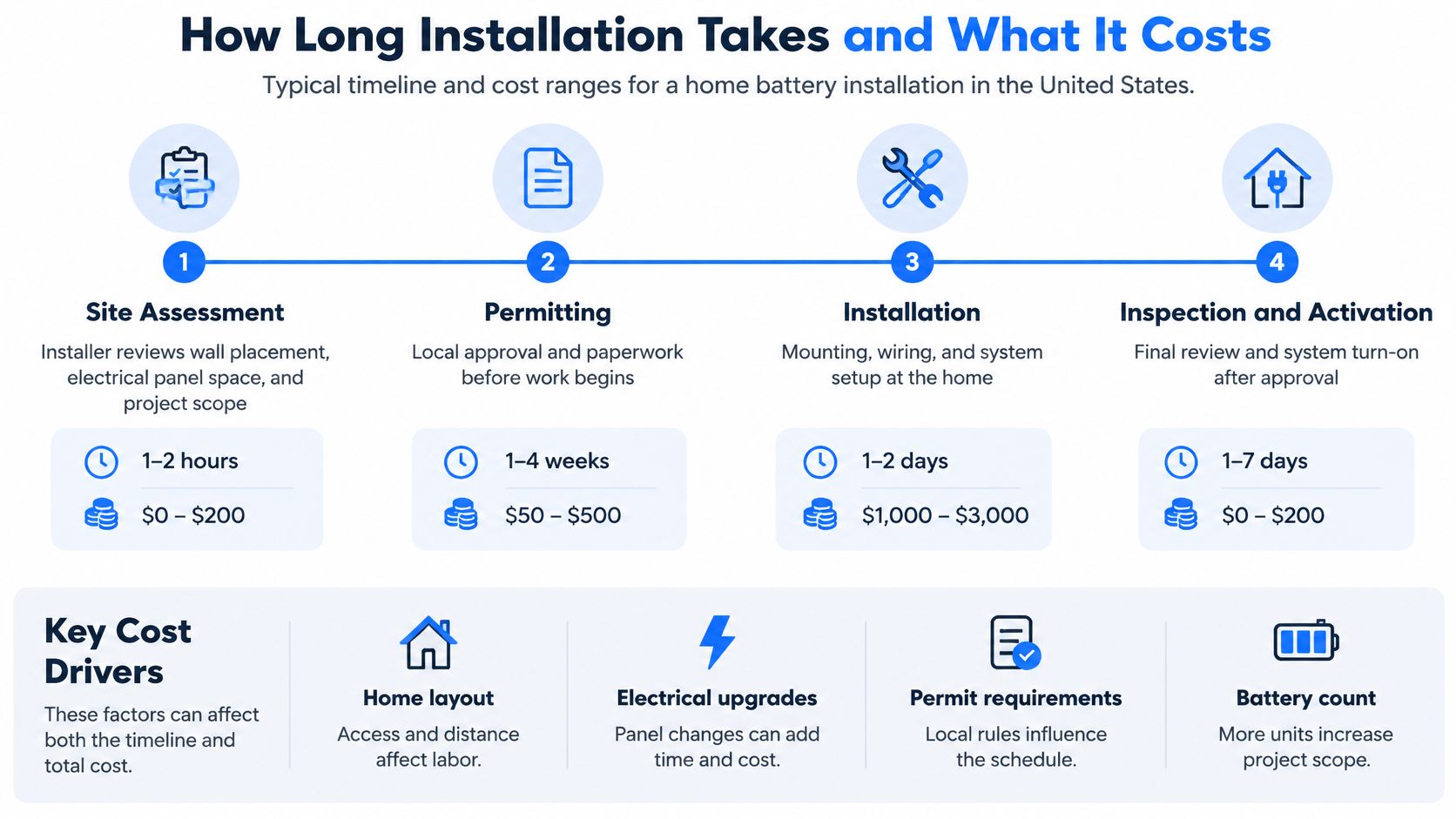
A Powerwall project can look nearly finished once the battery is on the wall, while still waiting on inspection or authorization. For a homeowner, the useful timeline runs from the first site visit through approval to operate. Ask for that full schedule, not only the day the crew expects to arrive.
There is no reliable universal price or duration for every Southeastern Pennsylvania home. The route to a working system depends on the site, electrical scope, approvals, and what the backup design is meant to support. A precise estimate before those details are checked can create false confidence.
Follow the project from design to operation
Start by asking when the installer expects to confirm the battery location and electrical layout. An unresolved wall choice or service connection can hold up a dependable work date. Once the design is settled, ask for estimated permit and utility-review milestones, plus a clear contact for updates if an application needs clarification.
Equipment delivery and crew scheduling should fit around those approvals. The schedule should also say when household power may be interrupted. After installation, allow time for inspection, corrections if needed, commissioning, and any authorization required before regular operation.
The mounted battery is one milestone, like setting a new appliance in place before connecting and testing it. It does not, by itself, mean the system is ready to back up the loads you expect.
Compare what each price includes
A quote is useful only when you know what outcome it covers. A selected-circuit backup design and a broader design may both include a Powerwall, yet require different electrical work and support different loads. Ask each installer to price the same intended backup arrangement, then review the scope line by line.
Check whether the proposal explains:
Battery equipment: The units proposed and how they fit the stated backup needs.
Backup equipment: The controls, isolation, and transfer arrangement.
Electrical changes: Panel or service work, circuit relocation, and load management.
Routing and access: Conduit, difficult penetrations, trenching, and restoration.
Solar coordination: Work to connect existing or planned generation.
Project administration: Design, permitting, inspections, commissioning, and homeowner instruction.
Distance matters. A long equipment route can require more labor and materials, while a detached structure may call for work that a nearby garage wall does not. These conditions need to be checked at the property before they appear as unexplained additions to a quote.
Use this guide to compare home battery backup system costs as you organize questions for each proposal. Compare inclusions, exclusions, and assumptions, not just the final total. If a quote leaves out load planning or permit responsibility, ask for the missing scope and written change-order terms before choosing.
Common Installation Problems and How to Prevent Them
A larger energy reserve doesn't automatically guarantee whole-home backup. The important question is whether the complete electrical design can support the loads you expect to use together.
Tesla's installation documentation makes configuration central to performance: service rating, load calculations, transfer equipment, and simultaneous loads affect backup capability, even when stored energy appears adequate (Powerwall grid integration and backup design requirements).
When the backup promise is too vague
Symptom: The homeowner expects normal household operation, but the proposed design assumes significant restraint.
Cause: Someone used “whole-home backup” without documenting what happens when large appliances overlap. That phrase needs an operating explanation, not just a place in the sales proposal.
Prevention: Request a written outage scenario. Have the installer explain whether the EV charger stays unavailable, whether heating equipment needs management, and how excluded loads are kept from operating. Don't rely on everyone remembering to change habits during a stressful outage.
Ask the installer to describe a storm evening with your actual appliances, not an idealized household using only lights and a refrigerator.
When construction reveals missing decisions
Other avoidable surprises become easier to address when you ask for evidence before work begins.
Symptom | Likely planning gap | Prevention to request |
|---|---|---|
Unexpected panel work | Existing equipment wasn't fully evaluated | Document panel suitability and unresolved assumptions before final pricing. |
Battery location changes | Placement was accepted without a complete site review | Approve a marked layout with access and routing identified. |
Monitoring is unreliable | Networking was left until commissioning | Include a connectivity method and verification in the work scope. |
Outage behavior disappoints | Operating expectations weren't written down | Obtain an included-load list and a homeowner handover plan. |
A location change deserves more than a quick verbal agreement. Ask whether it affects conduit routing, appearance, access, or the approved documents, and have the contractor record any resulting changes.
The same applies to equipment substitutions. If a contractor proposes different backup-control equipment, ask whether the layout, approval requirements, or operating behavior changes.
Before handover, request a supervised explanation of the system's expected outage behavior and limitations. You don't need to become an electrician. You do need to understand which household actions preserve essential service, which settings are intended for you to use, and when to call for help.
How to Choose a Certified Powerwall Installer
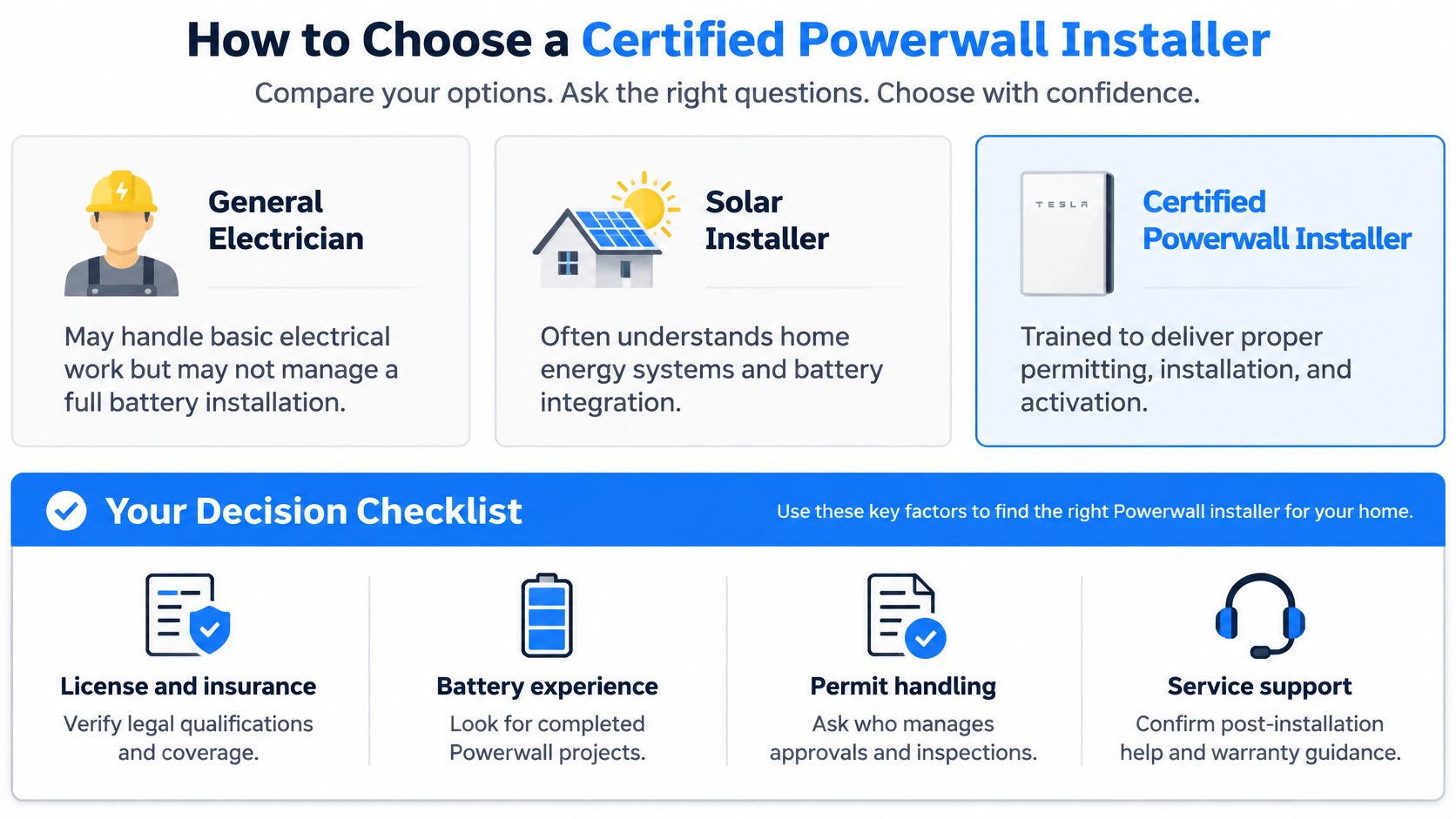
A capable general electrician, an unlicensed handyman, and a certified battery installer aren't equivalent choices for this project. The distinction isn't whether someone can mount equipment neatly. It's whether they're qualified to design, connect, configure, and support the complete system.
Tesla states that Powerwall installation and service require high-voltage electrical expertise and must be performed by a Tesla Certified Installer. Its documentation also identifies the need for a Powerwall together with compatible backup equipment, such as Backup Gateway 2, Backup Switch, or Gateway 3 (Tesla's installer requirements and installation documents).
Compare qualifications, then compare process
A general electrician without Powerwall certification may be suitable for other electrical work, but that doesn't satisfy Tesla's stated installation requirement. If that electrician is part of a larger project team, establish who holds responsibility for the Powerwall work.
An unlicensed handyman or homeowner DIY approach isn't an appropriate substitute. This is high-voltage electrical infrastructure, not a plug-in appliance.
A Tesla Certified Installer meets the manufacturer's stated installer requirement, but you should still verify applicable licensing, insurance, local approval experience, and service arrangements. Certification doesn't replace an address-specific design or an inspection.
Relevant experience: Ask for examples of completed projects with similar panel arrangements or backup priorities.
Design ownership: Identify who performs the assessment and answers technical questions.
Permit handling: Confirm responsibility for applications, review comments, and inspections.
Service support: Ask whom you contact after installation and how problems are assessed.
Look for a consistent handover process
The contractor should be able to explain what you'll receive from the first visit through commissioning. That includes a documented scope, an agreed layout, identified exclusions, approval responsibilities, and instructions for using the finished system.
For households also planning an EV charger, generator, or service upgrade, consider whether a contractor can coordinate those needs. Broad electrical capabilities can be useful, but ask how the proposed equipment will interact rather than assuming everything can operate together.
A family-operated regional contractor is one organizational option; a larger installation team is another. Evaluate either by the same standard: who owns the design, who communicates changes, and who returns when service is needed?
Before making a decision, ask the prospective installer to explain one limitation of the proposed system in plain language. A clear answer is more useful than reassurance that you'll never need to think about your electricity again.
Taking the Next Step With a Site Assessment
Prepare a small project folder before requesting an assessment. You don't need to calculate conductor sizes or open electrical equipment. You need to give the installer a useful picture of the property and your household's priorities.
Gather information without taking anything apart
Use an evening at home to assemble:
Utility records: Gather available bills and account information so the installer can review usage and identify the utility.
Panel photographs: Photograph the closed panel, accessible labels, and surrounding area. Don't remove covers.
Backup priorities: List what must remain available and what you're comfortable leaving off.
Future equipment: Note plans for an EV charger, heat pump, electric range, or other major electrical addition.
Location notes: Photograph candidate walls and sketch access routes, obstructions, and nearby service equipment.
Questions: Write down concerns about noise, appearance, outages during construction, and post-installation support.
Label your priorities clearly. A sump pump protecting a basement isn't the same kind of preference as keeping a television available. That distinction helps the installer discuss tradeoffs without guessing what matters to you.
Ask for a decision-ready assessment
Request an explanation of the proposed backup scope, panel suitability, equipment location, and approval path. If the installer can't resolve something during the visit, ask what information or investigation is needed next.
Keep the final operating plan with your household records. Anyone who may be home during an outage should know which loads are available and whom to contact with a problem. The purpose isn't to own the largest battery system you can fit on a wall. It's to have dependable support for the outage your household fears most.
Amp'd Energy Solutions offers Tesla Powerwall installation, site assessments, and related electrical upgrades for Southeastern Pennsylvania homes. Visit Amp'd Energy Solutions to request an assessment of your panel, backup priorities, and equipment location, along with a permit and timeline plan for your property.
Comments