

Level 2 EV Charging Station Cost: The 2026 Homeowner's Guide
A typical Level 2 residential charger in Pennsylvania costs between $1,500 and $3,500 for a standard installation, but electrical upgrades can push the total significantly higher. A project that needs a new service, long underground conduit run, or major panel work can become a $10,000-plus infrastructure project.
You may be looking at charger prices online, seeing a few hundred dollars for the equipment, and then receiving an electrician's quote that seems several times higher. That difference usually isn't a mistake. The charger is only one part of the job. Cost depends on whether your panel has room, how far the parking space sits from the electrical equipment, and what your local authority requires before the circuit can be energized.
In Southeastern Pennsylvania, that distinction matters. Older homes, detached garages, finished basements, long driveways, and crowded electrical panels can turn a straightforward installation into a carefully engineered project. The reliable way to price a Level 2 EV charging station is to separate equipment, electrical work, permitting, and infrastructure instead of treating the charger's retail price as the project total.
Table of Contents
What Homeowners Actually Pay for Level 2 Charging - Why two nearby homes can receive different quotes
Breaking Down Equipment, Electrical Work, and Permitting - Equipment is only the starting point - Electrical work determines the labor scope - Permitting should be visible on the proposal
Four Factors That Raise or Lower Your Installation Price - The distance and route from panel to charger - Available service capacity - Surface conditions and construction access - Detached garages and future charging needs
Choosing Between Hardwired and Plug-In Level 2 Chargers - Choose around the property, not marketing features
Sample Installation Quotes for Different Home Scenarios - Scenario one, a nearby garage with usable capacity - Scenario two, a detached garage - Scenario three, an older service with limited capacity
DIY versus Professional Installation for Level 2 Chargers - Where professional installation adds value - A practical boundary for homeowners
How to Get an Accurate Level 2 Charging Estimate - Questions to put in writing
What Homeowners Actually Pay for Level 2 Charging
A homeowner in the Philadelphia suburbs may start by comparing charger models on a weekend evening. One unit costs a few hundred dollars, another includes networking and load controls, and installation quotes vary widely. One electrician may quote a simple circuit, while another includes panel work, conduit, permit handling, and an assessment of whether the home can support the new load.
For a standard residential installation, $1,500 to $3,500 is a practical planning range in Pennsylvania when the existing service is suitable and the charger location is reasonably accessible. That isn't a universal price, and it shouldn't be treated as a promise. The final number depends on the home, not just the charging equipment.
The U.S. Department of Energy's charging infrastructure cost data lists residential Level 2 charger hardware at approximately $380 to $690, with installation averaging about $1,300 per connector before labor and permitting. Those figures explain why a charger advertised for several hundred dollars can still produce a much larger installed price.
Why two nearby homes can receive different quotes
Consider two houses on the same street. The first has the main panel on the garage wall, an open route for conduit, and enough available capacity. The second has a panel in the basement, a detached garage, a long paved driveway, and an older service with little spare capacity. Both owners want the same type of charging, but the electrical work is different.
A quote comparison should identify the charger model, mounting method, circuit work, conduit route, panel changes, permit responsibilities, and inspection process. If one proposal lists only “charger installation,” ask what it excludes.
Practical rule: Compare complete scopes of work, not just the final totals. The cheapest quote may describe only the easiest version of your project.
Breaking Down Equipment, Electrical Work, and Permitting
A useful estimate should read like a scope of work. You should be able to see what you're buying, what the electrician is installing, and which conditions could change the final price.
Equipment is only the starting point
The equipment line should identify the charging unit, cable, connector, mounting hardware, and any required disconnect or protection. A basic residential unit may be wall-mounted. A unit in a shared parking area may need a pedestal, physical protection, communications equipment, and a different mounting arrangement.
Networked equipment can add capabilities such as usage monitoring and access control, but those features may not matter to a homeowner charging one vehicle in a private garage. Choose features based on the property and your routine, not on a long specification sheet.
Electrical work determines the labor scope
The electrician may need to install a dedicated two-pole breaker, conductors, conduit, a receptacle, or a hardwired connection. The route could pass through an unfinished basement, crawl space, attic, exterior wall, or underground trench. Each route changes the amount of labor and material required.
The Federal Highway Administration's Level 2 cost synthesis shows how mounting method, networking, and site conditions affect installation cost. Its 2020 single-family-home estimate averaged $1,400, with a single non-networked installation listed at $1,182 and a single networked installation at $3,127. The same source recorded nonresidential averages of $2,035 for wall-mounted units and $3,209 for pedestal-mounted units, demonstrating why mounting and site construction deserve separate attention.
For technical background before reviewing a proposal, use this guide to EV charger installation requirements. It can help you recognize whether a quote addresses the dedicated circuit, equipment location, and installation conditions that apply to your property.
Permitting should be visible on the proposal
Permit and inspection handling should appear as a line item or a clearly stated inclusion. In Southeastern Pennsylvania, the responsible local authority may require an electrical permit, inspection, or additional documentation depending on the property and project scope. The contractor should tell you who submits the permit, who schedules the inspection, and what happens if the inspector requires a correction.
A bundled quote can be convenient, but it shouldn't hide the assumptions. Ask whether the price includes only branch-circuit work or also covers panel modifications, service changes, trenching, surface restoration, and utility coordination.
Four Factors That Raise or Lower Your Installation Price
The most important pricing question isn't which charger you prefer. It's whether the property can deliver power to the intended parking space without substantial reconstruction.
The distance and route from panel to charger
A charger mounted near the main panel usually requires less material and less labor than one at the far end of a house or driveway. A short route through an unfinished area is easier to install than a long route through finished walls. A detached garage may require exterior conduit, underground work, trenching, and restoration of the driveway or walkway.
The route matters as much as the straight-line distance. An electrician may need to avoid plumbing, heating equipment, structural obstructions, or finished spaces. Ask for the proposed route, not just a measurement from the panel to the car.
Available service capacity
A breaker slot doesn't automatically mean the service can support another substantial load. The electrician needs to evaluate the existing electrical demand, panel condition, service rating, and other major equipment in the home. An older panel may need correction or replacement before a charging circuit can be added.
The Department of Energy multifamily charging guide distinguishes a downstream installation from upstream electrical-capacity work. It reports that multifamily Level 2 installations averaged about $6,000 per connector in 2025 when installed downstream of the electrical panel. Service upgrades, feeders, switchgear, meters, and trenching can vary much more widely, and the guide warns that a panel upgrade may trigger utility work lasting several months and potentially adding tens of thousands of dollars.
That's how a normal charger installation becomes a capacity project. The equipment hasn't changed, but the property needs more electrical infrastructure to operate it safely.
Surface conditions and construction access
A charger on an accessible garage wall presents a different job from a charger beside a parking pad. Concrete, asphalt, finished flooring, masonry, landscaping, and narrow crawl spaces can all affect the installation route. A contractor who has inspected the property can identify these constraints more accurately than someone pricing from a charger model and a photograph.
Detached garages and future charging needs
Detached garages deserve special attention because the electrical path may cross a yard, driveway, or other structure. The estimate should state whether the design includes a new feeder, subpanel, underground conduit, grounding, and protection at the garage.
If the home may later add another EV, solar equipment, battery storage, or other large load, mention that during the first assessment. A design that works today may not provide a sensible path for future expansion.
For a deeper look at the service side of the project, review this explanation of electrical panel upgrade cost. The key is to determine whether the charger needs a new circuit only, or whether the property needs additional capacity first.
Choosing Between Hardwired and Plug-In Level 2 Chargers
Hardwired and plug-in chargers can both work well. The right choice depends on how permanent the installation should be, where the equipment will sit, and whether the existing electrical design can support the receptacle or direct connection.
A plug-in installation uses a suitable 240-volt receptacle and can make future charger replacement easier. That flexibility is useful for a homeowner who expects to change equipment or move the charger. The receptacle still needs to be installed correctly, protected appropriately, and matched to the charging equipment. It isn't a shortcut around proper circuit design.
A hardwired installation connects the charging equipment directly to the electrical system. It can provide a clean, permanent result and may be preferable in a location exposed to weather, accidental impact, or frequent plugging and unplugging. The equipment must be listed for the installation method, and the electrician should follow the manufacturer's requirements.
Choose around the property, not marketing features
For an indoor garage with a nearby panel, either approach may be practical. For an exterior wall, a hardwired unit may reduce the number of exposed connection points. For a charger that may be removed during a move, a properly installed receptacle may offer more flexibility.
Smart features also deserve a cost and usefulness check. A private homeowner may benefit from scheduling, energy monitoring, or integration with a broader energy system. A workplace or multifamily property may need managed charging because simultaneous charging can create demand charges or require load controls.
A commercial case study cited by this analysis of charging operating costs projected annual demand charges of $307,500 and total electricity costs of $339,200 for an unmanaged scenario. With solar and storage, the projection fell to $191,700 in demand charges and $203,100 in total annual electricity costs. That example isn't a universal result, but it demonstrates why equipment price and operating cost must be evaluated separately for shared charging.
For a single home, load management may be unnecessary. For multiple chargers, it can be central to the design.
Sample Installation Quotes for Different Home Scenarios
The following examples show how I'd read three proposals. They're planning scenarios, not fixed bids, because a site visit, load calculation, local permit requirements, and actual routing can change the scope.
Scenario one, a nearby garage with usable capacity
The first homeowner has a suitable service, an accessible panel, and a charging location on the same side of the house. The proposal includes the charger, a dedicated circuit, a short conduit run, mounting, testing, permit handling, and inspection coordination.
This is the kind of project that can land near the $1,500 planning point for a standard installation. The quote should still identify the equipment separately from the electrical work. A low price is reasonable only if the electrician has confirmed that the panel, route, and mounting location are suitable.
A proposal that says “install customer-supplied charger” without describing the circuit, permit, or inspection leaves too much open.
Scenario two, a detached garage
The second homeowner parks in a detached garage. The main panel is inside the house, the driveway sits between the buildings, and the preferred charging location requires an underground route. The proposal includes a feeder or branch circuit, conduit, trenching, grounding, a garage connection point, charger mounting, surface restoration, and approvals.
Here, the charger hardware may still be the inexpensive part of the project. The cost comes from getting power safely across the property and protecting the installation from moisture, vehicles, and future landscaping work. Ask whether the estimate includes excavation and restoration, or whether those items are allowances that can change.
A contractor should also explain whether the garage needs a subpanel and how future loads would be handled.
Scenario three, an older service with limited capacity
The third homeowner has a crowded or outdated panel and wants the charger in a remote garage. The scope includes an electrical load assessment, panel or service work, a new circuit, a long conduit route, permitting, inspection, and possibly utility coordination.
The project can move beyond a normal residential installation and into the $10,000-plus infrastructure category. The charger itself still represents only one line item. The major expense comes from capacity, distribution, civil work, and coordination.
A reliable quote explains what is known, what is assumed, and what would trigger a change order.
When proposals differ sharply, ask each contractor to price the same scope. Confirm whether panel work, trenching, permit fees, surface repair, and utility charges are included, excluded, or subject to further investigation.
DIY versus Professional Installation for Level 2 Chargers
A homeowner with electrical experience may feel comfortable installing equipment, but a Level 2 circuit involves more than mounting a box and connecting conductors. The work affects the service equipment, overcurrent protection, grounding, conductor routing, and the conditions under which the vehicle will draw power for extended periods.
DIY work may appear attractive when the panel is nearby and the charger instructions look straightforward. The risk is that the homeowner may overlook available capacity, conductor protection, torque requirements, weather exposure, or the permit and inspection process. A failed inspection can create rework, and an undocumented modification can complicate future service or an insurance review.
Where professional installation adds value
A qualified electrician can perform or arrange the load assessment, select a suitable circuit design, identify panel limitations, route the wiring, and coordinate the local approval process. That matters even more in homes with older panels, detached structures, finished walls, or multiple large electrical loads.
The contractor should provide a clear explanation of the equipment connection, protection, permit scope, inspection responsibilities, and warranty terms. Certification can be useful, but it doesn't replace a site-specific assessment or a properly documented installation.
A practical boundary for homeowners
Homeowners can prepare the site by photographing the panel, clearing access, identifying the preferred parking space, and gathering charger documentation. The electrical installation itself is better treated as professional work when it requires a new 240-volt circuit, panel changes, hardwiring, exterior routing, or local inspection.
The goal isn't to discourage capable homeowners. It's to match the work to the consequences of getting the design wrong.
How to Get an Accurate Level 2 Charging Estimate
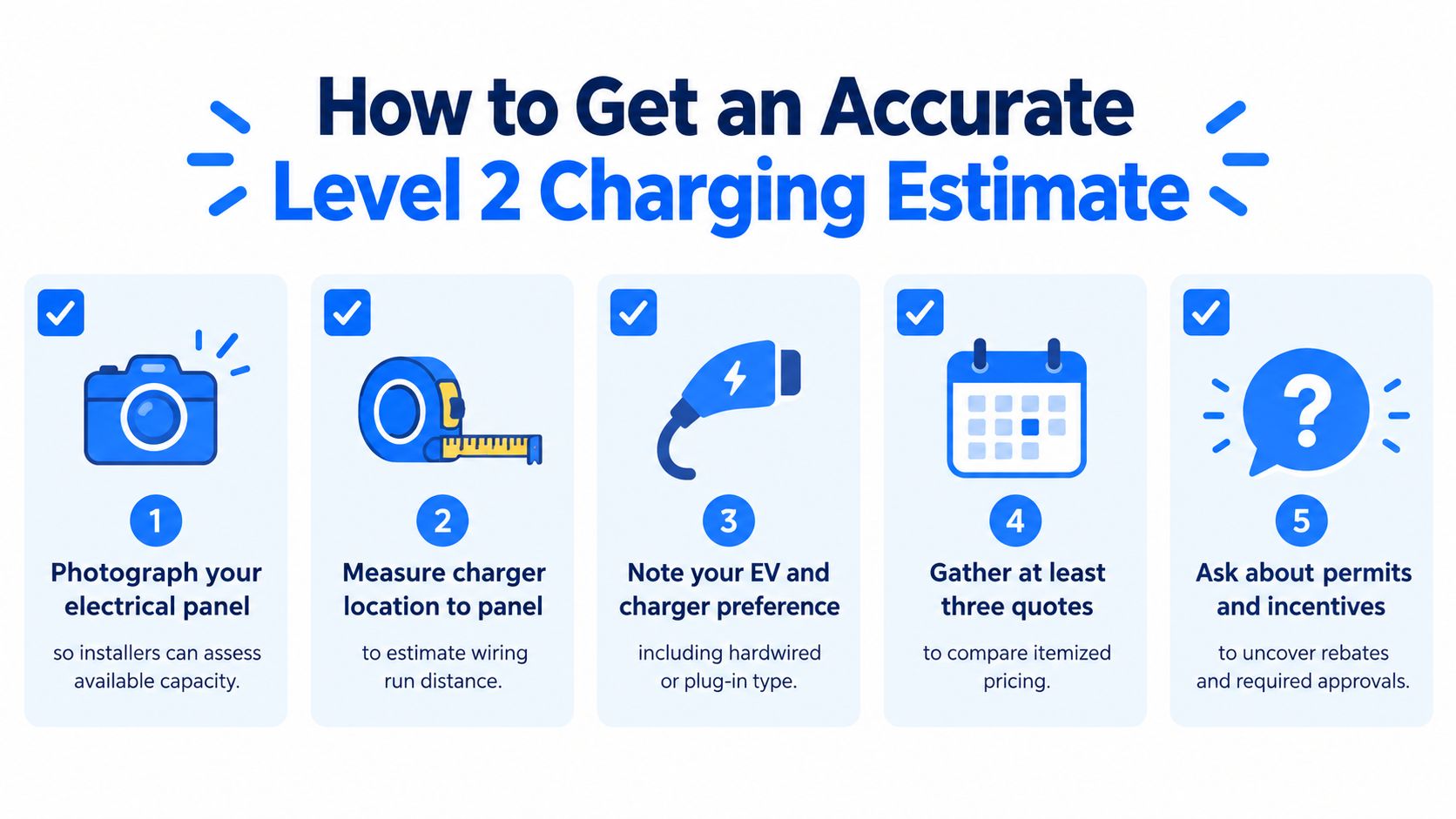
Start with information that lets the electrician evaluate the property before arriving. Take clear photographs of the main panel, including its rating and breaker layout. Measure the approximate route to the parking location, note whether the path crosses finished areas or pavement, and identify whether the charger will be indoors or outdoors.
Tell the contractor whether you prefer hardwired or plug-in equipment, whether you already own the charger, and whether you may add another large electrical load later. The more specific the initial information, the less likely the quote will describe only a generic garage installation.
Questions to put in writing
Ask each installer:
Scope: Is the proposal for equipment only, or does it include the dedicated circuit, mounting, testing, and commissioning?
Capacity: Will the electrician perform a load assessment before selecting the breaker and circuit?
Routing: Does the price include conduit, wall access, trenching, pavement repair, and weatherproofing where needed?
Approvals: Who handles the permit, inspection, corrections, and final documentation?
Contingencies: What conditions could require panel work, service changes, or utility coordination?
Warranty: Which parts and labor are covered, and who handles a problem after installation?
For complex homes or multiple charging points, an electrical load assessment gives the project a stronger technical foundation. It helps distinguish a charger that fits the existing system from a project that needs additional capacity.
Obtain multiple itemized proposals, but don't select by price alone. A quote that includes an assessment and complete permitting may be more dependable than a lower number that assumes the easiest possible route.
Amp'd Energy Solutions provides Level 2 EV charger installations, dedicated-circuit planning, panel-readiness assessments, permitting support, and electrical service upgrades for homes and businesses in Southeastern Pennsylvania. Visit Amp'd Energy Solutions to request a site assessment and discuss a charging design based on your actual panel, parking location, and future electrical needs.
Comments