

Level 2 EV Charging Station Guide for Homes and Workplaces
You pull into the garage after dinner, glance at the battery, and do the math. You've got errands tomorrow, a commute after that, and not much interest in babysitting a car while it charges. What most homeowners want isn't the fastest charger on paper. They want to plug in at night, wake up, and be ready to drive.
That's where a Level 2 EV charging station usually earns its keep. It's the middle ground that feels practical in real life. Faster than a standard household outlet, simpler than commercial fast charging, and well suited to the places cars already sit for hours anyway: garages, driveways, workplaces, hotels, apartments, and destination parking.
A lot of people start with the wrong question. They ask, “What's the fastest Level 2 charger I can buy?” A better question is, “How much charging do I need, and can my electrical system support it safely?” Those are not the same thing. A modest setup can be more than enough for one driver with overnight parking, while a larger unit may only make sense if the car, panel, and daily schedule can use that extra power.
Table of Contents
Introduction to Everyday Charging with Level 2 - Why Level 2 feels different in daily life - Why this type of charging shows up in so many places
How a Level 2 EV Charging Station Actually Works - Start with the power source - What the wall unit does and doesn't do - How the car and station communicate - Why the plug standard matters
Power Levels and Electrical Requirements Explained - Volts, amps, and kilowatts in plain language - Why continuous load changes the planning - Why a bigger charger sometimes does very little
Choosing the Right Power for Home and Workplace Needs - When 7.2 kW is enough - When more power helps, and when smarter design helps more - Matching Level 2 Power to Daily Use
Planning Installation and Electrical Readiness - What an electrician checks first - Why right-sizing often beats maxing out - Permits, layout, and planning ahead
Real World Examples and Common Misconceptions - Two everyday examples - Misconceptions that cause disappointment - What creates a bad Level 2 experience
Introduction to Everyday Charging with Level 2
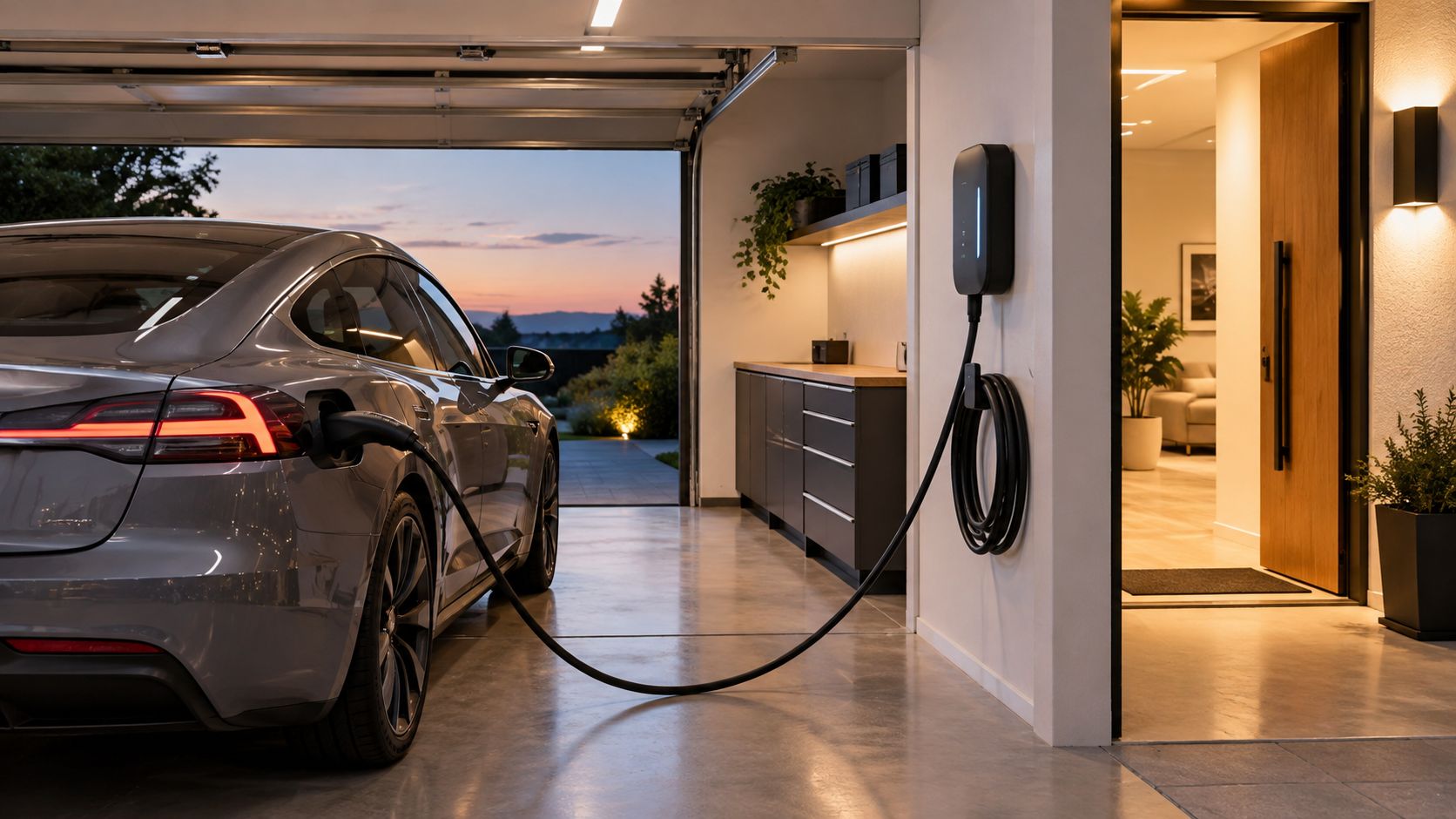
You pull in after work with 40 miles left, plug the car in, head inside, and stop thinking about it. For daily driving, that is the whole point. A Level 2 EV charging station turns charging into a routine instead of a chore.
Why Level 2 feels different in daily life
A standard household outlet can serve a driver with very short trips and long parking windows. For a commuter, a family with school and errand miles, or anyone who needs the car ready again by morning, that pace often leaves too little cushion. It works like filling a bathtub through a narrow straw. The water gets there, just slowly enough that timing starts to matter.
Level 2 charging fits the way cars are used. The vehicle sits for hours overnight, during a work shift, or through a hotel stay. That parked time is your fuel window. The goal is not chasing the biggest number on the charger. The goal is replacing the miles you used before you need the car again.
For many households, that means a mid-range setup is plenty. If you drive a moderate number of miles each day and park overnight, a common 7.2 kW home charger is often enough to refill what you used with room to spare. More power can help in some cases, but only if the vehicle can accept it and the electrical system can support it without creating a bigger project than you need.
Why this type of charging shows up in so many places
Level 2 is common because it matches dwell time. Homes, offices, apartments, hotels, and destination parking all have one thing in common. Cars stay parked there long enough for AC charging to make sense.
The International Energy Agency notes that public charging continued to grow quickly worldwide, and it classifies chargers at or below 22 kW as slower AC charging compared with DC fast charging in its charging outlook. That label sounds underpowered until you compare it to real life. If a car is parked for eight hours, the right question is whether the station restores the driver's daily miles during that window. In many cases, it does.
Practical rule: The right home charger replaces your usual daily driving during the time the car is already parked.
That is why right-sizing matters so much. One driver with steady overnight parking may be well served by a modest circuit and charger. A site with several vehicles may benefit more from load management or multiple moderate-power stations than from installing one larger unit. Speed matters, but matching power to driving habits and electrical readiness matters more.
How a Level 2 EV Charging Station Actually Works
Pull into the garage at 6:30 p.m., plug in, and walk inside. While you eat dinner and sleep, several pieces of equipment coordinate so the car charges safely at the rate your vehicle and electrical system can support.
The outside view is simple. A box on the wall, a cable, and a connector. The working parts are a little more interesting.
Start with the power source
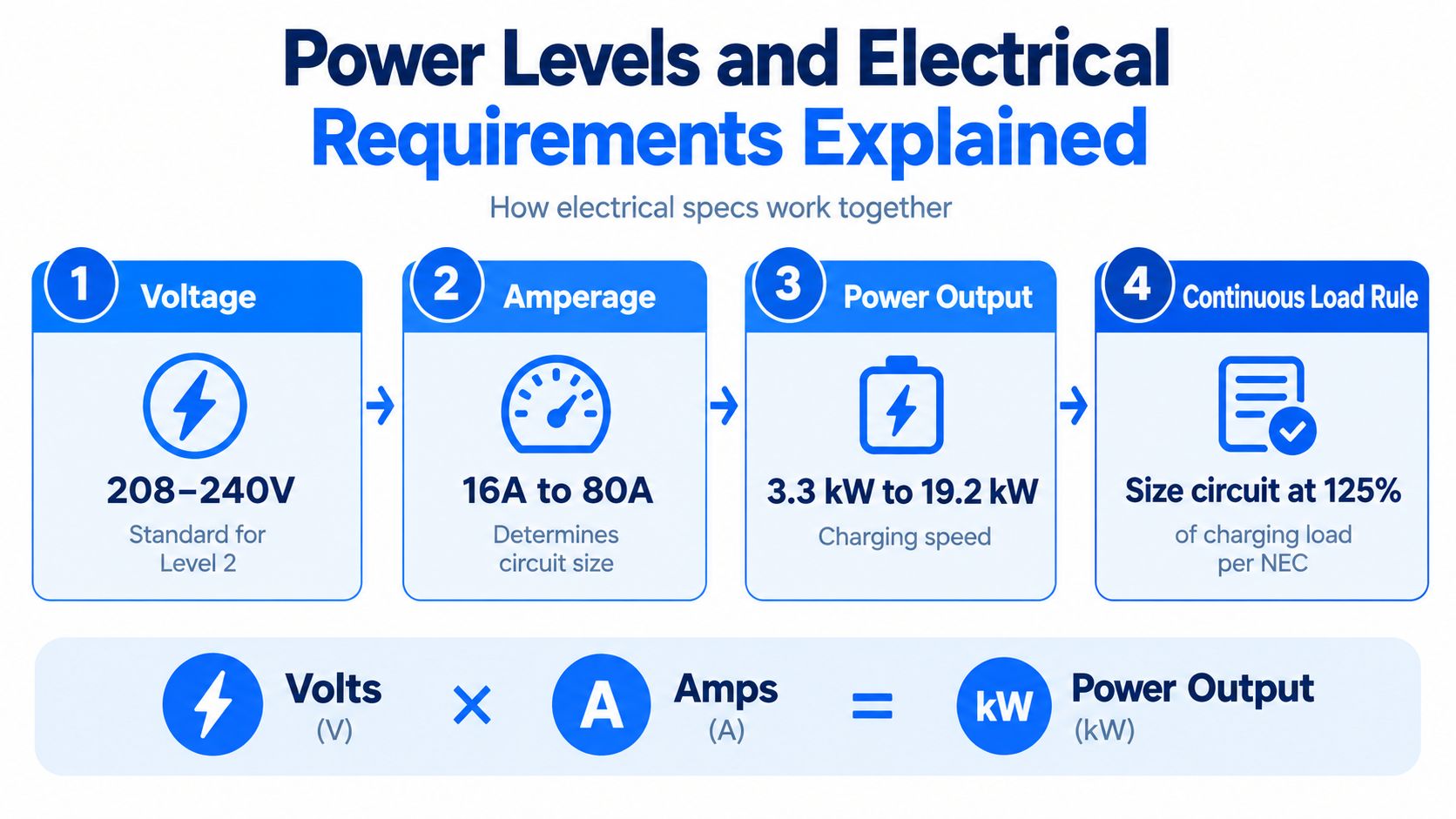
Household Level 2 charging uses 208 to 240 volts of alternating current, or AC. Water-pipe comparisons are helpful here. Voltage works like pressure. Amperage is the amount of flow the circuit can carry. Put those together and you get charging power, usually described in kilowatts.
The key detail is that the wall equipment does not push random power into the car. It makes a specific amount of power available, and the vehicle takes only what its charging hardware is designed to accept. That is why buying a larger station does not always produce faster real-world charging.
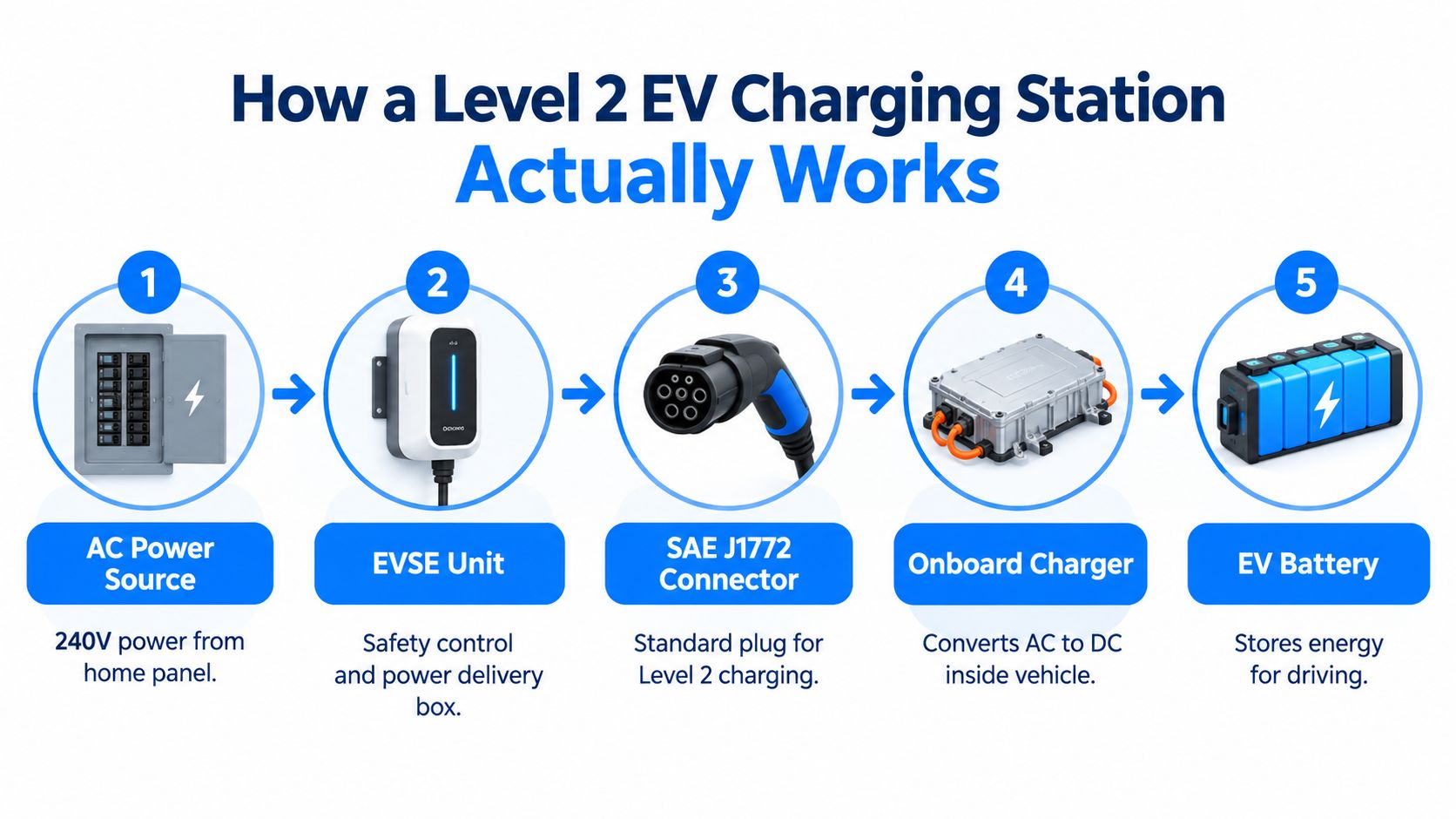
Here's the flow in a simple sequence:
What the wall unit does and doesn't do
The wall-mounted unit is usually the EVSE, short for electric vehicle supply equipment. Its job is to verify that the connection is safe, confirm grounding, communicate the available current to the car, and allow power to flow only when those checks pass.
The AC-to-DC conversion for the battery happens inside the vehicle's onboard charger.
That distinction matters for homeowners. If you replace a 32-amp station with a larger one, you have only increased the power available from the wall. The car may charge faster, or it may hit its own limit and stay at the same rate. In practical terms, the slower part of the system sets the pace.
This is also where right-sizing starts to matter. A setup around 7.2 to 7.6 kW is enough for many overnight charging routines because the car has hours, not minutes, to refill the miles used that day. Higher-power equipment can help, but only when the vehicle can use it and the electrical service can support it without turning a simple install into a panel project.
How the car and station communicate
Before charging starts, the station and vehicle perform a basic handshake through the connector. The station signals how much current is available. The car reads that signal, checks its own battery and onboard charger limits, then draws power within those boundaries.
That handshake is why plugging in is more controlled than plugging in an appliance. A space heater turns on and draws what it draws. EV charging is permission-based. The station advertises the safe limit, and the car stays inside it.
For homeowners, that communication provides a practical benefit. A properly configured station can be matched to the circuit you have, which is often smarter than chasing the highest number on the spec sheet.
Why the plug standard matters
In North America, Level 2 AC charging has long used a common connector standard for broad compatibility. For an installer, that means predictable communication between the station and the vehicle. For a homeowner, it means the question is usually not “Will the plug work?” but “How much power does my car accept, and how much power does my electrical system have available?”
A simple way to read a charger label is this:
Voltage tells you the supply type. Level 2 is typically 208V or 240V.
Amperage tells you the current available. More amps can allow more charging power if the car can accept it.
Kilowatts tell you the charging rate. This is the number that determines how many miles are added per hour of parking.
Vehicle limits still apply. The onboard charger may cap the actual charging rate below the EVSE rating.
The practical lesson is straightforward. A Level 2 station is a controlled power delivery system, not just a faster plug. Once you understand that, it becomes easier to choose equipment based on daily miles and electrical readiness instead of assuming bigger always means better.
Power Levels and Electrical Requirements Explained
A Level 2 charger is only as useful as the circuit behind it. Once you start comparing charger sizes, the better question is not “What is the fastest unit I can buy?” It is “How much power do I need to replace my daily driving, and what can my electrical system support safely?”
Volts, amps, and kilowatts in plain language
Electricians use a simple equation here: volts × amps = watts. Divide by 1,000, and you get kilowatts.
A garden hose analogy helps. Voltage is the pressure, amperage is the flow, and kilowatts are the total amount of water coming through. In EV charging terms, kilowatts are what affect how quickly the car can refill while it is parked.
That is why two Level 2 stations on 240 volts can perform very differently. One may be set up on a smaller circuit for modest overnight charging. Another may use a larger circuit and deliver more power each hour. More power can shorten charging time, but it also raises the continuous demand on the panel, breaker, and wiring.
For a homeowner, the practical comparison is simple. Kilowatts determine miles added per hour, so compare charger output to your overnight parking window. If the car sits for 10 hours and your daily driving is moderate, a midrange setup is often enough. Chasing the highest available power only makes sense if your schedule is tight, your vehicle can accept it, and the electrical service has room for it.
Why continuous load changes the planning
EV charging runs for hours at a time, so the electrical code treats it as a continuous load. That changes the installation math.
A charger that delivers 40 amps to the car does not go on a 40 amp breaker. Continuous loads are generally sized at 125% of the expected charging current, which is why a 40 amp charging output typically calls for a 50 amp circuit. The same logic carries through to conductor sizing and panel capacity. Many DIY plans go sideways. The charger label looks simple, but the branch circuit has to be built for sustained use, not a brief burst like a microwave or hair dryer.
If you want a clearer picture of how electricians evaluate available capacity, this guide to electrical load assessment calculations is a good starting point.
Why a bigger charger sometimes does very little
The charger rating sets the ceiling. The car still decides how much AC power it will take.
That means a homeowner can install a larger circuit, buy a higher-output EVSE, and still charge at the same real-world speed if the vehicle's onboard charger is the limiting factor. A common example is a car that accepts only a moderate AC rate even though the wall unit is capable of more. The extra electrical buildout does not disappear, but the extra charging speed does.
A better way to choose power is to work through three practical questions:
How many miles do you usually drive between charges?
How many hours is the vehicle parked where it can charge?
How much charging current can the vehicle accept on AC?
Those answers usually point you toward the right-sized solution. In many homes, that means a moderate Level 2 setup such as 7.2 kW is plenty because the car has all night to recover the day's miles. In other homes, the smarter investment is not a larger charger. It is load management, better circuit planning, or a panel upgrade if the existing service is already crowded.
The goal is not maximum charger size. The goal is dependable daily charging that fits both your driving habits and your electrical system.
Choosing the Right Power for Home and Workplace Needs
A good charger choice starts with a simple real-life question. How much energy does the vehicle need to get through a normal day, and how many hours does the property have to put that energy back?
That framing changes the decision. A Level 2 charger is less like buying the biggest air compressor in the store and more like sizing a well pump for the house. If the equipment can refill what you use during the time available, going larger may add cost without solving a real problem.
At home, many drivers leave in the morning, come back in the evening, and have all night to charge. For that pattern, a moderate Level 2 setup is often the practical sweet spot. The U.S. Department of Transportation notes that Level 2 charging commonly brings a battery-electric vehicle to about 80% in roughly 4 to 10 hours, while plug-in hybrids often need far less time, and it also distinguishes between 208-volt commercial service and 240-volt residential service in its EV charging speed overview.
When 7.2 kW is enough
A 7.2 kW charger is often a strong fit for a one-EV household with predictable overnight parking. If the car uses a modest amount of range during the day and sits plugged in for eight to ten hours at night, that charger usually has plenty of time to replace the miles used.
The key idea is recovery time.
A driver who uses daily commuting miles and plugs in after dinner does not need the garage version of a highway fast charger. The vehicle just needs to wake up ready for tomorrow. In many homes, 7.2 kW handles that job comfortably while keeping circuit size, wiring cost, and panel strain more manageable than a higher-output installation.
When more power helps, and when smarter design helps more
Workplaces follow a different rhythm. Vehicles may be parked for only part of the day. Several drivers may share the same equipment. Many commercial properties also work from 208-volt service, so the same charger nameplate can deliver differently than it would at a 240-volt house.
Multi-EV homes can run into a similar issue. The challenge is often not one hungry car. It is two charging windows overlapping with cooking, HVAC, water heating, or other heavy loads already using the panel.
In those cases, higher charger output can help, but it is not the only good answer. Sometimes the better answer is controlling when charging happens and how available power is shared.
Load management limits charging draw when the building is already carrying heavy electrical demand.
Staggered schedules let one vehicle charge first and the other later, instead of forcing both to pull hard at the same time.
Two moderate-power chargers can serve a household or employee parking area better than one oversized unit.
A panel upgrade makes sense when the existing service is already close to full and future electric loads are likely.
If you are sorting through hardware options, features, and installation tradeoffs, this guide to the best Level 2 EV charger for different use cases can help you compare choices in a practical way.
Matching Level 2 Power to Daily Use
Scenario | Typical Power | Best For |
|---|---|---|
One EV at a home with overnight parking | Around 7.2 kW | Drivers with consistent overnight dwell time |
One EV with shorter home charging windows | Mid-range Level 2 power | Drivers who need more refill between late arrival and early departure |
Two EVs at one home | Moderate power with load management or staggered charging | Households balancing panel capacity and shared charging time |
Workplace parking with daytime dwell | Moderate to higher Level 2 power, depending on site capacity | Employees, fleet vehicles, or destination charging |
Commercial site with several simultaneous sessions | Site-dependent configuration with load planning | Properties where service capacity matters as much as charger rating |
The practical pattern is straightforward. Long parking windows reduce the need for extreme power. Short parking windows raise the value of either more output or better control.
Right-sizing wins in both places. At home, that often means 7.2 kW is enough. At work, it may mean planning around shared use and electrical capacity before spending more on charger nameplate power.
Planning Installation and Electrical Readiness
A common home charging story goes like this. The charger arrives first, then the surprises show up after. The panel has no open spaces, the driveway parking spot is farther than expected, or the circuit you wanted would push the service harder than the house can comfortably handle.
That is why installation planning starts with the house, not the charger box.
A Level 2 charger is a little like adding a new major appliance. The wall unit gets the attention, but the question is whether the electrical system can feed it day after day as a continuous load. For many homes, a 7.2 kW setup is the practical sweet spot because it matches overnight charging needs without forcing bigger electrical work than the driving pattern requires.
What an electrician checks first
An electrician usually starts by asking how the car will be used, where it will park, and how many miles need to be replaced during a normal charging window. That answer shapes the electrical plan. A driver covering a modest daily commute may need far less charging power than the nameplate ratings on the charger market suggest.
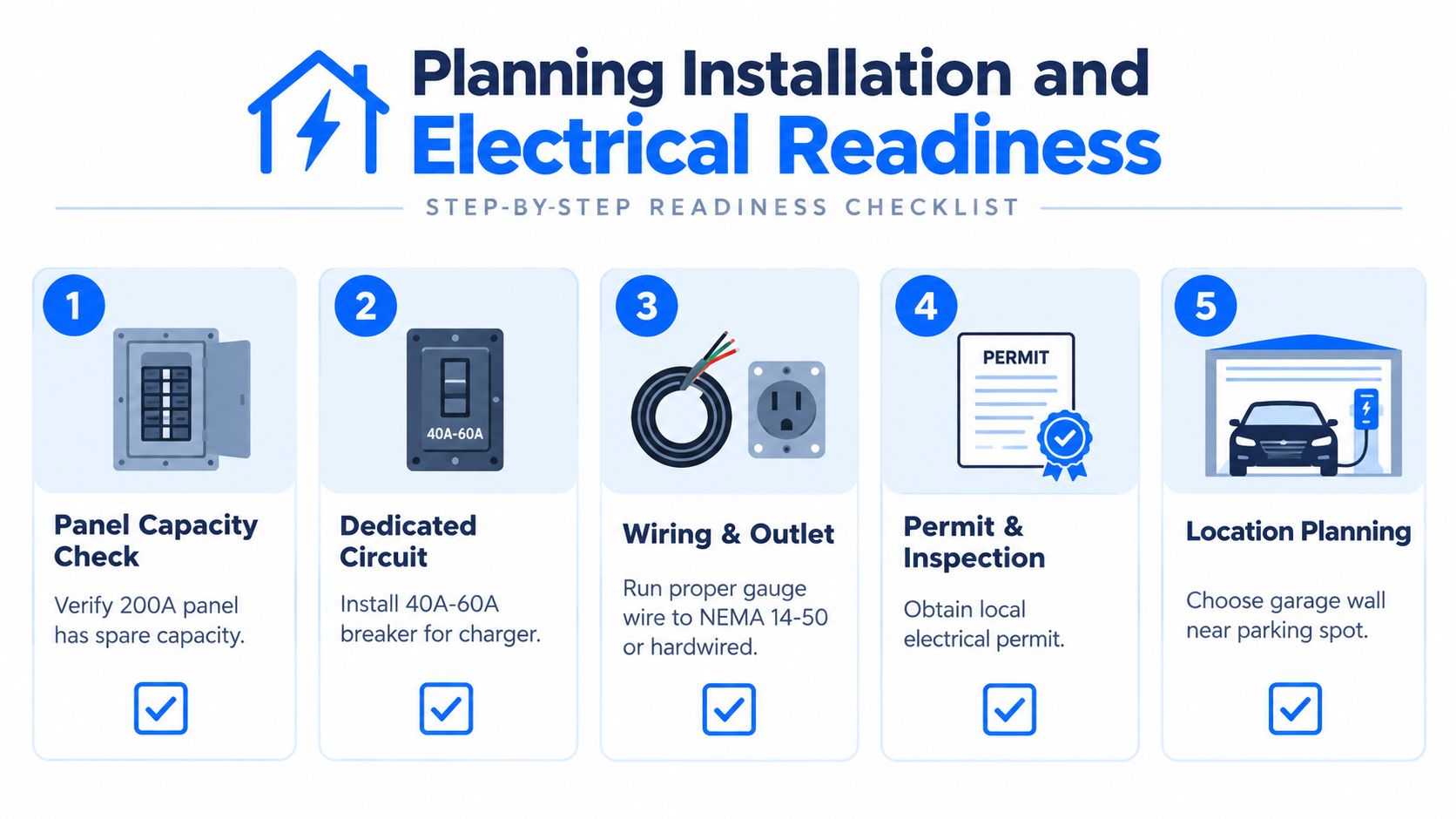
From there, the inspection usually focuses on four areas:
Panel capacity: Is there room for a dedicated breaker, and does the load calculation support another continuous load?
Circuit path: Can the wiring route reach the garage, driveway, or parking pad without excessive distance, difficult wall finishes, or outdoor exposure that changes material choices?
Charger location: Will the cord reach the vehicle port cleanly, or will daily use involve stretching, crossing a walkway, or backing into an awkward position?
Future electrical plans: Is a second EV, heat pump, electric water heater, battery system, or generator likely later?
Those checks help answer a practical question homeowners often miss. Do you need more charger power, or do you need a better plan for using the power your house already has?
Why right-sizing often beats maxing out
A larger charger does not automatically produce a better home charging experience. If the vehicle sits parked for ten or twelve hours overnight, moderate Level 2 power often covers the daily refill comfortably. In that case, spending money on the highest output unit may add cost without adding much convenience.
The bottleneck may be the house, not the charger.
Older homes sometimes have limited panel space or service capacity. In those cases, the smart move may be load management, a moderate-power circuit, or planning around charging times instead of rushing into a panel upgrade. That approach usually gives the homeowner a more usable system because it is built around daily miles and real parking time.
Verify service capacity, circuit sizing, parking layout, and expected daily charging needs before you buy the charger.
If you want a practical overview of the residential process, this guide on how to install an EV charger walks through the main steps.
Permits, layout, and planning ahead
Permitting and inspection matter for more than paperwork. They confirm the circuit, breaker, wire sizing, grounding, and equipment location meet code. They also help avoid the kind of shortcut that works on day one and becomes a nuisance every day after, like a charger mounted where the cord barely reaches.
Good planning also looks one step ahead. If the property may later add battery backup, a service upgrade, or another electric load, it helps to leave panel space, choose a sensible conduit route, and mount equipment where future work will be easier.
Amp'd Energy Solutions is a family-owned electrical contractor serving Southeastern Pennsylvania and handles EV charger installation, dedicated circuits, and panel-readiness work for homes and businesses.
Real World Examples and Common Misconceptions
A Level 2 charger usually works best when it disappears into the routine. You get home, plug in, and by morning the car has replaced the miles you used that day. Problems start when people shop for maximum output first and only later ask how many miles they need to recover, how long the car sits parked, and what the electrical system can support.
Two everyday examples
Take a homeowner who drives a typical daily commute and parks in the garage from evening until morning. That driver often does very well with a 240-volt charger in the moderate range, often around 7.2 kW. In plain terms, that setup is usually enough to refill a normal day of driving during an overnight parking window. Buying a higher-power unit may change the spec sheet more than the daily experience, especially if the vehicle itself will not accept much more AC charging power.
Now compare that with a small workplace lot. Cars may arrive low, stay for only part of the day, and compete for the same spaces. In that case, charger count, parking time, sharing rules, and load control often matter more than the highest output on any one pedestal. One strong example of this is a site where two moderate-power chargers serve employees more effectively than one higher-power charger that creates a queue.
That is the bigger lesson. Good Level 2 design is about matching power to dwell time. A charger is like a garden hose filling a bucket. If the bucket sits there all night, you do not need the widest hose in the store.
Misconceptions that cause disappointment
A few misunderstandings show up on job after job.
More charging power always means a better setup. Sometimes it means higher installation cost, tighter panel constraints, and no meaningful benefit in daily use.
A Level 2 charger should feel like public fast charging. Level 2 is built for parked time, not quick roadside recovery.
Any 240-volt option is basically the same. Breaker size, circuit rating, wire size, charger settings, and the car's onboard charger all affect the result.
If the charger turns on, the installation is fine. A system can function and still be poorly planned if the cord barely reaches, the parking position is awkward, or the charger trips load limits during busy household hours.
One more misconception causes expensive decisions. Some homeowners assume a panel upgrade is the automatic next step if they want faster charging. Often the better answer is to use a right-sized charger, set charging for overnight hours, or add load management so the charger and the rest of the house can share capacity safely.
What creates a bad Level 2 experience
A bad charging experience is rarely about one dramatic failure. More often, it feels like death by small inconveniences.
The charger may be technically operational, but the cable is too short for the way the vehicle parks. A workplace station may have enough power on paper, but one blocked space makes half the setup useless. At home, a high-output charger may sound appealing until it triggers a larger electrical project that the driving pattern never required in the first place.
Common trouble spots include:
Power that does not match actual use. The setup is sized for occasional worst-case charging instead of normal daily miles.
Poor placement. The charger is mounted where only one parking position works comfortably.
Sharing problems. Multiple drivers need access, but the site was planned like a single-car garage.
Expectation mismatch. Drivers expect a quick top-off from equipment intended for longer parking sessions.
A good charging setup fits the parking pattern, the daily miles, and the electrical capacity at the same time.
That applies at home, at work, and in shared parking. The best Level 2 station is not automatically the most powerful one. It is the one that reliably puts back the miles you use without forcing unnecessary electrical upgrades or awkward day-to-day workarounds.
Next Steps for Your Level 2 Charging Project
A good Level 2 plan starts in the driveway, not on a spec sheet.
If your car sits parked for ten or twelve hours most nights, you have a long charging window. That changes the decision. Many homeowners do not need the highest-output unit the market offers. They need enough charging to replace their usual daily miles, plus an electrical setup that the house can support safely for hours at a time.
Start by answering a few practical questions. How many miles do you typically drive before the next charging session? How long is the vehicle usually parked? Will one EV use the charger, or do you expect a second vehicle soon? At a workplace, do the same spaces get used all day, or do cars rotate in and out?
Then look at your electrical system with the same level of realism. A 7.2 kW charger is often enough for routine overnight home charging. If your panel has limited spare capacity, spending more on a larger charger may solve the wrong problem. Load management, scheduled charging, or a service upgrade may be the better investment because they address what the house can deliver.
A practical decision process looks like this:
Define the charging window. An overnight home schedule gives you more flexibility than a short daytime parking period.
Size the charger to daily miles. Choose power based on what you need to replace regularly, not on the highest number on the box.
Check panel and circuit capacity. EV charging is a continuous load, so the circuit and breaker have to be sized accordingly.
Plan for near-future loads. A second EV, electric heat, a battery system, or other major equipment can change the best choice.
Have a qualified electrician verify the installation plan. Wire size, breaker size, receptacle or hardwired connection, and load calculations all need to match code.
Sometimes the installation is simple. A newer panel with open capacity and a good charger location can make this a fairly direct project.
Sometimes the project is the electrical assessment. Older homes, detached garages, multi-EV households, and commercial properties often need more planning before anyone mounts a charger on the wall. That extra planning usually saves money because it helps you avoid oversizing the charger, underestimating the circuit, or discovering too late that the panel cannot support the load you chose.
The best result feels ordinary. You come home, plug in, and by morning the miles are back without tripping breakers, reshuffling other loads, or paying for power you never needed.
Amp'd Energy Solutions helps homeowners and businesses in Southeastern Pennsylvania evaluate panel capacity, plan dedicated circuits, and install code-compliant Level 2 charging for real daily use. If you want to know whether a 7.2 kW charger is enough, whether you need load management, or whether your service should be upgraded first, visit Amp'd Energy Solutions to schedule a site assessment or learn more about their EV charging and electrical upgrade services.
Comments