

8 Best Level 2 EV Charger Picks for 2026
You're home after a long workday, your EV is low, and you want dependable overnight charging without discovering that your electrical panel can't support the unit you bought. The decision isn't only about maximum speed. You also need to weigh Tesla integration, universal compatibility, smart scheduling, outdoor durability, access control, simplicity, and available electrical capacity.
The best level 2 EV charger depends on the job it must perform. Level 2 equipment uses 208 to 240V AC and can typically bring a battery-electric vehicle to about 80% from empty in 4 to 10 hours, while a plug-in hybrid may finish in 1 to 2 hours, according to U.S. Department of Transportation charging guidance. That makes it a practical fit for homes and workplaces, but the charger still needs a properly sized circuit and a compatible vehicle onboard charger.
In Southeastern Pennsylvania, a site assessment may reveal that you can use existing capacity, need a dedicated circuit, or should plan a panel or service upgrade. Amp'd Energy Solutions works with homeowners and businesses in the region on Level 2 installations, Powerwall systems, generators, battery backup, and electrical upgrades. The following picks are organized by the job they need to do.
Table of Contents
1. Tesla Wall Connector - Best fit for Tesla and Powerwall homes
2. Leviton evr-Green - A sensible first Level 2 installation
3. Clipper Creek LCS-200 Series - Built for exposed installations
4. ChargePoint Home Flex - Strong choice for changing household needs
5. JuiceBox Pro 40 - Designed for an energy-aware installation
7. Grizzl-E Plus - Simple equipment, serious installation requirements
1. Tesla Wall Connector
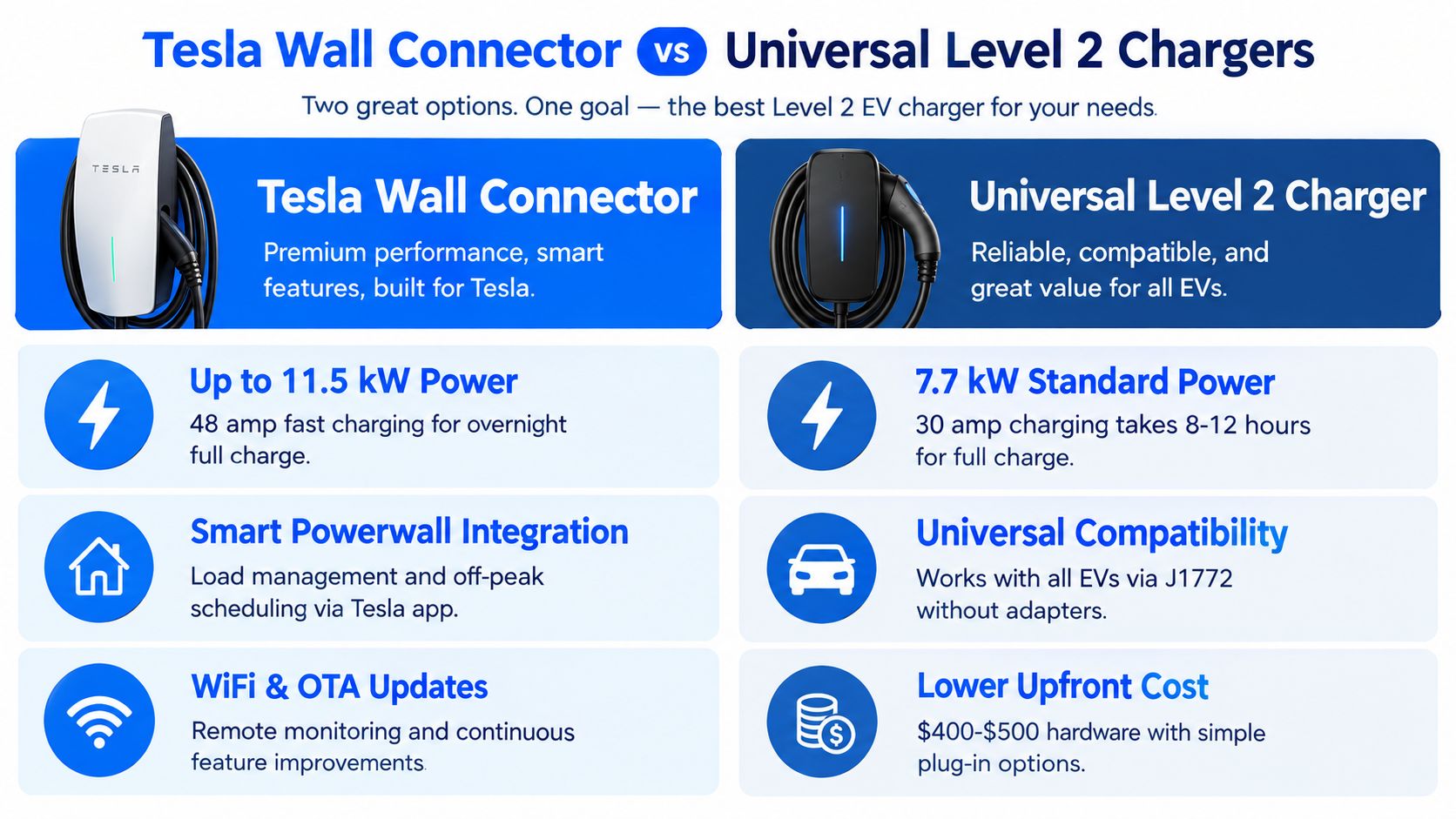
The Tesla Wall Connector is the direct choice for a Tesla-centered home energy setup. It's a hardwired Level 2 charger that can deliver up to 11.5 kW on a 48-amp circuit, making it well suited to Tesla owners who want strong overnight recovery and app-based scheduling. SAE J1772 remains the established AC connector standard for many North American EVs, and Tesla vehicles can use other charging equipment with the appropriate adapter, as outlined by the U.S. Department of Energy Alternative Fuels Data Center.
Best fit for Tesla and Powerwall homes
Wall Connector makes the most sense when your property already includes, or may later include, a Tesla Powerwall, solar installation, or backup-power plan. A unified installation conversation helps the electrician consider EV charging alongside household demand, battery operation, and future electrical loads instead of treating the charger as an isolated appliance.
Amp'd Energy Solutions can assess the existing panel before installation and determine whether the home can support the desired amperage. If capacity is limited, the installation plan may involve a lower charging setting, load management, or a service upgrade. A 48-amp charger typically requires a 60-amp circuit under the continuous-load rule, so the panel and wiring must be evaluated before the equipment is selected.
Practical rule: Buy the Wall Connector for ecosystem integration, not simply because its maximum rating is higher.
The unit is suitable for outdoor use, but placing it under an overhang or on a protected wall can reduce exposure to Southeastern Pennsylvania weather. Keep the connector close enough to the parking position for convenient cable management, and set the operating amperage to match the home's remaining capacity.
For a plain-language explanation of the equipment category, see this guide to what a Level 2 EV charging station is.
2. Leviton evr-Green
The Leviton evr-Green is the universal value pick for households that want a practical upgrade from standard outlet charging without committing to the highest circuit capacity. It supports up to 7.7 kW at 30 amps, and its compatibility with all EV makes and models makes it a sensible choice for mixed-brand households, rental properties, and drivers who may change vehicles later.
A sensible first Level 2 installation
The evr-Green fits a home where charging overnight is the priority and daily energy use is moderate. It can also work well in a new construction or remodeling project where the owner wants a straightforward, code-compliant charging circuit rather than a broader smart-home platform.
Amp'd Energy Solutions can determine whether a 30-amp circuit is sufficient or whether the property should be prepared for a larger future load. That assessment matters if you're also considering a Powerwall, generator, second EV, electric range, or other major equipment. The charger's rating should follow the home's electrical plan, not dictate it after the fact.
If you choose a plug-in configuration, have a professional install the required NEMA 14-50 outlet and verify the circuit is dedicated and properly protected. Don't treat an existing receptacle as proof that the wiring is suitable. The outlet, conductor sizing, breaker, enclosure, and installation location all need to match the intended continuous load.
Choose Leviton evr-Green when:
Compatibility matters: It's designed for households with Ford, Chevrolet, Hyundai, and other EV brands.
Your charging routine is predictable: A moderate nightly requirement doesn't justify maximum amperage.
You're planning future improvements: An electrician can coordinate the charger with a later panel or backup-power project.
The installation is sheltered: A garage, carport, or covered wall is preferable during wet and freezing weather.
Before buying, review how to install an EV charger and arrange a site evaluation rather than assuming the installation will be plug-and-play.
3. Clipper Creek LCS-200 Series
Choose the Clipper Creek LCS-200 Series when reliability and physical durability matter more than app features. Models such as the LCS-200P and LCS-200MU are hardwired Level 2 units rated for 9.6 kW at 40 amps, giving them a strong position for residential driveways, professional offices, and light commercial sites that need equipment to work consistently.
Built for exposed installations
This charger is especially appropriate for Southeastern Pennsylvania properties where the equipment may live outside rather than inside a garage. A protected exterior wall, carport, or covered parking area still offers the best environment, but the LCS-200's weather-focused construction supports installations where exposure is unavoidable.
The unit also suits homeowners who don't want to depend on cloud connectivity or a smartphone app for everyday charging. Plug in, charge, and manage the electrical installation properly. That simplicity is useful for a second home, a small business, or a property where multiple users need predictable operation without complicated account management.
A dedicated 40-amp circuit is the correct planning baseline for its stated 40-amp output. The electrician should verify the panel's spare capacity, perform the required load calculation, select conductors appropriate to the installation, and install suitable conduit for an exterior run. Long cable paths, detached garages, masonry walls, and trenching can change the project scope even when the charger itself is uncomplicated.
For a small business, place the unit where employees or visitors can reach it without crossing pedestrian paths or creating a trip hazard. At a home, prioritize a clean cable route and a mounting height that keeps the connector accessible while protecting it from vehicles, snow accumulation, and standing water.
Clipper Creek is the right recommendation for the buyer who values a rugged standalone charger and doesn't need advanced scheduling, energy dashboards, or integration with a larger home-energy system.
4. ChargePoint Home Flex
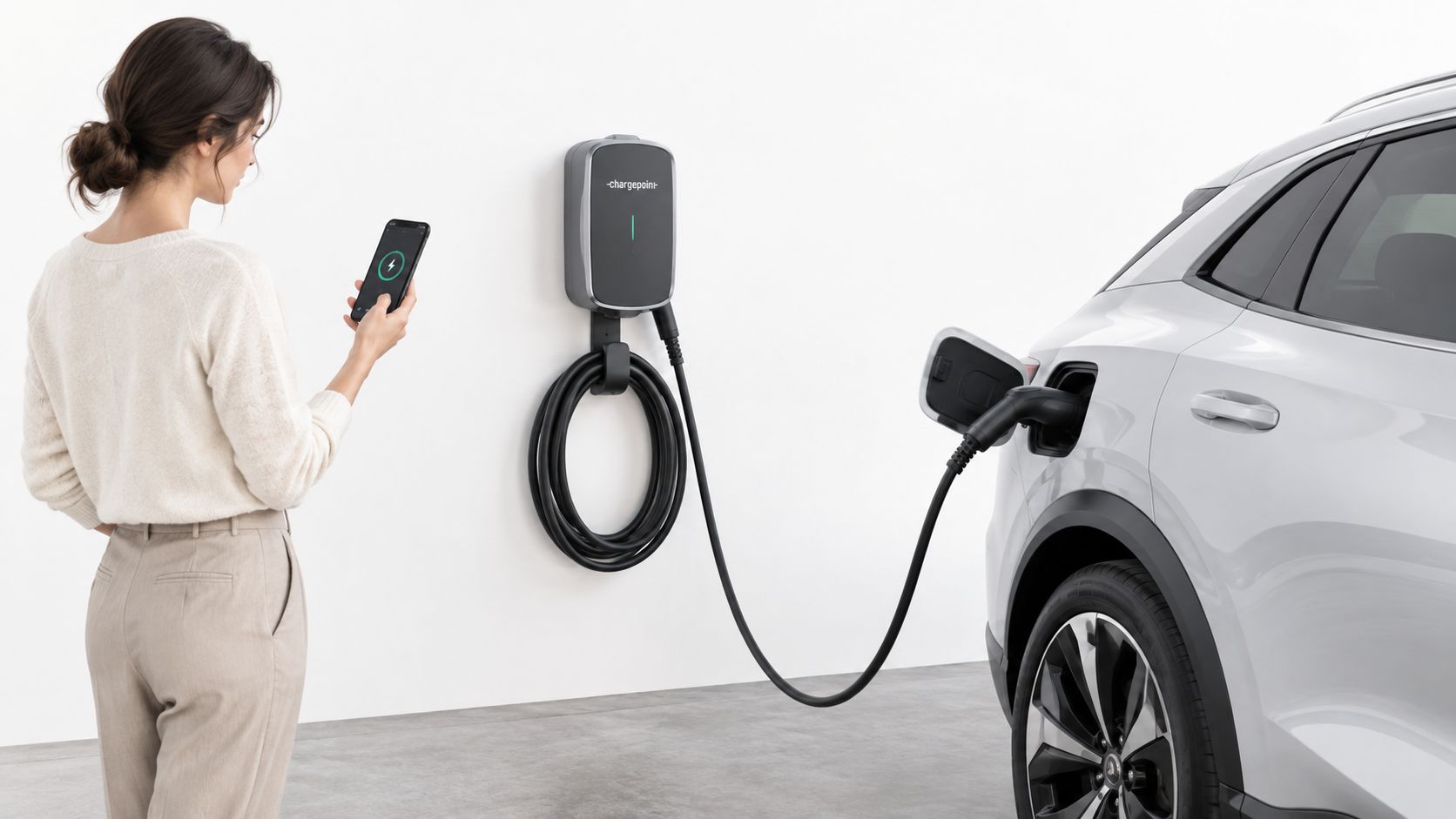
The ChargePoint Home Flex is the connected flexibility pick. It supports configurable charging at 16, 24, or 32 amps, operates on 120V or 240V, and can deliver up to 7.7 kW when configured for its highest listed Level 2 setting. Wi-Fi connectivity and app controls make it useful for owners who want to schedule charging, monitor sessions, and adjust the installation to the home's available capacity.
Strong choice for changing household needs
Home Flex works well when the electrical plan isn't ready for a larger charger today, but the owner still wants a connected unit that can adapt to a different circuit arrangement. A professional installer can configure the equipment to the approved circuit and confirm that the home's service can support the continuous load.
The app is most useful when your charging routine changes. You may want to schedule charging during lower-demand periods, monitor energy use, or coordinate charging around household activity. If the charger is installed at the far end of a garage or on an exterior wall, confirm that the home's Wi-Fi signal reaches the location reliably. Connectivity problems can turn useful scheduling features into a daily frustration.
A smart charger only helps if the electrical configuration and network connection are dependable.
ChargePoint Home Flex also deserves consideration in a dual-EV household, especially when the owners want visibility into charging behavior before deciding whether to add load management or expand electrical capacity. If a Powerwall or other energy system is part of the long-term plan, discuss that before the wiring is installed. The electrician can plan conduit, placement, and circuit capacity with the broader system in mind.
Review the manufacturer's privacy terms before enabling cloud features, particularly if you're uncomfortable sharing energy-use information through a connected platform. For a tech-focused Southeastern Pennsylvania homeowner who wants flexible settings rather than maximum output, Home Flex is the practical recommendation.
5. JuiceBox Pro 40
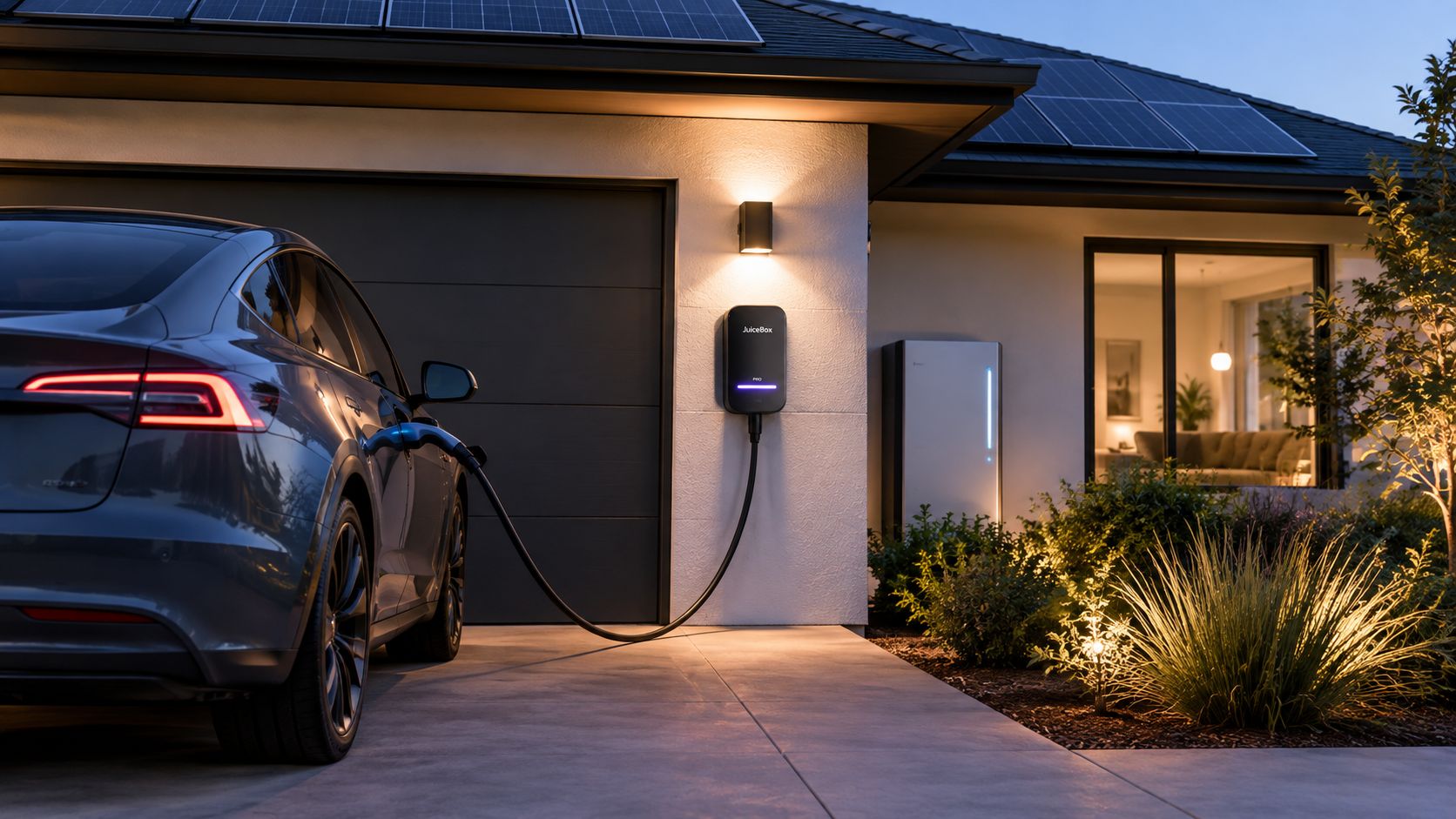
The JuiceBox Pro 40 is the advanced energy-management choice for a homeowner or small business that wants more than basic charging. It provides 9.6 kW at 40 amps, with Wi-Fi, app control, scheduling, and energy-management capabilities. Its appeal grows when charging must coordinate with solar production, battery storage, household demand, or a workplace operating schedule.
Designed for an energy-aware installation
A solar-equipped home can use scheduling to align charging with available generation, while a property with battery storage can plan around the interaction between vehicle charging and backup reserves. That doesn't mean the charger alone creates a complete backup system. The electrician and system designer must confirm how the charger, battery, inverter, service equipment, and vehicle interact.
Bidirectional charging also requires careful qualification. The vehicle must support the relevant capability, and the complete system must be designed and approved for that use. Don't buy this unit solely because a future energy feature sounds attractive. Confirm compatibility between the vehicle, charger, energy system, and local installation requirements.
For a commercial site, JuiceBox Pro 40 can support employee or customer charging while giving the owner more control over timing and usage. A dental office, legal practice, or small fleet operator may value scheduling and load management because charging occurs alongside normal building demand. The circuit still needs to be sized correctly, and multiple chargers may require a broader load-management strategy.
Use this EV charger installation requirements guide before selecting the circuit configuration. Amp'd Energy Solutions can evaluate whether a 40-amp installation fits the current panel or whether an upgrade makes sense based on actual driving needs and planned energy equipment.
6. Webasto TronIQ TurboDX 11
The Webasto TronIQ, also sold as TurboDX 11 in some markets, is the managed-access pick for commercial and multi-tenant properties. Its configurable 16-amp or 32-amp operation and enterprise-oriented features make it better suited to buildings where an owner needs to identify users, control access, review usage, or coordinate charging across a property.
Where access control matters
An apartment building, condominium, small fleet base, or office with assigned employee vehicles has different needs from a single-family garage. The property manager may need RFID access, guest permissions, usage records, or a clearer way to allocate charging access. Webasto's management approach fits those requirements better than a minimalist residential unit.
Amp'd Energy Solutions can plan the installation around the building's service equipment, parking layout, conduit routes, and future charger locations. Multiple charging stations can create a significant combined load, so the design should address demand management before the first unit is installed. A 32-amp circuit may be appropriate for one configuration, but a commercial project needs a complete electrical assessment rather than a simple product swap.
The TronIQ also makes sense for a small delivery or service fleet returning to a Southeastern Pennsylvania base. In that setting, charger placement, cable reach, vehicle turnover, and user permissions can matter as much as the unit's output. RFID cards can help verify employee or guest access without leaving an always-open charging connection.
For a detached home without shared access, choose a simpler residential charger unless RFID control or property-wide management is a real requirement. Webasto earns its place here because it addresses managed charging access, not because every homeowner needs enterprise-style controls.
7. Grizzl-E Plus
The Grizzl-E Plus is the no-frills value pick for homeowners who want dependable Level 2 charging without app accounts, cloud controls, or elaborate energy integration. It offers 9.6 kW at 40 amps and can be installed as a plug-in or hardwired unit, giving the electrician more than one practical path depending on the property.
Simple equipment, serious installation requirements
The plug-in version can suit a garage or carport with an appropriately installed NEMA 14-50 receptacle. Verify the circuit before committing to that configuration. A nearby outlet may share wiring or lack the capacity required for continuous EV charging, so an electrician should inspect the circuit rather than rely on the receptacle's appearance.
The hardwired version requires a dedicated 40-amp circuit. That makes it a strong fit for a homeowner who has adequate 240V capacity and wants a set-and-forget installation. It's also useful for a rental property where the owner wants straightforward equipment with fewer connectivity issues for tenants.
Installation decision: Choose plug-in flexibility only after the receptacle, breaker, conductors, and panel capacity have been verified.
Grizzl-E Plus works best when the buyer has already decided that smart scheduling and Powerwall coordination aren't priorities. If you expect to add solar, battery storage, a generator, or a second EV, bring that plan into the site assessment. A basic charger can still be the right choice, but the electrician should avoid creating a layout or circuit arrangement that limits future work.
Mount the unit in a garage, under a carport, or beneath a protective overhang where possible. Southeastern Pennsylvania brings changing temperatures, precipitation, and winter conditions, so sheltered placement can simplify cable handling and reduce unnecessary exposure even when the equipment is designed for outdoor use.
8. Siemens VersiCharge
The Siemens VersiCharge is the automation pick for properties that already use Siemens controls or plan to coordinate EV charging with broader building systems. Its stated 9.6 kW output at 40 amps gives it a familiar residential and small-commercial charging profile, while its integration potential makes it more relevant to smart electrical infrastructure than to a standalone garage.
Best for connected buildings
A new construction home with planned electrical automation can use VersiCharge as part of a larger design that includes controlled loads, energy monitoring, and future electrification. A small commercial building may also benefit when facility managers want EV charging to participate in an existing building-management strategy.
This product needs a deliberate installation plan. The electrician should confirm the automation equipment, communication requirements, panel configuration, and commissioning process before the charger is mounted. If you already use Siemens controls, provide that information during the site assessment so the installer can determine the appropriate integration path.
For a typical standalone home with no automation platform, VersiCharge may add complexity that doesn't improve the daily charging experience. A simpler unit can meet the need more directly when the only goal is reliable overnight charging. VersiCharge becomes the better recommendation when the property owner values industrial-grade infrastructure and future control options.
The same capacity questions still apply. A 40-amp charger needs a properly sized dedicated circuit, and the panel must have room for the continuous load alongside existing appliances. If the property also includes a heat pump, electric water heater, generator, Powerwall, or planned second EV, the installer should evaluate the combined electrical plan rather than approve the charger in isolation.
For harsh commercial or residential environments, durable equipment can be valuable, but reliability also depends on correct mounting, conduit, protection, and commissioning. Siemens VersiCharge is the right fit when automation is part of the brief, not when the buyer wants the least complicated charger.
Top 8 Level 2 EV Chargers Comparison
Product | Implementation complexity | Resource requirements | Expected outcomes | Ideal use cases | Key advantages |
|---|---|---|---|---|---|
Tesla Wall Connector | High, hardwired install, Tesla-certified recommended | 48 A 240V circuit, higher hardware cost, professional installer, Wi‑Fi | Up to 11.5 kW fast residential charging; seamless Powerwall integration and OTA updates | Tesla owners, homes planning Powerwall or high daily mileage | Highest residential speed; tight Tesla ecosystem and advanced load management |
Leviton evr-Green | Low–Moderate, plug‑in or hardwired, simple setup | 30 A 240V circuit or NEMA 14‑50 outlet, lower hardware cost, basic electrician | Reliable universal Level 2 charging (~7.7 kW) with ENERGY STAR efficiency; no smart features | Multi-brand households, budget-conscious or secondary charging locations | Universal compatibility, affordable, simple and efficient |
Clipper Creek LCS-200 Series | Moderate–High, hardwired only, professional install | 40 A 240V circuit, robust weatherproof enclosure, higher upfront cost | Durable 9.6 kW charging built for long life and harsh outdoor conditions | Outdoor residential, light commercial, small fleet or harsh-climate sites | Commercial-grade durability and reliability for demanding use |
ChargePoint Home Flex | Moderate, requires Wi‑Fi and app configuration | Dual-voltage (120/240V), up to 32 A circuit for max speed, internet connectivity | Smart charging with scheduling, monitoring and ChargePoint network access (~7.7 kW) | Tech-savvy homeowners, time-of-use rate optimization, future-proof homes | Smart features, dual-voltage flexibility, strong network ecosystem |
JuiceBox Pro 40 (Enel X Way) | Moderate–High, 40 A circuit, smart setup; optional V2H setup complexity | 40 A 240V circuit, higher hardware cost, Wi‑Fi/cloud, compatible EV for bidirectional | Fast 9.6 kW charging with load management; optional bidirectional (V2H) and grid services | Solar/Powerwall homes, forward-looking owners, businesses needing load control | High power plus advanced load management and V2H potential |
Webasto TronIQ (TurboDX 11) | High, enterprise features (RFID, reporting) require more setup | 16/32 A configurable 240V circuit (up to ~11 kW), premium hardware, network/account | High-speed charging with access control, data logging and commercial reporting | Commercial sites, multi-unit buildings, property managers | RFID access control, usage reporting, configurable enterprise features |
Grizzl‑e Plus | Low, simple plug‑in or hardwired, minimal configuration | 40 A 240V circuit or NEMA 14‑50 plug, low hardware cost, basic electrician | Robust 9.6 kW no‑frills charging; simple, durable operation without cloud features | Budget-conscious homeowners, "set and forget" users, rentals | Strong value, rugged construction, plug‑in flexibility |
Siemens VersiCharge | Moderate–High, hardwired; automation integration adds complexity | 40 A 240V circuit, optional Siemens automation controller, trained installer | Industrial-grade 9.6 kW charging with optional smart home/building integration | Homes/businesses with Siemens automation, new construction, facility-grade needs | Seamless integration with building automation, industrial reliability |
Match Charging Speed to the Site
The strongest choice depends on what your site must accomplish. Tesla owners building around Powerwall should choose the Tesla Wall Connector, especially when unified energy planning and Tesla vehicle compatibility are central. For straightforward universal value, choose Leviton evr-Green when moderate output and broad vehicle compatibility are enough. Choose Grizzl-E Plus when you want higher-output charging with a simple plug-in or hardwired installation and no smart-feature overhead.
For rugged standalone reliability, the Clipper Creek LCS-200 Series is the clear fit. It suits exposed residential locations, professional offices, and small commercial sites where consistent operation matters more than app features. For connected flexibility, choose ChargePoint Home Flex, particularly when configurable amperage, Wi-Fi scheduling, and energy monitoring matter.
The JuiceBox Pro 40 is the advanced energy-management option for properties considering solar coordination, storage planning, or managed workplace charging. Treat bidirectional charging as a complete system decision, not a feature to assume will work with every vehicle or home-energy setup. The Webasto TronIQ TurboDX 11 belongs in apartment buildings, condominiums, offices, and fleet facilities where RFID access and usage management justify a more structured platform. Choose Siemens VersiCharge when the charger must integrate into a Siemens-centered automation ecosystem.
Level 2 is the practical daily-charging foundation because it balances charging speed with typical 208 to 240V electrical service. The National Renewable Energy Laboratory's charging analysis identifies AC Level 2 as optimal for most battery-electric vehicles and estimates about 25 miles of range per hour at 6 or more kW, a figure that helps explain why this equipment fits homes, workplaces, and many public locations. The same source notes that Level 1 and Level 2 charging are expected to account for 80% of EV charging sessions, reinforcing the importance of getting everyday AC charging right.
Use this buying sequence:
Confirm vehicle compatibility: Check the vehicle's onboard AC charging limit and connector requirements.
Estimate nightly charging needs: Decide whether your normal routine calls for basic overnight recovery or faster turnaround between trips.
Verify 240V capacity: Have an electrician review the service size, spare breaker space, wiring path, and continuous-load requirements.
Choose smart features deliberately: Buy scheduling, monitoring, access control, or energy integration only when you'll use them.
Plan for future loads: Discuss a second EV, Powerwall, solar, generator, heat pump, or other major equipment before finalizing the circuit.
Request a site assessment: Use a professional evaluation when panel readiness, permitting, load management, or service upgrades are uncertain.
J.D. Power's 2026 EVX Home Charging Study reports satisfaction scores of 710 out of 1,000 for Level 2 portable chargers and 733 out of 1,000 for permanently mounted Level 2 home chargers. The permanently mounted category also recorded 44.2 problems per 100 vehicles, which is a useful reminder that installation quality, connectivity, cord management, and electrical fit can matter as much as the charger's headline output.
Amp'd Energy Solutions can help Southeastern Pennsylvania homeowners and businesses connect the product decision to the actual site. Its services include EV charger installation, dedicated circuits, panel-readiness assessments, service upgrades, Tesla Powerwall installation, battery backup, and whole-house generator integration.
Amp'd Energy Solutions provides Level 2 EV charger installation, panel assessments, electrical service upgrades, and planning for Powerwall, battery backup, and generator systems in Southeastern Pennsylvania. Visit Amp'd Energy Solutions to request a site assessment and match your charger to your vehicle, electrical capacity, and future energy plans.
Comments